
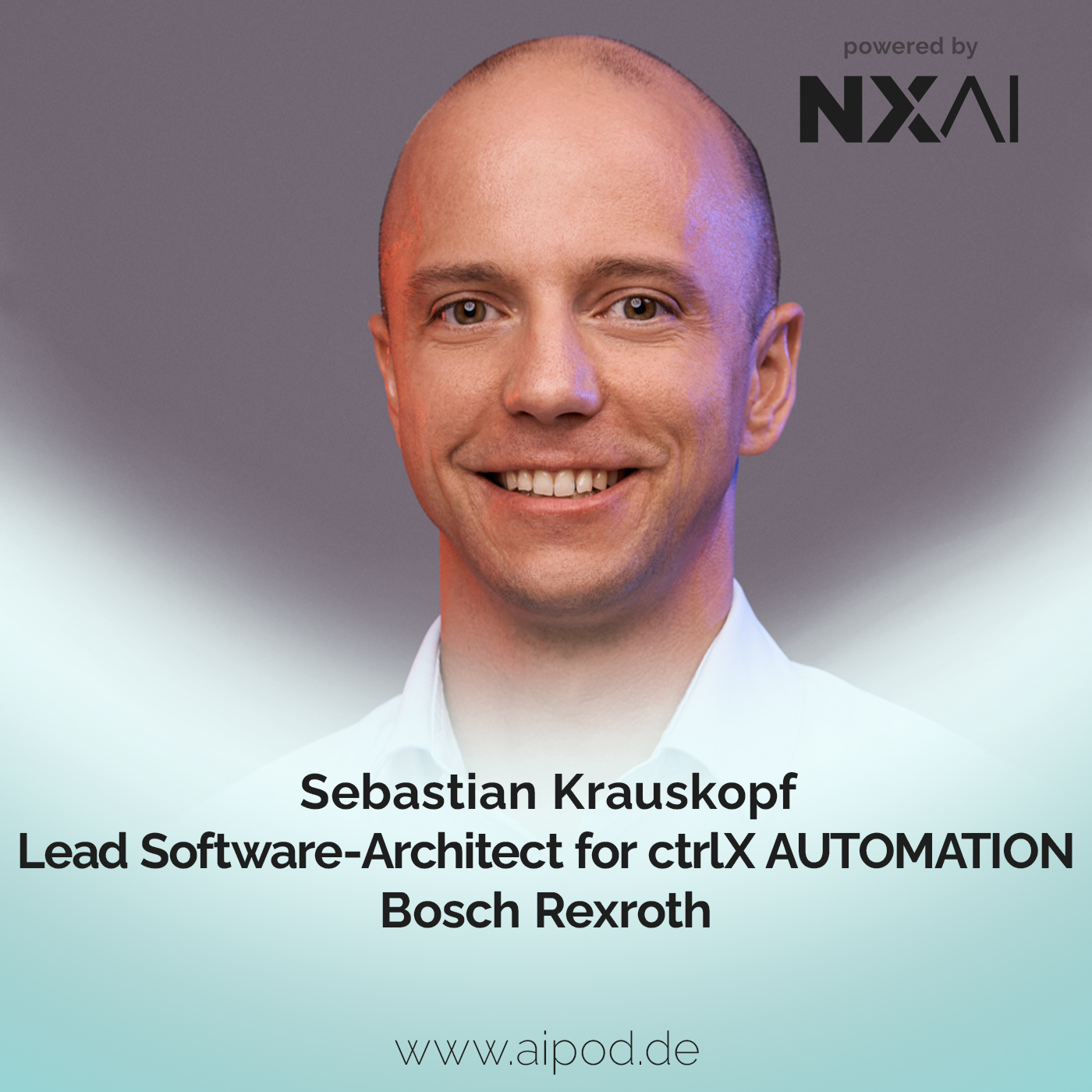
Bosch Rexroth:あなたの「秘伝のタレ」は何か? エージェント型エンジニアリング Agent iXi
Bosch Rexroth: What's your secret sauce?
Bosch Rexroth:あなたの「秘伝のタレ」は何か? エージェント型エンジニアリング Agent iXi
Industrial AI Podcast
要約
SPS週に収録された回。前半でPeterとRobertがAnthropicの「Claude for manufacturing」、産業オートメーション各社の買収、知能のコモディティ化とエンジニアの価値のシフトを議論する。後半ではBosch RexrothのSebastian Krauskopfが、ctrlX AUTOMATIONの上で動くエージェント「Agent iXi」を解説。ドメイン知識・MCP・人間による承認でPLCコードやHMI生成を支援し、信頼性を保つ仕組みと、そのビジネス上の強みについて語る。
この回のポイント
- ●AnthropicはClaude for manufacturingとしてスキル、ワークフロー、コネクタを発表。Peterは、ユーザーがアプリ操作でなくアシスタントへの依頼で仕事をする方向に進むとの見方を示した。
- ●Rockwell AutomationによるAgilox買収、ABBによるTeal Abec買収など、大手が高品質なAI企業を取り込む動きが続いていると紹介された。
- ●Agent iXiはMCP経由でエンジニアリングツールやコントローラのデータレイヤーに接続し、タスクを分解、スキルを動的に読み込み、人間の承認を得て実装する。
- ●ハルシネーション対策として、データレイヤーのメタデータによる文脈付与、API-firstで自己記述的なインターフェースでの検証、承認フロー、ドライラン、ファームウェアの検証を重ねている。
- ●差別化の源泉は、コンテナ化アプリ、サンドボックス、権限管理、Web基盤、オープンな標準といったAIに親和的なアーキテクチャと、実績あるドメイン知識の基盤にあると述べた。
- ●トークンは販売せず持ち込み型。UI作成は数日かかる作業が数分になり、生産性の向上は従来にない規模だという。
章立て
SPS週の幕開けとClaude for manufacturing
SPS(欧州最大級のオートメーション見本市)の話題から、Anthropicの製造業向け発表とMES(製造実行システム)への影響を議論する。
買収の動きと知能のコモディティ化
RockwellのAgilox買収など大手の動きを紹介。知能がコモディティ化する中で、特許や要件定義へ価値が移るという議論が展開される。
Agent iXiの仕組みと具体例
Sebastianが自己紹介し、Agent iXiの構成、MCP接続、スキルライブラリ、モーションシステム設定からPLC・HMI生成までの流れを説明する。
コード品質とハルシネーション対策
モデルによる品質差、検証の必要性、文脈付与や承認、ドライランなど信頼性確保の工夫を語る。
競争優位とトークン・モデル戦略
アーキテクチャの特徴と「秘伝のタレ」、持ち込みトークン方式、Qwenのローカル実行やClaudeの各モデルへの評価を述べる。
顧客の反応と今後の展望
顧客の驚き、チャットからエージェントループへの進化、エージェント間連携、生産性向上、agentic-friendlyな自動化について語られる。
解説記事
今回のIndustrial AI Podcastは、SPS(ドイツ・ニュルンベルクで開かれるオートメーション見本市)の週に収録された。前半でホストのRobert LieberとPeter Siebergが業界ニュースを振り返り、後半ではBosch RexrothのリードソフトウェアアーキテクトSebastian Krauskopfが、エージェント型エンジニアリングツール「Agent iXi」を解説している。
大手AIラボの製造業参入と業界再編
Peterはまず、AnthropicがClaude for manufacturingを発表したことを取り上げた。生産レポートや見積もり、検査といった業務向けのスキル、ワークフロー、コネクタを備え、コネクタにはAutodeskのほか、Microsoft 365やOracle NetSuiteなどが含まれるという。Peterは、これがロードショー的な宣伝の面もあると見つつ、フロンティアラボが製造・エンジニアリングに目を向けること自体は歓迎すべきだと述べた。
自身の見方として、今後5〜10年でソフトウェアはアプリを操作するものから、アシスタントに頼むものへ移るとも語った。例えばOEE(設備総合効率)が目標から外れたとき、アシスタントの側から提案してくる形が理想だという。MESへの影響も話題になったが、Peterは「Anthropicが明確にMESを狙っているかは分からない」と慎重だった。
買収では、RockwellによるAgilox、ABBによるTeal Abec、John DeereによるOrkut買収が挙がった。大手はAI開発への着手が遅れたため、高品質な小規模企業を取り込んでいるのではないか、というのがPeterの仮説である。
知能のコモディティ化とエンジニアの価値
Mario Popescoが提示した「コモディティとしての知能」という考え方も紹介された。知能が手軽に使えるなら、従来の知的財産の守り方より、信頼や共感に事業の重点が移るという主張だ。Christian Heiningは、要件定義、設計、実装、レビュー、デプロイの5段階のうち、実装の比重が下がり、価値が要件定義側(左側)へ移ると述べている。顧客理解や共感がツールスキルより重要になる、という点で両者は重なる。
Agent iXiの動き方
Agent iXiは、ctrlX AUTOMATIONの上で動くエージェントハーネス(LLMを動かす枠組み)で、デバイス上でもデスクトップでも使える。LLMは利用者が自前のものを接続でき、ローカルモデルも選べる。ユーザーは単なる指示ではなく、解決したい問題と望む結果を伝える。iXiはMCP(AIと外部ツールをつなぐ標準規格)でエンジニアリングツールやコントローラのデータレイヤーにアクセスし、タスクを分解して設計案を作る。HMI作成やモーション設定といった知識は、Boschが提供するスキルライブラリから必要に応じて読み込む。スキルはエージェントスキルの仕様に沿っており、Claude CodeやGitHub Copilotなど他のエージェントからも使えるという。
具体例として、複数ドライブを持つ運動系の設定では、座標系や制限値、プロファイルの設定、PLCコードの記述まで担う。ただし運用時には決定論的な動作が必要で、トークン費用もかかるため、エンジニアリング段階で得た結果をPLCプログラムとして書き出し、それを実行する流れを説明した。最後に必要ならHMIも生成する。
信頼性の確保と「秘伝のタレ」
SebastianはLLMが確率的なエンジンであることを認めたうえで、多層の対策を挙げた。データレイヤーのメタデータなどを文脈として与える、自己記述的なAPIを通すことで検証を行う、実装前に人間が承認する、ドライランで試す、ファームウェアが入力を検証する、といったものだ。モデルの性能でコード品質は変わり、最終的な検証やテストは人間の責任であるとも述べた。
差別化の問いに対しては、アーキテクチャそのものだと答えた。機能をアプリ(コンテナ)として導入でき、サンドボックスと権限管理で細かく制御できる。Rust、Go、PythonといったAIが得意な言語を使え、Webベースでオープンな標準とスキーマ付きインターフェースを備える。これによりエージェントが自然に扱える環境になるという。コピーは可能でも、基盤を一から作り直すのは経済的に合わないと述べ、実績あるドメイン知識の基盤の上で、残り約1割の独自部分をエージェントで素早く埋める発想を示した。
モデル選択、生産性、今後
Agent iXiはトークンを販売せず、顧客の既存契約を使う持ち込み方式である。AMDプロセッサ上でQwenをローカル実行する例も挙げ、Qwen 3では毎秒約40トークンで、設定や一部のプログラミングには十分だという。Qwenは知識が少ない一方でツール利用に強く、知識を内蔵するより必要時に探す方向へ進むと見ている。Claudeは用途別に複数モデルがそろう点を評価した。
顧客の反応は「ここまでできるとは」という驚きが多いという。UI作成は数日が数分になり、ローコードの将来性には疑問を示した。今後はチャット中心から、目標を与えてエージェントがループで進める形へ移ると見ており、エージェント間はMCPなどで連携し、主導権はトークン提供者よりドメインを理解する側が握ると述べた。設計手法の構造は変わらず、ワークフローがより柔軟・高速になるというのが彼の見立てだ。
まとめ
本エピソードは、エージェントに何ができるかだけでなく、自動化システム側がエージェントに適した作りになっているかが問われる、という視点を示している。Boschの事例では、承認、検証、権限管理を組み込み、人間が統制を保つ設計が強調された。日本の製造業やFA(ファクトリーオートメーション)関係者にとっても、オープンなAPI、スキーマ、サンドボックスといった「agentic-friendly」な基盤づくりは、自社システムを評価する際の注目点になるだろう。
文字起こし(英語・自動生成)
This podcast is presented by NXAI, your partner for Time Series Foundation Models and Physical AI. Hey, Robert here. Before we get started, our voiceover is generated by AI. Best wishes to Brussels, and now let's go. Hello everybody and welcome to the new episode of our Industrial AI Podcast. My name is Robert Lieber and it's a pleasure to talk to Peter Sieberg. Good morning, Robert. Good morning, evening, afternoon to you, dear listeners, wherever you are in this beautiful world. Good morning, Peter. It's SPS week. So, Sebastian from Rexroth is waiting for us in the main part. But, Peter, what did you bring with you? What does SBS stand for? by the way. Yeah, that's, I would say, the most important automation trade fair show in Europe.
SPS means PLC, right? So it's all about PLC drives, user interfaces, sensors. There are also some robots and, of course, AI and software and everything you can dream of. Yeah, good. You can tell us all about it in two weeks. Yeah, what did I bring? Two things. The big news, was it Claude for manufacturing or was it its owner company, Antropic, floating at 1.3 trillion valuation? I was almost going to say billion and I'm going to come to this confusion thing. So let me first concentrate on Claude for manufacturing. So Antropic, that was only days before going public, They announced a number of skills, workflows, connectors for such tasks as producing production reports, quotes, inspections. So a couple of things. Now, Antropic say the framework is intended to standardize the way that AI agents understand and operate factory equipment, robot, you just mentioned, robot arms,
a streamlining integration of hardware and automation software. So at the same time, though, yes, they do provide a range of connectors, one for Autodesk. That seems to make sense in this, what I just said, what they just said. But the other ones are Infor, Microsoft 365, and Oracle NetSuite. So that feels more like business applications, right? That was just my personal feeling. Now, the good thing, number two, is that I guess for all of us, all of us, you dear listeners, Robert, myself, we're interested in industrial AI, the front-tier labs, Entropic, but also OpenAI, and also Mistral, by the way, together with NVIDIA. Maybe more to that later. Focusing on manufacturing and engineering. That is a good thing. Now, then again, folks, question if this is really more than just a roadshow marketing evaluation for deflutation.
If so, they did a good job, right? because the flotation was overbooked and they came out higher than what they started. Maybe we come to that later, to these numbers again. Now, my personal perspective from the perspective of the user. So I personally, and it's not about me, but I do not want to be forced to do what people tell me to do. That's a Peter thing. That's a Peter thing. That's a Peter thing. That's a Dutch thing, huh? Isn't it? But I think it holds true for many of us in these days where we can just ask what we want and we get it. Not in the sense of, you know, I want an ice cream from morning to night, but, you know, the sensible thing. Because I believe that is the good old software applications paradigm. I didn't realize that, but, you know, that's what we've been doing for 50 years. Go here, click here, do this, do that. Sure, you had many options, but you were doing what a programmer had given you as options to do, right?
I mean, a skill, I understand, is a text file with instructions on how to do things. Well, not for me. I believe this is gone. And, of course, we're doing it today. When I say it's gone, I mean it's going to be gone in the next couple of months and years, right? So, I mean, I really want to know, as an example, what my OE is doing, right? So I ask, how is my OEE? Or better, as you know, I do not even want to know. I want to be contacted by my assistant. If it moves, plus, minus the target, right? Oh, Peter, look at that. We are plus 10 for OEE today. Oh, thanks very much. Oh, Peter, oh, we're below 5%. You know, I have a suggestion what I can do so we get back on track. That's what I want to hear, right? Nothing else. Or along the lines of what they're doing here, if I say, you know, prepare a quote for X, then sure. Then I say prepare a quote for X. But then I would not care less if the assistant, that's what I call it all the time, is going to be using his skill or whatever.
I don't care, right? Now, there's two more things here. A final feedback is with regards to IP, having clawed accessing intellectual property data, but I have a separate topic on that later on. But what will happen to all the MES system with this? Because, yeah, so this is a totally war on MES systems, what Antropic is doing here, right? Yeah, yeah. Well, the term war is a strong one. When I started with Intel, there was this book that also had this kind of verbiage. I don't like that word, but there you go. But it's an attack. But it doesn't matter. Yeah, sure. I mean, entropic. And there is a reason that, you know, and that's what I was going to say, but I'm going to ask my perspective on your question. There is a reason that they float up 1.3 trillion, which hasn't happened before, right? Because there is a big, you know, group of people, of course, with the capabilities of investing some of their extra money.
What am I going to say? You know, there is this thing about the Riemann, so about mass, and it's the thing about AI going, going for mass. Is that the first one? And then the question is, is now, I saw that question into the space where you are very close there, and Linz as well, is now AI going for physics? Is it going for biology? And the next step is, and that's what I'm going to come to later on, you know, is it, what is it? It's going for any of these things. Now, I'm not sure that my feeling would be that there is, I understand there is a big group of people in Antropic going or representing and doing things for industrial. I'm not sure they go explicitly for the MES or other pieces. Sure, there will be people who have a knowledge on exactly that. I think they just go, they say, let's go one market segment after the other. And now it's us. I think we see that at least in a positive sense. But, sure, things are changing.
Then things are changing. No, that has always been the case. If markets are changing, and so you hear that I'm just circling around. Yeah, I don't know. Does that mean I have been saying that software is that, and meaning software applications are that. Is MES a software application? Yes, MES is one of millions of software applications. And I believe, I strongly believe over the next five to ten years, things are going to be moving towards assistance. And you're going to be asking things that you want. And for that reason, maybe I'm sorry. I should say that, yes, I guess you're right. And the people you're listening in who you are now in charge for an MAS or you're building an MAS, you know, I can only say good luck. No. Yeah, well, yeah, well, you know. Maybe there's some listeners out there from an MES provider. Maybe we invite you to come to the podcast and we will talk about that. Yep, most certainly. And maybe you can tell us in two weeks what you've been seeing at the SPS,
because there's going to be hundreds of MES systems, I assume, but you will confirm or not, still around. And you can ask one or the other if. Now, let me quickly about the numbers here, because they're floating at 1.3 trillion. And we need to remind ourselves of, I didn't know it was called that way, short and long scales of the high naming system. So the long scale, that's continental Europe, German-speaking Spanish. So we call it, in this case, Germany has a budget of 555 Milliarden. That's long scale. That would be the same as 555 billion on the short scale. And the short scale, that's for most English-speaking, also Arabic, Eurasian, Israel, Brazil. So it's always 10 to the power of something, right, a number. So when we were at six, everybody in the world was the same. We called it always a million. Today, as I said, the German budget is 555 Milliarden, which in the short scale is a billion.
and the point is now we're moving to the next three zeros. We're moving to the 10 to the power of 12 and that's why when we say Antropic has a valuation of 1.3, I mean, I didn't look this morning. Oh, the shares have fallen again. Oh, yeah, but that's a normal thing, I guess, right? But still, it's going to be more than 1 trillion. It was 1.3 trillion, which we in the European market will call billion. So you stay with me? And I checked, is it ever going to change? Because I think it's going to be very complex at some point in time. People are going to be making these mistakes of three zeros. Actually, I did something similar when I was a young employee. I'm not going to tell you with which company. So maybe I'm just sharing this because I already had the experience. Perfect. What else do we have, Peter, or should I move on? You can do one. I still have a second one later on, yeah, or as you wish.
Just a side note, because I'm currently planning an episode with David Niedermeyer from Agilox, AMR provider, and then a news just popped up last week, and there's a quote. We are proud to share that Rockwell Automation intends to acquire Agilox By bringing our forklift AMR technology and European presence together with Otto by Rockwell Automation and Rockwell's Global Reach, we will all have the opportunities to bring autonomous material movement solutions to more customers around the world. And I thought, yeah, this is very interesting. And I'm really looking forward to record now an episode with David. Even more, yeah. Even more because Rockwell, Siemens, Schneider Electric, what else? Honeywell, the big players when it comes to automation business, ABB. ABB announced today that they will acquire Teal Abec, also very interesting. So interesting to see. Rockwell Automation wants to acquire Agilox. They're Austrian-based, right? Yeah, Austrian-based company.
Very great, nice AI power technologies for warehouses, production, shop floor, etc. So I'm looking forward to recording an episode with David this week. Yeah, interesting times. The big players are buying companies, right? Big ones. I mean, Agalox is not one of the big ones, or maybe in their market they are. I don't know. I don't know that market segment. Yeah, in their market they are really, I would say, they're top of the notch from the technology perspective. Yeah, yeah. Yeah, when I meant like Schneider PTC, that's like big, big. Yeah, that's a different story, right? So not from a size, but even the big ones are also buying the smaller but high-quality, top-notch, as you say, companies. Right. And then John Deere acquires Orkut AI, Orkut Robotics, which turns vehicle-mounted camera images into per-plant crop data. So all the big players are now investing a lot of money for acquisitions at interesting times. Why is that? Well, you're going to find out probably, but just as a thought, why are they doing that?
because they have not been developing early enough You know they didn start like you and I eight years ago or ten years ago even And now suddenly there this hockey stick I think we called it a hockey stick at this silicon company that the hockey stick goes up. I mean, we're shooting for the stars with what's happening with AI in general and industrial AI. So maybe that's just a hypothesis why we see it happening. And maybe they did internally, but in addition to say, let's, you know, as soon as we can, if we have the budget available, acquire those that have been building high quality AI products already. They have earned a lot in the last years, right? So Rockwell Automation and all the other guys. And now they are investing. And maybe they see that the growth in the market is going in different directions. And so they need answers for the next coming 10, 15 years. But I will do an episode with David in the next coming weeks.
I'm really looking forward. Let's stay close to that topic. I'm sure we're going to be discussing it more often in the next whatever, one, two years. Again, also applying to many of you listeners, you know, being inside of, you know, the small companies, smaller companies to be acquired or the bigger companies to acquire the smaller ones. And with all the organization, it changes that typically brings with it. All right. What else do you have, Peter? The second one I refer to already is about IP. It's Mario Popesco. He introduces the concept of intelligence as a commodity, and he questions, when you have intelligence as a commodity, do you think the old laws of IP still apply? My first reaction was, wow, that's a big thought, and I'm going to come back to that in a moment. My second one was, will we still have patent attorneys? Now, you recall, Robert, one of our first interviews more than seven years ago. I looked at it.
Yeah, exactly. May 2019. That was Peyton attorney, Thomas Lederer. And I recall I went to our Munich Theresienwiese. That's where the toberflast takes space. I actually just spent the other night there in a clinic, small surgery. If you believe I sound like Rod Stewart today, that's why. Different topic. What did he explain? It's not the alcohol. No, October 1st. Actually, they had just finished. They always build and build and break it down. Do you recall, Robert, what his definition for a patent? No, I haven't. I'll share it with you. He told us that a patent can be awarded for solving a technical problem with a technical solution. and maybe you do recall the examples that he gave us for one that could or one that could not be famous singer famous singer that just met the Pope the famous American Bart singer that met the Pope
I'm not I think you hear all these things Bob Dylan Bob Dylan so if you ask that's what he told us if you ask Alexa to play a Bob Dylan song that's a technical solution but it's not a technical problem. So as opposed to asking your machine, you recall, that was it at the time, that Zapp around, you know, he would say, you know, ask your machine for its oil or pressure levels. That would be potentially a technical solution to a technical problem. Now, Mario replies that with intelligence as a commodity, the business focus should be more on things like trust and empathy. I'm going to come back to that in a moment rather than over protecting what today so he's not saying stop, throw out the patent attorneys but he is saying you know things can so easily rebuild these days he thinks other features are
what we need to be concentrating on and I thought a little bit further what that could mean you know my thought was like you know all the smart girls and guys that all of us are, right? You know, we have taken special positions, not all of us, but those of us that were given the opportunity, right, to apply our intelligence. You know, typically we're visiting university, right? Now, there have been exceptions. Not everybody could do that. Now, but also at a normal level, you know, in our jobs, our companies, the goals, the people that decide of you how to apply industrial AI, et cetera. Is that going to change? So, but will not only those people that had the, let's call it intellectual intelligence, but they were not given a chance, but also the people that had other kinds of intelligence. Let's call it, you know, social intelligence. I think it's a general term, physical intelligence, people very good with their hands. And now they're going to be able to access the intellectual intelligence because that's a commodity.
It's there for us. It doesn't necessarily come out of our brain. It's just yet to pick up. And what does that do? Maybe I'm going to kind of stop here with my thinking. Two things. One thought was that this thinking is just a higher version of what we have been talking about. We talked about the product builder as a new job, right, which combines the product manager, the designer, the engineer, and decoder into one job. We call it product builder. Very much looking forward to if one of you listeners already have one of that kind of jobs, right? And I'm going to finish with Christian Heining because I thought that was very similar what he was talking about. So Christian Heining says the value we create for our customers stays the same. Machine that runs a feature that solves a real problem in a plant. What changes is where the work sits. Now, he has this whiteboard. There's five steps.
Requirements, design, build, review, and deploy. And then he looks at where's the work. And the old profile sits very high in the middle. It's the building. Exactly. And the new profile, it moves to the left. It moves to the requirements. So he says when the item middle gets thin, the work moves left into the requirements. And very interesting what I then read. He says, so the customer understanding and empathy certainly matter more than the tool skills. That's exactly what Mario said as well. So they must have been listening to each other or, you know, great thinking happens all around the world, right? So he says, shift left no longer is a testing slogan. It's where the value of an engineering team sits right now. Right. Interesting. I have one more news or one more message we see here, Peter, from Denmark. And Paul George Moses wrote, and this is now a quote, and we are very happy about this quote,
this is by far the best podcast if you're interested in AI in the manufacturing industry setting. It strikes a great balance between being curious about what's possible and staying close to the manufacturing shop floor where the real challenges lie. Yeah, I saw that. Very nice. Yeah, you saw that. And that's interesting because Paul is a CEO of a chemical company. and we don't really focus on those kind of companies. And so even the process industry is learning from us. And very proud and greetings to Denmark. It was a nice surprise. Thanks a lot. Did he get a piece of chocolate from you? No, but we started. I do recall that was not just, but Scott Duncan, he's attracting amazing attention in exactly that space. And he moved companies, right? and Davey is there. You did an interview with Davey from Belgium. And those guys are doing amazing things.
We have been kind of looking into it, but you're right. That's even more interesting because I guess 80-90% we've been dealing with discrete manufacturing. My final one on the brilliant experience, very short one, Agile Robots is one of the robotics companies from Munich, actually. I'm not sure that they are close to the Theresian Visa, but not everybody has to. I don't know. Close to the Theresian Visa. Absolutely not. They raised an additional $500 million from SoftBank, NVIDIA, Hitachi. Oh, we didn't talk NVIDIA at all, but we don't need to discuss it because everybody knows it anyway. Yeah, exactly. Which brings their valuation to $8.5 billion. and that's a number you can put into perspective to the entropic 1.5 trillion. Right. That's the difference of three zeros. Robert, I wish you a wonderful time at the SBS in Nuremberg. Thanks a lot, Peter.
And now we are moving into the main part with Sebastian from Rexroth and he would tell us a little bit more about engineering, AI and their new approach. It reminds me a bit what Bastian from SimCon explained us, and we also talk about a little bit about the secret sauce of Bosch-Rexroth and their agentic approach. So, worth to listen. Thanks, Peter. It was a pleasure. Thanks, Robert. Talk to you soon. Bye-bye. Bye-bye. Hey, before we start, a bit of context. Today, we are talking about the Control-X automation platform from Bosch-Rexroth. And the new agentic approach is a component of it. I'm sitting here in the beautiful Loa am Main in the Bosch plant and next to me, Sebastian Klauskopf. Sebastian, welcome to the podcast. Yeah, hi, Robert. Thanks for having me. It's a pleasure to have you here in the podcast.
Before we start talking about agentic workflows, PLC, automation engineering, I would like you to introduce yourself briefly to the listeners. Yeah, my name is Sebastian Krauskopf. I work as the lead software architect here at Bosch-Wexroth. And with the team, I'm responsible for the, or to shape the architecture of our automation system, Controlex Automation. Yeah, and right now, my main focus is on Controlex AI and engineering. And ICSI. Yes, correct. Can you guide us a little bit through the process in ICSI or with ICSI or with the agent ICSI? Because that would help us a lot with an example maybe. So ICSI is the agent harness that you can deploy in the device or that you can use on your desktop. And ICSI is of course powered by an LLM. You can choose to use any of the popular LLMs and bring your own LLM and connect it to ICSI or run your own LLM locally. And then, of course, you can either work by text or voice input with ICSI.
And usually you give ICSI your problem, your goal, your task. So not only a prompt of what ICSI should do, but kind of I would suggest to specify what is your problem and what is your desired outcome. Then ICSI is connected to our engineering tools via MCP. ICSI is connected to our internal controllers. data layer or message broker that we have on our devices where ICSI can find all the information. And then what ICSI usually does, it decomposes your task into several steps, and then internal agentic loops start to come up with a design solution of how to solve your problem. And what ICSI also does support is a skill system. So ICSI is able to dynamically load additional skills in order to solve the problem. And for that, we as Bosch-Rex Road provide a skill library, which contains a curated set of skills,
which has additional knowledge about the use of our system, about how to solve specific domain tasks. So one of the skills is about how to create an HMI. Another one is about how to configure the motion system. another one is how to... But this is hard-coded stuff, right? So you give the information so it's not an agentic or it's an LLM skill. It follows the specification of agentic skills. So we provide a set of agentic skills and these agentic skills you cannot only use in ICSI but you can also use them in a third agent So we built a complete architecture also to be open So you can also integrate our system with other agents like Cloud Code or GitHub Copilot and can make use of the skills and of the MCP servers So all of our tools and the devices itself have MCP servers that you can use. But to come back to ICSI, so ICSI usually uses these skills on demand. And then what ICSI does is it asks or chats back to the human who's still responsible and in the loop to review and approve.
And once you do this as the engineer, ICSI is able to implement it, to create code, to create a web page, to make a visualization, to even make a movement of the robot and so on. Can you give me a concrete example? Let's go through a concrete example. Yeah, let's say you want to configure a motion system, like a kinematic with a few drives attached. Then you can ask ICSI to configure this handling system, and it will come up with the necessary configuration, which needs to be done, configuring coordinate systems, setting limits in the drive, attaching profiles, configuring the field path, and even writing the necessary code in the PLC or in a script or in any kind of language in order to move the robot. because usually you want to use the agent and the AI during the engineering phase of the machine, but then during operation you want deterministic behavior, no longer want to use costly tokens,
and usually then the process is that you say, okay, what we have done now, what you have learned, Ixie, create a script out of this, a script or a program, a PLC program that I can execute during operation, and then Ixie will do that, and then often the final step is that you say, okay, but now I need also a visualization, create an HMI. Can you share a bit your internal review process by the quality of the code that was produced? Because everybody's talking about the stuff, the topic that the code is not reliable, that the code is not so good as a human code, maybe, I don't know. We see a lot of bullshit code out there. Can you give us a little bit of feedback or a quality update about the code at the end? how good is the code by an LLM or by an agent? Yeah, in general, this depends on the different models that we see. More powerful models like Cloud Opus are able to come up with better code and less reasoning. If you take not so powerful models, then usually you have to make additional loops
in order to come up with the final solution. So most of the time, it's also efficient to take a more powerful LLM. But in the end, you're still responsible to do a validation, to do tests, to do verification. So still you need professional software practices in order to guarantee the quality of whatever you produce. Yeah, absolutely. But your colleagues are quite happy because otherwise you would not launch XE to your customers, right? Yeah, definitely. Okay, coming back to the architecture. So can you give me which layer in which stage of development are you addressing? So can you explain that a little bit to me? In the end, it will be every stage. So Agent ICSI is one agent that assists you from the very first beginning, from design of the machine, over configuration, setup of the software, choosing the right software, choosing the right components, making the commissioning, doing the programming, and also for troubleshooting. At the current stage where we are, we can already fully authentic engineer several use cases.
Motion configuration, programming, coding, coding PLC, coding other programming languages, doing troubleshooting is great, getting a machine status. And the vision, of course, is that in the end, Agent ICSI is capable to address the complete machine lifecycle. How reliable is ICSI? Is a 1 is a 1, a 2 is a 2? What about this topic? Because you always have this hallucination topic, right? So it was huge, I think, two years ago. But how do you handle that? We implemented several things in order to reduce or mitigate these hallucinations. I mean, in the end, the LLM is a probabilistic engine. Right. And it will be always. Yes, this will stay true. But at the first place, you can minimize it. One of the things you can do is you can give the LLM additional context. And we have this context, for example, in the control X data layer. Data layer not only contains the variables, it also contains additional metadata, links, formats, what kind of data types to use, and all this additional information in the context of the machine.
We, in addition to what the user prompts to agent ICSI, we give to the LLM, and this largely improves the quality of the output of the large language model. But this is only one measure. Another one is that in the end, Agent ICSI works against a deterministic system, against a standardized interface. We have this principle of API first and self-describing APIs. So in the end, whatever ICSI comes up with, it needs to go through this interface and there happens validation. And even before ICSI starts to act, it will, of course, ask for approvals. So you as the engineer, you are the human in the loop and you can review what ICSI comes up with and you can approve it or you can deny it. And then in the end, once ICSI has made the configuration, created the code, it also will test it. So we implemented things like dry runs where ICSI can also validate the output. And of course, the underlying firmware always does validation checks to validate any kind of user input.
might it be an agent or even the engineer still made errors in the past and will also continue to make errors. Don't get me wrong, but it sounds like your framework or your agentic architecture, this is not rocket science, right? So everybody is working with a harness and the LLM. So what is the unique selling position there? What is your secret sauce in this agentic framework? I think it is the architecture. We have several ingredients which make it, I think, very friendly for AIs and for LLMs to work with our system. Let me give you a few of the characteristics of our system. At first, it's a software-defined platform. So you install functionality as apps on our system. And behind these apps, these apps are basically software containers. And these software containers, they run in sandboxes. So we come with a very fine-grained security-by-design approach.
Each of these different containers can contain software written in not only PLC languages, but also high-level languages like Rust or Golang or Python, which are also very AI-friendly. So you can deploy different services in different apps as software containers on the system. It's the real-time capital. You can confine what these different apps can do. So we have a permission management. You can tell the agent what it can do and what not. The system is web-based. So AI love to create or are very good in web technologies. So also this is nice. And it's an open system. So you can extend it. We have a whole ecosystem of these apps from partners. And you can add your own software on this. So I think it's a very scalable system based on open standards. So if you look into the architecture also of ControlX, you will see at every place that we used software technologies, which are very, very popular out there based on open source libraries.
So we have open API based interfaces. We have interface descriptions. Every interface has a schema description. We have a systematic data layer. And I think overall, this allows the AI agent to feel naturally at home. Okay. But, Sebastian, don't get me wrong, but isn't that possible to copy your architecture and to transfer this architecture to another open eco PLC automation system? So what is the secret sauce at the end that you want to sell or want to give to your customers or want to make money out of it? What we want to enable our customers and users is to get to reliable, innovative solutions where our customers can differentiate in a very efficient way. And to my understanding or to our beliefs, a platform-based approach like we have
is still, from an economical and from a risk-based view, the fastest way to allow or to do this. Of course, it's possible if you have enough tokens, you can nowadays copy any kind of software. I mean, we can see this on GitHub, like with all these clones of Photoshop and Fusion. That's possible. But from an economical point of view, it doesn't make sense to always reinvent the wheel or the complete stack from the ground up. Yeah, I'm totally with you, But I want to understand a little bit what is the business model behind that. So it's great to have this. And don't get me wrong. It's a great opportunity. It's a cool framework. But I think from my point of view is you always need something in behind this agentic framework where you have your secret sauce at the end as a company. What I see is the agent will fill up. So when you build a solution, you build typically on 90% of proven in use solutions on a foundation. This is what you can find on our site.
Reliable motion kernel platforms, lots of functionality that we have in our apps, how to move servos, how to move machines, how to create a packaging machine, all the domain knowledge. You can build on top of that. And then you can use the agent to fill in, in a reliable way, the remaining 10% at your own knowledge, nicely integrate it into our system to focus with the AI on creating an innovative machine. So this is the huge part in the back. So the domain-specific knowledge, the functionalities, the apps in the back. Yeah, and the workflow which allows the user to use these AI tools to get more efficient, more productive, but in a way where you have still a reliable foundation and you stay in control because in the end you need to make sure that you don't end up in technical debt. Right. You already mentioned tokens. Let's talk about token consumption.
Can you evaluate a little bit on that? How many tokens do I need? Can I run it locally? What kind of model do I need to use? or can I use my own model? I'm a ChatGPT company. I'm an Entropic company. I'm a QAN company. So can you evaluate a little bit on that? So for Agent ICSI, what we decided is that we, at the moment, don't sell tokens. So the idea is bring your own tokens. So Agent ICSI, you can configure your own API credentials because we have seen that a lot of customers and users that they already have contracts with the big token providers like Antropic and Azure and Microsoft and OpenAI. And their IT departments are quite happy that they don't have to onboard a new token provider. So what you can do with Agent XE, you can just use your existing subscriptions and API contracts and enterprise contracts to make or to connect Agent XE to those. And you can have multiple of them. And Agent XE can also work with different models and you can select different models. Do you see different results when it comes to different models, different performance?
Yeah, when working with models, I always like to make the comparison. It's like working with different colleagues. So every of these models has its strength. Can you name a little bit? Let's start with Qwenn. What is the strength of Qwenn? Oh, the nice thing is also, of course, you cannot only use the online models. But what we also support is that you can configure locally running models. And we even can host models on ControlX OS itself. So we also have an app to host Qwenn and run LLM, Qwenn LLM, locally on ControlX OS. because ControlXOS can also run not only on our devices, but also on third-party hardware. And for example, we have a collaboration with AMD, and they have very nice processors which can run the GVEN model locally And this works really out very nice So for example QAN 3 if you run it locally it outputs around 40 tokens per second and this is enough to do the complete configuration of the system and some programming. Okay so this is the strength from QAN. Yes tool. Working with
tools is a big strength of QAN. Where QAN is a little bit restricted is it does not come with so much knowledge. What we see is it comes with capabilities. It can work with tools. But this is a new idea, right? This is the new idea that we see. In the beginning, LLMs were mostly about knowing stuff, but not able to do stuff. And now we see a shift which goes in the direction of not knowing everything, not being able to name all the presidents of the United States, but being able to work with tools and in question... But this is a memory topic, right? This is a QVCache topic, right? To add more information to the model. So this is a huge discussion going on, how to handle semantic knowledge of stuff. But I think it's a totally different discussion. But I'm with you that we see now we want to do something with the model and not only ask the models. In the end, I think it's more efficient to let the model seek for information. At the moment, it needs the information instead of doing
all the training to put it in the training data itself. And this makes this allows to reduce the number of neurons and the number of weights in the model, which allows you to deploy it locally. And I mean, we're waiting for GVEN4, but I guess this is a trend that we will see more and more that we will be able to host these models locally and they will be good enough for most of the tasks. Let's check with Quinn. Let's talk about Claude and Entropic. So, because this is, from my point of view, maybe the most powerful model agentic approach when it comes to industrial applications. I think Claude or Entropic ended up with a nice palette of different capabilities. So, you have HIKO for the easy task, you have Sonnet for the S default model. Then, when you really need the power, you can use Opus and, yeah, for the really, really hard topics, but actually you don't need it so much. But it's a nice line-up where you have for each kind of problem the right solution, the right scaling.
Share a bit because you're in a better phase now. What's the customer feedback on your solution? Yeah, most of the responses I get is a, wow, okay, I didn't know that this works. How do they integrate such a solution in their workflow? Yeah, in our workflow, it's quite easy. I mean, this is one of the reasons why we built our own Agent Harneth, because of the onboarding and the ease of installation, because it's just an app. In our system, you install an app, and then you have Agent Xe. So in the web UI that our users already use today, there is a new portal. Hopefully they use that, yeah? Yeah, they use it. Okay. Yeah, and then they will find Agent XE and they start typing to Agent XE, asking questions and implementing stuff and explore what it can do. And as I said, most of the time the feedback is that they are astonished about what is already doable. I mean, we live in this nerd bubble.
Right, because I ask this question because let's think about from a customer perspective, what is the impression of them? Yeah, they start to think also what it means for their work, for the shortcuts that they can take. Because you mentioned they are still chatting with the XE, right? And we guys, from my point of view, I'm not chatting with the LLM anymore. I give my agent tasks to do. And maybe that's the next step for them to run agents in parallel to find new solutions, to find new capabilities, to find new configurations. I fully agree with you and this is the next step where we are going to from pure prompting to more or less building an agentic loop. So you give the task, the resources, the information, the goal to the agent. Our architecture gives the agent the necessary context and the tools in order to build this in the system. And then the agent starts to loop until the agent is finished.
Then the human approves, reviews, gives some additional hints. But this is the next step for your customers. I think the first step is now to chat with an agent, to get recommendations, to get configurations, but to run it independently. I think that's the next step for most of your customers. Or maybe I'm wrong and they are not far behind. There is a whole range. I mean, this is the typical learning curve. Someone starting only with questions but getting immediate. You learn while you are exploring the capabilities of Agent ICSI. It's like working with a new colleague. The first, you have to get a feeling about what you can do with ICSI and what you can do, which kind of tasks to solve, what it's capable of doing. But most of the time, the reaction is that the users, they didn't expect. What about creativity in this process? Because engineers are creative people. finding new solutions, finding new ways.
How does a solution like this covers creativity, new thinking, new ideas? This is, I think, what you can learn during prompting. What you already said is that instead of giving instruction, I think you have to learn that you tell ICSI your problem. And then ICSI usually comes up with a solution idea or maybe with additional questions in order to nail down the best solution. and then it will implement it for you. Let me give you an example. I had the problem of connecting an additional Control-X to a network, but I had in the same subnet another control which was already connected. So I asked ICSI if there is a way that I can route the traffic over the second Control-X device, And it came up with a solution idea of configuring the firewall to be a nut router.
And it also came up with some ideas, or not ideas, a clever way to also make the firewall, to not introduce a security hole here. But in the end, it was a thing of a minute to have the connection of the interfaces working. It's a great solution. It's a great approach. nice architecture, agentic approach. Let's think a little bit about the future, Sebastian, because everybody is doing something like this right now in the whole industry, right? So at the end, I need to handle 10, 15, 16 agents to help me to configure stuff like this or to have an e-plan, so it's another topic. But we will see all different agents on different approaches and different engineering agents working around. Do we will have a new layer of agentic workflows? Do we have a platform where a Bosch is connected, where XY is connected, where ABC is connected,
that we will see that these agents are working together, building together, and not working in isolated silos at the end? Yeah, definitely we will see this. and I mean we see this already today that everything is interconnected. I mean this was the core idea of the Internet of Things or the industrial Internet of Things. It's just that we don't have rigid interfaces but instead we will have authentic interfaces. So we will see. But who is owning this platform? Is there somebody who is owning a platform or is it that this will be handled by the big model providers? Because Altropic already launched Antropic Manufacturing, So a new platform when it comes to ERP stuff. So who will handle this platform? Who will be the lead in this platform? I don't think if we really need a lead. What I see is that at the moment, the token providers are still the token providers. I think the lead will be still by those who understand the domain, who have the domain understanding,
and not by those who will provide only the tokens. and we need a connection between the agents and everybody needs to have MCP standard to connect agents to the different workflows because in a moment when you go to an engineering approach you have workflows, right? And this is a strict workflow with strict borders where you give one software, another software and another software and I think this will be totally collapsed in the next coming months or weeks or years that agents will crash these workflows? Or am I wrong? The way we are working will change, but I don't see that the structure we are working will change. Agents will make workflows more flexible. They will make workflows faster. But I think the way we design machines, plans, how we control them will stay the same. It's a new tool.
which gives you better productivity. You mentioned productivity. Can you evaluate a little bit on KPIs? What do you expect when it comes to using ICSI? Do you have some numbers already? Because you already tried it out here at Bosch, I think. Yeah, that's really interesting. For some of the tasks, like, for example, creating user interface, We see that we can do stuff now in minutes that usually would took you as an engineer or as a programmer a few days. Today you can say, ICSI, so hey, I have these variables in the data layer and I need a visualization for that. Or can you have a look at the state of my drive? I need a visualization of the values and of my kinematics. And then ICSI will think for a few seconds. and come up with a fully visualization web-based running immediately in your browser that you can then use.
And this took a few days if you do it the normal way. And also I see, for example, that the use of low-code applications, I don't know if they have a great future. There are some companies investing a lot of money in low-code, yeah. So here I see productivity gains which are a thousand times faster. There will be other steps in the design where you still need to do clarifications, where you need to involve other people. But overall, I think the introduction of authentic workflows is a productivity boost like I have never seen before. Maybe it's one of the last questions I have because a few weeks ago we had our event AI on the volcano at Vitron and one of your colleagues was also there and was a very active part, I would say, in the discussions. And at the end, there was one phrase and I think that's an interesting phrase and I only want to have your opinion on that because the phrase was agentic-friendly automation.
Is this the new phrase for the whole automation business to really build an automation that is easy to enter through agents or agents are capable to enter easily the automation business or the automation layers and platforms, etc.? You can no longer ignore what's happening with AI right now. If you try to ignore it, you will be left behind. So it's important that you make use of this. And so I agree, you need to be AI-friendly. Agentic-friendly. Agentic-friendly. And I think this is what we concentrated on when we built Agent XE and the complete architecture around it to make it very easy, but also simple, but very powerful, reliable, robust in order to bring these agents to the physical world, to the world of automation. So I agree with you. Sebastian, it was a pleasure thanks a lot and all the best for you in ICSI and we keep our fingers crossed
thanks a lot you
番組の概要欄(原文)
We discuss what happens when AI moves from answering questions to configuring automation, writing PLC code, and building machine visualizations. Bosch Rexroth’s Sebastian Krauskopf explains how Agent iXi uses domain knowledge, tools, and human approval to support engineering while keeping people in control. We also look at the bigger shifts around manufacturing AI, MES, acquisitions, and the changing value of engineering skills. The question is not just what agents can do, but how automation systems can become reliable and ready for them.
出典・この記事について
- 番組
- Industrial AI Podcast(Robert Weber / Peter Seeberg)
- 元の回
- Bosch Rexroth: What's your secret sauce?
- 配信日
- 要約作成日
- 公式サイト
- www.aipod.de
この要約・解説記事は、元の音声を文字起こしした内容をもとに AI(Claude)が日本語で作成したものです。 固有名詞や数値に誤りを含む場合があるため、正確な内容は元の音声でご確認ください。制作方法について
関連エピソード
SPS 26:部品を超えて――AIと電気トポロジー設計(Murrelektronik)
Industrial AI Podcast
人間中心のAIを築く:Scotiabank の Gautham Pallapa 氏が語る価値定義とエージェント活用
Practical AI
ボイスAIエージェントはなぜラボで合格し、実際の通話で失敗するのか:Liam Dunne(Klearcom)
VUX World
MCP、MHS、そしてオートメーションピラミッドの終わり?
Industrial AI Podcast

すでに機能している企業をどう変革するか――Leidos CIO アレクサンドラ・ギュンター氏に聞く
The AI in Business Podcast
連合学習でエージェント型AIを強化する:Flower Labs の Lorenzo Sani 氏に聞く
Practical AI