
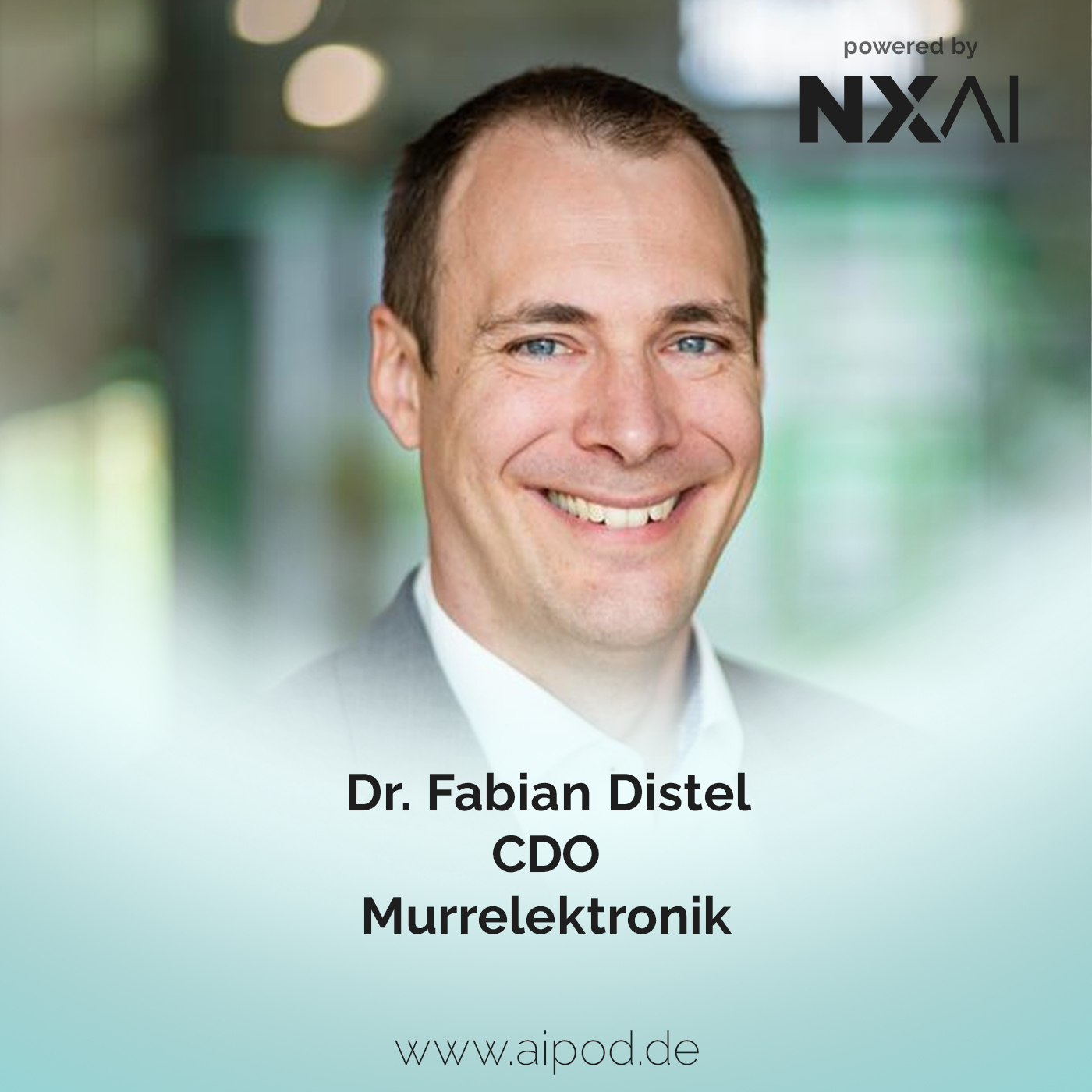
SPS 26:部品を超えて――AIと電気トポロジー設計(Murrelektronik)
Industrial AI Podcast
要約
Murrelektronik の Fabian Distel 氏と Julian Feinauer 氏が、電気設計を自動化する新製品 U-Konn-X Created を紹介した回。LLM ではなくチェスエンジンに似た専用の機械学習モデルと決定論的なルールを組み合わせ、他社部品も扱えるオープンな設計を採る。フリーミアムの事業モデル、顧客側の窓口の難しさ、トークン予算の考え方、部品単体ではなくシステム全体を最適化すべきだという見方も語られた。
この回のポイント
- ●U-Konn-X Created は、センサーやアクチュエータなど機能要件から電気トポロジーを自動生成する AI 中心のツールで、第1弾の現場向け製品は作業時間を約50%削減すると説明された。
- ●中核は LLM ではなく、チェスエンジンのように局面評価と手の候補評価を行う独自アーキテクチャのニューラルネットで、妥当性検証は電力超過などの決定論的ルールとコスト関数が担う。
- ●LLM は単純な課題でも失敗し、条件が複雑になるほど幻覚を起こしやすく、非決定的なため検証が難しいという理由で採用しなかったと述べている。
- ●部品は品番ではなく属性で扱い、他社製品やベンダー中立のダミー部品も追加できる。全く新しい技術が出た場合のみモデルの再学習が必要になる。
- ●基本無料で、API アクセスや MCP コネクタによるエージェント連携などは有料とするフリーミアムモデル。課題は顧客側で購買部門ではなく IT・変革の担当者に届くことだという。
- ●市場には部品単体の1〜2%の改善ではなく、システム全体で30〜50%の効率化を狙う視点が必要で、そこに AI が役立つと主張した。
章立て
Murrelektronik の AI への姿勢
AI は目的ではなく、製品中心から solution provider への変革の手段だと説明。AI ファーストの顧客ポータルとエージェント対応の API にも言及した。
U-Konn-X Created の概要
電気設計を自動化するスイート製品の第2弾。機能要件から電気トポロジーを生成し、中核は機械学習で、MCP 経由でエージェントとも連携する。
チェスに例えるモデル設計
局面評価と候補手評価を行う専用ニューラルネットと、ルール検証・コスト関数の組み合わせを Julian 氏が解説した。
なぜ LLM を使わないのか
非決定性や複雑な条件での幻覚の問題を挙げ、ヒューリスティクスの限界から機械学習に移行した経緯を語った。
ベンダー中立と ePlan との違い
属性ベースで他社部品も扱える設計と、ECAD の置き換えではなく設計から現場までエンドツーエンドでつなぐ思想を説明。
ビジネスモデルと顧客接点の課題
基本無料のフリーミアムで、API や MCP 連携は有料。購買部門ではなく適切な窓口に届く難しさを述べた。
今後の予定とトークン予算
SPS での NXAI の TiRex 2 連携デモ、回路図の取り込み機能、トークン予算の運用を紹介した。
システム全体最適という視点
部品単体ではなくシステム全体のTCOを見直せば30〜50%の改善も可能だと語った。
解説記事
産業用コネクタやケーブルなどを手がける Murrelektronik の Chief Digital Officer、Fabian Distel 氏と、開発を担う Julian Feinauer 氏が、Industrial AI Podcast に出演した。テーマは、電気トポロジー(センサー、アクチュエータ、電源、PLC をどうつなぐかという配線構成)を AI で自動設計する新製品 U-Konn-X Created である。LLM を使わない理由、他社部品も扱うオープン性、事業モデルまで話が及んだ。
AI は目的ではなく変革の手段
Distel 氏は、同社が部品を作る製品中心の会社から、顧客に solution を提供するシステムプロバイダーへ移行している最中だと述べる。AI はその変革で最も強力な道具の一つだが、目的そのものではないという立場だ。
新しい顧客ポータルは AI ファーストで作られており、ブラウザでクリックする操作が将来の標準ではないという考えが背景にある。エージェントがポータルを直接扱えるよう、ERP 向けだけでなくエージェント向けの API も重要になると語った。なお、AI 技術を組み込んだ物理製品はまだ出していないという。
機能要件から配線構成を生成する
U-Konn-X は電気設備の設置方法を変える製品スイートで、4月に発表した第1弾は現場向けのツールだ。利用した顧客は現場での作業時間を約50%削減できたと説明されている。今回の Created は設計工程を変えるもので、必要なセンサーやアクチュエータを入力すると、自動化設計としての電気トポロジーを生成する。
人間向けの UI もあるが、中核は機械学習アルゴリズムで、チャットで LLM に話しかける形式ではない。ただし MCP(モデルと外部ツールをつなぐ接続規格)のインターフェースを備えており、エージェント経由で入力し、結果をチャット画面に返すことも可能だ。Distel 氏によれば、機械設計者がボタンを押すだけで、実現可能かつ最適な電気設計ができ、電気設計の専門家は不要になる。
チェスエンジンに似た設計
Feinauer 氏は、この問題をチェスにたとえる。後になって良い手だったと分かる「犠牲」の手があること、一手しかない局面と似た選択肢が多い局面があること、そして攻撃的・守備的といった棋風の違いが、企業ごとの設計思想の違い(初期コスト重視、総保有コスト(TCO)重視、在庫の入手性、設置時間の短縮など)に対応するという。
仕組みも似ている。ニューラルネットワークが、現在の局面が良いか悪いかの評価と、次に打つべき手の候補の評価を担当する。標準的なアーキテクチャではなく、部分的に CNN や全結合層を使うカスタム構成だという。ただし最終判断は AI ではなく古典的なルールが行う。消費電力が電源容量を超えないか、全てのセンサーとアクチュエータが PLC につながっているかを検証し、ユーザーがカスタマイズ可能な決定論的コスト関数で案を比較する。たとえば TCO を重視すれば、初期費用は高いが診断機能が豊富で設置時間を減らせる機器が提案されやすくなる。
なぜ LLM ではないのか
LLM を使わない理由として Feinauer 氏は、非決定性を挙げた。単一のセンサー程度なら妥当な提案が出る可能性は高いが、確実かどうか分からない。診断機能を重視したいといった希望を伝えても、本当に良い提案かを検証できない。スキルやプロンプトで改善しようとしても「祈るようなもの」だという。条件が増え、ヒューズチャネルの分離、ケーブルの耐屈曲性、食品接触といった要件が重なるほど、幻覚が起きやすくなると述べている。
また開発の経緯として、まず専門知識に基づくヒューリスティクスで始めたが、毎週のように例外ルールが増え、別の例外を壊すという状態に陥ったと説明。ルールを人が書き続けるより、問題と答えからモデルに学ばせる方が自然だったという。LLM がなかった時期に開発を始めたが、今始めても同じ選択をすると述べた。
オープンな部品選択と事業モデル
システムは品番ではなく部品の属性(ポートの種類や仕様など)に基づくため、他社製品もデータベースに属性を登録すれば扱える。ベンダー中立のダミー部品も使える。Singapore Ethernet のような全く新しい技術が出れば再学習が必要になる。Distel 氏は、顧客を自社製品に囲い込まず、最良の解を選べる設計にしたと強調した。
ePlan のような ECAD との関係については競合ではなく、機械設計から電気設計、ERP、現場、アフターセールスまでを一つのデータの流れでつなぐ別のアプローチだと説明する。PLM との連携や、デジタルツイン用の管理シェル(Asset Administration Shell)モデルの生成も視野に入れている。
価格は基本無料で、BOM や PDF 回路図のエクスポートまで使える。API アクセスや、エージェントによる MCP コネクタの自動生成などは有料版とするフリーミアムだ。顧客が成功すれば自社も成功するという win-win の考えで、データ収集が主目的ではないという。開発自体より、購買部門ではなく IT やプロセス変革の担当者に接触することが難しいとも語った。
今後とトークン予算、システム視点
SPS では NXAI の TiRex 2 との連携を展示し、同社の部品を通るデータを顧客ポータルで分析できるようにする。回路図を取り込んでデジタルモデルに変換する機能も予定されている。社内の AI 利用では固定のトークン予算を設けず、効率に基づいて柔軟に増やしているという。KPI は一律ではなく、ユースケースごとに便益とコストの比率を見る。
市場については、各ブースに AI 展示が並ぶと予想しつつ、部品単体の1〜2%の改善では足りず、アジア勢との競争には30〜50%規模の改善が必要だと指摘した。部品を少し安くするのではなく、不要な部品をなくすなど、設計・設置・保守を含むシステム全体の TCO を見直す点に AI の価値があるという見方だ。
まとめ
本エピソードは、すべてを LLM で解くのではなく、問題の性質に合わせて手法を選ぶ実例として参考になる。検証可能性が求められる産業設計では、学習モデルが提案し、決定論的ルールが保証するという分担が現実的だ。日本の製造業にとっては、部品の最適化から全体最適への視点転換や、フリーミアムとオープン性による顧客接点づくりの考え方も注目点になる。
文字起こし(英語・自動生成)
This podcast is presented by NXAI, your partner for Time Series Foundation Models and Physical AI. Hello, everybody, and welcome to a new episode of the Industrial AI Podcast. My name is Rod Viva, and my guest today is Fabian Distil. Fabian, welcome to the podcast. Thank you very much, Robert. But I'm really excited to be here. Yes, me too. We are sitting here in Oppenweiler. Before we start talking about your latest and greatest when it comes to AI, please introduce yourself briefly to the listeners. Sure. Hi, everyone. Fabian Wistel. I'm Chief Digital Officer at Moelektronik. From my professional background, I studied mechanical engineering. I've been always very excited and prone to everything that has to do with digital technology and it has become my professional and I'm really, really happy about that.
And you are an active part of our industrial AI group. We meet with industrial AI leaders twice a year and you have been an active part of things since two times now and we are very happy to welcome you in our group. Thank you very much. And now you need to deliver. I try my very best. Let's talk a little bit more general at the beginning. When it comes to industrial AI, what is the main focus for Moore Electronic when it comes to industrial AI? AI for us is a tool in the end, so we don't try to think about it from the tool point of view, but more from a transformation point of view. We are in the midst of moving from a product-centric company that produces components to a solution provider, a system provider to our customers. And during that transformation, that transition we are in, there are numerous points where we want to change. And AI is one of the most powerful tools during that transition.
But AI itself is not the goal. It means to the end. So to integrate AI in your products and your solutions? We do that as well. We think about that for our digital solutions. We provide AI as a central point in the whole story. We created a new customer portal, which was AI first as well. So everything was built with AI in mind and in focus because we believe that clicking on a browser window is not where the future in interaction should go. So in everything we do, we always think about how can we go a different way, a new way. And, of course, AI is always one of the most powerful tools in the toolbox we are trying to go for. Also in our physical products, but to be honest, we're not having any products released yet with AI technology included. So an agent-friendly client portal.
Yes. So an agent-client, because we learned last time when we were together with Sweetron that in the future, maybe your machine interfaces are obsolete because agents will click and will find the solutions in the portal at the end. Absolutely. And to my understanding, an agent shouldn't need to open the browser to click through a portal. It should be natively integrated into the agent environment of any customer. So having any kind of API, of course, is important, but not only APIs for ERP systems, but for agents as well. Let's talk about your latest and greatest now. What do you bring on the table? We develop a new product suite, Uconnects. That's an abbreviation for Uconnect Anything. And with that, we try to transform the way electrical installation is done at our customers. So it's not about the hardware product and we add some software to it.
It's about delivering the tools to customers to transform their own business to become more efficient. And UConnX is a suite of products. We introduced the first one in April this year, and we are now introducing the second one. The first one was a shop floor product to really improve the way how to install electrical systems and machines. The customers using it save about 50% time on the shop floor because the process of installation is different with that tool. And what we are bringing now is UConnX Created. is an approach to completely change the way on how electrical systems are designed. So it's basically an AI-centric tool for automatically creating electrical topologies, automation designs. You just tell the software what sensors you have, what actors you need. That's from what your machine actually should be doing.
So from a functional point of view, you tell the software, okay, I need a few sensors, a few wells. Is it a chat or what is it? It can be anything. Again, it's AI-centric. We have an UI for humans. But, of course, the core is machine learning algorithms. It's very powerful. Do I chat with an LLM and say, I need two sensors, I need two connectors, what else? At the core, Uconnects created is not that. It's a machine learning algorithm that can create topologies based on the rules of electrical engineering. So basically, we designed the training field, the playing rules for the game of electrical installation design. But of course, this has an MCP interface. so you can use an agent with an LLM to input data and then the machine learning algorithm, the core, delivers topologies
and that can be output to a chat window again. But that's something that is around the core of the product. Let's come back to the core of the product. So you trained a machine learning model, an AI model on topologies, on different topologies, on millions of topologies, or what was the idea? We took a different approach. We tried to extract the knowledge from our experts. We have been advising customers for 50 years on how to build decentral electrical machines that have an optimized total cost of ownership. And every student at university learns the basics on electrical installation, on how to do a schematic diagram, how to calculate current. We have also a second guest here in the podcast, Julian Feinaur. Julian, welcome to the podcast. Hi, Robert. You are one of the masterminds behind the new product, right? Kind of, together with the team, of course.
Okay, because we want to look under the hood a bit. What have you guys been doing on the AI side? Well, basically what we do is that we play a good route of chess. Okay, what does that mean? Well, the problem we have at the end to find a good topology is in a way similar to playing a successful round of chess. So you are in a different situation, you have different options to make. Sometimes it's good to do a sacrifice to then later get a favorable position, which means It's not always visible that a move is good at first, but only two or three moves afterwards. You can realize that, in fact, this was a good move. Sometimes there are situations where there's pretty clearly only one valid move, and sometimes there are situations where there are many, many similar moves. Another aspect which probably also shows that it's similar is,
in chess there are many different play styles. You could play aggressive, you could play defensive, And this is also something we have at hand when looking at topologies because different companies, different machine manufacturers have different philosophies how to do their optimal topology, what optimal topology even means for them. Probably the cheapest initial invest or the best total cost of ownership, perhaps best stock availability, shortest installation times or that. wide barriers, although it's always the same problem, but many people have a different opinion on what a good outcome would be. Let's come to the AI part. So, chess engines for a long time were built without using AI and were quite good, but nowadays the best chess engines use AI internally. So, we take a similar approach and AI So what we don't do, perhaps this is important in today's times, what we don't do is we don't use LLMs.
What we have to do is similar to what a chess engine has to do. We have a given situation and we have to evaluate two things. One thing we have to evaluate is, is this a good position that we are in or is this a bad position? And the second thing we could evaluate is, what would be a good option to do now? What would be from all the options I have on a chessboard you have many options from all the options I have what would be a good option And this is where AI plays an important role So we trained several neural networks no standard architecture because the problem is pretty specific. We trained several neural network architectures who've helped us with these two problems at the core. So it's traditional machine learning that means CNNs or what is it? It's partial CNN, it's a partial feed forward fully connect the networks as a custom architecture because we have to encode a lot of information. Okay, but now you have these topologies, right? And you get a lot of suggestions by the AI, or am I wrong?
Yeah, this is how you can imagine it. Yeah, and how do you evaluate now if the suggestion is good or bad? Well, in the end, this is where AI ends, basically, and classical rules come into play again. I mean, a chess engine also in the end finally decides via rules if this is checkmate or not. And for us, we have clear conditions when a topology is valid. So we cannot do a topology where, for example, the actors would consume more power than the power supply supplies. This is something, although this could be a suggestion from an AI, this is something we cannot allow. So we have classical rules, a large set of rules, which takes this given topology and just scans and says, is this something that is allowed or does it violate boundary conditions? I mean, in chess, you can also not place your position on a field where another figure is standing already. So we have a clear set of rules which says, is this something we can allow? And we have a clear set of rules which says, is this topology problem solved?
in the sense of is every actor or sensor finally connected to the PLC, that the machine can work as expected. And also we have a totally deterministic cost function, which just says, okay, this topology is better than the other alternative. This cost function can be customized by the user, which says total cost of ownership is more important for me than initial price. This is a good example. But this could, for example, mean that we tend to suggest devices with high debugging capabilities, with a lot of diagnosis on board, because they will be a little bit more expensive at the beginning, but we expect them to save you time during installation. You used your traditional machine learning. Why not using an LLM approach? Because from my point of view, they were also capable to solve this problem. Or am I wrong? This is an excellent question. I mean, you could open the LLM of your favorite LLM and just say, ah, I have a sensor here.
What do I need to connect it? And there's a certain probability, high probability perhaps, that it gives you a good suggestion. With a single sensor, highly likely that the suggestion is valid. But you don't know for certain. It is the first thing. You don't know for certain if this thing is generally valid. But the second thing is, if you have this aspect that's like, ah, for me it is important that they have diagnosis, then LLM calls back and says, ah, perhaps then you should buy this thing. Is it really better? We don't really know. So first, this aspect of non-determinism is something that makes it difficult. But you can provide skills to the LLM, right? So that would be a way to go. But skills in the end is also more fingers crossed. Okay. We can write a skill which says, please don't make errors. Yeah, this is advanced prompt engineering. So L&Ms with all the things we also tested out, for simple tasks, it sometimes fails.
And if you have complex real world situations where you say things like all actors in this machine should be on a different fuse channel than all sensors. And in this area, I need cables that are flexible because they will be on track chain. And in this area, perhaps the material will be in contact with food and beverage. The problem gets more and more complicated and NLM will more and more likely just hallucinate. So I would say the same analogy is large language models can at a certain level play chess, but they will never beat a chess engine. But this is a very specific trained model. Let's imagine new products, new components. You add new components to the neural network, to your chess engine. How does that work? That's an excellent question. And in fact, the whole setup we took does not rely on article numbers. So we, as Moe Electronics in this case, provide this tool, but I think it was already said we don't only provide Moe Electronics products
because we don't believe in a world where everything is from Moe Electronics. I will not comment on that. It's product management. So, of course, we need to incorporate other products. So, the system is based solely on the properties of things. If something quarks like a duck and walks like a duck, it likely is a duck. So, if we get new devices, then we just have to enter the properties into the database, into the system, and then the engine is able to work with it. It has to know what kind of ports do we have, what are the specifications for this port, for the pins and so on and then it can work with it. What it could not do is if we get totally new technologies think of Singapore, Ethernet or something like this. This of course would mean that we perhaps need to adjust things a little bit or if new trends in the automation industry would come that it's favorable to do connections differently or legislation for such a stuff
then of course we would need to adjust the engine a little bit. So adjust means to retrain or what adjust means? Yes, yes. I mean, it's two things. One is the set of rules that I talked to you about or cost functions. The other thing is, yes, if we would see totally different products that are not just products we already know with different properties but totally different, then this would mean that we need to retrain the models, yes. So you used your chess engine. Can you explain a little bit how this idea came up in your team to use traditional machine learning? One reason is we already developed it. I mean, the product is quite complex, so we already developed it for some time. And in fact, we started development in a time where LLMs just didn't exist in the way we know them today. So basically, demo was an option. But even if we would start today for the reasons I just told you, LLMs are not the right tool to solve this problem, I would argue.
And basically what we did was we started with a set of heuristics. And this is a big advantage if you are a company like Moe Electronic, which has a lot of knowledge about what is a good installation, what is a bad installation, what are good principles to work with. And we worked with a lot of heuristics and ended in more rules and more rules and more edge cases and rules. And we came to the point where we saw that heuristics are not able to cut it. Because every week we had a new edge case, had to introduce a rule which broke another edge case, and so on and so on. So this is one of the aspects I would say generally where machine learning always comes to mind. When you say, well, I can give you a lot of problems and the answers I expect from you, but please yourself figure the rules out because I don't want to do rule engineering over and over. So this was a very natural, I would say, evolution to come up with saying, well, this is the kind of problem that neural networks were basically built for. Is it for you personally satisfying to see that LLMs don't solve everything yet?
I would say for me and hopefully for many others, listeners of this podcast or other people working with AI, whatever this means, satisfaction perhaps is the wrong word, but LNs are incredibly powerful and you can incorporate them in wonderful ways into your workflows. But in a way, it is good that thinking about a problem still can make a difference. What about adding an agent to your solution? Could that be a way to go? Of course, I would say adding an agent is a way to go for close to every system we talk about. But for me, as a tech person, this is another level, I would say. One thing is that, of course, the engine needs to do its job below the surface. And an agent, on the other hand, is more on the top layer, right, controlling the system overall, doing jobs. So, of course, it makes sense that I just open the system and say, oh. Maybe you don't need a user interface anymore, right? So give only the agent the task, and the agent will use your model in the back
as a secret source of Moore to present a solution? I mean, it depends on the use case, but if I say, well, I'm a customer and I plan a machine with roughly 100 sensors, what could a good Moore solution be? Yes, of course, why shouldn't an agent just send me out the proper solution, a code? Exactly. Is it the way to go for you, the next technical steps with your solution? I mean, we're working in different directions. Generally, the tool as it is today is meant as a tool for machine manufacturers to help them to plan machines better, easier, perhaps with better results, especially for those who are not familiar with all the details, the intricate details of decentralized installation concepts. But of course these aspects are also more or less on our roadmap But this is an important point Our goal is really to give you the best topology not to sell you more stuff
I mean, you could add a cost function which says, well, I want to give my money to more. The whole budget goes to more. Yeah. But as our mission, general mission statement is to produce the best topology. This is where we focus on. Thanks a lot, Julian. Thanks a lot for inviting me. And now, back to Fabian Distel. So you don't need an electrical expert to double and triple check the results. Of course, you can do that, and there's much more that you can do afterwards to optimize it for the SPS programming and so on. So the solution can be added with additional domains. At the core, you don't need an electrical designer anymore, any mechanical designer who decides, I need these motors, I need these sensors, can push a button and the electrical design is done. It's feasible and it's optimal and we can assure that. Okay. Is it a competitor to ePlan? It does not have all the functionality that ePlan has developed over the last decade.
At its core, if you have an electrical installation automation problem, you can use, you can excrete it, and you don't need Aplan after that for the electrical schematics. If you have special tasks where you need some special features that are implemented in Aplan, we don't have all of that at the moment. But is it on your agenda to be a competitor to Aplan, or is it more a different focus of customers and customer problems? It's a completely different approach. It's not about becoming a competitor to Aplan. It's about changing the way of how electrical installation, the whole process end-to-end is being thought and integrating current systems into the whole process end-to-end from mechanical design, electrical design, ERP to the shop floor and after sales. There are big hurdles in the data models and in how the tools are designed. We are a SaaS native, and we designed UConnix created with this end-to-end seamless integration in our mind from the start.
So we are very easy to integrate with PLM systems, for example, but we also provide the data that is needed in ERP or on the shop floor to use UConnix installation and then create your asset administration shell model so you can have your digital twin at the end. And this is one seamless data stream that we designed. And that's something that any ECAD on the market does not offer at the moment. So I wouldn't say it's a competition. It's a new approach to a similar problem. Moore provides a lot of components, right? But there are also different providers of electronic components, right? Is your platform, your product, focused only on more components? Definitely not. We always try to be agnostic to standards. So any component that is within the normative standards of electrical installation can and should be used.
We do not want to lock in any customer to a more electronic solution world. We want always to win with the best solution, with the best product, with the best service around the product. And if a customer feels like in certain situations somebody else offers a better deal on any product, he should always be free to use that component. So with this in the back of our mind, the whole software is designed to work with any component. Also, of course, competitors' components. So as a user, I can add my components or is it standard that you all add the different components from, I don't know, you have sensors from SICK, you have sensors from IFM, you have BALOV sensors, what else? So we do not produce any sensors ourselves. So, of course, the sensors are from a lot of different vendors. We also provide agnostic or vendor-neutral components.
So if you're not certain which component you want to use at that time, you just know, okay, I need some inductive sensor. You can add an inductive sensor as a dummy part in the solution, which also enables our customers to do a topology, even if a component is not a specific component, is not part of the solution space yet. The customers can add components themselves. The depth of data needed is very different for different kind of components. For simple sensors, it's easy to click that yourself in the interface. if you have a more complex component, it can become a very difficult task to collect all the information. We provide a lot of data ourselves from the beginning. It's going to be a continuous growing database, but we're also working with other companies in the field of electrical installation. They also started adding components of their own. So they also understand it's not a more electronic platform to push more electronic products.
It's a way of helping our customers build smarter, better, more efficient electrical installations and, in the end, better machines. And every customer who understands that doesn't want to be confined to a certain space of the selection of components from a single vendor. And we don't want that either. So our competitors can be assured that there's no unfair game behind it, that the best component or the selection criteria from the customers decides what is put into the topology at the end. Can you please define your dream, your wish customer for this product? My wish is that everybody who does an electrical installation has an automation problem. no matter what discipline, domain he's working in, first tries to get the first draft of a solution with Uconnects created to see what the possibilities are.
It's going to be free to use. You can just go online, register, and design your topologies. And after that, you're free to go any way you want. You can export the BOM, you can export the schematics as a PDF, and then... I can use it for my ePlan too, right? I don't know if ePlan has an import function. To my understanding, they are rather close doors. But, of course, you can use it at least as a concept that then you create in a different eCAD system. And that's totally fine for us. Of course, if you're satisfied with the result and you don't need any special functionality, you can be done with created. But you learn a lot about the people, what they are doing, right? So which components they choose for which problem. So it's a data-driven approach for you to learn a lot about your potential and existing customers. That's something that comes with that solution, of course. But we have a very deep insight in that already because customers trust us with their topologies, with their designs already.
because we are vendor neutral when it comes to sensors, actors, which is what the customers usually care more about because that's what differentiates their process, their functionality of the machine. If you use a connector cable from Moo Electronics or from a different competitor, that doesn't really change the functionality of the machines in its core. So we have already a very good insight into what our customers do, how they design the machines. So this is not the core or any motivation to go that way. Of course, it's an effect that happens, and that's at the core of the business or the core of the technology, but that's not the business behind it we are going for. Can you explain to me what is then the business model for this, for MooElectronic? So you develop a new platform, a new product. You call it product, but it's for free. It's a data-driven approach.
You said data, we're not so interested because we already know. But what is the benefit at the end for you as Moore? There are going to be paid versions of it, so it's more like a freemium model. At the end, some functionalities will scale the cost side, and there needs to be a paid solution or a paid version. But we are also going for the whole end-to-end process. And the other solutions we provide, they are not free. They are paid digital solutions. But we decided to promote the Decentral Electric installation with Uconnects Created because in the end, it helps our customers. And if our customers are more successful, we will be more successful. So it's more like a win-win approach than making money in that specific spot. That's interesting because everybody is doing something great when it comes to AI and machine learning, right? But in the end, it's always like we do not have a business model yet for this.
Or we have a product but we don know how to sell it Or you said now it a paid version also So is it really so difficult let talk a little bit more general to build for a component company like Moore hardware components right to design, to define new digital products? Is that a new – is it a cultural shift in the whole company? Is it a new understanding? Is it so difficult to do that? Or what are the barriers for you? Designing the product is easy. Developing the product is easy. We have great talent. It's a problem. Getting to the right person on the customer side, that's the challenge. Because at the moment when we sell components, we are talking to the purchasing department. I don't know a lot of companies where the purchasing department makes the IT strategy or the process transformation strategy. So you need different contact persons on the customer side.
And that's what the challenge is, getting in touch with the right people. Once we are in touch and we have a lot of C-level contacts and in every discussion we have, the one project comes out of it where the customers look into our digital solutions with us in depth. For our sales organization, it's a much harder approach to get in touch with the right contact to convince the customer to look into our digital products. And coming back to the paid, non-paid argument We have a very clear view on how the business model should work For example, if you want to have API access to UConn X created That's going to be a paid version But we do not want to hinder anyone of experiencing How successful this can make oneself using AI in the design process So it's like an entry.
It's a free entry. It's face-free. But if you want to really integrate it into your whole IT infrastructure, if you want to become a heavy user, if you want AI agents to automatically create MCP connectors, this is going to be all part of a page. Okay, perfect. Fabian, let's talk a little bit about your agenda. What is on your AI agenda, the Moore AI agenda in the next coming, let's say, six months, I think six months, everybody can overlook six months. Yeah, glad you asked. So at the SPS show, we are also showcasing an integration of Tyrex 2 from NXAI. Oh, wow. I've never heard about this company. Yeah, funny coincidence. But we want to showcase that a lot of data goes through our components because we are in the topology of the electrical installation. and you can get this information into our customer portal and then analyze the data there.
We will have more products from our digital solution side, so from the UConnix suite coming up with AI capabilities. So, for example, you will be able to import a schematic soon, and it's fully converted into a digital model, so you don't need to start from scratch. You can just import it and then keep working with it, either with created or with one of our other software suits. Then we also have the internal usage of AI, of course. Let's talk about token budgets. What is your token budget, Fabian? You as a chief digital officer, you must have a huge budget of tokens. How do you handle that yet more? We have not set a fixed budget for tokens. Of course, we planned for a certain amount of token usage, and we are often surprised that it wasn't enough. But it's a decision on efficiency of how much output do we generate.
So it's not like a mandatory budget, and once you reach it, you're back to pen and paper. It's about arguing that you use it efficiently, that you get great output from the tokens you use. And then we are rather flexible in extending the budget. And we've done that in the last year a couple of times. We've learned from that. We monitor the usage and the outcome. Of course, there are certain projects and experiments where we don't do that because we want to first find out if it actually works. But once we are convinced that we are going into a direction where actually we have a positive effect on everyday tasks, then it's more about calculating is it a positive ratio of cost and benefits. Now you are the CDO, right? What is the opinion of your CFO? So when it comes to KPIs, when it comes to cost spending, et cetera,
so is there a plan to build KPIs for token usage? For example, we talked to Werner from Arburg, I think, three episodes back, and there was also the discussion, what is a KPI for token budgets or for token usage? Do we need to define the KPI for that, or do you have something in mind that can work? I have no general KPI that works on all token usage. We try to look at it from use case to use case, like the basic formula you have for any investment where you try to calculate your return on invest. So it's always a benefit and cost estimation and the ratio between those two. And understanding what is the benefit for every single use case. Is that the core? So once you understand the benefit and you get an idea of how you can actually measure it, the other side is the cost and that you can monitor very easily.
And once you get too close to the tipping point, you need to look, am I using the right models? Can I do something on the cost side or do I have a problem on the benefit side because I'm not in the sweet spot of the use case? I am having too many exotic use cases where the automation of the process doesn't work as expected. SPS is rolling when this episode will be live. What do you expect? What do you want to see at SPS? Where do you focus on? We are going to showcase the whole… Not more. Maybe let's talk a little bit general. What do you see in the market? Where do you see that there's an ongoing trend? We talked about LLMs. We talked about tokens. But you also mentioned time series, right? So where do you see trends in the whole automation business when it comes to AI? I see a lot of AI integration into products, and I expect to see on every booth some AI showcase with a product.
What I hope that the market is moving to is taking a step back and looking at the bigger picture. So on the system, on the solution side, because optimizing individual components is not going to be enough in the competition our customers are in. We are not talking about 1% or 2% they need to optimize to be able to compete with the competition from Far East. It's more like 30%, 40%, 50%. That's more the scale that we need to think about. Is that possible from your point of view with AI? It's possible if you don't look only at small individual components and try to make this a little cheaper. But if you look at the big picture on the whole system and think about, okay, what components don't I need if I have a different approach? how can I be much more efficient in designing, installing, maintaining a machine
and then it's a total cost of ownership discussion we're going to have. And that's something where I believe that AI can really help but we need to look at the big picture and not on the small itsy-bitsy component. But this is interesting because you sell itsy-bitsy components, right? So is it a new strategic perspective from Moore? What is that? It's a bitsy component, by the way. What is that? Actually, we should talk about that later. Is it a new strategy or a new perspective of Moore? We've been going that direction for quite some time now. And, of course, we sell components because systems are made of components. But we try to sell the most efficient system and provide a solution for the customer. And that's what I'm talking about. So not only focusing on the development of the single component, but how it impacts the whole system, the whole installation, the application on the customer side, and everything that can be done around the component or around the solution to make the whole process even more efficient.
Fabian, it was a pleasure. I keep my fingers crossed for you, for Moore, and thanks a lot for the interview. Thank you very much, Robert. Thank you.
番組の概要欄(原文)
In this episode, I talk to Dr. Fabian Distel and Dr. Julian Feinauer (Murrelektronik)about using AI to rethink how machines are designed, installed, and maintained. Their U-Konn-X Creaited uses specialized machine-learning models and engineering rules to generate and validate electrical topologies, while keeping the system open to components from different vendors. We also get into why an LLM isn’t the right tool for every industrial problem, how agents could make these systems easier to use, and what it takes to turn digital tools into a business. The bigger question: can AI help manufacturers improve the whole system—not just shave a little cost off one component?
出典・この記事について
- 番組
- Industrial AI Podcast(Robert Weber / Peter Seeberg)
- 元の回
- SPS 26: Beyond Components: AI and electrical topologies
- 配信日
- 要約作成日
- 公式サイト
- www.aipod.de
この要約・解説記事は、元の音声を文字起こしした内容をもとに AI(Claude)が日本語で作成したものです。 固有名詞や数値に誤りを含む場合があるため、正確な内容は元の音声でご確認ください。制作方法について
関連エピソード

Gemini 4 Neon を試すべき理由——Fable 派にも「セカンドオピニオン」としての価値
The AI Daily Brief: Artificial Intelligence News and Analysis
Anthropic上場、ChatGPTに財布機能、AIによる創薬
Mixture of Experts

Huang騒動、Anthropic上場、そしてMetaのMuse――EP99.40
This Day in AI Podcast
Anthropic の1.4兆ドルIPO:人類史上最大の富の創出イベントか
Moonshots with Peter Diamandis
機械が「主体性」を持つために必要なこと(マイケル・トマセロ)
Machine Learning Street Talk (MLST)

Anthropic の IPO はなぜ成功するのか――Box CEO Aaron Levie が語る強気シナリオ
Big Technology Podcast