
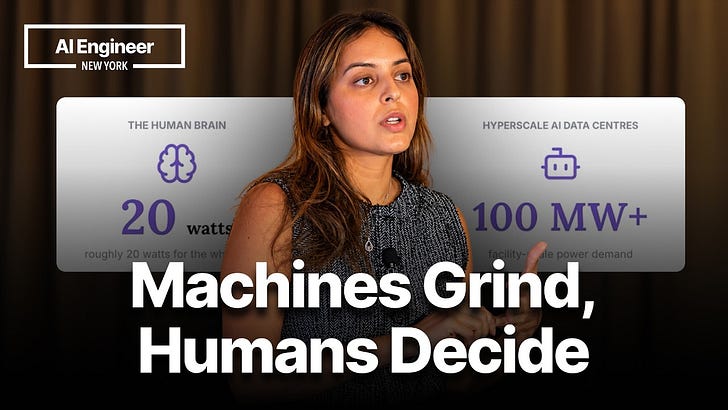
あなたがチームそのもの — Anekha Sokhal(Moshi)
You are the Team — Anekha Sokhal, Moshi
あなたがチームそのもの — Anekha Sokhal(Moshi)
Latent Space: The AI Engineer Podcast
要約
Latent Space のライブ収録で、swyx がコモディティ・エネルギー市場向けのリアルタイム情報サービス Moshi の創業者 Anekha Sokhal 氏に話を聞いた。元 JP Morgan のデリバティブトレーダーである同氏は、構造化・非構造化データやユーザー固有データを統合し、推薦システムで重要情報を届ける設計を語った。AI Engineer New York 登壇後の反響や、「あなたがチームだ」と迫られる AI エンジニアの悩みも話題になった。
この回のポイント
- ●Sokhal 氏は Warwick で数学・統計などを学び、JP Morgan でエネルギーデリバティブのトレーダーを務めた後、Fulbright 奨学金で渡米して機械学習研究を経て Moshi を創業した。
- ●Moshi は先物の時系列、需給などのファンダメンタルズ、ニュースや X、ポッドキャスト音声などの代替データに、ユーザー固有のデータを組み合わせて処理する。
- ●「Bloomberg と Claude と Netflix が子どもを産んだようなもの」と表現し、トレーダーが見ている対象の二次・三次的な影響を推薦システムで提示することを特徴とする。
- ●自作ダッシュボードが増えた今、課題は UI と利用定着であり、プッシュ型の推薦と UI は一体で解くべきだというのが同社の仮説である。
- ●情報源が割れていること自体をシグナルとみなし、信頼度スコアを付けて提示する。顧客の PDF などは自社の視覚言語モデルで処理し、第三者への送信を避けている。
- ●登壇後は顧客候補との面談が殺到した。AI エンジニアからは「チーム不在で全部自分で作る」重圧や、作ったのに使われない悩みが寄せられたという。
章立て
登壇後の反響と「あなたがチーム」
Sokhal 氏が AI Engineer New York 後に面談が埋まり滞在を延長した様子と、管理職からの重圧に悩む AI エンジニアの話。
数学からエネルギーデリバティブへ
Warwick での学び、JP Morgan での取引経験、データへの関心から起業を志した経緯を語る。
Fulbright と創業、Moshi とは
ガス市場の混乱期に Fulbright を得て渡米し、ML 研究を経て、自身が欲しかったツールとして Moshi を作った。
扱うデータの種類と規模
市場の時系列、ファンダメンタルズ、ニュース、X、音声、ユーザー固有データを統合し、プッシュとプルで提供する仕組み。
Bloomberg・Claude・Netflix と推薦システム
Bloomberg との違い、二次・三次の影響を示す推薦グラフ、ダッシュボードから UI・定着への課題を議論する。
信頼できる情報源とデータ統合
代替データの信頼性、情報源の不一致をシグナルとして扱う方法、PDF 処理の自社モデルとデータ保護の考え方。
カンファレンスの収穫と面談の工夫
登壇後の問い合わせ、1対多の対面面談案、運営への評価、採用と顧客獲得の優先度を話す。
swyx の AI への転身
ヘッジファンドからテックへ移り、AI Engineer を立ち上げた経緯を swyx が簡単に語る。
解説記事
Latent Space のライブ収録回で、司会の swyx が、コモディティ・エネルギー市場向けのリアルタイム情報サービス Moshi の CEO、Anekha Sokhal 氏に話を聞いた。元 JP Morgan のデリバティブトレーダーである同氏が、自身の経歴、プロダクト設計、AI Engineer New York 登壇後の反響を語っている。
トレーダーから創業者へ
Sokhal 氏は英国の Warwick で数学、オペレーショナルリサーチ、統計、経済学を学んだ。当時は「ナードっぽい」と思われて人に言いづらかった分野が、今は機械学習や AI として注目されていると振り返る。JP Morgan では新興国デスクからコモディティに移り、主にエネルギーデリバティブを担当した。
取引の現場でデータが重要になる変化を感じて退職し、データ企業の創業を目指した。そこで Fulbright 奨学金を得て渡米したという。同氏によれば、英国全体で枠は1人分であり、面接ではガス価格の高騰というエネルギー危機とデータの関係を語った。渡米後は機械学習研究に取り組み、Stability AI と共同で ICLR に論文を発表し、NASA とも協業したと述べている。これが Moshi につながった。
Moshi が扱うデータと設計
Moshi は「自分がトレーダー時代に欲しかったプログラム」として、商品・エネルギー・マクロ市場向けにリアルタイムの洞察を提供する。同氏は、自分が4秒で一文を話す間に Moshi は300件の新しい情報を学習する、と規模を説明した。
対象データは大きく分かれる。先物の時系列と各種テクニカル指標、需給などのファンダメンタルズの時系列、さらにニュース、X、ポッドキャスト音声などの非構造化・代替データである。これに、ユーザーが信頼するアナリストや購読中のレポート、社内データ(たとえばホルムズ海峡を通過する LNG 船の数を追う担当者の情報)といった非公開データを組み合わせる。クリーニングと変換を経て、統計や機械学習でタグ付けしオントロジーを作り、グラフ構造に格納する。出力は、ポートフォリオに関連する情報が開くたびに更新されるプッシュ型と、LLM に質問して数秒で答えを得るプル型の両方だという。
Bloomberg と Netflix の間
Bloomberg との比較について Sokhal 氏は「新しい Bloomberg」とは言わず、「Bloomberg と Claude と Netflix が子どもを産んだようなもの」と表現した。トレーダーが見ている対象に対し、二次・三次の影響を示す推薦システムを自社で構築しているのが特徴だ。たとえば、原油トレーダーに対して、間接的に原油に影響するエネルギー関連企業の動きを、ニュースのストリームではなく接続されたグラフから示す。
swyx は、推薦システムが YouTube や Netflix、Instagram、TikTok の中核であるにもかかわらず、自身が主催する会議の推薦システムのトラックは参加者が少ないと指摘した。両者は、誰でも自分用のダッシュボードを作れる今、他人に使わせる段階では技術より UI と業務フローへの組み込みが問題になる、と議論した。Sokhal 氏は、プッシュで自然に使わせる仕組みが重要で、UI と推薦は一方を解けば他方も解けるというのが同社の仮説だと説明している。
信頼性とデータの扱い
swyx は、自身がバイサイドで高額な X のデータを購入した経験から、SNS データはノイズや相場操縦の懸念があると述べた。Sokhal 氏は、ユーザーには信頼する発信者がいて、特に供給側の施設などが X で最新状況を出すことが多いと答えた。Moshi は可能な限りノイズを除き、提示時には信頼度スコアと周辺の議論も示す。また、Reuters や Bloomberg、Wall Street Journal の報道が食い違う場合、その不一致自体が情報になりうると考えている。
顧客データの統合では、整理されていない PDF を自社の視覚言語モデルで解析し、クラウド版にアップロードされたデータからデータベースを構築する。システム接続が必要なデータは個別に対応する。自社モデルにこだわる理由として、データを第三者に送りたくないこと、エンジニアのいる組織はモデルを自作したがることを挙げ、ベンダー利用かどうかはチームの状況次第だとした。
カンファレンスの反響
登壇後は、LinkedIn での面談依頼が相次ぎ、同氏は滞在を延長した。相手は、ファンドやコンサルのトレーダー、パートナー候補、そして AI エンジニアだった。AI エンジニアの多くは、「あなたがチームだ」と言われ、本来10人で作る規模のシステムを一人で構築する重圧を感じていると語る。エージェントの群れが必要か、壊れたらどうするか、作ったのに誰もクリックしない、といった悩みも出たという。
面談の効率化として、ウェビナーの開催を始める。swyx は会場で1対多のミーティングをできる仕組みを提案し、Sokhal 氏も賛同した。採用では、1つの求人が4日で2,500件の応募を集めたため、フィルタが必要だとし、現在は顧客との接点づくりを優先している。
まとめ
この回は、AI で情報を大量処理する以上に、重要なものを選んで届け、ワークフローに定着させる設計が価値を決めるという視点を示している。日本の読者にとっては、金融以外でも、推薦システムと UI の一体設計、情報源の不一致を価値とみなす発想、データ保護を踏まえた自社モデルの判断が参考になる。また、少人数で多くの役割を求められる AI エンジニアの現状も、現場の声として押さえておきたい。
文字起こし(英語・自動生成)
So I've actually extended my stay in New York because we've like now I was meant to leave today. We've now got meetings on Thursday. Extended another day, Friday. Extended another day, Monday. And then I've got now meetings where people are like, hey, we're in energy. Let's talk in Houston. So we've like filled up a week after the conference of meeting. And AI engineers was an interesting one because a lot of them are feeling like overwhelmed with the pressure from management. To do what? because people now say we don't need a team you are the team and so it's like hey i need to now build this whole system myself but that system would be typically done by 10 people okay we are in the studio last podcast of viu for me uh with anika from moshi welcome Thank you so much.
Did I get it right, Annika? Yes, you did. So your background caught my interest because I was a former trader and you're now a founder. Yes. And you also were telling me just about your experience. I kind of want to hear about it from you as far as I know this is your first AIE. How did you hear about us? What was the experience like in your talk and what happened after? Yeah, well, first of all, thank you to everyone at AIE because it's been such a fantastic experience. and thank you for inviting me on the podcast as well. I'm so excited to just share my experience. And also I think we're living in such a fast-moving time and everyone I speak to is very overwhelmed. So it's really helpful to be able to kind of share everything that I've had in my experience because I did my undergrad in statistics and math, which is now what everyone calls AI. And so it's really interesting to speak about that and the evolution of that and also to always speak to a former trader as well and just to share like
war scars on that. Did you do financial calculus like like spaccato calculus? Yeah I did that and I so my undergraduate degree was mathematics, operational research, statistics and economics, Morse at Warwick and it was uh what everyone was just like oh my god so nerdy and I hated telling people and now it's like wow yeah everyone's like oh my god machine learning AI yeah yeah yeah and in derivatives? So I did that. So my background was started in Warwick in England and then knew I wanted to work in trading. I don't know what your story to go into trading was, but I wanted something which was fast paced and to do with data, like absolutely love data. And it was when I read about what trading was, I could not imagine myself being in any other career. So I was just set on doing that. So I got my first internship in investment banking and trading and then got an internship at JP Morgan where I started and I started on the emerging markets desk and then
moved to commodities and did derivative trading there. So most of my career has been in energy derivatives and because I have that data background I always looked at the market from I wanted to break it down into all the different parts so for example in commodities a lot is about the fundamentals and about the different news and the different the physical happening and so I was always fascinated by like building out from zero and so when I was trading I saw this shift where it's like a data and then something was going to happen and that's when I left JP Morgan to to actually I wanted to be an entrepreneur and um and a founder but I wanted to have a data company so I got the Fulbright scholarship to come to the U.S. because you guys have such an incredible venture space. Just casually go to Fulbright? Yeah I guess the way I say a funny story I was doing a yoga class in London I was like so my
parents have a jewelry business I side hustled a computer vision startup before my startup at university and so I was like oh what are the problems in the jewelry space oh like virtual try-on so that led to me wanting to be a founder and I thought how could I be a founder in the best country to be a founder in and I thought what I want to be a founder who can talk about the technology so this was back in like 2020 2021 and i found fulbright had a data scholarship and they gave one in the whole of the uk so like my way to get here is a fulbright scholarship and they only give one and this is really funny because i don't know if you remember 2020 when it was covid and gas markets were going crazy so there was there was like gas markets had insane volatility and so when I did my Fulbright interview they asked me how do you like how do you see the future and I talked about the like global issue of everyone is having the energy market crisis
and how data relates to that and everyone could relate to what I was talking to because like gas prices were crazy their electricity bills were going crazy and so that led me to the US came here was deep in machine learning research, published at ICLR with Stability AI, worked in collaboration with NASA, did a lot of super interesting work, which then led me to Moshi. And what is Moshi? So, Moshi, we are building the program that I wish I had when I was trading. So, what we do is we provide real-time insights for financial traders, starting with commodity and energy markets and macro markets. So what we do is we process more data than is humanly possible to tell you everything that matters to your portfolio right now. What kind of data would you be processing? Give us an idea of maybe types and an order of magnitude. Types and order of magnitude. So let me start with order of magnitude.
So a fun way I explain it to people is it takes me four seconds to say the sentence to you. And in the same amount of time, Moshi has learned 300 new things. So that's the type of volume of data that we process. In terms of the types of data this very much comes to me like geeking out about how I would trade I break the market up into all the different types of data which a trader looks at to decide what trade to put on and how to manage the risk So what I do is I take the market and I say, well, there's structured data and unstructured data. There's the time series of the futures market and there's all of the technical analysis around it. So we're looking at all of this, like, statistical indicators, all of the different technical indicators, all of the moving averages. That's one data set. And obviously, that is updating constantly. The next data set we look at is the time series for fundamentals markets.
So especially in some commodity markets, there's a lot of demand and supply. And then we look at the unstructured data. So the news is the obvious one. But then there's also all this alternative data that exists. For example, there's X data. There's audio data on podcast. X Twitter, yes. You read Twitter? Okay. So understanding all of these different types of data, and that I would say is the public availability of data, and there's this whole other type of data, which is the user's private data. So I'm sure you had that when you were trading, which is you have the analysts you care about. I can't come and tell you, hey, you should, you know, read this person because you have who you need. And then you're going to have your subscriptions that you care about. You'll have your internal data, right? Like some of the companies we speak to, if they are trading markets, trading energy markets, they will have their person for the amount of LNG ships going through the Strait of Hormuz.
And so there's all this data which is personal to the user. So we take those two data points together, do all of the data cleaning, data transformation. We then look at the statistics and machine learning, tag it, kind of create our whole ontology on top of it. And then we put it into the Moshi, like n-dimensional graph. And then we produce the output, which is a piece of software which pushes data to you. So every time you open Moshi, you see something new related to your portfolio. And you can pull data. So LLM, I'm going to give you answers in 30 seconds, which would take you typically days. So do people often say New Bloomberg or is that something that you disagree? You don't like being characterized as New Bloomberg? Yeah, that's an interesting question. Obviously, that's the 800-pound gorilla or whatever the British version of saying 800-pound gorilla is. Yeah, you know, I think Bloomberg has certain features, which the Bloomberg chat.
It's a fantastic aspect of the platform. For those who don't know, traders would transact billions of dollars in chat. There's a standardized formula. My entry into NLP was actually pricing Bloomberg chat into a structured pricing sheet for my logs. That's how we do option pricing. There's the Bloomberg chat, which is one thing. I wouldn't say we're a new Bloomberg. I'd say we're a different type of software, which is not – I think this is the easiest way to say it, and I don't know how controversial this is, but if Bloomberg and Claude and Netflix had a baby – Netflix? It would be Moshi. You have videos? Netflix. We actually have a recommendation system, which we've internally built, which is if you're a trader and you're looking at one thing, you actually care about the second and third order derivatives right now,
which you wouldn't immediately know. I see. And so we've built a whole recommendation system where a simple thing, if you're, let's bring it back to like an oil trader, and there's an energy equities company that's doing something which would indirectly impact oil, you need to know that right now. You're not going to get that from like a news stream. you will get that from a connected graph which is showing that to you because if those two information points are coming out right now the only way you can do it is either a human which is being able to like connect those or by a mimicking human sort of like a recommendation system which can do that that's what we try and do because i like wish i had that when i was trading yeah well you know there's a whole addictiveness element of Netflix which is that but um yeah it's very interesting i think like rexist is one of the most important parts of ai and as a curator of aies i actually have every year an lm rexist track and engineers often don't appreciate how important it
is like it's not very well attended uh even though some of the people powering these things i mean they run rexist for youtube they run fx for netflix for instagram and tiktok and then like nobody shows up and i'm like what do you mean like you're not interested in rexist you know So I find it really interesting. I think part of it is they make it seem so easy. And it's like, oh, this is so, like, why? This is the most important system in the entire, like, you know, company. Exactly. And I'd say there's arguably something linked to it, which I think some companies do really well, like Spotify, Instagram, which is one thing that people have come out with AI is everyone now can build their own claw dashboards, right? It's like, hey, I built this myself. Great. If you want to get someone else to use it, that's your brain in a dashboard or your brain in something.
Try and get someone new to incorporate that into their workflow. You're then no longer dealing with a problem, you're dealing with a UI problem, which is how did they interact with it? Because sometimes users don't always use that. One thing that these platforms do really well is they push data to you, which like hooks you. So you naturally don't even realize you're on the platform and you're like, oh, I want that. No, no, I actually want that. And so we've been trying to internally as a company understand how does UI relate to a recommendation system? Because our thesis is if you solve for one, you're naturally also solving for the other. And I think that's a big thing right now, which is if everyone's building software, how do you get it to actually be software that people will use It a bit of an interesting take A bit of chicken and egg Well anyway I forgot to mention also my background to this I used to trade currency options in London, actually, and then I spent some time in rates
and it had a very similar career path where you start with EMEA and then you go into maybe G10, at least that's what we call it for currencies. and you ingest a lot of information and really probably LLMs can process it better. So we didn't have the tooling back when I did this 10 years ago, but now I see that. And then I moved to the buy side where you start paying for alternative data, exactly like you did. We were actually one of the very first few at Ballyazni to do the ex-fire host or Twitter fire host. Yeah. That's something like a stupidly expensive, like $300,000 a month, like, data thing that you have to pay for to get all tweets. You used to be free? I don't think, I don't know if it was ever free. It was free for researchers. Okay. But then if you're, like, a hedge fund, like, you have to sort of buy that. And it's very noisy. And so my eyes go to that because I don't know if I would trade on those things.
because sometimes people do just talk random crap, and sometimes people try to manipulate markets by saying stuff, and it just doesn't matter that much. But we would also have alternative data like satellite information or credit card information or whatever, right? And so on the buy side, my number one question is, are you looking at my data, right, which is probably not, but how do you assure people? How do you integrate with systems that you don't necessarily even see? Yeah, and I think there's two questions in there, which is the first one is, if there's so much data available, how do you know what's important? So when we're looking at X data, it's a natural conversation when we speak to people, or let's even expand it out to any types of data. One thing we found with people is they really will have their trusted people who they'll follow of these voices in industry. Especially in commodities, they'll be the suppliers of commodities, There'll be the LNG, all of these facilities who will be active on there because it's the quickest way for them to also give a status update.
Wow. So it's interesting because we found that a lot of our users will tell us about this. So it's like, oh, okay, so you find it as a trusted source because you believe this certain individual. Sketchy. Right? And so it's one of those things where we have found a way to try and filter out as much as possible. But when we are showing it to someone, we give a confidence score of, OK, someone is saying this one thing, but this is everything else happening around the conversation. Because what's interesting to people is if there are divergent sources, like an example would be how many ships are going up, how many planes are going above us right now. If Reuters is saying something or Bloomberg is saying something or Wall Street Journal is saying something, they may not all agree. But the fact that they don't agree is a point of data because is there an opportunity there because no one knows? So that's how we try and give people information. And then the second question is, you know, people's data sits everywhere.
And I think there's different types of integration. The first one is what about, like, their messy PDF data? that data is what we've built is like a vision language model to understand it so we'll take the data that they can upload to their cloud version of Moshi and then we actually go and we break it down and then build it up in our database and there are certain types of data where you just have to connect to their systems and then that's like more of a conversation. Is it important to I assume you're you're running this vision language model yourself Is it important to own that? Or would you want to lay out? I mean, there's any number of vendors. Reductive is like a non-document processing one. How important is it to have your own models versus just use whatever's off the shelf? I think that's a question that a lot of companies are battling with right now. The first question for us is if someone's giving us their data, we don't want to be sending it to a third party.
Because there are systems out there which can do these things for you. but you want to make sure that you've got that agreement on how are they processing that data, what are they doing with it. That's the first question. The second one is if you don't have a team of engineers, then that is a great solution. But if you do have a team of engineers like us, a fun fact is most of the team has in some capacity worked with NASA, then they want to build the models. But not everyone has that. And so, you know, I think it really depends like where you are as a team. Yeah, got it. Okay, and then coming into your talk, you apparently had a lot of inbound from it. This is our first finance focused one. Okay. So I was genuinely unsure who we could get in the door. Obviously, we like pitch it and market it very heavily for this crew. What kind of people did you end up talking to? Yeah, it was a fantastic opportunity.
Because we have been like back to back speaking to people. And what we initially thought would be the interest, we've had people like in the past hour messaging me on LinkedIn saying, hey, I saw your talk. Are you in Houston? Can we get a meeting? Or hey, are you in New York? Can we get a meeting? The types of people we've had, a lot of traders, either at funds, consulting. and then ai engineers was an interesting one because a lot of them are feeling like overwhelmed with the pressure from management to do what because people now say we don't need a team you are the team and so it's like hey i need to now build this whole system myself but that system would be typically done by 10 people so a lot of people have talked to us and they're like hey i I need to build a system, but do I need to have a swarm of agents? But then what if something breaks? Something interesting is, hey, I built this system.
People told me they needed it. It's in their email. No one's clicking it. But they complain that they have this problem. Like what do I do So that was one area And then partnerships We been meeting people people and people like hey you doing this that interesting because we doing this let have a conversation after so I've actually extended my stay in New York because we've like now I was meant to leave today we've now got meetings on Thursday extended it another day Friday extended it another day Monday and then I've got now meetings where people are like hey we're in energy let's talk in Houston so So we've like filled up a week after the conference of meetings. Oh, my God. Yeah. And my team was like, hey, Anika, another person signed up. Another person signed up. It was super cool. Is it interesting to do these one-to-one? I guess because they need to ask you things in private. It just seems very inefficient to set up so many meetings when you could be building a business or building a product. Yeah, we try and be as helpful to people where we will have an initial meeting, but then really we want to be able to understand what the problem is that you're solving for and then have a plan after that.
Yeah. So we have got things that we're doing now to stream that because, like, we're hosting our first webinar because of the amount of inbound that we have. We just can't always do these one-to-ones. And so more generally, when I was in the buy side, the banks would actually set up these meetings for us. And they'd come to little rooms like this. There'd be sort of a roundtable. I would meet five at once. So like I'd say I'm a CFO of a company and I need to do investor relations. I'm meeting five funds at once and I would be one of the five funds. And I imagine what we could do for you in the future, which I have not got this off the ground yet, but we should do the meetings on site. like you've that makes sense people like sorry talk they want to speak more with you they should be able to sign up and you can do five on one and probably all these questions are the exact same and like that would be a great idea actually because another because we used to do this in finance like that that is such a good idea because we had one where um sometimes you like don't know
what the person you're meeting looks like as well okay so you're trying to like take pictures of where you are really it's like hey meet me here meet me and like call them so an idea like that yeah it's like hey like i mean this whole floor is that but we have to pre-assign it to other speakers but um we we wanted to do some dynamic allocation i just don't know how to you know get that going i think and try to feel it out yeah so like you're not having to like fly to houston or even like even if they're in new york you don't even have to go to their office everyone just gets in here gets the meetings done you're out i actually think that would be a great idea Like, have a 30-minute slot for this person and then, like, sign up. Just, like, whatever you want, right? Yeah, like, smaller one. That is a great idea. Yeah, yeah. I mean, anything else that, like, I guess we could do better or, like, other experiences from the conference that you're on your mind? I think this has been the best organized conference I've been to. Oh, you've just done that. No, seriously. Like, the amount of good quality guidelines I've had, and it was super clear.
like the speaker team the breakout rooms um the speaker lounge having i feel like the lounge is never this good uh yeah so yeah haircut i know i didn't do a facial i did a facial and a massage yeah i know you got your haircut i did get my hair yeah um i i i mean we do want to swallow speakers uh this was definitely uh over and above and that's thanks to your cognition for doing that but uh yeah i mean uh organizing is one thing i do think like in terms of business value and efficiency i think that's an important element like we want to make this uh and you know something that's useful for you for both hiring and selling you know and i don't know how to balance that because yeah are you even what's what's more important to you hiring a song so in terms of we've just hired and we plan to hire um we're always meeting people but the priority right now is to meet clients. Yeah. That's a priority, not necessarily hiring.
Because I think what we have with hiring is we get continuous inbound from LinkedIn. Really? Yeah. We had one job up. We had to close it. It was open for four days. We had 2,500 applicants. Okay. And so it's like that's tough to deal with in itself. But meeting people who want to buy and people who... Because I think there's people who have the problem, but they don't want to buy. And there's people who have the problem and want to buy. And then you who are trying to find that match, that is, I haven't found any person who's done that. Well, but so I really like your one on one idea. Yeah. Yeah. I mean, so basically, I'm transferring over what I used to have as a hedge fund person to this market, which is AI and finance. Yeah. Well, we'll try to do that next year, which try to be the definitive thing. and I think on the hiring side so that's buying and that's clear I think I can definitely help you better there on the hiring side I also want to help you like $2,500 is too much and most of it is nice
and so you need a better filter I have a strong opinion the amount of people who are also doing it in a way where it's like undercover they're shopping they're spying You have that, but you also have, they're like legally not allowed to work. So there's so much noise in that. Visas. Visas. And there's so much noise around that as well. And so when I was a first-time, like I am a first-time powder, when I first started, you don't know those things. You don't know the like market, right? And there's a lot of noise related to that. Yeah, okay. Well, we'll try to get that higher signal for you. We want to be a high-signal conference. I'm just appreciative that you're spending some time with us, and congrats on your success so far. Thank you so much. I have one question, which is how you moved into AI. Just decided to start. Well, I left the hedge fund world. I moved into tech. And then when the AI wave happened, I realized that I better move very, very quickly to establish this field.
And so I did the AI engineering post and started this conference and the media stuff. Because I'm very much of a media person at my heart. I do miss trading a little bit. but this is very fulfilling because I get to meet real people instead of stare at a screen all day yeah I feel the same well thank you I think you're up to go thank you so much thanks
番組の概要欄(原文)
Anekha Sokhal, CEO of Moshi, joins swyx to discuss building a recommendation engine for commodity traders, turning market data into useful signals, and designing AI that fits users’ workflows. Watch: YouTube · Moshi · Anekha 0:00 AI Engineer New York and “you are the team” 0:54 Meet Anekha 2:09 From mathematics to energy derivatives 3:46 Fulbright and becoming a founder 5:45 What Moshi does 6:10 Market data 9:03 Bloomberg and market workflows 10:03 Bloomberg, Claude and Netflix 12:03 From dashboards to workflows 15:03 Trusted sources and signal 17:13 Models and document extraction 18:20 AI Engineer New York 20:32 Customer meetings 23:54 Hiring and customers 25:55 swyx’s path into AI This is a public episode. If you'd like to discuss this with other subscribers or get access to bonus episodes, visit www.latent.space/subscribe
出典・この記事について
- 番組
- Latent Space: The AI Engineer Podcast(Latent.Space)
- 元の回
- You are the Team — Anekha Sokhal, Moshi
- 配信日
- 要約作成日
- 公式サイト
- www.latent.space/podcast
この要約・解説記事は、元の音声を文字起こしした内容をもとに AI(Claude)が日本語で作成したものです。 固有名詞や数値に誤りを含む場合があるため、正確な内容は元の音声でご確認ください。制作方法について
関連エピソード
Fortune 2000のためのAI――Tenexが築くAIネイティブなSDLC(Alex Lieberman & CJ Hess)
Latent Space: The AI Engineer Podcast
プログラマブルなデータセンター — SF Compute の Evan Conrad が語る計算資源市場の物理的決済
Latent Space: The AI Engineer Podcast
計算速度で回すラボ・イン・ザ・ループ — Ian Quigley(Leash Bio)
Latent Space: The AI Engineer Podcast

Dyna-2:100万時間の人間動画で学ぶワールドアクションモデルと、1時間自律で動く汎用ロボット — Jason Ma(Dyna Robotics)
Latent Space: The AI Engineer Podcast
なぜ AlphaFold はタンパク質フォールディングを「解決」しなかったのか — Pushmeet Kohli(Google DeepMind)× Sal Candido(Biohub)
Latent Space: The AI Engineer Podcast
合成超知能へ――半導体から超伝導体まで:Periodic Labs の Liam Fedus と Ekin Dogus Cubuk
Latent Space: The AI Engineer Podcast