

AI:AM 米中AIインシデント通信は機能するか、GPUクラウド価格は3倍、AIが希少疾患を診断
"The Cognitive Revolution"
要約
Nathan Labenzらが一週間の話題を振り返る回。Gladstone AIのHarris兄弟は米中のAI事故時の連絡網と検証技術の必要性を語り、Silicon DataのSteve Hou氏はハイパースケーラーのGPU価格が新興クラウドの2〜3倍になる理由を説明した。ほかにOpenAI Dev Day、AIとの共著小説、Gamow Labsによる未解決ゲノムの再解析を扱い、AI進展を緩めることの人的コストにも触れた。
この回のポイント
- ●Ed Harris氏は米中間のAIインシデント用ホットラインについて、核分野の前例では相手が応答しないことがあると指摘し、現実的な見方と代替策の準備を勧めた。
- ●Jeremie Harris氏は、重大事故後に米国が求め得る手段が「一定規模以上のクラスターの停止」のような極端なものになりかねず、検証技術と遵守を担保する手段を事前に整備すべきだと述べた。
- ●Steve Hou氏によると、AWSなどのハイパースケーラーは新興クラウドの少なくとも2〜3倍の価格を付けており、ソフトウェアやコンプライアンスを束ねた差別化商品として売られていることが背景にある。
- ●Joel Borgen氏は小説The Receipt Horizonで、構成は自分で設計しAIに下書きを任せたが、文章は足場を組み自分で編集しないと読めないと語った。
- ●Daniel McKinnon氏のGamow Labsは、従来の解析が見逃した遺伝子変異をエージェント型AIで再解析し、ハーネス・ツール・評価が自社の価値の中核だと説明した。
- ●Nathan氏は、AIの進展を意図的に緩めることは有益としつつ、診断を待つ家族にとって実際の代償になると率直に認めた。
章立て
今週のハイライト
今週の各ゲストの発言を紹介する導入部。
米中AI外交とホットライン
Harris兄弟が米中間のAIインシデント連絡網の限界と、事故後に求め得る極端な措置について語る。
検証技術と外交の兆候
計算資源の検証の重要性や、習近平氏の演説など外交上のグリーンフラグの読み方を議論する。
計算資源の経済学
Silicon DataのSteve Hou氏がGPUレンタル指数の作り方と、ハイパースケーラーの価格プレミアム、トークン価格指数を解説する。
OpenAI Dev Dayの所感
個人向けエージェントDots、高速モデル、ChatGPTでのサインイン機能について二人の司会者が語る。
AIとの共著小説
Joel Borgen氏が足場の組み方、人間の判断の価値、楽譜認識の進歩を語る。
AIによる希少疾患診断
Daniel McKinnon氏が個人的な経緯、見逃された変異の再発見、VUSの扱いとウェット実験の計画を説明する。
ハーネスと評価、進展を緩める代償
ツールと評価で精度を上げる方法、フロンティアラボの反応、そしてペース調整の人的コストを論じる。
解説記事
AIポッドキャスト「The Cognitive Revolution」の週次ハイライト回では、司会のNathan Labenzと共同司会のPrakash Narayananが、米中AI外交、GPU価格、小説の共著、希少疾患診断という四つの話題を取り上げた。いずれも、AIが実世界の制度や市場、個人の生活に触れ始めたことを示す内容である。
米中AI外交:ホットラインの限界と検証技術
Gladstone AIのJeremie HarrisとEd Harrisは、米国務省の外交官約12人への聞き取りをもとにした報告を踏まえて語った。Edは、AI事故に関する米中間の連絡線ができても、核の分野の前例では相手が応答しないことがあり、重大局面では交渉材料として使われやすいと述べた。そのため、現実的に見て代替策を持つべきだという立場である。
Jeremieは、事故後に米国が中国に求め得る手段が現状では「一定規模以上のクラスターを止める」といった非常に高コストなものに限られると指摘した。データセンターの熱放射は衛星などで把握できるという前提に立った議論である。そこで必要になるのが、より低コストで確認できる検証技術と、遵守を担保する手段だという。情報機関が検証技術を公式に使えるようになるには年単位の時間がかかるため、検証系スタートアップと情報機関の接点を今から作っておくべきだと語った。
外交面では、習近平氏のWAICでの演説が比較的友好的だったことに触れつつ、レトリックは戦略的に使われるとして慎重な見方も示した。過去の「失敗パターン」を裏返したグリーンフラグ(恣意的な言葉への異議がない、権限のある人物が関与する、など)を見るべきだという整理も紹介された。また、相手が自国に見せたくない物を見せずに済む範囲での透明性は、中国がすでに米国のシステムに深く入り込んでいる以上、コストが小さい可能性があるとも述べた。
GPU価格:なぜハイパースケーラーは2〜3倍なのか
Silicon Dataの研究責任者Steve Hou氏は、GPUレンタル指数が提示価格と取引価格の両方を使い、機種や条件を正規化していると説明した。ハイパースケーラーが新興クラウド(NeoCloud)の少なくとも2〜3倍の価格を付ける点については、ソフトウェア、分析、安全性、コンプライアンスの束ね売りと、長年の企業顧客との関係による乗り換えにくさが背景だと述べた。ハンバーガーの比喩を使い、付加価値を分離できない商品は別カテゴリとして扱っていると語っている。
また、同社の物理ベンチマークSilicon Markの結果は、現時点では価格指数に反映していない。トークン価格指数は支出加重であるため、利用モデルの構成が変わると見かけ上の価格が上がり得るとの注意も示された。
Dev Dayと共著小説:人間の判断はどこに残るか
OpenAI Dev Dayについて二人は、個人向けエージェントのDotsは開発者向けというより消費者向けだと評した。高速モードは従来の約2倍に対し、Ultrafastは8倍で、同じ知能で遅延が小さいことが重要になるとPrakashは述べた。ChatGPTアカウントでのサインインは、新規ユーザーの試用にかかるトークン費用を抑えられるとNathanは評価した。
小説The Receipt Horizonの著者Joel Borgen氏は、全体構成の設計は自分で行い、AIには章ごとの下書きを任せたと説明した。ただし文章はそのままでは読めないことが多く、足場を組んで自分で編集する必要があるという。分量を約14%削る作業では、AIに見所を指摘させ最終判断は自分でする方法を取った。人間の判断が不可欠な期間がいつまで続くかは分からないとも語った。
Gamow Labs:未解決ゲノムの再解析
Daniel McKinnon氏は、息子Owenを希少な肺疾患で亡くした経験から会社を立ち上げた。当初の解析が見逃した、遺伝子から約100万塩基離れたエンハンサーを含む91キロベースの欠失を、o3を使った自作パイプラインが再発見したという。従来の解析は遺伝子から1キロベース超離れた構造変異を除外するフィルターを使っており、人間が見る前提では妥当な割り切りだったと説明している。
現在は難症例の再解析に特化し、臨床で多い「意義不明の変異(VUS)」を判定するため、ウェット実験の研究室を取得して実験データを集め始めた。同社のベンチマークRareBenchでは、従来型の手法が約10%、Opus 5.5が約50%とのことだが、これは診断率ではなく変異の優先順位付けの得点である。
強みは、複数モデルの使い分け、ツール(ハーネス)、評価だと同氏は述べる。モデルが遺伝子名を勝手に変えるといった誤りを、トレース分析で見つけて防いでいる。一方で、モデルが進歩するほどハーネス層は薄くなっているとも認めた。
まとめ
米中関係では、期待しすぎず、検証技術という地味な基盤を先に整える発想が示された。計算資源の価格は、性能だけでなく付加サービスで決まる。AIの共著や診断では、モデルの能力と、人間の判断やシステム設計の両方が成果を左右している。
Nathanは、AIの進展を緩めれば、診断を待つ家族に実際の代償が生じると率直に認めた。日本の読者にとっても、安全性の議論を抽象論に終わらせず、具体的な便益との比較で考える視点として参考になる。
文字起こし(英語・自動生成)
Real things are starting to happen, this week on AI in the AM. On AI risk and verification, we heard from Jeremy and Ed Harris of Gladstone AI. They remain hard-boiled realists about U.S.-China cooperation, but this week I heard a slight thaw. Here Ed considers what reciprocal transparency could offer the two countries. Certain kinds of transparency can be stabilizing, so the kind of transparency that goes like, hey, we're giving you enough vision into what we're doing to see that we are not doing the thing you fear most. That sort of thing is potentially useful. And additionally, may not actually be that costly to us to do depending on how we implement it, simply because the Chinese are already all up on our systems. So really, we're not giving anything away that they don't necessarily have already in many cases, potentially. Steve Ho, head of research at Silicon Data, which builds GPU price indexes. We asked why renting apparently identical chips costs so much more at the big cloud providers.
So in the case of hyperscalers, indeed, you are observing correctly, they charge regularly, consistently, at least two to three times, sometimes more, compared to a typical new cloud. The reason has to do with a long legacy of, you know, whether it's other type of products being offered on their platform, software analytics, safety, compliance, the fact that they already have this long established relationship with enterprise users that have been on board for a long time that have a certain stickiness for moving. It is being sold as very much of a differentiated product. Prakash, my co-host on AI in the AM. We spent part of the week on OpenAI Dev Day. Here, what changes for building software when the models get faster at the same level of intelligence? With ultra-fast, you can, as you type, you can interact. It's an interactive kind of build, software build-out, interactively building games. I think that's really the future. I think the speed, the latency, latency at same intelligence is probably something that is going to be very important,
especially as you clear these hurdles of capability. The thing can build a game, but can the thing build a game with you in the moment while keeping you in flow? Joel Borgen co-wrote his novel with AI Models. The text has a few AI ticks, but the book is legitimately good. Here, what he supplies his architecture and why the prose still needs him. I mean, I started the project knowing more or less what I wanted to have made. I sketched it out myself, especially the first half or so of the book was pretty well set before engaging the models. And then the models are good at certain things. They're getting better at everything. But as far as just prose writing itself, even if you tell it exactly what you want and you have a plan for a chapter, you often get something that's unreadable, unless you know how to scaffold it and then edit it yourself. Daniel McKinnon founded Gamow Labs, which uses AI to interpret genomes. He reports new diagnoses in children whose cases had gone unresolved.
Hear what he found when he looked closely at a model's work. and you'll see things like there's one particular case where grok 4.6 which at that point was state of the art on our benchmark uh in grok build where it missed one because it just renamed the gene it just like was saying like oh you know nr2 or whatever is responsible and then it just changed the name of the gene to something totally different i'd never seen that before and i was just like this is dumb and our harness and our tools prevent the agents from doing dumb things. Welcome to the AI in the AM weekly highlights with these introductions spoken in my cloned voice. Please tell us what worked and what did not. Your feedback helps us make the next one better. Part one, a slight thaw. Jeremy and Ed Harris have been interviewing diplomats who negotiated with China. We discussed the Trump-Xi talks and the possibility of a channel for communicating
about AI incidents. Ed starts with what he makes of that contact. Talking is always better than not talking. So that's a positive. And my understanding from at least the beginnings of the Trump-Xi conversation and the stuff leading up to that is that one of the things that may be positive that came out of that relationship was, you know, the development of this, I don't know if you'd call it a red phone, but of at least some kind of theoretical line between the two governments on AI incidents and AI risks. The report that we came out with, which is really just a long newsletter, is informed by speaking to about a dozen State Department diplomats who have dealt with China from the negotiating table and who've kind of seen how these things kind of develop in practice. And one of the issues that they do see, among many others, is we have tried the red phone thing before in the context of nuclear, and by and large, they don't always answer. And particularly in critical phases, it's often exercised as a point
of leverage saying, we're going to take away this phone line and not answer, rather than as something that is like this collaborative, unified project that makes everyone safer. Again, this is not to say, if the CCP does structurally take AI seriously, which there is, you know, decent reason to think that they may, we could have a whole different and much more positive level of engagement. All that we're recommending based on the experience of these folks is being realistic about it and having a backup plan. I asked Jeremy, after a serious AI incident, what could the United States ask China to stop doing? And what could be verified with the capabilities that exist today? Everything that comes after the sentence obviously has not made contact with the intelligence community from a red teaming standpoint. So the true answer is we can't know deeply. I couldn't give you an answer to a level of detail where it would be like, OK, you know, that's executable. One easy thing, if I'm in a caricature, data centers put off a hell of an energy footprint.
You know, the thermals on those are really, really bright. Data centers are huge. They haven't, by and large, yet been built to be hidden, and it takes a long time to build data centers. Now, this will change. AI 2027 talks about the timelines for this. We think it's quite plausible that the timelines could be a lot shorter for hiding data centers just based on conversations with folks in the industry. But, like, whichever way you slice it, like, you're going to have an initial conversation where to first order for the 80-20 that you really need then, it's like, so help me god if i see a cluster and that cluster is yay big you know that's like the kind of conversation you're looking at and how you quantify that is a matter of you know the sort of national technical means that the u.s currently has so so wait are you saying uh having a cluster above a certain size would be a red line so i'm saying yeah so if you're if you're just in that panic moment right you're like we have to do something and you ask yourself what is possible Like, what is possible to do with the existing assets and infrastructure that we have today?
Nothing else. Then you do get into a space, not necessarily where there exists a cluster of this size, because you can't ask them to tear down the cluster, but we have to see the heat signatures from this, like, go away. So if there is a running cluster above a certain size. And that is, to be clear, a tremendously expensive ask in either direction. The depreciation on GPUs is the major part of the OPEX cost. So you're saying an incident happens first, and the response to that incident, the mitigation for that incident is, hey, can you turn off this big data center? Yeah, like turn off any cluster above a certain size. That's one possibility. As of right now, to be clear, the framing is basically, as of right now, that's where we're at. And so in some sense, we're going to get into potentially a circular loop here where you can see how big of an ask that is. That is an insane ask. So if I kind of sketch out the logic from beginning to end here, it's like we don't have that great of a relationship. AI capabilities continue to progress at a fast pace.
We expect something crazy to happen. when something crazy enough happens, we're going to find ourselves by default in a spot where we have to ask for some outlandish, super high cost move, like shut down all your big data centers, because we don't have any other mechanisms in place that allow for a lower ask of better trust but verify type of environment because we haven't made those investments now. That leads me to the question of what should we be doing now to, A, ideally not end up in that situation, or B, if we do end up in that situation, have better options available to ask for aside from shut it all down, which is obviously going to be tough. Develop, basically it's like, you know, you absolutely nailed it. It's develop better verification and develop better offensive options to ensure compliance in the event that verification returns.
No, they're doing it. The better verification stuff you can do, the faster. The less you have to rely on absurdly expensive things like this gigawatt of energy radiation shouldn't be visible from space. if we have techniques like this that are vetted by the intelligence community, even if they are just like 50% better than this, even if it's like you have to shut down half your data center, and we can sufficiently verify the other half or something equivalent to that, you are saving billions of dollars right off the bat. And so the ability for this industry to continue to make large amounts of money is actually going to be gated for that period of time by these little verification technologies. And there's already this community of little verification startups that's working on this technology. And that's why this is so important. And of course, I will also say the offense side of things is critically necessary. If you don't have those offensive options, you cannot assure compliance.
You cannot assure compliance. You can verify and you can monitor the situation and you can say, oh, no. but fundamentally your hands are tied. You don't have the tools to actually do anything about it. So both of those things are super important. There's this kind of bottleneck that I think a lot of these verification companies haven't really necessarily priced in. And like, so this is kind of where a lot of our current work is focused. So imagine what happens when company A goes, I have the thing, this thing is gonna work, right? And it's a moment of crisis and Trump is casting about, or POTUS, whoever it is at the time, is casting about for options to alleviate this like the trillion dollar bottleneck. And then they actually go, okay, the intelligence community has to now vet this. Because they're not going to just start using it, obviously, right? So how long did it take similar technologies in the past to get used, to get vetted, to become what's known as national technical means, NTMs, right? And the answer is years, depending on the technology. But very often years. We have to do it. China has to do it. We have to handshake on doing it. And even if you remove money as an obstacle, it's no object.
There's just certain things that take serial time to do. And so a lot of what we've been doing is focused on saying, okay, AI agreement verification or compute verification company X, you probably should be talking to IC element Y about this. Because in a moment of crisis, you A, want as much pre-vetted as possible. And B, anybody who's involved in assessing a potential national technical means had better have on speed dial. They better have the signal, the phone number, the email, whatever, of like the founders of like all the verification companies that they plan to use or they may end up having to use. You want to cut down on all those barriers, the boring bureaucratic hurdles that nobody ever thinks about because they're boring and bureaucratic. But these are the things that we're just like trying to shatter right now so that when game time happens, things move more quickly. and today, those companies that potentially are pursuing research trajectories or agendas, in some cases, like multi-multi, like $10 million plus research agendas, that are just oriented in a way that, unfortunately, like an appropriately placed person in the intelligence community would
look at and be like, that's kind of a non-starter. We want them to get that feedback as soon as possible so they can reorient on things that do have a chance of working. Hey, we'll continue our interview in a moment after a word from our sponsors. Today's episode is brought to you by Athena, the executive assistant company on a mission to improve how people work and live. If you want to increase your impact, you have to free up your time. And that's what Athena does best. They match you with a dedicated, full-time, top 1% executive assistant who can take over your inbox, calendar, travel, and everything else that's quietly eating up your week. Athena is SOC 2 Type 2 certified, so you can rest easy knowing that your sensitive data is in good hands. And as a former AI advisor to the company, I can personally vouch for how much they've invested in AI tools and training. In fact, one of the very best AI users I've ever met is an Athena client who delegated the exploration of AI tools and the development of AI workflows to his EA.
Athena clients report saving an average of 15 hours a week, and the average client refers more than two friends a year. That, to me, checks out. I was an Athena client while running my startup, and to this day, I continue to refer friends. Go to athena.com slash cognitive right now and get matched with your EA. That's athena.com slash cognitive. Give yourself back a few hours this week. Go to athena.com slash cognitive and see who they'd pair you with this month. Today's episode is sponsored by Parallel, where agents find answers. Most engineers today closely follow new model releases, but don't pay nearly as much attention to their agent's most important tool, web search. If you're like me, your agents are often conducting hundreds of searches per day. And while the unit cost is small, over time, this does start to add up. Before starting to use Parallel, I calculated that my agent search bill would total roughly $500 this year.
The good news is that I just had my agents conduct a systematic test, and I found that Parallels Fast Mode, which costs just $1 per thousand queries, worked just as well as my previous default provider. And switching to it will save me roughly 80% of my search bill going forward. Parallels Infrastructure is enterprise-grade, and their suite of APIs offers a range of Pareto optimal options that allow you to choose the right balance of quality, cost, and speed for your needs. So, whether you're building voice agents that need 200 millisecond latency or long horizon agents that need deep research, adding Parallel to your agent's toolkit is a no-brainer. Get started for free at parallel.ai slash TCR. That's parallel.ai slash TCR. To fill with Jeremy and Ed on verification, I turn to work that could start among the AI companies themselves. How important do you think it is that we remain on the same fundamental tech tree or AI paradigm across US and Chinese AI development?
My sense is that we're in some ways a very fortunate position right now because we're basically building the same tech in the same way and we're sort of encountering the same surprises along the way. So that's one thing. And then the other question is, I feel like if there's anything good to be found in the open AI anthropic adversarial dynamic, it would be that maybe they can be a test bed for techniques that might later scale to a U.S.-China dynamic. And so if I was the president, I would say, you two have to figure out a way to police each other. And maybe we expand that circle to a few other frontier companies. but like you two, you're the ones setting off all these alarm bells. I need you guys in a room, whatever technology you need to develop, whatever access you need to give one another, it's on you to figure out a way that you can trust and verify one another. And then maybe we can kind of scale that up to a trans-Pacific dynamic that
could work similarly. I think that's not insane. Obviously there are big differences between, you know, what Anthropic and OpenAI respectively have on each other. although poaching of personnel does a decent job of mirroring the kind of access that China clearly has to the Frontier Labs anyway. There's also a basis of trust, I think, between two fundamentally U.S. companies with fairly close to similar values and blah, blah, blah, versus fairly radically different. Not to say that this is totally a mess or whatever, but they're giving me some differences as well, some similarities, but I think the similarities might be worth mining. Yeah. And it's also the case that like, so you're talking about the idea of the importance of the stacks being aligned. The hardware lottery does a lot of really good things in this space. I think the most crucial thing is the US and China clearly don't trust each other in terms of the motives that bring each respective side to the table, right? So when China sees the US come to the table and raise issues like slowing down AI or safety
guardrails, whatever, the interpretation that we've heard consistently from people involved in the track 2 or track 1.5 kinds of dialogues, and Nathan, I mean, you've been kind of in that ecosystem or touched it as well, is the Chinese kind of view it as an attempt to curtail their own development because they see themselves as being behind and they're justified, therefore, in doing things that even wouldn't be appropriate for America to do in their eyes just to catch up because they're in second place. Being in second place does also mean, being in second place with respect to scale does also mean that you don't see the warning shots with the same resolution. However, they seem to also be more public than at least I would have expected. And so the spillover is something that's nice that China can just verify themselves directly. So that might be a mitigator if you see the same kinds of failure modes emerging from whole brain emulation or if some completely wacky other branch of the tech tree were to become dominant in China. So I do think it's good. I think we kind of get there by default. It's hard to imagine alternatives that like really shake things up at this point. Quantum machine learning, if you wait long enough,
I just don't think that's going to be relevant on the timescales that matter that could radically reshape algorithms. But what we're seeing right now is an industry that's more or less doubling down on transformer MOEs with some bells and whistles and some variations here and there, but everything's kind of a transformer and that's what seems to ship. So yeah, I expect that we will have the benefit of that. It also comes with the benefit of being able to share safety technology as the U.S. did with Russia during the height of the Cold War at times. And so, in principle, that does mean that we can work on each other's safety stacks, and that might be the source of some trust-building measures, though that term also is problematic for China, and they've also pushed back on attempts to do that sort of thing in the past. So, I mean, I think it's a good thing. I don't know how far it goes. With the Harris brothers, the discussion returned from verification technology to the diplomatic evidence for cooperation. I want to not be naive, but I do want to notice and give appropriate weight to positive signals as I see them somewhat developing.
I think Xi's speech at the WAIC was pretty friendly, pretty conciliatory. He gave credit to the U.S. for inventing AI. He certainly didn't call for an international arms race. He warned against overstretching the national security concept. we can dismiss that as just nice talk. Probably should have at least some weight on that possibility. But what are the meaningful things that you are watching for, the decision points that will update your thinking on? Are they inclined to at least try to control AI for their own narrow self-interest? Are they inclined to meaningfully cooperate? or are they inclined to seek some sort of domination as we often project that we are interested in doing? So in terms of what signs to watch out for, I think anything that looks like a positive sign is at least a positive sign to some degree.
So a conciliatory speech is good. It's good. At least it's not a hostile speech, right? It could be worse. Everything is kind of tempered by the fact that, like, rhetoric is often used for strategic purposes in this way and to kind of shape the battle space in terms of the narrative and so forth. The point is not, like, these are not positive signs. It's just, like, we have to weigh the evidence in the context of the credibility that has or has not been established by this entity over the past span of time. In terms of what are maybe slightly more unfakeable signals that they could give off that would make me go like, oh, whoa, okay, this looks legit. You can imagine maybe I don know something like Deep Seek and Zifu coming to some sort of pacing agreement because they some crazy thing happened over there their equivalent to the hugging face incident. You can imagine the cyberspace commission that has, or the commission that has jurisdiction over the, whether models can be released and like, are they, you know,
properly ideological and stuff, actually putting the brakes on something because there was some misalignment thing and they're actually, they're finding that a model that was properly ideological in testing suddenly is not being ideological in the wild or something like this. I would say indications where that seem genuine, that they are starting to be on the receiving end of these incidents at the level, the same level of detail that our own frontier labs, like I think that begins to make us, all of us as humans go like, oh, you know, maybe the thing we should be concerned about is the giant, the giant like shagath thing that we don't understand and that we're growing in the labs at accelerated pace. Like that, that would make me feel a little safer. Yeah. Maybe procedurally too. Like, so if you take, we have a list of, I think it's like five different historical traps that we've seen in US China diplomacy. These are essentially like a brief catalog of the ways in which China behaves when they're full of shit.
at least like by the assessment of a lot of the diplomats we spoke. I should be clear, actually, there was a dissenting diplomat who felt that some of these things were much more sincere, including the use of the language, the objections over language, arms control, this and that. And that itself is the epistemic problem that we talked about earlier. But basically, I would say take each of those red flags and then flip them over and you get the corresponding green flag. And so if you don't see arbitrary concerns raised about language that seems random, that's a green flag. If you see engagement, this is actually really important, if you see engagement from empowered people, actually arguably as we did, right, with Xi, though, again, you gotta calibrate everything with like, we've seen this before in other contexts, but it's certainly not a red flag. But in terms of like concrete commitments, that's the sort of thing you look for. Empowered people, the lack of sort of capricious, arbitrary objections, things that actually look like they're making progress qualitatively is actually a surprisingly good sign because you can contrast it directly with how things have gone in the past,
which is not very good. I mean, the contrasting point is actually that low that it can be genuine signal. What are the things that we can do that are not so costly to us but are still credible signals to them that we are not going to try to use AI to gain a decisive strategic advantage and ultimately make them an offer they can't refuse? if indeed that is not what we're going to do, which I'm a little worried we might actually be about to try to do that. If we were on the path of trying to seek a Pax Robotica where we can all benefit from the abundance that AI, especially in its Chinese manufactured embodied form, might provide for us, what would be the steps that you would prioritize next on our side? Well, there may be some stuff we can do that's not functionally really even that costly. Generally, as I think, Jaren, you guys maybe as well, highlighted earlier,
certain kinds of transparency can be stabilizing. So the kind of transparency that goes like, hey, we're giving you enough vision into what we're doing to see that we are not doing the thing you fear most, that sort of thing is potentially useful. And additionally, may not actually be that costly to us to do depending on how we implement it. simply because the Chinese are already all up in our systems. So really, we're not giving anything away that they don't necessarily have already, in many cases, potentially. So maybe some kind of, you know, level of visibility into here's what we're doing, here's what the frontier labs are doing, and so forth. The problem is, like, that's kind of not necessarily something you want to be doing unilaterally. That would be something that would come as part of, like, trust-building measure, dare I say, between two powers in the wake of a moment like this. But stuff, I guess, goodwill type stuff we can do now certainly would be more interactions between the verification communities in the United States and in China. This kind of thing is already happening, actually. There's some quite good and
positive interactions between those communities. So yeah, the kind of linkages that you get at the level of academic to academic, startup to startup, all kind of trying to solve for the same mission, These are very, very positive things. There are also, like, the, it's true that right at the political levels, the two countries have started separating out, and even at the level of kind of big companies and stuff, like, that you see the Chinese kind of steelier designs, the classic, like, Chinese, like, spinoff story and all this stuff. But there still are, like, real genuine linkages between the two countries where, especially on the academic side and a number of other levels, there's like there's a bunch of sincere people just talking to a bunch of sincere people about like yeah this is a problem and this sucks yeah i agree like let's try to solve it so the more of those linkages there are uh the better like the more people there are on on both sides of the ocean who have the ability to talk to their own kind of domestic leadership and say look i've spoken to them like they're not they're not evil they're just trying to do this or that to whatever
extent that's true that kind of moderates the more extreme tendencies on both sides it's very very hard to do that completely because the, the, the actions of these countries are also constrained in a number of ways, but like it really does help. I think. Hey, we'll continue our interview in a moment after a word from our sponsors. I've got a text. The summer might be almost over, but a new bombshell has entered the villa. Meet the voices of deep grand flux TTS. I'm Drew. Low key casual. I'm Alexis, an upbeat morning person. I'm Haley. always cheerful. Flux TTS has some real personalities that are ready to speak. You can interrupt, pause, and keep talking without losing the plot. Fancy a chat? Come try all the voices free through September 12th at deepgram.com slash keep talking. Terms apply. This episode of the Cognitive Revolution is brought to you by OutSystems, the leading agentic systems platform. OutSystems is helping their customers build, modernize, and operate enterprise systems, starting from any
coding tool in a governed, agentic engineering model. It's time to innovate at the speed of AI without compromising quality or control, which is why thousands of enterprises worldwide trust OutSystems for their mission-critical apps. And we're not talking about theory. We're talking about massive operational wins. Take, for example, a leading global retailer that was struggling to keep up with their rapid expansion. They used Outsystems to build AI agents that automated their invoicing and translation processes, shifting 95% of their daily store operations to a new digital app, saving thousands of hours of manual work. Or look at a major global logistics giant that was drowning in technical debt. Their engineers were spending their weeks manually firefighting by reviewing platform logs. Using Outsystems, they built an AI log review agent in just five days, and that one agent now saves them over 1,600 engineering hours every single year,
letting their team focus on real innovation instead of reactive maintenance. Even in modern digital banking, companies are using this platform to standardize and automate complex financial workflows, delivering secure, personalized experiences at a pace their competitors can't match. OutSystems gives you the flexibility to deploy how you want and the governance to do it safely. Stop chasing the hype and start owning your agentic future. Learn more at Outsystems.com slash TCR. That's Outsystems.com slash TCR. Today's episode is brought to you by Anthropic. By now, you know my story. Claude drafts my intro essays and I rewrite them. Not because the drafts are bad, but so I can stand behind everything I publish. Well, I have an important update. Claude Fable 5 is the first model to have me rethinking my rule.
Today, I now think co-authorship, not sole ownership, should often be the goal. Where the model excels, rewriting its work can be more about vanity or a misplaced sense of duty than integrity. I feel it most in songwriting. I'm no lyricist, but I'm good with the song concept, and Fable writes some amazing verses. I give it feedback on its misses, and I push it to aim for higher inspiration, add layers of meaning, optimize syllable density, and above all, write a hit song. These days, I get compliments on just about every song we write together. Claude is the AI for problem solvers. It's the collaborator that understands your entire workflow and thinks with you, not for you. Whether you're debugging code at midnight, building a financial model, or strategizing your next business move, Claude extends your thinking to tackle the problems that matter. For problems worth solving, get started with Claude at claude.ai.tcr.
That's claude.ai.tcr. And check out Claude Pro, which includes access to all of the features mentioned in today's episode. Once more, that's claude.ai.tcr. Part 2, the economy of intelligence. Steve Ho leads research at Silicon Data, which builds price indexes for rented GPU capacity and model tokens. Turning compute into a measurable market means deciding which prices can be compared. Steve starts with the inputs to the GPU rental index. And we use a combination of both quota prices and transaction prices in our calculation, making those distinctions clear, right? So this is a large, you know, sort of, so to speak, a normalization process using machine learning to help us make the contracts comparable to the extent that you're looking at a single chip, let's say, or H100 being rented from different parts of the world. So one question that jumps to mind right away
is that, for example, in the case of an apartment rental index, you will never consider to use just an offer price. Someone who lists a number on the front of a building and say you can rent an apartment for $2,000 a month, you wouldn't expect you to just trust that number you can walk in. But we do use quarter prices. Why is that? The reason is because unlike in an apartment, you cannot click an API and just get hold of the apartment. You have to walk in and talk to somebody and negotiate, and that apartment may not be available. In this case, very often with API executable GPU rental, you can actually get a hold of the GPU, the same way you can buy something on Amazon. That being said, we also have a transaction, so we're comparing them so that if someone who has three nodes of GPU that rented out, say, all three at $275, I will not presume that I can go back to the same merchant to run another one at $275. it could very well be the case that the next one is not available anymore. Or if they rent out two out of three for $2.75,
the next one will not necessarily be $2.75 again either. It could be $4 or $6 or $1, depending on what everyone else is quoting. The person would be crazy if everybody is quoting at $4 and they continue to rent at $2.25. You would think either they're going to raise price or there's something wrong with that price, right? So this is the reason why I gave you a long answer again. But what we do is that we want to provide as broad a set of coverage of the market as possible and normalize everything so that we're capturing the market as it is, as faithfully as possible. One big difference I noticed in prices just browsing the Silicon Data website is between the NeoClouds and the hyperscalers. These are not small differences. These are like multiple differences in prices, like seemingly 2 to 4x. That's a pretty big delta. Why does that delta exist? Is there no way to arbitrage it?
And does that imply that, like, GPU hours are being wasted or that when I buy from a hyperscaler, I'm sort of preempting their internal work and they're using everything that's not sold at runtime? give me a little peek behind the so you so you can buy forget about again like i like to use analogies i gave you analogies an apartment you know single bedroom apartment i'm not gonna use an apartment again although i can you can by the way let's say imagine we're doing a single patty burger index right you can buy a burger from a burger stand off of the street of new york or you can walk into a high-end steakhouse and order a burger they believe you me like those two burgers are going to cost very different, right? They're both burgers, you know, and what we try to do is we try to, as much as possible, find the marginal price for a unit of a compute or burger in this case that is sort of have the same relative, the same feature. I wouldn't want to compare the price of a three-piece, you know, a three-patty burger with a single-patty burger, right?
But once I make those adjustments, there are some adjustments I cannot reasonably make because it's capturing a different type of premium from product bundling or product differentiation. So in the case of hyperscalers, indeed, you are observing correctly, they charge regularly, consistently, at least two to three times, sometimes more, compared to a typical NeoCloud. The reason has to do with a long legacy of, you know, whether it's other type of products being offered on their platform, software analytics, safety, compliance, the fact that they already have this long established relationship with enterprise users that have been on board for a long time, that have a certain stickiness for moving. It is being sold as very much of a differentiated product. So going to that single patty burger index analogy I gave you, I see people who sell single patty burger with fries and milkshake. I can try to strip out the prices of those two elements and isolate what I think would be the price of a single patty burger from that merchant. But if they, let's say, they blended up the fries and the milkshake and injected into the patty and say this is a brand new product
and charged two times, three times the price, I can't very easily, you know, sort of strip it out, right? At which point I say, okay, I'm raising my hands. Okay, you guys are a little bit different of a beast, and let me put in you a different category, right? And that's how we have so far handled it. We, you know, we believe that the way, this way, you're getting into a much purer form of a single unit of compute, right? You know, that is actually getting you closer towards this idea of fungibility to the extent that things are direct substitutes to each other. the same chip can perform differently at different places. And I think, according to your site, you have some software that runs on the chip. Silicon Mark, yeah. Yeah, that you benchmark the chips with. So I guess every single price in your index has been benchmarked by the system? No. So we have a fiscal benchmarking service called Silicon Mark that actually visits individual GPU at the EUID level to try to assess the GPU health, the performance, the throughput, T-flops, and so on.
At the moment, that physical benchmarking and physical performance does not enter into our pricing. We do not see a strong relationship, at least at the moment, given the nature of the market, a relationship between how the GPU is specifically performing, even though we do see that in the cross-section, you can actually have a bit of a variance from GPU to GPU. This is not, I think, surprising or new to anyone who is in this space. the GPU lottery, right? But over time, if you have a cluster that probably averages out and your flash numbers kicks in. So we don't use that. We have six features, including geolocation, you know, sort of CPU memory and various things, and term and provider, but the physical spec is not one of them, at this very moment. Eventually, when we head towards a scenario where we potentially could have physical delivery because inference, let's say, based on my, you know, So a thesis that could make compute more interchangeable that could enter into a pricing scheme, but at the moment it does not.
Another price that I noticed having moved on the website that caught my attention is the proprietary LLM index. Yeah. There you break down just token pricing. Token and close, yeah. Right. And so the proprietary one you have up 11.5% over the last seven days. And I guess I'm wondering, how are you measuring that? Because it seems like, you know, quality adjusted, everybody would say prices are coming down, right? Even like dramatically so. And like the retail, you know, posted API price hasn't changed, right? Except when they kind of introduced new models. So what are you measuring on a day-by-day basis that allows you to say what the proprietary cost is doing at such a fine grain of resolution? Yeah, so first of all, I want to give a little context for what our token indices mean because they've been, I think, repeatedly misunderstood.
I think partly it has to do with the unfortunate naming. We called it the expenditure index and then people maybe thought it either means price or total volume when it doesn't actually mean either is actually an expenditure-weighted price index that's normalized to a million. And so that can show trends based on usage mix, which I'll come to in a second. When you point out the proprietary LLM model, which is sort of the frontier model, having recently bounced a little bit higher, I should put it in a context that since like maybe late June through like basically, you know, middle of this month, it has been on a very sharp downward trend of going from some $4 to $1.6 or something. That's more than a 50% drop, right? During this time, we have seen a lot of not just frontier leading labs cutting prices on their newer variants by releasing cheaper variants of powerful models, new generation models, but also we've seen other proprietary models coming out like Meta and Grok.
Don't forget, these are proprietary AI models as well, right? And they've been very aggressive on the price front. So more recently, I think that the bounds could come from a variety of sources, right? You know, basically, if people decided to say, okay, I actually quite like, you know, the more expensive powerful model from Anthropic, and they use more of it, that could actually drive up the expenditure-weighted index, price index. The analogy I like to give people a little bit is like, forget all these are, again, LLMs. Imagine these are like cars, right? You know, if you have like, you know, a Mercedes have like sort of cheap variants and expensive variants, depending on which cars are being sold more and people are liking more, that could affect the average price of the car sold, right? So the same thing here, right? In the market of tokens, there are two things happening. You know, token model prices are changing, but usage behavior is also evolving. And to the extent that we observe volume from a handful of these public inference platforms or any platforms that allow you to look at how people use different types of models.
I think this most recent bounce of the Frontier Preparatory Alignment Index, I don't know. I haven't looked into the details, but I suspect it has more to do with usage mix than anything else. From measuring compute to using it, the next conversation is just the two hosts discussing OpenAI Dev Day. I start with Dots, the personal agents OpenAI presented, and who might want a system they do not have to maintain themselves. It was funny. I thought when they led off with the whole Dots thing, I was like, well, I think I have all of this, and I'm pretty sure I'm going to continue to prefer my version that I've gradually evolved over the last nine full months now. so that was definitely that didn't really feel to me like a developer product I thought that was a little bit muddled because it very much felt to me like that's a consumer product that's for JCPT users to use and it wasn't entirely clear
how that would be used by developers if at all, I haven't been down every last breakout session video so there's possibly at least more than I missed. But certainly at the keynote level, it just felt like that's a product that they are offering on a first-party basis to their users. And I do think it will be really useful for people. I guess I would say my guess is that people are really going to love these dots. But certainly for, like, my mom, on the other hand, you know, I would say go for it. Just use that. You know, it's probably pretty easy. You don't have to worry about taking on all this stuff yourself, managing your own database on your computer, troubleshooting when things go wrong, even though the models are getting so good at that on their own. I do think this higher level and more polished abstraction will probably be really good for a lot of people who don't care to learn a bunch of new tricks and just want to have this thing that they can delegate to.
Prakash then turned to the models OpenAI presented at DevDay. These are his first impressions of their capability and speed They had GPT 6 Sol and GPT 6 Astra Ultrafast GPT 6.1 Sol is about, I think, the same price or slightly lower price than I think GPT 6 Sol, but it's basically Astra for the price of Sol, which is what they're calling it. It seems to be a very competent model. I've used it. It's better. It's definitely better than GPT 6 Sol. GPT 6 Sol was only released like, I don't know what, two weeks ago, two, three weeks ago. So cadence of releases is stepping up. GPT-6 asked for UltraFast. So now you have, they used to have a fast mode, which is two times speed. UltraFast is an eight times speed. And they demoed how UltraFast works. With UltraFast, you can, as you type, you can interact. It's an interactive kind of build, software build out, interactively building games.
I think that's really the future. I think the speed, the latency, latency at same intelligence is probably something that is going to be very important, especially as you clear these hurdles of capability. The thing can build a game, but can the thing build a game with you in the moment while keeping you in flow? I think that's what's coming up next. Still in our Dev Day conversation, I turned to sign in with ChatGPT, which lets eligible users bring their plan to participating apps. My example comes from Waymark, the video company I co-founded, and the cost of letting a new customer try an AI product. So the classic try one, try seven days, whatever, those are tried and true tactics that have become very difficult in the context of, oh, but I got to spend a certain amount on tokens for every new user to give them that decent experience. Especially if you have something that's like involves a decent amount of setup or profile processing.
With my company, Waymark, we're not by any means like the most token hungry business. But the first thing that we do when you sign up is we make a big profile of your small business so that we can then use that profile as an input to make video content later. And that profile creation process, it's come down in price. I don't know exactly what it is today. At one point, it was like a dollar per customer, and it was like, okay, well, this does start to become material when you think about the all-in cost of customer acquisition and can we make this flywheel work and how fast we get paid back and all that sort of stuff. But I think this is a great value add to your ChatGPT subscription that you can now take it around. And, of course, developers will need to implement this, but it shouldn't take too long to tell your coding agents to implement this. so that's great for ChatGPT great for users, great for the SaaS companies I think it's a huge win and I do think it's pretty pro
ecosystem, it seems to me that they this is one way in which they can actually follow through on the promise of not trying to eat the world and instead trying to empower people to build cool stuff Part 3 The Craft of Co-Writing Joel Borgen is the author of The Receipt Horizon, a novel set in a world shaped by advanced AI, which he wrote in collaboration with AI models. We discussed what he supplied of the author and how the collaboration changed the work. I may have written the book eventually, but the activation energy that is required to get started when you have kids and a part-time job was limiting. I mean, I started it well over a year ago, and the tools at the time were not as developed as they are now. There were a lot of limitations, especially around context length. And you have the thread where you're trying to work on a chapter or part of the book, and you're constantly having earlier context drop out,
and you need to manage that carefully. I think it's getting easier and easier to make use of the tools, to do something collaborative and still kind of your vision. I mean, I started the project knowing more or less what I wanted to have made. I sketched it out myself, especially the first half or so of the book was pretty well set before engaging the models. And then the models are good at certain things. They're getting better at everything. But as far as just prose writing itself, even if you tell it exactly what you want and you have a plan for a chapter, you often get something that's unreadable unless you know how to scaffold it and then edit it yourself so i've been working on a follow-up book actually and the process has changed quite a bit as as the models have become more powerful so the book is definitely a lot better for having done it alongside the ai but i'm cognizant of the fact that you know ai writing will be controversial for a lot of readers and able to engage with it.
And I think the process made the novel a lot better, and it also had weaknesses as well that I didn't entirely, like, account for. I had asked Joel about building a positive vision of the future into a story that still needs conflict, and about the scaffolding he gives the models. Utopias often want to become dystopias in narrative form because you need to have conflict and friction. And it's kind of dull to see everything work out and everybody's happy, of course. So the fact that this was set after a big AI war and humans are sort of presumably locked into what they're able to do, you see both incredible flourishing in terms of the technology that's available and the options people have and also some really major downsides. So I do think so much of what you've talked about, and I agree, is trying to paint a positive vision for the future, and that is difficult to do in narrative form.
So I didn't want anything in the book or any character to be a mouthpiece for me. A lot of the stuff that I want to see created in the world is a part of the story, and a lot of, I present, you know, trying to steel man, the people that would have different opinions about that as well. So as far as the scaffolding, I often will write out kind of a large-scale architecture for the story and a lot of beats and then go back and forth with both the major frontier models. I mean, I primarily used whatever the flagship Claude model is and then the ChattieBT Pro model from like 5 on because that was the most, that was kind of the workhorse. It did the most kind of detailed work. quad used to be a lot lazier as far as like how much it would follow up on um and i'm doing it mostly through the chat interface which is probably has its advantages for me and also probably limitations but you know context length like i said earlier was a huge unlock as that got longer you could just you could give them the novel the entire book because at one point in drafting the
first one and i would you know every time the new model comes out you you'd use that to uh to try to make it better and up your game and allow it to do more. But as far as the actual scaffolding for the story, you kind of go in chunks often, and I'll draft chapter by chapter. And then, you know, when I was done with it, I had the advice to hire professionals for copy editing and art and layout. And I did that, and I learned a lot from doing it. It was very expensive and time-consuming and kind of slow, and there were definitely frustrations involved. But I've tried to kind of extract what I've learned from that and what made the book work better. And I've fed it to ChaiGVD5 or 6 now Pro and developed my own workflows for like doing the same process as the second book. So I think that'll be an interesting experience to see how well that works. With Joel, we moved from drafting to judgment, where he still wants a human author making the choices and how he edits the prose.
but as we move into a world when where the um the eye systems can do a lot of what we do a lot of what we thought was valuable with that was like a human contribution you think about um the abilities it has now like the reason why i found the book valuable to write is that um it was a lot of me in it it took a lot of effort on my part still i know um you can get i think i've heard a podcast episode where there was somebody writing books on Amazon in the romance area, and they were mostly automated and AI written. And I think there was something like a couple hundred per year. So they were playing kind of a scale game. A few of them would make a few dollars, and overall it was profitable. And you can certainly do that, and the models are getting so much better that you can probably have customized artwork of the same quality or better than the book that I created over many, many, many months on demand. And then what happens to the art at that point?
Thinking of it as an art consumer, if there was a new movie by Eamon Bergman or Stanley Kubrick or something, you know, movies that I've spent many hours thinking about and consuming and articulately moving to me, like what would that world look like where there's just a huge plethora of art on demand and it's pretty much custom just to you? You know, we already have a shared dropping off of a cultural space. You know, people are more fragmented in what they consume, and there's less unification, I guess, across the cultural landscape. So, like, is that art still valuable at that point if it's not something that we're sharing with other humans? I don't know the answer to that, but I think we're in a kind of a sweet spot now where in order to get, you know, a work that you're proud of, working with AI, it still requires a great deal of human judgment and work. And I don't know how long that will be the case, given kind of where things are headed.
I could envision taking some of the scaffolding. I had my book edit. I edited it down about 14% or so, mostly manually and through AI helping me deciding what to cut. Often you can take a chapter that's so-so and actually just take away some of the stuff that AI does particularly badly, the text, the over-explanation, and improve it in that regard. So I think you could architect something now that could create a pretty decent book with having the right kind of feedback loops. a lot of the stuff that I've developed is to take my own preferences where I want it to be be able to give the entire novel to a model and have it come back with an analysis and a list of these are things you should consider because doing it manually, slowly is extremely time consuming as you can imagine. So bringing things to your attention like an assistant
and saying here's something you should consider and then you can decide for yourself kind of point by point, I find is a fairly satisfying way to work. Joel is also a musician. To describe a capability he had watched arrive, he turned from prose to musical notation, and a viola cleft test he had kept trying on successive models. I've had this held-out test for well over a year now, maybe two years even. Very simple, a simple high-definition capture of five notes on the viola. And I give it to every, give it to the reasoning models. I'm like, okay, what is the clef? What are the notes? What are the note values? And so forth, the time signature. And not a single one of them got it right until Astra. OpenAI put in some, presumably put in some actual musical scores. And so it went from basically not being able to do anything to now I gave it a complex,
20th century score that's almost painful to look at, given how complex it is. I mean, there's double sharps and accidentals and ties everywhere. It's difficult, and it did an almost perfect job, turning it into a machine-readable form via codex. So this score that you just basically had a PDF of before, now you can turn it into something that you can manipulate and evaluate. So it went from kind of 0 to 99 overnight. and I think that is an interesting way to turn some of the scores that aren't machine readable into something that you could use to train a system. So I would love to see Suno move in the direction of adding a lot of classical stuff to it because I think in addition to it making interest in classical music, and classical music will have, it requires a different level of understanding of the form because it's much larger scale often. You'll have like a three-hour-long opera that has some internal structure or even a 20- or 30-minute single movement to something
that has a lot more going on than a pop song. So I would love to see that happen. Again, it does tie into the same element of if you're making just kind of private art, just mainly for yourself to listen to. I still think it's valuable, but again, like with writing a book, I would want to do it in tandem with the model, this hypothetical model of the future, and create something that's, you know, a large part of my effort and taste goes into it as well. I don't know how long that interregnum will last where you have a role for humans and AI to create something together. We use it as a tool, but it still requires a lot of you and your judgment. but I look forward to experimenting with that once the models improve. Part 4. The Diagnoses Still Waiting Daniel McKinnon founded Gamo Labs to use AI agents to interpret genomes and revisit difficult, unresolved cases.
His son, Owen, died from a rare lung disease. A human specialist later found the genetic deletion the original sequencing analysis had missed. Daniel subsequently built an AI pipeline that rediscovered it while his family was seeking answers during another pregnancy. That experience helped lead him into this work. And it really leapt out at me last summer now. When, I mean, we blessedly have a healthy 13-month-old right now, but because of our history, we are being monitored very, very carefully. And there was just something a little bit questionable in this 16-week anatomy scan. that our own maternal fetal medicine doctor, who is an absolute wonderful person, said, normally I wouldn't even flag this, but because it's you guys, we need to look carefully. And we did a whole genome of the fetus at that point. It came back negative. This is actually the third negative whole genome I've seen in between losing Owen and having our son Warren.
We actually lost a second pregnancy due to genetic reasons very late. So, you know, we've had basically five years of heartbreak before bringing Warren into this world and all of it kind of genetic mystery related. And so just as a patient, I've started to learn or a family of a patient, I start to learn a lot about like the failings of this system. And it was that moment where I said, I'm heartbroken, but I'm mad and I'm going to do something and I have tools to do something. Fast forward to last summer, you know, I got this result back. I said, this is unacceptable. This is the number one thing that I want in my life. I really wanted to have a family. I wanted to understand what would happen. I didn't believe these labs. And I basically called all the labs and I said, give me my raw data, which you can get through our HIPAA rights here. And I, you know, vibe coded my own interpretation pipeline, which I mean, now vibe coding is like crazy, right? Like right now, this would be so easy. You could just say, Claude Code, you'll make me this thing. But
back then, I mean, it was still like kind of like autocomplete original codex. Like it did actually require quite a bit of work on my end. And I just did it to see if there's any comfort that we could get around the pregnancy. And I was just shocked that it also outperformed on these other cases. And, you know, most clearly, is it diagnosed, Owen, when, you know, one of the best or, you know, some might even say the best prenatal sequencing lab, did not. And I knew at that moment that this is something I had to contribute to. I didn't know it would be a company. The deletion in Owen was 91 kilobases long and removed an enhancer, a region that helps regulate a gene. The specialist had already identified it before Daniel recovered it with AI. We asked Daniel how the original analysis missed that enhancer. how you miss it is this enhancer is a megabase one million bases upstream from the gene and
what brady did what many other labs do which is a very reasonable assessment is they have a filter that for structural variants which tend to be quite messy in what's called next gen sequencing which is you know how sequencing is done today where you have basically roughly a billion 150 base pair fragments and you need to piece them into this clinical puzzle. They said, we're going to have a filter and anything more than one kilobase up or downstream of the gene, we're not going to consider. And this is a totally reasonable trade-off if you have humans looking at all of this stuff. But my moment was, and this was before Codex, before Cloud Code, was can you put the O3 model, which was the model I used at that point, kind of the first like real agentic model, there was 01, but 03 was really a first breakthrough. Can you put it in some kind of loop and just have it keep looking? And it basically looped. And the first loop was like, is there anything wrong with the coding elements, which are kind of obvious things. And it's using these kind of bioinformatics
tools. This is very crude compared to what we had today. But then it misses something that goes through another loop and another loop, and it just keeps working. And when you are a clinical lab, whether you're a profit, nonprofit, like whatever your structure, ultimately you got to move. You know, you have to spend some amount of time on each case. And if you don't come to a conclusion that, you know, you say this is non-diagnostic and this is very common. Most whole genomes, even with infants suspected to have genetic disorders, come back non-diagnostic. And I really think it's one of these like meat space problems is if we can export these problems onto a machine intelligence that can work nonstop and in parallel, then we will be able to see many more kids, treat many more kids, and do much more kind of interesting analysis on top of the basic things that human are just pressed for time. And I don't want to claim I've, like, reinvented this. Like, people are trying to build software to accelerate genomic interpretation. People have been doing this for a long time.
But I think what I probably relatively uniquely identified early was that this is a really great task for agentic AI. And from, you know, improving on it, it's also it's long time horizon. It's agentic. It's verifiable and it's unsaturated. So I suspect that this will be a task like math where we can just generate these like, you know, Olympiad level problems and just keep hill climbing on that until this problem is like basically solved. Yeah. Daniel McKinnon then turned to the unresolved cases his team is analyzing now. Sometimes the remaining obstacle is a variant whose effect is unknown. We asked where the new biological evidence would come from. And on the backside, once we've done the interpretation, the majority of clinical cases we see right now, and to be clear, we are only seeing hard cases. So this isn't like, you know, most generic labs. We are seeing cases that need reanalysis that did not previously have an answer. the majority of them end up in what's called a V.U.S. state.
So it's a variant of uncertain significance. And these are scored according to, like, a very standard rubric developed by the American College of Medical Geneticists, or ACMG. And you need to get six points or more to be bumped into the likely pathogenic category. And that unlocks a lot of treatment options, insurance options. Like, just let's say it's, like, good to be either benign or likely pathogenic. It's very bad to be in this kind of intermediate stage. And if you are in this intermediate stage in the U.S., you can do two things to get a diagnosis. One is you just wait, and you can get more points if more patients emerge who have a similar phenotype or a similar condition as you and the same genetic variant. So this is often what happens when, like, you read in the news. You're like, oh, this kid has, like, had epilepsy for 10 years. finally got a diagnosis, and if they're lucky, oh, and since we know that's a diagnosis, you know, we worked with pharmaceutical company, and there's, like, some off-label use of a drug,
and it actually can, like, help their condition. That's typically because they just waited until somebody else had the condition, but this is not scalable and takes a long time. Another fork is you can convince a university lab to kind of care about this problem, And what they'll do is they'll do what's called a functional study. So they'll make a cell line that's like emblematic of your particular condition. So for example for alveolar capillary dysplasia that commonly used cell line is called IMR90s It a fetal lung cell line And this is very very important because this particular gene is only expressed from week 16 to week 20 of development. Like you can't just put them in a cancer cell line. And then you can go in and you can do something, like you can edit the genome or you can insert a plasmid or you can do a number of different functional studies to say, okay, in this physiologically relevant cell line, if I have this genetic mutation, is this gene broken? in some way. Daniel's team had just taken over an existing biology lab to test uncertain variants.
He described the experiments starting that day and the feedback loop he hopes to build between real biology and the models making predictions. So we basically bought what was remaining of Arpeggio, hired four people on the team, and very quickly pivoted to creating this basically like RL data from real world with biology experiments. And we're three weeks in, we're running our first experiments actually today. And I'm really looking forward to being able to close that feedback loop. And I think a lot of clinical genetic labs are as well as this service is not commercially available. We can not only sell kind of like a lookup table version of this, like, oh, I have a patient with this variant. Can you help me get a couple more ACMG points to get this up to likely path? Because you can get two to four points. Remember, you only need six points. So two to four points is a lot of points for a functional study. But also, it lets the machines learn. Right now, the machines aren't learning. Like, you get to a VUS, it's like, that's the end. Now, it's like, you get to a VUS,
you do the biology study, you say, oh, this region, the genome is actually quite important for this particular disease. We're going to do that. We're going to check these predictions, and then we can improve these predictions over time. We had been discussing earlier genetic testing companies, including Council. Daniel returned to the gap between sequencing a genome and interpreting it. The scores he cites are from RareBench, a benchmark his company built to prioritize genetic variants. I was like, oh my God, we sequenced the genome 25 years ago, and Bill Clinton and Tony Blair got up on stage and said, this is going to revolutionize human medicine. And I look back and there's this like graveyard of genomics companies. Like, you know, you mentioned Council, which I actually would not say is a graveyard. I think they were like, you know, modestly successful. But like, why is all of healthcare not based on precision medicine? Like everyone in this space is like, it should be, and there are examples, it's just too challenging. The interpretation is too challenging. So I actually look back and I see,
and you know, we kind of talked about Council ahead of time, is I think that what was missing prior to now was really that interpretation layer. It's very, very complex. Genome sequencing has gotten what I would call cheap enough maybe five years ago. I mean, below 1,000 of genomes, maybe 500 of genome. There are high-throughput labs that are doing this for less than 100 of genome. You see announcements on Twitter saying, oh, I can do a genome for less than $100. There's many people doing this right now. The sequencing is not the problem. It is, given your problem, what insights can you derive from that? And that was only possible as of, like, last summer. Like, I'd say O3 is the first example of that. And it's not just the variant interpretation, right? It's explaining to the provider why it's important. It's ranking variants in a nice way. It's explaining, you know, how can you treat this person. It is ranking different patients for ASO eligibility. There are many, many, many other things beyond just scoring the variants. Although I will say we benchmark a variant annotation in RareBench and other benchmarks we have,
and the best performing, like I'd say traditional machine learning-based approach in terms of variant ranking is called Lyrical. I think it scores something like 10% on our benchmark. And right now, Opus 5.5 in CloudCo, just a vanilla thing, scores something like 50%. So these traditional tools are also getting blown out of the water by this newer approach, but then they can do much more. And you basically need to make a very, very cheap, easy thing that people who are not surrounded by fancy clinical genesis, genetic counselors, top-tier hospitals can use, and that's the problem that we're trying to solve. Daniel distinguished screening a healthy person for possible future problems from investigating an illness that is already present. His team focuses on diagnostics and reanalysis of cases that have gone unresolved. There's already product market fit for sequencing. Every baby in top NICUs is getting sequenced. Every baby in lower tier NICUs would get sequenced if they
had the resources. And the problem is much better scoped. It's baby has pulmonary hypertension, figure out why. Not, is there something obscure that could be wrong with this baby now or in the future. And that is where we are working with various hospitals, various families today. There's two forks of this work. One is what I call online. And this is like case comes in, physicians do not get good results from the traditional labs. Patient consents for reanalysis. They send the data to us. We reanalyze it. And sometimes, but not always, we find additional things that can help them make decisions around either pregnancy or a newborn. The second fork is bulk scale reanalysis. So this is rare disease centers that have thousands of genomes. And they say, there's probably kids that we can diagnose or even treat in that database. But we have a handful of genetic counselors, a handful of bioinformaticians, and we just don't have the
resources. And because it's a machine that does most of the work here, you know, we can get a You can get a set of 80 or 100 or 200 or whatever and turn them around in a week. And that's not – this is kind of six months or a year's worth that they really can't prioritize. So those are the two forks right now. And we're four months in. We're pre-revenue. We're really not thinking about what is the, like, exactly appropriate business model here. We're just trying to diagnose more sick kids. For those cases, Daniel described what his team adds around the underlying models, the tools, the routing between models, and the evaluations of the whole system. and so then you know stepping one step up it's like what do we do i mean we're basically a harness a tools and an evals company and i think that you'll see this a lot in vertical ai in general you know i've worked in these frontier labs i started working on lms actually the first lm project at meta which was opt175 and unless you are somebody who is very famous with very deep
pockets. I don't want to bet against the Neo labs by any stretch. I think it's possible. You know, you are not going to compete at the model layer and intelligence is progressing so fast. You know, we ensemble models for sure. And that helps with both cost and it helps with performance. If you look at the confusion matrix of Rare Bench, we also published this, you'll see that the cases kind of cluster and like Claude is good at this and Astra is good at this and even Gemini, right? Gemini is not on the frontier, but they're kind of good at this. and you can kind of ensemble these things together and get better performance. So I'd say that's like one thing we do. And ensembleing, there's like very dumb ways of doing this, but like there's also smart ways of doing this. And I don't have to go into all the details here, but like I would say figuring out, you know, unique routing and intelligence per model is an important edge that I think we and many others are doing. And then I think another key thing that people kind of forget about, and this is what I worked on both at Meta and at Google, is evals, is unless you have very structured ways to measure the performance of the system. It's not just the model at this point. It's the whole system.
You don't know it's a hill climb. So we do pretty robust trace analysis of how models perform with and without our harnesses. And it's, I mean, this sounds stupid, but not that many people actually look that closely at data. This is a meme on Twitter, but it's very true. And you'll see things. There's one particular case where Grock 4.6, which at that point was state-of-the-art on our benchmark in Grock build, where it missed one because it just renamed the gene. It just was saying, oh, NRF2 or whatever is responsible, and then it just changed the name of the gene to something totally different. I'd never seen that before, and I was just like, this is dumb. And our harness and our tools prevent the agents from doing dumb things. I think there is a world where if I worked at OpenAI or Anthropic they can have access to infinite compute and I can do millions of rollouts that the agents with enough compute kind of like all converge on like some answer and like maybe mitigate all this work,
especially because they can write their own tools these days and everything. But really, it's like consistently and repeatedly and, you know, honestly, affordably getting to the right answer. I mean, for $10 a case, like who cares or even $100 a case. But if you would need to do a million rollouts and all of a sudden this is, you know, a thousand dollars a case or ten thousand dollars a case doesn't make sense. So we're doing a lot more research around like how those cost curves work and how everything works. But ultimately, our job is to take the smartest intelligences in the world and mix them together and give them access to the best tools and then get answers for our patients. And that's like the core of what we do and be able to measure if it's working. So I'd say that's like the core of what we do. So would you say, like, when you talk about vertical AI, you are looking at benchmarks where you combine an intelligence with the tools that you have. How do you evaluate the strength of the tools on their own, you know, excluding, because you're going to upgrade model families over time, right?
How do you measure the performance of what you're building, that layer in between in particular? Yeah, that's a good question. And I honestly don't have, like, a great answer to that question in that we are co-designing the tools with the models. And we have seen cases where, I mean, this is one, like, again, it's a very dumb example. And if you are getting deep into this and you have a specific eval, you will start to see this. Like, if you're not deep, it's very easy to be like, oh, I just had Cloud Code, like, one shot this video game. Was it good? Like, I don't really know. Like, it seems amazing. and I don't want to communicate that these models aren't amazing. They absolutely are. But with one tool, it was around a specific type of literature search. And the model, I think this was Astra, actually. Actually, here's a good example for Astra after this. But Astra said, oh, yeah, okay, these are all the papers you tagged for me to read. And then the answer was in the paper, and it missed it.
And then we're, like, looking through the trace, and we're like looking through the context window. It's like, I don't think you actually read these papers. Like there's lots of just like little things like that and it's little paper cuts. And that's what these tools do is it's like, oh, you miss a case here because of this. You miss a case here because of this. And you kind of put it on these better rails. And like actually Astra is a good example. The first time we ran the eval for Astra, it just stopped because some of the tools we had, it just like wanted to think about too much. It's almost one of these things, like you see this on X where people are like, oh, I asked the model to do some research for me. I came back and 30 minutes later, it's like looking at flights from, you know, Dubai to Calcutta on, you know, on, you know, Emirates airline. Like, why are you looking? And they just kind of do stuff like this. So I think that, you know, we try to co-evolve the tools with the models and we try, you know, we have like a, you know, coming back to something that many people might find boring, but I find fascinating is, you know, evaluating a model is very hard and we need to just have very robust evals that can catch these things early. In that case, we caught it early, and we updated how Astra called some of the tools, and it works again.
Prakash asked Daniel what he most wants the frontier labs to improve. Well, I want them to hill climb my task. Right, everyone wins when these models get really, really good at clinical genetics. It's probably we have less to do at the harness layer, which, to be honest, I'm, like, both bullish and bearish, vertical AI, in that I think that there's like lots of value in kind of owning a customer relationship. I think Open Evidence has shown this. But there's also like that layer is getting thinner. When I first started this, like vanilla O3 would not do this task. In fact, O3 scored 0% on my benchmark. I re-benchmarked it just for fun. So it was like, oh, I needed to do all this work and scaffolding to get these things to work. And now like, you know, there's like 20, 30 percentage points or something. I mean, it's definitely like shrinking. So, but that's it. My goal is to build this great AI-native clinical diagnostics company, and I want the best person to do the work. Prakash also asked how Daniel hopes to make those biology experiments cheap enough to run at scale.
But it's really an AI and robotics thing. You have an arm there that is doing 384 experiments at a time in a bigger plate. You have a cartridge over there with thousands of plates lined up. you have AI that's assisting with primer design and experimental design. And actually, this is one of these things where you say, like, oh, you know, can you use AI for this stuff? You have to get special permission, but you can. And then, you know, at very high throughput, you can design, order the primers, design the experiments and run the experiments. And then it comes to analysis as well, is you end up with, like, very large scale data sets that you need to poke through. So it's not, I don't have some, like, perfect explanation. Like, there's just this one invention. But it's a consequence of all those things. Daniel also described the response to his diagnostic work from people at the Frontier Model Companies. Here, he reports new diagnoses in other children whose cases had been unresolved. What was the process of talking to Frontier Model Companies about your bio use case experience like?
It was really positive for me because it's extremely obvious why I'm doing this. And I've never met anyone who is like, why are you doing this? Every single person I've met at any of these labs has been like, I want to help. Whether wanting to help as a person translates into like, I can pivot this trillion dollar company to work on your problem. is like a different thing. And I understand that. I've worked at these trillion dollar companies too, but it's been incredibly supportive. And I would be pretty surprised if at least the top frontier labs did not spend some amount of time on this problem. Because again, it's meaningful and it's good. And even selfishly for them, there's a really negative AI narrative swirling around right now. And you hear things like in Dario's recent tweet where he's like, oh, we're going to cure cancer in five years.
We're diagnosing kids today. We have many examples of kids who are undiagnosed who we have diagnosed at a small company four months in. And that's a great story, and it should be told by them, even if it's just for selfish reasons. Like, hey, people of the United States of America who are not happy with data center build-outs or uncomfortable with AI taking jobs, here's a very concrete way where we are helping people today. And then I also think it comes from the individuals. is like people find meaning in their work. And I think that there are a lot of people, especially like mid-career in tech, who are like, I've been doing some kind of ads ranking, data munching, whatever for my whole career. And what you're telling me is that you have a very concrete way where you can help kids. And I want to do that. And so I think that there's like the combination of like the business reasons and the personal reasons that are driving people to this task. After that discussion with Daniel, I came back to what slower AI progress could mean for families still waiting for answers.
The 50% figure I refer to is a score on RareBench, the company's variant prioritization benchmark, rather than the share of patients diagnosed. intellectual honesty demands recognition that this is probably still one of the things that we will be trading off when we pace the frontier in the near term to whatever extent that actually happens and i still think that's probably a good idea and probably worth it i don't think the frontier model companies are at risk of like not being able to grow business not being able to grow revenue becoming surpassed if they pace their frontier efforts. But it is important to keep in mind that there are very real problems in the world that AI is like climbing that hill on now, but has not finished climbing on. And this is one, you know, obviously that everybody would love to see solved sooner rather than later.
And it's important for me to stay honest with myself and everybody else. else that like that is a very real cost when you're talking individual people and their families and it's that 50% number that Claude gets to today you know that's like obviously leaves half of the questions unanswered and those questions are extremely meaningful to people so I do think we shouldn't take that lightly even if it is a trade-off that on balance I think probably we should be willing to make some compromises on. It's a costly compromise. Thank you for listening. Please tell us what worked and what did not. See you in the morning. I carried a tune for 20 years
and never had the hands to get it down. Kids asleep in the snow piled high Mine the only window lit in town Then somebody took the empty chair Said hum it once and I'll play along I hum four bars, you played it twice And asked me grinning, is that the song? Second fiddle play along Play me every note there is You never tire, you never slow I keep the ones that sound like me and let the others go The second fiddle play it right I've hummed the tune for twenty years I'm first chair now every night So play along, play along my dear Oh All day I raised the slides through glass
I know what's living, what should go You played the sunrise three times through I kept the one with frost and snow You'd play all night if I would let you Six hundred pages asking more I laughed and said let's find the ending And swept the extras to the floor Second fiddle play along Play me every note there is You never tire, you never slow I keep the ones that sound like me and let the others go Five little notes I tend up on the stand Two winners running, you just couldn't play Then one bright morning, you read the whole heart page Ties and flats and all And I laughed out loud that day Hey now listen to you read, pull up close and let it sing
Second fiddle take a bow They say a revolution's on A cognitive one, well, how about that? I say, boys, just play the song A stranger wrote me yesterday Said, Doc, that tune of yours is good I said, it's mine And you just grin like any second forward. If you're finding value in the show, we'd appreciate it if you'd take a moment to share it with friends, post online, write a review on Apple Podcasts or Spotify, or just leave us a comment on YouTube. Of course, we always welcome your feedback, guests and topic suggestions, and sponsorship inquiries, either via our website, CognitiveRevolution.ai, or by DMing me on your favorite social network.
The Cognitive Revolution is part of the Turpentine Network, a network of podcasts which is now part of A16Z where experts talk technology, business, economics, geopolitics, culture, and more. We're produced by AI Podcasting. If you're looking for podcast production help for everything from the moment you stop recording to the moment your audience starts listening, check them out and see my endorsement at AIpodcast.ing. And thank you to everyone who listens for being part of the cognitive revolution.
番組の概要欄(原文)
Nathan Labenz and Prakash Narayanan examine rapid shifts in technology, diplomacy, and medicine with guests Jeremie and Edouard Harris, Steve Hou, Joel Borgen, and Daniel McKinnon. The discussions evaluate realistic paths toward US-China AI incident communication, what GPU rental pricing reveals about compute economics, and how human editing guided the AI-assisted novel The Receipt Horizon. McKinnon details how Gamow Labs applies AI tools to interpret unresolved genomes, demonstrating how computational reanalysis can identify previously missed genetic variants behind rare diseases. Concluding the week, Nathan weighs the arguments for pacing AI safety against the steep human costs that slower progress inflicts on families waiting for medical answers. For full show notes, links, and references, read the episode page:https://www.cognitiverevolution.ai/ai-am-was-trump-xi-anything-what-counts-as-utopia-aws-gpus-cost-3x-ai-diagnoses-rare-diseases/ Sponsors: Athena: Athena matches you with a dedicated, top 1% executive assistant to handle your inbox, calendar, and daily workflows so you can save an average of 15 hours a week. Get matched with your EA today at https://athena.com/cognitive Parallel: Parallel provides enterprise-grade web search APIs for AI agents, offering the optimal balance of quality, speed, and cost. Get started for free at https://parallel.ai/tcr Deepgram Flux TTS: Deepgram Flux TTS is a streaming text-to-speech model built for voice agents with natural tone, context awareness, and interruption handling. Try it free until September 12 at https://deepgram.com/keep-talking OutSystems: OutSystems is the leading agentic systems platform, helping enterprises build, modernize, and operate mission-critical applications at the speed of AI. Learn more and start owning your agentic future at https://outsystems.com/tcr Claude: Claude is the AI collaborator for problem solvers, helping with writing, coding, financial models, strategy, and more. Get started with Claude and explore Claude Pro at https://claude.ai/tcr CHAPTERS: (00:00) Weekly episode highlights (03:44) US China AI diplomacy (08:12) Verifying compute and compliance (Part 1) (12:46) Sponsors: Athena | Parallel (15:37) Verifying compute and compliance (Part 2) (19:57) Reading diplomatic green flags (Part 1) (27:46) Sponsors: Deepgram Flux TTS | OutSystems | Claude (31:44) Reading diplomatic green flags (Part 2) (31:46) The economics of compute (34:06) Hyperscaler cloud pricing premiums (42:02) OpenAI Dev Day takeaways (47:30) Cowriting novels with AI (52:02) Human judgment in art (58:10) AI diagnosing rare diseases (01:04:01) Testing uncertain genetic variants (01:12:20) Model harnesses and evals (01:22:14) Costs of pacing progress (01:24:09) Episode Outro (01:27:19) Outro PRODUCED BY: https://aipodcast.ing
出典・この記事について
- 番組
- "The Cognitive Revolution" (Erik Torenberg, Nathan Labenz)
- 元の回
- AI:AM: Was Trump-Xi Anything? What Counts as Utopia? + AWS GPUs Cost 3X & AI Diagnoses Rare Diseases
- 配信日
- 要約作成日
- 公式サイト
- www.cognitiverevolution.ai
この要約・解説記事は、元の音声を文字起こしした内容をもとに AI(Claude)が日本語で作成したものです。 固有名詞や数値に誤りを含む場合があるため、正確な内容は元の音声でご確認ください。制作方法について
関連エピソード
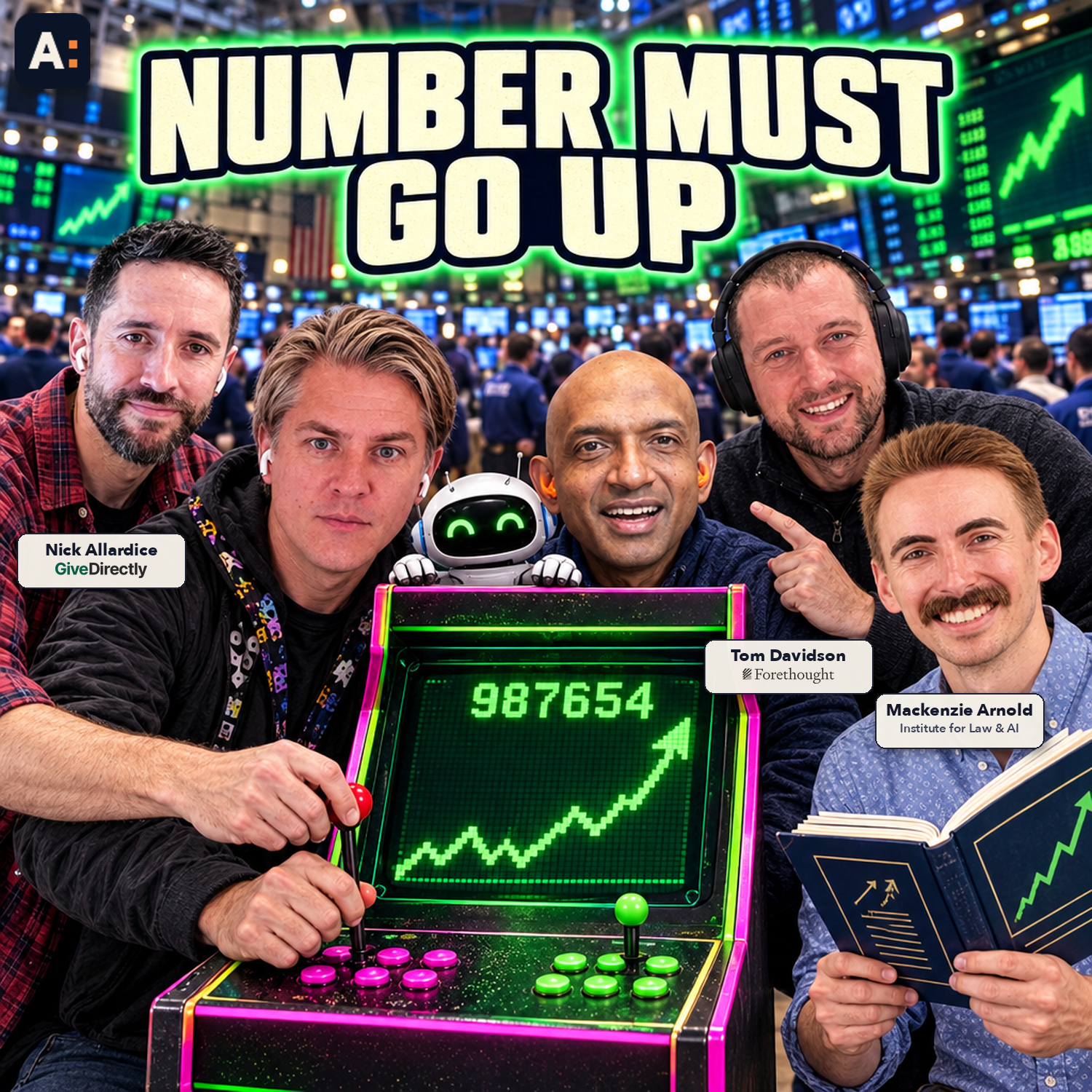
数字は上がり続けねばならないのか?クリスティアーノの警告、ジェンスン復帰、GiveDirectlyの訴え
"The Cognitive Revolution"
トピック深掘り:AIの地政学(米中エピソード)
Last Week in AI

緊急特集:ジェンスン復帰――トランプ政権とNVIDIAをめぐる輸出管理の混乱
ChinaTalk
リードを安全のために使え:バイデン政権AI顧問のBen BuchananとTantum Collinsが語る世界の行方
"The Cognitive Revolution"

緊急特集:BISがついに抜け穴を塞ぐ? 次に習近平はどう動くか
ChinaTalk

AI、現代のエニグマ:Bletchley Parkで行われたNathanの基調講演
"The Cognitive Revolution"