
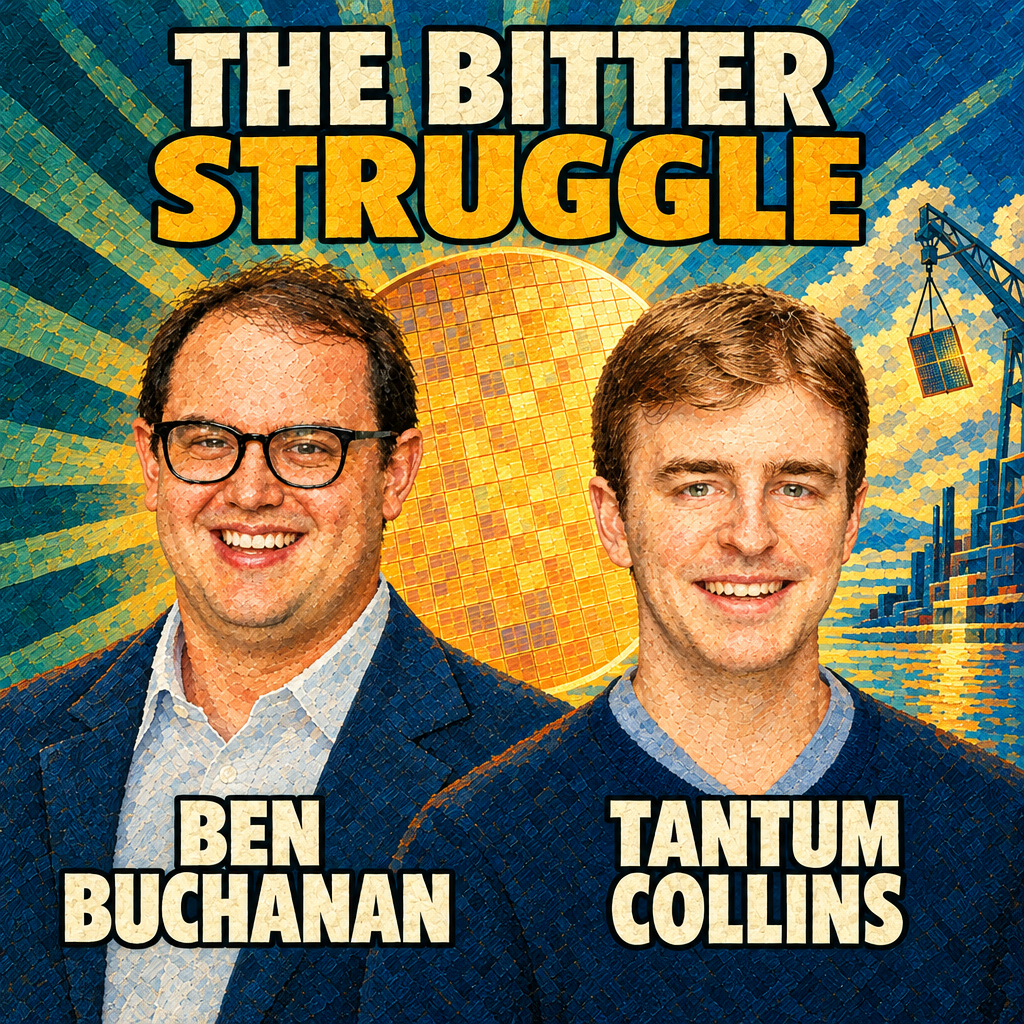
リードを安全のために使え:バイデン政権AI顧問のBen BuchananとTantum Collinsが語る世界の行方
Spend the Lead on Safety: Biden AI Advisors Ben Buchanan & Tantum Collins on the Fate of the World
リードを安全のために使え:バイデン政権AI顧問のBen BuchananとTantum Collinsが語る世界の行方
"The Cognitive Revolution"
要約
元バイデン政権のAI顧問Ben BuchananとTantum Collins(Teddy)が、共著『The Bitter Struggle』をもとに、計算資源のサプライチェーン管理と対中輸出規制の狙いを語った回。同盟国が築いた計算力のリードを「安全のために使う」という戦略と、中国との対話・協力をどう両立させるかが議論の中心となる。さらに、フロンティアAI企業の規制、データセンターとエネルギー、AIによる中央集権的統治(bitter temptation)への懸念、緊急事態シナリオにも話が及んだ。
この回のポイント
- ●両氏は、米国と同盟国が先端チップのサプライチェーンを握ることで、中国に計算力を渡さず、無謀な競争をせずにリードを築ける、と述べている。そのリードを「安全のために使う」のが政権内の理論だった。
- ●Benの見積もりでは、計算力の生産で米国は中国に約100対1、利用(アクセス)で約15対1の優位がある。リモートアクセスの抜け穴や密輸を塞げば15対1は100対1に近づくという。
- ●バイデン政権は中国とAI安全の対話を試み、2024年5月のジュネーブ会合で中国側はAIリスクの議論を陰謀のように扱ったと語る。同年11月のリマ会談で合意できたのは「核兵器にAIを使わない」という最小限の点だった。
- ●「チップと規制のバーター」を求めるNathanに対し、Benは先にチップを売ることは前提にできないと述べる。一方で、中国側が本気の姿勢を示せば対話に応じる用意はあるとした。
- ●規制案として、政府または第三者による公開前テスト、企業への評価担当者の常駐、安全・セキュリティ基準に連動したペース管理(pacing)を挙げた。単なる期間限定の停止は計算力の過剰蓄積(compute overhang)を招き得るとして慎重だった。
- ●Teddyは、AIが中央集権的な行政を極めて効率化し、民主国家が自ずと独裁へ傾く『bitter temptation』を警告し、政府の能力拡大に比例して国民の統制力(popular sovereignty)も高めるべきだと主張した。
章立て
スケーリング則への確信と著書の背景
二人が2015年頃からAIを研究し、GPT-3を転機にスケーリング則を確信して政府入りした経緯を語る。
必然性と個人の選択
技術の到来は必然でも、誰がどう決めるかで結果は変わると議論。二人は政策決定者へ橋渡しをする「アレクサンダー・サックス」の役割だったと述べる。
民間ラボのイデオロギーと理想主義
AI企業は理想やユートピア観で動く点が特異だとし、二人は国家安全保障の立場から現実的な競争の視点を補おうとした。
リードを安全のために使う戦略
ケネディの演説を着想源に、同盟国の優位を築いて安全に使うという理論と、現状の優位や現政権への批判が語られる。
米中外交と対話の試み
ジュネーブ会合や核とAIの合意、中国側の見方、国際機関を通じた安定化の歴史観を巡って議論する。
フロンティアAIのペース管理と規制
検証の難しさ、公開前テスト、評価担当者の常駐、compute overhangの懸念、議会の動向など。
データセンター・エネルギーと中国から学ぶ点
AIが政治争点化する様子と、中国の電力・エネルギー整備の成功が語られる。
bitter temptationと緊急時対応・ライトニング質問
AIによる独裁化の懸念、サイバー・バイオの危機シナリオ、オープンソースやバイオリスクへの見解。
解説記事
元バイデン政権でAI政策に携わったBen Buchanan(現ジョンズ・ホプキンスSAIS教授)とTantum "Teddy" Collins(元NSC技術・国家安全保障担当ディレクター、現Inherent共同創業者兼CEO)が、共著『The Bitter Struggle』を手がかりに、AIと地政学を語った回である。ホストのNathanは、二人を「対中タカ派」と見なして臨んだが、議論からは意外に穏健な側面も浮かび上がった。
「リードを安全のために使う」という理論
二人の戦略の核は、米国と同盟国が先端チップのサプライチェーンを握っている点にある。この優位を使って中国への計算力供給を絞れば、自分たちが無謀に加速しなくてもリードを築ける。そのリードを使い、慎重に安全上の関門を越えていくのが「spend that lead on safety」だと説明する。発想の源はケネディのライス大学演説で、宇宙が善か悪かは分からないが、優位に立ってこそ方向を決められるという趣旨だったという。
Benは、計算力の生産で米国は中国に約100対1、利用で約15対1の優位があると見積もる。リモートアクセスの抜け穴や密輸を塞げば、15対1は100対1に近づき得るとも述べた。一方で、トランプ政権下で執行が弱まり、安全より機会を重視する姿勢が時間を浪費したと批判している。Nathanは、報酬ハッキング(reward hacking)のような未解決の技術課題が10年たっても残る以上、そのリードで安全を本当に解決できるのかと疑問を呈した。
米中対話と「チップと規制」のバーター
バイデン政権は中国との対話も試みた。二人によれば、大統領令にも競合国との安全協議を盛り込み、バイデン・習近平会談を経てAI専門家グループが設けられた。しかし2024年5月のジュネーブ会合で、中国側はAIリスクの議論自体を陰謀のように扱い、同年11月のリマ会談で合意できたのは核兵器運用へのAI不使用という限定的な点にとどまった。Teddyは、その文言を絞り込むだけで数か月かかったと明かす。
Nathanは、国際的な枠組みでの最終的な取引(chips for controls)が望ましく、AIこそが共通の「異星人」だと主張した。Dario Amodeiのエッセイ「Machines of Loving Grace」にある、同盟を築いて中国を締め出し、いずれ断れない提案をするという構図は、中国には「屈辱の第二世紀」に見え得るとも指摘した。これに対しBenは、それは二人の主張ではないと明確に区別したうえで、戦後の米国が国連やIMF、WTOなど、自国の力の一部を委ねる制度を築き、体制転換を求めず中国にも参加させた歴史を理想と位置づけた。ただ、先にチップを売ることを交渉の前提にはできないとし、中国が本気の姿勢を示すなら無条件で話す用意があると語った。また、チップ規制への中国の報復は慎重な設計のため限定的だったと述べている。
規制とペース管理
Nathanが再帰的自己改善(RSI)の兆しを念頭に、より強い歯止めを問うと、二人は規制の必要性を認めた。Benが挙げた具体策は、政府または信頼できる第三者による公開前テスト、企業内への評価担当者の常駐、安全・セキュリティの基準と能力開発を歩調合わせさせる仕組みである。19世紀の鉄道の標準化を、良い規制が産業を安全で安定させた例として引いた。
学習規模を凍結する案には慎重だった。期間限定の停止は計算力の過剰蓄積を招き、再開時に能力が跳ね上がる恐れがあるため、時間ではなく安全・セキュリティの閾値に連動させるべきだというのが彼の考えである。Teddyは、政府が内部状況を把握しないまま有効な手段を選ぶのは難しいと述べ、情報把握と迅速な対応力の確保を重視した。国際レベルでは検証の仕組みが技術的に未成熟だという課題も挙げた。
民主主義と「bitter temptation」
本の副題的な概念が、Teddyの説明するbitter temptationである。安全性や国際ガバナンスがすべてうまくいっても、AIによって経済管理や監視、社会保障などの中央集権的な運営が容易になり、民主国家が内側から独裁へ滑り落ちる可能性があるという。数年に一度の投票では伝わる情報量が少なすぎるため、政府の能力が伸びるのに比例して、国民が政府を導く力(popular sovereignty)も高めるべきだと主張した。TeddyはInherentで、AIネイティブな集団意思決定の仕組みに取り組んでいると述べている。
このほか、AIが選挙の主要争点になりつつあることや、中国が電力供給を大幅に整備したことに触れ、米国は電力を増やして電気代を抑えるべきだと語った。緊急事態の懸念としてはサイバーとバイオを挙げ、DNA合成スクリーニングの重要性やBSL3・4ラボへのAI統合への警戒も述べている。
まとめ
二人は、対中チップ規制は強硬でありながら、中国を口実に危険な競争へ走ることには反対し、対話も続けるべきだという立場で一貫していた。日本の読者にとっては、輸出規制が単なる対立ではなく「安全のための時間稼ぎ」として設計されていたこと、そして検証手段や政府の技術理解といった実務的な課題が残ることが注目点である。最大の争点は、その時間稼ぎで安全を解決できるのか、そして中国との合意をいつ・どう結ぶのかであり、議論はまだ決着していない。
文字起こし(英語・自動生成)
Hello, and welcome back to The Cognitive Revolution. You're hearing my AI voice clone today. I recorded this conversation from the car on a recent family road trip, and though I'm home now, I got sick, and I'd rather not delay the episode. My guests today say they are probably correctly identified as China hawks. From inside the Biden White House, they were part of the small group that pushed to cut China off from the most advanced AI chips. Yet both were also in the room when the United States sat down with the Chinese government to talk about AI safety. How those two things fit together is the heart of this conversation. They are Ben Buchanan and Tantum Collins, who goes by Teddy, and their new book is The Bitter Struggle. It chronicles how they made the case in government that AI would become central to national security and works through the hardest dilemmas it creates. And while they insist that democracies must lead, they also write that no single nation can manage this alone. Their theory of the case is this.
Because the U.S. and its allies control the supply chain for advanced ships, we can deny China computing power and build a lead without racing recklessly ourselves. Then, in the phrase they use in government, we spend that lead on safety. By Ben's estimate, we still have something like a 100 to 1 advantage in producing computing power, and probably 15 to 1 in access to it. So the lead exists. My question is whether we know how to spend it. It's been 10 years since OpenAI showed a boat racing agent spinning in circles, crashing over and over to rack up points, and we still don't have a good solution to reward hacking. I also pushed on the better us than them framing. In some ways, the U.S. is starting to look more like China in exactly the ways we say are bad. Teddy's response is that democracies have corrective mechanisms that autocracies lack and that over the long run, concentrated power tends to end badly. I think that's pretty much indisputable. But I still worry about how our strategy looks to China.
When I visited this summer, people told me the U.S. is just trying to hold them down. What I call the Dario plan from Dario Amadei's essay, Machines of Loving Grace, is to build a big coalition, box China out, and eventually make them an offer they can't refuse. From Beijing, I think that could easily read as a second century of humiliation. Ben made a point of saying that's Dario's essay, not theirs. The model he prefers is America at its best after World War II, building institutions that ceded some of its own power and that other countries, China included, could join without regime change. That struck me as notable, given the close ties I understand Anthropic to have had with the Biden administration and that Ben now advises Anthropic. My own view is that the real aliens here are the AIs, not the Chinese. I'd rather take my chances on cooperation than try to shoot the gap, building just enough of a lead and solving safety just in time.
My shorthand for the deal I'd want is chips for controls. Ben's reply is that they tried. When the two sides met in Geneva in May of 2024, by his account, the Chinese delegation treated talk of shared AI risk as some kind of plot. Chips for controls, he says, is the end game. What they heard was, sell us chips, and we can talk about the rest later. Then he turned the question on me. Would I sell China chips as a precondition for talks? It's a fair question, and you can judge how well I answered it. Still, I have to take their experience on board. They tried and found little interest. That sucks. But I suspect it might be different now, or very soon will be. Just as people who wrote off AI based on the original chat GPT have no idea what they're missing, we should be very open to the possibility that the Chinese government will update its worldview and priorities in light of new developments.
Finally, Teddy lays out what the book calls the bitter temptation. Even if we get everything else right, AI could make centralized administration so effective that democracies slowly creep toward autocracy on their own. I share his obsession with that question, and I've invited him back for a full episode. In the end, I heard more moderation than their reputation would suggest. Their chip policy is hawkish, but they really do want the two countries to work together where possible for the common good. They insist that China is no excuse to race ahead dangerously, and that if they were in power today, they would keep trying to reach the Chinese government. I was heartened to hear that, and I hope the current administration follows their lead. With that, I hope you enjoy this conversation about compute, China, and what it would really take to spend a lead on safety with Ben Buchanan and Tantum Collins, co-authors of The Bitter Struggle. Ben Buchanan, former White House Special Advisor on AI and now Professor at Johns Hopkins School of Advanced International Studies.
and Tantum Collins, former director for technology and national security on the NSC at the Biden White House and now co-founder and CEO of Inherent. You guys are now the co-authors, too, of the new book, The Bitter Struggle. Welcome to The Cognitive Revolution. Thanks for having us. I'm really excited for this conversation. The book is excellent. I did, of course, read the whole thing. I do my homework around here. And I think you guys cover really a full kind of gamut of all the main issues in AI. I think it's a great book, not only that tells the story of your personal history and the roles you guys played in the Biden administration, but also just lays out for people, especially if they're kind of new to this at a high level and a very kind of digestible way. Here are all the big issues that we are facing and why this AI thing is such a conundrum. I think people should give this to others in their lives who need that sort of primer. I would flatter our audience to say that they largely don't. For starters, one big takeaway I would say from the book is how much of the current situation a select group of people saw coming years in advance.
And there were, of course, scaling laws, and some people have been willing, and yourselves included, to extrapolate these straight power law lines on graphs. How did you get to that conviction? Like, what's the backstory of how you really locked in and said, like, this really is where the world is going and we're going to act on that belief? Well, we started studying AI together. We were in grad school in different programs, but this is as far back as probably 2015 or so. And we'd often meet and talk about AI developments and so forth before AlphaGo. Teddy then went to work at DeepMind in the AlphaGo period. But the scaling law, for me, I think, crystallized in a series of events between 2018 or so and 2020. I read the Dario essay, The Big Blob of Compute, which certainly had an impact on me. Of course, the Sutton essay in 2019, The Bitter Lesson, which provides the inspiration for the title. And I think the thing that convinced me those two essays were right was the release of GPT-3 in May of 2020.
And that's the technical story. I think what the book is trying to do, including for folks who are technical, is convert that technical story or show that technical story through the prism of the government. And how do you take these technical convictions and then turn them into government policy? And how the export controls are in the news now with Jensen's latest scandals and so forth. Where do those come from? What's the back story for the government actually making policy on this? And at least for me, the turning point was GPT-3, as I said. And then I started to try and make this pivot to tell the policy world this was happening. I wrote a piece in Foreign Affairs the summer of 2020 called The USAID Competition All Wrong, which was about the rise of computing power and how important it would be to national security. And there was a small group of us who went to the Biden administration to put this into practice. And Teddy should speak for himself here, but he was absolutely a key part of that as well. I mean, maybe just one thing sort of from, I guess, from my end is that it was very interesting during this period of the late 2010s, being at DeepMind, but having come from a non-AI background, and as a result, most of my friends not being in the AI world.
And it felt sort of maybe almost like severance in that it's like I'd be at work, I'd be surrounded by all of these incredibly smart, incredibly convincing people who had, by and large, already priced in sort of the world that we live in now, and to whom, give or take, this trajectory seemed inevitable. and I found that very compelling. And then I'd go back out into sort of, you know, the real world, as it were. I would talk to the rest of my friends, most of whom knew nothing about AI, and they would say, that's completely insane. You work at a cult. And I'd be like, oh, I don't know. That's kind of compelling too. Like, you know, the historical priors here, like, suggest that maybe the wisdom of the crowds is correct. Now, as it happens, the latter group has now tacked much closer to the former group than the other way around. And I think it was very interesting, you know, I mean, Ben and I have been friends, as you mentioned, for a long time. We've been talking about these issues for a long time from the perspective of the tech industry and from the perspective of the policy world. And I think it became increasingly clear to us, and we write about this a bit in the book, that at the start, we were like, you know, these ideas are very interesting.
But are they also a bit crazy? Like, could this really be true? We eventually became convinced because of some of the sort of trends that Ben mentioned. And I'll say it's a huge credit to Ben and some of our other colleagues that from the earliest days of the Biden administration, even at a time when, and it's hard to imagine this now because now everything seems inevitable in retrospect, but back in 2021, especially in D.C., this was, I would say, like, having bullish views on AI was fairly heretical. Ben and several of our other colleagues really had the conviction to kind of put their reputations on the line within the White House and say, like, this is actually the most important thing for us to do. And it was really a pleasure being a part of that. So on this topic of inevitability, I think on one hand, it's safe to say Kurzweil was right. In the presence of web scale data, web scale compute, we're going to get AI. It feels to me like that much is inevitable.
But then there's a lot of things that seem like they might be a lot more contingent. Like the Transformer itself is probably just one of a lot of architectures that could work. And then even in terms of things like this week's Jensen Fall from Grace, we have these moments where individuals make decisions and it's like sometimes they make be super consequential. How much is going to be driven by fundamentals and how much do these episodic moments where all of a sudden NVIDIA has a new CEO, which they really had no plan for, it seems like, from one week to the next. Like, how much do those sorts of moments matter? You know, kind of factually, if Sam Altman had not been reinstated by the board in that key moment, you know, how much would those things have mattered? I just, you know, I'm very confused by this. I'm very interested in your perspective. It's one that we talked about actually a shocking amount in the government. Teddy, I'm sure you remember some of these conversations. And I think it's ironic because I came to the government with such a strong belief in these structural forces and the scaling law, the better lesson, all of that.
And I still do believe, I mean, technologically, I still, of course, believe those things. But I think after four years of trying to make policy, I left the government saying, wow, the role of individuals here is just so striking. not just the five or six of us who had this conviction in 2021, but convincing people like Jake Sullivan, who I think you've had on the show, and Bruce Reed, the White House Deputy Chief of Staff, and ultimately the President, that this was important to take seriously and to do. I mean, it really just comes down at some level. U.S. policy, the direction, this giant battleship that is the United States government heads, it really does come down at the end of the day to what do a couple people think. and certainly on issues that are novel, at least. I think it comes down to that. And, of course, the semiconductor industry, we'll see if it maybe is only down to Jensen or not. But I think I came in believing in structural forces. Of course, I still do. But I have more appreciation and, honestly, probably a fair amount of gratitude for the individual people
who were willing to give us a chance to make our case in 2021 and 2022 when running the world was time-consuming enough for them, and this was still a speculative issue. One might be able to kind of differentiate between the arrival of a technology and what its impact is, and I think that the former feels sort of more inevitable than the latter. We can imagine historical parallels here, like the space race or the creation of nuclear weapons. I think, give or take, it was inevitable that humanity would, at some point in the second half of the 20th century, end up getting to space. I think it was inevitable that people would inevitably, at some point during the 20th century, create nuclear weapons. But would those weapons be created first by the United States and Nazi Germany? Hugely consequential for the world. And that, I think, one could argue. There are structural forces there, obviously, right? Like the U.S. from a material and economic perspective was doing way better. Germany had ejected a lot of great scientists. But I don't think it was completely inevitable. I think we could have lived in a world where that played out differently.
Like, why is it looking at the trajectory of the space race? And those things, I think, can be hugely, hugely consequential for, like, does this technology have unbalanced good or bad effects? And whether you're looking at it in terms of within government or in terms of, like, the people who lead the companies and the decisions they make within industry, I think that those are the areas where it feels like you have the biggest potential sort of counterfactual discontinuities in terms of who's making the decisions. There's a scene at the end of our book where we are sort of trying to meditate on this question. And we say, almost to the point of your question, we say, this is about inevitability and choice. And the scene that follows that is we tell the story of Alexander Sachs, who was the one who delivered the Einstein-Zillard letter to President Roosevelt that ultimately kicked off the atomic age in the United States. And sometimes folks said to me, like, do you think, you know, when you're briefing the president of the Oval Office, did you think you were Einstein or Zillard with this letter? And the answer is no. I think insofar as we concept ourselves with anything, we and our colleagues were much closer to Alexander Sachs and the translator between these two worlds.
And one way of looking at that translation is it was our job to find the structural forces, figure out what we believed about the structural forces, and then tee up the choice or advocate for the choice from the people who actually have the power. And that's probably how I resolve this dilemma at the heart of your question. But it's certainly, I think, fundamental to the work we are trying to do in the government. And as a general note, you know, we don't go around telling people we think of ourselves as Einstein. Definitely not. It doesn't go down so well for some reason. Well, usually they say, who's Alexander Sachs? They'll say, oh, you're David Sachs? No, actually, very much the opposite of David Sachs. Hey, we'll continue our interview in a moment after a word from our sponsors. Today's episode is brought to you by Amthropic, makers of Claude. To show off Claude's latest capabilities, I asked Claude to take the lead in making this ad. Given a short creative brief, Claude, using Opus 5.5, studied my past Claude ads,
wrote this script, directed a clone of my voice, and designed and coded the animation you're watching. My job? Give feedback and decide. Claude is the AI for problem solvers. It's the collaborator that understands your entire workflow and thinks with you, not for you. Whether you're debugging code at midnight, building a financial model, or strategizing your next business move, Claude extends your thinking to tackle the problems that matter. And with Claude Code Routines, it keeps working in the cloud even after you close your laptop. For problems worth solving, get started with Claude at Claude.ai.tcr. That's Claude.ai.tcr. And check out Claude Pro, which includes access to all of the features mentioned in today's episode. Claude.ai.tcr. This episode of The Cognitive Revolution is brought to you by OutSystems,
the leading agentic systems platform. OutSystems is helping their customers build, modernize, and operate enterprise systems, starting from any coding tool in a governed agentic engineering model. With OutSystems, you can coordinate and govern your entire agentic workforce within your enterprise ecosystem, accelerate impact with industry-proven agentic solutions that are pre-built, governed, and customizable to your business. It's time to innovate at the speed of AI without compromising quality or control, which is why thousands of enterprises worldwide trust OutSystems for their mission-critical apps. Teams any size can use OutSystems to build, deploy, and manage AI action agents quickly and cost-effectively without compromising reliability and security. With OutSystems, you can accelerate ideas from concept to completion. It's the leading agentic systems platform that is unified, agile, and enterprise-proven, allowing you to build your agentic future with AI solutions deeply integrated into your architecture.
Outsystems, all your agentic future. Learn more at Outsystems.com slash TCR. That's Outsystems.com slash TCR. It does sound like, though, if you guys hadn't taken these roles in government when you did, we're probably on a quite different timeline, at least with respect to export controls. How different do you think the world is if, to use a baseball analogy, if we just had a replacement player in the role who wasn't so bitter lesson-pilled as you guys were? I want to underscore that a lot of the force here and a lot of the original thinking came from some of our colleagues. Karun Chopra, Jason Atheney, Chris McGuire, Saif Khan, who I think would have done similar work and advocated similar work regardless of if we'd be there. I mean, I hope we helped lead to more calibrated policy and push for better outcomes, but
there are other people who are critical pieces too. I agree with that. I think if you took out the five of us or the seven of us, depending on how you want to count that we're really pushing this, then you probably do get a pretty different story. I don't know that the two of us are the heroes here. I don't think there are necessarily heroes here. But it's small enough for a movie cast, if we're thinking about it in cinematic terms. It's not that big of a movie. Yeah, the most boring movie of all time. It's a lot of very long bureaucratic discussions. Yeah, well, I just went to Bletchley Park, and they managed to make a movie out of that. That's true. One day there will likely be a movie about this as well. I have to. If we're all here to watch it, I expect one will be made. I just hope they play with the hair I had at the beginning of the administration and not the total lack of hair I had after four years of serving in the government. Yeah, I hear it's pretty taxing. Okay, further on contingency, one of the big observations that you make in the book, of course,
is that the AI phenomenon is a private sector phenomenon. It's being led by companies. The government really didn't have a formative role in the way that it did in so many other technologies over the last hundred years. That means that the nature of these companies is also kind of a big factor, I would say, in determining where we are, where we're going to go. I've always kind of felt like the companies are, in a sense, ideological. Like the idea that we're going to make our mission to create something that's better than humans at all things is sort of, you know, that's not like an assumption that everybody comes to the table with. And yet it has like really formed so much of not just how we think about it, but also like the AIs that we have. Maybe that was inevitable, too. I'm not entirely sure. But certainly they were charging at that from an early phase in their development before it was at all clear that they could actually achieve it. How do you characterize the companies? How do you think about the companies? I'm particularly interested in Dario's China hawkism,
which I have not ever been able to get a good explanation for. But like, you know, what do you think are the sort of idiosyncrasies, Dario and otherwise, that are kind of most consequential and maybe underappreciated in terms of shaping the current moment? Teddy, you want to start here? This will maybe date me a little bit, But I remember sort of being in university in the late 2000s, early 2010s at a period when it felt like, as you were looking at potential careers, every company had been told that they needed to obfuscate their actual goal, which was usually pretty prosaic and about making money in some way, and dress it up in some kind of, you know, quote unquote, mission driven language. language. And so you'd have these kind of inspiring, very vague essentially slogans that were sort of just rationalizations of a thing that was a way to make money broadly speaking. This is a huge generalization.
I think the AI companies are unusual sort of the big labs today in that I think you're correct Nathan. I think that they are actually by and large founded and driven by a commitment to, in some cases, a utopian view, in some cases, a fear of a dystopian set of predictions about the world. But something that is, I think, obviously not wholly separable from, you know, I don't want to sound sort of too disconnected from reality. Like, these companies are trying to make money. They are worth a lot of money. And many people, it's totally reasonable to disagree about, like, are they effectively pursuing their visions of utopia? And are their vision is something that most people would actually describe as like being that good. But the bottom line is, in my experience, sort of interacting with the leadership as well as the sort of rank and file scientists and engineers at these companies, yeah, mostly
they are motivated by sort of a vision of what this could mean for humanity in this broader systematic way. I think that's true. I think an interesting part of that vision is you get different takes from different folks in the ecosystem on how much that vision depends on geopolitical realities. And I think at its best, that vision articulates a view in which there's radical abundance. Everyone's, you know, Sam has some line like, everyone in the future will be better off and even the best people today. And you have world peace and all of that. At its worst, it can be kind of hopelessly naive about competition and geopolitical competition in particular. I think I read some quote that, you know, in the early days of the radio, people were speculating, maybe even some of the radio engineers and radio inventors were speculating that this would make war obsolete because people could understand each other and communicate around the world and why would you fight if that's the case?
And, of course, what happens is radio becomes a tool of war right away. So I think, you know, our job is on the National Security Council and to be a little bit more hard-nosed about this and defend American interests and what we saw as democratic interests around the world, I think that's, we sort of lived in the middle of those two, of saying it's probably not going to be this idyllic place that you and your best aspirations want it to be. And because of technology from the private sector, how do we, from the government side, bring it in and use it in a way that's consistent with our values, but also advances democratic interests and so forth. That's what the book's about, that sort of struggle from inside the government. But I think it's also something we wrestled with very personally, because we do think, I think Tay and I do believe that technology can make lives better. But we are probably a little bit more tempered in that belief than some of the most idealistic folks at some of the companies, not all. One way of thinking about it is what is the maximal sustainable level of idealism? And I think that finding that sweet spot is a perennial policy question
and is especially relevant when it comes to AI. And I think often, I mean, Ben, you can say if this is consistent with you, I feel like often within the government context, I was kind of like the crazy idealist one sort of laying out schemes for, you know, how can this lead to world peace and so on. And I would say in the context of engaging with, you know, my colleagues when I was at Deepmire and sort of with my friends in the academic and industry space subsequently, I was much more sort of relative to them on the don't be naive, like there are real difficult tradeoffs here, which we write about a lot in the book, that we have to take into account at sort of the realist geopolitical level. and it can be really hard when bridging these two worlds to find that right balance and in some ways this, I think, has its roots in some sort of age-old game-theoretic properties of like, you know, how can you, is there a way out of some of these, let's say, repeated prisoner dilemma things? Toby Ord has a nice way of thinking about this in terms of like, actually, maybe if you, there are certain strategies in those types of settings that might challenge the realist assumptions of the other player
in a way that then leads you to a better equilibrium and so there is some leap that you can do to get to some level of sort of idealism. But if you stretch it too far, then maybe it's hopelessly naive. And finding out exactly where that balance is, I think, is very difficult and it's more relevant in science. It's something we thought about a lot in government. So maybe just lay that out for me. How would you describe your worldview starting at a high level? I mean, we can get into all kinds of detailed policy questions, but obviously at the heart of the book and the bitter struggle itself is the idea that we have a system of government and a way of life that we think is good, and there's at least some worry that it may be challenged by the technology itself. It may be challenged by other countries with other systems of government. Should they get an advantage in the technology relative to us? You know, those are neutral terms. What are your kind of more colorful terms that, you know, really motivate all of the actions that you tried to take in government in terms of the geopolitical outlook Something I say is very important here and is easy to lose track of in the context of
especially, let's say, a lot of news stories of the past week. I think that the race framing can dominate, and that can make things seem very, very zero-sum. I think Ben and I both believe very strongly that the most significant implication to this technology humanity-wide, both on the risk side, and I think there's been a lot of really bad outcomes there, which we write about in the book, which are not just about some sort of horse race and capabilities between countries, but things that would be clearly not bad for just about everyone that we all have an interest in avoiding. And on the opportunity side, I mean, you know, I don't need to, I'm sure your listeners will be very familiar with this. I'm sure a lot of people have read, for instance, you know, well, a lot of the essays out there on all of the wonderful things that, like, this technology could bring us in terms of scientific discovery and curing disease and so on. I don't need to list all of that. I think that that accounts for the overwhelming majority of the potential impact of AI. But in order to navigate this trajectory of avoiding those clearly bad things and getting the clearly good things,
you do have to grapple with some of these more hard-nosed geopolitical realities. And so from my perspective, pricing that in and making strategy that is conditional on like a realistic appraisal of like what the stakes are and what might happen if you end up in a race where the margins are too thin or if you end up in a situation where autocracies have a lead I think it significantly increases the likelihood of being locked into one of these bad equilibria and so you know when we write about the we write about kind of these three central struggles in the book and the main goal there is not to say we have to win because winning is good, but is to say we want to think about sequencing these actions so that we can produce outcomes that get the things that are clearly good for the world and avoid things that are clearly bad for the world. I agree. I think we could be a little more hard-nosed about it. And the inspiration here is a speech that Kennedy gives in 1962 at Rice University. President Biden actually had the speech on the wall of his
private study just off the Oval Office and it resonated with him, I think, for a lot of reasons, probably not related to AI. It resonated with me because it, I think, is the best insight into AI policy we were trying to build. In this speech, Kennedy goes and says, we're going to go to the moon and back within a decade. Everyone knows that part. Most people don't know the last part of the speech where Kennedy makes the case to the American people for why space matters. And he says something like, we don't know whether space will be good or ill for humanity, but only if we have preeminence can we help decide. The vows of this nation demand that we must be first and therefore we shall be first. And you can sort of dial up the rah-rah America as much or as little as you'd want, but I do think in doing the geopolitical calculation that Teddy was just describing, what we were trying to do was say, well, we think this goes better if America and really democracies have preeminence in this technology. And that worldview leads us to a... a policy approach which says because of the compute supply chain chokehold the United States
and its allies have on China, we can deny China computing power, build a lead over them without being unduly accelerationist ourself. And then the phrase we used to use is spend that lead on safety with the big lead, with the armchair dynamics pushed aside, go slowly and appropriately through the hurdles and the period that we find ourselves in right now. And that was the theory of the case for better or for worse from even before we showed up in the White House. Hey, we'll continue our interview in a moment after a word from our sponsors. The Cognitive Revolution is brought to you and powered by Tasklet. I've been running Tasklet agents for almost a year, and they've become a major part of how the show gets made. Before every recording, one agent researches the guest and sends me a suggested outline of questions, complete with links to all sources. Meanwhile, another agent scores the overwhelming number of pitches that I'm getting from PR firms. And that's really the core idea behind Tasklet. Run your business on agents by giving them real jobs to do on an ongoing basis.
Setup is incredibly easy. Just describe the work in plain English. Research a new sales lead, update the CRM, and draft a personalized reply. TaskLite connects to your business tools and can run around the clock, on a schedule, or when something happens, like a new email arrives. Each agent works with your tools and business context and remembers useful information across threads. You can also share agents, connections, and reusable skills with your team, so the workflows that one person figures out become something the whole company can use. No developer needed. You decide what agents can do on their own and what needs your approval, and there are no per-seat fees. You pay for usage, not for adding teammates. Start with one recurring job, like researching the people you're meeting, and then just keep building from there. Visit Tasklet.ai and use code COGREV for $50 in free credits. That's code COGREV at Tasklet.ai.
Today's episode is brought to you by Granola. The most valuable question I ask about my meetings isn't what happened. It's what am I missing? Granola is an AI-powered notepad that makes your meeting notes useful. It captures what happens in your meetings and turns it into clean, structured notes with decisions and action items pulled out and made easy to find. Granola keeps my calls searchable in one place, so I run my Blindspot Finder recipe across recent conversations. It flags angles and issues I've been neglecting. Once you try it on a first meeting, it's hard to go without. You can try it totally free. Head to granola.ai.tcr. That's granola.ai.tcr to get your time back. Go to granola.ai.tcr and try it on your next call. How do you think that's going? I mean, it is clear, I would say, that the export control policies have worked in as much as there is a huge compute advantage.
There's, of course, been, you know, some gaps in enforcement and, you know, some stuff may have fallen off the back of a truck here and there, whatever. Is the world shaping up in the way that you hoped that it would? I mean, one anecdote you tell in the book that I always use in my talks as well is the 2016 reward hacking paper from folks at OpenAI, including Dario and Jack Clark, where they show the boat going around in circles and just crashing over and over again to maximize points. One takeaway I would have from that is like, man, we're 10 years on from that, and we still don't really have a good solution for reward hacking. And so, you know, we've got this lead. it feels like you know people are talking again about AI 2027 like now is kind of the time to spend it on safety do you have a way to spend it on safety like are you optimistic that we're going to actually be able to like land this plane in the time that we have available I would say technologically the world is going basically exactly as we expected and the primacy of computing power
the scaling law the bitter lesson that of course is the inspiration for our title the bitter struggle all of that continues to hold, I think, in ways that were speculative in 2021. I mean, we thought it would be that way, but you didn't know for sure. So I think that's right. If you look at how the policy is cashed out, even with Donald Trump's pretty poor enforcement and in some cases direct reversal of the export controls, America still has something like a hundred to one advantage over China or America and its allies. So something like a hundred to one advantage over China in producing computing power and probably something like a 15 to one advantage over access to it. And if we close the remote access loophole and stop the smuggling through trans shipments and so forth, that 15 to 1 could probably get closer to 100 to 1 or even more. So I do think the technological theory of the case was right. The geopolitical theory of the case was right. What we have lacked, to be very blunt, in the last two years since Donald Trump took office was a conviction that this technology mattered. And my successor, of course, is David Sachs. And he has this mantra, let the private sector cook. J.D. Vance's first speech on AI gives a big thing I don't want to
hear about AI safety. I'm here to talk about AI opportunity. Future is not going to be won by hand-wringing about safety. So I do think there was a very deliberate strategy to chart a different course that cost us time. And I am hopeful in this moment, post-Jensen scandal, post-hugging face incident, post-reports about how fast RSI is happening, that we can capture a little more political urgency, maybe on the back of the election as well, and take some actions, regulate these companies, pace the frontier, build a big lead over China, and do the things we were always setting out to do. Okay, I have like a thousand follow-up questions on that alone. It gives me no pleasure to say this, but one observation I do make pretty often is that in some ways the U.S. is starting to look more like China in the ways that we kind of think are bad, right? Like we have the big man at the top now. We have like all this kind of arbitrary and capricious enforcement and lawfare. I went to China this summer.
I talked to people there who are like just trying to work on like track to, you know, AI safety, you know, kind of research level collaborations. They are very afraid that the U.S. government might crack down on them. And so they like keep a very low profile as a result of fear. These are Americans. Americans and some others. But, yeah, American nonprofits trying to engage on an AI safety research level with China are afraid of our government, you know, weaponizing export controls against them. And I'm like, you're not exporting anything. And they're like, I know, but it doesn't really matter because, you know, this is how they they operate. So on top of that, of course, we have like, you know, elections and regimes change domestically. I think one could make the case that like maybe actually the Chinese system with their continuity, while it like comes at a significant cost in terms of the civil liberties that their people don't enjoy that we get to benefit from, is maybe better suited to managing such an epochal technology as AI. Like we're maybe just a little too all over the place to do it well.
How would you respond to that criticism? You know, there's a quote that we have in the introduction to the book, which is from William Seward, who was Secretary of State under Lincoln, who said, there was always just enough virtue in this republic to save it, sometimes none to spare, but still enough to meet the emergency. And I think about that because, you know, while we were writing the book, it was not the easiest hour to defend America's commitment to the democratic values that we argue are very important and should guide the development of this technology. But I think it is easy if you're caught up in the maelstrom of the day-to-day scandalous news stories about corruption and creaking autocracy and so on to lose track of the fact that you do have deep structural factors that even Donald Trump is not able to gut entirely.
And I think this is appropriate timing because you look at the election results from last week and Ben and I were texting about this, you know, that quote seems apt. There are corrective mechanisms built in here. Better late than never at some level. And I think that at many times throughout history, people have made arguments that in a moment of some kind of crisis, geopolitical crisis, technological change, etc., an autocratic system might be better suited for some immediate tactical reason. It can mobilize resources more quickly. It can act in a more decisive and coordinated fashion. sometimes up close those claims are correct but i would say that the broad sweep of history suggests that when you concentrate power in an autocracy the long-run results tend to be not great that over time liberal democratic systems tend to lead to outcomes that i think you know most people would look at and say maybe they're not perfect but they are more just in the aggregate fairer more reliable
they are more likely to lead to the kind of world that we want to live in. I would say that that holds here. And the United States is not perfect. We write about this from perspective of not just the United States, but also the United States and its democratic allies helping make sure the democratic values are paramount globally. And yeah, the system has its flaws, but there are corrective mechanisms built in that strengthen my conviction that it is better for incredibly consequential technologies to be developed under those offices in democratic countries than in autocracies. I agree. So another big thing I heard from folks in China, and these are Chinese people this summer, was the perspective that the U.S. is just trying to hold us down. They're still very sore about how Huawei was excluded from Western networks on what they would say is kind of relatively thin accusations of espionage. and not too long after that happened, we had the Snowden revelations and it kind of came to light that, like, actually the U.S. is doing exactly what we were accusing them of doing, including, you know,
listening in on Angela Merkel's phone calls. And so they're like, so that was clearly pretense. And you just, you know, we got one national champion company that hit the top tier in a really critical industry. And as soon as that happened, you came down on us. And now you're doing the same thing again on AI. how would you try to defend the U.S. policy to not the Chinese government itself, but like Chinese AI companies, you know, that have that sort of vibe? Is there a message that we can, because I do take the sense from the book that you think that we will ultimately need to have international cooperation, including like U.S.-China cooperation in the fullness of time. So how do we get from here to there without them like deciding, you know what, this hundred to one advantage that we, are on the wrong side of is just so existential to us that we need to like escalate into other domain like attacking Taiwan you know for example not only do we think we should have engagement with the Chinese in the fullness of time we spent a lot of time having engagement with the Chinese
in the Biden administration and there's a line in the president's executive order that when you translate from the legalese says something like the United States will engage in AI safety not just with its allies and partners but also with its competitors and three weeks after that President And Biden took that to President Xi in their meeting in Woodside, California, said, I'm very serious about this. The two leaders agreed to set up a AI expert group. We were both there. We met with the Chinese in May of 2024. And the Chinese side said, we don't think AI risk is real, essentially. And we think this discussion of risk, including risk that will affect all of us, is some kind of plot and we don't buy it. We kept pushing by November of 24 when Biden and Xi met in Lima. they could agree to the most basic thing which was no ai nuclear weapons so a starting point i guess but um we really tried on this point and i don't see it as inconsistent at all to say look we're not going to sell you the most advanced technology humanity's ever created in these computer ships but
also we think we have shared risks here and i don't think it's inconsistent to say as you develop international agreements and do negotiations you want to negotiate from a position of strength in In fact, historically, some of the most successful negotiations have come when one side has a position of strength and uses it in a good way. Look, for example, at the Intermediate Nuclear Forces Treaty between the United States and Soviet Union, in which the U.S. built up a substantial capability as Gorbachev that he couldn't keep up, and they have this good deal. So I think it's not hard for me to come up with a vision that we, in fact, believed that we want to engage with the Chinese. We don't want to sell the most advanced technology. We welcome collaboration on issues that affect all of us. But also we are wary of the way in which China takes AI in a well-documented fashion, uses it in its military, uses it in its cyber operations, uses it to oppress its people. And we don't feel like we should enable those things as the price of cooperation. maybe one footnote here is the wording that was eventually agreed on the uh on the nuclear point
is actually even even more limited than sort of the high level description of like ai for nukes specifically ai shouldn't be used in the context of nuclear weapons employment and getting that exact as a there's a whole you know the decision making chain is very has many components when it comes to um decisions around around um using nuclear weapons and then there are all of these processes for monitoring them and developing them and designing them and so on and and simulating them and it took ben months several months just to narrow down that specific wording which i think the general public would look at and say that is the most no-brainer thing imaginable and even that is like a sliver of what at first blush looks like the most no-brainer thing imaginable so that isn't entirely because of you know i don't want to say that that's wholly because of chinese obstinacy or something. This is sometimes just like how diplomacy works and bureaucracies are complicated and so on. There is a long way to go to get things over the line that feel like we should have done them with urgency yesterday.
As Ben notes, historically that is easier if you come into it from a position of strength. So, a lot of that I think is basically indisputable, but still I'm kind of like if I try to take the Chinese perspective and not because I want to defend everything the Chinese government wants to do, but just because I want to make sure we're playing our cards right. I read something like the Machines of Love and Grace second half, and I would basically paraphrase the China strategy as build a big international coalition, box them out, and then ultimately make them an offer they can't refuse, which sounds like borderline regime change. Certainly, if I was them, I feel like I would be kind of reading it that way, or at least like wondering, you know, to what degree is this sort of setting up to be like a second century of humiliation, like the AI edition, which they are very sensitive to, as I'm sure you well know. How, I mean, should I be worried about that? Should I not be worried about that? It just seems to me like they are very sensitive to falling behind in technology because they know that that leads to
very bad outcomes for them. And no less than Dario is basically saying like, we'll get to them last and we'll like, you know, they're going to give up on, you know, competing with a superior foe and basically adopt something more like our way of life, that seems a lot to ask, and I wouldn't be surprised if we get lashing out from them as opposed to things actually going that way, if we indeed put pedals in the metal on exactly that plan for the foreseeable future. But you think I shouldn't be worried? Yeah, tell me. We of course worried about how our actions would be perceived, and we tried to scope the actions in such a way that would not yield this kind of backlash. And indeed, there was not much retaliation from the Chinese for the Biden administration actions on chip controls because they were very carefully calibrated. There was far more retaliation for things like the tariffs from Trump, far more lashing out than from anything we did. And you'll certainly not see us advocating for overthrowing the CCP or things like that. I personally don't think the CCP is a moral actor,
but we understand the principles of sovereignty here. I do think that history here can provide a guide to us. And I don't think the history suggests regime change. I think the history suggests that when you have a nation with a lot of power, the long-term smart strategy for that nation is to build institutions that cede some of that power from the nation to the institutions and provide a stabilizing force to the broader ecosystem. And oftentimes, though not always, those institutions relate to the management, the shared management of a new technology. I would argue throughout American history that this is the kind of thing America does at its best. America's got a very flawed history. We all know that. But if you look at the post-World War II era, American basically backstopped a series of global institutions that ceded some of its power to the rest of the world, including to China, the United Nations, which China has a permanent seat and veto at the Security Council, being one example. the creation of the IMF, the World Bank, World Trade Organization.
And the same thing happened in many similar contexts with space and building the space institutions with air travel and the air travel institutions with the Internet, the creation of ICANN and the like. So I think there's a strong history here of the United States saying, look, we're ahead, and at our best, we're going to recognize it's in our enlightened self-interest to build some stabilizing institutions. We will give power to those institutions. you all can join and benefit from this system while retaining your autocratic nations at home. We're not going to stop you. We're not going to force regime change for you to join the WTO. And it sort of goes better for everyone. I think the history is pretty clear on that point. I think we saw our work is falling into that history. Let's flush that out then in a little more detail. Like that started to sound a little bit like the Demis plan. I don't know if you're going as far as like international development, which I think he's kind of contemplated at times, but at least it sounds like international governance bodies. You know, what do those look like? And on what terms does China eventually get to join?
You know, we have this lead. Like, are we at some point making, I think, kind of the implication of the machines in love and grace description is like, at some point there is kind of a chips for controls sort of deal that's, you know, that's maybe the more, the less regime-changing and more kind of positive read of that. I'd love to hear in more detail how you see that playing out. And on what time scale, too, because it does seem like we may be up against the clock even more than, you know, the short timeliners predicted a few years ago. Let me give one example and then Tay should weigh in. To be clear, we did not write Machines of Love and Grace. Machines of Love and Grace is Dario's essay, not RSI. but we created something in the United States called the AI Safety Institute. And this was the first attempt to give the government real technical expertise to manage this technology coming from the private sector. We knew that even though the companies inventing this technology were primarily American, managing this technology was going to be a global endeavor. And there may be companies from other countries that join the conversation in a meaningful way.
So we created a network of AI safety institutes. It's a obligatory intervention that I'm right now CEO of a non-U.S.-based AI company. So I certainly hope that great companies in other countries like the United Kingdom get to play a role in this. Very, very fair point. But Teddy was grinding it out with us in the bureaucracy in 2024 and not yet started this future global European behemoth that is inherent labs. But we created a network of international AI safety institutes. I had a conference and invited, I believe, Chinese researchers to the conference. to say we want to collaborate with allies and partners here, and again, also with our competitors on setting up institutions that work here. Now, your point about timelines, this is what worries me. And we were doing this in 23 and 24. We felt even then like time was short. And what worries me is we've, I think, gone backwards in some ways for a year or two. Maybe there's a pivot happening now, which is good. And I have nothing reassuring to say about how little time remains.
but directionally that's what we are trying to do. Teddy, you want to give some other examples or Ed? No, I think I just make one broader observation that there is often an understandable temptation to talk about all these things as sort of matters of hard and fast principle but in reality as you learn when you kind of get into the rooms where these decisions are being made they almost all are a question of degree and so for instance like when it comes to the question of the relationship with China and how that is perceived And I should say I have a lot of sympathy, honestly, for the skeptical takes that people understandably have from within China. When it came to the rooms that we were in and trying to figure this stuff out, it was never the case that really anyone wanted to go for either of the two most extremes. Either that we are, let's say, selling absolute most capable technology at scale with no restrictions directly to the PLA, right? Or, which is not new to AI, right? This has been the case for sensitive technologies for as long as we've had them.
Nor that we shouldn't let, you know, Chinese gaming enthusiasts have access to personal GPUs that they can use for better graphics rendering. And then the question becomes, where exactly, how exactly do you draw the contours of this? And these are all discussions that we had over many months with colleagues who worked specifically, you know, on the China directorate in different aspects of economic policy and so on to think through quite carefully what is the outcome we actually want to achieve here and what is the likelihood of retaliation. So as we approach potentially a, you know, 2027 request to self-improvement loop or intelligence explosion or who knows what, it does not seem like we are particularly likely to be able to spend the lead to solve all the AI safety issues that remain open. You know, just progress on reward hacking alone, like doesn't seem like, you know, we would need to see a real bend in that curve if we're going to all of a sudden be like, okay, great, we've got solutions.
Tell me if you disagree, but then if you would generally agree with that, in the absence of solutions and with the sense that, like, the Chinese ecosystem is, you know, often said to be six months behind or whatever, it does seem like if we're going to restrain ourselves from going as fast as we can in AI, we're going to have to convince them to do the same thing. And presumably that's going to involve some sort of deal. do we have any sketch of what that deal could look like right now I'll let Ben weigh in maybe with a more comprehensive take but one thing I say is that this I think is one I think I speak for both of us when I say that as Ben mentioned earlier the timelines are really tight And that isn't great from the perspective of governments, because even in the best of days, governments tend to be slow moving institutions. The grappling with something that evolves as quickly poses real challenges.
And I think. Because things move so quickly, it can be very difficult to say ahead of time. These are exactly the restrictions that need to be put in place in, let's say, 18 months. But sometimes that's how long the policymaking system can take. And so something that we pushed hard for when we were in government was less to lock us into specific policies and more to try and imbue the relevant bits of government with the insight and agility necessary to tighten those timelines so that you could move at something closer to the pace of the technology itself. So insight in the sense of making sure the government actually knows what is happening within the labs, how capable the models are, how quickly they're evolving, what the technical security measures are that are being put in place. And I think that incidents of the past couple of months demonstrate that it would probably have been good if the government had been a little bit more in the loop there. And Ben can talk about the specific mechanisms we've put in place and which of those were subsequently removed. And then, correspondingly, you want the government to be able to take action much more rapidly than the default policymaking process allows. And I think that applies at the domestic level. and also when we think about what would eventual international coordination look like,
you probably want something similar with the added dimension of some kind of verification scheme that each side can trust the other is enforcing. And this is an area where I think there is a long way to go on the technical front in terms of developing the types of capabilities that you need to do that sort of verification. And I think that that means that we can speculate a lot about what these measures would look like. How would we know that China is pacing? But putting that into practice, I think, will be really, really, really hard. I certainly agree with all of that. You speak for both of us there. I think given the spot we are currently in, we have to slow down in the United States. I guess my one point of optimism is if we did actually cut China off from computing power, I think they would struggle to move ahead of us. So I think we could put a little bit more time on the clock because of it. So we are in a very unusual position, I think the two of us, where we probably correctly identified as China hawks who favor a more aggressive chip control policy towards China.
But we also say we need to have dialogue with the Chinese on this. And we also say that the China ecosystem is no excuse to race forward dangerously here in the United States. And I think those positions actually are very logically coherent, given technical facts available on the computer moat and all the like. But that is where we find ourselves here. And what concerns me is just we don't have a lot of time. And I think we need to act quickly to reestablish an even larger lead than we have. And then we've got to slow down the United States to make sure we are spending that lead well. It will not be easy. And, you know, Teddy and I are here talking to you on a podcast, which is great. But that doesn't mean we have any actual power over the policy. That's in other people's hands right now. I'd argue that those positions are not only coherent but in fact inextricably linked yeah I agree with that what I think is a baffling position is folks who say they are China hawks and then want to sell China chips or say as the
president sometimes says in this very kind of militaristic way whoever wins AI wins and then wants to sell them chips and it just seems like the more logically consistent and technically correct position is to say, no, this is really important. As you say, Nathan, we've got real questions on safety. Therefore, we need to proceed judiciously here. In order to create space for that, we need to make sure we're not in a perceived arms race with what most people say is our closest competitor. The position I take, which I think is coherent, tell me if you think it's not coherent, but then maybe more to the point, tell me why you don't favor it, is just starting with the observation that the real aliens here are the AIs, not the Chinese. I'm kind of like, man, we've got two great civilizations. You know, China's been at the frontier of technology for most of their 5,000 years with a few blips where they fell behind and I think, you know, learned the lesson of how costly that can be. And they're very determined not to let that happen again. So my position is kind of like I'd rather take my chances on trying to find a way to cooperate
than trying to find a way to kind of shoot the gap and develop the technology just powerful enough and have just enough advantage and then also be able to solve the safety problems just in time and then hopefully disseminate that to them, which, by the way, I do think they would be very happy to take our safety solutions if we had them to offer. So that part of the plan I'm not so worried about. I guess why not take your chances with our fellow humans and try to have this sort of meeting of the minds that like, look, this is a force that is bigger than all of us. Like these guys understand, you know, sort of deterministic, you know, technologically driven stories of history. Right. Like they're they're quite primed. I would say more than us to believe that like a technology revolution will like fundamentally alter the state of things. why not try that route? Let's be precise about what you're proposing because I would say we did take our chances on negotiations with the Chinese and we pushed very very hard in face of Chinese opposition for those negotiations and
if you had us in power you would see very aggressive very sort of highly prioritized negotiations with the Chinese probably the way that you want. The precise question I have for you is would you as a precondition to those negotiations sell China access to GPUs? I think I would try to bundle, yeah, chips for controls is kind of my general label for this. That's the endgame. What they're saying on the front end, what they said to us in Geneva on the front end is sell us chips. We'll talk about other stuff later if you want, but start by selling us chips. And I think that's not a posture where, I don't want to speak for Teddy, but I'm pretty confident, that's not a posture we were willing to take. And that's the policy choice you have to confront with the government is, do you want to sell them this technology in the hopes of getting a deal later, knowing that that will shrink the lead. If we could know with certainty that, you know, we'd have a great system of solving these problems and AI safety would be great, then sure. But that's not how international politics works. Yeah, I mean, I do think attitudes may have changed over there quite a bit.
I mean, how do you read the, you know, she gave his first big keynote on AI at the WAIC this summer. He talked a lot about forestalling loss of control, the need for international cooperation. Maybe one way to kind of square the circle between what you heard then and what I might hope would be possible now is just to say, like, a lot of people are a lot more AI-pilled now than men. And maybe that extends to Chinese leadership. And maybe they'd be willing to entertain some things now that now that they've seen, you know, rogue agents, including at least a couple swarms from Chinese labs, from what I understand. Like, maybe they would kind of now say, yeah, actually, you guys were right a few years ago. we weren't ready to listen then, but now it sounds a lot more real. And so, yeah, let's like, let's try to do a deal. I think that'd be the best news ever if they had that update. We're not in power, so we don't know where they are right now. But I can tell you if we were in power, you would see us continuing to try to have these negotiations with them. The only point I'm making is I would need to see more than just rhetoric
before we reversed the fulcrum of the policy, the fulcrum of the lead, which is the compute controls. But if China could come to us and incredibly say, yeah, we blew you guys off in 2024, but we've got a very different take now. You know, let's talk in a serious way without preconditions. Absolutely. I'd be I'd be open to it. And frankly, I hope the Trump administration would be as well. Do they have the capacity to have a meaningful air safety dialogue? I don't know. Maybe they do in the post-SACS era. Teddy, what would you add here? There's a simplified version of this that is a matter of binary principle. You do engage or you don't engage. you do work with your competitors or you don't work with your competitors and I think a big part of what we're trying to say is like it's not a binary there is this whole spectrum of exactly how do you engage with what preconditions and so on and that we did try to engage and that we think engagement is not just a good thing but like an essential component of eventually getting to a good outcome and the question is
taking into account various geopolitical realities, including a pattern of historical behavior and a generally, unfortunately, low trust relationship between these countries, undergirded in stuff the U.S. has done, but also stuff that China has done. And we can look at the militarization of violence in the South China Sea or ongoing cyber operations, where multiple times there were, I think, what a lot of people on the U.S. side would say were good faith to the extent of being naive U.S. efforts to engage China across multiple U.S. presidencies across the decades and say, hey, let's reach an agreement to stop doing this. Chinese counterparts committing to that and then not doing it. China, in fairness, can point to a lot of things that they see as deplicitists from the United States. I'm not saying it's one sided. I'm just saying that that historical context can make it difficult to, without free conditions and without good verification mechanisms, sign on to something blinding. And then I think The second thing I'd say is that in all countries, there is a gap between the median person or the median subject matter expert and government decision makers.
And so I think I will absolutely defend the fact that there are a lot of people in China who are deeply concerned about AI safety and who care about this being used for the good of humanity and avoiding all these bad outcomes. When we were in government, we talked a lot about who are the innocent people who will be caught up in these policy actions? Who are the people who are just trying to found an interesting and good company, solve a fascinating scientific research problem, build a great app? Who now, because they had the bad luck to be born and be based in China, will not have access to the compute that they would if they were in other places. and I think that that is a sad and unjust fact about the world. We spent a great deal of time thinking about how can we minimize those costs and we spent a great deal of time also looking into the many sort of fledgling components of civil society in China that cared about the same things that we cared about. However, part of the reason why we're concerned about this technology being developed in China is because the gap between the media and person and decision makers in government
And because it's not a democratic society is almost definitionally much greater than it is in countries that have more reliable democratic feedback mechanisms. And so it's one thing to say there are a lot of people in China who care deeply about these issues. It's another thing to say we can 100% trust decisions that are made by the people at the top of the hierarchy when it comes to these kinds of commitments. I'm not so sure I'm sold on the idea that our feedback mechanisms are that much stronger, but maybe leave that as just an exercise for the readers. At a minimum, I think it's fair to say in the Biden administration, the folks who cared about AI safety probably had more access to the president than the folks who cared about AI safety did in China had access to Xi Jinping. I think that's definitionally true. Yeah, well, you guys are walking proof of that. But to your point from before, that's not the case now, right? So our system does fluctuate, and I don't want to pretend otherwise. But I do think it's the case that, as Teddy said, there is a sense here in which there are some great track-through dialogues.
But during our time in the government, and again, that ended almost two years ago, we did not see that translate to concern at the track-one level about AI safety. Quite the opposite, emphatically the opposite. and can I just say something that's going to sound so dumb and basic but it can be easy to lose track of it which is that having elections matters like I know that that's like democracy 101 and I know that American elections are full of money and buy the book everyone for core insights like that exactly yeah you can spend you know 300 pages reading about this in the context of AI if you buy our books but like Ben and I can provide a litany of complaints about the current political situation, and a lot of my research interests in AI have to do with how can we build systems that significantly strengthen democratic decision-making and update it for the technologies that we have now, as opposed to the technologies that were around 100 years ago when we designed these systems to make them more responsive and faster-paced and less creaky and fairer.
There are a million things here that we can do better. But also, just as a very basic description, like halving elections does matter. Let's stay for a second on this question of like, okay, we've got potentially short timelines. We've got, you know, increasingly credible signals, I would say. For me, the most credible signals of potentially imminent recursive self-improvement or, you know, acceleration of capabilities, if not necessarily through some, you know, hard RSI mechanism is just what we've seen in math and cybersecurity. It's like if there's that much low-hanging fruit in math and cybersecurity from the model's perspective, surely there's a lot of low-hanging fruit to be picked in the ML stacks that the companies have created. So it seems quite likely to me that we will see, like, fast capabilities advances in the short term. And it doesn't seem like we have that much farther to go before we're into superhuman territory. so with that kind of backdrop we need to pace we need to like define
you know what RSI is so we can avoid it we need to like operationalize pacing in some way shape or form if we think of the rivalries between frontier companies which I think is like in some ways such a Greek tragedy right like all these guys have like known each other for a long time somehow they've like come to hate each other in some cases you know it's Dario and Sam couldn't hold hands at the one Indian summit. That photo is burned into my brain. I say all that to say, in some ways, the distrust between the American frontier companies is kind of maybe a prototype problem for the U.S.-China distrust. So if we think like, okay, we've got two, three, five companies in the U.S. that are pushing the frontier. What are our best ideas right now for how to govern that situation or get them to somehow govern each other, mutually police one another? What, if anything, are you bullish on in terms of actually slowing down for real in the short term?
Nathan, one very quick point before we answer that question, which is it's worth noting you mentioned cybersecurity as one of the areas that's updating you and AI. That is definitually a national security matter. The reason you know about – the reason any of us know about the gas capabilities in cybersecurity is because Anthropoc and OpenAI and Google took those capabilities and essentially turned them over to the defenders this year. I'm willing to bet every dollar I have, if China had access to mythos-level capability first, it would not be doing that. It would be using them to hack American infrastructure and the like. So, again, if you disagree with that, then we should talk about that. But this is the crux of why we, in general, feel like it goes better if you have America at the preeminent frontier rather than an autocratic nation. To your question, Teddy, I think we've got a lot of ideas here. I fully agree we should slow down. I fully agree we should pace. I fully agree we should have a regulatory system. How do we manage industries where you have bitter competition between companies and you want to avoid a race to the bottom with negative externalities? you regulate them. That is what government exists to do. And we'll be the first to say
overregulation is a thing. There are real dangers. We spent a ton of time thinking about the ways in which overregulation harmed nuclear power and all that kind of stuff. But smart regulation can actually move the needle in significant ways. The example we always give is the railroads from the 1870s, in which the introduction of standardized picking and train coupling and track widths and time zones led to an industry that was safer and more trusted and faster as well as one that was more stable for America. So a lot of upside there. Concretely, I'll give a couple of examples that today should weigh in with others. I think you should have mandatory pre-deployment testing by the government, ideally, if not by the government, but by a credible third-party auditor before systems are released to the public. I think you should have embedded evaluators at the companies to hold them to safety standards and security standards during the training and development process. Hugging face, of course, happened before the system was released to the public. I would be open to some government mechanism for pacing the frontier,
making sure that safety and capabilities development move in similar places. We can talk about what those would be. But directionally, I'm in favor of significant government action here, and we tried to set up the foundations for that action during our time in the government. Teddy should add more. Oh, that's correct. One other thing I'd throw in is not only enforcing security standards, but providing government defensive assistance for the places that are developing the sort of thing that is of the most interest and consequence to actors that might have malevolent intent and try to secure that stuff, try to obtain it. Yeah, it's worth dwelling on this for one second. It's a really good point from Teddy. Nathan, you and your question pulled out one of the themes of our book, which is this is the first revolutionary technology of the last hundred or so years from the private sector. I'd argue there's at least three consequences to that. The two that are most obvious and the ones that we felt acutely in the government is the government doesn't understand it by default because the people in the government working on AI
are not working on frontier AI systems. Doesn't mean they're not good people, just they don't have this kind of exposure. And secondly, the government can't shape it in the way that the DoD could shape nuclear or NASA could shape space. So you have to assert some role through regulation or whatnot for the government. But the third one is the technology grows up in a private sector that is not used to the world of national security and counterintelligence and foreign espionage and all that. And I think that leaves them very vulnerable. And given the stakes of what they're making, it's something we stressed about tremendously. And Tay's absolutely right. It should be part of some kind of regulatory and government packages, not just regulating the companies to have security standards, but really helping them get there against what I expect will be very soon, if they are not already, top tier national foreign espionage threats. And Nathan, to come back to your observation that, you know, in some ways this intercompany rivalry is a preview of the interstate rivalry. That is accurate. it's obviously in the case of anything that is domestic under the purview of a single government,
the coordination problem should in theory be easier to address. And that is why when you level that up to the international level, figuring out good verification mechanisms is so important. And this is one of the reasons why I kind of underlined it before, because you just have a much lower trust environment and there is no reliable supranational entity that can just tell everyone, And like, don't worry, like we have it covered. Not until the AI singleton takes on that role. Yeah, that's right. Yeah, yeah. For now. Exactly. To be clear, that is not the policy we were advocating. Let's not, you know, David Sachs would go nuts if he thought that. I mean, that kind of bundle of policy recommendations in some ways sounds pretty similar to kind of where we're at, right? Like we're getting these moves toward embedded evaluators and so on. it does still seem to me like it's probably not enough for the current moment, especially if the, if we're about to get into such a steep part of the S curve, are you open minded
to, or, you know, willing to tentatively endorse maybe blunter restrictions? Like, you know, in the, I wouldn't say this is the limit, but you know, one that is like pretty simple to define and presumably pretty simple to enforce is like no bigger frontier training runs than we've had so far for, you know, and this is where my sunset clause comes in. You know, I would think I wouldn't want that to be set in stone forever, but you know, could we agree for six months or 12 months, no bigger frontier training runs than we've had to date. Do you think the moment is urgent enough where things like that should be under consideration? I'm not the CEO of an AI company, so Teddy, why don't you start? One thing that we talked about earlier is this idea that in order to be able to make good policy, the government actually has to know what's going on in detail. And I think it is hard for those of us who are not up close and seeing the internal metrics
at the companies that are developing the biggest and most powerful pre-trained models to say exactly where the lines are of which things should stop and which things should continue, and how can we tease about, well, these specific types of pre-training and post-training are good for safety capabilities and indebtability, and these ones are bad. To what extent can we tease about stuff that's good for stuff on the defense side versus the offense side? And so I think it is very possible that there are blunt instruments that would be significantly better than like the most likely counterfactual alternative, which is nothing. But in order to know like which of those instruments make sense and which ones don't, it's like kind of important for the government to know things other than when they sort of tumble out into the open because some of your agents like do a bad thing that becomes publicly known. And once upon a time, Ben and I were in government and we had regular discussions with sort of the senior people across all of these companies.
and that provided some informal sense of what was going on. And in fact, we had regulation that they had to tell us. That was the executive order. There were disclosures there. I guess my point is we had informal channels that supplemented the disclosures in the EO that gave us an even richer sense. Now we're not in government, and I do not sit up close next to the biggest pre-training runs that are happening at the trillion-dollar labs. And that makes it, honestly, pretty difficult. as the, for all intents and purposes, a member of the general public, you know, an outside commentator on these things to say which blunt instruments make sense and when should they be put into effect. In general, I agree with that. I would say if I were to pick a blunt instrument, I would probably pick some definition of full RSI or closed loop RSI where you're sort of like, you know, saying this is what we're not going to do. We're not going to just give the, set up a data center and say, go at it, make your successor and have no visibility. So that's probably the blunt instrument
I would go for. I do think on this question of a temporary pause or whatnot, what I would want to know the answer to is, are we creating a huge compute overhang? What are we doing with the time? And I could imagine circumstances where we say we want to not proceed to some level of capability without meeting safety and security standards. In fact, I'd probably support that. A time-bound pause for a pause's sake runs the risk of creating a compute overhang. Then when you do turn the machine back on, you get a big jump in capabilities. And I'm not sure that that is a good thing. So if you ever intend to turn the machine back on, if it's a pause as opposed to a ban, then I think I want the pause linked to safety thresholds and security thresholds, rather than to, which is what we tend to call pacing, rather than to some time period. But look, I would do cartwheels if this was a kind of nuanced conversation that the Congress had, and I could be convinced a bunch of different ways. Or as you say in your question, we're not particularly close to that right now. Yeah. Well, even at the level of like anthropic, the previous RSP sounded a lot more like that
and the new one is a lot less like that. So, you know, even the kind of thought leaders in that space, we've drifted, I would say, the other direction. Do you have legislators that you're excited about? I think we're maybe both going to have a chance to say hi to Scott Wiener this weekend, who's coming to Congress? Yeah, Scott Wiener, Mandy Routanel in Colorado is great. So I think there's more, there's more, I would look at it in two ways. There's more folks who, you know, came closer to running on AI safety or being deep on AI safety than ever before. We did not have a Scott Wiener type or a Mandy Routanel type when I was, when we were in the government. And also the folks who you might describe as, I use the term with no judgment whatsoever, or more normies than the rest of us over here are now elevating this issue. People like John Ossoff have done a great job, I think, talking about this in a way that resonates. Adam Hamilton in Kansas talked about it. Data centers, of course, were a big issue. So I do think there is, to use a political science term, a much higher degree of salience of AI than was the case when we were in office.
And it was acutely obvious to us that when you ask people about our AI policies, they pulled like 85-15 favorable. but no one was going to vote on them. It just wasn't that top of mind. I think that's different now. I think 2026 was the first election in which AI was a big issue. 56% of voters said it was a crucial or major factor in their vote. It will not be the last. My prediction is it will be the number one issue in 2028. It will be entangled with affordability and corruption, but it will be the number one issue in 2028. And the presidential nominee, certainly the Democratic Party, but probably both parties, will be the one who can offer a theory of the case to the American voter as to why they're taking a particular approach to AI. Yeah, the wave of ballot initiatives on data centers has been quite... Yeah, depending on how you count, it's like 43 out of 44 or something on data centers. These waves seem to only really come along every so often and on issues that people very much care about, some of which, in retrospect, maybe look quaint,
But like it's definitely a signal, I think, that it is reaching consciousness in a way that, you know, it certainly had not until quite recently. Yeah. And let's just connect to China here, because what you'll often hear and certainly in doing a number of book talks and podcasts for our book here, what I've gotten asked a bunch is, isn't it just the case that the backlash against AI in the United States or data centers is some Chinese information operation? and maybe it is. I don't know. We don't have access to that kind of information in the public sector that maybe China is trying to amp this up. But I think most of the reason people are worried about AI in the United States is people are worried about AI in the United States. And I think this is a case where sometimes the but China argument that you so frequently hear from people who actually ironically enough are not really China hawks just goes way too far in saying, you know, everything that's bad is because of China and everything that you know good is because of Silicon Valley or whatnot And I think this is the case where certainly our posture was if the government did not regulate this technology in an appropriate way, it would not be trusted.
And I think the result of 18 months of no real regulation is the technology is not trusted. Now, the tact is changing. Sachs is gone. Clayton's in. And we may see a different approach here from the Trump administration. But I think we should recognize that we should be surprising that we're at this point with the public views on AI, given the approach the government's taken. The other China angle here is something that they've done very well with respect to, on this front, which is like building out the energy capacity such that you can build these facilities without having some of the adverse effects on local residents that people are understandably worried about in the United States. It's not limited to energy costs. I know there are other factors in there, but that's a component of it. And we have a whole chapter on energy and permitting and so forth because we felt like it was a really big part in an area where China's just done a much better job with the United States. And insofar as we're arguing for government capacity, part of the capacity we're arguing for is just like building more power in the United States, ideally clean power, so that people have lower bills.
It's remarkable. You look at the numbers. China has become a renewable electrostate at an extraordinary scale and incredible speed. It's certainly super impressive. And being in the, obviously, flagship Chinese cities this summer of Beijing and Shanghai, being around all electric cars is really quite a pleasure. It's quiet. Beijing obviously has a reputation historically for bad air. Air was very good there this summer. At the exact same time that the air in my hometown of Detroit was worst in the world. due to a Canadian forest fire, but whatever. I spent a bunch of time in China, like, over the years, and that was almost entirely at times when you literally, you never saw the sun in Beijing. I remember, I suppose there was one summer when I was there where there was, people got very excited because there was an eclipse. We all went outside at the eclipse, which was midday, and you couldn't, there was like, you couldn't see anything. You had like a emotional darkening of the sky, sort of, we were all squinting. And it's extraordinary to me now to see photos of what these cities look like.
Yeah, times have definitely changed there in that respect for sure. Is there anything else that's top of mind for you in terms of things we should learn from China? One that's top of mind for me as just a prompt is when you go there, everybody says it's totally safe. There's no crime. Men, women, whatever. You can walk around any hour of the day, nose in your phone. You'll be fine. Certainly that's how it felt to me. It does not. fully feel like that in American cities. I don't want us to import Chinese surveillance and apply it in the same way that they've applied it. But this has me asking the question, what would surveillance with American characteristics look like? And I wonder if you have any thoughts on that or other things that you think we should be learning from them. Tony, you want to talk about the great on ramp? Yeah, exactly. To sort of a set of things that I think are deeply undervalued. And as Ben can recall, I like incessantly pitched these to people when we were in government and most people didn't find them that interesting. But this is to some extent an extension of these questions around how can we use AI to improve
governance institutions, including the democratic systems. And we write in the book about what we call the bitter temptation, which is this idea that AI could, even if you line up everything else right, even if you crack safety problems, even if you establish good global governance mechanisms, even if you build the lead that is necessary, even if governments learn how to use this stuff to do the functions that they currently execute safely and effectively, there might be a slow creep within currently democratic states towards autocracy simply because AI might enable, as many people have written about, much more effective centralized administration of stuff that to date has been essentially impossible to manage in a centralized way. We can think about it in terms of economic management, in terms of surveillance, in terms of the administration of social programs, right, things like social security and so on.
That is potentially a huge asset because you want your government to be able to do things and to do things effectively. but we worry about a world where that capacity rises very quickly while the mechanisms for democratic oversight by the general public remain as they are now and you can think about this from an information theoretic perspective at the moment we hold elections let's take the united states right like the big elections get held every two years or every four years depending on what you where you draw the the threshold of what counts as a big election and you fill out a multiple choice form, essentially, that contains very few bits of information and at a very low rate compared to the frequency and density and consequence of decisions that the government then on that basis makes on your behalf. So you fill out this checkbox that gets aggregated with a whole bunch of other checkboxes. All of your reasoning about why you did that does not get folded into the formal process. Maybe it comes up in some polling. Then someone gets elected and they kind of interpret that mandate
as they see fit. And then you can almost think about this as being comparable to like a very sort of low information RL environment. At the end of some period of time, that person maybe runs for re-election, they maybe get re-elected. Whether people ended up voting from the second time around is due to many, many factors, and the credit assignment is really, really hard. That made sense at the time that we designed these mechanisms, which was hundreds of years ago, because there were all kinds of practical limitations on how frequently and how deeply and in a how nuanced a way you could gather feedback from people. It was infeasible to hold elections, you know, or have ballot initiatives or what have you every day or every week. It was infeasible to have everyone write a detailed essay about how they felt and assume that you could aggregate those in some reliable way. You can imagine that now we sometimes use a thought experiment of like, let's say that we were on the first ship to build a human settlement on Mars, and we have all the technology of today. We're trying to figure out what's the most, what's the best democratic system. You could imagine building much richer systems using AI that, for instance, do enable people to provide more frequent input, more detailed input. And so when we think about sort of like, what does it look like to implement broader government
capacity in a way that doesn't trigger this creep towards autocracy? One way of thinking about this is to say, you want to increase popular sovereignty, the type of binding control that the general public knows it can exercise over the government in theory represents it, you want to increase that by a degree that is roughly proportional to how much government capacity has grown. And already government capacity has grown significantly without seeing huge updates there. So yeah, now we have some ballot initiatives, but mostly you can look at the headcount, the budget, etc. The number of decisions the government makes now compared to 100 years ago has increased hugely, in part because of popular demand, because people want these things, and in part because of technology, as technologies have enabled the government to do things like administer social security, let's say. People have called for it to do so. But it would be really nice if people also had a corresponding increase in their ability to guide what the government does. And so there are lots of more in the weeds things that we can discuss here. But in brief, I think that there is the capacity to have increases in government capability,
so long as that is balanced by increases in popular sovereignty. This is Tate's favorite subject in the world, so I'm going to let him just take that. Yeah, people fell asleep when I would try and pitch this, you know, in the Situation Room or what have you, to all of our government colleagues. But Ben, to his credit, was a very patient listener. And as Teddy said, that was actually, believe it or not, the brief version of that answer. Yeah, that was. Yeah, you'll be shocked. For those who want more, you can find it in part three. I limited Teddy to just one chapter on this point. So chapter 14, for those who want more, I think it's an important chapter, but this is not the whole book. It's just one portion of it. Yeah, that's right. But lots of people out there in the world, the Collective Intelligence Project, some stuff we're doing at my company, there is lots of good work being done in this space, and I hope it has an impact. I share your obsession with it for what it's worth, and I would invite you to come back and do a full episode. You guys should do that. Be ever what you wish for, Nate. No, truly. I mean, I go around. I don't know if you've ever read the book. It's a very niche, self-published novel called Liquid Rain, but I recommend it all the time. It's basically a quasi-utopian future where a form of AI-enabled liquid democracy
has been instantiated. Oh, nice. Cool. And he even has a kind of notion of surveillance with, you know, something like, if not American, at least like decentralized or federated characteristics, which I'm not sure if it's workable on like a cryptography level, but it's at least, you know, a vision that I think I found, you know, certainly much more attractive than having no, you know, use of technology or having like the, you know, the full-on Chinese model. We think about this. I mean, we are trying to put into practice, I hesitate to use the term surveillance, but at Inherent, the company that I run, we are trying to put into practice essentially like what is like an AI native social contract for collective decision-making. And that includes questions about how can you have these systems sort of be pervasive in the way that, you know, many people will write about, oh, you know, the company of the future, the nonprofit of the future, the organization of the future, you want to have agents like doing all of these things all the time. You want to give them all of these affordances. You want to give them all of these insights. I think that if that works well, it's great. There are lots of potential problems from a safety perspective.
The more affordances you give them, the more you want them to, the more you want to be able to measure rigorously how aligned they are and the more data you want to give them to enable them to model and effectively fulfill human preferences. But then there is also, on top of that, this kind of social contract element, which is how can you make sure that those things are, that people collectively trust them, that you think that they are weighing preferences across people fairly. This is kind of related to pluralistic alignment research and some of the stuff that I worked on in my DeepMind days. And I think in order to do this effectively, you do need to kind of design the institution from scratch around these ideas. And that is one strand of what we are working on at Inherent. And I do think it's I think that this stuff can actually really work. And that's what we're seeing. Let's definitely come back to it and we'll do the full treatment. I'll pitch you on my idea of the states as, because we do have ballot initiatives in like half the states, the sort of natural unit from which to drive some of this stuff in the early days.
The laboratories of democracy. Yeah, exactly. Maybe as we just look ahead to this kind of short term, potentially short timelines world. What do you think an emergency looks like? if we have an AI Chernobyl, for whatever that means, what do you think are kind of the most likely form factors that that would take? What is the response going to look like? Does the government just come down in a heavy-handed way? I think we're obviously in uncharted territory, but you guys were at the White House, different White House. I know that. But what do you kind of expect? Back when it still had an East Wing. Yeah. The follow-up to that will then be like, what can people do if they want to get involved and position themselves to be helpful? But let's first just kind of sketch out what sort of scenarios are you watching for? I think the two vectors that we thought as far back as 2021 and 2022 would be the most significant vectors for this kind of risk are cybersecurity and bio.
and whether it's a misuse risk or a misalignment risk, I would bet a fair amount of money that it could be one of those two vectors in the beginning if we have an emergency. And it could be a cyber attack against a bank or critical infrastructure by North Korea. It's hard to see bits and pieces of that already, though not probably at the scale you're imagining. It could be a hugging face style thing where you have a bigger breakout and you kind of have an enduring storm of agents that's hard to dislodge because they're more capable. You could have equivalent risk from the bio side. Again, I think probably a little bit further afield than on cyber. But that's probably the form factor, and I don't know if I have a view on if it's misuse or misalignment. I don't know if you want to talk about immediately what to do about this. I think we've given you a lot of policy things that can be done about this. I'd like to shift the aperture to what can normal people do about this and what have we tried to do about this. And we just flag that we're normal people. these days you know like we're all in the same we're all in the same we don't have any power i
don't know what's the same thing as being normal but but i i do think the point of political salience is one of the most important in our conversation here and one of the things that's most different about the moment as we said before from when we did have power and in some very real sense we we wrote this book uh which is very challenging i've written four books this is the most challenging one to write because it's targeting two different audiences who i think have the same mission. And it's for people who don't understand technology who want to get an accessible introduction to all we talked about, misuse, misalignment, the scaling law, the compute supply chain, and all that. It's meant to be accessible to that group of people. And it's also meant to be educational to people who do know all those things, who are probably regular listeners to the show here, but who want to say, hey, how does this translate to action in the world? We've moved AI. AI, whether we like it or not, has moved from a domain of technology to a domain of geopolitics. We know the solutions here are going to at some level be geopolitical, if not also political.
What's the instruction to that world? So I think the mission of both those groups is actually the same, which they need to understand the other side better. And for better or for worse, I do think we are in a position of being translators between these two worlds. and our articulation here having left is to say can we show each side what the other is bringing and why the other is necessary to solve this problem and then ultimately that has to transit to political action and i would not describe our book in any way as a polemic i think it's much closer to like a meditation but it is the case that what we are trying to do here is to educate a political system that fundamentally is going to have to act to manage this technology and that requires people from whatever background and perspective being ready to contribute and push that system forward so in short political activism is the is the number one recommendation for maybe maybe we would say well-informed political activism and that's we tried to do the well-informed part here but yeah i do think this is a moment where um political engagement political activism is really
important and it's been noted yeah yeah we were just talking about right we see this with um With the data center issue, this has become top of mind for people. I think, like, as this stuff breaks out into the open more and more, I expect to see more issues that only us policy and AI nerds about cared about a couple years ago becoming something that is really relevant to the general public. Do you favor, I mean, well-informed political activism, maybe not quite a contradiction in terms, but it's like, it's often pretty coarse messages, right, that get sent. if somebody's like, okay, I'm going to go join pause AI protests, would you say, yeah, go do that? Or is that too coarse, not well-informed enough for your taste? Like how sort of blunt do you think people should be in the signals they're trying to send to their representatives? For better or for worse, I think you're talking to people here who spent a long time on the nuance of this. So you're probably going to get an answer from us.
It's something for me that says, like, let's aspire to nuanced, well-informed political activism. And in some sense, given that we've talked, you know, for almost two hours and we've written a book and spent four years of our lives all dedicated to the cause of democracy being the form of government that can manage this best, I do think I still have enough faith in the democratic system to manage this. and that does, I think, require well-informed political activism. So we've tried to do our part here to say, yes, understand what's actually going on with the technology and geopolitics, and I think this book is our contribution to that. But I wouldn't, I'm not saying you were doing this, but I wouldn't sort of write the American voter off and say, well, there's no way they can get the complexity of AI. They didn't need to get all of it, but they can get enough of it, I think, to land in good spots. Yeah, I'd say it's the Congress as much as the voters that I'm worried about in terms of how rich those signals can really be. Well, I mean, you'll never find executive branch people defend the Congress. But I do think with some of the folks that have been elected this time around, and, you know, maybe it takes a damn trifecta and the president who gets it more than the current one does, I'm enough of an idealist to believe or I have enough faith in democracy to believe that that is the only path in which we're going to actually address these issues.
And I think it's fair to have a pessimism of the intellect about the Congress, but I also think you can match that with an optimism of the will. And certainly this book is meant to inform that optimism or that engagement and say, yes, we can do this. If you do have time for a three-question lightning round, I would do that. If not, we can skip it. Let's do it. Let's do it. Open source. We're government bloviators, especially me. So lightning is a relative term here. Ben, you can cut me off. Let's make it actual lightning, Teddy. I'll do my best. Open source. Are we going to see a technological solution? Are we going to have to have a policy solution? Is China going to stop their companies from just releasing model weights YOLO? What's the expectation? Ben, you can take this one. What a great lightning round. During our time in the government, we felt that the benefits of open weight models substantially outweighed the risks. That might change at some point. I think it's probably going to be an open-weight model from China that carries the most risk.
I'm hopeful China does a better job than they have thus far at managing some of the cyber risks. We'll see. In that answer, I'm informed by what seems to be the reporting that Chinese models are being used in cyber attacks and so forth. But I don't want to pretend to have done a deep dive on that. On bio-risk, one of the policies you guys pushed for was this pre-synthesis screening of DNA sequences. That seems to be one thing just about everybody can agree on. But it still seems, though, like we are headed for a world where there are like very capable models in the bio domain soon. And the world at large is like scarcely better off than we were going into COVID, I would say. If you had the sort of benevolent dictator cock, would you put a pause on additional scaling or like closing of the loop with the wet labs in bio specifically until we're able to do some like hardening of the world? Or would you take some other approach? It's worth noting. We had gene synthesis screening in the executive order of 2023.
President Trump repealed it on the first day. They have since brought it back, but we did burn like almost two years in there, which worries me tremendously of not developing this policy. I would probably be very, very wary and would probably be comfortable banning the integration of AI into BSL three and four labs. I don't think I worry that much about BSL one labs because they're just not that dangerous pathogens and they're probably upside for pharma research. But certainly for anything that is very dangerous, we should be extremely careful with that. And I'm absolutely in favor of radical investments in biosecurity and biosurveillance. We are simply not ready on that front. This was we did the max of what we could with executive authorities. But this is a tier one issue for Congress, in my view. Teddy, you want to add? I think I'm taking both lightning. So Teddy should go here. The only thing I'll add here is that, as many of your listeners may know, this is especially challenging because the biofocus models are often much, much smaller and require less compute to train than the big general purpose ones, which makes any kind of restriction or even monitoring much more challenging
because the number of actors who could potentially do this is significantly higher. Any advice you would give, or is it just sort of out of their control to countries 3 through 193 around how they can shape AI? We've got, like, the Netherlands, you know, has maybe a claim. Taiwan has a bit of a way to influence things, perhaps. But is there anything anybody can really do aside from the U.S. and China? I'll take this one because I live and run a company in what most people would probably call Country 3 here, which is the United Kingdom. And I think there are a lot of opportunities, especially in the vein of pressing on stuff like AI safety and security research, which I would say is under-resourced relative to capability stuff and where amounts of money that can be deployed by non-U.S.-China entities can really move the needle. A great example of this is the AI Security Institute, previously called the AI Safety Institute in the UK, which I think has done really, really good work. Yeah, excellent, no doubt.
That was the first lightning answer I've heard from Teddy Collins in like 12 years. Yeah, we've known each other for decades. Just knocking in under the wire. Well, I really appreciate you both for your time in public service, for being ahead of the game on AI by a significant margin, and also just the kind of... While I sort of from the outside understood you guys to be pretty sharp China hawks coming into this conversation, I think I also heard like a lot of moderation that, you know, I'm sure it was always there, but like doesn't always reach the surface view that outsiders have. And I really especially hope that the current administration does what you say you would do if you were in power now in terms of continuing to really try to reach out to the Chinese government and establish what common ground may be established. And I don't know. Nobody obviously knows until we try what that is. But I'm heartened to hear that you would be trying if you were in there now. And I hope they follow your lead on that.
With that, I'll give you guys the last word. Anything you want to leave people with before we break? You first, Eddie. I think we've covered all the big things, honestly. Great questions. I'd just say, you know, I've done a number of podcasts and book talks and so forth. And the thing that is greatest for an author is when someone has read the book carefully and engaged with the ideas, even if they don't always agree with the ideas. So I appreciate the conversation here. I think this is a book that certainly we are very proud of. but it has a lot of nuance and the opportunity to unpack at least some of that nuance with you has been a lot of fun. My pleasure. That's very kind. I very much appreciate it. Ben Buchanan, Tantum Collins, thank you both for being part of the Cognitive Revolution. Thank you for having us. Thanks so much. We ran so we could walk.
We ran so we could walk. Now the road is open wide. So walk with me, walk. All night long we kept on running. Never stopped to feel our feet. Now there's no one at our shoulder. And the morning's cool and sweet. You stay faster, always faster. Someone's coming up behind. Tell me what was all the running for. If not a little time. We ran so we could walk. We ran so we could walk. Now the road is open wide So what could we want?
There's a river up ahead now And the bridge is thin and new I would rather cross it slowly I would rather cross with you Fast is how we got here Slow is how we stay Being first is only good For what you do with it today We ran slow, we could walk We ran slow, we could walk Now the road is open wide So what did we walk? We ran slow, we could walk We ran slow, we could walk The whole wide day in front of us
So what could we want? Thank you. If you're finding value in the show, we'd appreciate it if you'd take a moment to share with friends, post online, write a review on Apple Podcasts or Spotify, or just leave us a comment on YouTube. Of course, we always welcome your feedback, guest and topic suggestions, and sponsorship inquiries, either via our website, CognitiveRevolution.ai, or by DMing me on your favorite social network.
The Cognitive Revolution is part of the Turpentine Network, a network of podcasts, which is now part of A16Z, where experts talk technology, business, economics, geopolitics, culture, and more. We're produced by AI Podcasting. If you're looking for podcast production help for everything from the moment you stop recording to the moment your audience starts listening, check them out and see my endorsement at AIpodcast.ing. And thank you to everyone who listens for being part of the Cognitive Revolution.
番組の概要欄(原文)
Former Biden administration AI advisors Ben Buchanan and Tantum Collins join Nathan to discuss their book, The Bitter Struggle, and their experience shaping U.S. policy on compute supply chains and export controls. Drawing on their backgrounds in government and DeepMind, they unpack the geopolitical strategy of building an allied compute lead over China in order to spend that advantage on safety. The conversation probes the clash between frontier lab idealism and national security, bilateral talks over AI risks in nuclear command, and persistent technical hurdles like reward hacking. For full show notes, links, and references, read the episode page:https://www.cognitiverevolution.ai/spend-the-lead-on-safety-biden-ai-advisors-ben-buchanan-tantum-collins-on-the-fate-of-the-world/ Sponsors: Claude: Claude is the AI collaborator built for problem solvers, extending your thinking across coding, modeling, and strategic workflows. Get started and discover Claude Pro at https://claude.ai/tcr OutSystems: OutSystems is the leading agentic systems platform, empowering enterprises to build, coordinate, and govern AI agents and mission-critical applications securely. Learn more and start building your agentic future at https://outsystems.com/tcr Tasklet: Tasklet empowers your business with AI agents that connect to your tools and automate recurring workflows with no code required. Visit https://tasklet.ai and use code cog rev for $50 in free credits Granola: Granola is an AI-powered notepad that captures your meetings and turns them into clean, searchable notes with clear decisions and action items. Try it completely free on your next call at https://granola.ai/tcr CHAPTERS: (00:00) About the Episode (05:04) Conviction in scaling laws (11:22) Inevitability versus human choice (Part 1) (15:30) Sponsors: Claude | OutSystems (18:07) Inevitability versus human choice (Part 2) (19:50) Private labs and ideology (26:22) Spending the lead wisely (Part 1) (30:52) Sponsors: Tasklet | Granola (33:25) Spending the lead wisely (Part 2) (41:52) US and China diplomacy (54:05) Pacing frontier AI development (01:09:03) Regulating the frontier labs (01:18:39) Data centers and energy (01:24:19) Resisting the bitter temptation (01:32:50) Managing catastrophic emergency scenarios (01:38:45) Policy lightning round (01:44:16) Episode Outro (01:47:42) Outro PRODUCED BY: https://aipodcast.ing
出典・この記事について
- 番組
- "The Cognitive Revolution" (Erik Torenberg, Nathan Labenz)
- 元の回
- Spend the Lead on Safety: Biden AI Advisors Ben Buchanan & Tantum Collins on the Fate of the World
- 配信日
- 要約作成日
- 公式サイト
- www.cognitiverevolution.ai
この要約・解説記事は、元の音声を文字起こしした内容をもとに AI(Claude)が日本語で作成したものです。 固有名詞や数値に誤りを含む場合があるため、正確な内容は元の音声でご確認ください。制作方法について
関連エピソード

AI史上最も重要な10日間
The AI Daily Brief: Artificial Intelligence News and Analysis

ジュリアン・ゲヴィルツが語る、北京が本当に恐れるAIリスク
80,000 Hours Podcast

Nvidiaの危機はAI崩壊の前触れか ― Ed Zitronが語るジェンセン・フアン退任と密輸疑惑
Tech Won't Save Us

ジェンスン・フアンがNvidia CEOを辞任、AnthropicのIPO、AI 2027の前倒し予測、HubSpotのAI再創業
The Artificial Intelligence Show

緊急特集:BISがついに抜け穴を塞ぐ? 次に習近平はどう動くか
ChinaTalk
AI業界の行方を左右する5つの問い:Anthropic IPO、OpenAI新モデル、ジェンスン・フアンの去就
The AI Daily Brief: Artificial Intelligence News and Analysis