
エージェンティック・ステート:AIエージェントで政府を作り変える
ChinaTalk
要約
元エストニア政府CIOで The Agentic State 共同創設者の Luukas Ilves が、Jordan Schneider と対談した。市民のAIエージェントによる申請が政府に殺到する「agentic flooding」に対し、CAPTCHAなどで防ぐのではなく、サービス自体をエージェント前提で作り直すべきだと主張する。ウクライナ、エストニア、シンガポール、米国の州の事例を挙げ、政府間の知見共有の仕組みづくりが課題だと語った。
この回のポイント
- ●市民がLLMやエージェントでFOIA請求や補助金申請を大量に行う「agentic flooding」が起きつつあり、CAPTCHAや対面要件で防ぐのは悲劇的な対応だと Ilves は述べている。
- ●歩道カフェ許可のような裁量を含む手続きも、標準的なケースを数分で処理し、例外のみ人が当日中に確認し、住民審査だけに本質的な待ち時間を残す設計にできると説明した。
- ●OECD諸国では公務員の高齢化で大量退職が見込まれ、自動化が退職に追いつくかが本質的な問いだという見方を示した。
- ●ウクライナの市民アプリでのチャット型取引、エストニアのエージェントの機械的IDと法的IDの紐付け、シンガポールの公務員向けバイブコーディング基盤などの事例が紹介された。
- ●政府は互いに競争しないため知見が広がりにくく、コードだけでなく仕様・評価指標・データを共有する「政府版Hugging Face」が必要だと主張した。
- ●成否を分けるのは技術より業務プロセスの再設計と組織変革で、内部の経験者と外部人材の混成チームが重要だと述べた。
章立て
ゲスト紹介とAgentic Stateの構想
Ilves の経歴と、エージェントが政府の在り方をどう変えうるかを論じた構想ペーパーの成り立ちを紹介する。
agentic flooding への対応
市民側のエージェント利用で申請が急増する中、入口を塞ぐ対応ではなくサービスを再設計すべきだと議論する。
2031年のビジョンと人手不足
あらゆる公共サービスが瞬時に完結する未来像と、公務員の大量退職への対応としての自動化を語る。
歩道カフェ許可の再設計
ニューヨークの許可手続きを例に、標準ケースの即時処理、例外処理、住民審査の流れを具体的に描く。
政治的な摩擦と米国の変化
意図的な摩擦の存在を認めつつ、米国の州・地方政府がAI活用で先行し始めた背景を議論する。
事例:ウクライナ、エストニア、シンガポール
チャット型の行政サービス、エージェントの法的な代理、公務員のバイブコーディング、調達の自動化などの事例を紹介する。
政府間の知見共有とプレイブック
競争のない政府間で学びを広げる難しさと、仕様・評価指標・データを共有する基盤の構想を述べる。
行動の呼びかけと資金調達
まず作り始めることやプロセス再設計の重要性を訴え、財団の資金調達や事例観測所にも触れて締めくくる。
解説記事
元エストニア政府CIOで、非営利団体 The Agentic State の共同創設者である Luukas Ilves が、ChinaTalk の Jordan Schneider と対談した。テーマは、AIエージェントが政府をどう変えるか、そして変えられなかった場合に何が起きるかである。
「agentic flooding」という押し寄せる波
Ilves がまず指摘するのは、世界の多くの政府が「agentic flooding」に直面し始めているという点だ。市民がLLMで申請書を準備し、いずれはエージェントが直接行政サービスとやり取りする形で、情報公開請求や補助金申請が前例のない数で提出される。Schneider自身も、7年に1件だったFOIAを2週間で5件出したと語っている。
これに対し、Ilves が最も懸念する対応は「堤防を上げる」ことだ。CAPTCHAの追加、対面要件、LLMを使っていないという宣誓などである。これは正当な利用者のニーズを拒むもので、悲劇的な道だと述べている。望ましいのは、政府自身がエージェントを活用してサービスを作り直す道だという。
瞬時に完結する行政と、人手不足への備え
Ilves が描く2031年の姿では、住所変更のような単純な手続きだけでなく、複雑な許認可や建築許可も、裁量的な判断を含めて1分で完結しうる。新首長の就任や災害、侵攻といった事態でも、新しいサービスを1日で作り直せるようになる。
もう一つの論点は労働力だ。多くの先進国では医師、教師、事務系公務員の平均年齢が50歳を超え、OECD諸国は大量退職の波に直面する。Ilves は、公務員を解雇する話ではなく、自動化が退職に追いついて基本的な公共サービスを維持できるかが本質的な問いだという見方を示した。
歩道カフェ許可を例にした再設計
具体例として、ニューヨークの会計監査官の報告書が取り上げられた歩道カフェ(屋外席)の許可手続きがある。Schneiderによれば、申請から承認まで約18か月かかる。Ilves は次のような流れを提案する。
- 申請者側のエージェントがメール等から書類を集め、提出前に所管部局が内容を確認する
- 標準的なケースは数分で審査し、例外は担当者が当日中に確認する
- 住民への通知対象の特定や3Dレンダリングの提示を改善しつつ、コミュニティによる審査期間だけが本質的な待ち時間として残る
さらに、ライセンスはデータベース上の状態にすぎないので、4年ごとの更新審査ではなく、条件を常時監視して問題があれば即座に通知する形にでき、手数料も下がりうると述べた。
事例と、政府間の学習という課題
ウクライナでは、2019年開始の市民アプリが、全面侵攻時点で成人人口の半数に使われていたという。そこにチャットボットを載せ、証明書の取得や支払いなどの取引を会話で完結できるようにしている。エストニアでは、利用者のエージェントの機械的IDを法的IDに結びつけ、MCPサーバー経由で政府がエージェントによる代理行為と認識できる仕組みを検討中だ。シンガポールは、IT標準やデータ基盤のAPIを組み込んだ公務員向けバイブコーディング基盤を持つ。
エストニアの調達担当者が、数か月でツールを作った例も紹介された。トイレットペーパーを調達しようとすると、ロール数ではなく長さ(フィート)で指定すべきだと市場調査から提案されたという。少額調達を統合して価格交渉に使う構想もある。
課題は横展開だ。企業と違い、政府同士は競争しないため、優れた取り組みが広がりにくい。Ilves は、コードだけでなく仕様、評価指標、法との対応関係、業務データを共有する「政府のためのHugging Face」のような基盤が必要だと主張する。デジタル政府の旧来の型は確立されているが、エージェント時代の型はまだ謎だとも述べた。
行動の呼びかけ
呼びかけの第一は、まず作り始めることだ。コーディングエージェントを職員に配り、プロダクトを作らせる。米国の州と協力して、エージェントのガバナンス審査を支援するスキルも公開したという。その一方で、作業の3分の2から4分の3はプロセス再設計や組織変革で、そこが最も難しいとも述べた。成功には、公共の使命や例外処理を知る内部人材と、良い状態を知る外部人材の混成チームが必要で、DOGE型の経験の浅い若手だけでは機能しないという見方を示した。
まとめ
日本の読者にとっての注目点は、エージェント化が政府の都合ではなく、市民側の利用拡大という外圧から始まりうるという視点だろう。申請が機械的に増える前提で、受け入れ側の手続き、データ、本人確認、委任の仕組みを見直せるかが問われる。また、成否は技術導入よりも業務プロセスの再設計にかかるという指摘や、自治体・国が知見を共有する仕組みが要るという論点は、日本の行政DXにも通じる。なお、成果の数値は番組では示されておらず、本人も実証はこれからだと認めている点には留意したい。
文字起こし(英語・自動生成)
We have a large portion of the world's governments are starting to be confronted with what is being called agentic flooding. So their citizens are lodging lots of FOIA requests or applying for grants in unprecedented numbers. Even if you don't want it, it's coming for you. So there isn't a reason that pretty much any public service, and we're not just talking about the easy things like let's go, you know, change my address, but really complex things like applying for a license for something complex or a building permit, those couldn't be done end to end in a minute. But, you know, one of the big constraints that most countries face in their public sector is not that, oh, we need to fire all the bureaucrats because they're expensive. But we're actually going to be running out of a lot of the human labor that we rely upon to provide a lot of public services. The government. Does it annoy you in petty, frustrating ways? Do you use your chat GPT or clot every day and think, man, all these government services that I touch, wouldn't it be nice if they were powered by this sort of thing? Do we have the man for you? Lucas, co-founder of the Agentic State, very promising nonprofit, has a wealth of past government experience and is, in my mind, the person most deeply thinking and trying to thinking about this future and trying to bring it into action.
Lucas, welcome to China Talk. Well, thank you for having me. Yeah. So look, I mean, I spent most of my adult life sort of working at the intersection of government and technology. And there's two kinds of government technologists. There's the sort of the technologists who get dragged into government and there's the government people who get dragged into technology. And I'm the latter. Like I'm at heart, I'm a political scientist and an economist, but just work. I spent most of my working life in Estonia, which is known as being one of the most digital governments out there. And so doing that, it kind of regravitated into doing tech. And a couple of years ago, I was the government CIO for some years in Estonia. And then after I left public service in Estonia, I had the privilege to work with the Ukrainian government in the last few years on how they've been using government, how they've been using technology. And so the identic state was born last year looking with some other very smart people at the capabilities that agents are bringing to the table and asking, well, how does this fundamentally change the nature of government or how could it change the nature of government?
So we wrote a bit of a vision paper last year where we got about 20, 25 of the sort of top government technologists in the world sort of sharing their thoughts and then putting that together into a vision for how we might reimagine government. and now we're asking and thinking how we can make that a worldwide reality. So what is the agentic state? What should we be aiming for? Well, so look, fundamentally, if we look at what agents are good at, right, which includes a lot of sort of cognitive stuff, workflows, there's a very strong overlap with the kind of work that government does. So the first kind of obvious thing is just to say, like, you know, the types of things that government work is made up of And where, because governments are slow and episodic and effective, they're not very good today, we should expect agents to make that a lot better. But on one side is how government can use agents. The other side is the rest of society is running around with an increasing portion of individuals, companies, quite AI-pilled, doing really cool things.
So even if government itself isn't going to be a fast mover in using this tech, how do you as a government react everyone else using this in terms of the infrastructure you have, the data you have, how you help people using, as you said in the introduction, using ChatGP and using Claude to actually sort out what they need to sort out in their life and engage with the part of their lives that is public services, that is government rules, that is government reporting. Yeah, and I guess just like, even if you don't want it, it's coming for you, right? Like, I submitted one FOIA in seven years, and then I did like five in two weeks, because I just came up with ideas and thought it would be fun. Same with, you know, any sort of like legal activity. I mean, there's just like as intelligence and work gets cheaper, there is like going to be an onslaught of demands, which are going to be thrown onto governments that if they're not kind of like changing how they do things are just going to be even more overwhelmed than they currently are, I imagine. That's absolutely right. I mean, when we started, we came out with this positive vision, right,
which is really attractive to the subset of governments in the world that are actively asking, you know, how can I do a better job? How can I have a fairly good understanding of what what their outcomes are and are really actively looking to leverage tech? But that that is unfortunately a small portion of the world's governments. But then, as you said, like we have a large portion of the world's governments are starting to be confronted with what is being called agentic flooding. So their citizens are lodging lots of FOIA requests or applying for grants in unprecedented numbers. Today, that's still mostly humans in the loop, you know, using LLMs to prepare stuff and upload it and submit it. But increasingly, that's just agents interacting natively with the government services. And that's kind of this push factor that even if you don't proactively want to go and read our vision paper and implement it, you're forced to sort of start thinking, what do your infrastructure and your rules look like? And I think that what's at stake when we get to this authentic flooding discussion is there is a very counterproductive likely reaction that I think a lot of governments will consider, which is, oh, gosh, all of these inbound agents are terrible.
If we're being flooded, let's raise the levees and let's dam the input shut. So let's put in a bunch more CAPTCHAs. Let's add in-person requirements and declarations that you haven't used LLMs and so on. And that is a possible path, but I think it would be a tragic one, because that would basically be government looking at, frankly, legitimate user need and people reacting to services being broken, saying, stop, I don't want that. And I mean, clearly what we're about is how do we provide all of the understanding and ultimately the rails for government to react to this flooding with the positive response of actually redesigning their services and themselves leveraging agents to get us to better outcomes. Amazing. Well, Lucas, let's paint the vision. What's the beautiful future we can expect by? 2031 right that's five years in the future look i mean i think in the sort of in the governments that figure this out there's a couple things i mean i think at the level of the individual user and this is sort of what we decompose in our vision paper the level of the individual user
uh there's just the services that you want to use being basically instantaneous so there isn't a reason that pretty much any public service and we're not just talking about the easy things like let's go, you know, change my address, but really complex things like applying for a license for something complex or a building permit, those couldn't be done end to end in a minute with all the kind of discretionary questions blended in. Then there's kind of going one step up from like the individual service being instantaneous. There's also the kind of larger capacity of government to do new stuff. So let's say you have a newly elected mayor, governor, president, and you have to deploy new stuff or you've got an unexpected circumstance god forbid like ukraine you're invaded or you have a natural disaster can you put new services out there completely reimagining services in a day technologically feasible um and you know what this should ultimately lead to is first of all just people actually being satisfied with the work their government does that should feed into legitimacy and frankly most of what government does being automated and i think that's
That is fundamentally a public good for two reasons. That should make everything more efficient. But, you know, one of the big constraints that most countries face in their public sector is not that, oh, we need to fire all the bureaucrats because they're expensive. But we're actually going to be running out of a lot of the human labor that we rely upon to provide a lot of public services. You look across most of the, you know, sort of rich world, your doctors or civil servants or public servants in many countries or teachers. a lot of your just back office civil service staff, they're like average age is over 50. So we're actually facing massive waves of retirement in much of the OECD. And for me, the bigger question is not, oh, my gosh, are we going to have these armies of unemployed civil servants? But can the automation keep up with the retirement and allow us to sort of maintain a basic level of public service? And then, I mean, we can get into like the sort of more sector specific outcomes in every area, you know, from like what is the value of more effective and efficient taxation to better schools and so on,
where it's just in all of these domains of what government does, there's a story about how agents can make it better. And that's not to say that we're Pollyanna about this, that they inevitably will, because all the risks and the downside factors, like those are real risks, those are real downside factors. And I think what we're trying to bring to the discussion is to counterbalance all the friction, Because anything, the natural tendency in governance is to see the risks and the downsides more clearly than the upside. And so there does need to be a set of target architectures, a path toward what good looks like. And that's what we're trying to sketch out. So, all right, we're going to we're just going to have a positive vision conversation. Maybe we'll bring some some downside mitigation. Yeah. And the New York comptroller just came out with a report earlier this week about the 18 month backlog it takes as a restaurant owner to open outdoor dining. So during covid, anyone could do whatever they wanted. And then the city council was like, all right, we're going to put some like process in.
And that process is now a year and a half from first application to going through. And look, there's a little bit of in there, which is like, quote unquote, like representative democracy, participatory democracy of like, let's get clearing from the community board or whatever. But eight of those nine processes are like, OK, they need to fill out the form. They fill out the form wrong. They need to do like a 3D like vision. You know, they need to do a rendering of it, which like takes a while. People submit the rendering wrong. And like, are we really going to like make every restaurant owner also have to be like a 3D CAD person? And it's just all of this stuff that does not require human beings going to places which just can be more efficient. How about immigration for another one? Like anytime anyone needs a visa ever, you know, this is like inputs in inputs out. We have decades of data you should be able to train on about, like, you know, what makes, you know, the likelihood of someone overstaying their visa, you know, is there enough money in their bank account to support themselves, whatever, the other thing.
Like having visa backlogs, something that like seems like totally automatable to me. The amount of things that you can get out of the way and like speed up from like 10 months to three hours before you start hitting this sort of like, you know, OK, democracy quagmire is like we need, you know, the elected officials to weigh in on this. just seems like an enormous swath of all the things that people expect out of their government. So, full agree. And actually, let's pick apart the Sidewalk Cafe approval process, which, I mean, maybe in the show notes you can share the link because there's this really helpful Comptroller report on it. And eventually, I mean, I will praise the Comptroller. It's been a very nice visualization of all the steps. And I think what's interesting about something like issuing an approval for Sidewalk Cafe or a visa is there are some discretionary steps there because there's stuff in digital government services that are purely deterministic and where the Estonias and the Singapures of the world
have already automated it, right? And there in some sense, you could just kind of bang your head against the wall and say, well, why hasn't government in New York or whoever figured it out? But something like a sidewalk cafe approval process is not going to be automated today there either because, I mean, first of all, you've got just in terms of the data input, you've got a bunch of unstructured, non-deterministic stuff. You know, you've got pictures of the sidewalk. You've got some risk assessments going on. It's really easy, though, if you look at the sort of workflow to think how most of that could be an agentic flow. And also all the kind of internal review processes. There's a bunch of deterministic checks. There's also probably some judgment. But those judgment calls, you know, define what you're judging, define the risks and build like little, you know, probabilistic assessment components around all of those. and you know what good would look like for everything that's an internal assessment to the government it's not necessarily that a hundred percent of applications get processed in zero time but it's you want to have 90 or 95 percent that are compliant process quickly now
before you get there because actually a large part of what's going to happen in the current thing is it's there's the work of you putting all the the data together the first thing is you could have an agent assemble all this for you because you're you're the business owner most of the information you need is probably sitting in, like, if you're a small business, frankly, in your email, right? And there's probably some, like, licenses and other stuff that you could pull from some various public sources. And you can have the, you know, the DOT review all the documents before you press submit, just to make sure that it's the right information. So right there, like, you get to the point of pressing submit, and you know that you've got a complete application, you're not going to hear back from them in two weeks because you were missing some paper, right? Then all the stuff that's a review of what the government itself is going to be looking at, the various compliance checks, etc. Again, the happy path should happen in minutes. Maybe there's exception cases, maybe there's edge cases. But if you got the happy path happening in minutes, then the edge cases and the exceptions, that should go to a person who like reviews it same day. So even that should happen in a day or two. And then you get to the part which is going
to always have some friction and should have friction, which is the public review, right? Fair enough. You're going to have, you know, you want the community to be able to look at it, you obviously have to give people some time to work through it. But even there, there's ways in which Aiden can make it better. Identifying the impacted people, getting the notification to them. This is something where you can do a much better mapping. You can make sure they've got it. And when they see it, you know, let them have the 3D render. Let them have the VR walkthrough of what's actually going to get built so people can visualize and understand this. Let them chat with the plans, understand things. So those types of processes, you know, you're not going to like slim, you know, 40-day review for the community board down to a day, maybe you could actually bring it down to 20 days. And that's the only real inherent latency there. So everything outside of the community getting to think about it should happen in minutes. And what this ultimately should mean is also that your license fee isn't as it currently is $1,000. You know, the objective cost of doing that once it's set up, maybe it's $100. And it shouldn't be a four-year license
where you have to go through the whole process again in four years. Like a license is ultimately it's an entry in a database stating a status of some kind of legal authorization and all the different constituent conditions to that. I mean, first of all, if you start failing one of those conditions, you start doing something unsafe, that shouldn't be something that gets addressed at your four-year license review. That should immediately trigger a notification. But if four years in, you know, all the data has constantly been a green light, You should just, you know, maybe get a notification that you've successfully operated your license for four years and keep on doing it. Right So something like this kind of process redesign is something that a lot of these sort of types of things should be going through And then I think there a meta level which is there a lot of processes to redesign But hey the agents can help us with that because a lot of like the sort of the chunks and pieces of this these are very complex workflows, the agents can actually stitch together. And the human work has also gotten a lot cheaper. You know, we see a couple of governments now that are really pushing vibe coding out to their entire workforces.
And that requires some work because you want it to, you know, you have to worry about security, governance review, et cetera. But Singapore has a platform to allow their civil servants to, you know, wide code applications that has built in the IT standards, the APIs for the data platform and the identity platform they've got in Singapore. And then a security review and a governance review that today still has humans in the loop, but they're going to work on automating. And so over time, a lot of this sort of – a lot of why public sector IT has been complex, because if you're the process owner or the business owners where you think this is something you're going to have to hand off to someone to, you know, procure from a software provider, or it's something complex that you can't do yourself, now becomes just an integral part of running your service. And so, I mean, what I would hope for the CAFE approval process is that, yeah, aside from the democratic function of everyone being happy, with their sidewalks, which is always like a tough political thing. All the other brain damage around that should should flow away.
So Anne Lowry recently published a book called The Time Tax, How the Government Wastes Our Time and How to Fix It. And basically her thesis is like the things that there is this sort of political economy to do fast and efficient, at least in the U.S., like are already done fast and efficiently. Like Medicare, you get signed up automatically. Medicaid for the poor people. Oh, let's slow down a little bit. Let's make sure we got some work requirements. Let's make sure, you know, we're asking you obnoxious questions about when you conceived your child and all of this stuff, which is sort of like built into the system to be painful. And I guess I'm curious for your sense, Lucas, because there is like a political not because like bureaucracy is sporadic and it gets worse over time, but because politicians have decided that they want access to these goods and services to be harder than just like something that like showers down upon you beautifully, like you're paying your taxes in Estonia or whatever.
So, look, I mean, both things are true, right, which is that there are a whole lot, you know, a whole bunch of countries in the world that generally don't sort of impose friction to gate access to public services. And that just, I mean, truly, honestly, like just lack that as an aspect of how they do things. Right. Whereas like I think there's not a U.S. phenomenon uniquely, but in many countries, there are a lot of public benefits where if everyone who were eligible were to consume that benefit, it would be underfunded by several orders of magnitude. Whereas like in Estonia, but I don't think this is a uniquely Estonian thing for most public benefits. Like there's an explicit mandate for the product owner, as it were, responsible for that public program to go make sure that everyone that's eligible actually gets it. And like iteratively over time, that just like there's a new there's a different equilibrium state. Right. Like if you if 95 percent of your eligible people like you go out and try and reach out to them proactively, you're obviously going to have a you're going to think differently about how well you funded and what the thresholds are and so on. So, like, yeah, there's a suboptimal equilibrium that the U.S. is at.
And I think part of that's political will. But let's also not kid ourselves. All of the bureaucracies broken friction elements are also part of that. And I'm not going to come here and claim that we just sprinkle some technological pixie dust and it all goes away. It doesn't. But what I will say is that what is changing is the unit economics of a lot of these problems. And so, like, if you have a whole bunch of friction that comes from political and procedural reasons and you've got the friction of doing the tech because you can't procure the tech and it's hard to do. And people, you know, sort of get stuck in these processes and then those things compound. And so I think, you know, if we can take out some of those compounding factors, it's going to help. And I think what's really interesting in the U.S. context is like the U.S. has typically in the last decade or two not been a leader in terms of leveraging technology for public services. You know, when I first started and I was working for the Estonian government, sort of looking into, well, what could we as Estonia do with some U.S. states middle of the last decade?
It was a pretty sad picture from an Estonian perspective. That is different today. And I think it's different for a couple of reasons. First of all, you do now have a very sort of discrete political agenda around state capacity. Sometimes it can be a little bit sort of destructive, but it's often quite constructive. It's often, especially if we go to the state and local level, it's actually bipartisan. You've got left and right-leaning think tanks, politicians really thinking, okay, like, let's seriously think about how we change how things work in both the tech and the process side. The second thing is I think right now the U.S. economy is moving so quickly on AI. And frankly, your average enterprise in the U.S. is so much more AI pilled than in most of the rest of the world, maybe bar China, that that's having a spillover effect. And so when I think about the conversations that I have with IT and AI leaders in U.S. state and local government, they're actually much more mature and interesting conversations than you have in much of the rest of the world.
and they're doing really cool things at the level of the tech they're deploying, the tooling they're pushing out, which is then going to spill into there's going to be a lot of teams that can build faster. And, you know, it's an iterative game. So the teams that build good things, they're going to get positive feedback. Politicians are going to like it. So, I mean, there is an optimistic story. And I'm sure we could imagine already the postmortem on how it goes wrong. But obviously we've got to shift the trajectory to the positive outcomes. Lucas, the ratio of guests I have that like want to tell the optimistic story versus want to tell the pessimistic story. This is like I get this like twice a year. This is so fun that this is your bias. You know, I agree with you. And I think the idea that, you know, like voter demand and voter tolerance changes once they see this in their personal lives, once they see this in the companies that they interact with change. Like, OK, pre-AI, what was like, you know, Amazon giving you from a like frictionless perspective?
And eight. What was your local bank giving you? Maybe a five. And your government was giving you a two. If all of a sudden your local bank is a 10 and, you know, your consumer stuff is like a 25, then that two starts feeling way worse and way less acceptable than like, OK, this is just part of my life. Yeah, you know, we're still within like an order of magnitude of pain that, you know, my local school gives me in filling out forms as opposed to, you know, a financial institution or something. So I like that story of like just like as the Overton window of how smooth and delightful interacting with systems gets with your AI-pilled private sector. Like then it also I mean, there's like there's a demand function. I think there's also like a like a comfortability with the government. So it's like when they see this everywhere else, it's like, OK, maybe it's not all like, you know, made up probabilistic stuff. And then just on the skill perspective, like the more people you have five coding stuff at home, then like, you know, you don't need to hire the 10,000 software engineer.
You can hire two. And it's just like it's easier to get the skill set that you need to start implementing this stuff. So I agree on that. I mean, there's a dynamic I would add to that treatment, which is like if there is also going to be sort of a push factor. If you don't figure it out for the first time, the technology that citizens have at their disposal, individuals, can exceed the technology at their disposal, at least of the governments or the administrations that haven't figured it out. Right. So if you think if you take individual or small team outside of government with cloud code or codex next to, you know, somebody in government who doesn't have any kind of a coding agent, you're actually going to get better civic tech out of the individual, the citizen. And sort of the one of the sort of weight, many ways in which things can go wrong is you start having, you know, citizens building stuff, which actually sounds really cool. Until you suddenly get to a point where basically like there's a whole bunch of public functions where there's kind of this shadow alternate sort of government out there that's saying, hey, like this is better.
Use us. And either that's going to like amp up the dissatisfaction even more or, you know, ends up being a massive. I mean, depends on who puts it up. It could be a white hat citizen. You know, a bunch of places have had copycat. A bunch of countries have had copycat versions of America.gov, which, by the way, everyone I speak to praises it. I mean, it's not super fancy technologically, but the fact that sort of this work was done of aggregating all the information across a whole bunch of local websites and federal websites, it's a good service. It's a really good start. But, you know, and so what you've had in a bunch of countries is you've had someone outside of government disaffected by the fact that they don't have an America.gov just put up their own kind of copycat version of this. I mean, to your point as to why I'm an optimist, it's not that I'm analytically saying everything's going to be all right. It's more that with all of the many possible futures, both in the narrow sense of how government will function and in the broad sense of what happens to society with AI,
we at least have to sketch out what could go right and try and pull the trajectory of that one. I think there's a really specific point here about what most of us can or can't do. You know, maybe, I mean, some of your guests and I think a lot of your listeners might be in a position to do something about AGI. They're at labs, they're regulators in the U.S. government. But for the most part, most humans are not going to have much of a material impact on the things that could go wrong. whereas that you can have much more material impact on the things that could go right and i think one of the sort of problems in the discussion this is both in government but i'd say as humanity that we're having with around ai is we're very much pilled on the like what's the nature of the ai going to be and we're not talking so much about who's using the ai maybe we get to a point in agi where the agi is using itself and it's irrelevant but today the intent and the nature of the actor matters as much as the character of the technology and so like you know all the baddies the cyber baddies the like people who want to wage war
the call them baddies or not but all the people who want to hack your psychology and sell you something like they're all pretty AI pilled if all of the people who have public purposes they're in government they're you know in health and education they're civil society people like if they're much less AI pilled and they're the ones who actually are optimizing for public purposes humane outcomes well if we're not at least getting them into the pipeline or the funnel who's using AI, what hope do we have that we're going to get the positive outcomes? And so at least getting those people, getting the institutions using the tech, like, that's not going to guarantee a good outcome, but it's at least bending the curve of, like, possibilities in the direction where maybe we'll get the better outcomes. It's kind of like a beautiful little vision, right, of all your retiring civil servants. Like, what do they do before they leave? They automate themselves. And they can just, like, you know, leave their brains into the, you know, civil fabric of their state or city or country no but i mean jokes aside this is like if we're going to be agi
pilled for a moment uh as ai does more and more you know we're seeing that the mains that are either formally verifiable or kind of explicable to the ai are going to get automated more and unfortunately like what government does is some of the hardest to make formally verifiable hardest to automate because it's super complex you've got a whole bunch of different overlapping and competing mandates. You got complex workflows. It's like I can certainly imagine a world where the AI is really good at marketing and cyber and crappy at good systems level health outcomes and ethical judicial decisions. And let's see if we can do some of the cognitive labor to make ethical judicial decisions or, you know, population level public health outcomes or political legitimacy also work with the algorithms and the sort of AI shifting into whatever transformative or AGI. Let's do some case studies. I don't know. How does this actually get manifested? One is Ukraine, which, as I said, I've had the privilege to help them and work with them over the last couple of years.
Back in 2019, they launched a really great citizen app for a lot of public services and by the outbrittles of the full-scale invasion in 2022, and half the adult population using it. So they've got this channel to reach people. And last year they layered first a chatbot, not too different to America.gov, but then they very quickly started adding some slightly more agentic features. So, I mean, one thing they do have in the background, and the plumbing is still important, is they've got a layer and an identity layer. So a logged in user on the chatbot can go and query all their data. So, you can now, India, in the Ukrainian citizen app, you can get all sorts of certificates just by stating what you want. They've got their first transactional service now, which is paying. But what they basically have is a backlog of transactional services. And, you know, if you start transacting, you've got more complexity on the guardrails where you state your problem, you state your outcome, you chat with the service, and the transaction actually happens.
And you get to the transactional outcome in the course of a conversation. And this is sort of there's a bunch of governments that are working on building sort of user assistance like this, which is sort of just a different UX paradigm. I think there's an interesting parallel path, which is maybe government doesn't need to build the app. maybe I'm sitting in Claude or ChatGPT and I just connect to the government via MCP server and I do the same kind of thing. So one of the things Estonia is looking at doing and in some other jurisdictions across the world are doing this, Delaware's company context, Germany is looking at this in the business context, is can I link the machine identity of an agent that I have to my legal identity in the sort of public services and the government systems? So if I want my agent to go and change my address or file my taxes for me, the agent can actually do that at the NMTP server, and the government knows that it is an agent, it's a bot,
but acting on behalf legally as a representative of Lucas. And where that becomes really interesting is actually when you have a combination of public and private services. You think about a life of it. Let's say moving, right? Most of the friction around moving doesn't have anything to do with government. Obviously, it's the actual logistics of the move. It's going to be canceling all of, you know, my power, water, whatever, subscriptions in old address, subscribing in new addresses, moving whatever, like other subscriptions I have that are tied to my address. But there is also some government stuff. You know, I've got to update my legal address, maybe in some database. Maybe I have to change my kid school And so what cool in terms of what an agent can do is you can have that very complex user journey over to the agent And there are bits and pieces of government interactions Like the user journey there that Astaire is thinking of is like how can the public and the private kind of stitch themselves together so that from an end user's perspective it all kind of flows. I think it's like there's individual scenarios. There's also a lot around business stuff like filing taxes is a good example.
Individuals file taxes once a month. But if you're a small business, you've got payroll, you've got other kinds of reporting you're doing on a monthly basis. So if you can have the agent that's running your AI native company do the reporting natively, that's going to save you a lot of time. Other countries, I mean, some examples to go through in terms – and we talked – they're probably, like, in the lead in terms of getting civil servants to VibeCode, and that's really changing nature of what products look like. And you're starting to see really a curled teams like capabilities, you know, in very short order. I've done a couple of examples of this also just working for the Estonian government where, you know, we had a I was back in the prime minister's AI team this year for a little bit. We had a sort of procurement actually around AI skilling as a framework procurement. It was like it's going to be a very complex procedure with a lot of like tenders filling in Excel sheets and so on. It's like, wait a minute. This is like we can just vibe coded kind of a little online tool for this. did that we threw in the procurement requirements did that in a week and everyone was super happy
and like now every time we need to you know procure a bunch of ai trainings it takes 24 hours end to end and the bureaucracy takes care of itself so i think these stories are starting to emerge um and i think what what is going to be tricky is not the individual cases it's going to be the horizontal scaling now there's going to be a playbook over the next couple of years that develops amongst the fast movers i think what we're asking is okay estonia learns how to do something, Ukraine figures something out. That's nice. But how do we make the lateral knowledge transfer work? Because this was really like this has been the big failure of technology and government. Most sectors, you know, one market actor figures out something in tech. And first of all, the sectors are pretty globalized. So like the, you know, the people who do bank information systems take something slow and regulated, like we all meet in global conferences and they're constantly looking at each other. Plus, it's competitive. So one bank get, you know, figures out something more efficient, more customer friendly, they've got a big competitive advantage. Well, governments don't talk to each other like that. They don't really, with some edge
cases, compete with each other. So you have to figure out other ways to get that learning to happen. I think that's what we're, that is a design question that with our little baby foundation we're trying to solve, which is not just what does each government have to do, but how do we get governments learning from each other and doing this together? I have a crazy example for you. So there was a Chinese blogger who showed up in Iran a month ago. I will link to this article in the podcast. But basically he had someone write a piece for him about the Iranian consumer digital ecosystem. And basically, Iran has its own Amazon. It has its own Uber. It has its own Snapchat. chat like there's like the whole like e-commerce architecture has basically been like learned and brought over by entrepreneurs who like you know we don't have amazon and around so they have a little blank space but they know what the playbook is they're trying to implement it in their own context but like yeah you don't have that um when you're mississippi and in minnesota does something
or you're estonia and you see portugal do something in the it's the most inefficient form of knowledge transfer which is they all go to conferences on each other's use cases or what they've done and they get inspired and they think oh that's cool maybe we should do that and then like maybe two years later they do something so i think that there's like the very basic level you've got it but it's not the kind of intense competitive you know let's copy each other's software and frameworks type thing that you've got in some sectors um and that's i mean that's that's a tricky design challenge and i think we're not gonna fundamentally up in that dynamic but why not Is there something, Lucas, where like, you know, going to the conference three years ago in order to do the thing, okay, you needed to hire three people. It was like a lot of pain. And, you know, maybe not today, but six months or a year or two years from now, like once you see the idea on the slide deck at the conference, you can just like press the button and the AI can tell you if it's legal or not. The big shift, and this is not in any way government specific, is that code is no longer kind of the expensive bottleneck, right?
But that just moves the bottleneck around. So the ability to, you know, form us as these are, understand the underlying business, do the evals, those all become bottlenecks. And so I think there's a kind of argument that there's a sort of hugging face-like function for government that is missing today that maybe we need to develop. And I say very clearly, I don't think we're government IT, I say for government, because ultimately the object of analysis is not how is government doing tech, it's what is the underlying government process. And if you can model that process, then going today to agents and saying like instantiate that has become trivial or a lot easier. And so like there's bits and pieces that are out there. So this whole sort of work on machine-readable code is a chunk of that. But, of course, code and law is only part of how government is. And one of the sort of bits that isn't out, that governments are less good at calling upon, is all the kind of raw, messy, unstructured data that all big organizations are floating in.
Like a lot of the efficiency comes when you let the AI loose at a fairly low level on your operational data and ask, how could we do this differently? So I think there's definitely still like what that picture of the evals and the shared data and so on. I don't think we know that yet. But what is cool and I think what what makes this an interesting design space. Contrast enterprise. Governments do actually have an openness mandate to kind of legal design level. There isn't I mean what governments do, in fact, should be well specified in a public way. You know, a company has good commercial reasons to not open source everything they're doing, to not be fully, you know, open kimono on exactly what their workflow is and who's responsible for what and what their like internal quality benchmarks are, because that's the secret sauce of how their company works. Whereas that's it's also the sauce of how government works. But it's like not only not shouldn't be secret, it should be public. And so I think there's a kind of there's a world in which not the code, because I think we've had the idea of let's put the code base of government out there in the open for a while.
But I think we've discovered that that is a very small portion of how government works. But like the broader kind of metadata, the evals, the data of government, everything that isn't like the individual's data out there and copyable and and sort of learn from a bull. plus of course as a bigger chunk of the work we do itself becomes instantiated in code i mean so like if agents can do a bunch of stuff that used to be human labor also having the code out there becomes more valuable um so i think i mean i think there's a we're all still figuring out this design space but i but if you just think of the parameters of the types of data that would allow you to construct what is ultimately a lot of like very complex abstract government work as a tile you run in a government data center, but let's say as data constructs, you could call them agents, we could call them whatever follows agents. Like the fundamental kind of constraints and conditions are there for that to work. There's a whole lot of trial to get there. But I think we're starting,
you know, you're starting to see that in certain types of workflows. I mean, you can start with the workflows that are similar inherently between government and enterprise. There's a bunch of back office stuff that government does. It's no different to what enterprise does. You know, your payroll, your personnel processing, where there isn't, you know, there isn't today a good reason that a government payroll platform shouldn't be as good as an enterprise one. And then furthermore, as we start developing the identification of the edge cases, because today, you know, your average pre-identic AI payroll system, for instance, yes, relational database, all the deterministic stuff is automated, but all the edge cases, the resolution, et cetera, still requires a lot of people to operate it. And that in government gets fractured between the silos. We're going to have software that, you know, is trying to do stuff as a single software platform where we've had internally in government a lot of internal silos before. That's going to be an organizational challenge. Also, to be very honest, like we have like, you know, there's a lot of hypotheses over what's going to work.
And we don't know which of the many hypotheses is going to be the one with asymmetric leverage. And this is, I think, the kind of search function that the domain has to do and that certainly we are trying to do as a foundation, which is of the many hypotheses of what that playbook could be, what's actually going to be high leverage, what's going to work? And the comparison is like we know by now what the pre-AI digital government playbook is. You know, Estonia and Singapore had to figure it out slowly by trial and error. And it took, you know, 20 years for 10, 15 years for Estonia to get really good at using tech in government. But if you were the kind of government CIO or the digital minister of a country or a large, you know, or state in a large federal system who came into office, say, end of the last decade, you could kind of say, okay, we'll take some Singapore, we'll take some Estonia, we'll take some stuff the UK did, we'll take some like, you know, we'll renew that a bit, we'll fit that to our system. And you could say with a fairly high degree of confidence that, hey, like, dear governor,
dear prime minister, you give me a couple years runway of money, political capital, and I can actually like deliver pretty concrete results. And I kind of know what it's going to be. At least that's what happened in Ukraine, right? Mikhail Fedorov, digital minister, he took some Estonia, he took some UK, He took some stuff that he invented himself and did some amazing stuff in two years' time. The conservatives in 2019 in Greece had this very concrete panel. Like, you know, on day one, this is the agency I want to start. Here's the reforms we need to do. And Greece went from being a basket case in terms of a lot of quality of administration to being not the best in Europe, but like, you know, top sort of quartile, or certainly upper half in every metric of digitization and a lot of quality of administration metrics in three or four years. So within the timeframe of one political mandate, it's like in pre-agentic AI digital government, that playbook exists. And today, if you're a politician who gets elected, you can know what you need to do. That doesn't mean it's trivial. It's still there's like, there can be a lot of entrenched interests that get in the way, but it's not a mystery.
And I think with agentic AI government today, it's still a mystery. Like we have a lot of ideas. And clearly if you just go in and like say, okay, we're going to have a lot of vibe coding around a lot of smart people, we'll do good stuff. but could I tell you exactly like what the outcomes in terms of you know return on investment what the user satisfaction is going to be etc don't know yet right that's the kind of thing that hopefully we are going to figure out collectively in the next couple years and so all these like natural experiments you know what Estonia is doing what Ukraine is doing but also what Mississippi is doing which you know random example Mississippi is doing some really cool stuff. I think they're the first, you know, they're deploying a whole bunch of agents. They've got good governance. We've been talking with them about how to do the governance a bit. So you're going to have these natural experiments all over the world and in the U.S., in the usual suspects, in some middle-income countries that have not been good at this in the past. And a few years later, hopefully we can actually start saying, look, here's what works. Here's what the playbook looks like. So, Lucas, what are the calls to action? What does the world need to do
to make the agenda state broadly look broadly i mean the very broad call to action is just start doing this stuff right so i mean there is a sort of an element of just pulling whatever government function and pulling yourself out of your usual sort of equilibrium state of of being cautious on tech and so like go and build some stuff yolo something ahead of an agency you know get the agent you know the the agentic coding licenses for your teams start building products you know one of the things that that we did with some u.s states is that we came up with a kind of a skill that would let a product team that's building an agent do the governance review so like also the ai can help you do some of you know solve some of the blockers that might previously have been in the way of quickly launching a product quickly i mean at a more systematic level and if you have a good central IT function, a lot of the sort of IT functions of government
are going to have to evolve. Obviously, security is a really big issue right now, but that and how security relates to what software looks like, I mean, ultimately, it's a push factor, which is actually, assume your existing tech stack is going to get broken, is going to get hacked, so your anyway is going to have to be moving to a much more agile stance. So, I mean, this is a whole different rabbit hole to go down on down to in terms of what the future of software is on the other side of all of the sort of agent driven cyber attacks we're going to have but i think governments are going to be a bit dragged taking and streaming into that but that's going to force everyone to have you know much be more agile on the tech side but and here's the harder part right the hard part is not the tech estate the hard part in all sectors i mean the kind of canonical thing that all the studies say is like two-thirds to three-quarters of the work is process re-engineering organizational shifts that is hard for government and so the real hard work is not going to be done by the technologist individual teams it's going to have to be the sort of your you know your business owners ultimately your finance function i think we've been sort of what we've done with a couple of countries that
are also used to looking at things at a portfolio level is to look at their whole service portfolio and ask like where do you have recurring workflows across your silos and can we actually start looking at where we would expect agents deployed systematically to really change outcomes at this point it's still there's a lot of informed guesswork but like the only way you're going to learn that is to start the informed guesswork so i think i think if i'm trying to generalize for everyone that's in a government function just sort of put yourself in the position where whatever you're doing assume this is a new reality and and then of course read our read read our vision paper and the stuff we've put out to figure out what that means in detail right because we got to unpack that i think there's just on the on the you know on the um optimistic like yes it'll be stressful to be a civil servant when everything gets hacked all the time but like if and when we get to the other side of that like now you get to be a 10x civil servant and like that was really hard to do and basically being a 10x civil servant meant like twice as many hours and like you know hoping you got really lucky by having you know the political cover and being
able to hire your talented friends and having the budget line up or whatever but just like the amount of opportunities for people to like have outsized impact because they can like get more you know throw more intelligence at the problem um i think should be really exciting for folks yeah you know put me in the department of transportation mom donnie give me three months i will solve your sidewalk table problem uh no but that would be awesome look uh what we know sort of pre-agentic government is you have to have a mix of the sort of the long-standing insiders and some outsiders Because if you go into a public authority that just sort of has been very static and has the same people there for 20 years and you just have them to do things differently it too much of a sudden shift some need to bring in some people who kind of have seen what good looks like, who are at an individual level agentic in the sense that they kind of know the tempo, they know what's possible. But by the same token, like the Doge playbook, if we're just going to have a bunch of, you know, AI pill 23-year-olds who don't understand the processes,
that also doesn't work. Again, the success stories that you've had with government digital transformation, it's a blend. It's a blend of the kind of we've come from outside of government, we've come from consumer, we've come from enterprise, We know what good looks like. We're really revved up to get stuff done. But also the people who have worked with the public mandates, who know, you know, all the edge cases, who know why stuff is broken and like they've got to form a team. There's usually some friction. But then if they figure it out, you can start going pretty quickly. And I think the good news is you'll actually discover you've got a lot of people inside your, you know, your civil service that when they're given the opportunity can really move at a different tempo. And I just, I mean, again, it's all anecdotal, but you start looking at what small teams, not the tech teams, you know, the product teams are starting to do. Super little, I'm going to give you a really concrete toy example from Estonia because they demoed what they've just built for me last week. So we've got like a sort of shared services center that manages procurements.
And they make procurements. And the sort of pain point in public administration is saying that the small the small procurements like under the fifteen thousand dollar threshold. Everyone does it on their own. And and there's a huge amount of inefficiency there, both because it's inefficient to do that. But then often people procure the wrong stuff. And if you just get a bunch of tech bros to write a sort of procurement solution for that, they're not going to understand the nuances of why procurement breaks. So basically we had three or four people who are like really professional procurers and a tech guy who helped them sort of over a couple months build out this sort of platform that it does a couple of things. The first thing, it does the naive thing of like state your problem and write a procurement document for you. But then there's some other things that actually help make you a smarter procurer. It'll go and do the market research for you. and we'll figure out what would a procurement of this good or service structured appropriate to how the market works actually look like. So my toy example is testing that. I said, I want to buy toilet paper for my agency with 100 people.
And I said, like, I need this many rolls of toilet paper. And it went in like the, you know, the whatever algorithm, like just, you know, went and searched a bunch of stuff and looked at what gets advertised and so on. And they said, look, here's the market survey. Here's how much stuff costs. But the appropriate unit is or feet of toilet paper. Because if you're buying toilet paper for like a large institution, if you're going to ask for roles, like a role is a very unspecific thing. You actually want to ask very concretely like this many feet of toilet paper. And you can calculate how many feet of toilet paper you need per hundred employees over a year. And like that's something I wouldn't have known. And if I were like not a professional procurer in a small public body, I might have bought it in a really stupid way and bought inefficiently. And then they've layered it on top of that, that as the suppliers become more AI-pilled, they can connect their MCP servers to this platform, and the market research can go and query their MCP servers, and they can give them the pricing. And then the next thing is going to be they can submit bids by MCP server. And so what you can see is it's not all there yet, but you imagine a couple iterations, and I can see by the beginning of next year, that procurement of small supplies are completely automated end-to-end.
and then the government also can form, can start consolidating this stuff. And say, hey, like, we know everyone's buying little bits of toilet paper here and there. And these are all below the procurement thresholds. So before it's just been in these individual purchases. But now we can intelligently put this together, get everyone a better deal on toilet paper. So there's these little things, but like you can have hundreds of these optimizations. But let's come back to your point. The real driver behind this, it was a couple of people who are really nerdy about procurement and have been doing this professionally for a really long time, suddenly saying like, it used to be to do some little widget i had to go and like work with the tech provider took a year now i can just like vibe code this and iterate and iterate and iterate and i've gotten to like a product that is super awesome and that they're going to be launching soon so like these are the it's just like these are really cool success stories and then to the knowledge transfer point it's going to be okay if sony has built this they vibe coded it now i'm sure procurements in new york look a bit different in some ways. But if not just the code, but the specs, the metrics,
how those relate to law, that's all there as a bunch of structured information, then it's going to be trivial for the New York, whatever agency that does procurement, you know, somewhere in the finance office to be like, okay, what would the New York version of this look like? And let's think ourselves also with our coding agent, like how would we localize how can we like how can we specify what good looks like and the the sort of lead time to have the new york version of this goes down and then like over time they compare notes you can maybe share the operational data so like new york and estonia can be comparing what is a good agentic mini you know small procurement platform look like and what are the analytics and so on so that's kind of i think it's the kind of world that we could be in all right slightly more crass yeah Call to action, Lucas. Look, I mean, I'll be super straightforward. What we're trying to do, what we're trying to do is build this sort of global learning infrastructure. And so it's not the easily fundable thing. I mean, things that funders, and let's say in a very broad category, that can include field and topic funders,
but it's also what governments pay for is like solve a specific problem in a specific jurisdiction. And so this kind of field-making infrastructure is always trickier. is a good analogy, Hugging Face, right? I mean, Hugging Face, in some sense, has figured out the business model around how you provide a broad informational infrastructure for the domain of AI builders. And I think we're trying to do something similar for government. And I say very consciously not for AI and government, but for government as a domain, whereas it's just the fact that it's going to be increasingly data and software mediated as part of it. So, I mean, we are fundraising. And I think we're trying to falsify the question of whether this is fundraisable from a sort of philanthropic and impact perspective. So to everyone who indexes to governance outcomes, there's an obvious pitch. I think there's also, to come back to the AGI question, I think there's a non-obvious safety and alignment bit here, which is if the hard takeoff comes tomorrow, we're too late.
But if, in fact, the hard takeoff or the takeoff is incredibly hard, it's a little bit more gradual, then who's building and the extent to which we can encode the sort of the societal level good outcomes that we care about into the algorithms is going to matter. I think this is the pathway to do that. And obviously, you know, if we can't get the public good stuff to put it out there in the open, callback plans to go and raise a bunch of, you know, private capital and start selling this as a product and figuring out revenue models about this. But I mean, I'll be honest, I think so much of what we're doing is about a public good of how we share more and faster. It's like a level up, right? And you might not need you might start like the whole case you made over the course of the hour is you need to start with a level up before you do the level down. And I think I think there's also a version of this. And maybe it's not. Maybe it's just it's not you should play to your comparative advantage. Right. But like just the let everyone vibe code and evangelist where you just like do trainings for city council people who themselves can just like build little things.
And then they start demanding more of the agency heads. um uh you know so much of the discussion around ai that i hear from politicians is just a few degrees of abstraction away layer of the like what's this going to do for the workforce like data centers are they going to is they going to kill us all i'm like okay sure yes think about that stuff but it like the way just you can hear it and how the politicians talk about it is like they have not spent an afternoon just like trying to build something which will improve their lives and giving more and more legislators that experience i think is going to be a really important part of the unlock and like you know having everyone have an eye having every legislator like have an iphone okay now they kind of understand like spectrum and whatever else that is very much part of what has to happen you know we actually have to as i said my big contact or just go build the thing go use it but i mean as we also know that is a necessary but
insufficient condition um maybe i'm wrong i mean that's you know certainly if i if i were to that's the question i ask myself maybe we just do the bottom up pathway maybe this is all just going to percolate up bottom up anyways um but my my hunch is it won i think i think the thing that reinforces is the extent to which what we're seeing already is that a lot of uncertainty around the governance and the tech and the lack of a kind of positive model just is slowing a lot of this down. And, I mean, again, super concretely, like we built some scaffolding. We launched this actually yesterday with the Center for Pacific Futures, a nonprofit foundation in the U.S. with some states, this sort of tooling to do governance reviews for agents. and feedback we've gotten from the testing is there were states that were like sitting on agents that they were going to launch for months and they ran this and they like they solved their questions in an hour but the salient point there is like they had the idea they had done the bottom
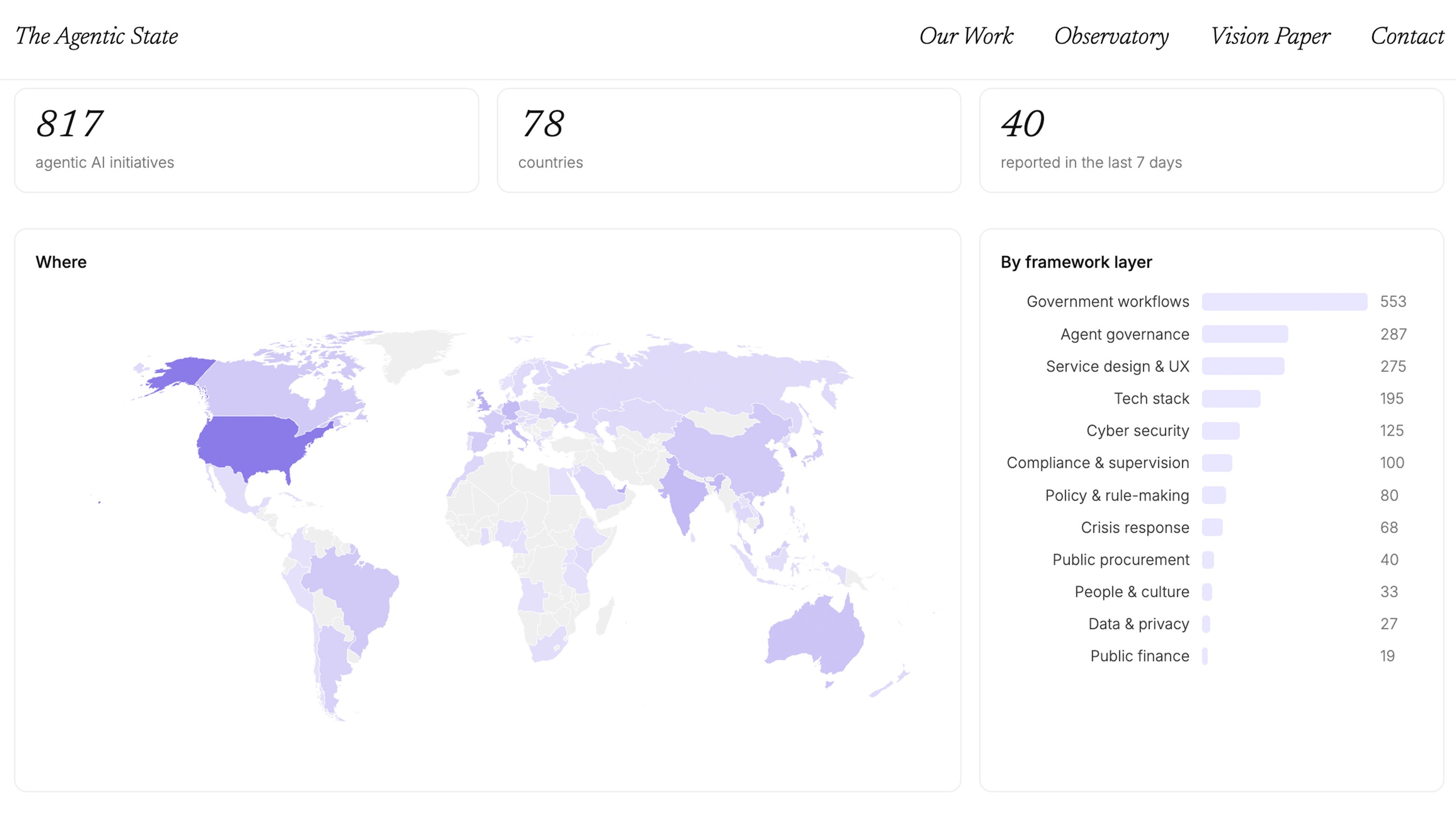
up thing but still like somewhere in their process in the machinery they were sitting on it for months my thing it's gonna like the junior staffers are going to show it to their bosses like the labs are going to show it to their bosses Accenture is going to show it to their bosses like there there's a whole universe that's going to push this and your bet is a cheap bet right uh in the grand scheme of things um and yeah i believe it i think that there's a real there's going to be a real need for some sort of like conceptualization of like where to start and what to aim for and what your metric should be and um you know to build out the library of case studies that can that you can share in a more efficient way than the, you know, conference slide deck version. So I'm in. Put me on the board. And this will be my last little infomercial plug is we have this observatory where all those publicly announced use cases out there of agents in government anywhere we track. And it's such impressive. There's like 50 new cases a week at this point.
I'll admit this is like press releases. So sometimes there's vaporware there, but there's a lot going on. The pace has gone up. And so like that, and one of the things we do is we map that to the kind of our taxonomy of what different use cases are about. And I think we're building up the kind of the world model of what AI and government can do over time. Love it. All right, Lucas, what is the genre of the agentic state theme song going to be? The genre of the, oh, Jesus. Okay, reggae. We'll do reggae. Great. Amazing. Why not? We're going to run with it. Lucas Elvis, thank you so much for being part of China Talk.
Then one day he told me, story stirred, the system's down. I cried the prophecy and danced all over town. It was just a portal. Then a white paper came from Thailand, Estonia. Said it's going agente. It's a brand new Babylonia. Babylon you chase. Babylon you chase. You used to lose my papers, leave me standing in the queue. Now you know what I need before I do. You prefilled my application before I ever could apply. And you always tell me, darling, the high and the wide. Proactively, when the hurricane came and took away my roof. Five ministries came running
And not one asked me for proof I don't show you my raw data I just give you yes or no Minimal disclosure Maximum assurance That's how true love goes Babylon you change Babylon you change You used to lose my papers Leave me standing in the queue Now you know what I need before I do You prefilled my application before I ever could apply And you always tell me, darling How and why Proactively Remember what I told you back in 2025 Babylon, you better change if you wanna stay alive The camera got an agent and the tax dodger too Everybody got an agent Babylon except for you If you don't build it Then fix the charge of fee Robot butler for the rich
And the cue for you and me Keith built a state agent In the middle of a war DC still on the fax machine What you waiting for? So I brought my own agent Like the white paper says Now it does my paperwork And I write love songs instead Babylon, you change Babylon, you change You used to lose my papers Leave me standing in the queue Now you know what I need before I do You prefilled my application before I ever could apply And you always tell me, darling The how and the why Proactively Babylon You there, darling Medea
Love your passport Runs out in March I pre-filled the renewal Do you consent? I do, Babylon I do Ooh... Ooh...
番組の概要欄(原文)
AI agents are about to flood governments with FOIA requests, grant applications, and permit filings. Will governments slam the door, or rebuild themselves around AI? Luukas Ilves, co-founder of The Agentic State and Estonia’s former government CIO, joins Jordan Schneider. We discuss: Why more CAPTCHAs would be the worst response to “agentic flooding,” and what it takes to get a building permit in a minute. Whether automation can keep public services running as a generation of civil servants retires. What Ukraine, Estonia, and Singapore are already doing with agents, and why governments are so bad at copying each other. Why U.S. states are suddenly ahead, and how a citizen with Claude Code can out-build their own government. Plus: why you should buy toilet paper by the foot, and the agentic state’s theme song. Learn more about your ad choices. Visit megaphone.fm/adchoices
出典・この記事について
- 番組
- ChinaTalk(Jordan Schneider)
- 元の回
- The Agentic State
- 配信日
- 要約作成日
- 公式サイト
- chinatalk.substack.com
この要約・解説記事は、元の音声を文字起こしした内容をもとに AI(Claude)が日本語で作成したものです。 固有名詞や数値に誤りを含む場合があるため、正確な内容は元の音声でご確認ください。制作方法について
関連エピソード

AIエージェント2万体を計画していますか?Capital Oneからの警告|Abhijit Bose
Eye On A.I.

SPS 26:部品を超えて――AIと電気トポロジー設計(Murrelektronik)
Industrial AI Podcast
AI効率を探る:Armが描くエッジAI、エージェント、フィジカルAIの安全性
The Stack Overflow Podcast

Anthropic歴史的IPO、ジェンセン復帰ならず、Gemini 4 NeonがGPT 6.2 Sol/Astraに迫る|ThursdAI 11月19日
ThursdAI - Highest signal weekly AI news show

Huang騒動、Anthropic上場、そしてMetaのMuse――EP99.40
This Day in AI Podcast
GeminiとAGIへの道筋:Koray Kavukcuoglu が語る製品・アーキテクチャ・再帰的自己改善
Google DeepMind: The Podcast