BI 250 ニマ・デフガニ:脳はどのように計算するのか
Brain Inspired
要約
MITの計算・理論神経科学者ニマ・デフガニ氏が、脳を含む物理システムが「計算する」とはどういうことかを厳密に定義する立場を語った回。何でも計算と呼ぶと概念が空疎になるとして、計算的閉包(computational closure)を基準に挙げ、大腸菌から皮質までを同じ枠組みで捉える。分割正規化とWinner-take-allの合成や、再帰ネットワークをバックプロパゲーションなしで扱う研究、フィードフォワードの限界にも触れている。
この回のポイント
- ●デフガニ氏は脳が計算すると主張するが、情報の中継や単なる状態変化まで計算と呼ぶのは概念を無意味にするとして、厳密な定義を求めている。
- ●従来の計算理論は「関数→計算モデル→装置」の向きだが、物理計算の理論では物理システムから出発し、その自由度や状態遷移、抽象化を読み解く向きに逆転させると説明する。
- ●計算的閉包とは抽象化が系自身の内部に組み込まれ、外部の観察者や実験者の介入なしにループが閉じていることで、同氏はこれが主体性(agency)の種だと見る。
- ●神経活動をデコードできることは、系がそのように処理している証拠にはならないと指摘し、ニューラルネットで脳を説明する安易な同一視を戒めている。
- ●分割正規化とWinner-take-allという皮質の標準回路を合成すると、単体にはない新しい動力学が生まれることを、有限状態機械の分解理論を使って示したという。
- ●フィードフォワード系には物理的・数学的な限界があり再帰が必要だと述べ、重みの更新に頼らずバックプロパゲーションに相当する計算を再帰系で行う共同研究も進めている。
章立て
脳は計算機か:問題設定
脳の比喩の歴史を踏まえ、計算を厳密に定義する必要性と、デフガニ氏の理論家としての立ち位置が語られる。
N4フレームワーク
神経物理、神経計算、神経動力学とその上のneuro-AIという枠組み、スケール間の合成と有効理論の重要性を説明する。
物理計算の理論と圏論
チューリング流の向きを逆転させ、物理系から抽象化へ進む理論を説明。圏論は装飾ではなく写像の道具だと述べる。
計算的閉包と主体性
ウェーブウォーカーの例から閉包を説明し、デコードの落とし穴、AIエージェントの誤称、大腸菌での主体性に論を広げる。
マーの3レベルとの関係
マーの階層やブザキの内側から外側への見方と比べ、物理的な自由度から有効理論を積み上げる立場を述べる。
標準モチーフの合成と再帰
分割正規化とWTAを合成して新たな動力学が生まれる研究と、再帰系をプログラムする発想を解説する。
生物に着想を得たAIと限界
効率とフィードフォワードの限界、世界モデル、バックプロップなしの再帰系、主体性を持つAIへの見方を語る。
全生命は計算か・オープンサイエンス
全生命に閉包があるという見方、良い説明は変えにくいという基準、故障検知への応用とデータ共有の重要性で締める。
解説記事
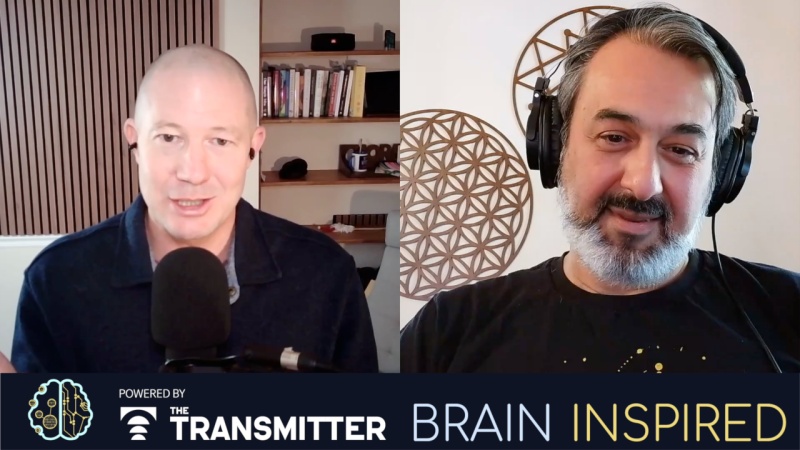
MITの計算・理論神経科学者ニマ・デフガニ氏が、Brain Inspiredの司会者と「脳はどう計算するのか」を語り合った回である。直前に司会者が開いた「脳は計算機ではない。ではそれは何か」というワークショップを受け、あえて「脳は計算する」側に立ち、その主張に厳しい条件を課す同氏の考え方が掘り下げられた。
「何でも計算」では意味がない
デフガニ氏はまず、脳の比喩が電話交換機や蒸気機関から計算機へ移ってきた歴史に触れ、新しい発明に脳というラベルを貼る傾向を指摘する。そのうえで脳が計算すると主張しつつも、定義の厳密さを求める。石が投げられた軌道や太陽系の状態変化まで計算と呼べば、言葉が役に立たなくなるからだ。情報の中継も、それだけでは計算ではないという。
同氏の物理計算の理論では、従来とは向きが逆になる。チューリングやチャーチの系譜は「計算可能な関数→計算モデル→物理装置」と進むが、同氏は物理システムを与えられた側から出発する。自由度や状態遷移を調べ、そこに埋め込まれた抽象化を数学的に記述する。圏論の関手などは飾りではなく、レベル間で記述を写すための道具だと説明している。
計算的閉包という基準
中心概念が計算的閉包である。フランスのグループによる、振動する油の浴槽上を跳ねる液滴(ウェーブウォーカー)の実験を例に、同氏は理論モデルを作った。このシステムには記憶や書き込み、消去といったチューリング的な要素があるが、位相を反転させるのは実験者であり、ループが外部で閉じているため自律的な物理計算装置ではないという。
この見方は神経科学のデコードにも向けられる。神経活動から何でも読み出せるのは、読み出す機械を外側に作ったからで、系自身がそう処理している証拠にはならない。同氏は、ニューラルネットで脳を説明して同一視することへの警戒を繰り返し述べた。
さらに閉包は主体性と結びつけられる。環境を抽象化して内部モデルを作り、それを用いて環境と自分自身の双方を制御できることが主体性だというのだ。AIエージェントという呼び方については、暴走したのではなく境界設定が不適切だっただけだと批判している。同氏は、大腸菌のような単細胞も閉包を備えると考えており、走化性の研究でそれを示そうとしている。ただし系の一部は単なる情報中継にすぎない可能性も認めており、その点を検証可能な形で扱う姿勢を強調した。
標準回路の合成と再帰
具体的な研究例が、皮質の標準的な回路である分割正規化とWinner-take-all(勝者総取り)の合成である。入力のあらゆる組み合わせ列を与えて到達状態を調べると、それぞれ単独では持たない「ギア」(状態を切り替え続ける成分)が、「ファネル」(終状態に落ち着く成分)だけの系から生じる場合があるという。どちらがどちらを駆動するかという接続の向きで結果が変わるとも述べている。
背景には、再帰ネットワークをどうプログラムするかという関心がある。同氏は再帰を神経科学の聖杯とみなし、生物はシナプス重みを速い速度で更新し続ける余裕がないため、バックプロパゲーションとは別の仕組みが要ると語る。共同研究では、スパースな再帰系で重みを変えずにバックプロパゲーション相当の計算を行う仕組みを作っており、生物がそうしているという主張ではなく、探るべき手がかりだと位置づけている。
フィードフォワードの限界とAIへの示唆
なぜ大きなフィードフォワード網で済ませないのか、という問いに、同氏は二つ答える。一つはエネルギーなどの効率。もう一つは、フィードフォワード系には物理的・数学的な根本限界があり、解けない問題には再帰が必要だという主張で、この論文は公開準備中である。加えて、大規模言語モデルは雨について多くを語れても、雨を経験してはいないとし、世界モデルを持つ主体には再帰と閉包が要ると論じた。経験を持つAIは将来ありうるとしつつ、現時点の議論は主にSFや哲学の領分だとした。
また、細胞種や配線図のカタログが増える現状に対し、測定の重要性は認めつつ、部品を合成したときに何が起きるかを語る言語が必要だと述べている。オープンデータと専門的な観測施設の拡充にも期待を示した。
まとめ
本回の要点は、計算という言葉を使うなら、使う側が証明すべき基準を持つべきだという姿勢である。同氏の言葉では、閉包の基準は脳が何を計算するかを教えるものではなく、何かを計算すると言う資格として示すべきものだという。理論は良い説明ほど変えにくいという基準で検証可能であるべきだとも述べ、意識の議論には距離を置いた。
日本の読者にとっては、「脳に似たAI」や「エージェント」といった言葉が曖昧に使われがちな現状を見直す視点になる。再帰系の設計や省エネルギーな計算を考えるエンジニアにとっても、合成可能な部品から動力学を予測するという発想は参考になるだろう。ただし多くの成果は準備中の論文であり、今後の公開が待たれる。
文字起こし(英語・自動生成)
If you have a theory, you can change your theory to accommodate everything. That's not a good theory, right? So I think that's what neuroscience needs. We need to go to a new level. Basically, our theories are actually, you can put it to test and refute it and reject it and just move forward. We are hopefully entering that era in neuroscience. Recurrence is a beast, right? And I think that's the holy grail of neuroscience. Can we come up with theories of how these recurrent systems are working, how they are doing the operations, how they change their operations without constantly changing the synaptic rate and at that fast rate because biology cannot afford that. To me, that's agency. The agency comes from this aspect of having the shorter computational closure built into this system that now you can have an understanding of the environment.
And then from there, you can act on it and you can control yourself. And now you have the internal model of the world. That's, you know, now I'm going to use the bad word, the forbidden word. That's where intelligence, consciousness, agency, all are different, like, you know. This is Brain Inspired, powered by The Transmitter. Nima Degani is a computational and theoretical neuroscientist at MIT. His work is framed by what he calls an in-for, as in neuro-for framework. And that would be neurophysics, neurocomputation, neurodynamics, and encompassing them all, neuro-AI. So we have a wide-ranging discussion on this episode, mostly revolving around his work and views on how brains and physical systems in general perform computations to carry out their functions. Most neuroscientists, I believe, more or less casually use the term computation
to describe whatever it is the brain might be doing. But NEMA is focused on a principled account of how the various parts of our brains work, how they compose together, and what those compositions can achieve across the many scales of the brain and within the massive recurrence of the brain. In the show notes, I link to the papers that we discuss, to his website where he blogs about his work, and to some of the nice recent primer videos that he created to help us ease into his work. Those links are braininspired.co slash podcast slash 250. Look at that, 250. Thanks for being here. Hope you enjoy our conversation. Here's Nima. First of all, welcome to Brain Inspired. Nice to have you on. Finally, like I was just saying, I invited you years ago, but your email spammed me or something. Yeah, I think it's because I'm very bad at emails. Emails, messages, the slack, but I'm sorry.
It's nice that I didn't get some messages before. Well, it's actually a good time to have you on because just this past Friday, I had organized a workshop, which eventually got the sexier-than-my-original title to help it out, which was requested. The title of the workshop was Brains Aren't Computational Machines. So what are they? And we had a few invited speakers, and so this is great timing for you to be on because you're all about neural computation, right? Fantastic. Fantastic. One of the things that's... I look forward to hearing about it also. Yeah. Well, I mean, one of the things that came up over and over, I mean, you know, there were people arguing there's no way that brains compute. They aren't computers, you know, and whether the computer metaphor is, you know, just a metaphor, like because it's the most recent technology, like throughout history, you know, the brain has been seen as hydraulic fluids, as an information telephone board, et cetera, et cetera, and now we're up to computers, and so we have this computer metaphor.
but you would have argued strongly that brains do compute. Am I correct? Yes, I do argue that brains do compute, but however, I put serious constraints on how do you find this sort of thing. In a way, actually, let me get back to what just you said. You said people have talked about it as a switchboard of telephone, or people talk about, oh, this is like a steam engine, so on and so forth. So it's as if every new invention that we have, we try to attach a brain label on it. and say, yeah, this is the brain because it does something about communication and does something about the mechanics of what we think is the mechanics of thought, right? And that actually is easy to put something so mysterious and, you know, amazing into this sort of like box and then just like refer to it as like, okay, now we have something to talk about, right? I would say in terms of like whether brain is a computer or not, like, you know, We have to go back to the basics of what the meaning of computation is.
How do we define it rigorously, right? So that's actually part of the reason I started developing this sort of, like, theory of physical computing because, you know, we talk about physical objects that are doing some sort of, like, information, transfer information, processing, all so on and so forth, and then at the end they do something, that they use that information to do something with it, right? So that's the sort of like fine detail that we have to really be careful about how we define this. And in a sense, it's not just like, you know, we have to pay attention to brain, you know, the one that we share, but also about like, you know, simpler systems, right? Like simpler systems are doing something with information like, you know, bacteria, amoeba, slime mold, all sorts of things. And throughout the hierarchy of life, they are trying to pick up information about the environment and utilize that information, make an abstraction of that information in some way with the machinery that they have.
And that machinery is not some sort of like a magic dust in there, right? So I believe in the physicality of this life and the mind and everything, right? But that's the machinery that is doing this. And at the end, they have to be able to transform this sort of abstraction that they create from this external world to regulate their internal states and also their interaction with the outside world. So I think that's the sort of like umbrella of where you have to tease apart what is computation and what is not. Because some of them could be just information relay. Not every information relay is a computer, right? is not an actual description of what a computer is. And that's actually what motivated me to move in this direction and develop the theory of physical computation and so on and so forth, which I'm writing a bunch of papers. Some of them are very large. Yeah. And a few more which are coming out. And basically, I've written a lot of these things,
and I'm now trying to polish them and make sure people can read them. Yeah, yeah. Well, there's a punch on archive right now, Of course, we're going to talk about a few of them, and I'll link to them. And we've already discussed that depending on how far we get in this conversation, we'll have to have you back because, you know, you're almost like Michael Levin. Are you producing a new paper every week? Is that the rate right now? No, actually. So I work with Mike, too. We have actually papers together. In fact, actually, I just sent him a new paper. Of course. Mike is an experimentalist, and he's a fantastic experimentalist. And the way actually I came across Mike is that I used to be in a metaphysics. I used to be in a postdoc over there. And he used to hang out with some postdocs at the physics of living system. And, you know, one of them turned out to me. We used to talk about all sorts of things, from information, you know, computation, all sorts of things, right, like thermodynamics and limits of information processing living systems.
So one of them told me, hey, I went to this conference. It was NeurIPS. and this guy gave crazy talk he's a madman of biology you're a madman you should talk to him we ended up working together and then the pandemic hit things change, life change and so on and so forth so Mike is an experimentalist and he's doing great experiments I'm a theorist I have worked with experimentalists and I continually do so I have one leg in the experimental world. In fact, I should do some experiments once in a while. So I have basically done experiments with everything that I'm writing about because I think that keeps me connected with the limitations of the measurements. And rather than just like, you know, going and making some toy model that has nothing to do with reality, I'd rather like, you know, say something about what's out there, what we can measure, and also with the shortcomings of the measurements
because some of these measurements, they have some limits, But can we use theory to kind of push the boundary and find ways to kind of like guide experiments and, you know, suggest new rats? Yeah, okay. I want to come back to computation. Even, you know, some more kind of introductory thoughts and remarks before we really get into the weeds of your – so we'll start kind of with your paper about neural computations. But can you just, in broad strokes, I guess, discuss kind of your approach and your worldview? I mean, on your website, you call it the N4 approach. So maybe discuss just what that is before I then really badger you about computation some more. Okay, sounds good. So, you know, as I said, like, my view about, like, computation is that I don't think it's something so specific to the brain. I think simpler systems do it. Even other cells in our body are always doing it.
But it's limited, right? So that's the sort of general framework within which I operate. And then in terms of N4, so I have neurophysics, neurocomputation, neurodynamics, and what I say is that neuro-AI or bio-inspired intelligence goes on top of this. And the idea is that in the neurophysics part, or biophysics, for people who work with, like, single systems, single cell systems, and so on and so forth, is the part that we try to really link, like, molecules, after molecules, like, you know, the operations, the dynamics, and whatever that's happening over there, to some processes, right? And we've been successful in that space to a huge degree in terms of, like, we know a lot about ion channels, right? And surprisingly, maybe the last and first big successful theory of neuroscience is still at that level. Yeah. So that's the part that, you know, you want to know what are the properties of the system from physics lens.
So meaning that, like, now we're looking at measurements at a massive scale, right? So we want to know what are the organizing principles of this. So how do the spikes, like, get produced together? Or can you find patterns in, like, spiking or in local potential that tells us something about the collective dynamics? So that's the sort of the neurophysics part. And, of course, the dynamics part comes in as soon as you're thinking about a system that has a state of space, moves around, you know, visits different parts of it depending on the problem that you're trying to solve or sort of like modulation that happens in the background, for example. And, you know, the neuromodulation is a huge aspect of it because it really tunes how a system responds to different things. And that kind of creeps into this sort of like setting up this space where a collection of neurons can operate a new regime without changing anything else. Like, you know, the machinery hasn't changed, like if you think about it in many ways, right?
But now some gears and knobs are sort of twisting because the neuromodulator comes in and then the system now can enter a new space. And then the other part of it is the neural computation. in some sense for a lot of people maybe especially the people who come from the systems neuroscience aspect and old school way they're all after code in the brain and so on and so forth but that sort of illusion is quickly disappearing in a sense because think about it they're all trying to say what's the algorithm here maybe it is not about the specific algorithm It's about how this network of neurons can do computation. They're doing information processing and everything, and they're solving a task. But we can look at it from a different perspective, and that's the rise of neural networks as very successful machines have kind of like shaken some of these people to the core, perhaps.
And I think that's one other aspect. What is the neural computation here? And I think that's the part that we want to be very careful about. We want to say it's a computational principle that basically emerges from the neural system. You have information for, you have coarse graining, right? So you have abstraction of the lower level computation as it enters newer or higher areas, especially in mammalian cortex. We have a visual hierarchy or auditory system and so on and so forth. So we have this. We have the state-dependent competition. We have talcortical control. And these are really, to me, the main things we need to go after because that's where we can actually find how the system is controlling the sort of flow of information throughout. And then the idea is that if you put this all together, the neuro AI is the umbrella around this.
Like, how do we go from these aspects and then into sort of like designing biologically inspired architecture, right? How do we understand, or the other way around, how do we use mathematical and computational tools to understand physical competition? That physical competition could be a level of a single cell or single neuron, like, you know, how they process information. And, of course, the single cell is doing something limited, but, like, E. coli swims toward some sort of, like, you know, nutrients. and then regulates itself and so on and so forth, right? And then how do we use that information about understanding these little ones in a circuit, in an assembly, right? I can have a bacterial biofilm, and it's the bacterial biofilms are doing something amazing about the environment. Or you'll have a tissue that is doing like, you know, and basically has a non-excitable membrane, but it's still doing something in terms of maintaining some sort of memory of its own shape.
And that's actually, for example, the work of Michael Leavitt. Or we can think about how all these things can jump into the bigger level. Now we're talking about cortex, for example. We're talking about mammalian cortex and a much higher level of abstraction and computation and everything that happens in the... Excuse me. And in that case, there's one key mode is that if you want to know this, we have to be able to understand how these components are working together and working individually, what are their individual properties, and what happens when we compose them. We know something about ion channels. We have done tons of work about ion channels, and we know a lot about them. But now as soon as you put a lot of them into a cell, and then you have it distribute and so on and so forth, that goes to the next level. and then from there now you have a few neurons connecting to each other and that was the next level and then we have like different cell types like you know this is something that is largely ignored in
a lot of like you know theoretical work or analysis of data right and because the tools didn't exist for it and now it's only now picking up that we're able to like you know go and tag neurons and understand them or being like manipulate them so we we are gradually transitioning to this era where basically we can come in and look at the system, look at components, understand something about a component, go to the next level, understand something about the cell at that level, understand something about the network, and that's actually where effective theories matter. So we need to be able to build effective theories that can give us the right interpretation at that level without basically detaching us from the reality of the lower levels. I think that's a key point here, right? Because somehow neuroscience started the other way around. It started like, you know, with philosophers, everybody thinking about what the brain is or the soul is,
what the consciousness is, and so on and so forth. And then we had all this sort of vocabulary of explaining it, and then we started like teasing parts, parts, but there's a massive disconnect. And for that reason, I think somehow having this sort of like umbrella that you don't let go of these other levels that we can have a solid description, but yet we can do something more is very important. It's almost like Philip Anderson's more is different sort of like paper, right? So that's a sort of like umbrella within which I work. Yeah, okay. You said a lot there and I wanted to interrupt you over and over. Okay. So one of the things that you said was, you know, we now have the tools. And I thought you were going to say, because you're developing those theoretical tools, but that's what I thought you were pointing at, but then you pointed to the experimental tools, which is what we also need. Yeah, absolutely. So, okay. And also I'll just note that the, you know, you said that neuroscience has not historically
gone across these different scales, across these different levels. And that's true because I think that that's difficult. And people are really comfortable studying one level. And you've got to figure out the ion channel by itself, let alone this distributed, integrated, interconnected system of ion channels. You can think of it as a big mess. So a lot of the work that you do is tying together those levels and going across levels. So it's really cool. So, okay, but so set me straight here about computation because, you know, what came up, one of the things that came up in the workshop and, you know, frequently comes up is, well, of course we don't mean the brain is a Turing computer, but then you start to get into the triviality of computing. Like, you know, you write about we don't want to say that the rock is computing just because it has, like, transitions, so there has to be something special about it. But is computation not well-defined or is the definition changing over time,
like all other terms that we use in neuroscience, consciousness, memory, et cetera, all these ill-defined terms that we use? I mean, part of what you're doing is you're formalizing a different notion of computation. And then, of course, you point to all these different notions of computation throughout history. So is it just my, you know, I brought up the worry that when, and you've written about this also in your papers that, and on your blog, that like someone will say, yeah, okay, well, this circuit computes, for example. Yeah. But they don't really, it's like a filler term because they're not formalizing what computation is. Yeah, exactly. And then, you know, they go to this sort of like hand-waving sort of argument. Right. And then they become a true believer that it is or it isn't. Right. So my concern is when you say the brain computes, the word computation just gets applied to whatever the brain is doing. You call it computation. And that kind of trivializes the notion of computation also.
Exactly. You avoid that. I think that's the big issue. We don't want to open. If computation is everything computes, then it's a useless word. Then why are we even saying it? If I throw a rock and then say, well, you know, the rock computes its trajectory, or does the solar system compute its future state? Like, I mean, if that's computation, then like, okay, so everything that moves, everything that changes is computation. So not every state changes is computation. Not every information transfer is a computation. And that's actually the key point here because in that formalization, and, you know, I don't want to throw out jargons here because, you know, I don't want to bore all the audience. And, you know, if they're more interested, they can go and read you there. Yeah. Yeah. Your papers are deep with the videos that I created about this. Yeah. And I try to bring different levels of description that, you know, people can find. Well, the videos, so I'll just, I'll tell people, like, you're making these videos that are kind of explainers of the concepts. Yes. And they're fantastic videos.
Your papers are very dense. The videos are also very dense. Like, even though you're simplifying things, there's so many things that you've included that, you know, I need to watch it a few more times. But they were very helpful and very well done. Yeah, it's funny because I think that's true. Like, my papers are very long in general. Like, generally, I don't write short papers. I like very long papers because I want to, like, really get into the details, right? So it's not that I cannot write short papers, but I think I don't like short papers. A lot of them are just like, you know, they hide all the real stuff. But, you know, back to that question. Back to that question about what is computation here. In this case, I think the way I have created this sort of like framework, initially, again, it came from like thinking about a brain. But then I decided I need to go to something, to a simpler scale first, like describe at the fundamental level of what it is that a physical competition is.
And I want to point out to the arrow of the scripture, because the definition of the competition that we have, like the Turing Church, that's sort of like definitions that we have. And they emerge from thinking about Hilbert's problem, right? like Hubert came up with a set of 23 sets of problems, famous sets of problems, and I think it was 1912, or maybe Ron Patton. And he said basically, okay, so this set of problems, can we basically, can we come up, sorry, 1932, 1912, sorry. So he said, can we come up with a way of understanding if we can, like, you know, if you have a set of mathematical problems or basically can we figure it out, like, automatically? Can we find out, like, you know, have this way of completely answering this sort of thing, right? And, you know, I don't want to go through all details of it. And then, you know, the response to that was that Elizabeth Church and Alan Turing came up with two different ideas.
And they both pointed out and said, like, no, we can't, right? So, and then from there, the sort of like operations here is basically the problem that you have some sort of like procedure. And this procedure, of course, for mathematicians is just a set of like, you know, you train a set of functions and so on and so forth. But yeah, think of it that way, right? And can we basically know like how to get to the end of this? Because if you know, then you can actually solve everything, right? So that's the background idea to Innocence, right? And in that case, you have this sort of trajectory from basically going from this description to the sort of like the operations to the sort of machine that we designed to do those operations. As we know, a Turing-computed machine doesn't necessarily solve everything.
So that's the idea. In a theory of physical computing, the arrows are reversed, which means that now you are actually handed a physical system. You're handed a physical system, and you want to look at this physical system, and you want to go back from it. You want to understand this physical system, right, and figure out what are the degrees of freedom in the system, and how does this system go from the sort of state transitions that it can carry, right, to the sort of operations that interests us, right? And that's basically the idea of this theory of physical computation. And that basically you start, instead of going computable function to model of computation to physical device, You go from a natural system to physical operations that they can carry and a mathematical abstraction or the abstractions that build on top of it.
And that actually brings this whole idea of, you know, the whole Pandora box opens basically at this point. Because now that you have a physical system that you can find its trajectory, the evolution of its, you know, states, right? And then you can link other systems to it, right? Now, you can have linked dynamical systems that have physical underlying nature. And then each of them has certain degrees of freedom. And, of course, you can build it in a hierarchy. You can build it as a nested sort of thing. You can have multi-realizability. All kinds of things actually emerge out of this, right? And that's actually when you look at it from the other way around. So instead of, like, you know, because a lot of people, when they talk about, like, is brain a computer? is E. coli a computer, is such and so is a computer, they go the other way around. They are thinking about it, I have this sort of function, how do I shove it in there Like you know let build a DNA computing system But that not what the physical theory of computation is The physical theory of computation is that let have a clear boundary between physical processes
and abstract processes that emerge from it, but these abstract processes are embedded in those devices themselves. And here, it can be that they're done in a way that another layer, for example, you have a chain of reactions, regulatory systems and bacteria and then another chain combines with this and then has some abstraction of the underlying level. So let's say the lower level, the lowest level, has n degrees of freedom. But by the virtue of the operation that it does, it does some sort. And then the way that it links with another set of molecules is chain reaction in that machinery of the cell. Now you have an abstraction of those large degrees of freedom to fewer states. So that by itself is that a sort of information processing that is more than just relay of information, right? So now you have what we know is in the mathematical formalism is the functor that takes the transition of the illusion of the system from the physical state to the abstract space.
But here the abstract space is itself embedded in some physical machinery itself, right? And, of course, at some point, one observer can come from the outside, poke something in, and, you know, connect it to some external device, and it starts having its own abstraction of that system. And that's what we do as, like, you know, neuroscientists, for example. We put an electrode in there. We measure something. And that measurement could be a measurement at the level that is relevant to the competition we're looking at, or it could be actually wrong. It's also a possibility, right? Like, you know, as I was mentioning earlier, it's only now that we are basically being enabled by the advancements in technology and tools to look at all the other things. Like, you know, the activity of industry cells. Look at the activity at the level of dendrites. I think this is just like, you know, it's going to open up this whole field wide open to a completely new frontier. So that's why the angle, I think, is sort of like the lens that you can use to look at the computation at physical system matters.
And, you know, this story also, it didn't come from actually neuroscience anyway, right? Like, some people started, like, building this sort of, like, initially philosophers would build this sort of, like, this idea is about mapping. Like, you know, Hillary Putnam, right? He was a mathematician and a philosopher, and he came up with the idea of this sort of mapping between different states. But then the problem is that, like, in a lot of these descriptions, either the definition is too loose, right? or is so bounded by the objective of linking everything to brain and minds, right? Like it goes into the category of semantic mapping and so on and so forth that it's, you know, load-bearing, right? So it doesn't enable you to build real theories because you jam in all this extra stuff or it's so naked and bare that everything is computation and it becomes, like, useless, right? So I think this is a key point here.
How do we approach this in a way that we have that rigor? And do you, well, before I ask you about category theory, because this is sort of category theory is a necessary ingredient to this. Actually, I'll go ahead and ask you about that. I mean, use the word functor. Is category theory the, without it, could you do, could you explain the computational aspects? There is something I can't believe here, is that category theory is a language that shows you how you can basically transfer a set of basically morphism and objects and relationships between them. So you have objects and the relation between those objects. How can you transfer to another state? So think of it that way. I don't want to throw in wrong word, but basically you can have a category, You can have another category, and then you have a functor, basically, that maps every object to object, every morphism to morphism, or relationship between those objects.
You can have, basically, a junction and so on and so forth. That's what, you know, used to show the multiple realizability. Or you can have natural transformation. This is a technical term in category theory that you can basically lift something from one level to another level, right? So it's a set of tools, basically. It's not an ornamental tool in a way, right? It's not a decoration. It's something that you can use it to map from where you are, and you have a description of it, to another space where you want to have a new description of that system, right? That's the idea. And, in fact, actually, the recent APA that I released about the wave computation, Much of it, I go without using category theory. And that's intentional because I want to show that you can actually look at the systems. So just to give a background to the audience,
there was a very interesting paper that was released by a French group. And it was published in PRL. And the idea was that they had this sort of like a bath of liquid. And basically you can vibrate this bath, some sort of like oil, right? So they can vibrate this back and below some threshold, and then you can put a droplet on it. But the droplet doesn't, like, you know, diffuse and go away. It actually bounces on this. And each kind of bounces on the surface, it leaves an imprint. So it leaves an imprint. But that wave that is being created now starts pushing the wave, and the wave goes back on it. So you have this. It's very interesting because you have, you know, feedback. you have memory, you have writing, all sorts of things. And they show that even you can actually push the system and then you can have a trajectory, a completely chaotic trajectory. And then if you shift the phase of your wave, now you can actually go back and raise the path.
It follows exactly the same thing. So what is this system? And they call it, this is a two-in-complet system, this wave walkers, right? And in that paper that I released later about this, I basically go in, I build a model about like the sort of like physical waves and how this sort of like wave is registering the movements of the walker, how the walker does this. So they do this as experimental tests, right? So I now build a theory around it. And then from there, I am able to, again, link to that sort of theory of physical competition through what it is that this system is doing and how the coarse graining looks like here. Because now you have basins and these basins of where your space is, now how you can have abstraction of it, so on and so forth. And at the end, I end up in something which I call the competition closure. Yeah. And that's actually what separates, basically, systems that have a sort of abstraction that is built in in their own,
like in their own, like, you know, structure. Like, you know, that's like our brain, right? Like, our brain does that. Like, our brain has competition and closure. But not every computing system has it. That's also another thing. Like, not every computing system has it. So even that wave walker is doing something. It has the Turing-like primitives, but it's not an autonomous physical computing device. And I think that's a huge difference, right? And that's also what can clarify and get us rid of all these sort of like crazy notions that come up. And, you know, everybody gets confused. Like, oh, hey, LLMs are like, you know, conscious and all these things that come out, right? Like, and people argue about it or they write paper about it. and we need to be much more precise about these things, and that's the sort of effort that I can. Yeah, so you think that the computational closure would be essential for something to be conscious, I would presume, right? So, yeah, I have a little bit of allergy about using the word consciousness.
I know, okay, I want to jump into this, like, you know, all right, it's like, what is it? And, of course, there are some theories out there, from integrated information theory to stand beyond, like global workspace and so on and so forth. The problem is, again, there are layers of explanation that are easy to wear. And I think that's not a good way of approaching scientific problems because if you have a theory, like, you know, you can change your theory to accommodate everything, that's not a good theory, right? So I think that's what neuroscience needs. We need to go to a new level. Basically, our theories are actually, you can put it to test and refute it and reject it and just, you know, move forward. Physics have been really, you know, and physics scientists have been really successful about this. And we are hopefully entering that era in neuroscience.
So, yeah. Okay. So, we'll steer clear of consciousness. But going back to the closure idea. So correct me with what I'm about to say. So what you were saying with the wave walker experiments is that the experimenters can flip the phase, can change the phase, right? And then new properties will emerge. But the point about the computational closure is that phase flipping mechanism, we'll say, can't come from the outside. And it's the same with, like, the way all neuroscience decodes neural activity. Exactly. You can decode anything you want out of that neural activity almost, right? Yeah. Yeah. And I think that's exactly the point. And, you know, that's why I say that that wave blocker has torn primitives. It has memory. It has erasure. It has writing, right? It has all those components. But it's not an autonomous component. So I build a ladder run, basically, saying, like, where you are in this, you can be at a place at the lower rung of this ladder, and then you'll have memory, right?
And if I knock on this table, it has a memory. If I bend it, it has a memory, right? Like if I bend something, like, you know, spoon, magic, like bending a spoon and so on and so forth, it has a memory, right? But then you go to the next level, and now you can have computation in some sense, but it's not necessarily an autonomous computation. Because it's the experimentalist who goes there and switches the action over there that closes the loop, right? And that also is the case about when we are looking at it as an observer. This is actually very interesting because now it really creates this sort of thing like, how do you deal with a system with a physical computational device that is doing something and you want to observe it? Obviously, you're going to interrupt something because you're pushing things in there and manipulating stuff. But at the same time, that observation, you have to be careful about what operations that are using or what deductions that you have is yours versus the computer.
Like, you know, again, back to that sort of like a neural coding sort of problem that I pointed out to earlier. We can, you know, build all sorts of decoders, right? You can build all sorts of decoders. So that means information is there in the system. It doesn't mean that that's what the system is doing, right? Like that's the machine that we have built on the outside of the system that is giving us this illusion of that's what the system is doing. So to understand what the system is doing, we have to look at it from a very different lens. And I think that's why suddenly a lot of people have lost their identity. They are facing an identity crisis. because they didn't, so if we were looking for, like, all these neural codes for this long time, and now, like, you know, you look at this, I don't know, somewhere on network, trained on a bunch of videos, and suddenly does sort of, like, image recognition and all sorts of things,
then, you know, where's the code in that one? Right, well, I mean, in a sense, these big neural networks are just big decoders. So, like, so neuroscience is in the business, right, of, so you record some neural activity, or a large swath of neuroscience these days and has been for a while. You record some neural activity. You decode some information using a neural network, your favorite bespoke model or whatever it is, right? Yeah. You decode the information and then you say, ah, that's how the brain must be doing it. And that's the big error, right, that you point out. Yeah, exactly. And, you know, we can learn a lot from those systems. How do I get it? Because now we can look under the hood of those systems in a way that it's not easy to do in neural systems, in real biological systems, right? And we can build methods that can give us some way of, like, you know, decomposing the actions and properties of those networks, but it doesn't mean what we learn from there is necessarily, you know,
transplantable into actual biological systems because the degrees of freedom of biological systems is, like, way more. It's just beyond those systems, right? As I was saying, look at the dendritic computation. It's something that, or like there are astrocytes, there's inhibition, there's excitation. It's not even like one type of inhibitory cell in there. There are like a million types of inhibitory cells. So the main point is that we don't mistake, we don't mistake, make a mistake of basically thinking that this object that can do something, that behaviorally, right, is similar to this object of interest is the same thing. And this is very crucial because a lot of people, they take, you know, they're training the network and they say, hey, look, yeah, this is what the brain is. No, that's not what the brain is. You're doing something, you're capturing something of what the brain does. You're tapping into some aspects of it. But that's not, there's no equivalence here.
So, yeah, and, you know, I think the value here is to think about, like, if we have access to all the information in a given system, which is in this case this sort of like artificial neural networks, what do we learn from there, right? How do we build models and real methods that can give us a way of describing these systems? And then that is going to be useful to look at the actual biological system. But, of course, then we have to come up and, you know, expand those methods, expand those models, that they would match the realities, the physical reality of the system that we want to study. So that's the long road that, you know, we have to basically do methods, you know, combine a bit. Experiments, right? And I think this is why experiments are super crucial, because it keeps us bounded in reality.
I can sit down here and make a zillion, you know, mathematical and theoretical models about like a point-neuron model that has nothing to do with what the actual neural system does. It's a good abstraction in some level, but it misses a lot. In fact, actually, I just put out a paper not long ago, but I think I sent it to you too. The coastline, how long is the coastline of neurons? And that kind of points to this issue. Yeah, well, that reminds us that we can easily slip between scales. It reminds us that everything is at a different scale, but it's easy for us to slip in talking across scales as if we're talking about the same scale. Yeah, exactly. Yeah. Going back to the closure idea, I think that you've written about – So AI, quote-unquote AI, has sort of driven, as a neuroscientist, you know, has sort of driven me crazy in terms of calling, you know, units, neurons, right, and sort of usurping a lot of the language.
And going back to the closure idea, so now we have AI, quote-unquote, agents. And I think this drives you a little crazy, too, because there's nothing actually agential about those because they don't have the computation of closures. Oh, yeah, that's such a misnomer. It's terrible, right? Yeah, and I think this also, like, it almost bleeds into how they treat them because they say, oh, these agents, they got out of control and they went and hacked something. No, they didn't go out of control. You didn't put the right boundaries. Just, you know, it's not that they had, like, they sat down and decided, all right, let's start a revolution of hacking. I don't know, what was it, hugging face? They hacked something. I don't remember what it was. And every day something comes. It's a situation. They're giving them agency. And I think that's the wrong issue. So agency goes back to this sort of computation closure, right? Now, that's actually – that's why, you know, I avoid, like, using labels like consciousness or something like that. Because I think what we need to deal with is that we need to deal with the systems that they are,
biological systems that interact with the environment, that have a boundary. They can sample information from the environment through the machinery that they have at their disposal. and that machinery is very different from system to system. In simpler systems, it's just some sort of like ligands and receptors. And as you go towards like more complex systems, then you have the evolution of brains and eyes and so on and so forth. Like, you know, all the whole machinery that was built around it. But then at the end, they use that to make an abstraction of the environment, do some prediction about the environment. Basically, that is the internal model of the world. So they are building this internal models of the world that they can act on it, right? And the action on it goes in two ways. One is through the interaction of an environment, and two is regulating internal system, right? You have homesthetic systems. You have set points, right? And that's the sort of knobs that the systems do use all the time to kind of like maintain their life, right?
And that's, to me, that's agency. The agency comes from this aspect of having this sort of composition and closure built into this system that now you can have an understanding of the environment. And then from there, you can act on it and you can control yourself. And now you have the internal model of the world. That's, you know, now I'm going to use the bad word, the forbidden word. That's where intelligence, consciousness, agency, all are different. You can put labels on it, right? But all the bad words. I want to be precise about this is what we measure. This is what we can do. Yeah. It kind of reminds me of, so Henry Yin comes at this from a control theory perspective, and he says, he writes about the crisis in neuroscience, that essentially it's the same sort of thing but from a control theory perspective where the reference signal or the set point is set externally by an external observer, right? And so you need a control system that sets its own reference signal internally somehow,
and that's where the closure of computation comes in. Yeah, exactly. And, you know, be sure to forget that at the end, the whole nervous system is there for the regulation of our body, right? That's what the nervous system does, basically. At the end, it tries, like, you know, it's a vast machinery, right? You have all sorts of systems interacting with each other, and they have to be regulated, otherwise it's going to fall apart. So, you know, we build this, like, crazy, complex model of this in our world in our minds. But at the end, it's just for us to be able to interact with it and maintain the internal state in a way that we stay alive. and that's why we get hungry, we get tired, et cetera, et cetera. So you can still see that the operations that we need to do at the end is not that different from bacteria. They're reproduced by splitting. It's different. But the mode of eating is different from ours,
but at the end it's the same thing. So we're just a collection of cells. That's the sort of multicellular system that now you have specialized organs that do something better than the single-cell counterparts. Well, does a single cell have computational closure, or must it have computational closure? It does. The fact that I'm working on something on E. coli to show that actually how the whole chemo-taxas falls into this sort of like physical computation direction. So I'll be looking for you around that one. And that's actually where basically I link the systems biology descriptions that exist. Because there are a lot of systems biology also being carried out. But the problem there is that then again, there's a disconnect from describing the dynamics and so on and so forth to what the system does as a whole as the sort of information processing unit. And that's actually where we need a theory like this, basically.
well so I'll ask again I guess so does a bacterium or E. coli yes it does does it have it and does it need it, is it necessary are two different questions I guess well you know it has evolved to do so so and I think yeah and it does need it because you know the bacteria does need to process where's the sugar, where's the gradient of the sugar that I need to swim to because if it doesn't, it can duck You're going to swim in the wrong direction where it's going to tumble around too many times, and it's going to run out of fuel. Yeah. So that's a major issue for bacteria. That is the issue for bacteria, right? Yeah, I guess the question is related to the idea, you know, we originally were talking about brains and computing, and that's the big, you know, that's the sort of tired question now is like in the computer, right? But if the bacteria is also implementing computational closure, then you might conclude, well, there's really nothing special about brains then if the computational regime can just be imported, transferred across, you know, to the single cell level or something.
But there are different levels of this, right? Like, you know, there are different levels. You can have the state. It means that you can put these systems into this sort of like space. They're equivalent in some ways, but some are doing far richer sort of abstraction. For example, just remember what I said in terms of using the sort of refinement and multiple realisability and so on and so forth that we're building in this theory, is that you can explain the abstraction and the abstraction levels that you can create. And that is different in a bacteria from a collection of bacteria, right? So even there, you can have a bacteria biofile, but it does something in a single bacteria it cannot do. And this is very interesting, for example, because there are very cool experiments that show you can have a bacteria biofile, and then in it you start having pulsation of potassium waves and calcium waves that go around. And, you know, because the bacteria at the boundary are the ones that are actually sensing the external world in a way, right?
The ones at the center don't. So this is very interesting. Right there, even in such simple system, now you have emergence of a new property, right? Not all of them are going to do the same exact thing. But through this sort of communication, through waves of ions that they create, this pulsation is now carrying a sort of information for them about the environment. And this is, you know, again, that's sort of like you build abstraction on top of abstraction, but all in physical world. So there is no spooky, like, you know, demons sitting there and doing these things, right? It's, you still, you know, you're bounded to molecules. That's the reality of physical life. But that's fine. Now you have construction on top of it. And then you've, and that's actually another aspect. Like, we reuse these components to do something. And they do some sort of, like, you know, computational or information processing sort of thing. And then now you can use them, and that's what evolution does, like, you know, reuse and use and react and modify them to build better and more robust systems, right?
That's the objective of evolution is to do that. So it just creates more. Yeah, so I want to get to, because you write about this specifically in terms of some cortical canonical motifs, right, that the cortex performs and linking them together. Before we do that, I had the thought while you were talking earlier about your approach. So, you know, there's David Marr's famous three levels approach to understanding things, right? And so you start with the computational level, which is the goal of the organism or the bacteria or something. And then below that is the algorithmic slash representational level where you work out what algorithmic steps it would take or what algorithm you should implement to accomplish the goal or the computational level. And then finally you go down to the brain and say, well, it must be happening in there, so we have to figure out how it's happening. Classically, that's the way.
It's like top down. That's the way you're supposed to do it. There are people like Yuri Buzaki, who wrote, you know, The Brain from Inside Out is his most recent book. But he says, no, no, let's go from the implementation level to the computational level. Let see what the physical tissue is capable of And that can constrain what we can say about the algorithmic representational level which can constrain what we can say about the computational level How does your approach relate to the Mars levels approach? It's interesting because you're mentioning two things, which are I can see the relationship over there between this sort of, like, mindset of, like, looking at different levels of the process carrying forward, like, something from past to the future and how you can kind of translate it. You're interested in, like, what is available physically, like what the physical tissue can do, you know.
Exactly. But you're also interested in the computation, so that's why I'm starting. So that, and that's, yeah, exactly. I think that's what we need to be able to kind of like move away from like putting random and loose labels. Right. And in terms of the general principle of like, you know, Mars principle, like, you know, F3 levels and so on and so forth. And people write a lot about it and then they, you know, they go back and forth or whether they like it, they think it's useful or not and so on and so forth. like Jonathan Pirio and Martin Longfield, for example, they had this sort of back-and-forth papers on it that they agreed to disagree, but then they ended up agreeing. So I think that's a very interesting approach. It might be more useful in terms of how we anchor looking at behavior and wanted to link that to some description that we find at the lower level.
So it's very useful from that perspective. In fact, actually, with a colleague of mine, another of you we talked about it is, you know, we won't go into details of it, but like how to be like knowledge graphs around this idea and so on and so forth. But I would say I'm more on the side of saying we need to observe the actions of the system in different states. And really, that's just the bottom line, biophysical measurements and then physiological measurements. So we need to do this at different levels. And we need to understand what are the degrees of freedom of the system, what are the effective theories that we can build on top of this. And then by doing this, you can have a description of the abstraction that is built in the system. So if you want to think about it like the relationship to Buzhaka's idea or Maher's idea or Freeston's free energy principle, it touches all those things in some ways, right? But all bounded by the actual physics.
So like, okay, so now we can actually talk about it. We can have a measurement here. In this measurement, we have this system of interest, and it can visit these sort of states, and it has these degrees of freedom. From these degrees of freedom, now you can build another layer on top of it that now it can have an abstraction of that physical layer to a new one. And now you have the evolution of the physical state in this system. There you have the emergent layer of abstraction, and then so on and so forth. So basically you can see it's almost like layers of an onion, right? So you peel more and more and more. But all is about that scale, right? like about how you have properties that emerge at a scale that are not as spooky emergencies. Because that's the key point, right? Like a lot of people who talk about complex systems, they may end up with like, you know, being a little bit goofy, right? Because then they talk about like, oh, this thing is just like emerges.
Okay, what does emerge? Right, right, right. But on the other side, you also have the pure reductionist view, which has been a play of neuroscience, I would say. Yeah. Because it's a big issue, right? Like everybody, like, you know, you put it. Let's think about it. People used to put one electrode in the brain and then start, like, telling us the stories about, like, how the whole memory and attention and everything worked by just, like, observing. Yes. That's, you know, that's what we did. Right? Yep. But it is changing, and it is changing because both experimental technology has enabled us to do more. And then now it opens up new questions, right, questions that we didn't need to do before. And also we have now this equivalent sort of advancement in AI that is giving us a clue of, okay, well, you know, we can build out of systems by just purely connecting a bunch of nodes, and then they do operations in their brain.
than what the brain is for. So this is the sort of the two sides that are helping us to sharpen our questions in a way, if we want to understand it properly. Okay, very good. Okay, more is different. So this idea has come up multiple times. I mean, you just used the term emergence a minute ago as well. So let's talk about the work that you've done. Maybe you can introduce the two canonical motifs, right? So there are these, I will broadly introduce it. I'll let you get down a little bit more in the weeds, right? So there are two of various canonical motifs. One is called divisive normalization that have been shown to carry out sort of a normalization procedure among populations, small populations of neurons. And another motif is called a winner-take-all motif where essentially a decision is made because of the inhibitory and excitatory neurons and the way that they interact.
Some population of neurons eventually wins and takes all. And these are two canonical motifs that are thought to just be repeated over and over and over, like you said, which evolution does, in the cortex of the brain. And I don't know if have these two – so what you've done is asked when you link these two procedures up and make them functions of each other and put them in a series in various orders, what happens? And has no one asked that before? Perhaps not. That's one of those very – what sounds like such an obvious and simple thing to do. But it's not simple to understand. Implement. Right. That's why we're here. I'm sure people have thought about it. And I'm sure, like, you know, I'm not the only person who has thought, oh, what happened? Seems like a Steven Grossberg would have thought about this or something, you know. Well, some people, I'm sure also some people will come and say, oh, we have done this before.
Well, maybe. Maybe not. Okay, but so tell us more. What happens? And if I misspoke about what the truth. No, no, I think actually maybe this is actually a very good point that you raised. Have people thought about it? As I said, I am 100% sure people thought about what happens when you combine these things, right? The main thing is do we have the right way of looking at it? Because you can try to look at a circuit and describe it in different ways, right? Like you can look at a circuit and describe it just purely by the connections, right? That's the connectome, the old term. like we are the connectome, I am the connectome sort of approach, right? But, you know, we know for the books of Eve Marder, for example, you can have a few, you know, very unsophisticated neurons in the lobster's gut, and then the same wiring can give you a zillion types of dynamics.
Right. Okay. Okay, so we know that. Then we can think about, all right, you can have a description of a system, the dynamical perspective of a system. And you can say, all right, so here's a bunch of neurons. I connect them. I put some boundary conditions and so on and so forth. And here is going to go. I push it. It's going to go here. Right? So you can draw a trajectory. If it gets pushed, it goes there. So that's another aspect. But then comes the question that I was asking in that paper. And that is more about actually, well, we know evolution reuses components, reuses modules, right? It's not that it just makes it bigger and bigger by adding things randomly. Rather, it actually reuses different bits and pieces, almost like Lego pieces, right? And then from that sort of a composition, it builds something more sophisticated, right?
And that's why, for example, we have columns of the cortex. What's happening in the columns of the cortex? You have a bunch of columns. Each of them is doing some operation. And, of course, comes the whole connectivity of how they get feedback from the other parts of the cortex, from thalamus, you know, they send back to the reeling nose of thalamus and so on and so forth. So you have all these sort of things. But then deep down, you can tease apart and say, all right, well, now we also have this sort of repeated motifs, right? What do these motifs do? You can describe those motifs from the perspective that was mentioned. You can describe the cell types. You can describe the sort of like wiring. And you can describe the dynamics. But none of those lend themselves to describing the operations at a newer scale. And that's, again, back to what we were discussing before, is that we need to figure out what are degrees of freedom at a given level and what happens when you go to the next level. The next level in this case is that you compose two circuits with each other.
So you have, there's a normalization. Basically, the population changes the gain of that neuron's output, basically. So that's the gains of neuron, and then neuron's output changes. So that's something that was shown by David Heapier and Mathilde Pagdenian and so on and so forth. And these systems adapt to changing stimuli. Like when we walk outside and it's bright, this helps us adapt our visual experience of that. And it's great. And then you have also the binate call. Basically, you have two populations competing with each other, and one becomes active at some point, and sinus is the other one through some sort of common route to an inhibitory neuron. So we have this. And then the idea is that can we think about using these things to compose them together and build a new system? So that's actually where the idea came from, because I was thinking about how do we program networks, right? That's what. How do we program recurrent networks? If you have a feed-forward network, it's much easier.
People do it all the time, especially like AI nowadays. They have this thing, and they do the modification, and they say, oh, we also add this to it. We also add this to it. And then you have this thing, and then you run the backdrop, and it works. Recurrence is a beast, right? And I think that's the holy grail of neuroscience. Like, can we come up with theories of how these recurrent systems are working, how they, like, doing the operations, how they change their operations without, like, constantly changing the synaptic weight and at that fast rate? Because, you know, that's just, like, biology cannot afford that, right? Like, biology cannot afford backpropagation on that scale. It has to be something different. So that goes in a few different directions from that sort of, like, perspective, like tackling recurrence, right? and that's a major theme of my research nowadays, is looking at recurrence. But looking at it from a different perspective, one of them is how to compose a system, right? How do you program a system? And to do that, that's the idea of this sort of like Kroninger's theory
and halalomy decomposition that come in. And you can use those to basically think about a system that is composable. You can also factor it out. Right? It's almost like, you know, you have, you can say a natural number, you can decompose it, you can factorize it. Right? And you get, eventually you get to some prime numbers. There's some power of those prime numbers. Now, the same thing happens to be also true in finite state machines. You can basically describe that system and break it down to bits and parts. Let's call them funnels and gears. and funnels are the ones that are basically, they have an end state, reminiscent of the name funnel, and gears are the ones that actually could switch, could switch between different states. So they don't end up in some final state. Now, when you look at the machinery of winner-take-all or division normalization,
then you can actually approach it and try to figure out what are the generator explicit funnels in the systems? And is there a generator explicit gear? And the idea here is that you move away from this steady input or like one push through the system and see where the dynamic goes, right? Because that's the dynamic of you. Now here the view is that you want to know, you harness that, of course. You harness that sort of knowledge, but you go one step above it. And you say, what is the computational repertoire of this system? If I can zap it continuously with all sorts of inputs that it can have, right? So in this case, you can think of it as words, right? Like, you know, the word input comes in and it says, like a sentence comes in. Like, you know, one input after an input after an input after an input after an input.
And it's changing all the time. And that's really what the systems are experiencing. cortex. For example, you can have an input to this one, then the other one could be off, or you can have input to both of them, or both of them could be off. So you can create a whole sort of like dictionary of all possible combinations of these things, and just like, you know, push the system with all this, and then figure out what ends up at the end. Where does it end up at the end, basically? Two, does it end up in the funnel, or does it end up in the gear? Okay, so that's the sort of like a person you can have here. Then we can ask a different question. Okay, now I know the properties of this individual motifs or canonical circuits. Let's call them canonical circuits. It's a little bit above the motif. Motif would be like more, hey, you have a connection between two neurons back and forth. That's more like a little motif. Like here is one layer above it, right? Now you can say, all right, now I know what the DN, or the normalization,
or WTA for re-and-take-all does. So I can figure it out, and I can see where you have, if you have a set of inputs of this sequence, and that's like the witness word, like the shortest witness, you can end up in this sort of state. So you can push the system, and, you know, and this is like competition, very expensive, by the way. It's insane how you have to rerun and run a zillion sorts of configurations. But it's doable for at least small canonical circuits. And then at the end, now you can say, now let's connect them with each other. Now if you connect them with each other, you can end up with a different state. So for the divisive normalization, let's say you have four states, right? for input states, which ones you push. And then for the winner-take-all, you have eight. So now you put them together, you have this, like, four-by-eight sort of grid of states within which you can move around, right?
And the question is, now that you start, like, saying, all right, so now let's say it's the divisive normalization that pushes the winner-take-all, but then again, from where to what, right? Like, that matters. like who is connected to whom, is what defines the boundary or the constraints of how the system as a whole is composed and operates. So now the dynamic, actually, of these two systems expands enormously. It's just like a completely different beast. But you want to look for transitions that are happening within the basically directions of only one system. So let's say if you only see changes in the winner-take-all sort of states, that is a different sort of composition than if you saw changes in both winner-take-all and divisive normalization.
And that's the point of this paper that is showing how you have emergence of this sort of dynamics. that if based on the sort of composition that you have and who pushes whom with a certain set of inputs, certain train of inputs, those words that I was mentioning, you can actually push the system that now you have generation of gears out of purely funnel systems. This is quite actually interesting. How can you create this sort of thing? It's doing something that none of them could do before. But it's also able to do this sort of like emerging computation only and only if it's going through this specific route. And, you know, this is part of what evolution does. Like, you know, it connects them in different ways and so on and so forth. But we can use that. We can use that actually to think about if we want to design a new system, a recurrent system, or a system that has recurrent components into it,
then we should be able to mathematically computationally predict the properties of the system. And that means it will dramatically change our way of looking at the system because instead of relying on, all right, we need to just collect all sorts of data and have a gazillion labels or come up with crazy solutions to do the backdrop. No, we can actually go in a different way. We can program these systems just the same way that evolution did, right? Evolution did it by trial and error. It didn't create a sort of mathematical theory of how to do it. But we can come up with that mathematical theory to be able to now go there, understand the systems in biology, and, for example, we can, you know, experimentally can look at a certain circuit, and then tease apart the connections and wiring in different cell types. Again, as we talked about it, these are emerging technologies. Use optogenetics, for example, to manipulate things or, like, you know, pharmacological modulations
and push these sort of operations in these stakes that I was talking about, in this sort of, like, configuration board, the compositional board, right? That's one way is that we understand those systems better. And then the other way around is that now we want to build an artificial system so we can actually go in and play around. And depending on the task of Atrust, we design the system to do that best by some minimal configuration. Or if we want to have more general systems, they perhaps need to do something like what Evolution did. Like, you know, we built some sort of like composable units. we know what they do, and then we compose them, and then it becomes a more general sort of like a computing machine. So that's the sort of approach behind this sort of like a more different, and that's exactly the idea of more is different. Like Philip Anderson's more is different, right? It says you can have symmetry at the symmetry of walls, like very simple things, but then from that,
from the different layers that are built on top of it, then you can end up with new rich phenomena that are not explainable directly, but at a lower level. And I think that's the key point here, that why, you know, pure reductionism is bound to fail. It doesn't mean that we don't have to go and measure, like, you know, the transport of ions through a single ion channel. We should do that. We should do that. We should measure that. We should, like, you know, vary the temperature. They're also doing, you know, of course, these are done, but, like, you know, that's needed to understand the components. But to go from those components to a different layer, we need to have this sort of machinery and abstractions. So, but why would we want to use that knowledge to build better AI if I can just make my feed-forward network bigger and essentially get the same results? Is it just about efficiency, or is there something, you know, is the emergence principle, does it go beyond,
is there something special about building, you know, an AI system in this way that you could get outside of efficiency? So there are two answers I have to that. One, of course, efficiency matters dramatically, right? Efficiency matters dramatically because nowadays you can see that they are building data centers. because, I don't know, cities and so on and so forth. So, you know, there's research found that, like, you know, that's something. And it has negative effects on the environment and so on and so forth. And maybe, like, someone comes in, well, you know, let's just build them in the future. We'll come up with some green technology solution, and we don't need to worry about it. But it's almost disappointing to just, if that's it, it's almost, I don't know why, but it's kind of disappointing to say, like, it just seems like there's, it's less special if it's just a matter of efficiency. I think this is the idea of scaling, right? Like, you know, people are saying, like, you know what, this is it. Like, we just do this. We just make it bigger and bigger, and we have more data,
and eventually it's going to solve everything, right? And in a sense, actually, it touches us personally as humans. It's like, okay, this is it, you know? Right. That's what I am. But, like, first, I don't have any problem with that. because fundamentally I think, okay, yeah, we're just a bag of atoms. Sure, there's an organologist. We're doing something, like, you know. And it's very cool. Like, you know, I get hungry. It doesn't matter, like, if there's some neurotransmitters go or not. I get hungry, and I, you know, I have joy in, like, drinking a glass of wine because, yes, there's taste blood. I can explain all of that. But it doesn't, you know, separate me from that experience of being a human and having experiences and so on and so forth. So I have no problem with that. And if there's like some, we can make alternative things that are as intelligent or more intelligent than us, well, that'd be it. That's, you know, that's like what does my dog think about me. Like he's intelligent. He lives his own life.
Like, you know, he's happy. If I go with him, like, you know, for a run he goes for a run. He has his own experiences. So that's one thing. But I think energy efficiency matters. So that really matters because we can't push it to some level. And it's a bounding problem. Another one is the data, right? At some point, yes, we can measure more data, we can measure more data, and so on and so forth. But again, we can always think about it, that making abstractions of the external world is a different thing rather than just explaining everything. Like, you know, if you build models that are maps which are as big as the territory that we live in, they are useless maps in a way, right? Like you want to Google Maps because it tells you, all right, well, there's, you know, buildings and whatnot, and you want to go from here to point. There you just go through the road, and, you know, it shows you a traffic on it, and then you know how to get there. You don't need to know what's the color of the door of that room to get there, right?
So that already tells you, like, the abstraction can get you there much faster. And without that, you know, cladding your mind. So that's one thing. But more importantly, and that's actually a paper that I have to release it. I'm just very obsessed about every aspect of it. It's, I don't know, version 16 of edition of something. And in that paper, I basically showed that there is a fundamental limit, fundamental physical limit of what feed-forward systems do. And that is something that you need recurrence for. So without recurrence, you cannot solve those problems. Those are actual physical problems that no feed-forward system can do. And that was, when I released it, we'll talk again later. But there is that fundamental limit. And there's also another aspect, is that can we force ourselves to think about, again, let's look at biology. Why does biology use this sort of recurrence all the time?
Whether it's a simple system, as we talked about it, like a bacteria or amoeba or whatever, or a very complex system, like a complicated system, because those are also complex systems, a very complicated system, like our brain, it's full and abundant with recurrence. Right? It's everywhere. And again, this goes back to that idea we were talking about, the idea of closure, that you actually build a world model. You build a world model, and you have now an experience, and I think this is something that is fundamentally missing from feed-forward systems. You know, you can have a large language model now tell you everything about rain. Right? it can it knows the temperature much better than you do by precisions that you know you may not know because you couldn't even connect it to some sensors and it knows something about it it can tell you about models of the rain it can tell you about it can write poems
it can write haiku in Japanese I don't know Japanese it can do that it can paint something about rain in the style of I don know Monet It can write a symphony about it But it has no experience of what rain is. It just absolutely doesn't know what rain is. My dog knows what rain is. He knows what it is. He has experience of what he likes. So that sort of like being in an environment is the place where basically you need now that sort of like machinery that we were talking about. Now you need to have this sort of machinery. The recurrence machinery has to come in to be able to have this sort of different environment. But yet again, I was saying that there are fundamental mathematical limits of what these free-forward systems do. and you know that's I'll be releasing this I'm hoping I'll release by the end of the year but you know maybe it gets to the next year
I don't know so that's one thing and then the other one is actually it's a paper that I'm working with a friend of mine I meant to send to you but like you know for some some things happen in his personal life and he couldn't finish it so we back to Ashpavadi who is a confidential neuroscientist but also is a physician too and he worked with Larry Abbott and Haym Samplinsky and now We're collaborating with each other on this topic, which we created on this sort of machine that we operationalize all things that the backpropagation does, but we do it explicitly with the current system. No backprop at all. Right? And the idea is that we want to show, hey, you can actually do this. It's more energy. It's a very sparse system. it's a highly sparse matrix that can do all what that computation does but we don't need to change the weights, the whole thing actually happens, the weights
are the recurrent state of the system, right? the modifications of it and that kind of also shows you that, I mean, we are not claiming okay, look, this is what biology does but it's a clue that maybe that's what we should look at So the learning happens in the dynamics, and then the weights get updated after learning? Is that the way it's? So basically, think of them, you know, we have some modules. Again, you know, the idea of composition. We have some modules that these modules are doing, they're basically operational, and it's all the mathematics of back-topplication, but only with, like, few neurons. Like, three neurons are doing this sort of, like, multiplication and so on and so forth, and the way the whole system is integrated and put together. And what it shows is that it basically can mimic what you can do with single-layer perceptron or multi-layer perceptron and so on and so forth. And anything with that sort of like a learning rule is adaptable by the system.
And, you know, the paper, I think we should be able to, like, finish it, hopefully, in just a few weeks. We just start doing the language edits now and just, like, you know, beautifying it a little bit. Well, you said, I mean, so you said that you're not claiming that this is the way that brains do it, but the backpropagation has been a sort of a thorny issue in neuroscience because it is what enabled neural networks to function so well, even though famously it takes tons and tons of examples because the ways have to change so slowly. and so people started looking for backpropagation in brains. So surely brains must do it because these artificial networks do it, right? Exactly. People always jump into the transplant ideas from different fields without really trying to think about the limitations that exist in that system. I think that's a big issue, whether you come from physics and you don't look at the real biology, you come from computer science, you don't look at the real biology,
you could end up with that sort of picture. And, of course, there's that idea of some are saying, well, you know what? I can see that the connection of some neurons, and it does something similar to what we do in terms of the outer function. Right? So that's the sort of abstraction. Yeah. Exactly. And then they take that as granted that, therefore, the biology is doing the same thing. This is sort of like mistaking the sort of equivalent system for what that system is. Yeah. And that equivalence, of course, as I said, is very simplified. It's a wrong interpretation. But, you know, yes, truly, LLMs are powerful and amazing. They're very cool. You can do a lot of things with them, but it doesn't mean that that's what the brain is. So earlier you said, when I was asking, like, why shouldn't we just do it in a bigger feed-forward network, and you said there were two reasons.
One is the efficiency. And then I think I lost the thread on the second reason, but you were talking about the experience. The second is the fundamental limitation. Fundamental limitation. Right. Fundamentally, there's some physical systems that you cannot understand them straightforward. I'll be releasing that mathematical paper on this. but also what we just talked about the other aspect of it is also that sort of biological systems building a world model that they can act on it and the true agents, right, like you know as we talked about you don't need to have a mathematical description of how a rock falls or whatever to be able to understand that it's fallen, like you know my dog doesn't do that, like he never went to I don't know, School of Galileo or Newton or whatever, right? But he can understand those things. And LLM can give you lessons with all sorts of things about those aspects, but it has zero understanding of what actually the real fault of an object is
or rain is or so on and so forth. So for that to happen, you have systems that need to build in recurrence in them to be able to do all the sort of things that we talked about and have the computational closure. My worry is that, so you and I were laughing earlier about the idea of calling these things agents, right? Yeah. And that has, like, repercussions societally, like, well, it must be conscious because it's an agent, you know. But I don't know that I want an AI system with what you and I agree on is real, quote-unquote, agency, right? Do you think it's a good idea to build that into the system? Okay, so that's like a Blade Runner. Yeah. And I think it will happen. I assume at some point it will happen. It may not happen in our lifetime, but it may happen at some point. You just need to build a system that can change itself, you know, and it's connected to the outside world. Right now you can think of, okay, we can enable these LLMs
by attaching some sort of sensors to it. Then it will have some information about the environment. But, again, that's, again, the raw thinking, not the deep thinking and rigorous thinking. What is it happening inside the system? Is it changing anything inside the system or not? So there's two different things. But could it happen at some point? I mean, it could happen. I leave that to science fiction and philosophy. I'm just not sure I want it. It's a few stories. Do I have a fundamental opposition to it? I don't, actually. I like Blade Runner. I could be on the other side. Yeah, sure. Yeah, yeah. Humanity's ending will make for a good sci-fi story. No, I don't like humanity's ending. But it would actually happen. Yeah, that's true. But much simpler things, like, you know, elements like disrupting the whole Internet and banking system. Right, right. Like idiotic things, not because they're very intelligent, but, you know, some bad actor using them to do that. Right, yeah. Yeah. So, sorry, I'm kind of jumping around a little bit now, but is one of the things that you're interested in,
so you're talking about like when you compose a system, multiple different computational modules like divisive normalization and winner take all, and the interesting things happen when you compose them, and you're talking about this sort of explosion potentially of the capacity of the system. Is that one of the fundamental things that you're interested in, is figuring out the capacity of what's possible? So there are two aspects of it. One is, on one side, I want to understand what the brain does. On the other side, I want to be able to translate that to build something novel. And in doing so, both of them converge on these aspects, for example, understanding the mathematical aspects of recurrent systems, understanding what composition is in these physical systems and how it can be then reinterpreted into some physical device.
Again, because if you understand it, then you can also transplant it on the other side. And composition is a huge aspect of it because composition is what enables us to go from lower-level abstraction to bigger and much richer abstractions, but it also can give us the aspect of being able to build systems that they are very much tuned to what they need to solve. That's also another aspect, right? You know, we talk about the sort of LLMs and the scaling and so on and so forth, but also think about it that you can build machines that are super good at, I don't know, predicting something very specific, right? And you can utilize these sort of ideas and then build a system, not just like a general intelligence system needs that, but also even like an expert system. You can build an expert efficient system when you know how to program it.
And for that, you need to know what the environment of interest is because the other paper that we talked about through emails and so on and so forth was this idea that the environment itself shapes that machinery when you interact with it and you want to predict about and you have predictions about that environment. It's not just like, okay, let's have a classification system. Now you're in a changing environment and that environment imposes constraints of your internal machinery when you're building this internal world model of it. And that is actually the point of this having a definition of what the composition is and what it enables us to be. And especially in terms of neuroscience, it becomes hugely important because every day we know more and more about cell types, right? About wiring diagrams. Too much. This is too many cell types. What do you say? We know too many cell types now. There's too many stuff.
That's right. And, you know, that's actually one of my problems with this is that I love all the experiments and everything that is coming out. They're amazing. But you look at these papers, what do you learn yet? It's just like a catalog, right? Well, that's what biology was criticized for is stamp collecting. And in a sense, we're still doing that. But you do need to collect some stamps. That's right. And that's the key point. And I want to emphasize this. It is super important that we do measurements because without the measurements, we can't say much. So we do need more measurements and more measurements and so on and so forth. That's important. But to have an understanding of these measurements, we need to go beyond just like, hey, this is a catalog of things. Because from the catalog, you can't really go further. Now you need to know, you have to have the language of, okay, now what happens when I combine these pieces together in this sort of order? And that's where basically the sort of like work I'm doing is in this direction, right?
Yeah. So a little quote from your, I think from a blog post. So you put out companion blog posts to many of the papers that you write, and then you're still creating these companion videos as well that summarize it. So the closure criterion will not tell you what the brain computes. It will tell you what you have to demonstrate before you're entitled to say that it computes anything at all. So I like that this is related to what you were just talking about, about how to go from the stamps or from the catalog to what the catalog could potentially do. Yeah, yeah, exactly. And, you know, one of the reasons I was making these videos and I wrote these blogs was I wanted to have different levels of description for people because not everybody is going to sit down and read necessarily, like, you know, the multiple equations in a paper or whatever, you know, or just whatever, right? So people have different interests.
But I want to carry the message forward and then make it more digestible in some ways. so in a second I'm going to ask you how much of brain processing is computation before I ask you that because that's an explicit question that you ask on your website is that's what you want to figure out part of what you want to figure out do you think of all life processes as mostly computation or is it specific you know it's not specific to the brain we were talking about the computational closure criterion in single cells earlier. Yeah. But is all life computation? So I think so. I think all life has that aspect of computational closure. Okay. I really do. And I think that's where basically that's the seed of agency, intelligence, consciousness, you know, these sort of other loaded labels that we use.
That's the true seed of it because that's where basically you go from matter to dynamics at different scales. You have reflective states that have abstraction of it that enable that system to do prediction and control of action, controls on the environment and on themselves. And that requires this sort of like recurrence, inclusion, computation and composition that we talk about. I said that's the sort of like view of life that I have. It fits into this sort of like theory. So how much of the brain processing is computation? So I don't know. I don't know. That's the idea. I mean, I work on it. Yeah, yeah. But are you comfortable with like non-computational, like things that wouldn't fit your definition of computation? Are you comfortable with those kinds of dynamics and processes
contributing to the mind or cognition or behavior? To me, good explanations are hard to vary. So if you have a theory. It's a Deutsch kind of idea as well. Absolutely. Absolutely. I think he's saying something fantastic there. Like, you know, if you have a theory that, you know, you see a new phenomenon, then it's like, oh, well, you know, and it's like tweaked. This here sticks partly. Let's add something to it. That's a bad theory. Right. So if you follow that theory and you tease apart the system and look at different aspects of it, like, you know, for example, that's what I'm doing with, like, one of the things I'm doing is looking at the bacteria, for example, to see how the kinetaxis works. And if it tells me, hey, these parts of it are just simple information relay, that's the way it is. That part of it is just information relay. So I'm ready to put my neck out and say, like, you know what, this part of bacteria is nothing like computation.
But as a whole, the system is doing this. Right? So that's totally okay. And I think the same is going to scale up to brain. Of course, it's much harder because now you have a system that's scaly. It's just like, you know, astronomical. Right? Yeah. So, yeah, there's plenty of work with people too. I see people disappointed and what do I do as a theoretical scientist computation don't worry about it because it's so enormous because it's so astronomical there's AI now solving mathematics oh come on yeah it's great use it okay Nima this has been fun I'm going to ask you one more question here and that is if there's something that I didn't ask you that you're particularly excited about that we didn't discuss here. I mean, I know you have your fingers on a lot of things, but do you want to close on something that we haven't discussed?
Well, actually, you know, we didn't discuss, like, anything about, like, we're showing optimizations or... Oh, the recurrent neural networks, yeah. Exactly, or harnessing, like, you know, functional connectomics and so on and so forth to build, you know, machines that are very cool. Yeah, yeah. Do you want to talk about those things? But, yeah, I think that just, like, is a whole different conversation. But so that aside, I would like to say one thing that actually is more about what some of the things I'm doing now, which is basically building the sort of systems. again, this idea of like bringing reservoir computing and recurrence and so on and so forth, but to do like fault detections. And that's the idea, is that we have observations of the system. And observation of the system could be limited to some aspects of it or to some, you know, you have partial observation of a system from which you can have a recording.
And that's like driven by that idea. Like you have measurements, right? and can you build a physics-informed neural network that can give you a sense of where is something, let's say that that system has changed. So if you observe it long enough, can you build some sort of like description of that system that you recognize when it's changing, right? And that has a few applications. You know, this was actually driven initially by some application-oriented question, and that's actually where the funding came from. So we're working on that one. So that's a really cool thing that adds to this, basically, like using that sort of recurrence machinery to look at the system as it changes and you want to know where its shift is happening, even if you have a partial observation. And I think a similar set of tools would be very useful for neuroscience because that's our fundamental limitation. Like, yes, you record from, now from 100 neurons instead of one neuron.
But still, that's like massive subsampling, right? Let's say we go orders of magnitude higher. It's still the same thing. And then again, we need to be able to figure out, like, when you manipulate the system, what sort of change do you see? Because at the end, it's a system that we need to be able to, you know, poke it, right? Like, that's the real way of, like, recognizing that causal, we can have a causal description of the dynamics of the system. Because that's when you have, you can bring in causality. You can bring in counterfactuals, right? And much of this is missing in this sort of, like, a very complicated sort of, like, information processing systems that we want to study. Because, yes, you know, there's optogenetics and you can poke something. But, you know, if you don't embed it in this sort of like description and this sort of like a bigger system description, then it's very hard even to come up with some true description of what that poking did.
To integrate, yeah. Yeah. And, of course, one thing I want to say also is shout to open neuroscience because that's what's going to enable us to go forward. and we really need to move in a way that people share their methods, their tools, their computational methods, experiments. Of course, after they publish their paper to get the credit. Right. That's the whole thing. I think that's less of a concern now because there seems to be a lot of fruit for everyone. But, I mean, I remember giving a talk as a graduate student. I'm sorry, I'm repeating this for my listeners because I've told this before. and I went to Zhao Jing Wang's lab and his students were asked, because I was an experimental neurophysiologist, and we were talking about open data and stuff and his students were saying, well, why don't you guys just share your data? I'm like, you have no idea how hard that data is to get. And I might want to model it, you know? And so, you know, like whatever you do, you need to get your credit for collecting that data. You know, you do this for a specific reason and you're doing an experiment.
And, of course, it goes both ways, right? You can also build models. I mean, if you don't release your models, no one knows if it was true or not. Yeah. But I think that's something that, as you said, the barriers are getting lower and lower. But I think that this is quite useful because some of the work that I did, for example, we didn't get to talk about it, for example, harnessing connectomics data, But that really comes from the fact that it was collected and released. And, you know, I don't know how to go and read Electron Microscope. You know, I want to spend my time, like, building an algorithm that goes, like, figures out, okay, this is the connection from this slice to data slice to data slice. Like, you know, someone else is doing that. Well, I don't want to do that. Someone else is doing that. I think that's fantastic, right? and we have you know this came up once in a meeting that I was invited to
by Jerome DeCocq who is running the brain observatory platform in Allen Institute so there was a session with him and Carlos Verboide and Christophe and a few others and then they invited a few of us to go and talk about it and it was partly because it was also associated with Dandy and you know doing some stuff around that. And I think that's a very interesting platform. So maybe and, you know, one of the things we were talking about was like, maybe we need a few of those instead of like one of them. Back to physics, the tons of observatories, right? Right. And there you have dedicated rigorous experimentalists. They know what they're doing, right? And, you know, it's not that they're like some technician. No, they're actual like, you know, proper scientists doing these experiments because that's what's needed, because it needs that expertise. But then the data opens up, and many people can pour in and test things and so on and so forth. So maybe in some future, hopefully not far from now,
we can have multiple of those centers, right, that people can collaborate, they can propose experiments, perhaps in a group of people together, experimenters and theories that come up with something and propose it there, and then they're sort of like dedicated experts in that system produce that. And, you know, it goes back to the public. Everybody can pour in and explore it as much as they want to. So I think we'll all be holding hands and singing that we solve the brain. No, I think competition will always exist. I think that's the key. Humans will always compete with each other. I'm not worried about that. We always compete. But collaboration also helps us to go in places where we don't go. And collaboration can be competitive, and that can be a source of productivity, actually. Absolutely. In fact, actually, it was like lately I was saying that someone was saying about the opening AI, solving math. I said, like, you know what? I'm not worried about humans. They will create, like, maybe we should create something like M1, like instead of Formula 1, M1 teams, you know,
like crazy mathematicians that are now out of the AI system. They can work with AI as a group, and then they compete, and then they try to say, we'll beat you in solving a remand hypothesis. That will happen. Okay, Nima, we've covered a lot of ground. We've come a long way. We have, as you alluded to, lots more that we didn't talk about, so I look forward to doing it again down the road. But thanks for spending time with me for this one. Thank you very much for having me, and thanks to you, Wighton. I really love your show, and I've been following you for a long time. Sometimes I listen to some episodes again, and I haven't listened to all of them, but there's some episodes I listen to. I think you've done a service with the family. Of course, it comes from, you know, you being obviously a very curious person and thoughtful person, you know, thinking in directions that most people don't necessarily do, you know, and it has a cost, and, you know, it's very demanding. So thank you for doing this.
I'm also very glad that you have a practice with Transmitter. Transmitter is fantastic, so it's really good. Yep, yep. Brain Inspired is powered by The Transmitter, an online publication that aims to deliver useful information, insights, and tools to build bridges across neuroscience and advanced research. visit the transmitter.org to explore the latest neuroscience news and perspectives written by journalists and scientists if you value brain inspired support it through patreon to access full-length episodes join our discord community and even influence who i invite to the podcast go to brain inspired.co to learn more the music you hear is a little slow jazzy blues performed by my friend kyle donovan thank you for your support see you next time Thank you.
番組の概要欄(原文)
Support the show to get full episodes, full archive, and join the Discord community. The Transmitter is an online publication that aims to deliver useful information, insights and tools to build bridges across neuroscience and advance research. Visit thetransmitter.org to explore the latest neuroscience news and perspectives, written by journalists and scientists. Read more about our partnership. Sign up for Brain Inspired email alerts to be notified every time a new Brain Inspired episode is released. To explore more neuroscience news and perspectives, visit thetransmitter.org. Nima Dehghani is a computational and theoretical neuroscientist at MIT. His work is framed by what he calls an N4 framework: neurophysics, neurocomputation, neurodynamics, and, encompassing them all, neuro-AI. We have a wide ranging discussion, mostly revolving around his work and views on how brains - and physical systems in general - perform computations to carry out their functions. Most neuroscientists more or less casually use the term computation to describe whatever it is the brain might be doing, but Nima is focused on a principled account of how the various parts of our brains work, how they compose together, and what those compositions can achieve across the many scales of the brain and within the massive recurrence of the brain. In the show notes I link to the papers we discuss, to his website, where he blogs about his work, and to some nice primer videos he created to help ease us into his work. Nima's Neurovium website @neurovium.bsky.social Related papers Autonomous Physical Computation: A Categorical Closure Criterion for Physical and Neuromorphic Reservoirs. Harnessing cortical geometry, wiring, and function as inductive biases for recurrent neural networks Algebraic Emergence of Effective Theories in Canonical Recurrent Motifs of Biological Neuronal Networks Evolutionary Optimization Reveals Structural Constraints on Reservoir Architecture for Spatiotemporal Chaos 0:00 - Intro 2:49 - Computer metaphor 9:38 - N4 approach 19:00 - Defining computation 30:36 - Category theory for computation 36:37 - Computational closure 43:40 - Agency 47:31 - Canonical motifs of cortical operations 52:44 - Marr's levels 59:02 - Canonical motifs of cortical operations 1:15:12 - Bio-inspired AI 1:28:58 - Importance of composition 1:34:22 - Computation across all life?
出典・この記事について
- 番組
- Brain Inspired(Paul Middlebrooks)
- 元の回
- BI 250 Nima Dehghani: How Brains Compute
- 配信日
- 要約作成日
- 公式サイト
- braininspired.co/series/brain-inspired
この要約・解説記事は、元の音声を文字起こしした内容をもとに AI(Claude)が日本語で作成したものです。 固有名詞や数値に誤りを含む場合があるため、正確な内容は元の音声でご確認ください。制作方法について