BI 248 アンドレア・ヒオット:心への「ナビゲーション的アプローチ」
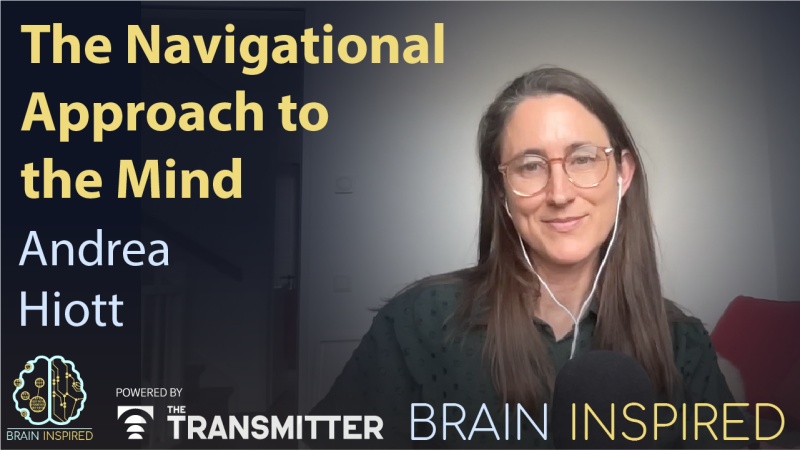
BI 248 Andrea Hiott: The Navigational Approach to the Mind
BI 248 アンドレア・ヒオット:心への「ナビゲーション的アプローチ」
Brain Inspired
要約
哲学者アンドレア・ヒオットが、新著『Holding Paradox』で提示する「ナビゲーション的アプローチ」について、司会ポール・ミドルブルックスと語った回。海馬の記憶研究と空間ナビゲーション研究という二つの歴史を題材に、二項対立を捨てずに矛盾を保持する姿勢を説明し、脳を計算機とみなす比喩の限界やAI観、意識論にも話が及ぶ。ミドルブルックスは、その主張を共有する共同体が実際にあるのかという懐疑も投げかけた。
この回のポイント
- ●ヒオットは、脳を計算機とみなす比喩がもはや比喩でなく研究の前提になっていると考え、これに代わる枠組みとしてナビゲーション的アプローチを提案している。
- ●「Holding Paradox」は中間や第三の立場ではなく、対立を否定せず位置による見え方の違いとして保持する姿勢だと説明する。海馬の記憶説と空間説の対立も、研究の進展に必要だったと位置づける。
- ●実験はより具体的であるべきだと述べる。迷路のマウスなら何の中を動いているのか、文脈をどう計算的に表現するかを明示する必要があり、計算ツールはそのために使えるとする。
- ●認知は生きた身体が環境と交換し整合し続ける活動であり、脳だけでは定義できないという立場を示す。この見方では、LLMは認知を行っているわけではなく、AIは「拡張知能」と呼ぶほうがよいかもしれないと語る。
- ●意識も覚醒と地続きで、世界との整合を重ねた結果、自分の身体や規則性に気づくことだと説明する。
- ●ミドルブルックスは、本が既存の共同体を前提に書かれているように読めると指摘し、懐疑的な見方を示した。ヒオットは、公式の場には出ていなくても多くの分野に収束の兆しがあると応じた。
章立て
イントロと本の楽観性
ヒオットの紹介と、批判ではなく創造と楽観を軸にした本であることの確認。
矛盾を保持するとは
心と身体の二分法を解くのでも否定するのでもなく、星座のように配置して開く姿勢を説明する。
哲学者が神経科学へ進んだ経緯と海馬
ベルリンでの学びと、幼少期の引っ越し経験から「動き」に関心を持ち海馬に至った経緯。
計算論的メタファーへの異議
本の動機である、脳を計算機とみなす枠組みから、ナビゲーション的な見方への転換。
対立と科学の進め方
記憶対空間の対立の意義、探索的研究との関係、実験をより具体的にする必要性を議論する。
なぜ今か:AIと認知
AI企業の使命文が前提とする認知観への批判と、LLMは認知か、生命と認知の関係についての議論。
遠近法主義との違いと意識
因果の茂みなど遠近法主義との関係、保持という動詞的姿勢、意識についての見解。
今後の仕事と共同体への疑問
次作『How to Be Alive』や今後の予定、共同体は実在するのかという問いに答える。
解説記事
神経科学の番組「Brain Inspired」第248回に、ハイデルベルク大学の哲学者アンドレア・ヒオットが登場した。新著『Holding Paradox: The Navigational Approach to Mind』をめぐり、司会のポール・ミドルブルックスと、脳を計算機とみなす発想に代わる見方を語り合っている。
批判ではなく創造としての本
ミドルブルックスは、この種の本は批判的になりがちだが、本書は何かを創り出しており楽観的だと指摘した。ヒオットはこれを認め、自身は現状に冷静でありつつ、この本は楽観的だと述べている。自分の立場は中間でも第三の道でもなく、複数の分野が取り組む試みをつなげて見せたいのだと語った。
「矛盾を保持する」とは何か
ヒオットによれば、これは心と身体といった古典的な対を解こうとも、違いを否定しようとも しない姿勢である。彼女はそれを「星座化(constellating)」と呼ぶ。たとえば目の前の相手が自分の「反対側」にいるのは事実だが、犬や別の人から見れば反対側は変わる。対比は本物でありながら、位置に依存した見え方だと理解することが要点だという。
題材は海馬だ。海馬には記憶の座という歴史と、認知地図・空間ナビゲーションの座という歴史がある。ヒオットは、両者の対立が研究を深めたのは確かで、この論争なしに現在の理解には届かなかったと強調する。ただしそこで止まる必要はないとも述べる。
科学の進め方への示唆
ミドルブルックスは、探索的に膨大なデータを調べる研究スタイルと、仮説を立てて検証する伝統的なスタイルの違いに触れ、二項対立を捨てれば科学は停滞しないかと問うた。ヒオットは、立場を持つこと自体は避けられず「何でもあり」ではないと答える。そのうえで、記憶と空間の違いは認めつつ、どの位置・文脈でどんな動きを扱っているのか(概念空間か、感情空間か、迷路のラットか)をより具体的に特定すべきだと述べた。
さらに、迷路のマウスが実際に何の中を動いているのかを計算的に表現するなど、計算ツールを使って文脈を精密に扱う実験が可能になると考えている。ただし自分にはその技術的スキルがなく、力学系や数学の会議で専門家に働きかけているという。また、各研究室が異なる文脈で同じ結果を再現すべきだという前提にも疑問を示した。
計算論的メタファーとAI
ヒオットは、脳は計算機ではなく計算もしていないと言い切る。計算そのものは愛しており、むしろ計算を脳のモデルとして使う限り、その可能性を使い切れていないと考える。OpenAI、Anthropic、DeepMindの使命文が人間並み以上の認知の構築を掲げていることにも触れ、認知が絶対的かつ十分に定義できるものとして扱われていると批判した。
彼女の考える認知とは、生きた身体が環境と交換し、環境に整合しながら自らを舵取りする活動である。この立場から、LLMが記号を操作するだけで認知をしているとは考えず、「拡張知能」と呼ぶほうがよいかもしれないと語った。本を読むとき、過去の経験に結びついた記号を通じて自分自身と交信するのと同様に、AIとの対話も説明できると見ている。ミドルブルックスは、認知と生命の関係には距離があるのではないかと疑問を投げかけ、小説を書くような高次の認知との隔たりも問題にした。ヒオットは、世界との整合という連続的な過程として説明できるので大きな断絶はないと応じた。
遠近法主義、意識、共同体
ミドルブルックスが、複数の視点で複雑系を説明する遠近法主義との違いを尋ねると、ヒオットは両者は対立しないと答えた。保持(holding)は動詞であり、一つの正解があると思う限り複数視点の考えには開かれない、その前提となる態度だという。意識については、覚醒や覚醒度と切り離さず、世界との整合を重ねる中で自分の身体や規則性に気づくことだと説明している。
ミドルブルックスは、本があたかも既存の共同体を前提としているように読めると指摘し、自分は懐疑的だと述べた。ヒオットは、公開された論文にはまだ表れていなくても、多くの分野で二項対立を超える動きが見られ、AIをめぐる不安や意味の問い直しがその背景にあると答えた。次作『How to Be Alive』は2027年刊行予定だという。
まとめ
本回の主張は、計算の否定ではなく、計算を脳そのものの説明と取り違えない姿勢への転換にある。実験設計を具体的な文脈に即して見直すという提案や、AI企業の前提する認知観への疑問は、研究者にもAI開発者にも考えるきっかけを与える。一方で、共同体の実在やAIが認知を行うかどうかについては、司会者の懐疑が示されたとおり、まだ議論の余地がある。
文字起こし(英語・自動生成)
Maybe we're at a point in the way we think about cognition that we could stop with the the proclivity to use machines as metaphors. What if we thought about it through a navigational approach? When you're really trying to understand what cognition is in any living system, whether it's a cell or it's a human or if you just want to look at a brain you cannot get away from what is this needful freedom which is that you're constantly having to exchange yourself as the environment i honestly say this out of deep respect for the the work that we call computation and out of a real kind of sadness that we are limiting ourselves through language which was not our choice. Most of us, unless you're weird like me, you have to talk like that, right? Why does it matter right now? I mean, a lot of tech people, I think, are really confused about what
cognition means. This is Brain Inspired, powered by The Transmitter. Welcome to Brain Inspired. I'm Paul Middlebrooks. Andrea Hyatt is a philosopher at Universitat Heidelberg, and she has various degrees across philosophy and neuroscience. You may know her from her podcast Love and Philosophy, or her way-making Substack, or her many writings elsewhere. Throughout all her work runs a central theme that we need to go beyond dichotomous thinking and learn to hold paradoxes as they are. Holding Paradox is the title of her new book, the full title of which is Holding Paradox, the Navigational Approach to the Mind. And that subtitle, The Navigational Approach, is the term Andrea uses for her version of what should replace the current computational metaphor of the mind. In the book, Andrea uses the rich history of research in a particular brain area, the
hippocampus, her favorite brain area, to illustrate what Holding Paradox is and what what the navigational approach is. The hippocampus is a good example to use because it has two parallel histories, one as the seat of our memory and another as a cognitive map, how we move through the world and how we move through our thoughts. So we discuss all of that and more in this episode. And, of course, I link to her book and her website and more information about her in the show notes at braininspired.co slash podcast slash 248. As always, you can support Brain Inspired through Patreon to get access to the full archive of episodes and all of the full-length episodes as well. Go to braininspired.co to learn how to do that. Thank you to my Patreon supporters. Here's Andrea. Before I ask you what the book is about and how you came to write it, one comment, this just hit me yesterday, and I don't know why because it's obvious.
Most books like this are really critical, and criticism is an easy path. I mean, it's hard. Everything's hard. But to criticize things is relatively easy relative to creating things. And one of the unique parts, things about your book is that you are creating something and you're optimistic, which is the opposite of criticism. So do I have that right? Is that an accurate reading? I think so. I'm definitely optimistic. I think I'm pretty sober about where we are in the world or kind of in life. But the book is optimistic for sure. I'm optimistic. I can't help but be. So I think it's an accurate reading. Yeah, what are we doing if we're not being optimistic? What's the point of spending so much of my life on these subjects,
which, I mean, I literally have devoted a lot of my life to this, or even just to writing. What's the point of writing books that take so much time and energy if you're not hopeful in some way that you can contribute to something? Also, I'm very hopeful. I studied these subjects, but I really try to think of this as like a community effort, even though a lot of times people think I'm on different sides than them because I am in this kind of middle. Holding Paradox is not a middle position. It's a third way. It's not even a third way. You just take that for a little while. But even because I'm doing this weird thing we are calling Holding Paradox, it can seem like I'm not on any one side. But really, I'm seeing how everyone's doing something very exciting and connected. And so that, for me, is really optimistic. I really want to show that or share that somehow. Okay. So I want to come back to this idea about community because the way that you write is as if there is a thriving community that's extant.
And I don't know that I buy that, but we'll come back to that. So what paradox are you holding in the book? I'm living. I'm alive, even though it's really hard. And I'm optimistic, even though it's really hard. But you mean in the book, I guess. And I think it has to do with classic problems or ideas or questions in philosophy, but also in cognitive neuroscience, just about what mind is and what body is and how we tend to think of those as somehow separate or somehow needing to be defined by one another. And what I'm trying to do here is none of that. It's, you know, what I think about is constellating. So it's not trying to solve them. It's also not denying that they're different in the way we use them. And that's what I'm trying to kind of open the space and hold here. And what I see that a lot of people in a lot of places are doing, Maybe they're not really tight-knit communities in the way that it sounds when you put it into a book form.
But I do think there are a lot of people working on problems in different niches that are showing us ways to do this. And that's not only in neuroscience and definitely not only in the hippocampus, but that's the example that I've studied so long and that I'm trying to illustrate this idea with through those examples and through sort of trying to tell the world, like, this is an interesting thing that's happening in science as well. Yeah, okay. So the book is in three parts. The first part is the memory story of the hippocampus. So the constant throughout the book is this idea that we need to define the function of a brain area. And there's this long historical track. Hippocampus is somewhat unique, and you're very excited about hippocampus. There are other brain areas that are like this, but you focus very much on the hippocampus because it has this long tract of being the seat of memory and being the seat of our spatial navigating through the world.
And you tell those stories through the people who did the research through the stories, quite in-depth, actually. You must have done a lot of research. A lot of it seems like you seem to know what people were thinking while they were doing the research. And I'm not sure. Maybe you can talk about it. Well, I mean, I started studying this as like a teenager. I mean, I went to Berlin to study German for philosophy and ended up going into neuroscience classes. And I mean, that would be another kind of story. But I've also talked to a lot of these people. I mean, I've worked in proximity or even I'm even friends with some of them. I mean, I think, like, Lynn Nadeau is in the book a lot, obviously, and he and I have had a lot of conversations. I mean, at least five of them are public, I think. So I did actually do the research in terms of trying to find the stories because I wanted to tell it. I mean, I also write other sorts of books, and I wanted to tell it in a way because it's so hard what I'm trying to express. I wanted to at least help it be a good story. Also, it is a good story.
I mean, I think it's a really incredible story, like all of these stories. It's a fun story, though. It's a lot of stories. It's a lot of stories, but they're all about this little, these, you know, sear-shaped areas of the brain, right? So it's kind of, to me, it's really just exciting anyway. I love other parts of the brain, too, like the cerebellum is a close second, but the hippocampus is for sure. Oh, really? You're going to eat one of those? And actually, I think the cerebellum does a lot of the same things, but that would be another story. Okay, yeah. But when you were in neuroscience classes, you were a philosopher. already, right? Yeah, my first degrees were in philosophy, and I studied German philosophy, and that meant I felt really weird because I was writing about Hegel in my thesis, but I couldn't speak German, so I moved to Berlin to study German, but also just, I'd always, I'd come to Berlin as a teenager once, and something about it, I just like wanted to be there, so I ended up trying to learn German, but also being in Berlin.
And I was also very interested in the brain already for different reasons, like some things in my family or friends, too, just things that I wanted to understand, like in this teenage kind of way where you think you can help people. I had this. So I've been reading about the brain a lot for that reason. And when I was in Berlin, some of the people in my class at the Goethe Institute were studying neuroscience. And so I was, like, very interested in it and, you know, talking about it in a very nerdy way. And so they invited me to come to their classes at Humboldt, which I'd gone to because Hegel and Alexander Humboldt were part of my whole philosophy, Humboldt University in Berlin. So I ended up sitting in on all these neuroscience classes with, like, Arno Villanger, I think it was. I wasn't really supposed to, but they were okay with that in, you know, in Germany. And, of course, I was completely lost because it was very neurobiology-oriented,
and they all had biology degrees, and I was coming from philosophy. But I was so hungry to understand. I really remember sitting in Arna's office, at least I think it was Arna. This was like 2004, and telling him, I really have to understand the brain. I really have to study it. There's no way I'll ever be able to get a biology degree to get into your program because I just I'm a philosopher. And so they let me sit in on the classes. And then weirdly enough, I actually ended up back in Berlin studying at the Berlin School of Mind and Brain, which he helped found not too long after. And which does exactly this. It allows philosophers to come study the brain. So basically I studied neuroscience as a philosopher. I was in all the labs and everything. And it's one of the first programs that really lets you do that. I think there's more now. So that's kind of how I got into all of that. But what was your question again?
Well, I don't remember what my question was. But why hippocampus? Because I'm sure they weren't just studying hippocampus in the classes that you were sitting in. So what drew you to the hippocampus? Movement. and I mean by that word everything you can possibly mean by that word in my philosophy I talk about it as mattering which is a whole other thing too philosophical probably for this but as a child we moved all the time literally like changed our position as a family and I noticed that in every place I was you know I had to re-acclimate and it felt I was like a different cognitive being. I, of course, wouldn't have expressed it that way at whatever age. But it really... Interesting way to express it. It really affected me, and I really did think about it. Like, wow, this is weird, because in certain schools, I don't know if you moved as a kid, but in certain schools, like, one thing would be super cool, or like, kind of everyone, nobody would make fun of it. They would think it's great. But then you do that same thing in another school, and you're, you know, you're
tagged, whatever, a nerd, or maybe you want to be a nerd. But in any case, every school had their own kind of vocabulary about all this stuff, right? This kind of abstract stuff, but the stuff that matters the most when you're a child. And for me, it was very weird. It was just like, what, how do I understand this? Also, just when you move to different climates or different social groups, the way that your emotions shift, the way that just, of course, I was not really thinking of it this deeply, but I was thinking of it as a kid and trying to understand in my journal and trying to read things about it uh and so for me movement the way that we literally move through the world uh was always tied to whatever i was trying to understand about consciousness or mind so that was always a theme you know whether i was reading poetry or whether i was reading philosophy or neuroscience and of course the hippocampus you know it's it's both of those right it's like so such a like what what a honey treasure honey pot or whatever you call it like
for a young person who cares about those things. So you have a real origin story in this regard. Yeah, it goes deep. Yeah, I mean, I'm not joking here. It's like one of those things you don't choose. Okay, so I told you this offline, and you actually, as the author in the book, you warn the reader, this is going to be difficult at multiple times. You're like, we're almost there. Too much, right? We're getting there. As I know, this feels hard, but we're going to get there, and then we get there. And I think that's right. You know, I'm a practicing neuroscientist, and I know, you know, it was enjoyable reading the histories. Again, I know about all the patients that you wrote about and the history. Actually, when I was in graduate school, Brenda Milner came and gave a talk at one of our retreats in our graduate school, and I remember one of my classmates trying to buy her a shot at the bar.
Did she accept? By that time, she was almost 100. No, she did not accept. She's still alive, right? I mean, how old is she now? I mean, she has to be 103, 104, something like that. That woman, she deserves a book of her own. She doesn't have one? I bet she has multiple. She probably does. She probably does. I think I read a lot about her, though. I don't remember. But anyway. Yeah. Anyway, it's clear throughout the book that you know you're doing hard work and that this is a hard message to deliver. And I think that you've known that for a while because you've been doing this through your podcast and through writings and through many other avenues. So I guess you have a sense of how difficult this is for people to accept. Would that be accurate? Yes, and also I think it's a little of trying to combine. I mean, it's what I do in the podcast too, but combine or bring together groups and ideas that don't normally share references.
So, you know, for you, it's really easy to read all that stuff about the brain, maybe even too easy at times because you know it. But someone else, that's very hard for them. I try to write it in a way that's not, but that's a whole lot of new information, you know, it's overload. But then on the other side, you know, of course I'm around philosophers all the time, and even within philosophy you have all these groups that are always, I won't say judging each other, but, you know, there's a lot going on there. There's competition. There's external judgment, but I think it's about legacy and competition perhaps. And even just that you try, you know, it's like this in neuroscience too. You need to find your group because you can't know everything, and you try to find your kind of place where you're going to publish or your lineage or whatever. And I don't really, I mean, my way is not, I'm not fitting into any one group. Maybe this goes back to when I moved so much as a kid.
I mean, I've always been a little bit interstitial, you know. It's for whatever reason. And this book is like that too. And I think what I'm trying to do is so important to me in a way And it's not like my, I didn't come up with any of this. What I'm just trying to do is present it in a way that I hope over time will make it easier for people to function between worlds in a little bit better way. Because I really think that is what we need to be doing right now. We need to be becoming much more careful and much more, what is the word, like, precise at the same time that we're opening up and understanding that there's no one group that's right in philosophy or neuroscience or anywhere. And that actually is part of the motivation of why I did all my degrees, why I wrote this book. What bothered me so much early on about studying mind is that, you know, you usually either study it as mental or as physical.
That's changing a little bit, but always having to decide these categories. And then on top of that, once getting into it, what really bothered me, which I this book is really about that, even though I don't think I mentioned it, is the computational metaphor that has not is no longer a metaphor. that it's like the way we have to talk about what we're studying. And that is the territory now. It frustrates me beyond belief, not because I don't like computation, because I do love, I love computation. If anything, I think computation is like the greatest thing that's come in the past five years. It's like obviously the greatest thing that's come. But we completely misuse it and we completely miss the point, in my opinion, in a lot of ways that I think are becoming very dangerous even now in the current AI environment just because of the things we assume, which we really aren't what cognition is, at least not for me. So, yeah, I'm getting on a bit of a soapbox here, but it matters to me a lot in that way.
And so trying to tell the story in a way that wouldn't just completely alienate, you know, everyone, but would just be like a story that you could read in many different layers, right, is what I was trying to do. Yeah. Okay, there's a lot of different ways you can go. But that's very hard to answer your question, and I know it is because I've gotten a lot of pushback. And because I'm trying to talk about things in many different environments all the time, and I know that in each environment it's a code switch, you know. You've gotten pushback. Yeah, of course. I mean, I'm a philosopher, so it's all about that. Well, yeah, okay. Pushback, not in necessarily a bad way, but just resistance, I think, is a better way to say it. Okay. What's the resistance like? I think healthy, and part of what this book helps me handle, because, you know, you need it. We all need it. But the point where it becomes negative, I think, is when we think that there is an absolute answer, whether it's in a very specific field of neuroscience or in philosophy or just in everyday life, then I think the hard thing is just being misunderstood, to really answer your question.
I'm always aware that I'm going to be misunderstood by someone, and I find that incredibly frustrating. And that's a lot of friction for me. Yeah, that's hard to remain optimistic than I would imagine. You just keep going, right? And you hope over time. What else can you do? Yeah, because you have the heart and soul inside of you that's creating things, right? So it's a beautiful thing. I think when you are in touch with that and you realize that you can be okay with being misunderstood, which, believe me, has been a hard process. I'm still dealing with it. I'm not saying that's easy. It's very hard. But once you get to the point where you understand that as long as you're, it really matters to you and you're really trying to understand, even if you are going to make mistakes. I mean, mistakes are wonderful. It gets easier, right? If you, if you can, because then I don't, at least, at least then I don't doubt myself. At least I know I'm trying from that place. So. Yeah. And as long as you can survive and maintain, you know.
Which is hard too. Yeah. Yeah. Yeah. Okay. That's why I've carved out this crazy life for myself. Yeah. Okay, so I asked you if it was hard, and then you took us down many different paths. And I want to revisit a lot of those paths, but I also want to ensure, I'm going to ask you a very stupid and simple question. I'm going to ask you to summarize what you're trying to do in the book and just to state it explicitly, and then we can move on from that. Okay. I should have a canned answer for this, but I don't yet because I've been doing too many book projects. But what I'm trying to do is through the story of the hippocampus, which I find very, very interesting, and through bringing into light a lot of research that's been going on over these past 50 years or so in neuroscience. And I can't talk about everyone, but I really try. Well, you talk about a lot of people. I try because it's very hard. You always end up having to leave people out.
But I'm trying to tell a good story in a way that I think is helpful for us to be able to understand that maybe we're at a point in the way we think about cognition that we could stop with the proclivity to use machines as metaphors. and to think about what if we thought about it through a navigational approach. I think I see this approach not only in neuroscience but in biology. I mean, I could go through the list, right, of the ways that people are trying to think about cognition at all sorts of levels, whether it's cellular, whether it's animal, whatever, in a different way, which is bodily, and which has to do with thinking about when we're assessing it, assessing it through a navigational framework instead of, I would say, a computational framework, which for me then means computation can become its full wonderful possibility.
As it is, yeah, by itself. I think so. I think we're hardly using it for what we could be using it for, for this reason. However, I don't explicitly say that in the book, but that's really what motivated it. I really want to shift us from a computational way of thinking about the brain, but not only the brain. Thinking about cognition as bodily with the brain, of course, very incredibly important. But I just want to open that up. I want to open up the possibility of stories that let us begin to do that. And I think the hippocampus is like the best example of it. There's many other ways. I think I even say that in the book. I could have chosen other things to tell the story, And maybe one day I will or someone will But I do think that kind of the motivation is how can we what about thinking of our assessments navigationally instead of computationally That really what at the heart of it But also at the heart of it is trying to give us a place, this third space to this threshold,
to kind of pause a little bit collectively as philosophers, as neuroscientists, to think about what we're really doing and rethink some of the things we take for granted, even when it comes to something like representation. No, let's not do that. Yeah, I know, dare I do this. But when it comes to something like representation or something like the way we tend to talk about higher and lower cognition or we think that because there's dissociation in what we think of as internal representations that it must be a completely different system. All these things which I think are, we're choosing either or frameworks at the expense of the very data and possibility that all of those researchers are giving. We're not using it fully. I know that's a little convoluted, but really at the heart of it is trying to kind of open up some paths of communication that don't always immediately force us to think in hierarchies, like let's think in heterarchy.
and also that allows us to think about context and bodies as part of cognition without that meaning that the brain suddenly doesn't have an importance. Like, yes, if you do something in the pons or the thalamus or these particular parts, if you have a lesion, okay, yeah, big things happen. This is obvious. We can't deny that. So it's not like, oh, everything is, cognition is only interaction. But that's the point, right, that why do we always fit one or the other? That bothers me, obviously, a little bit. And it bothers me because I think there's so many amazing thinkers and researchers doing such great work. And when you try to fit that work into these paradigms, you lose so much of it, I think. Yeah, okay. So I was going to maybe ask you this later, but I'll ask now. Like, I mean, dichotomies and labels in the language that we use, it makes things way easier because you can anchor something, right?
And you actually even write about that in a book. Like when you give a word to something, you essentially reify it. But then that colors everything that you do around that topic. But, okay, an example from the book, right? So you have the two lines of research in hippocampus, and you're using those two lines to show that we don't have to think about it in that dichotomous way, that we can hold a paradox. But do you need to have those two lines of research in order to get that other path, right? To arrive at that, it's almost like it's necessary to have had these two stringent lines of thinking almost. Does that make sense? Yeah, I hope I say that in the book. It's definitely part of my more, you know, like real, real philosophical stuff. I don't want to reject the either or.
No, you say that over and over in the book. Okay, good, because it's really, that's the hard part. That's the thing, right? How do you still realize how important it is to have contrasts and that there are real contrasts? at the same time that you understand that that's always going to be a positional kind of assessment, such that this is why I talk about constellating. I know it gets kind of crazy, but like a constellation of points. So if I'm like right now we're in rooms and across from you and across from me, there's an opposite, obviously. Why would I pretend like there's not an opposite to where I am right now? But if I think of my dog or whatever, someone else in the office somewhere, then there will be a different opposite. And even though it's a shared space, we're going to see those opposites differently. That's a really general kind of way of thinking about this. But just how do you have to understand that we have to somehow understand that we're not making a choice,
that we don't throw out using contrasts. But how do we use them knowing they're just one way to understand where we are in this particular position coming from a whole trajectory, you know, in a shared space. So then you kind of, it's just, I'm trying to open up the space. So, I mean, I couldn't have written this book without contrast. The contrast, which is surprisingly changing faster than I, it's funny because when I first started doing this research and going into these, like I found these labs really early on who were working on thinking about how we navigate concept spaces or abstract spaces or whatever, which gets into that middle ground, right, between mental and physical. Yeah, it's all navigation. Yes, all of that. And that's beautiful. That's like in the past 10 years that we've opened up this very ambiguous and yet incredibly computational space, which for me is just, it's been a huge gift.
But the point is, before that, let's think of like that Lisman paper from 2017. I don't know if you're aware of it, but it's in the hippocampal research. I think it's 2017. It's kind of like, is it a review? It's a little bit of like, let's look at the state of what the hippocampus is doing. And you have, you know, the side that's kind of, I'm caricaturing, but you have the side who thinks of it like relationally, like Eichenbaum, and it's for memory, right? Let's just put it like that. And then you have the side which, no, everything is spatial, and then the memory develops out of that. And so back then you still had these two very, I mean, it looks really like they couldn't possibly share space, you know. And you look at that paper and the way people are writing about it, and that's so important. All of that research, all of that dialogue, every, all of that, bringing Tolman in, you know, like you can't get to the understanding I write about in the book or the understanding that a lot of other people have in a much deeper way right now
relative to this area of the brain without all of that. But it also doesn't mean that that's the place to stop, you know. Yeah, I mean, that is, I mean, you just mentioned Tolman, and in a sense, I mean, there's nothing new under the sun, as Yuri Buzaki is fond of saying. I write that in the book, don't I? Do you write that? Yeah, he always says that to me, yeah. Oh, yeah, yeah, yeah. I'm pretty sure. Maybe it's not in the book, but somewhere I wrote exactly that as Yuri. Well, I mean, well, it's interesting because I was thinking about Yuri while you were talking there because of the way, so I just recently had Daniel Levenstein on, and he came up through Yuri's lab. And the reason I was thinking about this is because, you know, different scientists have different ways of doing science. And the way his lab works, at least through Dan's lens, is they have all these data sets. So Yuri is famous for, well, many things,
but more recently he wrote the book The Brain from Inside Out where he talks about how what we should be doing is paying attention to what's actually happening in the brain, not coming at it with all of our psychological preformed terms and concepts. And you're sympathetic to this as you write in the book. But maybe because of that, because of his views on the brain, And so when graduate students, again, I'm going to use one example, so I don't know if everyone has the same experience, but they have all these data sets that they've collected while it's a more exploratory role, right? So you kind of, the way that I see it, and this is the caricature, is you get in the lab and there's a data set and you're like told, find something, you know, explore, essentially, which is a very different way than saying, so, you know, the hippocampus is for memory, So we're going to study memory in the hippocampus, and we're going to make this very particular experiment with a particular question because we know it's about memory.
So we're just going to, you know, ask this particular question about the memory. So the theory, the viewpoint is already baked in. The assumptions are already baked in. And so there are different ways of doing science. And, you know, the method of alternative hypotheses is a wonderful way of doing science. But that depends on these dichotomies. And an exploratory approach is a different way. But you still have to advance. You still have to grasp onto something. And that's a very long-winded soliloquy I just gave. But in the background was a question about the process of doing science. I can imagine if you don't hold these dichotomous positions that you could become stagnant in your science. And so the question is, is it necessary to hold these false assumptions to actually make progress?
No, it's not. It's necessary to understand that you proceed through contrast and that you have to always have a position. You can't get away from having a position. You can't be, it's not anything goes. That's definitely not going to do anything for any of us, no matter what we're doing. And it's not true. It's from each position, there's always something that is going to be clear, and there's always contrast. So this is what's so hard, right? It's not that those contrasts are to be dismissed. They're really real. There is a difference between memory and navigation in the way that we use what those words mean for regularities. I'm not saying those are the same thing. It would be pointless to say that because we're studying very different things when we use those words. But you can also understand how if you constellate, if you allow the opposites to be what they are, but you sort of zoom out and think of what other points are in relation to it.
Then you can start to understand, okay, like from that position, that's the contrast. From this position, there's a different contrast. And I think the same can happen with what we study as memory and navigation, because what you have to do then is get really specific about the context. You have to get really specific about what position in what context and what's the movement. Is it a concept space? Is it an emotional space? Is it a rat and a maze? It actually makes, we have to get really, really much more specific in the way we do experiments. We can't even do experiments in a binary way if we try to consolidate. So this is, what I'm proposing here is really dissonant, and I think a lot of people push back just hearing what I'm saying, because it does call into question a lot that we take for granted in the way we do everything in science. But what it doesn't question is that there's contrast and that there's difference. that is like always the case. And Yuri is a really interesting example
because I'm pretty sure that listening to paper, he's one of the big voices there. And I'm pretty sure too that in that paper, he's starting to kind of go in a direction that's saying, actually memory and navigation aren't so different people and what we're studying here could be thought of in a different way. And I think Yuri, having talked to him, I went to his lab and toured it with him a while ago, I know that he is really interested in deeper questions about philosophy, and he's really smart. He really understands the way science works, and he's able, I think, to sometimes, right, understand that he's got to present things in a certain way, even if he understands it to be a wider picture. And maybe that change you described in his lab has come since that 2017 paper. I don't know. But I think a lot has changed in the past 10 years in the way that we use and collect and think about data.
And I feel that Yuri, I mean, he's very successful. but I do feel that he's constantly sort of pushing at the edges of what we're taking for granted. He's not the only one so yeah he's an interesting example to think about even that book he wrote which I do sympathize with if only because it helps us see the other side of the contrast. Right, right. I don't even think, I mean he probably does think that's like the real right total answer. I think he does. Yeah I think he does too but But I think in a wider sense, you know, he's actually opening up more dialogue with another position through having written that book, right, and taking that more extreme position. Which is super helpful, yeah. For me, it's been very helpful. That book is helpful. His work is very helpful in the way that we think about memory and navigation. I mean, his work with Edward Moser, the Mosers in general.
I mean, they've done so much trying to, what I would think of as, like, let this be a little bit more complex, which, again, I'm probably being over-generous by some people's measurements because everyone has their story that they're sure about. So I'm not trying to say that. Well, you have to at least pretend that you're sure about it. Yeah, we have to. That's a weird way science has worked. Yeah. And also just to stay motivated, right? and take care of a lab and have PhD students. I mean, it's a lot of responsibility. You do want to have some structure in place. Yeah. But you mentioned in that one of the repercussions here is that we need to be more careful with our experiments. And I had the, I guess the question in my mind is, you know, while reading your book throughout was, does this change the way I do science or does it change the interpretation that I give to any results that I get?
But you think it changes the way that we should do science? Well, probably not that book, but it's definitely what I'm overall aiming for. I think I wrote about it more in the master's thesis I did with the Max Planck at the Dole Lab and also with Nortoff, because I was trying to combine these very different ideas, again, in neuroscience towards sort of opening that. But I think larger picture, which I don't get into in that book, is I do think we have to change the way we do experiments. Who am I to say that? Nobody. I'm a philosopher who studied this. But do I really believe it? Yeah, I really, really do. I really think that we can do experiments differently. Right now they're set up in such a binary way, and we assume so much. we just assume words and we assume what we're looking for and we assume the context when we could be like we have the computational tools now to be so much more precise about what we mean
by i mean literally what the let's think of a mouse in a maze or whatever what are they literally moving through and how do we computationally represent that you know instead of just it's a or that's a very general example. But just if we're going to be very specific about thinking navigationally, then you have to be really specific about what the context is in a computational way. You have to somehow actually represent that. What do you mean? Do you mean measuring everything? Like what do you mean more specifically? Well, this is like a whole other line to go on, which isn't in the book. But I think what I really mean is using – We don't have to only talk about the book. Sorry to interrupt. But, yeah. No, no. I just don't want people to think I'm talking about this in the book. Oh, right. Okay. Yeah, that would be a wrong reason to buy the book. I really think that this constellation idea, Paul, I don't have, other people could do this better than me,
and I've been trying to ask them, believe me. I go to, like, dynamical systems conferences or math conferences because I don't have the skills to, I'm serious, I don't have the skills to kind of computationally create what I can see, but I can really, just being in these worlds, I can really see a way that we could be doing experiments that's so much richer and that's so much more computational, but not thinking of the brain as the computation. Like, that's such a hard shift for people to make, and honestly, I think it's so ingrained in our language and the way we do it. that it's become like a blind spot that we just were in this kind of narrow way. But what I really think we could do with the way we do experiments is constellate out of that you have an experimenter and then a person across from you and that you are trying to replicate the same thing all the time. It goes back to what I was saying about my childhood.
And I know very well just that when you move places, everything is different. And everything is the same at the same time. So, you know, it's not that you become a new person, but you can have a very different reaction in a new environment than you would have in the other one. And I don't know why we imagine our experiments are supposed to replicate in different labs, with different people, in different contexts, across the whole world. I just think there's a lot of ways there. It's because the hippocampus has a single function. That's why we think that. Exactly. yeah sure okay i think we know i mean yeah that's the the kind of danger isn't it paul that it becomes that uh too wide and anything goes and there's no structure um because we all know that hippocampus doesn't have one function even even that the way we think about the hippocampus maybe
We could think about other parts of the brain in a similar way, you know. We kind of know that if you study, but how do you take that position and still write a paper or start a lab or, you know. Yeah. That's hard. One of the things that I wanted to ask you about, specifically about the book, is that what you try to get across multiple times is that now is the time. It's important for some reason, like we're in a position now where this is the time where we can take this new way of thinking. But why? It seems like everyone around me is doing normal science, you know, in the CUNY and paradigm sense of normal science. Don't you think normal science is changing? Well. But I know what you mean. In neuroscience, normal science is I'm going to figure out what computation this part of the brain is doing. Well, that's not the future, I'm sorry to say to everyone, which doesn't mean that the research isn't the future.
Yeah. Well, you write confidently that you seem so sure of the fact that it will change. I am because the brain is not a computer, and the brain is not computing. I'm sorry, everyone. It's not computing. It's just not. And that we use those terms is not a bad thing, and it doesn't mean that all the research and data is wrong. If anything, it's much more right than you've been able to see because you're missing a lot of patterns by trying to fit it into a static input-output frame. Algorithm. Yeah, I honestly say this out of deep respect for the work that we call computation and out of a real kind of sadness that we are limiting ourselves through language, which was not our choice. Most of us, unless you're weird like me, you have to talk like that, right? And you have to just publish a paper. So it's no one's fault, by the way. But I do think right now it's incredibly important.
And there's a lot of examples that come to mind. I think right now we're capable of changing, first of all. But why does it matter right now? I mean, one thing that comes to mind is just thinking about, I mean, another side of my life has to do with AI, which, I mean, your brain inspired, but a lot of tech people, I think, are really confused about what cognition means. And a lot of that comes from all of this that we're talking about, right, this history of how we use these terms. I mean, if you look at, for example, the goals of open AI or anthropic or deep mind, And, you know, it's basically to build a system that's going to match or exceed human cognition. That's a huge thing right there, everyone who's working on cognition, which is every neuroscientist. So, you know, in their mission statements, they say really explicitly, like, that's what they're going to do. As if they know what cognition is.
Yeah, and as if it can be represented adequately and absolutely. That is not true for the same reason that my cognition in one town in America was very different from another, even though it was continuous. The place and the people and the experience and everything on your path up to this moment shifts what cognition is because cognition is an activity. It is a living process. Brains are really, really important for that. in humans, like I was saying, I mean, what's that story, the diving bell? We can't deny that if you do, if you have certain lesions in the brain, it's going to change what we've thought of in the past as cognition. But I do think that doesn't preclude opening up to understanding cognition as a bodily contextual process that can't be adequately or absolutely defined by computation
and that can't be represented in an AI system. This is a whole other can of worms that I'm opening here, but it's hard to think of a more important thing in terms of our overall, in terms of our overall, I was going to say psychosis, but our overall. our overall capacity for minds right now, like where we are as societies and as what we're choosing is important. And even even, you know, what we think of as the future, which affects all our jobs and all our ways of being in the world. So, you know, I've gone really broad there, but I actually think that that's part of the reason that this is so important to understand that we don't have to use the computational metaphor. There are other already much more adequate ways of considering this. It's going to hurt to change because of the language, but it's not as hard as it seems, actually.
I mean, if you think about, like, I just talked about DeepMind, I think, and it made me think of, um, isn't it Google? Yeah. Dennis Hasebus who was at the lab of Eleanor McGuire which was part of how I got interested I didn tell you that but when you were asking about how I got into the hippocampus when I was thinking about movement I been working in transportation and movement and so I found those taxi driver things of hers really early on. That was a long time ago. She did those. Anyway, I was really inspired by her. She's a woman in neuroscience or was. I'm sorry that she passed away. Anyway, the point is the reason I brought him up is he was working on the hippocampus, and navigation and memory and imagination in her lab. And this is just like there's so many. I'm thinking also I can't remember his name right now, but the guy with the thousand brains thing about where he thinks. Yeah, the hippocampus is like the model for how the whole brain works.
But also if you look in biology, Mike Levin talking about cells as the best way to understand cellular cognition through navigation or someone like Edward Hutch. I mean, I could go on and on. The navigational approach, which is just another way of assessing, is so already there and we already use the language. So I just think it's not that hard to maybe start thinking about what we're doing as less computational and more about how this brain, which is an active organ, dynamic, moving part of a moving body, is making its way through particular spaces from particular positions. And if you look at the data through that lens, which, again, is very, it's a dissonant thing at first, but it opens up so much more, in my opinion. Yeah, I mean, the thing about computation is it's very clean,
and there's something very satisfying. Yeah, I agree. It's like coding. It's so addictive in a way because it's just so... Yeah, it's really addictive. Yeah. You want it to be the territory instead of an app. I want to stay in there, yeah. Yeah. But it narrows me. I mean, I don't know about you, but when I'm coding, and I'm not a great coder, but I just like it, or even when I'm just online doing stuff you're supposed to do online, I get into a bubble, right? Like, my possibility space has narrowed so much in terms of my actual kind of cognition, and it feels like it's expanded, you know? You end up iterating, iterating, iterating, feeling excited about it, but not really doing anything different. But there is also this tension, right? Because I really appreciate what you said maybe 10, 15 minutes ago about the computational metaphor, just appreciating how fucking awesome it's been, right?
It's super exciting. I think we just are at the tip of what's possible with it. Right. Not the metaphor as a brain, though. As a brain, yeah, yeah. Well, but then you alluded to or you hinted at that that might be a problem, and you were just talking about Dimas Hacibus, you know, and you dropped all these AI companies, that that metaphor might be leading us astray in artificial intelligence. Can you expand on that, like what your worry is? I think it led us really far astray. And by the way, I'm not the person who hates all these people. I know that's like kind of popular to hate everyone right now who's doing all this stuff in AI. I really don't hate them. I really think we are at an incredible moment. This is crazy what's possible now in terms of just how convenient it can be now to do so much hard work. But I think there's a real, real big danger that, again, I don't know if it's someone's fault, but those mission statements, when I read them,
and when I look at the way that they just assume these words, it's really not true. It's just not true. Brains are not computers. We can't take the brain out. And if we know everything about, oh, how many neurons are there, 86,000 million, million, billion? Billion, billion. Billion, right, gosh. Even if we could know every single thing, this neuron is just one part of the brain. But anyway, if we know everything about all things, glia and everything, you can't take it outside of a body in context and it mean anything. I mean, we're very confused there about what living as a body with a brain and being cognitive is. and I see it very much in the current debate about AI and what AI means. And again, it's the same annoyance because I think we have this amazing moment where we could use this in such different ways, but if we think of cognition as the way we're assuming it,
the way all those mission statements assume it, then it's like we can find the absolute and adequate definition of it and we can just solve it. And that's not life. That's not living. That's not living. Okay, so ironically, like, my growth as a scientist and as, like, an appreciator of philosophy, I have come, with the rise of AI and computational neuroscience, it's actually, ironically, made me appreciate what life is more. And most people go on to, like, the opposite way. Like, okay, we can define this computationally. It's a machine. We can understand it as a machine. And so there are these differences. However, I'm open to the idea that if, depending on how we define cognition, it maybe doesn't have anything to do with life. And maybe that's a different, a separate thing. So because we have these systems that are doing cognitive-like things, right,
solving tasks. That's very cognitive, and they're not alive. No, it's not cognitive. I don't think it is. I'm sorry. I mean, I understand what you're saying, but I think artificial intelligence should be called extended intelligence. In the book, you say artificially intelligent, which is slightly different. I'm always trying out different things. Right now, I'm thinking of extended intelligence, because it always affords back to life and i don't i mean i don't understand how we can think about cognition outside of i mean i understand how we do it because it's the way we've set up the language and it's all that we've been talking about that we get to this point where we think that this that that llms are doing something cognitive because they're using they're manipulating symbols in a certain way that associates as our bodily experience as cognition. I totally get it, and it's very confusing.
That must mean they're conscious. I mean, that's a whole other thing, right? But even aside from that, I just don't think as software, as computer, I don't think they're doing what cognition is unless you think cognition is computational, which then you're in a circle, right? You've defined cognition as computational, and then you've said, oh, look, we created computational programs that do the computation. And to me, that's wrong from the beginning because when you're really trying to understand what cognition is in any living system, whether it's a cell or it's a human, or if you just want to look at a brain, you cannot get away from what is this needful freedom, which is that you're constantly having to exchange yourself as the environment. It's not even that you're exchanging something you own with the environment. You are literally exchanging the environment as your body. And for me, that is cognition.
It's what brains are doing as bodies. And I know to a lot of people that will still sound kind of like, oh, it's mystical or something. But no, it's actually just common sense that we've forgotten. It's biology. It's just biology. And I honestly have looked really deeply into all the science, and I've talked to a lot of the scientists about this. And for this reason, right, I mean, as research to try to understand maybe I'm missing something. And so the reason I say it confidently is because everything we crave and that is so exciting about AI is actually about life. It's just that we want that clean answer, and we don't want, we can't really handle the ambiguity and the messiness, and so it's really attractive for me, too. Believe me, I get it. but I really think if you look at it deeply in any subject, whether it's neuroscience or biology,
if you're really just being honestly, like, using common sense, you can't get away from the living system of it. And, yeah, we could talk about what life is forever, but just let me just say it's exchanging, it's systems exchanging, not even systems, that's hard, but it's mattering, right? It's that you're in a needful but also a gentle, like you do have agency. This needful freedom means you're constantly needing to exchange, but you're also able to, through that exchange, steer yourself. So I don't think we can have cognition unless you start there. That's what that whole tradition of what Varela and Odepliasis and I think what some of your other guests, when they're trying to think not about genes but about these systems of, I guess, like intrinsic motivation might be the word they would use.
I think they're getting at that, is that you don't have cognition in any sense, even the way we use it right now in neuroscience, unless you have that. But if you have a way to show me that that's not true, I would like to see it. But I just, I don't see that as much as I've tried. Well, that's the example that we have, is life blossoming into, so I'm not going to equate cognition and life. And I'm not sure that's what you're trying to do also, but there is cognition, there is life, and life gives rise to, cognition comes out of, like, life processes. But it's pretty distant to be a thermodynamically open system, maintaining oneself far from thermodynamic equilibrium. That's super, super impressive. But then to write a novel about a girl who grows up moving from place to place, you know, and just to come up with that.
I don't know where I get that idea. you know, to have that like in your head and like produce it and imagine all the scenes. It's such a far cry from this kind of struggle of existence, you know, that you're exchanging. That's really what I think the hippocampus story tells, honestly. And that's what I was trying to get out with the typical kind of examples of, gosh, I'm having trouble finding the words now. But when you're just, you know, when you're thinking about like a real cognition, we might call it or something where, you know, there's I'm thinking of Rodney Brooks and the whole all these kind of examples of like you can have you can say cognition is life in this most basic sense that I just described. But then how do you solve how do you understand real cognition or higher level cognition, which is what you just described, which is like someone writing. I didn't say that. I didn't say that was real cognition. I just said it. They would say, right. That's what they read. So that seems like such a big problem.
But if you go back to what I'm trying to express in the book and what I definitely try to write about in that master thesis, you start in a different place. So right now, even in spite of ourselves, maybe we're still assuming that computational starting place. But if you actually assume a place of, let's say, movement as first philosophy or something, I don't know. But if you think about what happens, like a being, your child, or any living being comes into the world, and you begin aligning with the regularities around you, exchanging yourself with that environment, it could be through hearing your mom talk to you, but it's also through everything in the room around you, what's on the TV, like everything. None of that is separate for the body. It's not like separate levels. So Yuri Hassan might call it direct fit. You're directly fitting with your environment as a kind of baseline activity, which is the body.
This is just survival. You're fitting with your environment. My other supervisor talks about it as aligning with, spatio-temporally. Buzaki might call it, what does he say, fitting with? I don't know. He has a way of talking about it. Everyone has a way. But so obviously I think we can accept that and that this is happening. And I think this is cognition. I mean, that is sense-making in a, if you look at Varela kind of tradition, or if you look at Hans Jonas, what I'm talking about, the metabolizing, the needful freedom, that is cognitive, as they take it. So you already have, it's not cognition in the sense of using language or being reflective or all the ways that we start, right, as humans, like we realize, oh, wow, we know ourselves. And so that's how we think of cognition. But if you think of it as just life, aligning with, fitting to, surviving, exchanging with the environment.
So then how do you get to something like real cognition, which is like solving math problems or writing novels? Chess. Chess is real cognition. Playing chess, yeah. Or go. Now it's gone. This typically seems like such a big gap. Even for inactive writers who, like Evan talks about mind and life as a continuity, but, you know, sometimes it can still seem like they're different things. Even, you know, because it's very hard to talk about. But I think if you think of it through a metaphor of, or not even a metaphor, if you think of it as this aligning with, fitting with the world, and you stop thinking in like as if the layer of talking to your mom and watching tv and reading a book is some other layer that it's just regularities your body is aligning with because it is that's what the body's doing we are bodies and we are aligning with everything we take in whether that's in conceptual space or geographical space or virtual space um this is what you're doing and And I don't think there's a gap there between the irregularities that you're taking in for language and so on and so forth and being able to communicate through representations like language or fMRI or whatever.
To me, you can understand those as more like natural statistics in a Barlow sense. Or, you know, it's what we're aligning with. And cognition is part of that. So then the question becomes, okay, so when something happens to what part of the brain is it? Is it the pons or the thalamus or the brainstem? When something happens and you become, like, locked in, but you could still write a novel, like the guy in the, is it Vogue? I'm not sure. The Diver in the Bell Jar, whatever that is, that book, right? He was locked in and then he wrote a book. So how do you do that? I think that to me doesn't feel like a problem anymore because you have up to that moment aligned with your world in such a way that you're communicating with your own self through those regularities. And so now that your body can't move in the same way, the communication with yourself doesn't change.
It's like if I broke my leg, I can still move my arm. um it's just that you know you have to find a different way to be able to express that than you would by moving your your mouth and so on that that's a really deep thing that probably would need a lot more explaining but i think if you really take this path you can get there actually not not in a mystical or hard way and you can still have a difference between what we think of as mental representations for example that is a kind of communication with yourself that you as a whole body begin to align with yourself in a certain way. That is different than the way you're walking to the park, but only different in the sense of the spatial, the regularities. So what's AI doing then? Well, I think AI represents the... And so this is like really complicated and deep stuff we're talking about here.
It probably sounds crazy. But AI uses language or symbols or what do you want to say, like code or, I mean, binary, you know, a lot of things, right? But those already fit in with this system. So like when we read a book, we're looking at representations that we've learned how to associate with particular actions. You know, so like when you read a book, you're not like going to the places in the book, but because you learned that those words associate with things you've already experienced in your life or that you can imagine, we could talk about memory and imagination, then you have that communication with yourself through the book. You know, it's it's like based on the same regularities. So I don't see how what we're doing with AI is I mean, it's a transformer model.
So it's really exciting. But isn't it really connected also to like I'm thinking of James Whittington and that I told him I can bomb model. that's really close to a transformer. And if you think of that navigationally through just the regularities, I just see that it's not a big puzzle to solve. It's just that we read so much into it when we're talking to what's your AI of choice. Do you have one? I'm not going to share that with you. Okay. I won't either. So whatever your AI of choice may be, when you're communicating with it, it's just gotten so good at almost being like a million books at once, right? It's the same thing happening when you read the book. You're communicating. You feel like you're communicating with these characters and people, because the associations are, because of your whole path up to that point,
when you see those representations, You will have a certain communication with yourself through that mediated entity that to me is no different than a lot of the other communication that happens in the body. It's just different because we, as a whole body, are in communication with our body. That's very, like, that's kind of very hard to get. But I just think that's what's happening with AI, too. It's amazing. It's crazy. it's like you remember when haptic screens came out even you are going to give that disclaimer that's what everyone has to say it feels that way right now I think in 10 years it won't I was going to say when haptic screens came out it felt crazy to me that you could touch the screen and that like whoa you just touch the screen and you do all this stuff that felt crazy and impossible it's completely explainable but also so complex and hard to understand that it seems magical.
I think there's something similar right now with LLM's. Let's switch gears here a little bit because so holding paradox is its own thing. Part of my growth as a scientist or as a thinker, I guess, is really coming to appreciate these really old ideas and philosophy about multi-perspectivalism, right? And especially in complex systems, like biological systems, we have what William Wimsack calls the causal thicket, where it's not so... Yogi. Yogi, yeah. I didn't know what you said. Yogi and I, he was going to come on with me and Yogi onto Brain Inspired, but I'm not sure if he's unwell or what. It was really hard to get him to... I thought he was recently just on to talk about Cyborg. That was Yogi. I was talking about Wimsat. Oh, I was talking about Yogi.
Yeah, yeah. Because Yogi is the one, I mean, he's always talking about Wimsat. Yeah. You were going to get Yogi and Wimsat to come on. Oh, wow. That would be great. Yeah, we talked about it. That would be great. It seemed promising, but then past a certain age, it's hard to get people onto a screen, perhaps. Understandably so, yeah. But anyway, yeah. Perspectivism or perspectivism or limited beings. That's part of it, right? Being a limited being. Yeah, well, so, okay, so what's different about, like, holding paradox versus multi-perspectivism, you know, or perspectivism, which is the idea that, which I didn't explicitly state, so let me just say what it is, essentially, is that there's, you know, there's not a, there's no one grand unified theory of something when you're in a complex world like this, in a complex system. Like the causal story is not a straight causal story because you have so much recursiveness and different levels interacting with each other, levels of organization, levels of size, levels of time, et cetera.
And so this idea of the causal thicket from WIMSAT, and other people have described it in other ways, is that the more ways that you can approach something in an explanatory framework, if they all cohere together well enough, we can talk about Hasef Cheng here if you want to, but if they all cohere, that is a robust explanation, and you actually need the different perspectives of explanation to characterize a system that is a complex system, essentially. How is that different than holding paradox? Well, I would say it's a verb holding paradox, right? And that's kind of the point. It's like the action that you, if you can't hold paradox, like be with this threshold, all that you just said doesn't happen. You know, you don't do it because you have to first. Because there's a right way. Because there's the single right way.
I don't think there's a right way. It's just that, like. No, I'm saying if you can't hold paradox, you think that there is a single right way. holding paradox allows you to say, to open up to perspectivism, perspectivalism? Yeah, but yes. And it's also just the recognition that there's always a view from somewhere, you know which is a very perspectivism kind of notion But you to understand there always a view from somewhere and that there many other possible positions you first of all have to be able to hold this kind of contradiction that what you are experiencing is right and that it's not the only way this can be experienced, you know? Right in the kind of limited being sense, in the causal thicket sense, you know? So I think of this notion, especially when we were talking about really like science and trying to understand that this isn't relativism and that it's also not like this idea that the theory mirrors the reality exactly.
So to be able to take all that research seriously that would be called relativism or whatever, these kind of either or sides that perspectivism or perspectivalism or causal figure, all that is actually offering another vision of, you first have to kind of understand that you aren't going to choose between them. but that they've been helpful in the same way that we were talking about memory and navigation. You don't discount them, right? Because that doesn't help either because then you just end up on the other side. You're not really doing the causal thicket thing. You've just found a new bandwagon, you know? So I wouldn't say that holding paradox or what I'm trying to express is different. I've talked to Michaela Masimi, for example, on the show, and I can't think right now who else, But those theories are some of the most inspirational for me, and I cite her a lot. I don't agree like 100% with it.
I don't agree with 100% of anything. That's kind of the point. But where Nancy Cartwright and the whole dappled world and promiscuous realism, I mean, all of these, I don't even remember who that is, but John Dufresne is who it is. But all of that is super inspiring for me because it's trying to do something very similar. So I wouldn't say like, oh, holding paradox is better. If anything, it's a way to appreciate all of that. I'm just trying to give it a little bit more of a – I'm connecting it more to the tradition of something like Gödel or Nils Bohr or paradox, where you're grappling with what can't be resolved and finding that not resolving it but allowing it to continue being and constellate and see what else is in connection to those is possible. To me, that's very close to something like the thicket or realizing the limited being
or this overall idea that we're always starting from somewhere. Well, it's almost a celebration of that aspect of who we are, I would say. Yeah, it's exciting, I think. I really do. I really think that we've barely begun to understand what we're capable of as bodies in the world and as inter-beings, you know, to get a little bit, you know, whatever. But I really think it's true. And I really think with technology, the way that we could explore that is so exciting. but it doesn't do any good if we can't hold the paradox, right? If we can't understand that no matter what position we're in, there will always be another way of viewing the same reality. So physics has embraced, like, perspectivism. Maybe they were the first to embrace it, which is interesting, and biology has really embraced that, understanding it's a complex system.
So I don't know if neuroscience is like late to the party to start to begin to accept that it's not like that you can't understand things in a single vein. I'm not sure if neuroscience has accepted that yet or if it's beginning to. So I guess my question is, you know, how unique is the idea of holding paradox? how important is it for something like neuroscience relative to other endeavors, scientific endeavors? It's kind of, I think we have to be careful the way we characterize neuroscience, because when I think, I was just thinking about like clinical neuroscience, where when I was at the Charité and I worked for this neurocure for a little while, and there were so many, one of the guys, Hegemon just won the Nobel Prize, by the way, But there were so many labs in one little space, and they were all doing pretty different things. Neuroscience is such a broad topic.
They were definitely holding paradox as a whole. Maybe not in each lab, because as we described, you kind of have to find your, like, this is what you're going to test. But I feel like when they all came together, it was not about which one of us is right. It was about what's finding, I mean, of course, in their best moments, right? What is going to be the best translation to the bench, you know? I think it's just cognitive neuroscience is really hard because we're talking about these subjects that are the most meaningful to all humans in the world. Let's just be honest. Memory, consciousness, like you just don't get any, like this is everything in so many ways. And so I think it's so young and it's so hard to even talk about all this stuff. much less try to test it, that we, and unfortunately, the computational language has sort of nailed things into a place that ends up making us feel like we have to be defensive.
coming a bit out of analytic philosophy actually I think I just think it's like early moments of what you were saying of did we need to have this in the hippocampus research like did we need to have the contrast it was helpful right it could have probably happened another way but it was really helpful and I think it's the same with a lot of things in cognitive neuroscience that the fight to have definitions of one way or the other was maybe important for establishing what's become a kind of field and now I think if we can shift out of the computational metaphor towards in my opinion something like a navigational approach but whatever and start using competition computation for its strength, then, yeah, I think we can have the thicket, and it can
be really rich. It's already sort of there. I mean, you look at consciousness, for example, the many different theories of it, and so on and so forth. But I think, okay, that's an example where I think the many people who hold one of those theories are not seeing all of the other theories and thinking like, okay, this is cool. I can hold paradox. They're thinking my theory is correct and we need to adjudicate between theories. That's true. But isn't it changing? Like I can't remember right now, but wasn't there this, wasn't there like a big effort to try to compare two or three theories and all the people work together? Yeah. Like Global Workspace and maybe Tonini or whoever. Honestly, I really think a lot of that needs to be re-evaluated through thinking of, you know, in the same way I was saying about the AI people, like we need to think about bodies in places and be more rigorous about what we're actually studying instead of using these big words like consciousness as if they're in brains.
Sorry to say. The fact that for humans we can do a lesion in the brainstem and knock out consciousness doesn't mean that the best way to explain consciousness is through a brain computation. That's a hard paradox to hold that I don't think we're holding yet. But if we do, a lot of that data that comes from those fields I think could be actually really exciting to pick up that scaffold and see what else is actually in that data would be really exciting. Did you ever believe that, if this is too personal of a question, that's fine, but what I want to ask you is whether the brain generates consciousness, receives, transmits, is permissive of, do you have a definitive answer to that, but also is whatever you think now, how different is it from what you thought 20 years ago? 20 years ago when I was first coming to Berlin,
and so I had probably really abstract ideas about all of that, and I'm probably very mystical. I was like a poet and stuff. By the way, your book reads a bit like poetry in places, so that tracks. So I hope that's good for some people. Others maybe, definitely not. But honestly, the movement part is still there. How do I think of consciousness? I mean, I think I go back to the most basic level of thinking about arousal and awareness and like a GLS kind of understanding of consciousness. This is very unpopular in AI circles. But yeah, like Glasgow scale, GSL. Glasgow scale, you know, where you're, so like when the medic arrives, they have a scale of how conscious you are. Wakefulness conscious. Hmm? Like wakefulness conscious.
Yes. But I think in the spirit of all we've been talking about, distinguishing from wakefulness, consciousness, arousal, all this, and this higher level consciousness is wrong. and that we are missing a lot of things because we it's the same way right the the real cognition versus yeah sure robots can move through the world and that's kind of that expresses what humans do as cognition when they move through the world but once you get to higher level it's something else this is the story right and i think it's the same with consciousness like oh we can talk about if you're conscious or not an arousal at this level of the body but that's not what we're talking about when we're talking about being aware of your own thoughts. I think it's actually this, if you follow the iteration of aligning with the world, you end up becoming aware of your own body and its own regularities. And that's what we mean by consciousness. And that it's not separate from what we mean by arousal and awakeness of the body.
It's just that the more you align with the world and experience, the more conversations you have, the more books you read, the more you learn ways to represent and communicate with the world and with others, the more probably you need brains, right? and so the brain for a lot of that is doing probably in prefrontal cortex and whatever a lot of that communication of the body with itself is being made possible probably through you know the brain um in humans but there's all kinds of levels of of what what that can mean So I don't think of consciousness as separate from what it means to be awake and alive. I think of it as something amazing that's happened through all of this life evolution of all kinds of life forms
that we've found a way to communicate with each other through representations like language, images, and so on. and that's helped us then notice that we are subjects and communicate with ourselves and that that is really what we mean when we talk about consciousness and that there is something special happening in the brain, but it's not special in a way that's disconnected from how special it is to be a conscious body, an awake, aroused body. Holding Paradox is the book that we've been talking about mostly, although we've veered off course here. That's the book that's out already. How to Be Alive is a book you just submitted. When will How to Be Alive be out? I think in about a year. I don't know when this podcast will come out, but The Holding Paradox comes out pretty much now. And then, yeah, that one comes out, I think, in 2027.
Why are you so prolific? I don't know. I, I, uh, that's another story of my life that I'm sure no one really wants to hear right now, but I've just, I've just been writing to make money and ends meet for a long time. A whole other part of my studies was in, um, like urban studies and transportation and things like this. And someone told me that you don't want to be known as the person who wrote the book about the beetle. That's not what you want to be known. Did Yogi tell you that? I'm not going to tell you who told me that. I don't think I ever told him that, but it's probably, it's definitely, it's a little weird, right, to be known for writing a book about the beetle. Well, honestly, I wouldn't know. That book is about all the stuff we're talking about. If you read it, it's about holding paradox. It's about, because that happened when I was in Berlin and I realized that the Volkswagen Beetle was created by Hitler. I mean, I'm Oh, I didn't know that. Yeah, I didn't either until I ended up in Wolfsburg,
and I associated that car with love and Janis Chaplin. And so I was like, what? How can this car be the sign of love and peace? And it was started in Nazi Germany. So there you go. You've got to hold paradox. You've got to hold some paradox there. That's what that book is, actually. But, yeah, anyway, the point is I started, I've had a lot of different layers of life, and a lot of it was writing. So a lot of the way I've been able to do Be Free and study what I want to study and not try to write papers that are about what matters to me has been that I've also found a lot of other ways to survive and be alive in the world. And writing is one of those. That's why I'm prolific, I guess, to answer your question. I see. Well, tied to that question was what you're working on now. Anything new and interesting? or do you feel burnt out from having written 100 books in 20 days? I'm honestly really exhausted. It's been such a hard couple of months,
and my cognitive state, based on the spaces I've been in, whether geographically, emotionally, or otherwise, is pretty, like, I'm recovering, I think, from the books, but just other stuff too. Right now I'm working on the philosophy side of it, So I want to do a monograph, which is actually more about the real philosophy, and there's people interested in that, and so that's what I'm working on. But I'm so kind of exhausted at the moment that I'm trying to take a break from that. I mean, the next thing I have is I'm going to Models of Consciousness, Mach 7, tomorrow, or this soon, which is about, you know, it's just a conference about consciousness, where John O'Keefe will be and Evan Thompson. Although, actually, I think Evan's not going to be there. But anyway, I'm doing that. I'm trying to present some ideas of how to think about what the navigational approach might look like philosophically at different conferences and stuff,
and also working on that monograph and teaching intro to philosophy and stuff like that. I won't take up much more of your time here, but one of the things that comes across in the book is you write as if there's like, what it feels like when you're reading the book is that there's this already established kind of community that you're a part of, that people feel already, you're surrounded by people who feel the same way. And or sometimes it reads like the field knows the neurosciences, cognitive neurosciences field. Oh, yeah, everyone agrees that this is the time to move forward in this way. And I think I told you offline, like I'm surrounded generally by people that I would not consider to be in that field or even have thought about it in some cases. So am I misinterpreting the reading, or are you really surrounded by a community that feels the same way?
I think there are a lot of people who really sense the main ideas of that book in a really profound way. I really do feel that in a lot of my communications. A lot of it isn't necessarily public stuff, right? I mean, it's not in the papers and stuff yet, but I think there's hints of it. But I also think, you know, because I do this other podcast, which is talking to people in all kinds of fields, there's a lot of convergence around considering what it would mean to think beyond either or. And that will sound really trite to some people. But I feel like a lot of people are really finding a crisis in terms of they want motivation and meaning. They want their work to matter. They're worried about why, you know, that technology for their kids or for what it means for their work.
We can all live in our bubbles in our scientific world. But I do think we're reaching a moment, and a lot of people feel it. Maybe you don't, but maybe you do. I don't know, where a lot of the tasks and motivations and even a lot of the stuff like paper writing and grants and all the metrics that we've all depended on, me less so, but that mean a lot to me and that I respect a lot. All of that is shifting just a little bit and it feels very uneasy. and I just think that recalibrating and considering why we're doing this and what it matters for is not something that is, yeah, it's close to the surface for a lot of people in my life that I've, not necessarily people I've even talked to or that are in the book, but just in general across many fields, yeah. But I also think there's a kind of, like I was saying before, there's a sort of strange, I still want to call it a psychosis,
but the way we're thinking about AI, it's definitely pushing us to a threshold, I think, in terms of the way we understand cognition and maybe the role that neuroscience plays in that. Because if what I said is true about that we're confused about what cognition really means in the way that all the biggest companies and the richest people in the world now literally make their living from, then what better place to begin to shift that, change that, think about that differently than neuroscience? I think you're more optimistic than I am. You know, I'm a recovering cynic, but I think I still have deep cynical roots. And it's hard to see the world moving in a direction that I don't know. I see it's hard for me to be optimistic seeing exactly what you're saying, all these companies making these assumptions and making millions and millions of dollars off of these assumptions.
I see it in students and young people, to be honest. I mean, that's always the cliche, but, you know, once you get older, you see it in younger people. But honestly, I really I don't think people like this world or want it. And that's a really general statement. But and there's so much more possible. And it doesn't mean rejecting it. It just means we have to reprioritize and calibrate differently and demand differently. And I see people doing that. I do. I think I also see what you're talking about. and when I'm in certain environments, it feels really very far away from what I'm talking about right now. I get what you mean. Like, just everyday life in some ways doesn't feel at all connected to some exciting shift in the way we do science. However, I bet if you really, you know, a lot of people are just trying to survive, and, like, they have families, and they're just doing what they have to do.
Of course. And this is there's nothing wrong with that. The shifts come fast these days. So if if people in neuroscience began to reprioritize in a certain way, it shifts, it shifts quickly. Right. It shifts very quickly. This is what just happened to us in terms of how we think about LLMs and machine learning and all that. And reprioritizing towards reconsidering cognition in a way that is not absolutely or adequately knowable in the way that we're all taking for granted right now, I think could be really powerful for all the things we want as scientists, including all the kudos and the ego stuff and all that as well, because it's part of it. Let's not pretend that it's not. We need motivation. Okay, Holding Paradox. I will link to it in the show notes. I don't remember if we talked about it during this conversation or our last conversation offline, but it's a challenging and enjoyable read. It's filled with so much history, even just from learning about the history of neuroscience, people can glean a lot from it.
And all those classic stories you tell very well with a little bit more color than I'm used to reading in other texts. So I love the book. Thank you for coming on and sharing some of the stories from the book and outside the book with me. Thanks for being here, Andrea. Thank you, Paul. Thanks for all you're doing. You know I love your show and have major respect for you and what you're doing. So keep on keeping on. Brain Inspired is powered by The Transmitter, an online publication that aims to deliver useful information, insights, and tools to build bridges across neuroscience and advanced research. Visit thetransmitter.org to explore the latest neuroscience news and perspectives written by journalists and scientists. If you value Brain Inspired, support it through Patreon to access full-length episodes, join our Discord community, and even influence who I invite to the podcast. Go to brandinspired.co to learn more.
The music you hear is a little slow, jazzy blues performed by my friend, Kyle Donovan. Thank you for your support. See you next time.
番組の概要欄(原文)
Support the show to get full episodes, full archive, and join the Discord community. The Transmitter is an online publication that aims to deliver useful information, insights and tools to build bridges across neuroscience and advance research. Visit thetransmitter.org to explore the latest neuroscience news and perspectives, written by journalists and scientists. Read more about our partnership. Sign up for Brain Inspired email alerts to be notified every time a new Brain Inspired episode is released. To explore more neuroscience news and perspectives, visit thetransmitter.org. Andrea Hiott is a philosopher at Universität Heidelberg, but she has various degrees across philosophy and neuroscience. You may know her from her podcast Love and Philosophy, or her Way-making substack, or her writings elsewhere. Through all her work runs a central theme, that we need to go beyond dichotomous thinking and learn to hold paradoxes as they are. Holding Paradox is the title of her new book. The full title is Holding Paradox: The Navigational Approach to Mind, and that subtitle, the navigational approach, is the term Andrea uses for her version of what should replace the current computational metaphor of the mind. In the book, Andrea uses the rich history of research in a particular brain area, the hippocampus, to illustrate what holding paradox is and what the navigational approach is. The hippocampus is a good example to use, because it has two parallel histories- one as the seat of our memory, and another as a cognitive map, how we move through the world and how we move through our thoughts. Andrea's website. Book: Holding Paradox: The Navigational Approach to Mind Podcast: Love and Philosophy Substack: Way-making Radical Embodied Relation at any Scale, from Remembering to Navigating. 0:00 - Intro 3:01 - Creating vs criticizing 5:25 - Holding paradox 9:04 - Neuroscience and philosophy 11:42 - Hippocampus and movement 18:05 - Computational metaphor 30:52 - Ways of doing science 43:25 - Why is now the time? 51:34 - Navigational mind and AI 1:09:27 - Perspectivalism vs holding paradox 1:21:31 - Consciousness 1:25:38 - How to be alive 1:29:26 - Holding paradox community?
出典・この記事について
- 番組
- Brain Inspired(Paul Middlebrooks)
- 元の回
- BI 248 Andrea Hiott: The Navigational Approach to the Mind
- 配信日
- 要約作成日
- 公式サイト
- braininspired.co/series/brain-inspired
この要約・解説記事は、元の音声を文字起こしした内容をもとに AI(Claude)が日本語で作成したものです。 固有名詞や数値に誤りを含む場合があるため、正確な内容は元の音声でご確認ください。制作方法について