
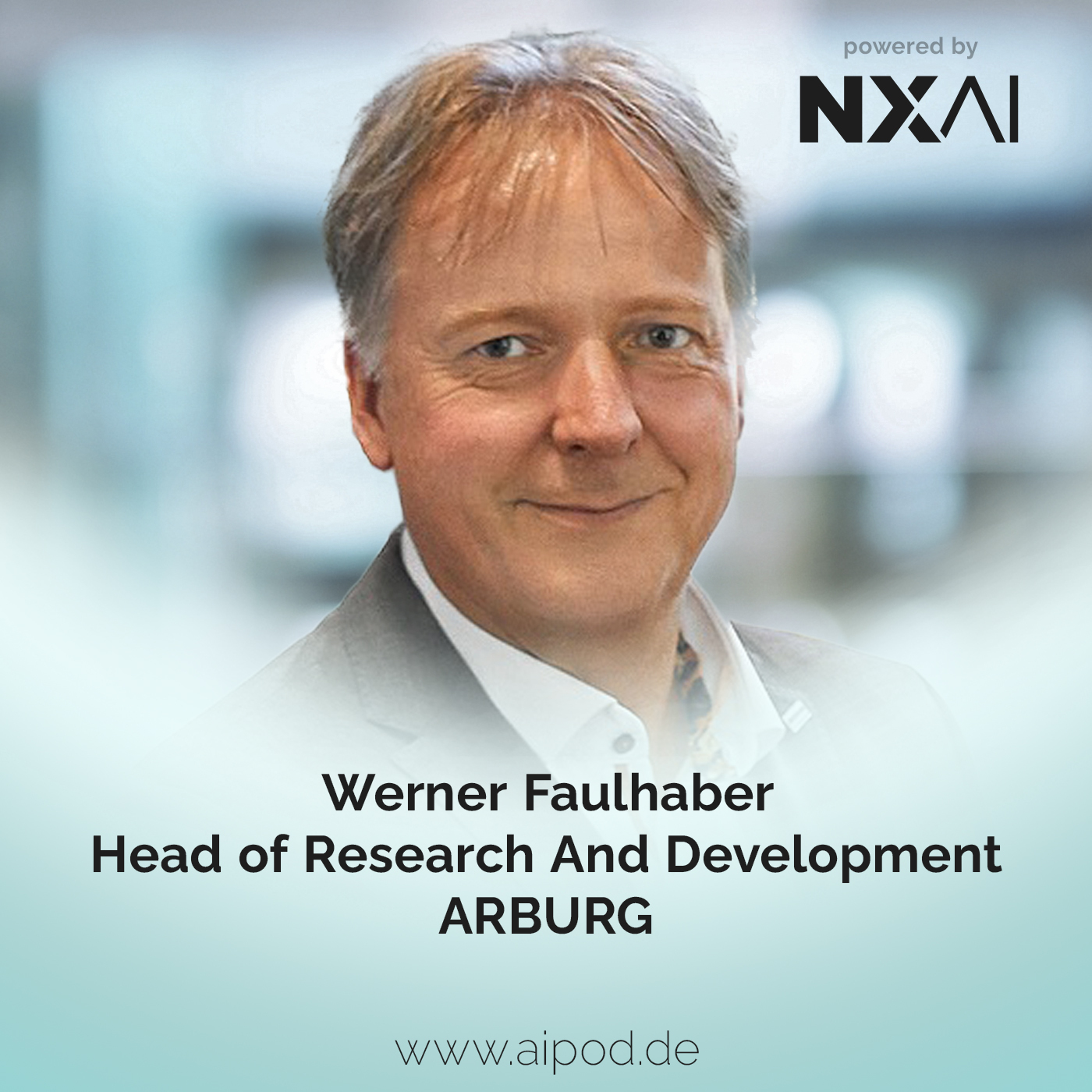
時系列は産業AIで最も過小評価されている領域 ― Arburgが語る射出成形×AI
Industrial AI Podcast
要約
Industrial AI Podcastの回。前半は司会2人がSchneiderによるPTC買収などを雑談し、後半でArburgのStefan LampとWerner Faulhaberが登場する。4年前に掲げた「Urモデル」構想が、独自の小型時系列モデルから時系列基盤モデルの活用へ移った経緯を語る。プロセス安定性予測、パラメータ推奨、シミュレーション活用、エージェントの安全性、クラウド接続や予知保全の課題、AIの価値測定にも話が及ぶ。
この回のポイント
- ●Arburgは4年前、再利用可能なベースモデル(Urモデル)とフェデレーテッドラーニングを構想したが、顧客データの入手が想定より難しく、フェデレーテッドラーニングは「ベンチ入り」で長期課題になったと述べた。
- ●2023年後半に約5MBの自社時系列基盤モデルを合成データで訓練し、品質パラメータが公差から外れる兆候を予測する「Stability Assist」に使っている。現在は外部の時系列基盤モデルへ移行する方針。
- ●競争優位はモデルを持つことではなく、機械パラメータや工程理解といったドメイン知識を適切なモデルと組み合わせることだと強調した。
- ●エージェントによる機械パラメータの直接変更には懐疑的で、まずは根拠付きの推奨から始めると語った。課題はOPCインターフェースにパラメータの意味情報(セマンティクス)が欠けている点。
- ●予知保全では異常検知より分類が難しく、現場データと30年分の部品表・サービスチケットを結びつける運用プロセスが鍵だと述べた。
- ●AIの成功指標は段取り時間短縮、不良削減、故障対応時間などに加え、開発者や顧客がどれだけ実際に使うかという採用率も重要だとした。
章立て
Schneider・PTC買収の雑談
SchneiderがPTCを約220億ドルで買収する提案について議論。エンジニアリングAIの観点や、既存ソフトの価値が下がるという見方が語られる。
ロボット指・AI教育などの小話
触覚グローブの調査で3本指が作業の大半を担うという話や、LMUのGitta Kutyniok氏の「人間+AI」という視点が紹介される。
Arburg登場とUrモデル構想の4年後
ゲストが自己紹介し、4年前のUrモデルとフェデレーテッドラーニング構想の現状、独自時系列モデルから基盤モデルへの移行を説明する。
ドメイン知識とチャットボット・エージェント
汎用AIは自社機の固有知識を持たないため、Ask ArbokのRAGで補う。エージェントやMCP、OPCのセマンティクス不足についても議論。
Stability AssistとPlus10、クラウド課題
品質安定の予測機能、Plus10のパラメータ推奨との連携、クラウドコストや接続・データ主権の課題を語る。
予知保全とシミュレーション
異常の分類には現場データが必要という点、First Shot AssistやDOE Assistによる立ち上げ短縮を説明する。
サイクルタイム最適化とR&DでのAI活用
多目的最適化に時系列基盤モデルを使う構想、顧客のAIへの関心、特許分析やトークン予算の話題。
今後の展望とAIの価値測定
NXAIとのプロジェクト、ロボットや世界モデルの構想、段取り時間短縮や採用率などによる成果測定を述べる。
解説記事
産業向けAIの現場では、時系列データの扱いが静かに重要性を増している。今回のIndustrial AI Podcastでは、射出成形機メーカーArburgのStefan Lamp氏(データ分析チームのリード)とWerner Faulhaber氏(研究開発担当VP)が、4年前に語った「Urモデル」構想の現在地と、時系列基盤モデルの活用を語った。冒頭ではホストらがSchneiderによるPTC買収提案など業界ニュースも雑談している。
前半の雑談:エンジニアリングAIの見立て
番組前半、ホストのPeter Weber氏はSchneiderがPTCに220億ドルを提示したことに触れ、これは単なる統合ではなく、各ソフトが蓄積した知見をAIに取り込み「Schneider personal AI engineer」のような形で提供する狙いだとの私見を述べた。個別ソフトの価値は5年ほどでゼロに向かうとも語っている。一方、共同ホストはこれを設計領域の穴を埋める動きと捉え、SiemensによるAltair買収と並べた。
Urモデル構想はどうなったか
Arburgは4年前、射出成形の工程全体を見据えた再利用可能なベースモデルを構想し、顧客が現地で追加学習し、フェデレーテッドラーニング(生データを共有せず知見だけを共有する学習)で知識を横展開する計画だった。Faulhaber氏によると、フェデレーテッドラーニングは「ベンチにいるが試合から外れてはいない」状態で、有用なベースモデルと明確な顧客価値がないと成立しない「鶏と卵」の問題があった。顧客データは想定より集めにくく、射出成形全体のエンドツーエンドのシミュレーションもない。そこで2023年後半、合成データで時系列予測の一般的なパターンを学ぶ約5MBの小型モデルを自社で訓練した。これが、品質パラメータが公差を外れそうな時期を予測する「Stability Assist」に使われている。その後、時系列基盤モデルが次々登場したため自社開発は止め、Tirex 2のような既存モデルの統合へ軸足を移した。
競争優位はモデルではなくドメイン知識
Faulhaber氏は、AI技術自体は誰でも使えるようになり、優位性は適切なモデルを工業の文脈で使いこなす力にあると述べた。機械のパラメータ化、工程理解、モデル出力が技術的に妥当かを判断する力である。Lamp氏も、ChatGPTは公開情報で学習しているためArburg機のパラメータや使い方には答えにくく、そこを補うのが自社の役割だと語った。現在は社内ナレッジ検索型のチャットボット「Ask Arbok」がRAG(検索拡張生成)で取扱説明書などから回答しており、アラーム対応やメンテ手順の案内にも使える。背景には顧客側で射出成形の専門家が減っている事情がある。
エージェントには慎重、通信層も課題
エージェントによる機械パラメータの自動変更には両氏とも慎重で、まずは理由付きの推奨にとどめる考えだ。次の段階として、機械設定や直近の信号を参照するツールをエージェントに持たせる構想がある。課題として挙がったのはOPC UAなどのインターフェースに「そのパラメータが何をするか」というセマンティクスが欠けている点で、MCPへの切り替えだけが解ではなく、意味情報のデータベースを与える方法もあるとLamp氏は述べた。クラウドについては、コスト、工場の接続環境、IT統合、データ主権が障壁で、オンプレ版や5G内蔵機で対応しているという。Plus10のパラメータ推奨ツールも、Webインターフェースを制御系に統合して展開を簡素化する。
予知保全、シミュレーション、価値の測り方
予知保全では、異常検知は難しくないが、それが良いか悪いかの分類には現場データが必要だとLamp氏は指摘する。故障前後のデータを回収する運用プロセスが本質で、30年分の部品表とサービスチケットの突き合わせに期待を示した。新プロセスの立ち上げでは、シミュレーションを使う「First Shot Assist」を発表予定で、数百サイクル要する条件出しを10回未満に減らせると述べた。これは古典的シミュレーションでAIではないが、DOE Assistで実験を自動実行して質の高いデータを得れば、AIモデル改善につながる。サイクルタイム最適化は品質・稼働率・部品寿命を含む多目的問題で、時系列基盤モデルによる予測が有望だという。成果指標としては段取り時間、不良、トラブル対応時間などに加え、開発者や顧客が実際にAI機能を使う採用率を挙げた。
まとめ
今回の話で興味深いのは、独自基盤モデルの構築を早々に切り上げ、外部モデルとドメイン知識の組み合わせに競争軸を移した判断だ。時系列基盤モデルが現場のパラメータ予測や最適化にどこまで効くかは、顧客データの入手や運用プロセスに左右される。日本の製造業にとっても、AI導入の障壁がモデルではなくデータ回収、接続環境、意味情報の整備にあるという指摘は示唆に富む。
文字起こし(英語・自動生成)
This podcast is presented by NXAI, your partner for Time Series Foundation Models and Physical AI. Hello, everybody, and welcome to a new episode of our Industrial AI Podcast. My name is Robert Weber, and it's a pleasure to talk to Peter Weber. Good morning, afternoon, evening to you, Robert, and to all of you, dear listeners, wherever you are. Wherever you are in the world, you are sending out of the caravan, Peter, right? Yes, I'm in the country that yesterday celebrated their national holiday because it was, I don't know, I don't know how many years ago, 1492, Columbus arrived. I think what is today called San Salvador. I'm not there. But the country who celebrated their nationality yesterday, that's the country. So you're still in Europe, I think.
That's the quiz now. Yes, exactly. That's the quiz. I'm going to be asking more questions, actually, today. Me too, because I caught up in trade show fever because FACUMAR is running, right, which is our main feature. It's all about FACUMAR in the main part. So I suggest I will let you take the stage, Peter. Oh, yeah, very good. Yeah, the big news of the last week, I think, at least as far as I could see, was the fact that Schneider wants to buy PTC. That's the one I saw. So there were so, so, so many comments. And I think it's very, very, it is very interesting. I think this is more than just one of the major automation companies buying consolidation. Yes, implicitly it is also about consolidation, I believe. So Schneider offers $22 billion. Is that too much? That's one question. Amazing. Is this about CACs? So computer added X. Computer added X for design.
Computer added design. That's where I come from. That's what I studied. Engineering, whatever. Is this about a new AI way of engineering? Is it about those? Let's discuss. So where I would like to start maybe very quickly is because I think this is a big thing. Now, for me, let's see what for you, Robert, who is and what is Schneider? I have known Schneider as a French automation company mainly for building and lately maybe also data center automation. So I'm a main supporter. And as I was looking in a former role of my life at all the different communication protocols, there's hundreds, right? And they are a big supporter of this BACnet. BACnet is the Building Automation Control Network Protocol. Is that how you've seen Schneider, roughly? No, I also see Schneider in the automation business. So in our industrial automation business, I think you can compare Schneider with Siemens.
So it's the French Siemens. They are not building trains, right? but in the whole automation business. And I think Schneider is also in the field of robotics, evaluating stuff there. So I think they're in the whole automation loop, in the whole automation circle when it comes to PLC, to robots, to data centers, to energy. But when I was at GTC last year, Jensen promoted Schneider as a data center partner and the whole stuff. I would have thought so, yeah. Yeah. And I think that's a huge market for them. the whole data center market too. But yeah, I think you can compare it with the Siemens guys, I would say. And there's also some management exchange between Siemens and Schneider. Yeah, if this is going to go through, they're going to become closer, right? So let's see. PLC is, you know, they offer a range of digital solutions, computer design, product lifecycle management for industrial manufacturers. I haven't been that close to them. I'm not sure if you have been.
So if we look at exactly what you said, and maybe I've known only one section of Schneider. So starting with, if they were, at least they were just building lately data center, plus what you know, they've been doing also in industrial automation. Now, they bought Aviva, right? 2023, last week, I had David Rodriguez interview. We had him live. He said, you know, PI system is his bread and butter. And after, you know, started with OZ Soft, he explains that that was bought by Aviva. So that was one of the things actually now is belonging to the Schneider Group, right? So all of MES systems maintenance in its portfolio. And then also June of this year only, I think they announced the definitive agreement. So I guess it has gone through then of the Norwegian. Norwegian, we talk about a little bit countries here as well, because after all, this is going to be a consolidation, concentration of European,
at least European-based automation activities, right? And they are acquiring the, what is it, industrial AI data management, Cocknite, and they serve industries like energy, process, etc. That's huge. That was huge. And now they're going to add PTC. So, yeah, so along this complete, let's say, lifecycle management, the stream, they are adding now more upstream, I would say. So it's all the computer-added design, which maybe in the past they did not have. PLM stuff, right? Yeah. Yeah, but also computer-added design, really. So it's more like the upstream, like before you start maybe designing whatever it is that they've been building, that's maybe what they didn't have in their engineering. But it's interesting because you can't compare Altea or PTC, right? But remember last year Siemens acquired Altea, the engineering simulation guys? So the big automation players going fully into engineering CAD, CAM, simulation stuff.
That's very interesting, I think. Now, what, yeah, and what for me this is, what it is that they're doing, I believe, is that they're not just thinking of, you know, I have one product, I have two, I have three, I have four, and they come after each other. So that's always about integration, which almost never happens. It's so difficult. Now, it's not only the integration of the humans. I mean, we as humans are the most difficult part, typically, because we are like children sitting in a sandbox. Sometimes we're very happy, but sometimes we're not that happy. We don't want to play with the other children, right? So we are the biggest. So my point, my personal perspective, and the investors haven't seen it like this because their stock was down from 300 to 260 or something. So it's huge, like 10, 12% I looked yesterday. I'm not that sure. I do strongly believe what the Schneider people see in this is that in the end, they're going to provide what I will call, in my words, a Schneider personal AI engineer.
And this engineer, which, of course, is in the end some kind of model, it will have extracted the core value out of all of these different software pieces. They're adding one, right? and this Schneider personal AI engineer, my term, not their term, it will be offered to existing and to the new customers as well. And it will offer this new way of creating high-level value by phasing out the individual software. In my perspective, the individual software, very soon, over the next five years, the value is going to be going to zero. So that's my perspective. It can only be like that, I believe. If it was the good old, I buy one in my line, there's one missing, I buy one, and that's going to take, you know, five to ten years, no way would that ever have had the value of $20 billion, I believe.
It is only with this very, very much higher level new way of doing things through AI, my perspective. From my perspective, it's closing a gap, right? So they had a gap when it comes to engineering at Schneider. And how is it called, the PLM stuff from PTC, this name? Windchill. Oh, is that the one? Yeah, I'm not in detail. And Creo, I think Creo is the CAT stuff, right? And now when it comes to design, they have now a solution on the market. And I think they are closing the gap to the engineering field, right? Because they already knew how to run the machines or what the customer is doing with the machines, but they were not involved in the whole design process of the machine. And now they are closing this gap because Siemens already had this engineering capability, right? And now Schneider has also this capability. Yes, I completely agree with that. But as I say, I do not believe that within the next couple of years,
their customers are going to be working the same way that they've been doing. We see so many new kids on the block, young people just doing the engineering a complete new way by just saying, you know, what is my job now to buy whatever, an electrification house, piece, factory, whatever. and I just say my LLM do it. And we're seeing that David Meyer, you did the interview with, he's showing now every day, he is showing how he's building a plant. And how is he building it? And he is the guy, I think he's been what, was he like 10, 20 years in China? He's back, whatever. But he, and he could, he can do it with the tools, but now he's not doing it with the tools. He's just saying, go for it, build it. Now, it is impossible to believe, to understand that Schneider believes that they, their customers, are still going to be doing it the old way.
No way. That cannot be. It must be, as you say, filling the hole. And if they wouldn't have that hole filled, then what I call this AI personal engineer by Schneider would not have been capable of helping their customers out. in three of the four segments, yes, but not in the fourth one. Yeah, exactly. And you can see that the whole engineering world is changing. For example, with the ME guys acquired by Mistral and not acquired by Siemens or by Schneider, they are acquired by Mistral, right? There are new kits on the block, as you mentioned, and these new kits will change how industry, how engineering will work in the future. Or Physics X, that's another startup in the whole engineering world. So, yeah, maybe you're right. Maybe it's all about data. It's all about getting access to data, getting access to customers. Maybe that's more important than WinChill or Creo or something like this. It is the access to the data, but the data, it's the intelligence in the data, right?
So each of these, it's not the software. It's not the line. There's millions of lines of code in whatever language. That's the software. That's the thing that does things for you. But by the fact that these pieces of software, these applications, these apps have been running for 10, 20, 30 years, they have been gathering knowledge about the environment of each of these computer edit, whatever they were. That's the value. And that is the knowledge that is being extracted by the large language model. So that is what the new kids on the blog, you know, they need to, all of them, find for solutions. You know, if we talk robotics, then we have the robotics go to the gym is one way. You know, we know that Nora is doing that. There's many, many other ways of doing it. But if you're a company like Schneider or Siemens, you know, you have all exactly that data
and you can have the AI, the models, go into and learn about it. And I believe that's what this is all about. What else, Peter, do you have? I'll let you go first if you want to. Tell us about the – you are at the exhibition, you say, or there is an exhibition this week? I will join the exhibition today. We are recording on Tuesday. We'll join the exhibition today because as you – you recorded an episode with Bastian Simcon, right? So I recorded an episode with the A-Book guys. I was very impressed. So in the main part, Werner is waiting. Very impressed because he has a really interesting AI strategy when it comes to the A-Burg-Ur-Model. So very interesting. But I think, yeah, the whole industry injection molding is very fast forward when it comes to AI. For example, Engel. That's what the exhibition is about, right? Yeah, exactly. Exactly. It's about injection molding stuff, right? And as Werner always said, it's a very complex process. process. It's very difficult. You can't find people anymore
to run the machines. You need a lot of domain knowledge. And they are looking for AI experts, or not AI experts, maybe for AI solutions that help the normal, in quotation marks, normal people to run an injection molding machine. So, because of labor shortage, etc. And I'm really looking forward to meet the guys there at FACUMA because I think It's a very innovative branch, and I hope I will see a lot of AI solutions there. Okay, looking forward to maybe, so maybe then, I don't know, I was talking about SimCon, I don't know, but just another example of young guys, young people, you know, coming up with a complete new way of doing things, right? So we started talking about, which is now maybe the big four, big five still, most of them now with a European head office. some of them within the conglomerates still being run out of the United States, but that's one.
And the second one, as you say, when we need two people, maybe just as a quick reference, sort of Entropic investing money in training what they call frontier deployment engineers, right, FDEs. When I was in one of these tech companies, there was the FSE, right, the field support engineer, And that was more like you would have your customer would start designing something. And if they would have a problem, they needed help. Then, you know, in this case, the chip company would send out a person who would know most. And that's something similar. They call it now the frontier deployed engineer. But basically, those people will get into the companies. And maybe that's what's going to be happening in what you just mentioned as well. and those people can then work with whatever tool, whatever maybe AI, whatever large language model they have chosen, and they know the complete environment. So they know the injection molding machines inside and out,
and then they learn to use the tool. And I'm going to come with a specific quote from Gitta Kutnjock, you recall later on that is going to bring that all together as well Very interesting Perfect I have one news because things are about to change around here too The podcast is going to change a bit We will be producing more episodes but with a specific focus. I won't reveal any more than that for now but it will all kick off in September. No, in November. I'm sorry, at SPS. So we will have something new here with the Industrial AI podcast but we will reveal this in November. I'm really looking forward. it's no surprise for you it's no surprise for you I thought what is he going to be talking about now ok let's see we have a new co-host so Peter goodbye that was your last episode greetings to a human or an AI
it's a humanoid one that can walk or one that can drive no only speak I only need persons that can speak very good Okay, I'm going to extend. Bogdan Kirstay, he had a conversation with a tactile sensing founder. They make gloves. You know, there's hundreds of these sensors on the finger pads. And the workers, they wear them, right? So that's the same topic almost like as what I just said. That's, again, a way of producing the capabilities around, in this case, what's right. And they wear them during the normal shifts in electronics, automotive factories, and then they capture pressure, temperature, vibration, whatever, right? Now, what they found out, I'm going to ask you, after collecting data across thousands of hours, real factory work, they analyzed which fingers. First, I'm going to ask you how many fingers were doing the actual work
during this high-value manipulation. How many fingers? Five, four, three? Three. Yeah, you're right. And which ones were they, you think? Oh, I don't know. The other, the one, two, three. So the thumb, the index, and the middle. Okay, well. So I think if you go to your right hand and you look at it, the thumb, we all know what the thumb is. The second one, I think the one that is next to it, that's what we call the index finger, I guess. And the middle one is easy as well because it's the middle one. So long story short, why is that interesting? I think it is interesting in as far as that this company, it doesn't matter who they were, I guess, but they now start building, instead of a five-finger robotic hand, they're building the three-finger robotic hand. Not sure that you have heard about that or you have seen it maybe already before. I have seen it before, I think, yeah. You've seen the three-finger ones before, yes. So I'm not sure that we or you and I have already the experience in knowing that the three fingers, you know, represent whatever, 90 or 99 percent of the use cases.
And I guess in the end, it's another confirmation of the fact that the human form factor, you know, if I may talk that way about our human body, is not the ideal for working in the factory, I guess. So there's always things that can be better than, you know, I think in the end, the human body was not necessarily, oh, what can I say, made, produced. I don't want to be too specific there, but arrive as the form as we have for work or work only. Right. Well, that's Peter. So Werner is waiting. Yeah, I have a close-off, a close-off by Gitta, Gitta Kutunjok. We had an interview with her, I think, one year or two years ago. No, it's three years ago. Three years? Oh, wow. Running when you're having fun, Robert. Yeah, absolutely. She's the chair for Mathematical Foundations of AI at LMU in Munich. That's where you started as well.
And she asks, why should a company hire one of our graduates to do tasks an AI agent can already do faster, cheaper, and sometimes better? What is her answer? Oh, because I was going to ask you first. You're a very smart robot. You immediately want to know her answer. Well, okay, yes, I left that to the end. So Gitta, increasingly things that we should ask not whether a student can outperform an AI agent, but whether the student plus AI can achieve something that neither could have achieved alone. She's looking for the sum of both. She's saying, like, you know, what is it that one plus one makes three, you know, rather than two, I guess. Is it a hope or is it? I'm not sure. I think she is. I'm not sure. We discussed it last time. I never know because there's always so many messages when Jensen.
Maybe we should invite her again. Yeah, and it's exactly on this topic because she's the mathematics chair, right? And was it that Jensen said, you know, we don't need to study mathematics again? Is that what we discussed last week or not? That's exactly this very topic. Now, she's not saying that, right? I mean, she's the chair for mathematical foundations of AI. There you go. But I think it's very, what should I say, it's brave, it's almost the wrong word. But asking this question, I didn't see, but there's going to be many, many people saying, oh, what's happening there? You're the chair for Method, et cetera, et cetera. I think it's very, very, very correct that she, exactly in this position, asks exactly that question because I think that all of our universities, all of our education is changing, needs to change. and I guess we're all part of that. And, you know, you just mentioned,
maybe Werner's going to be telling us, just like now, he needs people that know not only the tech. No, we talked about the token budget for his employees. Well, there you go. So, looking forward to listening to you talking to Werner about... The Urmodel. The Urmodel. So, I have no translation for the Urmodel. What is the Urmodel, Peter? Can you... Well, maybe it's one of these terms that's going to stay, you know, as, yeah, maybe because you recall that Siemens came with this word eigen, when they came with their eigen solution. And there are certain words that may, and maybe also the majority of you listeners will recognize the word ur-model. It's like the original, the original, original of all. And that's what the ur-model is, right, I guess. I'm not sure. The Ur model. It was interesting because there's one quote in this. It's a very nice quote because I asked Stefan, do we underestimate time series when it comes to the Ur model, right?
And then he laughed and said, yes, everybody is underestimating time series a lot when it comes to this. So a very interesting episode. Looking forward to it. Thanks a lot, Peter. Greetings to the country where Columbus was born or where he left. Where he left. Okay, where he left. Where he left in 1490. I don't know when, how many years he took. A couple of years he took before then, 1492, I believe, right? He arrived in El Salvador. Perfect. Thanks a lot. Bye-bye. Thanks, guys. Bye-bye, Robert. My name is Ruhl Weber, and today I invited two guests, Stefan Lamp and Werner Faulhaber from Arburg. Welcome, guys. Greetings to the Black Forest. Hi, Em. Hi. It's a pleasure to have you with us. Before we start talking about AI, AABUG, and the UR model, we need to explain that a little bit later, what is the UR model. Please introduce yourself briefly to the listeners. Stefan, please start. Okay, I'm the team lead of the data analytics team within AABUG, within the innovation and technology department.
And my main topics are AI, chatbot, everything we do on the product, which has to do with AI, it's on my table. integrating the great ideas coming from silicon valley and europe and china basically yes perfect verna please introduce yourself briefly okay my name is verna faulauer i'm vice president research and development at our book and ai is one of my main topics in the last four years yes so we always get together at our events and that's where you share your ideas but the last time we spoke publicly was four years ago. So let's talk about the vision from four years ago. Can you evaluate a little bit what became reality and what about the UR model and the federated learning stuff? We will go into deeper in the next question, but what has become reality? Okay, our vision was not simply to add an isolated AI function to the machine. We wanted to look at the entire injection molding process.
The idea was to develop reusable base models. Today we would call them foundation models for different process and material classes. Customers would then be able to adapt these models to their own production environment by training them locally. An important element was federated learning, allowing customers to benefit from knowledge gained across installations without exchanging actual production data. It means using anonymous data. What is federated learning? Is it that? No, not at all. I would say federated learning is currently still on the bench, but not out of the game. At the moment, we're focusing more on the new trend with the foundation models, and explicitly with the time series foundation models like Tyrex 2, because they allow us to move much faster and create value more quickly. But is there still a market for federated learning from your perspective? I think it's more in the long term because the gain we get through federated learning would still be there.
So like learning across customers, across a production lens the customer has. So the idea is not that, but it will be there a little bit later than we expected in our initial vision. Werner, you mentioned foundation models, right? And when we recorded the episode four years ago, you had this wonderful phrase, the Ur-Modelle, so base models. Maybe that's not the right translation of Ur-Modelle, but what is it all about Ur-Modelle? Is Ur-Modelle now a foundation model, an injection molding foundation model? Is that still the goal of ABUG? Yes, I think that's still the goal. The federated learning remains actually interesting, but we learned that it first requires a useful base model and a clear customer value proposition. And without that, we run into a chicken and egg problem. That's interesting. So when talking about a UR model, do we talk about time series data or is it more material data?
What else is part of this UR model? Is it also text related? Maybe let's dream a little bit. what could be in this UR model? So in this vision, I would say it's more like a time series prediction model. And back then, we also wondered, so where does the base model come from? The initial vision was to get customer data across different lands and just train a model on that. And the first step would be to get customer data. And that's a little bit harder than we expected. Because I think the technique was not yet ready for that, right? So we saw a huge increase of foundation models, I think, two years ago. something like this. Yeah, and it was earlier than that. It was in late 2023. So we knew we couldn't use customer data, so we looked at simulated data, but there's not an end-to-end simulation for injection molding machines yet. So what we did was we looked at a different approach using synthetic data and the idea behind it was okay, so we don't have a model
that does understand injection molding explicitly, but maybe we can broaden or generalize the model so it could at least predict patterns on time series data because obviously the injection molding machine also uses time series data. And so back then in late 2023, we trained our first own base model, our foundation model for time series data, and that worked pretty well actually. and up until now we still use it for our product stability assist which predicts when quality relevant process parameters are likely to drift outside the tolerance limits. Okay, so you already solved the problem or do you see improvements there when it comes to the model? Improvements to what? Technical improvements, new architectures, new ideas, how to run models, etc. Sure, that was a very simple approach we had. the model is still really small, I think about 5 megabytes.
And as soon as we saw that more and more time series foundation models would be emerging, we stopped basically our own development and looked at those and how to integrate them within our machine control. Isn't that, Werner, your own model trained on your own data, isn't that a competitive advantage? Because you said AI itself is not the competitive advantage, but now you gain something with an own model. Maybe you can use the existing models out there to fine-tune them. Isn't that a competitive advantage? The rapid development of foundation models shows that AI technology itself is becoming increasingly accessible. That means the competitive advantage is not to have your own model. It's more than knowing how to use the right model in the right industrial context. For us, that means combining time series foundation models with injection molding expertise. We have the machine parameterization.
We have the knowledge about process understanding and the ability to judge whether model output is technically plausible and useful. So you mean only to say, oh, now we are running an AI model on a machine. You need to have the deeper understanding about the process and you need more details. You need domain knowledge and you need to partner or to transfer domain knowledge into the model and you take the power out of the model for domain-specific data. The domain's plastic material, the knowledge about the process, the machine, that's something you have to combine with the right model. When we meet each other, you always tell me, we are the most complicated industry in the whole world. So our processes are the most complicated process. in the world. Why is it so complicated? Why is it so special? Can you give me an example of what is so difficult when it comes to injection molding? I think
it's not so different to other processes. Sorry. You always say we have very difficult problems to solve. The problem is the machine controller doesn't know about the process. That's something we want to change and that's the idea to bring the model on the machine and combine it with three domains, plastic, mold, and process. So I think we have a step to go, and that's the difference to other branches where it's maybe a little bit easier to do this. Stefan, can general-purpose AI models, as Werner said, Time Series Foundation models, understand injection molding machines I mean sure if you asking JGPT injection molding questions it would be definitely able to answer that But if you asking a specific question for our machines so how would I change, which parameters would I have to change to increase the quality or to reduce the cycle time?
The answer wouldn't be that great because it doesn't know the parameters. It doesn't know how our machine works. because if you're looking at how these models are trained, they're using publicly available material. And if you're Googling our machines and how to use them, there won't be much material about that. So that's our domain knowledge, and that's why we see that as our own task to put this domain knowledge into these AI agents or AI chatbots. Okay. Oh, agents. That's the interesting thing now. Agents. Everybody's talking about agents. Arbog is also talking about agents now? Sure, because as you said, everyone is talking about it. Okay. What are you doing with agents? I mean, we already have a chatbot solution like with Ask Arbok. And as the name says, it's about asking and getting an answer. And with agents, the next step would be… On the shop floor or where's the chatbot? Next to the machine? Basically everywhere. You can use it on your smartphone or tablet.
Also on the machine itself, we have an innovation for that. And it's a maintenance topic there, or what is the main use case? Multiple use cases. I mean, it's the great thing about large language models. You don't have to explicitly have one use case. Sure, maintenance use cases, so it tells you what to do step by step when there's maintenance needs on your machine, but also when there's like alarm at the machine, what should I do? So by that, we're also solving the problem that there are less and less experts on injection modeling within the companies of our clients. Now, this is a chatbot application, right? So what is your idea when it comes to agents now to have swarms or to autonomous agents? Because there we see, I think, deterministic machinery applications. I'm a bit skeptical when it comes to the whole agent thing. in a short-term period, maybe 10, 2 to 5 years.
But what is your opinion on that, Stefan? Sure, we are also skeptical because do we already want an agent which can change the parameters of your machine? I'm not sure. It could be, in the first step, it could be making recommendations at least and also give reasons why it's recommending these parameters. So you can read it and then you're like, okay, that makes sense what it's actually recommending. And the step to getting there would be, if you're looking at Ask Arbok now, it uses basically the classic retrieval augmented generation. So to a question, it retrieves the semantic correct data. So from our training manuals or machine manuals. And the next step would be giving the agent to have different tools to access the machine, to look, okay, how is the machine configured right now? What happened in the last hour? How are the signals looking right now? Is there, because you're also very ambitious when it comes to OPC UA, Werner,
and the whole standard of communications. And now we see agent communication is going via MCP, new ideas by Anthropic, From an industrial perspective, do we underestimate these new communication layers or will there be an industrial-grade communication layer? Good question. I think we see a good foundation model. We need high-quality data for this. And we are also working on bringing up the quality of the data out of the machine to a level we can use on agents, for example. We have on our Abox world, means on the customer portal, to support the customers in every need. They will have, for example, they have maintenance problems. They have quality problems to their parts. And so the idea is to have a solution for them. Okay.
It's interesting because I started my career in the whole automation business and there was an editor-in-chief and he told me, yes, when I was young, there were these field bus wars and everybody was talking about which field bus and which communication layer. And the thing is still not solved, right? So we are still struggling when it comes to communication layers. And now we see a new kid on the block coming, agent, and we talk about a totally new concept when it comes to MCP and stuff like that. Stefan, do you have an, maybe not a solution, but do you have a feeling or idea how we will handle this? So I think what's missing now is currently at the OPC interfaces, the semantics. What does that parameter actually do? What happens if I change the value of it? In what context is it needed to be used? I'm not sure if MCP only, switching to MCP would be the solution. you could also go ahead and give the agent database so it can retrieve that semantics about these parameters
and then go ahead and just talk with the OPC interface by itself. Yeah, I think we still need to discuss this topic in the whole industry because we have challenging problems when it comes to agents and everybody wants to run agents in the factory, but we have not the layer in the moment to run them very efficient and smooth with the right information to fulfill the task. That's only my point of view of this discussion. But let's talk a little bit more about use cases because FAKUMA, the most important trade fair show, is coming. You will present some AI news, some real AI use cases, some new add-ons, some updates, some new products. Can we talk a little bit about that? Because that's the most, I think, interesting part for all our listeners. What is this? You mentioned the stability assist. What does the stability assist do? As I said, stability assist uses basically our rule model or the foundation model that we trained ourselves.
And dust is the first step. If you're running the process the first time on the machine, it always needs a little time until it stabilizes. And it looks at the quality parameters, and after a while it decides, okay, your process is stable now. Go ahead, and all parts after that are marked as good parts. Okay, it's predictive quality, or can we frame it like this? Yeah, exactly, and that would be also the next step. So we're stable now, and we want to be stable in the future. so it predicts where the quality parameters are heading. So maybe is there a shift upwards or downwards and it will predict if we will leave our tolerances within the next 100 to 200 cycles. Okay. So this is an existing product and you will update the product, you will evaluate what is also possible when it comes to new models, etc.
Yeah, definitely. So what it doesn't do currently is reacting to changes of parameters when you're setting a new parameter. So it will start at basically zero and look at the process anew. That's definitely a field where we're looking currently to be better. And the new foundation models, which were released in the last months, I think will give us the answer to that problem. Okay, perfect. You also demonstrate something with the guys from Plus10. We already had an episode with them, I think, maybe one year ago or something. Greetings. What do you do with them on the shop floor? So basically what Blast10 has is their product Blast10 Hubber, which is, I think, in simple terms is a parameter recommender. So it basically looks at your process, and after a while it knows how your process reacts to external influences like change of material batches or if parameters are changed by the operator. and later on, for example, in the night shift,
when there's an unexperienced operator and, again, a situation which occurred in the past, the system knows how it was handled back then and can recommend these parameter changes to the low-level operator, basically. Okay. And do you integrate the solution into the machine controller? How do you do that? What has to be said is the model is still running in the cloud, in the past-time cloud, but we're integrating their web interface into our controller. So no additional phone or tablet is needed. And also normally when you would use Plus 10 Hopper on other machines, you would need their Plus 10 Data Collector, which runs on an additional server. So you would need to set up a server at your plant. This one is also not needed because it runs directly on our GSD card control system. So it's much easier to deploy because you basically only need the machine with the option enabled and connected to the Internet.
How difficult is it, Werner, to sell cloud connectivity related to a product in this month or since one year or something? Because cloud costs are exploding. And how difficult is it or how easy is it? Or is it a discussion cloud or edge, or is it both? What is the customer feedback? That's really different. Some customers, they want to have the data on their own. That means no cloud version is possible. But for that, we have also a solution. We have then on-prem, we have our ALS system. We can support them also on-prem. So we can react in both directions, and we have their solutions also for the Rbox world. And is it more a topic, I don't want to have my data in the cloud, or is it a cloud cost topic from your point of view? Because when I talk to machine builders, they say, we cannot sell a product when there is a cloud connection for the customer.
I think there are different problems with cloud. One thing is, sure, the cost, but also connectivity, because some plans are not really good connected to the Internet. We have examples in Italy, for example. In Germany, too, I think, right? Yeah. You're right. Not only in Italy. Not only in Italy. Greetings. What else, Stefan? So, cloud cost is a topic, infrastructure is a topic, and data security, sovereignty, is that also a topic? Exactly. That was the point I wanted to talk about. The infrastructure is still a thing. So the solution works with IT of our clients. That's still a huge problem. That's also why we, for example, have machines with 5G directly enabled. So they just can't connect it without integrating it in their own IT systems. And with cloud, you have the same problem. Because you have that connection via VPN or whatever into the cloud.
It has to be integrated. The machine has to have an internet connection. That's still a huge problem, which I personally didn't expect when I got into the manufacturing branch. Yeah, interesting, right? So you already mentioned predictive quality, and there's another huge topic. Nobody wants to talk anymore about predictive maintenance. It's still not solved yet. Everybody is still struggling, and it's a boring use case, but I think it's very unsolved yet, I think. what is your topic when it comes to the whole topic predictive maintenance? Because you said you have solutions when it comes to predictive quality. You must have some ideas when it comes to predictive maintenance. The realistic objective is to supplement established maintenance strategies with weather condition information. That means we have predictive methods that can identify deviations earlier, improve planning, and avoid unnecessary interventions. That's the topic we want to work on.
But that means safety requirements, for example, component specifications and operating experience, they remain important. When it comes to detecting anomalies, is that enough? Because everybody is now talking about classification stuff. I think that's the next step, or am I wrong, Stefan? I have the same opinion, because detecting an anomaly isn't that hard, and you don't even need client data for that. just like from a few experiments, but classifying that problem. So what does that anomaly actually mean? Is it good or is it bad or is it still somehow normal because it happens every, I don't know, one year? For which part is it at the end? Exactly. That we can only find out using field data. And that's why I personally think that predictive maintenance is more a topic of processes. So getting that data from the field, like when you have a service case at the client, something broke, getting that data so you see what happened before something broke.
So you can learn from that. That's still a huge process topic in my opinion. When I talk to people who sell components, right, pumps or something like this, they always tell me, oh, it's nice to know the anomaly. It's nice that there is something, but they want classification as Stefan already mentioned. How important is it to really know from a service perspective, from your service technicians, to really know which part has the problem? As already explained, high-quality data is the key for that. It means we have a bill of material data from all of our machines since 30 years ago. So it means if you can combine this bill of material data with the service ticket knowledge we have and bring that together, then you have a possibility to find out the right part for this specific topic here. Peter recorded an episode, I think, three weeks ago and published the episode.
And he did a fantastic episode, I think, with Bastian. and you know Bastian also quite well from SimCon, and he talked a lot about simulation, and we know all the great story with Johannes and Mistral and all the stuff with MEAI. Which role does simulation play in the injection molding business for you? Because we talk a lot about deploying models to predict quality, etc., but when it comes to engineering or to simulation, Which role does this topic play for you? So simulation allows us to explore the process virtually and identify promising parameter combinations before running the trials actually on the machine. So those selected experiments can be executed systematically using a feature of ours on the DOE assist, which automatically runs a set of experiments one after another. This will generate a lot of high quality data obviously and that data can be used then to improve the underlying AI models So that the connection from the simulation basically over experiments virtual experiments to actual experiments to the AI model
Okay, that's interesting. So is it a product you're working on there? Yes, definitely. It's basically also part of the vision we presented in 2022. Okay. Can you evaluate a little bit more on this topic? because that sounds very interesting. The first step, I think, is something we will present on the FACUMA next week. It's called the first shot assist. And the first shot assist is a tool that helps us. If you have setting up a new process, that requires time normally. You need material, plastic material, and you normally have to have an experienced person in there to bring the process table. and there is the target from our first shot assist. The first shot assist is intended to shorten this phase and have the user reach to stable an initial process more quickly. That can reduce trial and error loops and make the expert knowledge more accessible.
It means we use simulation here on this topic to find the right parameters and to bring the first shot. But this is not AI related or am I wrong, Stefan? The first shot assist is not implemented using AI models. It's basically a classic simulation. But the steps after that, so finding good initial parameters, setting up a DOE, then doing the actual experiments on the machine and then getting high quality data for the AI model, that's where I get the connection to AI. Okay. Okay. Does simulation replace machine trials then, Werner? It shorten the time. Normally, you have to have hundreds of cycles to find the perfect condition on the machine. And if you have simulation behind, then you can reduce it less than 10 times to find a good solution for the first reduction lot. Okay. So, you accelerate the time, right?
That's correct, yes. You accelerate, yeah. You mentioned cycles because cycle is a huge topic also for you and cycle time optimization is a topic for you, especially in your industry. How can AI help to optimize cycle time on your machine? Cycle time is a main topic, but cycle time has never been considered in isolation. That means a shorter cycle time is beneficial only if quality is good, the process is stable, the machine availability is high. and the component life remains within acceptable limits. That means the objective is not maximum speed, but the best overall production result for the customer. And therefore, we have to have a good model behind to bring these parameters and the limit we want to have. Can you evaluate what are you doing there or what is the idea there? The idea is also basically time series foundation models. So we have a multi-object target problem. Well, what means multi-object?
Can you explain that for our business? That would mean we have multiple objectives, so low cycle time, higher machine availability, higher process stability. There are also hard margins like the quality tolerances I talked about earlier, which the stability is looking at. And that's a promising area because you could predict, you could basically simulate different parameter sets and what effect those have on the cycle time and objects I was talking about. You are very fascinated when it comes to time series. We do not often talk about this topic. Do we underestimate the topic time series in the whole industry a bit when talking about AI? Definitely. Definitely? Yes. Okay. I think it's one of time series foundation models is one of the enablers Because as I already told, back then with disability assistance, it was also the enabler to have that product at all. And without that first foundation model, we trained ourselves the product wouldn't be there.
So it's about opening the door to our customers. We can already deliver an added value to them because we have a running model which works. And so the next step would be when we finally have to foot in the door to get customer data and to basically fine-tune these models to further improve their performance. Do you inform your customers? That's more management strategic decision. Do you inform your customer? So listen, this is AI-driven. We have new technology. This is a traditional model. This is more a foundational model. Are they interested in this technology? Is it part of a discussion when selling a machine or is it I'm not interested, I'm only interested in the assets? Good question. Depends on the customer. We have knowledge customers. They are very interested. Is it AI enabled or is it standard? And what kind of an AI they are interested in?
How are the limits of the AI? Is it limited? I think in the future we will also have a security discussion with the customers in AI. So there are borders or limits we have to discuss, and other customers, it's more okay. They don't care. Yeah. Okay. So that's interesting, right? So it's a broader bench when it comes to AI, because in some industries I see, oh, we don't want to get in touch with AI. But you already have customers say, yes, is there an AI-driven approach? Do you have an AI approach in your machine? I think that's a good sign for the whole community when it comes to industrial AI, right? Four years ago, there was a side discussion, Werner, we had. And it was a very, very interesting side discussion because you mentioned a project you are running with the guys from Insein, Straßburg, with the university, with Dani. and there was a topic, patents and to do research with AI, patent research.
Can you do a short recap how AI now changed the whole thing when it comes to patents and to research? Okay, I think how is AI used in R&D, that's the question. Yeah. I think we do not have to talk about Claude or GitHub, GitLab. That's clear, we use that also. But we have a good connection to the university in Strasbourg, and that's the idea from Dennis Cavallucci, Professor Dennis. Dennis, not Dennis. Danny Dennis here, exactly. He's the guy who worked on it, and that was a combination of good methods and the idea to extract the information of the patterns, bring that together. And with the step, use models of LLMs that we got steps forward now. And that means we have now a tool which is possible to link together the information of the patents, which is not so readable, and make there the connections. Patents contain extensive information about technical solutions and mechanisms and also the development history.
But the knowledge is distributed across many documents, so it's not so easy. It's very hard to extract that. And also, is it in a specialized language, also not easy to read? But AI can analyze this information semantically, and instead of extract keywords, the engineers now could search for technical problems and functional principles or similar solutions approaches. It means from another domain, for example, you have a look in the domain medical, for example, and find a solution for a physical problem. So you are already running agents that will scroll through all the patents that are on the market. How do you handle that in R&D? Is it really agent-identic-driven approach or is it more that's the future? Because you can run agents, right, on the patents and say, please, every two weeks, check all the patents in the field of engineering, in the field of medical, in the field of I don't know what.
This could be a way to go, right? That could be a way to go. it's not actually done here at AVOG. We look weekly at the new patents, but normally it's problem-driven. It means we have a problem, our customers have a problem, and so we look inside of the possible solutions about this tool, and it's not screening the actual patent market. Okay. Do you use these fantastic tools also to generate innovations or to help you to scope something and to define the scope of work or define projects, define new approaches. So how do you use Gen.AI in the whole R&D field? I think AI can support creativity by finding connections, as already explained. Support creativity. That's interesting. Okay. And also identifying related solutions and making knowledge more accessible.
Innovation is not simply the automated combination of the documents. Engineers still must understand the customer needs. That's the first step. Define the problem, evaluate feasibility, and take responsibility for the result. It means the AI experts expand the engineer search and solutions space, and that's the idea behind this. So what about tokens? So it's a huge topic for you too, right? burn tokens. Yeah, absolutely, yes. I think that's a question of the future. The companies, they spend billions of dollars in the development of the models and there must be a Nari. They want to earn something at the end, right? Yeah, I'm not sure what's going on next year and year back. Okay, exactly, yeah. Interesting. Do you run your own models on a private environment or you use existing providers like OpenAI or Cloud or do you use maybe a Quen or something like this? Mainly we use GitHub Copilot.
So basically all of the models are available to us. But we also are experimenting with local models and good old 4090 RTX. Yeah, but it's a token topic, right? It's a huge topic with our developers because they yearn for the tokens. Yeah, and I think it's also a KPI topic because nobody has KPIs when it comes to tokens, output, engineering output, token output. What could be done by the engineer alone without the system or without the copilot? We have no KPIs for token engineering stuff, right? So I think it must be a discussion because at the end you have to pay a bill and you need to, is it efficient or is it not efficient? And nobody has a feeling, was it now efficient or not efficient to use it? We try to measure that. Really? Okay. How do you measure that? Good question.
We defined a period of three months and the usage of the different AI tools. the guys have to describe what they have done and how many tokens they needed for that and also to explain how much shortened time we have, what was the result and was it a good result and what was the benefit. We collected the data and then that was a good base to discuss about a new token system for our IT and the R&D department with our financial department. okay what was the result more tokens more budget on tokens i will not share that with the community okay okay so we have a token topic at our book i would say so let's do a quick at the end a quick outlook what is on your ai agenda stefan what are you looking into in the next let's say three to six months as i said the time series foundation models will be still a huge topic in the next
months. We also have a project now going on with NXAI. We are looking into... I'm familiar with the company, yes. With that, we're looking into that multi-object optimization and also we're looking into the chain-tick mode of Ask Arbok. What about robotics, Werner? You're also using robots next to your machine as a part of your machine, as a part of a process. A lot is happening when it comes to robots. Do you see there some topics on the horizon or do you say, oh no, we have classical automation that works pretty well, we have no topics here? You are absolutely right. That's the next topic we have to address. You know, we are in discussion with Professor Stratis Gavis of the University of Amsterdam with the idea to use a world model there. That's something we are in discussion. We also work here with a local university and together maybe with Marco Huo We have some ideas.
So we work on that, and that's some of the new topics, yes. Perfect. So we will record an episode next year on robotics topics, Werner, together with Gratis. That could be an option. Maybe, yes. So maybe at the end, I have one more question, because you presented a lot of interesting use cases, a lot of interesting approaches, ideas. So at the end, we need to talk about money. We talked about tokens. We talked about budgets. How do you measure whether an iProject has succeeded? I think industrial AI succeeds when it delivers reliable, measurable operational benefits. So we are not yet there? Depending on the use case, the indicators include the reduced setup time that we had already discussed, fewer rejected parts, so there we have also solutions, more stable production, also discussed, shorter troubleshooting time, we have also discussed, I think, of the maintenance time, improved machine availability and better maintenance planning. Also reduced specialist workload
which is constant and faster access to technology knowledge. So all this and A plus for AI we have already addressed. We have not already a solution for that but we are working on that. Okay. Do we need new KPIs to measure the impact of AI or is it still the old stuff OEE maybe? I think a big part of it would be adoption. So we have the same topic inside the development department. So how many developers are actually using AI? Are they using Agendic? And the same goes for our customers. So how many customers will actually use the stability assist, use our AI features? And that's, I think, a good way to measure it. Yeah, absolutely. Okay. Thank you very much, guys. It was a pleasure to talk to you. Greetings to the Black Forest. All the best for the FAKUMA. I think you will have a fantastic show there, present the latest and greatest when it comes to AI and injection modeling.
Thanks a lot and greetings to the Black Forest. Bye-bye. Bye-bye. Thank you. you
番組の概要欄(原文)
We talk with Arburg’s Stefan Lamp and Werner Faulhaber about how AI is changing injection molding—from predicting process stability and quality to helping operators troubleshoot machines. They explain why time-series foundation models matter, where domain expertise makes the difference, and how simulation can shorten the setup of a new process. We also get into the practical questions: Can agents safely recommend machine settings? What holds back cloud connectivity and predictive maintenance? And how should manufacturers measure AI’s real-world value? A grounded look at what’s working now—and what still needs solving.
出典・この記事について
- 番組
- Industrial AI Podcast(Robert Weber / Peter Seeberg)
- 元の回
- Time Series: The Most Underrated Domain in Industrial AI
- 配信日
- 要約作成日
- 公式サイト
- www.aipod.de
この要約・解説記事は、元の音声を文字起こしした内容をもとに AI(Claude)が日本語で作成したものです。 固有名詞や数値に誤りを含む場合があるため、正確な内容は元の音声でご確認ください。制作方法について
関連エピソード

AI不安をどう乗り越えるか:ThoughtSpot CEO ケタン・カルカニス氏に聞く
AI Today Podcast
Dyna-2:100万時間の人間動画で学ぶワールドアクションモデルと、1時間自律で動く汎用ロボット — Jason Ma(Dyna Robotics)
Latent Space: The AI Engineer Podcast

AI時代の仕事で成功と喜びを見つける――「バーチャルアシスタントの父」Kevin Surace との対談
The Pulse of AI
OpenAIのセキュリティ担当「モデルの制御は今や地獄」――AI Explained クロスポスト
80,000 Hours Podcast
PIシステムとAI:産業データと大規模言語モデルをどうつなぐか
Industrial AI Podcast

#380 RADAR 11x ベストモーメント:AI、仕事、エージェント、スキル
DataFramed