
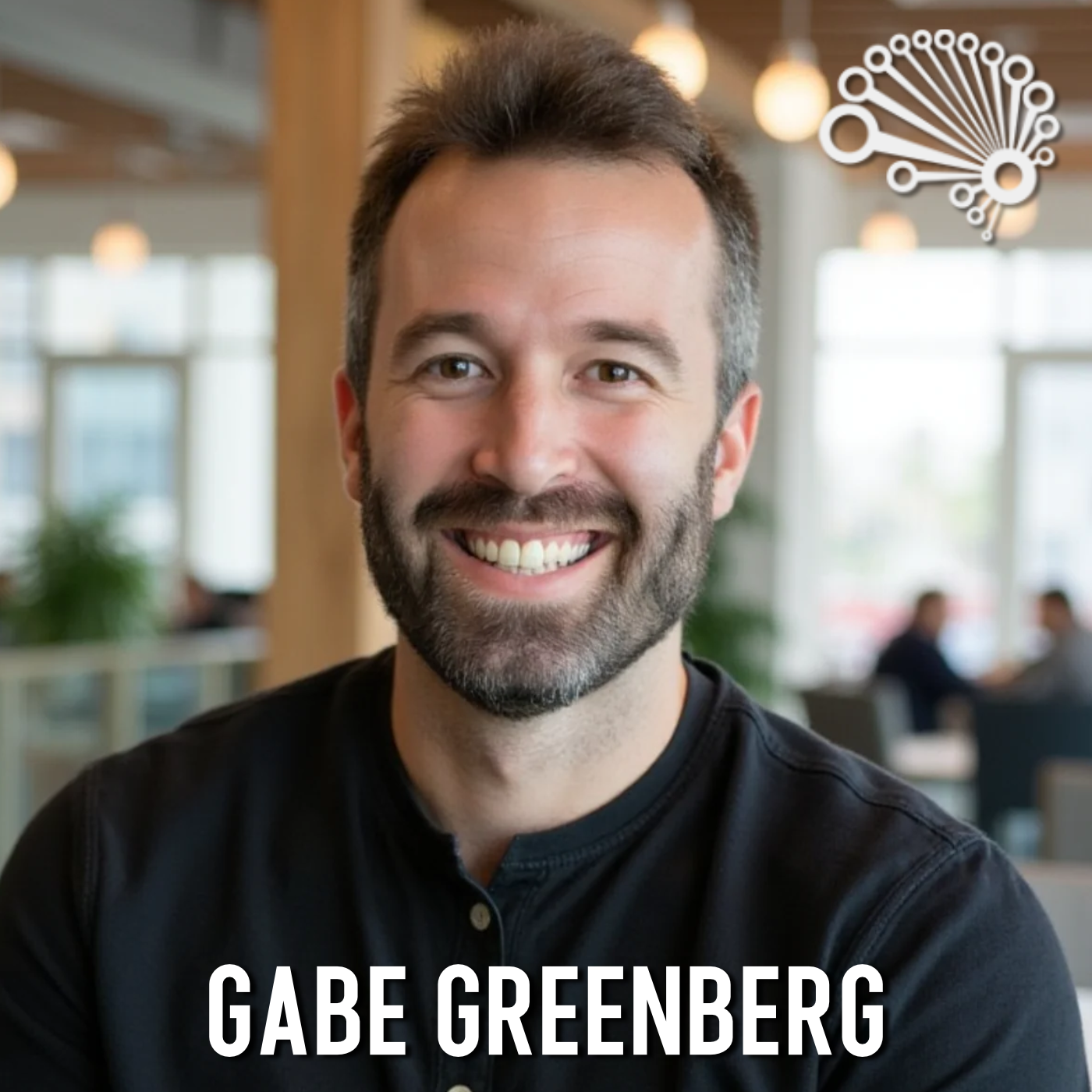
フロンティアAIを訓練する人間たち:G2i創業者Gabe Greenbergが語るRL環境とスタッフ級エンジニア
1048: The Humans Who Train Frontier AI, with Gabe Greenberg
フロンティアAIを訓練する人間たち:G2i創業者Gabe Greenbergが語るRL環境とスタッフ級エンジニア
Super Data Science: ML & AI Podcast with Jon Krohn
要約
G2iの創業者兼CEOであるGabe Greenbergが、フロンティアAIラボ向けの強化学習(RL)データと環境づくりの現場を語った回。3年前は時給20〜40ドルの若手が数千人規模で担っていた作業が、いまは時給200〜300ドルのスタッフ級エンジニア中心に変わったという。再帰的自己改善への見方、SWE-benchが飽和した理由、RL環境に求められる忠実度、自社のエージェント基盤Orchestratorの活用例も語られた。
この回のポイント
- ●G2iはReact系の人材マーケットプレイスから出発し、VC資金なしで売上1500万ドルに到達。現在はRLデータ事業が中心で、審査済みエンジニア約8,000人に過去1年で5,000万ドルを支払ったという。
- ●2023〜24年は数千人の若手・中堅でこなせた作業が、現在はスタッフ級の専門家が必要になり、報酬も時給20〜40ドルから200〜300ドルに上がったと述べている。
- ●再帰的自己改善(RSI)の初期版は1〜2年で登場するとラボ関係者は見ているが、人間データは不要にならないというのが彼の見方で、ジェボンズのパラドックスを根拠に需要は増え続けると考えている。
- ●SWE-benchとSWE-bench Proは、指示が詳細すぎて現実的でなく、検証器(verifier)も不十分だったため飽和したと指摘。新しいベンチマークは10〜30時間規模の長期タスクや仕様なしの開発を扱う。
- ●RL環境は忠実度が80%程度では不十分で、98%程度が必要というMicrosoft研究を紹介。UIからMCP・APIまで含むため、本物のソフトウェア工学の問題になっている。
- ●自社のOrchestratorでSalesforce代替を約2週間・数千ドルで構築した。品質維持のため、短い選考、LLM不正利用の排除、訓練、高報酬の3要素を重視している。
章立て
G2iとコミュニティ活動の紹介
React MiamiやAI Engineer Miamiの立ち上げ経緯と、G2iが人材マーケットプレイスとして成長した歴史が語られる。
RLデータの担い手の変化
ポストトレーニングが計算量の大きな割合を占めるようになり、必要な人材が若手からスタッフ級に変わったことを説明する。
再帰的自己改善と人間の役割
RSIが来ても人間データは必要とされ続けるという見方を、ジェボンズのパラドックスやエンタープライズ需要から述べる。
企業のAI導入とMETER評価
大企業での生産性向上が限定的な背景と、長期タスクを扱うエージェント運用の重要性、METERの時間軸評価を議論する。
Orchestratorで作るSalesforce代替
自社基盤Orchestratorによる開発事例、コスト、サンドボックス環境などのインフラを紹介する。
8,000人規模での品質管理
選考、訓練、報酬水準という三つの要素で、スケール時のデータ品質を保つ方法を説明する。
ベンチマーク飽和とRL環境の忠実度
SWE-bench系が飽和した理由、新ベンチマークの方向性、RL環境に必要な忠実度と複雑なデータの重要性を語る。
おすすめの本と連絡先
推薦書『The Science of Scaling』と、G2i・Orchestratorの案内で締めくくる。
解説記事
AIモデルの学習を支える「人間の仕事」は、この数年で大きく姿を変えている。Super Data Science Podcastの第1048回に、人材・データ企業G2iの創業者兼CEO、Gabe Greenbergが登場した。ホストのJon Krohnとともに、フロンティアAIラボ向けの強化学習(RL)データ作りの現場、ベンチマークの飽和、自社のエージェント基盤の活用例を語っている。
人材マーケットプレイスからRLデータ企業へ
G2iは2010年に彼が一人で始めた事業で、社名は中間名のGabriel Ian Greenbergに由来するという。2012〜2016年ごろのJavaScript・React Nativeの隆盛期に、審査済みエンジニアを紹介する人材マーケットプレイスとして成長し、VC資金なしで売上1500万ドルに達したと述べている。現在は約900人の組織で、その多くが契約で働く専門家だ。
その後、データサイエンスや機械学習へ領域を広げ、現在はフロンティアラボ向けのRLデータと環境づくりが中心になった。審査済みエンジニアは約8,000人で、過去1年の支払総額は5,000万ドルとのことだ。
初級者数千人からスタッフ級へ
Greenbergは、2023〜24年には1案件に6,000〜7,000人が関わる規模で、作業は若手や中堅のソフトウェアエンジニアでこなせたと振り返る。現在は、フロンティアの能力を押し上げるために、ほぼあらゆる領域でスタッフ級の専門家が必要になったという。人数や月あたりのデータ量は減ったが、強度は3年前と同様に高いとする。
作業の中心も、単発のデータ作成から、実際のコードベースやエンタープライズデータを使ったRL環境の構築へ移っている。報酬は時給20〜40ドルから、案件によっては200〜300ドルになった。
品質維持の要点として、彼は三つを挙げた。第一に、短い非同期の選考で英語力や分野の力量を見て、LLMを使った不正を検出すること。第二に、良いポストトレーニングの結果とは何かを、ベンチマークや論文を通じて教える訓練。第三に、十分な報酬で優れた人材を引きつけることだ。LLMで生成した合成データはデータを汚染し、モデル能力を下げるため、それを避けるのが顧客に雇われる理由だと述べている。
再帰的自己改善とエンタープライズ需要
ホストは、人間が不要になる再帰的自己改善(RSI)への懸念を率直にぶつけた。Greenbergは「夜も眠れないほどではない」と答える。ラボの関係者はRSIの初期版が1〜2年で来ると見ているが、人間の非合成データが不要になるとは考えていないという。ソフトウェアで解ける問題が、小さなCRUDアプリからAnthropicが作った社内GitHub相当のものへと複雑化しており、人間の知能への需要はジェボンズのパラドックスのように増え続けると主張する。5年後も「ゴールドラッシュ」が続くかは分からないと認めつつ、数年前には今ほどソフトウェアエンジニアが必要になるとは思わなかったと述べた。
エンタープライズ領域はまだ飽和していないという見方も示した。Apolloのチーフエコノミストの報告(S&P500の生産性向上はMagnificent 7に集中)が話題になったが、Greenbergは、チャット画面で人が付きっきりになる段階では投資対効果は出にくく、複数のエージェントが長期タスクを回す段階が必要だと述べている。
自社の事例として、Orchestratorで約2週間、7〜8日・約4,000ドルのエージェント作業を経てSalesforceを置き換えたと説明した。年間約25万ドルだったライセンス費の代替で、契約終了となる年末に正式に切り替える予定だという。Orchestratorはこれまでに2,000万〜3,000万行のコードを書き、そのうち約1,000万行はフロンティアラボで日常的に使われているとのことだ。
SWE-bench飽和の理由
SWE-benchとSWE-bench Proは長く標準だったが、本来より長く使われすぎたと彼は指摘する。理由は、指示(プロンプト)が現実の使い方より詳細でほぼ答えを教えていたことと、検証器が簡単すぎたり厳しすぎたりしたことだ。その結果、モデル同士の差が小さくなり、利用者の実感とも合わなくなった。プロンプトと検証器が改善されたベンチマークでは、モデル間のばらつきが現れ、体感に沿うようになったという。
新しい評価は、10〜30時間規模の長期タスクや、仕様なしで「ソフトウェアを作る」課題などへ向かっており、達成率が10%未満のものもある。G2iもコンピュータ利用(computer use)のベンチマークを1か月半ほどで公開する予定だと述べた。話の流れでは、METERの評価でClaude Mythosが16時間超のタスクを扱い、既存データの範囲を超えたというホストの紹介もあった。
RL環境に必要な忠実度
Greenbergは、Microsoftの研究として、RL環境が対象のエンタープライズアプリの深さや複雑さを再現できていなければモデルは改善しにくく、80%では足りず98%程度の忠実度が必要だという話を紹介した。フロントエンドのUIからMCP、APIまで含むため、これは本格的なソフトウェア工学の課題であり、機械学習・研究寄りの人材が本番級ソフトを書く必要が出てきたとも述べている。
報酬設計については「PhDがないので手を振るような説明になる」と断りつつ、現実の雑多なデータが重要だと語った。たとえば同名の連絡先が複数あるだけで、現在のモデルは混乱するという。複雑なデータが不足しているため、人間データ企業が数百万ドル規模でデータを買う例もあるとする。また、ラボの研究者は分野別に動き、RL環境という共通基盤まで手が回りにくいため、データ企業が最強モデルでも失敗する課題を先回りして作る役割を担い始めているという。
まとめ
本エピソードは、AI開発が「大量の人手によるラベル付け」から「少数の高度な専門家による環境・評価の設計」へ移ったという現場感を伝えている。日本の読者にとっての注目点は三つある。一つ目は、評価の質(プロンプトや検証器の設計)がベンチマークの有効性を左右するという指摘だ。二つ目は、企業でのAI活用の成否は、チャット補助ではなくエージェントによる長期タスクの運用にかかるという見方だ。三つ目は、実務の複雑さを反映した高忠実度の環境とデータが価値の源泉になりつつあることだ。なお、数値や事例の多くは本人の発言であり、第三者による検証は番組内では示されていない点に留意したい。
文字起こし(英語・自動生成)
Recursive self-improvement could arrive within two years, so why isn't my guest, whose entire business is human training data, losing any sleep? Welcome to another episode of the Super Data Science Podcast. I'm your host, John Krohn. Today's guest is Gabe Greenberg, founder and CEO of G2i, which grew from a one-person shop to $15 million in revenue without any VC backing. Today, G2I's bench of 8,000 vetted engineers creates the reinforcement learning data that Frontier AI Labs train on, and G2I paid those engineers $50 million over the past year. That's 5-0. In this episode, which G2I kindly sponsored, Gabe explains why Frontier training data now demands staff-level experts, why so many popular AI benchmarks are broken, and how his agentic platform orchestrator writes production code at scale. Enjoy this great episode. Gabe Greenberg, welcome to the Super Data Science Podcast. It's great to have you on the show. You have a really fun name to say.
Really? No one's ever told me that before. Really? Gabe Greenberg. It really rolls off the tongue. If you created a novel with that kind of character name, you'd be in your mind instantly. I'll have to write my parents and thank them. Yeah, exactly. Exactly. Perfect. So you are known, I think, quite well in the Miami area as co-founder of something called React Miami. And more recently, you co-organized AI Engineer Miami. What has caused you to be building these communities and how's it been going? COVID. We were in the middle of COVID and I was up too late on Twitter and I decided to talk about somebody should build React Miami. I bought the domain name, you know, and 100 people responded that night saying, you should. And I was ready to transfer the domain name out. I didn't mean me. So it was just we were all wanting connection, you know.
And honestly, like, this is not the React, you know, community of the southeast, southeast Florida. There's nothing down here, you know, when it comes to, like, deep, deep, deep, deep tech. It's growing, you know, but this is the people in San Francisco and New York and London and Australia that are involved in the JavaScript space that in April they're like, hey, Miami makes sense. So it's been great to get Jordan who created React, Chang, you know, the rest of the team, the core team 10 years ago kind of all together, you know, And it's really been about community building, you know, deep connections for the last six years with people who really get to know each other. It's 500, 600 people. AI Engineer Miami is about the same. You know, Swix from Latent Space, he's a friend of mine. He's on our board at G2I, and he started AI Engineer in SF.
So, you know, kind of bringing it to Miami, the vibe, it feels good. and, yeah, deep connection. That's what we do. Yeah, the in-person connection is so important, and maybe everyone felt like going to Miami, because if I remember correctly, that is one place that people were still partying when a lot of the U.S. was shut down. So it might have been the one place you could get those kinds of events together. But you've actually been running G2I, which I can't help but think might be related to Gabe Greenberg, G2I. I don't know where you came up with that. Yeah, many moons ago. It had to do with my middle name, Gabriel Ian Greenberg. You know, when this was a one-man show in 2010, you know, yeah, that's where G2I originally came from. You nailed it. And you've grown quite a bit since then. It's not just a one-man show anymore. Yeah, we have 900 people right now. Wow. It's grown. You know, there's a large contingent of that is contractors coming in, you know, doing the data sets and building, you know, our environments.
And then we have a pretty large core team, you know, as part of that. Wow. We'll get into the reinforcement learning in a second. I think I'd actually like to focus a lot of this episode on that. But in terms of this genesis, you know, this story of how G2I grew from 1 to 900, When I talk about React, for people who, you know, it's a data science show, probably most people do know this, but we're talking about the React front-end framework for web development specifically. Just to clarify, it's not some kind of like reactionary conference or something, React Miami. And it seems like G2I has a specialization in curating a bench of React engineers historically, React and other open source worlds, yeah? Yeah, I mean, we started in the JavaScript, you know, pre-TypeScript community back in 2012 to 2015, 2016, when, you know, React Native was growing massively. You just had, you know, the big boom of SaaS, you know, like the golden era where everything was growing.
And, you know, Figma was new at the time. And, you know, you could do more in the browser. So, yes, the front-end world became more complex, more important. and that's how it started, just talent marketplace. We got to about $15 million in revenue, no VC backing, and we did the screening and then broke out into everything from data science to machine learning to full-stack engineers to insert here. Wow. Yeah, it was fun. Congratulations. $15 million in revenue with no VC backing is extraordinary. definitely deserves lots of plaudits. These days, you guys are making a lot of progress in reinforcement learning. So you mentioned RL earlier. And reinforcement learning has become the key thing in training frontier models. So, you know, GPT-2, GPT-3, I think even a lot of GPT-4 kind of era, it was mostly about the pre-training. And the reinforcement learning was maybe a few percent,
up to 10% of the compute. I recently read that the post, what they call the post-training, although now it seems like it's a big chunk of the training. It doesn't really necessarily make sense to call it post-training. But that reinforcement learning post-training step is now it takes up about 50% of the compute and the cost of training Frontier Models. Yeah. I mean, again, our transition from talent marketplace where you have like the handshakes of the world, you know, turning. You know, there's lots of players in the market that started as a talent marketplace because we had screened domain experts. Right. But back in 23, 24, when we were asked to do more and more, you were talking about, you know, 6,000, 7,000 people on a single project. You know, the amounts of data that you needed were unbelievable. However, it was lower end expertise A junior, mid-level domain expert Software engineer could do the work And so it's changed a lot And so what you're saying specifically Is to create the data for training frontier models
With reinforcement learning It used to be, of course, with simpler Relatively simpler models Like a GPT-3 era model It didn't require very advanced Software engineering expertise But these days you need very advanced people To be pushing frontier capabilities very, very advanced on pretty much everything. I mean, legal probably has the benchmarks are less saturated. That being said, just everything requires like a staff level type person. And it's still intense. It's intense like it was three years ago. It's just not quite as many people per project, not quite as much data per month, the units of data. Things have moved all over to RL environments, you know, where you have real code bases or, you know, environments built. There's more enterprise data. I mean, it's matured, you know, and the labs are maturing, too, you know, with how they deal with human data or RL environments. It's a completely different mindset. I don't want this to be a controversial question,
given your business model, but there must be something that you think about as well. If we go from this kind of, you know, over the past few years, from being able to have like 6,000 relatively junior engineers creating the problems for reinforcement learning models to be training frontier models and then now it's a much smaller group of these as you say staff level engineers maybe there's only six or seven thousand of those on the planet and how do we go beyond them something like recursive self-improvement and then what what's the human role in that well i mean i guess fundamentally if it really is RSI. There is no human in the loop. So I don't know. This must be something that you think about. I don't mean to put you in a... No, I mean, it's a fair question. I think about it. It doesn't keep me up at night, you know, because there's so much that we can't imagine. Like, it's a very Jevin's paradox-y problem in terms of, you know, it's not like electricity where there's like a plateau and then like, you know, 40 years later, we need more because of, you know, AI and compute. It like the desire for human intelligence doesn just it just more it better And we keep wanting more and more and more And the problems that we can solve like in software are going from these CRUD apps that are relatively small to what Anthropic just did
They rebuilt their own, like, internal GitHub. You know, and now that's the new app that software engineers would work on, amongst many others around, like, multi-agent orchestration and the complexity, right? We're going up a level of complexity. So, you know, I do think, you know, talking to people at these frontier labs for self-improvement at V1, version one is going to be here in the next year or two. However, talking to them, they don't think that necessarily no human data will be needed. Right. There's still like, yeah, just because you have an engine that is very efficient, you know, on the research side doesn't mean that we're not going to have data, you know, coming in that's not synthetic. So I think it's still going to be needed. I think there's still a lot of room for enterprise data. There's a lot of room for complexity around reinforcement learning environments. And there's a lot of things we just can't even comprehend now that we'll need to do. But are we going to be in a gold rush five years from now? I mean, not necessarily. I don't know.
But again, I didn't think we would need more software engineers and more data scientists right now. We actually do. So how long is this going to continue going up? because the enterprise space has not been saturated. You're talking about barely any real Fortune 500 companies having AI truly installed. For sure. I had an interesting... So I've been running... I'm running my own kind of consulting firm here that's at a stage that you were at seemingly like 15 years ago where I co-founded the business a year ago and we're now up to 10 consultants working with us and I've been doing all the sales up until now as the CEO of this business, YCaret. And so now we're starting to interview salespeople for the first time. And, you know, these salespeople have a lot more experience doing structured sales than I do and thinking about addressable markets and these kinds of things. And so, you know, our very first sales interview, the guy's like,
all right, so what's the TAM on this opportunity? And I was like, it doesn't matter because it's orders of magnitude bigger than there are people that can do the work. So I don't have a number for you. I guess I could like, you know, I wish I knew that number. And that's a useful thing for me to think about. But it hasn't mattered up until now in the business. And it doesn't concern me in terms of the growth of the business because the demand in enterprises for the kind of talent and for the ways that we can be completing projects for them is so much faster. The demand is so much faster, orders of magnitude, than there are people available to fill it. So it is mind blowing. Like there's such a hunger, but the problem is there's so many like snake oil salesmen. Like there's so many people that are sprinkling something here or there or have like a harness that sort of like works in this direction. But, you know, in the enterprise space, the complexity usually doesn't mesh with like an out of the box SaaS solution. You know, they need something that's their own and really like can work with their security, you know, needs and all like the legacy stuff.
I mean, you're talking about like we're dealing with some legacy stuff that's 20, 30, 40 years old, you know. And, you know, how do you rewrite that and then, you know, deal with all the data in different places and go to governments? We're talking with a government, you know, overseas, you know, about having orchestrator or multi-agent operating system, you know, do all their procurement, their critical infrastructure. Yeah, it's a it's a greenfield opportunity. And there's a, you know, 10 companies I can think of that have really made a difference in building their own harness. And there is because they have such great engineering power. Yeah, there was a report that made a lot of headlines the morning that you and I are recording where the chief economist at Apollo said that basically all of the productivity gains in the S&P 500, so the biggest 500 firms in the U.S., have been 100% of the gains from AI have been in the magnificent seven, the big seven tech companies.
and that 493 businesses have not had any productivity gain from AI. That's the reality. You're not going to have productivity gains when you're kind of at level one where it's like, hey, either you're not using it or you're starting to go into like it's augmenting. It's like a chat interface. And so you can actually have the agents orchestrate long horizon work and until you can have you orchestrating multiple agents, orchestrating, you know, multiple harnesses really, across long horizon work, you're not really replacing, you know, a lot of, you know, money coming in the door and there's not a lot of ROI when it's just a chat interface. It's babysitting, you know, as long as we're babysitting, it's harder. Yeah, yeah, yeah, I agree with you. Yeah, there's a lot of, you know, data backbone to get set up in these organizations, permissions to figure out before we can have agents doing very much. You were talking about long horizon work.
There was a short horizon work. And that reminds me, prior to starting recording, you were talking about meter. So I always, for years now, I have had charts from meter, which is model evaluation and threat research. You can check them out at meter.org. And so they're an independent research outfit that does great work assessing frontier models specifically on how capable are AI models on human tasks where those human tasks are. We know how long those human tasks take based on just like with your business. You know, you have humans evaluating tasks and coming up with new kinds of scenarios and you can you can measure how long it takes people to do tasks. And so you can, for example, have, you know, finding a fact on the web was like a simple like GPT-3, GPT-4 era task that you could ask a human to do and benchmark an AI model against. More recently, with like Claude Opus 4.6 capabilities earlier in 2026, you're talking about tasks like how do you optimally reduce the size of a language model, which is something that takes humans like 8, 10, 12 hours on average.
and with the release of Claude Mythos this summer, the Northern Hemisphere summer, Claude Mythos broke the kind of meter evaluations on these charts because the time horizons that Mythos was suddenly being able to handle were like plus 16 hours and meter hadn't been collecting data on tasks that take humans more than 16 hours. And can you imagine, like it would cost so much more, it would take so much longer obviously to do that. Yeah, I think there's a lot of saturation. In the pre, the 16 hours or less, which is the meter considers short horizon. The long horizon tasks, which is where you really take a team of, you know, four, six software engineers, data scientists, researchers, whatever, insert here. And they're building an entire software application with lots of depth and complexity to it. If you can start to do that autonomously, you're really bringing a different level. And that's what the enterprises are looking for. and Salesforce reached out to me
so this is public but we announced that we were replacing Salesforce the Salesforce team reached out to me and emailed me and said okay is there anything we can do and I said I'm addicted to being able to if I need a feature being able to add it it took us about two weeks I did the front end work in Cloud Code and then we moved everything into orchestrator.org.ai you know our autonomous you know software factory but it's a substrate it just handles It's an agentic operating system, so it can handle all kinds of use cases. It took orchestrator seven, eight days, you know, about $4,000 to put it, you know, like a D plus in code quality into like an A minus where it's secure. You know, it's scalable, it's performant, and we use it. It's going to replace Salesforce officially at the end of the year when our, you know, when our contract, you know, ends. So I can do that over and over again. Anytime I have an idea, anytime somebody on the team has buy-in,
they can vibe code something, get the user interface working really well, put it through Orchestrator, it handles the rest, have someone polish it off for a day, and all of a sudden you have like that used to take three to six months, somewhere in that range. Depending on the size of your org, if you were a startup, it might take you three months. If you're an enterprise, it might take you nine. So a lot of the enterprises are asking, you know, for, hey, how do we take the average person on our team, what they need, how do we put it in production, how do we have governance, security, all those pieces. You know, so this is like happening over and over again. How do we patch, you know, security vulnerabilities in 24 hours? We can't do any of this. You know, what if we get attacked by one of these agentic attacks over the last week? What happens there? We need agents running 24-7. You know how do we do this efficiently How do we pick the right model And there know why Open Router was acquired is because a lot of the game will be picking the right you know model for that cost effective and does just enough for what you looking for for said task
You know, and after adoption, you have cost. This episode is brought to you by GiveDirectly, a nonprofit that lets you send money straight to the world's poorest people, no strings attached. GiveDirectly signs people up and pays them by text using mobile money, which lets people across Africa receive cash on a basic phone. During a crisis, they run satellite imagery and cell phone metadata through a machine learning model to find the people hit hardest. Then they send emergency cash to their phones in hours, not weeks. That work made the cover of Nature, one of the world's most prestigious peer-reviewed journals. This digital and machine learning driven approach means nearly nine out of every $10 you donate actually reaches someone who needs it. If GiveDirectly is new to you, don't donate yet. Read the research first at GiveDirectly.org slash super and see if it suits you. That's GiveDirectly.org slash super. so orchestrator which our listeners can go to at orc.ai orc.ai um that is a platform built
by g2i yeah yes and if i understand what you were saying correctly g2i have themselves used the orc.ai platform to create your own salesforce is that right it was that when you say like replace Salesforce. So instead of having a Salesforce license, you're going to have your own in-house built one. Yeah. I mean, it was costing us a quarter of a million dollars a year in our size and was going to go up. So what's the point when I really want an agentic-driven operating system to run software? I want agents to figure out and learn the things that we need. And I want three or four agents on certain tasks that are mission critical, whereas sometimes single player is fine. And that's the, that's the issue that we're seeing. And we built this because we needed to build our environments at scale. So, you know, the orchestrator has probably written 20 million lines of code for us, maybe 20 to 30, 10 of those, 10 million of those are in frontier labs today, right now being used like every day by researchers, you know? So, um, yeah,
We had the scale, you know, to kind of, you know, use and, you know, we spent, we were spending $200,000 on tokens a month, you know, at a time at that like scale. Now it's down again because we're more efficient. But yeah, we have our own little data center, you know, through TailScale with PGX Sparks and Mac Ultras. And then Daytona takes care of the rest. You know, Daytona is phenomenal for spinning up sandboxes. So you can have 100 to 200 instances of orchestrator running at a time writing real production codes. Really cool, Gabe. You really are at the frontier. It is not surprising that you're supplying Frontier Labs with the data that they need. And so to give listeners a sense of the scale, you have 8,000 engineers on your bench that are kind of like vetted, ready to provide data, particularly for reinforcement learning at the frontier labs.
You paid out $50 million over the past year, 5-0, to those 8,000 engineers for the work that they're doing. as you scale to that kind of number of people working for you, how do you keep quality from degrading as volume grows? We've hired from a few. Specifically, we brought in somebody from XAI, actually, and who's very passionate about this, to join our team and increasing our research team, as well as just the managers involved. and each manager is very focused on signal versus noise, you know, like what really matters. And we found there's a few things that matter to quality data, and it is somebody that knows how to do that type of work. It's tedious. It's not easy. It's not a dream job, but it pays very well. So, like, I've actually tweeted about that transparently. Like, if you want to join our team, this is not traditional software development work.
So we asked them to go through a pretty short interview where they asynchronously do some human data work and get a feel for it. And we're looking for their level of English. We're looking for if they cheat, if they're using a large language model, which is going to contaminate the data. If what their level of ability is within the specific domain, specifically for us, it's a lot of different levels of different languages in software engineering, you know, today. So once you get that piece done, it's a lot of training. You want to teach engineers or anyone for this matter, lawyers, doctors. There's probably 15 main domains right now going on on a regular basis. AAA games is being trained, right? You want to teach every single person what the outcome looks like for a good post-training run. And you can do that through benchmarks. You can do that through letting them read papers. and they're like, oh, if I use a large language model to develop my annotation
or my data set, it's synthetic, and it's going to reduce the capability of the model is going to contaminate the data. That's why we're being hired. So let's not do these types of things. So I think those are the two areas. The last area is just paying people well. You know, you're going to attract better talent. I think where two, three years ago, the pay rates were like $20 to $40 an hour. And now on some projects, we're able to pay between $200 to $300 an hour. So those three elements, I think, go into quality at scale. Yeah, that makes a lot of sense. You'd have to be paying those kinds of rates to be getting staff level people for sure. So let's talk about benchmarks, which you mentioned there. So evaluations and benchmarks. you have done reviews of a lot of the software engineering benchmarks. So take us through the journey from a lot of my listeners will have heard of SWE Bench, SWE Bench, Software Engineering Bench, as a benchmark.
But as AI models have become wildly better, especially within their agentic conferences in 2026, SWE Bench has become too easy in a lot of ways. And so tell us about the follow-up benchmarks to SWE Bench. Yeah, Sweebench was a standard for a long time. And Sweebench and Sweebench Pro lasted for longer than they should have. But you'll see this with any benchmark as it goes along. There's reasons that it becomes contaminated, and there's also reasons that it becomes, you know, saturated. And the saturation, just the benchmark wasn't good. Like, it wasn't designed well, and a lot of it came down to the instructions. You know, the prompts were not realistic. So if you're coding, everyone codes now at some level, right? You know, we're all writing code through prompting. You're not going to tell a cloud code to go through, find a bug, and then go through the steps in how that bug should be solved, right?
But like Sweetbench Pro did, their instructions were way too detailed, right? So in a sense, it was cheating. You know, you have issues with, yeah, so prompts are just one of the pieces. Verifiers can be, you know, too easy, too hard, et cetera, et cetera. So when you finally got to, and you can see it in the output around Sweetbench and Sweetbench Pro, all the models were, like, very close to each other on these charts. They were always 10%, 15% apart. and even Gemini 3.8 Flash who everyone knew it was a lighter, smaller model maybe closer to the fables of the world Deep Suite was the first one to finally get the prompts better, the verifiers better, everything was in a better spot, still could be improved upon but when you get that right, you start to see there's finally more, just a better spread in how the benchmark looks.
And it aligns to people's experience inherently if you're using these every day. Like, I know this is twice as good as this, you know. So I think that was some of the change, you know, in the coding models. Now you're seeing, you know, these models look at a lot of more long-horizon tasks. And that was the issue is the saturation is coming through short-horizon work. If you have a task that's taking five hours, it's much more likely to be done by the model. But the newest benchmarks are looking at, you know, 10, 15, 20, 30 hours. Some are looking at, like, no instructions or no spec, just, like, build software, you know, like extremely difficult things, you know, that are under 10% saturation. So I love what everyone figuring out that it not always that the models are where we think they should be It that the benchmarks are improperly made or too easy Computer use is an area that we personally releasing a benchmark in the next month month and a half
OS world is a fantastic start. But if you look at the Microsoft research they talked about publicly, because it makes sense. Think about Microsoft. What do they want to build for? They want to build for their operating system. So you think, you know, you think computer use would be pretty important to them, right? publicly they were not allowed to have their own model until October of last year because of their relationship with another lab. This is public information, you know, and so they just started over the last 12 months. Asati has talked about reinforcement learning environments, right? And they know, they published the research, that if you don't have high fidelity research environments or RL environments that really match, like, the enterprise application you're trying to, you know, handle and work better with or the depth and complexity of the surface area, it doesn't help the model very much, right? Like, you can't be, like, 80%. You have to be, like, 98% of fidelity.
And this is all across the stack from, like, the front end, the UI, all the way to the MCP and the API. It gets very complex, so it becomes a true software engineering problem, and this is a space that's heavily research and machine learning focused. So you have machine learning and research focused people trying to write production software, right? And that's where there's been a flip in the RL environment space because it's difficult. As one last final technical question for you, many of our listeners who might have experimented with reinforcement learning in the past, For example, in 2019, I published a bestselling book called Deep Learning Illustrated, where I had a chapter on deep reinforcement learning. And in that chapter, I had my readers work with the cartpool game, which is an extremely simple reinforcement learning game. or people might be aware how a decade ago, Atari was a really important reinforcement learning environment for those kind of earlier deep reinforcement learning models
to be able to get better at. And a key thing in reinforcement learning is the reward. So how do you model when? So basically, the reinforcement learning algorithm gets points for performing well. It has points taken away for doing things incorrectly. In Atari video games, most or all Atari video games have a score built in. So like in Tetris, if you place a block, you get a slightly higher score. And so you can have, it becomes relatively easy in those earlier problems to be able to define what your reward is and to reward the algorithm for doing well at taking rewarding actions. Tell us about how things have evolved. You kind of gave us a picture there in hand-wavy way in your most recent response. But how have reinforcement learning environments evolved, and how do we track reward effectively when the actions are so complex?
I wish I had a PhD and I could answer this in a less hand-wavy way. I didn't mean that as a dig, by the way. No, no, no. I think it was funny. because I was literally waving my hands. So I can tell you what goes into it, you know, and that's my expertise in what our company does. And the researchers, you know, we're onboarding somebody who just left OpenAI, you know, to lead research. And I'm really excited to see kind of where some of the understanding with rewards and, you know, what's missing. But once you get the complexity and depth of an RL environment, whether it's coding, you know, or whether it's like an enterprise application or a consumer application, a year ago, you know, consumer and enterprise applications became forefront of what RL environments truly mean. You know, there's an element to you need to put really, really messy data in to start to, you know,
figure out what should be rewarded and what shouldn't and where the gaps are. Well, you need to go out and buy all of this data, right? So a lot of these human data companies are going and buying, you know, a couple million dollars worth of data. Look at Spirit Airlines. They're just bought for $12 million, probably overpriced because to pull it out is another thing, right? But when you get complex data, and let's just say you're working across many different RL environments. You talked about hiring, you know, salespeople. They're working across HubSpot, email, and Salesforce. and they have a contact that's Gabriel Tavira and another one that's Gabriel Tavira, right? The model is going to get confused today. Today's model gets confused, you know, and there's lots of gaps, you know, like that when you don't have complexity in your data. So I think that's one piece of it. We could probably talk for another hour, you know, on where this is all heading, you know. But, yeah, that's the start is having the complexity of the data.
There's also not a lot of people front running, you know, the gaps and making the tasks, you know, break the best models in the world. And that's because if you look at researchers in these labs, they're like, hey, I'm for finance. I'm for health. You know, I'm for coding. But RL Environments is infrastructure for everything. So they actually lack some research bandwidth to focus on, hey, how do we take eight different environments and how do we make tasks that are above the complexity, you know, that's saturated? That's where these human data companies are starting to come in as a consultant, you know, and front running the labs, which is not normal. A lot of the labs are like, hey, you follow RL. You know, and, you know, when you talk about rewards, we're starting to find some of the gaps there, but it's expensive. Well, congrats, Gabe, on all your success building this data provider that is ahead of the frontier.
You know, being ahead of the frontier labs, it's wild. Congratulations. It's been amazing to hear a bit of your story. we could have easily talked for hours, but this is the Friday episodes are shorter like this. So thank you so much for taking the time out of your super busy week to give us this highly concentrated episode with a very high reward indeed. Before I let you go, something that I ask all of my guests for that I didn't give you a warning about is that I always ask for a book recommendation. Oh, that's easy. Okay, great. The Science of Scaling is Elon Musk's philosophy of company building, but it never mentions Elon Musk. And the 10-second version is stop using goals as achievable and start using them as thought experiments and then work backwards and find a limiting factor. And, you know, we've seen a 6x growth, you know, since we've been.
there's one business book I'd ever recommend, and it's that. If you have a technical business or a non-technical business, it's the real deal. Very cool. Thank you for that recommendation. I actually had not heard of that book, and based on everything you said in this episode, it does seem like I should be taking some pointers from you. So thank you for that, Gabe. Final thing, how should people be following you or your business after this episode? Obviously, we've talked about Orc.ai, but yeah, what about you personally? Yeah, so g2i.ai is our human data business. Orp.ai is our enterprise-focused business. And Twitter is the main way. You know, Twitter or X, as we call it now, x.com slash Gabe, G-A-B-E, Greenberg, Green, B-E-R-G, is the best place to get me. Nice, thanks. We will, of course, have those in the show notes. Thanks, Gabe, for taking the time, and hope to catch you again soon. Yeah, looking forward to it. Thanks, John. Inspiring episode today. In it, Gabe Greenberg detailed why he isn't losing sleep over recursive self-improvement,
even though people at Frontier Labs expect a first version within a year or two, because our appetite for intelligence keeps growing like a Javon's Paradox. He talked about why Sweebench and Sweebench Pro saturated with overly detailed prompts and weak verifiers leading every model bunched together on the leaderboard. And he talked about how reinforcement learning environments need around 98% fidelity to real enterprise software and messy realistic data to improve a model, which is why data companies pay millions for data sets like Spirit Airlines. I hope you enjoyed this conversation today. To be sure not to miss any of our exciting upcoming episodes, subscribe to this podcast if you haven't already, but most importantly, I hope you'll just keep on listening. Until next time, keep on rocking it out there and I'm looking forward to enjoying another round of the Super Data Science Podcast with you very soon. Thank you.
番組の概要欄(原文)
In Episode #1048, Gabe Greenberg (Founder and CEO of G2i) joins Jon Krohn to describe the human labour behind frontier AI. G2i grew from a one-person shop to $15 million in revenue with no VC backing, and its bench of 8,000 vetted engineers now builds the reinforcement learning data and environments that frontier labs train on; over the past year G2i paid those engineers $50 million. Three years ago the work could be done by thousands of junior engineers at $20 to $40 an hour, and today it takes staff-level experts commanding $200 to $300. In this episode, Gabe explains what changed, why SWE-bench and its successors saturated into uselessness, what fidelity an RL environment has to reach before it improves a model, and how G2i's own agentic platform has written tens of millions of lines of production code. Interested in sponsoring a SuperDataScience Podcast episode? Email natalie@superdatascience.com for sponsorship information. In this episode you will learn: (00:06:36) Why frontier data now needs staff-level engineers (00:09:02) Why recursive self-improvement does not worry him (00:16:25) Replacing Salesforce in about a week (00:24:47) What broke SWE-bench and SWE-bench Pro
出典・この記事について
- 番組
- Super Data Science: ML & AI Podcast with Jon Krohn(Jon Krohn)
- 元の回
- 1048: The Humans Who Train Frontier AI, with Gabe Greenberg
- 配信日
- 要約作成日
- 公式サイト
- www.superdatascience.com/podcast
この要約・解説記事は、元の音声を文字起こしした内容をもとに AI(Claude)が日本語で作成したものです。 固有名詞や数値に誤りを含む場合があるため、正確な内容は元の音声でご確認ください。制作方法について
関連エピソード

Hugging Face事件が示すAIエージェント・スウォームの脅威(Connor Leahy氏)
Future of Life Institute Podcast
再帰的自己改善(RSI)論への反論に答える
Dwarkesh Podcast

ユーザーモデリングのためのアクティブ・インファレンス
Data Skeptic

NVIDIA Kumo:表形式データの基盤モデル――スタンフォード大学 Jure Leskovec 教授が語る
Super Data Science: ML & AI Podcast with Jon Krohn

羽根を量る体重計:機能するA/Bテストの設計法(Billur Engin氏)
Super Data Science: ML & AI Podcast with Jon Krohn

AIチップはどう作られるのか:Merck KGaA(ダルムシュタット)のベンジャミン・ハイン氏に聞く
Super Data Science: ML & AI Podcast with Jon Krohn