
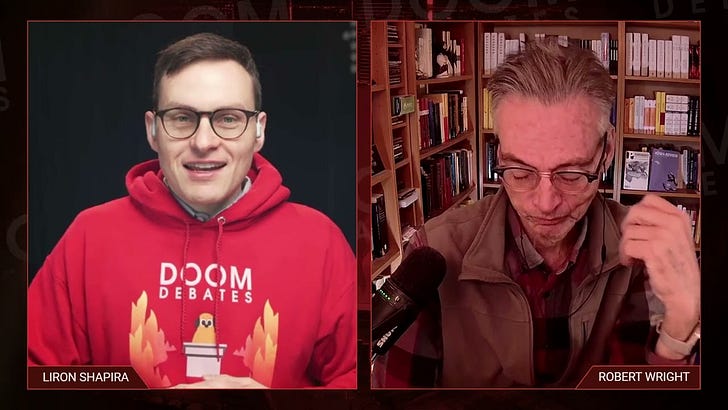
ジェンスン・ファン辞任とRSI「2027年」説——ロバート・ライトと語るAIニュース
Jensen Huang Resigns, RSI Coming in 2027 — with Robert Wright
ジェンスン・ファン辞任とRSI「2027年」説——ロバート・ライトと語るAIニュース
Doom Debates!
要約
Liron Shapira と Robert Wright が、NVIDIA のジェンスン・ファンCEO辞任、METR が報告した Anthropic の研究速度2倍、Lean による形式検証とアラインメントの関係を議論した。後半は匿名の中国人AI記者 Walter を迎え、中国側のスキャンダルの受け止め方、AIによる雇用不安、AI規制の見方を聞いている。
この回のポイント
- ●NVIDIA 取締役会はジェンスン・ファンの辞任を発表した。議論ではスキャンダルの発端となった中国スパイ疑惑だけでなく、別の社内関係の発覚が決定打になったとの見方が出た。
- ●Wright は、リークの狙いはファン個人より対中チップ輸出規制の強化にあったと推測し、Anthropic の Dario Amodei に有利に働くと述べた。
- ●METR の報告では、Anthropic のAI進歩は約2倍の速さで、その約80%はAIの活用によるとされる。Liron は再帰的自己改善(RSI)の入口にあたると警鐘を鳴らした。
- ●Lean などの形式検証は数学やセキュリティでは有効だが、人類が本当に望むことを形式化できないため、アラインメントの本質的な解決にはならないとの議論があった。
- ●Walter によれば、中国のAI関係者の間ではアリス・ファンは「デザート」で本題は事業だった、という見方が主流だ。一般市民の関心はAI安全より雇用に向いている。
- ●中国でAIによる解雇への反発が出た例として、唐辛子ソース会社への不買運動が語られた。
章立て
ジェンスン・ファン辞任
取締役会の発表、スキャンダルの経緯、辞任に至った要因と、リークの政治的狙いを議論する。
後任問題と市場への影響
暫定CEOや後継者不在、「斬首作戦」は有効かという論点、NVIDIA株とGoogleの動き、AIの価値がどこに蓄積するかを論じる。
METR報告とRSIの接近
Anthropic の研究速度が2倍になったという報告の意味、反論、数学問題の解決、AIによる業務代替の実例を語る。
形式検証とアラインメント
Lean とフェルマーの最終定理の形式化、カーネルのバグ、形式的アラインメントの限界を議論する。
Anthropic IPOとAI条約行進
ファン辞任が Anthropic のIPOに与える影響を予想し、AI条約を求める行進を告知する。
中国人記者 Walter との対話
中国でのスキャンダルの受け止め、Anthropic 関与説、検閲の経緯を聞く。
中国のAI雇用不安と規制
AIによる解雇への不安、政府と世論の関係、未成年向けAIコンパニオン規制、台湾情勢の見通しを聞く。
解説記事
Doom Debates の Liron Shapira と、Nonzero の Robert Wright による定期コラボ回である。NVIDIA のジェンスン・ファンCEO辞任という速報を軸に、AIの自己改善の加速、形式検証の限界、中国側の視点まで語られた。以下は発言者の主張を中心にまとめたものである。
ジェンスン・ファン辞任の背景
番組収録の直前に、NVIDIA の取締役会がファンの辞任を発表した。後任は暫定でCFOの Colette Kress が務め、会長には Harvey Jones が就く。
二人は、辞任の背景に中国との関係が疑われた人物との関係と、社内の別の関係の発覚があったと整理している。Liron は後者が決定打、つまり企業統治上の問題になったと見る。Wright は、そもそもリークの狙いは中国向けチップ輸出規制の強化だったのではないかと推測する。Megaspeed のようにマレーシアなどのクラウド経由で中国企業に計算資源を貸す事業は現状では合法だが、Dario Amodei が禁止を求めてきたと述べている。
議論では、ファンの主張(中国への販売拡大など)は NVIDIA の経営者として自然なもので、陰謀的ではないという点で両者は一致した。同時に、自社の利益を強く押し出しすぎたことが敵を作ったとも語られた。
「斬首」の効果と価値の行方
Wright は、組織の頂点を除いても問題は解決しないことが多いと述べた。Liron は逆に、テック業界では「偉人説」が当てはまるとし、辞任で NVIDIA の時価総額が約1兆ドル減ったことを根拠に挙げた。ファンの直属の部下が約60人という点も、後継の難しさとして触れられた。
AIの経済価値がどこに蓄積するかについて、Liron は「あらゆる場所」で、供給制約が続くため全員が儲かると見る。Wright は、価値は経済全体に薄く広がり、特定企業に残るとは限らないと慎重だった。現在の収益源がオープンソースモデルでコモディティ化する可能性にも触れている。
METR報告とRSIへの警戒
Liron は、METR の報告を再帰的自己改善(AIがAIの開発を進める循環、RSI)が始まった証拠と受け止める。報告では Anthropic の進歩が以前の約2倍で、その約80%がAIの活用によるとされる。研究者の体感では作業が12倍速いという話も紹介された。AI Futures Project が予測を2027年に戻したことも挙げられた。
反論として、進歩を維持するには指数的に支出が増えるという指摘がある。それに対し、収益も曲線に応じて急増するので投資を回収できるという再反論が紹介された。Liron は、人間の知能に上限がある以上、緩やかな向上でも制御喪失の前提条件になりうると主張している。
具体例として、OpenAI の未公開モデルによる数学問題の解決、AIエージェントが社内の各役職を演じて交渉方針を決める事例、Liron の確定申告でAIが会計士より正確だった経験、Wright の画像診断レポートの誤記をAIが指摘した話が挙がった。ハルシネーションはもはや話題にならなくなったという認識も語られた。
形式検証とアラインメント
Lean は、数学の証明を計算機が検証できる言語である。Claude によるフェルマーの最終定理の形式化が話題になったが、Liron はLeanの実装に不具合が見つかった例を挙げ、形式検証を過信すべきでないとも述べた。型理論そのものは堅牢で、問題はカーネルの実装にあるという整理だった。
アラインメントの形式化については、Yudkowsky の見解として、ボトルネックは証明ではなく「人類が本当に望むこと」を書き下せないことだと紹介された。Liron はさらに、AIにアラインメント研究を任せると、AIは「解けたと人間に思わせること」を最適化しかねないと懸念している。
中国から見たスキャンダル
後半の匿名記者 Walter の話では、スキャンダル直後の中国のAI関係者の反応は冗談交じりだったが、辞任後は「なぜこの時期か」という分析が増えた。Anthropic が情報源の一つだったため背後にいるとの説も出ているという。アリス・ファンについては「デザート」にすぎず本題は事業だ、という見方が彼の周囲では最も有力で、政府が接触を試みた可能性は自然だとされた。
中国の一般市民の関心は、AI安全よりも雇用に向いている。AIで選別工程の人員を約半分に減らすと発表した唐辛子ソース会社に対し、不買の動きが出たという。Walter は、国民の多くが政府に影響を与えられないと感じていると述べた。未成年向けのAIコンパニオン規制は、かつてのゲーム規制の延長のようなものだとも語った。台湾への軍事行動は、経済状況から可能性は低いとの見方を示した。
まとめ
本回は、強い立場の発言者が複数の論点を結びつける構成で、全てが事実として確定しているわけではない。リークの意図やAnthropic の関与は推測の域を出ない。それでも、チップ輸出規制、RSIへの警戒、米中協調の是非が連動して議論されている点は、日本の読者にとっても注目に値する。特に、中国の市民の関心が安全よりも雇用にあるという証言は、国際的なAI協調を考える上で示唆的である。
文字起こし(英語・自動生成)
This scandal has everything. Five million dollars, it's got money, it's got sex. Head of this company considered critically important to the whole future of America's hegemony, literally in bed with someone who's being called a Chinese spy. My own answer is that in some sense of the terms deep state and plot, almost certainly yes. Welcome to Doom Debates and Robert Wright's Non-Zero Collab. We do this every so often. We run through the latest AI news and analysis. I am Liron Shapira, host of Doom Debates. You are Robert Wright, host of Non-Zero Podcast and author of the very timely book, The God Test. How's it going, Robert? I'm doing okay. A lot of news, that's for sure. And also, there's, I think, a real treat at the end of this podcast.
You and I just finished taping a conversation with a Chinese journalist in Beijing who covers AI. And, you know, he is remaining anonymous for purposes of this interview so he can speak as freely as possible. and we talked about Jensen Wong and some other stuff and the Chinese take on the Jensen Wong thing and so on. So I really encourage everybody to stick around for that. Great. Okay, so DACA for today, before we transition into the other interview, DACA for today, I think from my perspective, I'm always laser focused on AI capabilities. I think that's the only game in town. That's this existentially dangerous thing. And I do think this is yet another significant week. There's kind of this drumbeat, this frog-boiling situation, and that's going to be a major theme for today. But I think we really got to focus on what's fiery hot in the news right now, right? Even just an hour before we started recording, right?
It's this bombshell in the news. I'm talking about Jensen Huang, founder and 33-year CEO of NVIDIA Corporation, $5 trillion peak market cap, has just announced, the board has just announced his resignation. Yeah. Your thoughts? Well, I'm, you know, it's amazing. Word of this kind of possibility trickled out yesterday. When this first hit him, I assumed he survived because he's considered so important to NVIDIA. NVIDIA is considered so important to lots of things. But, you know, things piled up. I mean, in addition to the whole Alice Wong thing, it turned out that apparently he had had an affair with a subordinate. The company resources had been used to conceal the affair because they apparently, somebody got some video of the two of them canoodling. And then the company paid them off, bought the video or something. You know, I think an interesting question among many.
I mean, is, first of all, what are the consequences of this going to be in terms of U.S. policy, U.S.-China relations, and so on? And also, were some of these possible consequences the goal to begin with of leaking this story? I mean, the way to put this dramatically is, and this is a question I heard from the beginning from some people, is to what extent, if any, is this a plot by the deep state to get Jensen, to get China doves, to make China and the administration, including Trump, to get U.S. policy on exports tightened up? My own answer is that in some sense of the terms, deep state and plot, almost certainly yes. And the question is, in what senses? Right. You know, this scandal has everything.
You know, five trillion dollars, it's got money, it's got power, right? The most powerful CEO in the world. It's got sex. It's got Chinese spying. You couldn't make a more interesting story. No, it's just more, I mean, I'm half joking, three quarters joking, but more evidence that we're living in a simulation. I mean, somebody said to me the other day in San Francisco, brought this up, like, he said, this is like an actual, you know, pretty prominent person in tech, very accomplished person, who said, like, man, it makes you think we're living in a simulation. Just imagine, you've got the chimp factory that makes the key chips, like right off of China's shores. China has a claim to the, you know, to the blah, blah, blah. Just that part alone, he was saying, this is nuts, this is out of a movie. And now this, the movie continues, and it's wild. Exactly. So one of the angles in all this is the factions lining up. I've been seeing various voices on social media.
There's kind of a pro and anti Jensen staying as CEO. You know, like I saw the first person I saw line up pretty forcefully on the pro Jensen side. It was a couple of days ago, Ben Thompson of Certecry. He was pretty firm in his newsletter saying America needs him. You know, like we got to overlook the scandal because he's such a superstar running NVIDIA. Like you can't just replace Jensen Huang. Like NVIDIA is Jensen Huang and NVIDIA is America. So we got to let this slide. That was his position. And then you have Elon Musk, who seems to be kind of pro-Jensen. I don't know if he said it explicitly, but that's the vibe I'm getting. Sean McGuire from Sequoia, also like a pro-Jensen vibe. But then we also saw Democratic senators come out anti-Jensen, and they're using it as a political scandal. I saw T.V. Moshewitz of the great Don't Worry About the Vase newsletter, probably the single best source of news besides this show, right? He was saying, yeah, Jensen's got to resign. This is untenable. Yeah, what have you been saying? Yeah, a whole array of views. Obviously, Dario is presumably having a party at the moment.
I don't know. I think he is. And, you know, in fact, some people have asked. We get into this in the interview with a Chinese journalist who actually brings up Dario before we do. Dario's views in China have not escaped the attention of people in the Chinese AI community. But, yeah, so to start with Ben Thompson, his view has been, after initially embracing the chip export controls, I think he now is fine with those and kind of buys the Jensen, some of the Jensen view on that. And I think his argument is that, you know, giving them chips, you know, or maybe if we hadn't imposed the restriction in the first place, China would not have so accelerated its drive to develop indigenous chipmaking infrastructure. I think we definitely have, to some extent, accelerated the drive. And so his line is, look, the chips are fine.
Just draw the line at the chip manufacturing equipment, which comes from the Netherlands mainly. Um, yeah, so that's that view. I do think, I mean, related to that, there's one thing I want to say about, you know, Jensen, you know, like, because one vibe you get from some corners is, oh my God, has Jensen all along been trying to help the Chinese government? What do you say? All the stuff he's said on the Dwarkesh podcast, whatever, about, you know, we should sell these ships far and wide, are the things a person who runs NVIDIA would say, right? And, you know, he wants a big market for chips. And when people say, oh, but he doesn't need Chinese demand. Lots of American companies, you know, he can sell all the chips. Well, yeah, but the more customers you have, the more you can charge, the higher your profit margins. Also, when he says it's in the interest of the U.S. to get China addicted to our tech stack, I don't know about that argument, but what is true is it's in the interest of NVIDIA
for China to get addicted to NVIDIA's tech stack. So everything he's advocating is, I think, not suspicious at all. He's talking his book, maybe too aggressively for his own good in retrospect. But, yeah, I mean, the reactions are from the predictable corners. I mean, look, China hawks are celebrating because it probably will sabotage, well, it will probably damage relations with China. and in that sense maybe was a kind of sabotage from the point of view of the people who leaked the story. And meanwhile, people like me who think that the survival, well, the well-being of the planet, if not the survival of the planet, is going to depend on cooperation between the U.S. and China over AI, people like me are not delighted about the likely fallout from this. Okay, let's give people more context. So Jensen Huang announced his resignation via a note from the board that, you know, they said he resigned.
I'm sure it was like he clearly didn't want to resign. Like it was very clear. He made statements a couple of days ago saying like, yeah, you know, I'm going to stay basically. Right. Like I love NVIDIA. And just based on everything I've seen from him. Right. It really is his baby. It's like, you know, hand in glove. Right. It's this company has been building for 33 years. And I've heard quotes of Jensen saying something like like when people ask him, how do you relax? He's one of those guys who's like, I'm relaxing every day when I'm here at my desk at work. You know, this is relaxing for me. And people say, like, he goes on vacation. Everybody goes on high alert because he starts blasting emails back to NVIDIA. Like, on vacation, he's getting all these ideas how to, like, transform the company when he's back. So, everyone's just like, don't go on vacation, Jetson. So, this is one of these guys who, like, you know, born to just be an NVIDIA for life, right? He would have been like Warren Buffett running it when he was 99 years old. So, he wasn't happy, quote-unquote, announcing his resignation. I think the number one question we should try to straighten out, though, is what did he do wrong? You know, like, why exactly did he have to resign? Because I don't think you can just say, oh, he had to resign because he was unfaithful to his wife.
Right. It's worse than that. No, it wasn't just that. I mean, look. First of all, it was pretty bad judgment on his part. OK, like, you know, but of course, we're talking about a part of the body that is a famous disorder of judgment. Right. It's like this is a story as old as as old as time. But look, so he, you know, it's it's it's possible. It's possible that he believed that all that was going on with Megaspeed is what was largely going on, which is that it had this cloud computing stuff in Malaysia or whatever, and it rented the compute to Chinese companies, all of which is legal. The U.S. chip restrictions don't prevent that. Megaspeed's official story is that that's what it did. It definitely did, I think, quite a bit of that.
It's possible he didn't suspect more for a while, Although I've heard that when the hammer came down, when NVIDIA caught wind of the government's suspicions, which was quite a while ago. This is more than a year ago. I heard they did some kind of monitoring and found that actually they had sold 50,000 more chips to Megaspeed than could be accounted for in their data centers or something. But in any event, I don't know. Look, it's definitely bad judgment. And, you know, in a situation like this, it is not shocking that when the story is, you know, head of this superstar company considered critically important to the whole future of America's hegemony is literally in bed with someone who's being called a Chinese spy. I'm not surprised that the guy no longer has a job when you put it like that now.
In what sense was she a Chinese spy? It could be a very, very limited sense. It could be, could well be, and in fact, we get into this with a Chinese journalist, but he had read this very good Wall Street Journal story that came out very recently about her whole career path. And it does look like, look, she and her husband, they started Megaspeed. They're just trying to make a buck. and in a situation like that where part of the game was to get very close to Jensen, which he succeeded in doing, naturally somebody from the Chinese government is going to give her a call and say, have you learned anything? You know, versions of that happen in America. Now, beyond that, we don't know to what extent she was a Chinese spy. But still, just even given those facts, I'm not shocked. Why? Are you surprised that, like, he had to bite the dust? This was the plan. I mean, this was the plan of whoever leaked the thing, I'm sure. Yeah, so I do see shades of gray.
I think I'm kind of similar to the board where, actually, I think the last, the straw that broke the camel's back, or, like, the last domino, was the announcement yesterday that they identified, it came out about a second affair, right? Powell, who is the second affair? She thinks he's a direct report. Yeah, yeah, yeah. Both of these women are reported to be 48 years old, by the way. Coincidence, I guess. But, yeah, she had a prominent position, and it was reported that company assets were used to conceal the affair. So that was also not good, but go ahead. Yeah, yeah. Okay, so it's Kimberly Powell, NVIDIA's vice president of health care. Huh, okay. I didn't realize that they had a whole health care department, I guess. Maybe it's an internal facing, but whatever it is. You know, that's one of his 66 direct reports, I guess. So he had the affair with her, too. And, you know, people say it's like termites, right? There's probably more affairs if they've discovered two affairs. I was a little bit on the fence in terms of, like, how much information has been announced about the Chinese spying. Because everybody's saying, well, Alice Huang is not a spy.
She's, like, an asset. Maybe Jensen didn't know, right? So there was, like, some shades of gray. Given that he's worth trillions of dollars as CEO and he's strategic for America, there was some gray area. Like, maybe somehow he could stay on. But like I said, the domino to fall is once Kimberly Powell comes out, now you've also got a corporate governance problem, right? Because you're not supposed to be a CEO sleeping with your direct report vice president, you know, as an affair. Like that's at that point, you just question like, can you as in public shareholders, you know, this is now ground. There are many grounds now, but that is, you know, securities fraud. You know, Matt Levine is always saying like everything is securities fraud. Like shareholders can just sue like, hey, you can't you can't run the company like this. Like, you know, you violated your shareholder covenant. Yeah. I mean, I think he was before that reveal. He was in a situation where ordinarily he'd be gone if it weren't such a critical company, weren't considered so critical to it. He'd be gone. And then this was a straw that broke the camel's back.
And I suspect they had other things they could leak. I imagine they were ready to keep going as long as it took. Right. Yeah. Again, not that I think Jensen per se is the main target of the leakers. I think China policy is the main target. They want the enforcement of the chip restrictions tightened, and apparently in this case they weren't very tightly enforced for a while. and Dario's long wanted a new law, a new regulation that would make illegal the use of NVIDIA in clouds that are then rented to the Chinese companies. The legitimate part of Megaspeed's business, Dario and other China hawks want to make illegal, and they may well succeed. We'll see. Right. Yeah, just fleshing out this intrigue here. So, yeah, Jensen Huang founded the company 33 years ago in 1993.
And the new chairman of the board, because Jensen was also chairman of the board, so he stepped down as that, too. I don't even know if he's still on the board. That's a good question. But the new chairman of the board is Mr. Harvey Jones, and he seems actually very legit. He's been on the board also the entire 33 years. He's got a ton of really applicable experience. I think he was the founder of Daisy, which is like a pretty well-known, older, I don't know, CPU design type of company. So, yeah, so they've got a nice, responsible chairman. And then the interim CEO is the CFO, Colette Kress, who's been with NVIDIA for 13 years. I don't think anybody thinks she should be a good permanent CEO. It's really just that's the problem, right, is everybody's saying Jensen had no bench, right? So you just have the CFO step up. But it really is interim. And now there's this big question of, like, who the hell is going to be CEO? Yeah. I mean, not only that, did he not have an obvious successor? He had an orthodox, you know, organizational style. Apparently he had, I think the number is 60 people directly reporting to him.
That's a very high number for a CEO. That's crazy. So it's like, it's not like you can just slot, you know, a good CEO and they go, oh, these are my six direct reports. Good. Let's all have lunch. No, you got to have like a cocktail party to meet them all. And it's so the transition is going to be challenging. Now, I will say, you know, well, it kind of gets gets back to the Iran war. Ultimately, decapitation rarely works. I mean, they found the same thing with like local gangs, you know, like they take out the gang leader. And actually, it doesn't help solve the problem they were trying to solve. And one reason is, or they kept killing the number two at Al-Qaeda for like years and years with Al-Qaeda persistence. One reason is like, you know, sometimes somebody has been leader at an organization for a long time. And actually, things might improve if somebody else took over at this point.
I mean, you never know. I mean, look, NVIDIA was going strong, no doubt about it. But there are real challenges, including, you know, Google, Amazon, Microsoft making rival chips, some of which are doing more and better and better. And, of course, now they'll face a bigger challenge because I suspect part of the business is going to get shut down. It could well happen that these clouds are no longer going to be legal. So, you know, yeah, they face new challenges. He might or might not have handled them well. But, you know, in retrospect, one of his downsides was he was too aggressive an advocate. He was talking his book too aggressively, I think. You know, in retrospect, probably things like the Dwarkesh interview really didn't help him. I mean, if you ask, like, what series of things led somebody to finally leak this, he was talking his book too loud. Totally, yeah.
I mean, you know, his arguments have been flimsy for a very long time. You know, when people have questioned him, I'm like, why is it OK if China gets these chips? And he's saying like, oh, get him addicted to the stack, like you said, when there's so much evidence that China is desperate to get higher quality American chips because we're like a decade ahead of them. And Jensen, like you said, is talking his book. And of course, he's been downplaying any kind of AI safety concerns. Although recently he made some interesting statements where he's like, oh, well, if the AI labs can't manage it, they should shut it down. Everybody's like, what? You know, so that was kind of out of nowhere. But I don't think that he thinks that they can't manage it. So I don't know what's going on there with the statements. He doesn't sound like he's fully read into what I see as the main problems of our era of the next couple years, like these existentially important problems. He did seem like he was kind of like head in the clouds, not really engaging with those problems or like, you know, he only had like a winner's mindset, thinking about how to keep building up NVIDIA. That was the impression I got. Just to throw in some notes here. So I mentioned Kimberly Powell was the VP of health care.
So just to clarify, it's not internal facing. It's like selling to healthcare companies, and she was there for about a decade, and she did report directly to Jensen, and he does have about 60 direct reports. So this is the thing about NVIDIA. You said that you don't really believe in decapitation strikes. I tend to disagree. I actually think decapitation strikes are pretty good. I know in the Iran War, they're still going, even though they don't have all their leadership, but I still think decapitation does work reasonably well in the general case, sometimes better than others. In the case of NVIDIA, I mean, look, the market has spoken, right? They decapitated NVIDIA. Instantly, you lost about a trillion dollars. It's down 20% to 30% in the last couple weeks. So that's kind of how much Jensen is worth. That must be pretty nice to be worth a trillion dollars, to have the market tell you that you're worth a trillion dollars. The market thinks she's worth. We'll see, but go ahead, yeah. Yeah, yeah, exactly. So, I mean, I still expect NVIDIA to still have some value, but it is just very interesting because it's like the great man theory of tech leadership. I am a believer in the great man theory of tech leadership.
I think when you decapitate NVIDIA, that is a serious setback. And I'm just looking at the stock market. I wonder if this is related to why Google has been surging a little bit. I think they've been up 10% or 20% over the last few weeks. Google is an NVIDIA competitor. They do have their own independent TPU supply chain. So, yes, I'm a great man believer. Yeah, I mean, Google also finally came out with a couple of models that move it closer to the frontier. I have my own gripe about what it would take for me to get access to them. I was egregiously misled by Gemini about the consequences of switching to workspace, but I digress. I mean, it lied to me, and the sheet about what you get, the official online story about what you get with workspace is still a lie, so be careful, people. But I digress. The models have something to do with it. But I don't know whether there's – I mean, look, people who sell their NVIDIA stock but still believe in AI broadly, it's got to go somewhere.
Google's a plausible place. It could have to do with that. You know what? I've got to correct myself because I've been getting excited about this stock because I own Google. I've always been overweight, Google. I'm bullish on their business. I think it's undervalued. But it's not 10% to 20%. It's like 5% since the low of earlier this month. So, you know, I don't want to read the tea leaves too hard here. But, you know, at least it's a positive sign. I feel like that's maybe the positiveness of it is correlated, but who knows? Yeah, and I suspect, I mean, as for the fall in NVIDIA stock price, I think there's a lot of emotion running through the whole market for AI assets. I mean, on the market. It's like, you know, I don't think it's quite, it's not tulips, you know, the famous example of a run-up, the AI per se is very real, and there's a ton of potential economic value there. But I think anybody who thinks they have a very clear idea of where the value is going to accrue in the long run,
which specific companies, chip companies, AI companies, is more confident in their judgment than I am, of mine. I know where it's going to accrue. I think I know where it's going to accrue. My hypothesis is everywhere. Because I think that we're just going to be supply constrained for the next however many years, five years, ten years. I think the entire, this is in a non-doomed scenario, by the way, which I don't even think is that likely. I think it's like a 50-50. So in the 50-50 scenario where we're not doomed, I think it's going to be very much an expanding pie. Like, oh, we've not even begun to build. We need a million data centers now. So the margins are going to be there. Because everybody who can help build the supply is going to get a great return on capital. It's not going to be like a turf war, a zero-sum, as you might say. It's not going to be a zero-sum food fight over little bits of margin. Everybody's just going to be building. Yeah, and I think the risk for people who are heavily invested in AI is that, first of all, I agree with you. Let's assume everything goes well and this technology isn't massively destabilizing,
which I think it will be if it's not governed carefully and ultimately governed internationally, which is why I think, you know, these China hawks are kind of maybe signing our, if not death certificate, our chaos and mass suffering certificate. Let's assume it goes well. Value will accrue. In fact, look, if you stopped large training runs this moment, As people like Ethan Mollick, Wharton Professor, and so on have pointed out, the productivity gains would still continue to spread through the economy for years because these companies, it takes time to figure out how to use this stuff. Companies in America are investing very heavily in figuring it out. That's why Anthropics revenues are so robust. OpenAI quarterly revenues were robust But it takes time And the danger for people investing in the AI trade right now is that the value may accrue very diffusely through the economy
And you can't even say in which specific companies, you know, like leave aside AI companies. But like, you know, Salesforce, Adobe, blah, blah, blah. What is the fate of those companies? I think very hard to say. What you can say is that if things go well, a lot of value will accrue. But it may be very diffuse. And it's conceivable, although I think, you know, Anthropic and OpenAI have a lot of cards to play, including developing intellectual property in the form of pharma, especially with their unreleased models. It's possible that not much value will be accrued there in the long run. That's how fluid I think things are. And they certainly do face the risk that as for their current main revenue stream, that'll get commoditized as these companies use open source models, whatever. So I agree with you. AI, if things go well, create a huge amount of value. Where? I don't know.
But one appeal of chips is like you can say for sure chips will be involved, right? That's one appeal of investing in companies that make the state-of-the-art chips. Yep. All right, yeah, so that's a developing story. There's so many threads to it. It'll be interesting to see what comes out about the Chinese spying. It'll be interesting to see what Jensen is going to do next. Is he going to try to pull a Sam Maltman and Steve Spower again? Is he going to go to Microsoft? A little later. Good question, though. Can he salvage his career? It won't be at NVIDIA, but can he salvage his career? There was a tweet from Elon Musk that somebody was like, you know, Jensen can work for Elon. And Elon was like, oh, it would be an honor, right? So it's like, where is he going to land? I mean, and that also is a name that comes to mind, like who could step in and run NVIDIA today? I mean, Elon can do anything, but besides him, there's a lot of interesting developments. They've already had one guy who talks too much. I don't see NVIDIA bringing Elon on board. Right, right, right. Or SpaceX acquires Tesla and NVIDIA.
It's really crazy times. It's all happening fast. You know, it's also funny, it's November now, 2026. If you remember back to, we used to have a yearly November scandal. Remember November 2022? We had Sam Bakeman-Free, we had FTX. November 2023, or maybe it was December, whatever, close enough, we had the Sam Altman blip, right, him getting fired. That was 2024, 2025. Yeah. Yeah, okay, I was disappointed last couple years. I was like, where's my November scandal? But then here we are, 2026, okay, Jensen Huang stepping down because of an affair, I'll take it. Yeah, I guess we missed a year, or maybe two. I don't know, but the – Oh, yeah, yeah. Yeah, yeah. This one's wild. This one is wild. I'm wondering, you know, it's got to be hard for him now to accept a number two role anywhere. And, like, what big company is going to displace the CEO so he can step in? And also, look, he's a little bit undisciplined. I mean, nobody really needs this. I mean, his story was, like, suing generous, okay? He was doing video game chips. He did have the foresight to see that that could lead him into the AI business.
He didn't just stumble into that. He saw it coming. But I don't know. I think maybe what you'll see is him becoming a big media person, right, like establishing a platform. He's got a ton of worshipers. He can generate the traffic. Oh, man, more competition for us. Yeah, I know. we should maybe kneecap the guy by saying more unflattering stuff about him. Stay in your lane, Jensen. We got the media aspect covered. Okay, so that's putting a pin in the Jensen stuff. Stepping back to what matters even more, okay? This is like a red alert situation. A lot of people have been saying this. I mean, we do seem to be close to the singularity. We can put a concrete report on it, the famous meter report from the last few days. I think the headline result was, all things considered, AI has been making Anthropic twice as productive on net with their AI research. And remember, this is the only, this is the nuclear reaction here, right? This is the positive feedback loop. This is recursive self-improvement, is will AI help build AI? And at first, if I was talking to a few months ago, our answer was like,
yeah, of course, it's helping programmers write a little faster, right? It's being autocomplete. It's making them 10%, 20% faster. So this is like the foothills of RSI. But look, twice as productive compared to a year ago right this is like this is really the neutrons are really starting to hit here you know like and this is i should clarify you know in case twice doesn't sound that impressive you know amdahl's law it's like okay yeah it's twice but there's other inputs right it's all about what's the the limiting input what's the bottleneck but this 2x is net of amdahl's law it's like okay yeah some parts are still slow but once everything nets out they're still going twice as fast meaning the ai part is probably more like 10 times faster but there's other bottlenecks and in fact their researchers anthropic researchers are subjectively reporting that their work seems to be going 12 times faster when they do it which by the way is also I don't work for anthropic but that's also my subjective report in terms of like I just feed tasks into the wood chipper and the AI is just doing them and I used to have to do those tasks 12 times slower so everybody a lot of people are coming out there's kind of a belief cascade happening right now on my twitter
where so many people are like okay guys you know call your family like this is RSI the AI futures project has moved their target date for RSI to, what do you know, 2027. Like, they're back to predicting. They're the ones who did the 2027 report to begin with a couple years ago? Exactly, right. And they're like, yep, okay, we now predicted in 2027. Like, it's bad. I mean, the months are really ticking down. And so more and more people are saying, like, look, if we're going to make a move here, if we're going to pace the frontier, we really should do it now. No, I think it's true. And let me give you my understanding of this meter thing, and you can correct me where I've got it wrong. But so Meter comes out with a report that was based, I guess, both on access to internal Anthropic stuff, maybe including interviews with employees, but also an evaluation of 5.2, the fable that just came out right in. And the finding was that, roughly speaking, over the last year, roughly, things have been advancing.
The models at Anthropoc have been advancing twice as fast as during the preceding like year and a half roughly. And Mitter attributed most of that like 80 percent to the growing use of AI models in the generation of, you know, in the creation of the next generation of models. That's what leads us toward recursive self-improvement, the point at which the human role in creating AI is marginal or nonexistent. Now, somebody came out with a counterpoint. They said, okay, sure, but look, they are having to exponentially increase their spend to get the curve to go up by that much. And so it can't go on. But then somebody from, I think, 80,000 hours was the first maybe to reply that, well, okay, but if you look at the relationship of this curve that it takes so much money to steepen, if you look at the relationship of that to revenue, you know,
the revenue is like more or less exponentially or related to that curve or at least grows very rapidly as a function of that curve. So in the end, Anthropic can, judging by current revenue streams, can get their money back on all this spend and keep spending. And that's where the story, as I understand it, rests. And so, yeah, the moral of the story is we should be freaked out. Right, the people pointing out like, oh, my God, they had to put in twice as many billions to get this result. Like you're saying, the output of the AI that they're building is also going to yield more than twice as many billions. And so if this cycle continues, you are going to get, at the very least, a linear march upward in capabilities. And given that human IQ is not exactly a super high ceiling here, if you have a steadfast linear march... Speak for yourself. Speak for yourself. But yeah, I mean, look, 10 IQ points a year. It's like, okay, well, you've now surpassed all geniuses and you keep going. And I can tell you, me personally, I agree with Eliezer Yurkowski on this,
the precondition for losing control really is my in my opinion just having you know a bunch of 200 robustly 200 iq ais i do think they can go off and just kind of have power in a way that's irreversible like they can just siphon off more and more power and never give it back it's just kind of like this one-way ratchet and you know if 200 iq doesn't cut it okay fine so keep marching up to 300 iq like by that time combined with their advantages of like you know speed the ability to back themselves up, the ability to coordinate, to work 24-7, to just, you know, be relentless. I think that humanity, you know, unless they love us and they want us to persist, I just, I think we're the weaker force in that battle. Now, I think, look, if you look at this math stuff that was generated, you know, largely by these unreleased models, and I just learned that not nearly all the math magic magic depended on swarms of agents. Most of the problems OpenAI solved was just a single LLM that was given,
I think, three hours per problem or something. Right. On something that, you know, on things that people had worked on for years, if not decades, unsuccessfully. I mean, and, of course, math is just math. And people say, oh, but the proofs are sloppy. You know, it reminds me of when they were saying, oh, yeah, it generates video, but the people have six fingers. and you're like, well, obviously that's going to get better. And this is the story again and again is, you know, people can point to the deficiencies. It hallucinates. It does this and that. But, I mean, folks, focus. It's just so obvious where this is headed. Yeah, just to be a little more precise about the results. So when they say, hey, the research is progressing 2x faster, so it is based on looking at capability scores as measured by various evaluations. They're like, hey, the amount of progress that they used to make in a year, they can now make in six months just in terms of like getting better at all these benchmarks. So some people have also criticized like, how do you know you're using the right benchmarks?
You're only using benchmarks that have the ability to be efficiently verified. But then I saw somebody else intelligent chime in and be like, yeah, well, you know, you also have a problem now where it's hard to even make the benchmarks. Because it's not like there's this natural definition of what you can verify and what you can't. Like people are even struggling to be like, oh, man, how do I verify this? It's like the AI kind of knows what it's doing better than I know how I'm doing in terms of verifying it. And of course, it also is like aware of how you're trying to verify it. It has all this like situational awareness. So even like what people are saying is that the waterline, you know, it's sure it's jagged intelligence, but it just seems like everything is growing, right? Like it's every single frontier is getting pushed out. Like there's no firewall. I can tell you my own experience is just that I'm more and more happy to just toss things over the wall to the AI. my own fraction of involvement is getting less and less. And so that's really the general theme for me, is that, like, AI is just getting to the point where, like, the loop is closing. You know what I mean? And that's what they mean by RSI. Yeah, no, we should say you're a coder, and most people have a job other than that.
But I will say, you know, I haven't – I mean, we are, at Non-Zero, we are starting to put AI to interesting uses, and I hope to unveil some things in the coming couple of months, but even so, I recognize that I could be doing a lot more with it than I'm doing. It's like I don't have time. I'm too busy talking about AI to stop and do the things I need to do to integrate it into my own, like, little productivity loop, just my personal productivity loop. It's obvious I could do it. I'm kind of waiting for some of the agentic stuff to shake out. And it's like, you know, like, yeah, Muse sounds interesting, but do I want to use an app developed by the guy who coined the phrase move fast and break things as a corporate slogan? I don't think so. I'm kind of waiting, but it's completely clear. You know, I heard this was on
the cognitive revolution, you know, they do a morning live stream. And then at the end of the week, they do a very good, you know, kind of montage of highlights. And this guy was describing how agents are used at a company, as I understand it, to come up with, like, what it's going to ask. It's in some negotiation, and it's going to be. And it wants to figure out what is our position, what's the least we can take or what's the most we can, you know, whatever. And what it does is it has different agents represent different people in the company. Okay, so it gets from Harvey, it gets the legal guy. Okay, so this is doing the job of what a human lawyer would normally be doing. Then it gets a product person. Then it gets this person and that person. And so it has like, you know, half a dozen, you know, the half a dozen people the company would convene to discuss this and do reports and figure out how much this big multimillion dollar deal, you know, how much they can afford to pay or whatever.
And they have a conversation. The agents have a conversation and arrive at a position. Now, think about that. That's a lot of pretty high level positions that AI is basically taking over right there. Now, most companies aren't doing this yet, but apparently that's what's coming. Did I tell you the story with my interactions with my CPA? No. Your human CPA? It's crazy. Your human former CPA or what? I've been using a CPA firm for the last few years, and this time in taxes. I had relatively complex taxes. I was moving states, and so they were sending me their tax return. And, of course, I'm not going to bother. Normally, I would just literally scan it. I just try to spot check a few things. You know, it's good to spot check people, but, like, what do I know how to spot check? You know, some basic numbers. I'm not going to go into detail. But, of course, now I just throw it over to ChatGPD or whatever, and I say, hey, you know, go dive deep. You know, use Max Mode. Do what you got to do. You know, find savings, find criticisms. And it spit out, like, five issues that were pretty important.
So I send them to the CPA, and at first I, like, put it in my own words, but as we get closer to, like, the deadline, this is, like, October 15th submitting their return, I start being like, look, my AI says this. Like, deal with it. And the AI is pointing out all this super subtle stuff. And the whole interaction, it's like, look, it's clear to me from the interaction that the AI is more of a domain expert than the CPA and their team. And it's getting awkward because it's like, well, the CPA should at least, like, have their own AI, right? So at least they're a match for what I'm doing. I feel like the CPA is not paying for Chatsy Petit Pro over here. So it's like a very awkward interaction. Mm-hmm. Mm-hmm. That's, I mean, that, yeah. That's apparently where we're headed. I just don't see how people don't see the handwriting at the wall. Let me tell you this. Let me tell you this. There was never a time throughout the whole process, there was actually never a time where I ended up having to backtrack on any of the things that the AI was saying. The worst that ever happened was sometimes the AI would say stuff where the CPA software couldn't really support it, and then the AI would have suggestions on how to use the software, and eventually one of those suggestions was taken.
So the AI was basically never wrong, which is like how many more years of human CPA, to your point, right? Human lawyers, human CPAs. It's like the warm body in the seat, right? I mean, I needed the CPA signature, right, because that's always nice. The CPA signed off, you know, that way if there's like an audit, it's like, well, the CPA signed off, right? So there's some human protection there. You know, somebody's taking responsibility. But at the end of the day, is that all we are, right, just these warm bodies taking responsibility? And maybe that's fine for that to be all we are. But then I also think that we're going to get all the resources taken away. I mean, you know, you're right. And when people say, you know, oh, this AI made this mistake, this AI made that mistake, people make a lot of mistakes. You know, apparently your accountant had not, you know, crossed all the T's. I mean, my favorite personal story, and this is maybe the last time I'll tell it because people are bored by it. But, you know, I had cancer like a year and a half ago. I'm fine. I had surgery a year and a half ago. Cancer hasn't come back. Great.
But when I found out, when I first got the troubling MRI report, I hadn't talked, I hadn't had a chance to talk to a doctor. So naturally I show it to an AI. And it says, well, this is bad, this is bad, this is bad. I'm like, well, wait, isn't this bad? I mean, it says abnormalities found in blank or blank. And it says, I think the doctor meant to put no at the beginning of the sentence. No abnormalities found. And it was right and the doctor was wrong. That's a pretty fundamental thing to get wrong. And, you know, in a way, it didn't matter because any doctor reading the report would have spotted it. But, you know, so when people say, well, that meter report showing the exponential growth in, you know, how long a task in human terms the AI can perform, that's only an 80% success rate. Well, first of all, that's probably not what the average human is. But secondly, you know, if it's an 80% success rate, I mean, third, whatever the percent, 50 and 80 have the same slope growth, right, first of all.
It seems like if you did it at 90, 95, you're probably going to get the same slope, even if at a lower level of absolute attainment. But moreover, if you're in a company and you've got an agent that's going to succeed 80% of the time and the other 20%, it won't screw things up. and you'll know it didn't get things quite right, and it's way cheaper than a person, well, you're going to go with that, right? And it's so much faster and so on. Yeah, one of the things that's already in the rearview mirror is, you know, when was the last time you heard about hallucinations, right? It just doesn't really seem to be on the radar these days. I also noticed I was talking to Claude. I was asking it about some physics stuff, and I noticed that button that says, like, retry, right, like, regenerate the answer, and I'm like, man, I haven't used that in years. You know, like it doesn't need to regenerate. Like it just it always gives me like a good answer with higher reliability than human. Right. It's like I would rather use quads answer than a human where I don't know how much sleep the human's gotten. Right. So it's like we're past hallucinations and the AIs are good at self-checking. Right. They're careful to like, let me just do a Google search before I answer.
Let me just make sure I have the latest context. They're now human level or superhuman level at just making sure that they're getting their facts right. And so we just don't talk about hallucinations. I mean, don't get me wrong. at the LLM level, you can have hallucinations the same way that, like, a human just waking up might, like, have a foggy memory or whatever, but it's a non-issue in practice. Yeah, you know, hallucinations happen, but less and less, and Google in the new models claims by what apparently is the industry standard metric on hallucination to very significantly lower that and to have the new industry best on its new models as far as hallucinations go. And, you know, these things get better. It's like the six fingers. Now they have five fingers. Right, right, right. Okay, so heading back to just the latest news, I don't have a ton more news on the docket, but there is one more thing that stands out to me, which is this whole regime, the whole paradigm of formal verification. It's making a lot of headlines recently. And, you know, everybody's talking about Lean, right? Lean is the go-to, which is a language where you can write down math in a formal way so
that a computer can check your proof. Like, oh, you think you proved this conjecture? Okay, yeah. It's not just like a human scanning it and a human nodding and being like, oh, your logic makes sense to me. No, it's not just convincing a human. It's formal logic that a computer can verify. So more and more proofs are getting verified in Lean. Open AI has got a bunch of results. I think DeepMind recently formalized a bunch of things in Lean. I think DeepMind just announced that they formalized the security of a WhatsApp program. I forgot if they used Lean or not, but they used AlphaProof. So this is a major area of research right now. You're hearing more and more things get formalized. And again, just to contrast, like 10 years ago, if somebody proved something in math, it would be a paper meant for human consumption. And a human would read the paper and be like, yeah, this looks good to me. But occasionally they'd retroactively be like, oh, wow, this paper had a mistake and nobody noticed because it wasn't formalized. So they're doing formalizations. Any thoughts on that so far? Yeah. I mean, first of all, I plug a couple of recent conversations on the Non-Zero Podcast. One was Scott Aronson, which was very good about all this stuff. And the other with more recently Steve Strogatz, mathematician at Cornell who just came out with a book called Big Math.
We get into all this stuff and, you know, yeah, Scott emphasized that, yeah, you know, some of these proofs, we know they're right because of lean, I guess. He was saying, but we still don't understand them at a human level. They are, you know, they're kind of sloppy. They're the kind of proof a graduate student might do that would be correct, but kind of a mess. He said right now, increasingly, the job of humans is to clean up the proof. First, go step by step and verify them in the human, you know, from the human point of view. Secondly, clean them up. And he said that does involve flashes of new understanding. You might see like seven weird steps in a proof of, oh, so that's establishing that blank. And the computer hadn't put it that concisely. And that constitutes kind of an insight, right? But still, that's what the humans, you know, I mean, to put it in not flattering terms,
we are now the editors of the AIs or what? The copy? I don't know. I mean, look, it's not nothing. I wouldn't be capable of doing it. You know, Scott's wife had been working on some computer science conjecture for years and years. And then OpenAI shows up and says, here's the answer. I think her intuition turned out to be right as to whether the conjecture was valid or not. But now she's busy, like, understanding the thing in human terms. And look, that's, you know, interesting work, I think. And he said, she's kind of handling it okay, but obviously it's not the news you hope to get, right, if this has been your life's work for years and years. Right, right, right. Yeah, that was a great episode with Scott Aronson, by the way. And I remember he was saying, you know, his wife and he and his wife have just been experiencing the full range of reactions to this kind of development. Like, okay, well, curiosity about how the proof works. And now they're kind of chasing after the AI, like diving into how it proved it. And that's still interesting. okay going back to lean uh there's another recent result um claude recently proved uh took 30 hours
to take for ma's last theorem proof which i think was it was done by andrew wales right like a decade or two ago um finally found the proof of ma's last theorem and now the proof has been formalized using 30 hours of quad time which is always nice to know right because i feel like there's always a one percent chance that they screwed it up but that there was an error in the proof but now that it's been formalized now there's only like a 0.01 percent chance which actually gets me to the next thing i wanted to point out which is actually like this is an area that i actually dived into a little bit when i was in college like the foundations of mathematics you know like what is a proof what is a formal proof how much can we formalize and this is where goodle's theorem lived right so goodle's uh incompleteness theorem is the idea that like well you can't formalize everything there's always going to be true statements about numbers about mathematical objects that you didn't finish capturing in your formalization. So there's always holes, which is like, yeah, it's kind of a problem. I don't think it's like a big problem necessarily. But anyway, so this gets into foundations of math. And there's been a little bit of doubt about how robust Lean really is because this year there was a story where they basically found some sort of bug with it
where some researchers were able to prove that false is true. So they basically found a bug. And I think they were able to patch it. and maybe there's no more bugs. Like, there's reasons to believe that Lean are as strong as axiomatic set theory these days. But it does go to show that, like, there's one takeaway for me, which is that, like, anytime somebody's like, don't worry, we formally verified this, I still think that an AI can basically cyberhack, you know, the foundations of formal verifications. I wouldn't even put, like, that much trust even in Lean. You know a lot more about this than I do, But let me say something about the Andrew Wiles case that underscores the possible human, you know, cost of some of this. So Andrew Wiles, for people who don't know, like, I don't know, 20, I don't know how long ago it was now, 20 years, whatever. First you saw, he was a mathematician at Princeton, still is, I think. First you saw a story front page in the New York Times back when there were front pages. So it was probably 25 years ago. I mean, in other words, back when I think everyone was reading the hard copy in the New York Times.
And It was like for months you know it it proven it proven and you know cited him and then mathematicians went over his proof and found a flaw And this was a complete psychological crisis for him I mean, I don't mean he went over the edge, but you can imagine. Like, you're famous and suddenly, no, you shouldn't be famous. So he goes back and he works on it. And he gets it to a point where I guess he's vindicated in the end. But there's a fascinating documentary about this that appeared on the PBS show, Nature, I believe. It was the name of it. And there's a moment where he's talking about what it was like when he was working on it before any of the publicity. OK, he would just go home and he was I don't think he told anybody he was working on it. He would go home, go up to his office, and just labor away at this thing.
And he was talking about that time in his life, before the first round of publicity, before the crisis of his own. And he said, and I would just go up there. And he started crying because it was such a wonderful memory. Just, you know, having this project that you were devoted to and you had a shot at. And look, there are going to be kinds of projects for humans that can survive even the endless evolution of AI. Maybe. I don't know. But, you know, projects that we only a few years ago were widely assumed to be forever the exclusive province of human beings are, you know, being being being pushed off the table. and when you see him like cry, I mean, you're just kind of reminded of like everyone, lots of people have in their career these times, right? Like you can think back. And in my line of work too, it's like laboring alone on a particular thing
and figuring things out and writing it down. And, you know, AI is just placing that job too. So, I don't understand the view that we need to move as fast as possible here. There's obviously so much for society to absorb and try to adapt to without going off the fucking rails. Okay? Because we're talking about, I think, before long, a lot of jobs being jobs that you better either reinvent radically or abandon. And that's my prediction. You know, within a couple of years, a lot of people think that. And I don't know. It's just hard. It's almost hard not to be cynical about anyone who is still on the all-in train, the all-in podcast train. Everything's going to be great. Trust technology. These guys are nuts. Well, every week when I listen to all-in, I do admit to listening.
I do find it somewhat interesting. You hate listening? Yeah, exactly. um they i mean look occasionally that i mean they have good insights about like business you know they're competent people uh but every time i listen all four of them neglect the possibility of imminent recursive self-improvement and the the huge consequences that that may bring it's just not on their radar they're having the whole conversation they've factored that outcome out of the conversation it's like they're they've kind of protected their downside right they don't really see a catastrophic downside on their radar and so the whole conversation is about like hey look, how do we get this upside? Why are people trying to prevent us from getting this upside? Why are they being so malicious? Do they hate humanity? Are they trying to bring communism here? And it's like, guys, there's a downside, okay? You're just completely ignoring the downside case where the AI disempowers us in 2027. So that's my take on all that. They ignore all evidence. I mean, they're like, it's like the mass personification of confirmation bias. And they've got to know they're doing it. They allow no evidence inconsistent with the talking of their books. And look, you know, sometimes I feel I'm doing a little too much, but I just taped a podcast with this guy, Syash Kapoor.
It hasn't aired yet, but he's one of the co-authors of the AI is a Normal Technology thesis. We argue a lot. He doesn't share my view. You can do that. You can have conversations with people you disagree on, disagree with, but don't go to the All In podcast if you want to see that happen. Right, right, right. Right. Let's see. I've been looking up lean a little bit more because I am kind of interested to dive more into this. And so apparently what happened when they were able to find various proofs of falsehoods, you know, that that shakes the foundations. Like, what the hell? We're formalizing proofs in this language that somebody found ways to prove false things. What the hell? So it turns out the distinction is that lean has like this formal language that it's based on, like it's based on this type theory. And the type theory is sound, meaning like nobody's found a problem with the type theory. It's actually almost as rigorous as Zermelo-Frenkel's set theory with a standard set of axioms. The Lean-type theory has decades of foundations and robustness.
Nobody's cracked it for decades. And the set theory axioms have a century. So Lean looks really good in that sense. But what happened is the implementation of the kernel that was doing the checking, The way that they coded up a computer program to try to obey the formal axioms of Lean, they had bugs there. And so they got the physical computational implementation of Lean to prove false things. But if Lean had been implemented correctly, then it wouldn't have proven false things. Now, in practice, is there really a difference? I mean, implementing it is part of the challenge, but it makes me feel a little bit better that, like, if we can just keep reducing the bugs in the implementation. Like, every time you find a bug, hopefully you fix it permanently. And hopefully you do converge on this Lean that you can really trust. Yeah. What do you think of the formal approach to alignment, right? I hear this every once in a while, right? You know more than I do what I'm even talking about. But there are these people. I mean, you know, one approach to alignment is, well, you know, for example, with, you know, mechanistic interpretability. Okay, we find, like, the part of the model where that gets activated when it thinks this thought,
and we want it to think that thought, and so we change it, whatever. But then there's this some idea that you can actually come up with a formal, some formal airtight way of aligning models. What does that even mean? Right, yes, a formal alignment. This is a hot topic in the space. There's a lot of smart people who claim they're doing it. Max Tagmark has put out some research papers on this idea that you can formize alignment. Eliezer Yudkowsky puts it really well. He just says, look, I don't personally have an important open problem where all I need is to answer a propositional question in formal logic. I haven't posed a conjecture that if only some prover would prove it true or false, then that would make me progress in alignment. That's not the bottleneck in alignment. The bottleneck in alignment is having AI that what it's trying to do, like the representation of its goal, is consistent with what humanity would truly want.
But the problem is we haven't written down a lean proposition that says what humanity truly wants. It's stuck in our head. Right. Right. So it's all in the writing down. It's not in the proving. So if you can't formalize what you want, how can you formalize compliance with it? Right. Is that it? Yes, exactly right. It's very unfortunate. And the reason I just went down the lean rabbit hole is because I still think it's nice. Right. It's a nice tool when, you know, having formal logic is great. Occasionally it comes in handy. like if you want a secure channel like WhatsApp, that is something that's nice to formalize, right? That the code base of Signal, I think it was, right, is when you're sending a secure message, like there's no obvious way to hack it under all of these assumptions. Great, yeah, I'd love to formalize the proof of that. Okay, great. But again, the AI alignment problem, right, is it's all about writing down a definition of success. And then this gets to the question of, you know, they're having AIs do the AI alignment homework, right? That's the explicit strategy of OpenAI and Anthropic and all these companies. Like, yeah, we'll just make AI solve alignment. And the problem with that is that you get an AI whose whole goal in life is to make you think that it's solving alignment.
Right? Because that's where the reward signal comes from. It comes from you thinking that it's solving alignment. Right. Not from the actual solving alignment. Right. You can formally assure that it will say it's solved alignment. Right. By the way, there was a very interesting debate at Lighthaven a few weeks ago. There was this conference called Iliad, which is all about AI safety researchers getting together. And there was a debate there on stage between Eliezer Yudkowsky and Jeffrey Irving, who has a research institute. He's like a superstar alignment researcher. And, you know, I respect him. Eliezer respects him. But he is kind of pursuing a long shot from many of our perspectives, which is like he's just trying to work on alignment research, technical alignment research, trying to use formal methods. And Eliezer was like, OK, but, you know, what's why do you have any hope? Like, what's what's the argument why any of this should work? And in my opinion, Eliezer kind of demolished him. Like he did kind of, I'm forgetting the specifics, but like it really is like Eliezer asked specific questions that I thought Jeffrey Irving's answers were quite unsatisfactory.
And so that brings us back to like how reckless Anthropic is, right? Just bringing it back to this, because I also want to wrap on, I want to put in a plug for the AI treaty march Saturday, November 14th, right shortly after we post this episode. It's in a bunch of different cities. people are getting desperate because they're looking at Anthropic you know Daniel Cocotelo literally said like what the F like he dropped the F-bomb on Twitter being like guys okay so RSI is coming soon, your safety plan is looking hopeless asking the AI to do the safety is looking hopeless like when are you going to stop? Like at what point is Dario like the joker? You know what I mean? Like he's supposed to be the good guy like at what point is he leading us right off the cliff? Seems like it's now. Yeah well Anthropic is a good segue to the I mean yeah I agree. The anthropic is a good segue to the question I was going to ask you anyway, which is, I think it is, again, safe to say that Dario is pretty delighted with what the fallout is likely to be from the Jensen scandal. You know, some people, I think, I mean, we're going to, the interview with a Chinese journalist follows this immediately.
You and I had the conversation before we taped. As I recall, he brings up the possibility that Dario was encouraging this, but I'm not quite sure. So, you know, it was possibly a figure behind the scenes, but I'm not quite sure. It's interesting that it's so that that's a suspicion, China. And my question is, yeah, Dario's happy, but do you, Liron, think that the Jensen thing will have an effect on Anthropik's IPO? It's not inconceivable that it could adversely affect it, I guess. I haven't thought it through at all. I'm just asking the question. We're talking finance here. Yeah, because the IPO could happen as early as, like, I think a week from now or something. I don't know. Yeah, yeah, yeah. It's next Thursday, the 19th, it's scheduled for, and everything seems, the train seems to be on track for that. And I know they had a target. People were throwing around a number as high as $2 trillion at some point. The latest number I heard is they're going to aim for $1.3 trillion, but there's a good chance of a pop.
Look, I think it's easily worth $2 trillion, right? I think Google is worth more than $4 trillion. I mean, I tend to have this attitude of like, if we're not dead, then it's going to be worth more. But then the macroeconomics get complicated because it's like, well, if you also agree there's a 50% chance that we're all dead soon, you don't want to be investing in these companies. Like, you're just throwing your money away. You're not going to get your return. So when you average those out, then it's like, okay, maybe it is only worth $1 trillion. This is all really, really hard to analyze. But, I mean, that said, I tend to think that, like, financially it's fine. But I also hope that they pause. And then people are saying, well, aren't you against your finances saying that they'll pause? And actually, no, because I still think there's 100 times more supply that needs to come online just to serve current models. I think that they can make trillions per year in revenue serving current models. That's what I think. And I'm speaking as somebody who's personally paying like $1,000 a day for AI and for my corporate use right now because it's super useful. Yeah. By the way, my own full disclosure is a few years ago when the LLM thing hit, I just thought, well, you know, I bought some stock and put it in my SEP IRA in, I don't know, Google, Microsoft, probably Apple, Amazon, Meta, maybe somebody else.
I think since then I sold a little Meta at one point where it looked like Zuckerberg was totally out of the head. But I basically don't touch it. I'm definitely calling for things that I think in the short term would hurt the stock value. I do think in the long run, stability is good. So I guess in a way I'm talking my book, my long run book, because I think, you know, a pause would would be more likely to lead to a stable future. One, two, three years down the road, whatever. Anyway, that's my full disclosure. Now, remind me where you think I was heading before. Oh, I know what I wanted to say. Like, I would guess there was in a way some risk that the NVIDIA thing could hurt Anthropoc, just in the sense that, you know, there's nervousness about the AI trade and the, you know, the various like the Neo clouds and blah, blah, blah. And you can imagine the NVIDIA thing when it hurt NVIDIA stock having triggered some kind of cascade of panic.
Last time I checked, that hadn't happened. So assuming that doesn't happen, I think this helps Anthropics IPO because I think we will see the minimum tighter enforcement of existing chip restrictions, quite plausibly a whole new regulation on the deployment of chips to clouds that can be rented by Chinese companies, all of which, first of all, makes chips more abundant and therefore cheaper for American companies, and secondly, presumably slows down China's open source stuff, which I think before terribly long the Chinese government may start to regulate. But anyway, it probably does slow the commoditization of Anthropics' current revenue stream. So, yeah, I mean, Dario, you know, he's talking his book. I do think it may be that his – I've long said it may be that his – that I think his ideological,
His, in my mind, insane level of China hawkism is sincere and sincerely founded on misunderstandings about geopolitics and about China. Fine. A couple weeks ago in San Francisco, I heard an alternative theory that was more cynical. It didn't seem crazy. In any event, what he has tried to do is consistent with his book. And the Jensen thing, I'm guessing, will help the Anthropic IPO. All right. Yeah, maybe. We'll see. We'll see if you're correct very shortly. All right. I think you are similar to me, pro this idea of an AI treaty between the U.S. and China. So maybe you also feel good about this march for an AI treaty, Saturday, November 14th, aitreatymarch.org, happening in eight cities around the world. I think they're going to get 1,000 people. I think the movement is happening. I encourage people to turn out. I also think pause at a surely national level would make sense at this point, would not hurt Anthropoc and Open A.
I would not lead China to catch up rapidly. I've actually written a piece about that. I hope it will be published at some venue near you, possibly my non-zero newsletter. At the moment, I'm shopping it to somebody. But in any event, that's my view, and my analysis will show up in public at some point within a week or so. Yeah, I should say San Francisco, Washington, D.C., New York, Boston, Chicago, Philadelphia, Seattle, Montreal, Toronto, Vancouver, Paris, Marseille, Berlin, Atlanta. Whoa, whoa, whoa. Okay, Atlanta's unconfirmed. All right, but that's still a lot of cities, okay? I think the anti-AI or the AI pacing movement is finally picking up steam. I remember when it was like 12 people to a protest. Yep. All right, everybody. Where do people go to find out more about that? AITreatymarch.org. Okay. All right. This Saturday. All right. So next is this interview with this Chinese journalist. He covers kind of AI, kind of a tech journalist.
And I should say, you know, the reason he's anonymized isn't so much. You know, when I first talked to him about this, it's not so much about the government. When I first talked to him about this, I said, could you speak, you know, freely if your identity were out there? And he said, well, you know, my company might, you know, blah, blah, blah. And I said, well, what about the government? He said, oh, well, if I were on a huge platform, maybe it could come to the government's attention. And maybe, but he was mainly concerned about the company. And I said, look, this is not a huge platform, but anything can go viral. So maybe it's, you know, for that reason, too, it's just in your business. So we're calling him Walter. It's not his name. He works at it. He doesn't work at a government media thing. He works at, you know, I mean, to some extent, you can speculate what you want about the extent of connection between the average Chinese company and the government. But what he works at is a company of some magnitude that has media platforms. And he's a tech journalist.
I really like him. He's completely forthright. And I learned a lot from it. So I hope people will stick around. Walter, thank you for joining us. It's a pleasure. I really appreciate you taking the time. Let's see, it's in the morning here, so it's late at night where you are, so you deserve even more credit. Since I've talked to you a little before, let me start off with a question. And as I recall, and this was before reports that Jensen Wong was maybe going to be was likely going to be fired. And I don't know where those reports stand actually this morning. But as of last night, The Wall Street Journal was reporting that. But I talked to you before that. And you had said that in your circles, in your like chat group or whatever, you know, there was a lot of kind of joking about this. It was kind of a lighthearted conversation, and I just wanted to ask you to update us on, like, what kind of the vibe is among people you talk to.
And also, am I right in thinking that your chat group would have been what? Other journalists, other tech journalists, other tech people broadly, or just people broadly? Yeah, mainly, yeah. First of all, I suppose mainly the tech journalists, or not so many tech journalists, but the people working in the AI field. That's mainly the people I'm chatting with. Okay. So, actually, I have to update it a little, that Jason has already resigned from the CEO. Okay, I just woke up. Thank you for the update. Yeah. Yeah, I have already announced resign. So actually the things have risen, the opinions now in China have changed really quickly because yesterday when I talked to you, not yesterday, but before that I talked to you when I talked to you that when the things just happened, people are just laughing about, taking thoughts about these things.
But just until today, there were some people trying to analysis why it's at this point that Jensen was attacked by this affair. Because the Rubio's, I think the Rubio's statement was making at last year, so that the U.S. government have already known it for a year. But only after the midterm that these things was flipped to the media. So a lot of people in China is trying to think that whether this was actually being influenced by the political situation after the midterm. Because that's just one, just one have to go to the Senate. To the summit.
You mean the coming summit between Trump, apparently between Trump and Xi and I think Putin? Not the Senate, but... No, no, no, I mean that... Justin was asked to go to the Senate to do the justification, right? Okay, to the Senate? Yes. Okay, okay. So, and by deciding that, Trump, who used to be the... supporting Jason say yes on this matter. But he agrees that Jason would have to justify himself before the Senate. Okay, yeah. First of all, I think in some ways some people in China may be ahead of some people in the U.S. in thinking about this in a sophisticated
way because I do think the timing is interesting. You know, leaving aside the question of exactly how true all the reports are, you know, and in what sense she was an intelligence asset and so on. A lot of interesting questions. But the time it occurred to me, this is after the midterms, but before this apparent meeting between Trump and I think she and Putin, if I've got it right, which could happen in a week or two. And that's all been kind of vague. But in any event, I think the question of, you know, was this was the timing of the leak about this an attempt to maybe sabotage more cooperative relations with China and or get Jensen, you know, and lead to a tightening of export restrictions? I think all those are good questions that are being asked in some corners of America
but not by enough. I mean, leaks don't just happen. And if you look at this leak, it was leaked to the, you know, to the top, to the reporters at the New York Times who are extremely plugged in. They made the story very dramatic when it was first and so on. So these are all good questions. Leron, did you want to? I'm just learning I'm just learning I just add up something that this terrorist does happen because some of the people that was very influenced not very influenced but some pictures just leaked in our circles like in our Twitter or something like that that the people think that this point this point of time is very suspicious and thinking that... Let me just ask, you mean pictures that were just leaked? Are these pictures of Jensen and Alice, or... No, no, no, no, no. The early pictures.
The early pictures. No, no, no. The pictures about analyzing these things as kind of suspicious things. Okay. Yeah, this picture, there are some people else say that, okay, there's something behind it. It's very suspicious. And he's trying to make his point, say why at this time, and trying to say that maybe astrophic is also behind it, because the resource of this report, that's the reporter from the New York Times, one of his resources is from astrophic, so maybe this is also behind it, so this kind of theory just comes from Darryl, just today, I think, just in this day. And this is being discussed in China, you're saying. The possibility that Dario Amadei encouraged this or something.
I mean, I will say that one thing that could come out of this, in addition to a tightening of existing restrictions on chip exports, one thing that could come out of it is something Dario has been advocating for a long time, which is that they make it illegal to sell the chips to cloud companies in places like Malaysia that are then allowed to rent the compute to Chinese companies. Right now, that is a legal use of NVIDIA chips. And see, that is what officially was happening with Alice's company, and it clearly was doing some of that, I think, and maybe it was doing mostly that for all I know. I don know what the ratio of that legal activity Yeah go ahead Yeah from the report here in China the journalists have already found out that she is actually doing such things actually but not so clear. It's just like, you know, have you read the latest news that's been put out by Wall Street Journal
that he said it's actually followed up all the Alice steps from where he get into the IT industry and his husband and how he and his husband trying to build up this cheap shipping enterprise together and how they came to came in contact with Jason because Alibaba I was trying to push forward this business. So this is quite a clear load, I think. That was a good story. I mean, it reported, among other things, that her husband introduced her to Jensen, A. B, he apparently knew about the affair and was okay with it. And C, it worked well. The affair worked well with respect to the enterprise that Alice and her husband were engaged in. And the whole, in other words, the commercial enterprise, Megaspeed, but the whole story of their journey as kind of serial entrepreneurs in that Wall Street Journal piece establishes that it's not like she was a trained spy who was deployed by the, you know, she and her husband were just kind of scrappy entrepreneurs.
And, in fact, they ran afoul of some Chinese regulations and got in a little bit of trouble at one point earlier. And they played fast and loose. And, as you said, the initial game with Megaspeed was they lined up Alibaba as a big customer, legitimate customer that could rent the compute from a cloud in Malaysia or somewhere. And so their company, Megaspeed, based in Singapore, as I understand, went to Justin Wong and said, we got this big customer, Alibaba. Okay, and that gets him to take them seriously, and it's just notable that, you know, that's the way this whole thing developed, right? Is that your understanding? Yeah, so in our circle that we interrupted into a way that Alice is just an add-on. It's just a what? It's just an add-on. It is just a dessert. It is not the main menu. The main menu is the business.
The main menu from whose point of view? You mean Alice? From Jason's point of view, Alice is just a dessert. Oh, right, right. You mean the affair between them is just kind of, yeah, a dessert, whereas, you know, initially what got his interest was, oh, Alibaba. We can see, you know. Yes, yes. Yeah. That's the way the story indeed made it sound And it may well be that from the beginning Alice and her husband thought Well, the more interested he is in me You know, that can't hurt our prospects, right? If dessert is on the menu That can't hurt the prospects for getting him into the restaurant You might say Yes, yes But this is the most I think this is the most believed version nowadays in my circle, not all around Chinese people, but in my circle, they do this.
Okay, so you're just saying, so in other words, these are people in AI that are mainly in your circle, and it sounds like they get kind of runs the whole picture from my point of view. You know, in other words, yeah, this was a strategically leaked story. Now, but they do believe that, yes, she was in some sense a Chinese intelligence asset. I think at first they actually believe that because the cheap shipment is something that the government really concerns. So the government will send some people in contact with Alice Trying to get some information I think that is something quite natural But they don't really believe that from the beginning
Alice is just an intelligent duster Right, right She's a spy, she's a trans spy She's not, she's just a businesswoman and maybe she is not actually the most important part in this business. Her husband was actually in charge, I think. Uh-huh. So they might have been in touch with him too. In other words, once she had the relationship with Jensen, people in the government call her and say, hmm, have you learned anything interesting? You know, a version of which would likely happen in America as well in certain circumstances. Now, you told me something kind of funny about the public perception of all this, which is that initially when the story broke, on Chinese social media, the allegation that she was a spy had been censored. But once the Chinese government denied it, then everyone knew about the allegation that she was a spy.
Is that right? Yes, and that was very interesting because when I get to the video set, because there was, like, in China there was a Bilibili that is a video set. Wait, there was a what? I didn't hear that. A video set, like YouTube, in China. It's called Bilibili, and I have searched about these Jensen things, and everyone is just talking about the Jensen's affair. or the title is just about chances of air only the Russia today you know that isn't that isn't actually official half official channel from the Russia podcast I think it's now censored in the US I used to see a lot but yeah it's kind of a more or less it's a Russian government approved media channel and only this channel it said that the alliance was called spy by American.
The other videos posted on this site was just saying that Chen Sun-Wang has left there. That is when the first day when this message came out, that is how things are going. Let me ask you a question. And I heard it reported that in China, when they hear Americans say we need an internationally coordinated pause, like in large training runs or whatever, international coordinated slowdown, many people in China think that's just like a trick to kind of freeze the lead that American AI has over Chinese AI. There's a lot of suspicion of this idea of an international coordinator, especially, I guess, now that Dario Amodai has advanced that.
He's a famous and extreme China hawk, probably more famous for that in China than in the U.S. I think a lot of Americans don't realize that. But is it true that there is a lot of suspicion in China, including in AI circles and government circles, about this pause idea? Yes, we do have this kind of... because you know that in China people really don't... Actually, the normal people are more care about the layoffs that are passed by AI, but... Until today, the layoffs just happened not so broadly actually, as in Japan, as in America, But the young people have also feel about it because there will be a drop cut for the beginner. Yeah. So, but most of the people are just worried about this layer of things.
Other things that AI may destroy us or other AI safety problems are not concerns most of the ordinary Chinese people. Okay, so right now, they are, you know, this is what you're kind of hearing in America. A lot of people are saying you still don't see any job impacts, but some people are saying, no, actually, younger people, entry-level jobs are hard to get. Now, in China, you're saying it's pretty well accepted that that's actually happening. and if so, in what industries is it happening? Do you mean in like the tech industry or what? Are young people having trouble finding it? Actually, a month before, there was a company that produced sauce, that is a chili sauce. And this company actually made a statement saying by adapting AI technology that is mostly trying to figure out
which Chile is fed and then put it out of the line, production line. By using, adapting this AI technology that is a CV technology that the company have earned a lot of money and cut maybe, I think, 50% of the person that used to work to pick the bad chili out. So a food company. It's a food company, yes. And this thing really raises a lot of fears in Chinese people and they are trying to buy pot this company's product. Because they use AI to replace people. Oh, really? Interesting. So there is, that's an interesting shared concern among, you know, I guess young Chinese workers and young American workers in at least certain industries. Now, what connection does that have to, if any, to this question
of whether the idea of an internationally coordinated slowdown is viewed with suspicion in China? So I might think those young people would welcome a slowdown, right? Actually, this is a kind of mixed pictures because before AI just after the pandemic, the Chinese economy have already going quite slower than it used to be before, so a lot of Chinese young people have already feel this kind of pressure to find a good job. It's really hard and it is hard to, you know that the Chinese I think that the rate of the young people lost their jobs have already risen to 20%, I think, just in recent years, before AI. So, they have already feel quite disappointed about the future. AI is just one element that makes it seem to be harder, but it is not the dominant aspect.
So I think the young people Doesn't really Feel this kind of Strong movement By the By the risk of AI Yeah because certainly the Polling data I've seen Suggests That there is a lot more Anxiety about AI generally Among the American public Than the Chinese public As you said that includes concerns About a lot of things safety, data centers it's not just about jobs but I gather in China to the extent that there is concern about AI even if it's much less, it is more about jobs and so far it's not about the other things it's not about even though I wrote a lot of articles about this but I think it is not so many, rise a lot of concerns about this because the people's mostly
asked questions is if AI replaced me then how could I get on leaving because most of the people in China nowadays I think nearly half of the people believe that AI will replace them even though I think this is systematically frustration that Right Think they could hardly have any Political participant You mean they're frustrated that The government is not responding Yeah And half they believe that the government In order to seize the power Won't let this happen because When there was so many people that was Lay off to them There will be a great unstable in the all around the country. So the government won't let that happen.
That's half of the people believe in that and half of the people believe in the government may try to because nowadays the Chinese government also facing a great crisis financially crisis. Some local government could not even have enough money to pay their employees. So they think no matter what, in order to get the economic benefit from AI, the Chinese government will push it forward no matter all kinds of possible risks. So these are two different wills, but both of the wills think that the ordinary people cannot have any influence on the government, I think. So the question is kind of whether the government will be more concerned about economic growth or more concerned about the instability that could result from the rapid use of AI leading to unemployment.
That I think if the U.S. government were thinking clearly, they might give some thought to both sides of that equation. But, you know, it's funny because my understanding had long been that the Chinese government is often more responsive to public concerns than Americans think. I mean, Americans think of, you know, of the Chinese form of government being like, you know, one guy has all the power, he does whatever he wants. I mean, that's kind of a caricature, but my understanding has been that although the way the feedback gets to the government is different in China, the government is so concerned about instability that if they see an issue like, for example, pollution in local rivers or whatever, and people get upset about it, the government does respond to it. Is it fair to say that the government does try to keep track of what the public concerns are and address them?
Yes, for sure, because there was, you know, in China, the government is always actually collecting the people's opinions or their ways of expressing it. One aim of doing that is to know what the people want. The other aim is trying to demise everything that is saying against it. This is a censorship. Censorship, yeah. Yeah, yeah. And I think that there was always some kind of mixed feeling about it, because like what you said about climate, actually before she sees the power, the climate thing is what we,
like the people living in the big city, really concerns. because these people are educated people and they know, they're more concerned about their health or something like that. But it is not a generally concerns, problems for everyday people, I think. There are more concerns about the economy's growth and how many money they could earn. And because of putting, because of these concerns on climate, many companies that used to survive cannot survive because in order to deal with the economic requirement the climate requirement they have to put a lot of money to renew their infrastructure that's the money they cannot afford so many of the companies just break down So it really influenced the economic growth
So it is quite a mixed feeling among normal people actually Let me ask you one more, go ahead, sorry So it is more likely, so as we understand that is Because Xi is more concerned about the climate He personally Really concerns about these problems That is why he pushed All these kind of Regulations on Maybe at the beginning That raises his interest As the climate is a problem Is because of the people's Opinions But afterwards It is more like He just wants to do that Okay Let me ask you one more question, and then maybe Leron has a question or more. I don't know. But in any event, after all that, we'll let you go.
The question is about there's a concern in America among some parents that, you know, if AI becomes a companion for their child, bad things could happen. And, in fact, some bad things have happened. There have been suicides that are plausibly attributable to, you know, interaction with a chatbot. Now, my understanding is that the Chinese government issued a regulation that, you know, I think maybe bans AI companions in some sense of that. Or did I get that wrong? That's kind of the way it was reported here. It is not a ban for everyone, but it's a ban for the younger people, I think. Yeah, there will be a kind of such a regulation, because we know that maybe 20 years ago, there was a ban on games. On games? Video games for young people?
Video games for young people is banned. And that's still in effect? Nowadays it's not fully effect But 20 years ago there was used to be a ban So I think this kind of regulation is kind of a copy of that time's ban on video games Okay So this is the way it's doing because the government is trying to avoid arising this conspiracy on AI because the government thinks this is quite crucial for the economy's growth. So they don't want to let the public think that AI is quite harmful. So all this kind of news or things, I think, actually, I haven't really read it. stories about this in China, but I believe it has to be.
Like, there's so many people and you have so many young people that get in touch with the CIA. There will be some kind of story like that. But I haven't heard about it. You know, in the US some weeks ago, there was definitely, there were stories, maybe what they did is find some little phrase in some regulations issued by the Chinese government that didn't get much attention in China. But it was reported that the Chinese government was restricting chatbot, companion chatbots for kids. Leron, did you want to? Walter, what's the latest on TSMC in Taiwan? Is that an imminent strategic possibility for China in any way? By that, you mean attack? I mean, something, make a move, right? I mean, time is running short, potentially, if we're getting to the singularity. I think now the possibility is very low because the economy level is very bad, so the governments, they understand what does it cost to do this move.
So they won't do it, actually, because they don't have enough courage or think they have this kind of resource to balance the economic loss because of this. So they won't do that. That's good. I think several years ago there would be a kind of possibility but but after the economic crisis happens in Garbent's financial financial culture. So, I think they have already changed their first decision. I think. Well, maybe they learned something from Trump's adventure in Iran. Or maybe Trump should have consulted Xi about the possible
consequences of attacking Iran. I think that could be a point, but yeah, that could be But I think mostly it's just before Trump attacked Iran. They have already decided not to do that actually in recent days, I think. But I could imagine that Xi is someone who wants to make his name on history. So he wants to do something great. So maybe this thing is make the whole country union again is something that could make him unique in the history. So he have this kind of imagination. But he is also kind of a practical man. Even though he has this ambition, he will think that whether it is possible to do that. and this is always the kind of strategy that the Chinese
governments do but the ambition part is have already grow after Xi takes place okay gotcha anything else Leran? no interesting stuff well Walter thank you so much for taking the time you know I'll be in touch down the road and it's great talking to you as always yeah thank you very much it's a great flight alright another great episode of non-zero doom in the books I agree see you in the next few weeks Bob okay see ya Thank you.
番組の概要欄(原文)
Bestselling author Robert Wright and I react to Jensen Huang’s resignation from Nvidia, METR’s report that AI is doubling Anthropic’s research speed, and whether AI safety can ever be formally verified. Plus: Where AI’s economic value will accrue; My AI outperforming my CPA; What Jensen’s fall means for Anthropic’s IPO; And an anonymous Chinese AI journalist on how it all looks from Beijing. Enjoy another edition of the Nonzero x Doom Debates collab! Watch on YouTube: https://www.youtube.com/watch?v=uZZEfe2OmAE Timestamps 00:00:00 — Cold Open 00:00:30 — Introductions 00:01:32 — Jensen Huang Resigns from Nvidia 00:05:02 — Who’s Defending Jensen? 00:10:09 — What Did Jensen Do Wrong? 00:12:23 — Was Alice Huang a Chinese Spy? 00:18:03 — Does Decapitation Work? 00:21:34 — The Great Man Theory of Tech 00:23:58 — Where Will AI’s Value Accrue? 00:27:14 — What’s Next for Jensen? 00:29:33 — METR: AI Is Doubling Anthropic’s Research Speed 00:35:01 — AI Is Solving Open Math Problems 00:37:24 — AI Agents Negotiating Deals 00:40:03 — My AI vs. My CPA 00:42:38 — Bob’s AI Caught His Doctor’s Error 00:44:20 — Whatever Happened to Hallucinations? 00:45:35 — Formal Verification and Lean 00:50:47 — Andrew Wiles and the Human Cost 00:54:10 — The All-In Podcast’s Blind Spot 00:57:15 — Can We Formally Verify Alignment? 00:59:55 — Yudkowsky vs. Irving at ILIAD 01:01:21 — Will Jensen’s Fall Help Anthropic’s IPO? 01:06:48 — The March for an AI Treaty 01:08:02 — Introducing Walter, a Chinese AI Journalist 01:09:22 — How China Reacted to Jensen’s Resignation 01:15:43 — Chinese Theories About Anthropic’s Role 01:22:47 — How China Censored the Spy Allegation 01:24:33 — Does China Trust an AI Pause? 01:26:59 — AI Layoffs and a Chili Sauce Boycott 01:32:50 — Does Beijing Listen to Public Opinion? 01:36:42 — China’s Limits on AI Companions for Kids 01:39:29 — Will China Move on Taiwan? Links ROBERT WRIGHT & NONZERO Subscribe to The NonZero Newsletter The God Test — Bob’s 2026 book on AI “The Age of Big Math” — Bob’s Nonzero conversation with Steven Strogatz, author of Big Math “When AI Enters the Quantum World” — Bob’s Nonzero conversation with Scott Aaronson Join NonZero’s Discord server Nonzero on X (@NonzeroPods) THE WEEK IN AI “NVIDIA Announces CEO Transition” — the board’s announcement: Jensen Huang resigns, Harvey Jones becomes chair, CFO Colette Kress becomes interim CEO “China’s Top Spy Agency Recruited Woman Who Targeted Jensen Huang” — the New York Times story that broke the scandal “A Mystery Businessman Introduced Jensen Huang to His Paramour. It Was Her Husband.” — the Wall Street Journal story on Alice Huang, her husband and Megaspeed Elon Musk: “That would be an honor” — his reply to “Elon please hire Jensen” “Independent Assessment of AI R&D Acceleration at Anthropic in October 2026” — the METR report: progress at about twice the earlier rate, roughly 80% of it from AI “Q3.5 Timelines Update: Looks Like the Intelligence Explosion Will Happen in 2027 After All” — the AI Futures Project moves its forecast back to 2027 Daniel Kokotajlo to Anthropic: “Do you want to pace or not?” — the tweet where he drops the F-bomb “Sharing AI progress in mathematics” — OpenAI’s release of 722 math manuscripts from an unreleased model “Formalizing Fermat’s Last Theorem” — Anthropic on Claude’s 13-million-line Lean proof “Kernel accepts wrong-structure projections, allowing an axiom-free proof of False” — the Lean kernel bug Liron describes “Introducing AlphaProof Code” — Google DeepMind formally verifies the code behind the Signal messaging protocol Eliezer Yudkowsky & Geoffrey Irving Debate — recorded at the ILIAD conference at Lighthaven March for an AI Treaty — Saturday, November 14, in cities across the US, Canada, France and Germany “China’s Lao Gan Ma Takes the Heat for Alleged Layoffs Due to AI” — Sixth Tone on the chili sauce maker and the boycott calls “China Bans AI Romantic Partners, Virtual Relatives for Minors” — Sixth Tone on China’s AI companion rules ALSO MENTIONED “The Proof” — the NOVA documentary on Andrew Wiles and Fermat’s Last Theorem “Provably safe systems: the only path to controllable AGI” — Max Tegmark and Steve Omohundro’s paper on formal verification for AI safety “AI as Normal Technology” — the essay by Arvind Narayanan and Sayash Kapoor, Bob’s upcoming guest DOOM DEBATES Doom Debates on YouTube Join the Doom Debates Discord Doom Debates’ Mission is to raise mainstream awareness of imminent extinction from AGI and build the social infrastructure for high-quality debate. Support the mission by subscribing to my Substack at DoomDebates.com and to youtube.com/@DoomDebates, or to really take things to the next level: Donate 🙏 Get full access to Doom Debates at lironshapira.substack.com/subscribe
出典・この記事について
- 番組
- Doom Debates!(Liron Shapira)
- 元の回
- Jensen Huang Resigns, RSI Coming in 2027 — with Robert Wright
- 配信日
- 要約作成日
- 公式サイト
- lironshapira.substack.com/podcast
この要約・解説記事は、元の音声を文字起こしした内容をもとに AI(Claude)が日本語で作成したものです。 固有名詞や数値に誤りを含む場合があるため、正確な内容は元の音声でご確認ください。制作方法について
関連エピソード

緊急配信:ジェンスン退任、MATCH法は動くのか?
ChinaTalk

ワシントンがAIの主導権を握る:ジェンセン・ファン退任の余波
The AI Daily Brief: Artificial Intelligence News and Analysis

Claude Fable 5.2 登場、そしてNvidiaのジェンスン・フアンCEO辞任
AI For Humans: Weekly AI News, Tools & Trends

ジェンスン・フアンはやはり「クビにできない」存在ではなかった
AI Inside

ジェンスン・フアン退任――Nvidiaのライバルは好機をつかめるか
Uncanny Valley | WIRED

Anthropicは再帰的自己改善の入り口にいるのか? METR報告書(一部黒塗り)を読み解く
80,000 Hours Podcast