
火山の上のAIから得た学び:エージェント時代の検証・物理AI・不確実性下の意思決定
Learnings From AI on the Volcano
火山の上のAIから得た学び:エージェント時代の検証・物理AI・不確実性下の意思決定
Industrial AI Podcast
要約
Industrial AI Podcastが、ドイツ・バイエルン州パルクシュタイン(火山の地)で開催したAIカンファレンスを振り返る回。前半はPeter SeberqとRobert Weberが雑談とニュースを話し、後半はIvado LabsのEnrico Cremoneseが、議論から見えた5つの潮流(ワークフロー、検証、ハイブリッド、組織、インフラ)と3つの分科会の内容を整理した。結論として、モデル選びよりも不確実性の下で正しい判断を下すことが問われると述べている。
この回のポイント
- ●Enricoは議論を貫く5つの潮流として、製品の単位がワークフローになること、検証が新たなボトルネックになること、ハイブリッドの必要性、組織面の難しさ、ハードウェア制約を挙げた。
- ●出力の生成は安価になったが検証は安くなく、1人が30のエージェントを動かせば、その人が詰まりになると指摘された。何を作るかという上流の判断も重要だという。
- ●シミュレーション分科会では、金型成形シミュレーション企業が自社をエージェント中心に作り替え、数千の並列実行で約6か月かかっていた検討を約2週間に短縮した例が紹介された。ただしエージェント基盤は誰でも作れるため差別化にはならず、独自モデルのような「秘伝のタレ」が必要だとの議論があった。
- ●物理AI分科会では、シミュレーションと世界モデルを組み合わせる「learnable simulation」が紹介され、汎用ロボットの実現はまだ数年先とされた。安全性が最大の課題として挙げられた。
- ●産業ユースケース分科会では、モデルのスコアよりビジネス成果で価値を測るべきこと、エージェント時代でもデータが核心であることが強調された。
- ●DRAM不足でエッジよりクラウドに偏る可能性が議論され、Peterは20対80の比率が逆転するという自説を述べた。
章立て
オープニングと新ロボットモデルの話題
RobertとPeterが挨拶し、ロボット制御に強いとされる新モデルのシミュレーション動画と、LLMは行き止まりかという議論に触れる。
火山でのイベント振り返り
Peterが開催地Vitronの環境、参加者の事例、エージェントだけでは差別化にならないという議論、DRAM不足とエッジの話を語る。
Robertのフランス大使館訪問
Robertがフランス大使館の招待でベルリンを訪れ、VC向けに話す予定を紹介。産業AIへの関心の高まりにも触れる。
Enricoの紹介と5つの潮流
Enricoが自己紹介し、ワークフロー、検証、ハイブリッド、組織、インフラという5つの潮流を説明する。
検証のボトルネックと組織・インフラ
生成は安く検証は高いという非対称性、人間の役割、変革管理、チップ不足などの制約を議論する。
シミュレーション分科会
エージェント中心に事業を作り替えた企業の例と、会社の戦略を共有するカンパニーブレインの発想が紹介される。
物理AIと安全性
learnable simulationの考え方、汎用ロボットまでの距離、産業現場での安全性の重みを語る。
産業ユースケースと総括
ビジネス成果とデータの重要性、ドイツとカナダの共通点を述べ、不確実性下での意思決定が核心だと結ぶ。
解説記事
Industrial AI Podcastの今回の放送は、ホストのPeter SeberqとRobert Weber、そしてIvado Labs副社長のEnrico Cremoneseが登場する回である。バイエルン州パルクシュタイン(火山の地)で開かれた2日間のカンファレンス「AI on the volcano」を振り返っている。Enricoが参加者に共有したメモをもとに、現場でどんな議論が交わされたかが整理されている。
雑談とニュース:ロボット制御モデルとイベントの空気
冒頭でRobertは、新しいモデルがロボット制御で高い能力を示したと紹介した。二本腕ロボットのシミュレーション・ベンチマークで他のモデルを上回り、その用途向けに明示的な学習はされていないという。Peterはこれを、従来のロボットプログラミングの層を飛び越える例だと受け止めた。ただし動画は早送りで、シミュレーションである点にも言及している。
Peterは参加者の事例にも触れた。シミュレーション企業のCEOが約40人の組織をAI中心に作り替えた話や、LLMを自社の仕事に深く組み込んだ若い自動化企業の話である。もう一つはDRAM不足の話だ。Peterは、メモリが調達できなければエッジ処理が難しくなり、クラウドとエッジの比率が逆転するという自説を述べた。
5つの潮流:ワークフローと検証
Enricoは議論を貫く潮流として、ワークフロー、検証、ハイブリッド、組織、インフラの5つを挙げた。エージェント化の波では、製品はツールそのものではなくワークフローになる。1つの部署向けに作られたツールは、組織図上の境界を失っていくという。
特に強調されたのが検証である。出力の生成は安価になったが、確認にはコストがかかる。1人が30のエージェントを動かせば、その人自身がボトルネックになるという見方だ。規制の厳しい分野では、人間による検証を残す必要があるとも述べた。Peterは、作るのが容易になるほど「何を作るか」という上流の判断が重要になると補足した。
組織とインフラ:人への配慮とハードウェア制約
組織面では、レガシーシステムと並んで人への配慮が挙がった。Enricoは、変更管理やユーザー定着の重要性が新しい話のように語られたが、自分が15年間この仕事をする中で常に重要だった論点だと振り返った。変革を担う人の背景が行動心理学であることも興味深かったという。
インフラについては、チップやメモリの不足が現実的な制約になっているという話題が出た。Peterは、会期中にIntelの株価が約20%下落したことを、PC向けメモリ不足と結びつけて語っている。
分科会:シミュレーション、物理AI、産業ユースケース
シミュレーション分科会では、金型成形のシミュレーション企業が、自社をエージェント中心に作り替えた例が紹介された。数千件の並列実行により、ビールケース製造の検討が約6か月から約2週間に短縮されたという。社内向けには、会社の戦略目標をエージェントが常に参照するフォルダに置くという、「カンパニーブレイン」と呼ばれた運用が語られた。また別の議論では、エージェント基盤は誰でも作れるため差別化の源泉にならず、独自モデルのような「秘伝のタレ」が必要だと指摘された。
物理AI分科会では、Stratis(アムステルダムの物理AI教授)が繰り返した「learnable simulation」が焦点になった。シミュレーションは精密だが柔軟性に欠け、世界モデルは柔軟だが幻覚を起こしうる。そこで骨格となるシミュレーションを置き、残りを実世界データから学ばせる発想である。汎用ロボットの実現は数年先とされ、最大の問題として安全性が挙がった。産業規模では、わずかな誤りも膨大な数のロボットで積み重なり、許容できなくなるという。そのため、近い将来の現実的な応用は、一つの作業に特化したロボットだとEnricoは述べた。
産業ユースケース分科会では、Fraunhoferの Marco Huber が現場に根差した視点を示した。価値はモデルのスコアではなくビジネスと業務プロセスの成果で測るべきで、まず解くべき問いを定めること、エージェント時代でもデータが核心であることが確認された。コーディングエージェントにより職務が変わるなら、教育や社会制度も変わる必要があるのではないかという問いも残された。
まとめ
今回の議論に通底するのは、生成が安くなるほど、判断と検証が価値を持つという見方である。Enricoは、問うべきは「どのモデルを使うか」より、「どの意思決定を改善したいか」であり、それは未来を知らずに決める人間共通の課題だと語った。日本の読者にとっては、エージェント導入で差別化の源泉をどこに置くか、検証の担い手をどう設計するか、物理AIで安全性をどう担保するか、という実務的な問いの手がかりになるだろう。メモリ不足によるエッジとクラウドの配分も、製造業の現場では見逃せない論点である。
文字起こし(英語・自動生成)
This podcast is presented by NXAI, your partner for Time Series Foundation Models and Physical AI. Hello, everybody, and welcome to a new episode of our Industrial AI Podcast. My name is Robert Weber, and it's a pleasure to talk to Peter Seberg, as always. Good morning, Robert. Good morning, evening, afternoon to all of you, dear listeners, wherever you are. Good morning, Peter. Maybe you can listen. I have a bit of a bad cold sitting here in the hotel recording in the morning with you. But it's always a pleasure to do that because it's busy days, I would say. Are you disturbing people at breakfast, Robert? Exactly. I'm not recording in the breakfast room. I'm recording in my room.
Yeah, maybe we're going to come to where you are and why you're there. At the end, I have a question for you there. I have only one thing, which is my personal recap of AI at the volcano. And then directly after that, I will be doing a detailed one with Enrico. you have other things you want to talk about as well? Because this morning Fable 5.2 shows up and it's the new claw model and it shows really improved skills in controlling physical robots that is really impressive and there's one benchmark on RoboDojo a benchmark with simulated two-armed robot it outperforms other models and most AI systems built to control robots so this is very impressive and the model was never explicitly been trained to do so yes the video is sped up and stuff like this a lot of simulation we know
since the real gap but you see that there are capabilities I don't know if we still call them large language models I'm not sure but it's really really impressive to see so I will put it in the show notes Yeah, maybe we do or maybe we don't I mean, in our bubble But anyway, I always think it's very Tiresome is the wrong word It's too small No, I just call it like AI, I think And people outside of the bubble They don't know what it is that they're talking to Anyway, I mean, they will call it KI in German or AI, I guess, in general And in the English language That is very impressive to see Yes, it's simulation, the video is sped up but you see the possibilities with Fable and yeah, really impressive. It feels like this is one of those examples where we are just skipping the layers, which is the topic, the hypothesis that I shared a couple of months back, I think.
You know, where, if you look at, and I'm not sure if we talk robots, there is still this thing called ROS and ROS2, which is where you program. You say, so, you know, go a step to the left, go to the front. And that is industrial robotics, which always was like you have a fixed position that's changing as well. So that is the layer of coding and the layer of the programming interfaces. That's what we've been doing for 50 years, right? And this, the example you say, you say it hasn't been trained specifically. That's even more impressive. I don't know how that works exactly. but as you're skipping those layers it's like you're just a human being and maybe you're working next to that robot not today but maybe tomorrow and you will just communicate with the robot or the robot will see what you're doing you will tell the robot so it feels like skipping this big jump over the layers It's interesting because there's an ongoing discussion on X
in the moment that maybe Jan Le Kuhn wasn't right and LLMs are not a dead end at the end because he is working on world models and robotics. So there's an ongoing discussion on X. I will share the discussions also in the show notes. Very interesting. Good. What else do you have, Peter? Yeah, well, let's jump into... AI on the volcano. AI on the volcano. So I'll do my personal recap. Not very long, as I say, and then I'm going to go in detail with Enrico later on. And so I would have said first is the environment. Wow, Wittron, food logistics distribution, warehouse automation in the middle of beautiful Bavarian scenery, loads of trees, hills. Upper Plotania. Thank you very much. You know what I said. That was called. I even forget it in German. One of the, let's call them provinces maybe. So Bavaria split in seven, I think. So Upper Plotania. We were invited by Georg and his team into the hunting lodge.
Very impressive, right? So thank you very much again to Georg, to Vitron and your team. Absolutely. It was really impressive. Also to see the cable car. Did you see the cables car, Peter? I did. By the famous Austrian company Doppelmayr. That's one I saw. So Doppelmayr, they typically build in Europe. It's a ski resort, right? And I assume maybe even worldwide. So they build these. Well, you're an active skier, so you're probably sitting every now and then even in them, right? So they become bigger and bigger where you sit with, what, six, eight people together, and you're being moved from the bottom to the top of the mountain typically. Right. Right. But I think this was the first cargo cable car that was installed in Parkstein. I'm pretty sure because... And the last. And the last, exactly. The only day I ever did. Yeah. Yeah, it's very nice. But nevertheless, again, talking about it, you don't believe it.
I mean, so the guy who started everything, remind us his name? Mr. Winkler. And he living, being part of the village, is always so careful about it. He doesn't want to have any high rise. And it's really very impressive how he did it. Because when we did the tour, you start and you go up and then you go down two stores. And you think, how is that possible? You know, because they are hills, but they build it exactly on the hills. And when you come in the morning, you look to that side of the mountain, you see that there is something. But it's like it moves exactly along the hills. So, yeah, it had nothing to do with AI specifically, but nevertheless. Also, the fact that two guys had their birthday had nothing to do with AI. I still want to share it because that came to my brain. We were in this beautiful Bavarian old-style restaurant, and Matthias from Norway and Bastian, one of our breakout sessions, captains, I come to him in a moment, they both had their birthday. And as I sat in between them, I started singing together with you guys.
We're not going to share the ages. The only thing I can share is that they were exactly 10 years from each other. Vaz kind of want to call out one of the guys that totally impresses me, not only for completely reorganizing his, you know, 40 kind of person organization around AI, which he was really very happy to share with all of us, right? Simulation was his actual topic. You can listen to that. I did an interview with him, right? A few weeks ago, yeah. Four, five, six weeks ago, two weeks ago only. But he also produced a series of, that you see it in, one, two minutes, funny videos around, but having nothing to do with molding, you know. It's amazing to see, oh, of a molding simulation company set for, what is it, 375 euros a month, I believe, for Claude, I guess, instead of paying whatever, you know, a 50,000 euro budget. Very, very impressive. He said that is really walking the talk, showing what is possible.
And all the other things that he did, I'll come to you later. But what I found very interesting, he showed us his agentic approach, his harness, etc. And this was really impressive. There was a very interesting discussion between the Bosch guy and Bastian. But at the end, he also needs a secret sauce, right? So he needs something. what is his USP to the customers, right? And you clearly said it's not the agentic approach. This is not our USP because everybody can build this architecture. And he has the secret sauce with this great model with MEAI and simulation stuff. This is the secret sauce at the end. The agentic stuff is more the common layer or the common architecture for the coming years. but you need a secret source. Agents alone or agentic framework won't help you alone. Oh, that's very interesting.
And now what you can hear, dear listener, is that just a reminder of the way this works is we have three parallel breakout sessions. And typically Robert and I, we always go on separate ones. So this is something I have not heard and very interesting. So you say, yeah, everybody's going to be using agents so that it cannot be your mode, your USB. Very good. You need to define what is your USP when it comes to AI. What is your secret sauce at the end? Very good. What else, Peter? So we can't speak out about all of the attendees. Just one more name I'm going to call out just by first name. In the use case, in fact, with Marco was Jens, CEO also of a young automation company who also had completely moved working with AI LLMs. There was, again, the same topic we had before. What do we call it? Just the LLMs or the AI. It doesn't matter. So much that I had to say, you know, I can easily speak. I talk about things.
You know, your mobile is going to be your personal assistant, whatever. And then I do not say that that's happening today or tomorrow. At some point in time, and some customers listen to it, and they tell the guys, the girls going there, well, Peter said so, so please build it for me. and this time I really felt Jens had already done exactly that. He had no clue. And I was sitting there and I thought, oh, that's really, really impressive. They're very similar to him. And again, so there were other ones, maybe at the same level, other ones again. Not at the same level, so that is again the other thing that we do. We learn from each other. Other ones come in and have very specific other things, like Thomas, us, that was the day after Interstock fell 20%, right, because of the lack of memory, they cannot sell PCs. Think about that. So he brought forward a topic of the availability of DRAM in relation to edge. And in the end, it's all about, you know, my hypothesis, which I brought probably five
years ago. You know, we're going to change from a debt time 20% edge to maybe an 80 cloud the other way around, 80 to 20. If we can't get memory because the top five LLM companies are buying everything from the world, sucking all the data. You should send your RAM to Sam Altman. I heard that. Maybe I should. Well, I don't have any RAMs. I can take old notebooks that I just – I'm always afraid that I don't want to throw them away. Well, you shouldn't. I don't want to bring them away because I'm always afraid there's still some data on them. So that was really my personal recap on what we did on the volcano. Yeah, and I'm very grateful that also Stratis Gaffes was part of our group again. And it's so interesting. I think you will talk to Enrico in the main part also about the physical AI stuff, right? But what happened between one and a half year AI in the Alps with Stratis to now?
That's huge. And this was really a great discussion because Matthias from Solver was very engaged in this discussion. But in the main part, you will hear more about Stratis and physical AI. Right. And when you say now, you mean now because you opened our discussion with exactly that topic. Exactly. Exactly. Exactly that topic. And in the meantime, Stratis has renamed his job as being a professor of physical AI, right, for a good course, right, for exactly that reason. Okay, I understand, Robert, that you are can I share that You in Berlin I believe Machine Building Summit No not Machine Building summit I got an invitation by the ambassador of France So I will visit the ambassador of France You know, France is a powerhouse when it comes to AI. Mistral, for example, and Antalpik, Jan Le Kuhn. Paris is a hot spot when it comes to AI. The French government is investing heavily in AI.
And so the French ambassador invited me to come to Berlin. Oh, that's amazing. Yeah, and talk to some. And that's now the interesting part, talk to some VCs. I'm not sure what I can tell them, but maybe give them some investment advice on what to do and where to invest. Oh, that's very interesting. Yeah, it's a nice setting there in the French embassy. I think 200 people are invited, and there will be a discussion with our friends from Merantix also. They are also part of... Oh, we had our friends of Miranda's at the very, very beginning. Very beginning, yeah, exactly. In the first year. Now, because what I was going to say, and so maybe you're not at all, but maybe you see people from the machine building summit. Yeah, I was in contact with the MassWorks guys. So, yeah. I was going to say, say hello to Udo, and I'm going to record a session with his colleague, Muhammad, next week on the TÜV approval of AI-agentic certified guidance. I was going to say hello to Chancellor Mr. Mertz as well.
And, you know, you recall that we met exactly there in 2018. You know, I had just finished my keynote. Yeah, I'm very, very proud of that, looking back. And you came to me and you did an interview. And if you guys, you girls want to look at it, we're going to share the link with you. At the end of the video, you can see bodyguards coming in. And that was at that time the finance minister later on, the former, meanwhile, former Chancellor Schultz, right? So if you want to know what I said, what Robert asked me, what he wanted to know, and if you want to know what I answered about industrial AI eight years ago, check it on YouTube. Exactly. So now I will join the breakfast room and then I will go to the French embassy and talk a little bit with our neighbors about what's coming in the field of physical AI and industrial AI and how to finance the startups because I saw a lot of financial rounds last two weeks
and it was heavily invested in the U.S., a lot of money, 30, 50 million euros in a seed round. absolutely unbelievable and I think we are still behind this and maybe we will find some solutions today when we discuss it very good and maybe you will get some invitations for us to go with our AI in whatever in Paris for the beginning of next year exactly maybe we get an invitation by the French government or something like this that would be nice why not yeah visit a new president there or something like this how that's going to happen there as well I got an email by Schneider Electric and they wanted to join the podcast as well with the chief of AI and you see a really rising interest in the podcast in the last two, three weeks we got a lot of emails from really great companies want to talk about their solution so I think we
see a momentum in the whole thing when it comes to physical and industrial AI we have never seen that before, Peter, I think. Yeah, that's amazing. Eight years after we started. Last week, two weeks, it was German Chancellor, Mr. Marz, about KI in the industry, AI in industry. We started with exactly that verbiage, you know, initiated by yourself. And now you are with the French Ambassador. It's amazing things that are happening. Thank you very much, Peter. Robert, have a wonderful day with the French. Good luck and have a nice day there. Bon chance. Bon chance et bonjour. Bonjour. Au revoir. Au revoir. Take care. Take care. Bye-bye. My name is Peter Seberg and I'm your host. Today I'm going to be talking to Enrico Cremonese and we're going to be talking about our AI at the volcano. Enrico, good morning. How are you doing? Good morning, Peter. I'm doing very well.
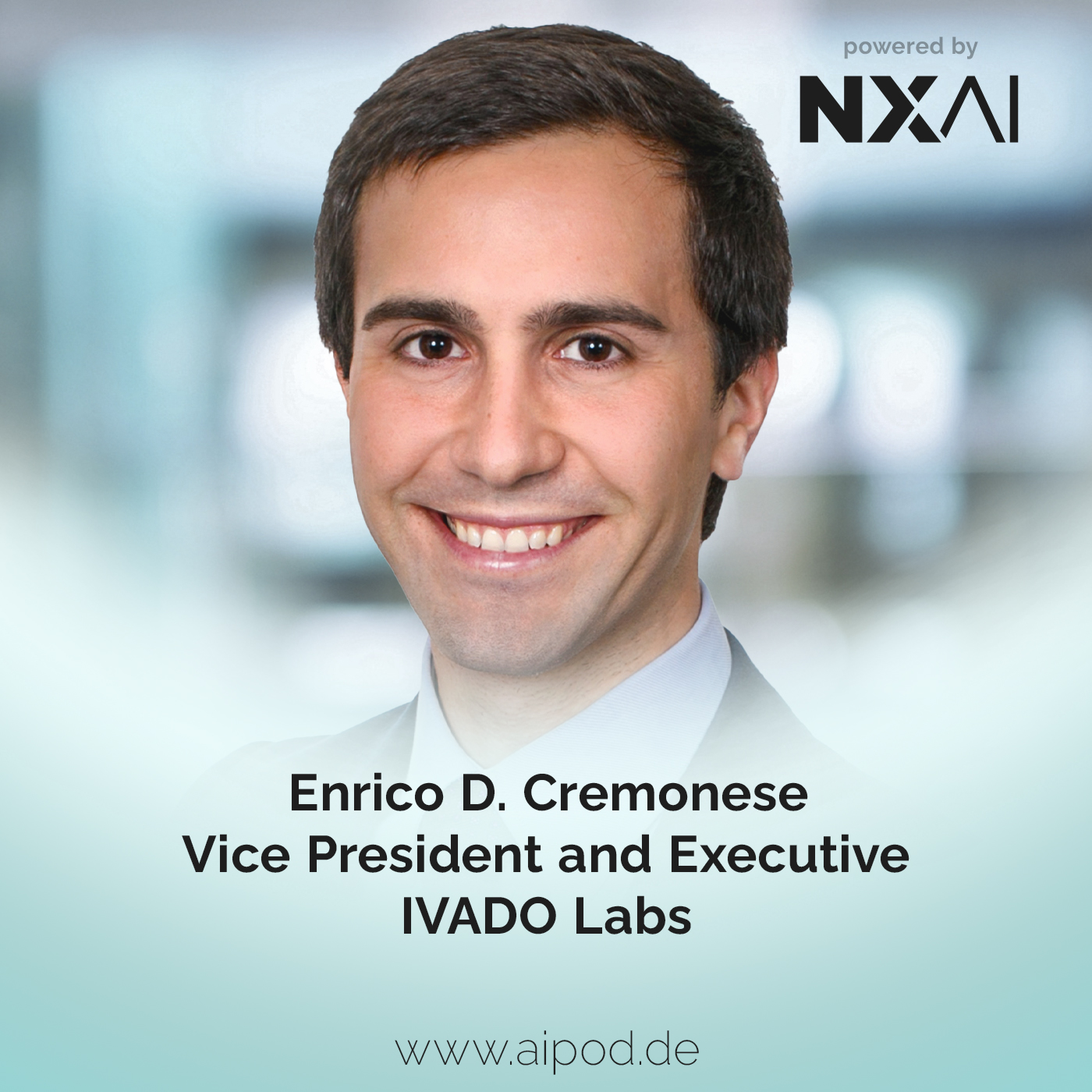
Thank you. Thanks for having me. Nice way to start a Monday. Yes, exactly. I agree with you. So, Enrico, did you come home well from the volcano? And I'm going to explain what that stands for, but you already know what it means. Yes, I came back really well and inspired and with a lot of topics. So thank you for organizing that. I think it was a great event. Yeah, so I'm going to come back to that in a moment. Some of our listeners will already know right now what we're talking about. But before we do that, please introduce yourself to our listeners. Yeah, so I'm Enrico Cremonese, Italian born and raised, as you can probably tell by my name. And in my day-to-day, I'm Vice President at Ivado Labs, where I co-lead our key business accounts and partnerships. I'm based between Montreal and Amsterdam and spent the better part of the last 15 years working on tech innovation artificial intelligence With large companies startups and NGOs in various continents and I can talk a bit more about Evalo Labs
I guess later on or now whenever you you recommend Peter Yeah, very good. Yeah, I when when I look at your LinkedIn, Andrea, I see that you do a couple of other things in addition next to the guest, but I leave it up to you to bring those in or not as we get to it. So you and I met on the volcano. Yeah, actually, so it's one of our industrial AI podcast conferences. We always call them AIFX. So wherever we go into the Alps or into the Black Forest, this time it was on the volcano. It's a very old thing, but Robert said a couple of million years back that it was active. And this lies in Parkstein, that is in Bavaria in Germany. And we were invited by Vitron, Vitron as a logistics automation company in Parkstein. And you shared your notes with the attendees afterwards,
which Robert and I thought was a real great source, a real great opportunity, maybe to share a little bit of what we do during these sessions, during these two-day conferences. So in Parkstone, we had three breakout sessions, right? One was simulation by Captain Bastian Aude. He's the CEO of Syncon. Then we did physical AI by Stratus Gravis. He's the professor of physical AI, Amsterdam. I believe that's where you are at the very moment as well, and Industrial Use Cases, as always, by Marco Huber. He's the Scientific Director, Artificial Intelligence at Fraunhofer. So, let's jump in. Let's see what it is that you already shared with the group. We're not going to refer to names of the people who were there, but we're going to stay at a high level. and as an entry point you recognize five threads that ran through the three sessions maybe
as an introduction as an overview shared in with us please yeah absolutely i think uh first of all it was a it was a really inspiring event and uh not to to you know just uh please you but uh i think the the format was something that uh that stayed with me uh it allowed for good exchanges and honest exchanges, which are not always feasible in larger conferences. But going back to those five threads, I think there were five, right? So workflow as a new unit of product, and then we had a concept around verification as a new bottleneck, the requirement for hybrid, and I'll get more in details in a minute. Yes, yes, please. That's the idea, yeah. Then the hard part is organizational, so not just systems. and then infrastructure, the actual hardware can become a real constraint. So I think when we talk about the workflow as a new unit of product, the agentic shift that we're seeing is something that is significant.
And it's probably more significant than the other AI changes that we've seen in 2010, 2015. But the product is no longer the tool, right? So the workflow is what we have to think about and reimagining the workflow across different business units where you're not responding to a single process or a process that was designed, but it's much more integrated. And so how can agentic systems allow us to do that is something that was actually demonstrated in the room, right? We had good examples, and I think some of them were also presented on your podcast in a previous episode of how do we go about re-envisioning these flows across the organization. What I read is the wonderful formulation. You say tools that are built for one box on the org chart lose their boundaries. It's almost like a poetic description of what happens, I guess. and if I interpret and then you can react to that
it's like this example of you know it doesn't matter what we talk if we talk you know coding with the help of let's just call it in general always AI the engineering that we have been talking about and everybody is now looking at doing something and then we many times talk about what does it mean for which is the workflow, the org chart, the workflow, does that mean that we're going to have more product managers or product builders? What are we going to call them and what kind of capabilities do they have? Do they still have coding, engineering capabilities, validation? So that's what I feel in your very poetic way of saying it is like the org chart But with the boxes and the tools that each of these boxes have kind of maybe felt responsible for, that is, as you say, it's losing their boundaries, right?
Yeah, and that was a good point that emerged, right? The conversation was broad, it was technical, but it ended up often in, so what do we do about it and what does this mean for our teams, our people, both the ones who are here today and the ones who are coming in later? What do they know about a process? Do we want to teach them ways of working that might not be applicable anymore because this tool is now different? And I think that, you know, you touched briefly on that title, which to me is really a role, right? How do those lines blur is an interesting question that I don't think anybody has just solved quite yet. But the competencies that need to come to bear, I think, are still the same. So you need critical thinking. And I think we'll touch upon it a little bit later as well, where, you know, the importance of the human in the loop or on the loop still today and or the risk of still having that human on the loop. Yeah. And without realizing, I already mentioned the work that is in your number two,
which is, you know, it's going to be more about verification, verification, which is maybe this, I don't know, if it is that new product builder or if it is the old, quote-unquote, engineer, I guess depends on what is it that is needed to be verified. I guess it's like, you know, what are we going to expect the agent to be capable to do? And today we're, I believe, very much at the point, well, but yes, the engineer or the product manager or whoever has to verify. And I believe there is this feeling that the role, the percentage of the agent will grow in general. I'm not sure how you see that until the point where we're going to say maybe that was even you said, well, you know, in the end, at some point in time, the human is going to be the bottleneck. Yeah, correct. And look, I can talk from personal experience on this because at this stage we do use agentic systems in the solutions that we build. but somebody needs to review it, right?
And so what is also the role of the people or the agents producing these outputs And do you build an agent that is able to verify some of those outputs I think there will be a combination I will touch on on the hybrid notion but I think there's something that we're not talking perhaps enough about which is the fact that generating these outputs is now becoming relatively cheap it's still expensive but it's you know becoming affordable but checking it is not and so So to what extent can we trust the output and who is responsible of validating what has been produced? Is it back to a hierarchical approach where the human is in a consulting mind like the senior partner or the partner who has final say on the output? Or are we able to bring in a series of more experienced folks and therefore the organization itself becomes one with a series of very senior people?
and so less hierarchical, much more flat and horizontal. But if a person is running 30 agents, either on a single project or on multiple projects, well, that person becomes a bottleneck. And so I guess we can leverage some technology to help us with that. But especially in regulated sectors, we do need to keep that critical human verification and validation of what is then going into especially systems in production. Yeah, and the other thing I think I've been talking about in our news section before is like when building things becomes so easy, so cheap, so to say, it's even more important that we just don't start building everything. but we even put more time into oh we could now build you know 10 times X but we you know we cannot build we should not build 10 times X or we should not build A, B, C, D, E, F, G, H
in parallel because you know our organization cannot manage so it's also the upfront it's not only the at the end who's going to be in charge front end of what happens the complete process verification but also the decision on what it is that we're going to be building, that we're going to have the AI, the agent, built for us. Yeah, I think I couldn't agree more. So that goes back to the core principles and what is required. The initial thinking and how you structure it and what do you want to do and what are the litmus tests that you want to run on a system are things that we need to be able to set up front. And these are all design choices, right? So whether they're at the beginning of the loop or at the end of the loop, we still need to have that consideration in place. Okay, you want to go into the other general one? So you want to jump into the breakout sessions, whatever you feel you would like to...
I think we had a couple of other points because maybe just on the hybrid. So when industrial AI, we often think about robotics, right, which is hardware. And there's a lot of talk in the AI world for those who are following it now about physical AI and world models and what does this mean and how do we get there. I think the consensus across the rooms was that we're still a little bit far. But in general, whether it's for physical AI or other approaches, this notion of hybrid beating just a single approach was something that came up. And so when we talk about physical AI, it's around how do we build and train models and what do those models learn from. And when it comes to more traditional AI approaches, again, it goes back to human plus AI and less about having systems run constantly autonomously, which you could choose to do. But that was an important notion, I think.
So how do we think about hybrid and bring it into all the solutions that are developed? Yeah, then you have the organizational thing that we talked about. Yeah, so organizational, I think here we spoke about legacy systems, but then the importance of the people, right? We touched upon it before. So how are organizations going to change? And I think, you know, actually thinking back to this, I thought it was funny because it came up as relatively novel, right? saying, well, we have to account for people and change management and user adoption. And having been doing this for 15 years, like many of the people in the room, I actually remember this as being one of the critical components. I don't think I've ever had a conversation about AI without talking about what does it mean for the people and the business and the value that's generated. So that was something that I think is still very, very much present. Yeah, and there were some attendees that were very, very far ahead, kind of.
And I'm just going to call out Bastian, as he has been called out as one of the breakout session captains, who, in addition to his simulation topic, which we'll talk about a little bit more, but he kind of really wanted to share, so he's completely changing his organization as an example. And there were some other wonderful examples. And I think, you know, many others of us are still more looking at it and thinking, oh, what can I do? I mean, sitting maybe in the middle of an organization, what do the people around me? And the thing you wrote down here, and I think I learned that in the past, you cannot easily say that the young people want to change and the old not. I think you find them anywhere. it but yeah bringing them along the journey and how to do it is is i think the most interesting part and what i thought was interesting as well in one of the breakout sessions was you know that the background of some of these change leaders or change inspirers is actually
you know behavioral psychology it's not necessarily business not necessarily engineering but it still has to do with people and how we succeed as a community or a society as a whole yeah and then And I think the last general topic that we discussed before going into the breakout sessions was the fact that hardware and infrastructure are becoming real constraints, right? And whether this is the availability of chips or recent chips, the scarcity and the concern around some of the resources that are required for running these large compute and data centers. We were talking, I think it was in the news yesterday that now Elon Musk wants to send some of his data centers to space. But this is something that has already happened, actually, with China, right? So it's not. Yeah. It was the second day when overnight Intel stock fell 20% because they can't sell PCs because they don't have the memory chips, right? So there was a lot of discussion on that, which I thought was a very interesting topic.
And it's so wide because so many of us, and I already talked about this in the upfront news section with Robert. It's, you know, many of us in the industrial space do want to go at least in addition to using whatever is in the cloud, but want to do many things with Edge locally. And, you know, if we don't get the memory, plus if, you know, the big five are, how should I put it, almost like sucking all the data out of wherever we are, every corner of the world into the cloud, and we don't get the chips for the edge, that was a very interesting discussion, I thought. Yeah, for sure. Did you want to talk a bit about the deep dive sessions? Yeah, yes. Let's spend five minutes on each of the breakout sessions. You want to start with, I already mentioned, simulation, and then Bastian already kind of
offered himself from the very beginning that we are going to talk about the agentic shift as well. Yes, let's do that. Yeah, for sure. And I think this was the session. It was the first session I had. So it was rotational, but this was the first one for me. And I really loved it because I think this was a session that made it very concrete for me. It was the example of a real company rebuilding itself around agents, right? And it also touched upon all of the higher level topics, right? Org, tech and investments. So we touched upon a bunch of different things that helps set the context for the other two days. And I think what struck me here, I mentioned it briefly earlier, but it's not just the product that changed, but the company itself. So in this specific example, there's a component on desktop simulation. And this has become one part, which was a core of the business before. It's now become part of a much broader agentic solution that is provided to clients with thousands of runs in parallel.
checking. I think the example that was given was at one point the production manufacturing of a crate of beer, right? Yeah, exactly. It would take weeks to do before and now instead we have the ability to run these simulations instead of six months in about two weeks. So that was pretty impressive. Yeah, very Very impressive. Yeah, it's a molding simulation that Bastian and his company concentrates on. And, yes, that's what we talked about. But in addition, he also shared with us the way that his organization is completely changing. And also there already mentioned, you know, at the news section, maybe you recall that the young, relatively young CEO of this, not that young company, finds time to do things that are completely crazy, referring to him, you know, building the one to two minute Afro cereals.
That's really, really impressive. So I think that's almost like a great example of, you know, eat your own dog food. Don't tell your people. And what else was he saying that, you know, I come back to my time and my intel. I was raised by NBOs, right? So the company's strategic objectives, they would be put on the walls. So there would be 25,000 posters. Everybody would get one. And he says he just puts it into the folder, which is where the agents go for when each of his people do something. You know, the agent will be told to always look at this folder. I thought that was – they are just like two small examples. of a completely new approach to how you run an organization, right? How you tell the people, this is what we are, this is where we move, and then use the agents and tell the agents almost like how they should help,
along what lines they should help the employees. Yeah, I think that was, we called it company brain, right, at one point, I don't think it's a term that was coined in the session, but that's how we referred to it. And I took that back immediately. So we, these systems and these approaches, but the notion of having a single agent that is telling other subsystems or subagents what to do and what to incorporate or not sort of improves that workflow. And I really like how simple that notion and pattern is where you give the agent the information or what you want to see, the constraints, the goals, whatever they may be. And then that gets turned into information or skill or a script for other agents. And it runs as a loop and then provides that feedback to yourself. I think there were a couple of takeaways also from the session itself that I thought were really interesting.
The first one is the hands-on and the velocity at which we can get to a proof of value or a prototype. So that's something that is really powerful, and we see it also in our day-to-day. So if we can put something in the hands of a user, show them how to go from an idea to a result, that is extremely powerful. as a tool to convince people to adopt the technology, but also as a way to start actually drawing those lines and sketching the direction that you want to get to. So that, yeah, there was a very few insights a few very few interesting insights that popped up during the session Yeah yeah I recall we should then probably move to the other two but I do recall the other one that you have there the show and tell, you know, convincing the skeptic people rather than telling them. That was a very good one as well, yeah. Yeah, so let's move to the second one, physical AI, the one that was done by Stratis.
What did you bring back from that one? So I think this was the most technical session for me and the one that tried probably cut through most of the hype of what we're hearing and what is being seen also in the markets in terms of raises and valuations for physical AI. And I think that the big takeaway was also what Stratis is trying to achieve, which is a simulation world model that work together to answer the same question. So not trying to solve them separately, but leveraging simulation and real world data to see and try and predict what happens next. Because simulation is very precise. It's a simulation. and world models are very or can be very flexible but they might hallucinate because they don't have the amount of training data that is needed and so i think the key term that stratus kept repeating was learnable simulation right um that helps us take yeah exactly that was this term yeah yeah and so that helps us take a little bit of what we know as a skeleton setting it up and then
learns the rest from the real world data that is provided inside. So that I think was one of the really interesting technical takeaways for me. And the question I left though, and still don't have a full answer on is, you know, when will we see an application in industrial that is general enough, right? Of course, we see self-driving cars and very specific tasks for specific robots. And I'm sure everybody's seen now videos of people wearing headsets or kind of cameras to show how tasks are achieved and performed. But that might be, you know, at least a few years away before we see kind of a general approach or general robot that can move in the real world. I agree. Then there was this, the elephant in the room that you recognized, that we recognized together during that session. Yeah, I think that the big one is the elephant in the room, which shouldn't even be an apple
product. It should be the main thought is safety, right? If you are running just a software model and it fails, yes, you might incur financial loss. But if you're running a robot, effectively, at an industrial scale and has to take thousands of decisions every second and it has not 100% accuracy, that means quite a few mistakes in the course of the day and across a scale of millions of robotic interfaces that just becomes not acceptable, right? And that, I think, was something that we need to keep in mind as these are being built. Yeah, I happen to be looking. I do that every now and then in YouTube. I mean, I mix private with work, whatever, you know, the greatest, best, whatever artist I love to listen. And then, you know, the algorithm comes up with stuff that I look for work. And there's things that go wrong in an industrial setting. And then you see specifically the robots.
If you have never seen that, it's like, oh, you don't want to look at it. I'm a very sensitive guy there. When you see that a robot, you know, slams a human being, right, just because they stand somewhere where they're not supposed to see, you want to put it immediately off. You don't want to see that, right? So, yeah, I mean, we have many specialists in the room, some of them, and we have been going, like the last time, to six. We have many people that are kind of born and live safely. But I do believe here that many times people who have not, you know, they see the wonderful demos, and it's very difficult for them what can happen if something goes wrong. Yeah, I agree. I think there's a component of how do we design this, right? And it goes at every level from, I think this came up also across all sessions, from regulation across countries to individual organizations
having clear guidelines on how to adopt and then obviously how these tools are designed and the scope of what is allowed. And so when we tend to talk about robotic, at least in my brain, it's always a humanoid approach that is able to do everything. But perhaps I think another takeaway from this session was, you know, that future seems still quite far. but where the opportunity is and where we might see applications much sooner or we're already seeing them in quite a few industries is sort of robots that are very good at doing one task in a specific way and so they can learn their complex environment but it's limited in range, right? It doesn't interact with any and every possibility. Okay, let's look at the third one. What did you take away from the use cases, the industrial use cases that was captained by Marco? Yeah, I think here, you know, this one was really grounded in what is happening today.
And so it was very downturn, quite reassuring because it addressed real problems. Right. And so I think the main one of the main points was that in the industry, we we measure value. And this is also what we do, right? We measure value on business and process outcomes. Model scores are important, but they matter more to the data scientists or the people developing the solution than the ultimate impact that is being delivered to companies. And so that is something that is true and important, right? When you think about an AI use case, you should think about the business question first. And then I think the other step that, you know, is always top of mind is what about the data? And so even with agents, we're still faced with the same problem. I'm sure you've lived it in your professional experiences as well. But, you know, it's been 20 years or more that data is still the crux of the question. And so how do we train agents on data or help agents access the right data with the right levels of yams or whatever is required in order to do the task and deliver the value, right?
That's, again, the core. Yeah, Marco is in charge of AI digitalization at Fraunhofer. Fraunhofer, for those of you, I think it was new for you, is a German, but they act globally. globally, I think it's like a, not sure if I say 25,000, but it's something like that, employee, it's applied research. And that's why when we do have the sessions where maybe we look a bit further into the future, like I personally typically do, and Marco will, you know, stand with two feet on the ground because he is, you know, providing services to companies in the field. And So then he will always give us this feedback of, you know, at least where he has had the experience, where things are working, where they're maybe not yet working, how far the market is or how not yet far the market is. Yeah, it was a very good bridge, I find, with indeed what research is doing and where the market is actually applying some of these solutions and some of the questions that are still being faced by organizations.
I think even in this session, we raised it around the future of software or the roles evolving, right? And who is able to remain more traditional reviewer or engineer and those who now are questioning a bit what their role is. Because with coding agents, it's really changing their line of work. And so how do we move organizations and even beyond the companies themselves, but also university or education? Like, how will this change? Because if the requirements of the jobs are different, well, then the entire societal system also might need to change. Perhaps, yeah. And even during the sessions, we left a couple of questions open as well. We can't go through all of them. What I would like to do is maybe as a closing office, like at a top level, you with your experience traveling between many countries, many parts of the world, how can you make a relation? What is it you would say, you know, you came and experienced the most of us, you know, guys from Germany, guys, only one women.
There always need to be more, dear women listeners. This is to you. Is there a couple of things you can say that maybe you see there as differences or, you know, very similar to what's happening in other parts of the world? So I think it's an interesting question. I think there's a lot of similarities and it's nice to see that people and leaders in the space are thinking about the same types of problems. and especially between Germany and Canada, I would say there's been and there is even more now ties for artificial intelligence, right? I think there were a few announcements and multiple company partnerships. So that notion of how do we build solutions at work that are ethical, that are also secure and sovereign, I think those are quite similar. So that's one big similarity I see and if I have to think about differences I think the practitioners right like your your group was really applied and it might have been a sub-selection right so we need to
assess the the broader sample but I think it was very applied in AI and I think this would be extremely interesting to to bring as a format and as a conversation to other countries and regions to showcase some of the advances that are being made. And then I think the takeaways overall are the same, right? We mentioned them before, but all outputs and generating things is getting cheaper. We still need to focus on judgment. And so organizations and even individuals, like in your personal life, you need to think what role do you want to play and how much are you willing to outsource? Will you be satisfied with, you know, maybe a relatively average output or will you find specific workflows that you can fully automate so i think the question is not really which models to use and what to do but more how do we find the right decisions that we want to improve on and i think this is something that is common to
all humans right it's like trying to solve a problem or question and making the right decision without knowing the future. So decisions on their uncertainty. Okay. Well, yeah, sure. I mean, we do go to other countries. We've been to Amsterdam. We want to go to Paris. And, you know, if you're going to be inviting us to, you know, you just mentioned Canada, other places. It was great to have you with us, Enrico. It was wonderful that you did this recap, which in a way that I hadn't seen it before, and that's why we jumped on it. So thank you very much for your personal perspective, for the stuff that you brought in, for us to learn from you. I'm happy that you brought many things back for you to use in your day-to-day work. Thank you very much for that, and looking forward to have you again. Maybe the people are going to say, oh, yeah, we need Enrico again, because he's going to be doing, he's going to be writing the recap again.
I'm sure you can find an AI to do that as well. is it going to be as good as what Enrico does and of course if then we would not want to have you for that reason it was great to have you with us Enrico and thank you very much for having shared your perspective on what we've been doing thank you and have a great day thank you likewise and it was really fantastic to participate and I look forward to many more exchanges with you and the rest of the cohort, bye bye thank you Enrico, bye bye Thank you.
番組の概要欄(原文)
We also get into learnable simulation, physical AI, robot safety, and the practical business value of industrial AI. The big question isn’t just which models to use—it’s how to make the right decisions under uncertainty.
出典・この記事について
- 番組
- Industrial AI Podcast(Robert Weber / Peter Seeberg)
- 元の回
- Learnings From AI on the Volcano
- 配信日
- 要約作成日
- 公式サイト
- www.aipod.de
この要約・解説記事は、元の音声を文字起こしした内容をもとに AI(Claude)が日本語で作成したものです。 固有名詞や数値に誤りを含む場合があるため、正確な内容は元の音声でご確認ください。制作方法について
関連エピソード
サンドボックスから2万5,000ユーザーへ:Bayerはいかに AI をスケールさせたか
Industrial AI Podcast
フラットな地球:エンジニアリングツールは消えるのか?
Industrial AI Podcast

見せるだけで仕事を覚えるロボット:Standard Bots CEO が語る物理AIの現在地
The Neuron: AI Explained
ナビエ–ストークス問題とAIエージェント
Industrial AI Podcast

NVIDIAのフィジカルAI:ワールドモデルとロボット開発の最前線
Software Engineering Daily
時系列は産業AIで最も過小評価されている領域 ― Arburgが語る射出成形×AI
Industrial AI Podcast