
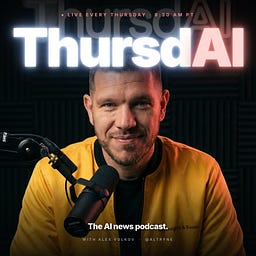
ThursdAI 10月1日回:OpenAIがアシスタント競争に参戦、CoreWeaveがサーバーレスGPUを発表
ThursdAI - Oct 1 - OpenAI joins the assistant race, CoreWeave drops serverless GPUs & more
ThursdAI 10月1日回:OpenAIがアシスタント競争に参戦、CoreWeaveがサーバーレスGPUを発表
ThursdAI - Highest signal weekly AI news show
要約
CoreWeaveの年次イベント Fully Connected の会場から生中継された回。前半はニュースで、OpenAIがDev Dayで常時稼働エージェント「Dots」、GPT-6.1 Sol、Ultrafast、Codex Cloudなどを発表したことや、AnthropicのSonnet 5.5、Gemini 4 Argonを議論した。後半はCoreWeaveの幹部・PMへのインタビューで、物理AI、Forgeのエージェントループ、Vera Rubin、サーバーレスGPUの発表が語られた。
この回のポイント
- ●OpenAIはDev Dayで、独自のPCとブラウザを持ち24時間動く常時稼働エージェント「Dots」を発表した。Sam Altmanは自身の会社運営に使っていると語ったと紹介された。
- ●GPT-6.1 Solは価格が据え置きでキャッシュ入力が大幅に安くなり、「Astraに近い知能を5分の1の価格で」と位置づけられた。出演者の間では、日常使いにFableやAstraは不要という見方が出た。
- ●Anthropicの Sonnet 5.5 は Terminal-Bench でOpusを上回るとされ、速度面と無料枠での利用が評価された。一方、コーディングではOpus 5.5が優位だという意見もあった。
- ●Gemini 4 Argon はTextアリーナで首位だが信頼できるテスターに限定公開で、エージェント性能では他の主要モデルより下との指摘があった。Googleの配布力にも言及された。
- ●CoreWeaveのPhysical AI担当VPは、物理AIを「現実世界で知覚・推論・行動するAI」と説明した。データ不足とシミュレーションと現実の差(sim-to-real gap)が課題で、生成AIによる物理近似が有望だと述べた。
- ●CoreWeaveはForge(観測・データ選別・改善・評価のループ)、蒸留、Sandboxの一般提供、そして契約不要のサーバーレスGPU(プライベートプレビュー)を発表した。
章立て
オープニングと今週のTLDR
Fully Connected 会場から生放送を開始し、OpenAI、Anthropic、Googleの新モデルやDev Dayの発表を一覧で紹介する。
今週のBuzzとオープンソース
CoreWeaveのForgeやCognitionの採用事例を紹介し、Yandexのモデルやオープンソースのデータセットの話題を扱う。
Dev DayとDots、GPT-6.1 Sol
常時稼働エージェントDotsの機能と各出演者の使用感、GPT-6.1 Solの価格と性能、Ultrafastと500ドルの新プラン、Codex Cloud、Decisions APIなどを議論する。
Sonnet 5.5とGemini 4 Argon
Sonnet 5.5の使い分けや無料枠での位置づけと、Gemini 4 Argonのベンチマーク結果、Googleの配布力を議論する。
政策・産業ニュースと個人アシスタント活用
AI CEOらによる自主合意、AMDによるWorld Labs買収を議論し、出演者が自分のアシスタント活用例を紹介する。
物理AIとCoreWeaveのインフラ
物理AIの基礎、データ拡張やシミュレーション、sim-to-realギャップ、Caterpillarの事例、ロボットの実用化時期を聞く。
Forge・蒸留・Sandbox・サーバーレスGPU
Forgeのエージェントループ、蒸留サービス、Vera CPUの「エージェントパッキング」、Sandbox一般提供、サーバーレスGPUのプレビューを紹介する。
Corey Sanders氏とAgent Lens
CoreWeaveのSVPが Agent Lens、蒸留、Weights & Biasesの今後を語り、会場の様子を紹介して番組を締める。
解説記事
今回のThursdAIは、CoreWeaveの年次イベント Fully Connected が開かれているサンフランシスコのMoscone Centerからの生中継だった。司会のAlex Volkovらが、OpenAI Dev Dayを中心とする1週間のニュースを振り返り、後半ではCoreWeaveの幹部やPMへのインタビューを行った。番組の協賛元の会場からの放送である点は前提として読んでほしい。
OpenAIがアシスタント競争に参戦
今週の目玉は、OpenAIが発表した常時稼働のエージェント「Dots」だった。番組の説明では、Dotsはクラウド上に自前のコンピュータとブラウザを持ち、4,000超のコネクタに接続して24時間動く。電話のように話しかけたり、SlackやTeamsに追加したりでき、できることの範囲や事前確認の条件も設定できる。Sam Altmanが自身の会社運営にDotsを使っていると語ったと紹介され、Dev Dayのデモ前に、本番障害でデモが動かない可能性を担当者のDotsが知らせたというエピソードも語られた。
出演者の反応は様々だった。Peter(Arena AI)は、導入時は物足りなかったが、Astraと話せる点や複数スレッドをうまく調整する点が良いと評価した。Wolframは、実運用で使われていることを前向きに受け止めた。論点になったのは、Muse(単一のエージェント+サイドチャット)、Grogbot(複数ボット)、Dots(単一)という設計の違いだ。Wolframは「1人の秘書と多数のサブエージェント」という構成を支持した。Alexは、Googleの Spark の出来に厳しい評価を示した。
価格競争とモデルの使い分け
モデル面では、GPT-6.1 Solが発表された。価格は入力2ドル・出力10ドルで据え置きだが、キャッシュ入力は95%安くなったと説明された。OpenAIは「Astraに近い知能を5分の1の価格で」と訴求している。Peterは、日常使いのモデルとしてはFableやAstraを選ぶ理由が薄れたとの見方を示した。ただし小型モデルは「より芸術的」「EQがやや低い」といった癖も指摘した。
AnthropicのSonnet 5.5は、Terminal-BenchでOpusを上回るとされる。AlexはOpusの利用枠が広く、Sonnetを使う動機が弱いと語った。一方、API利用者にはコスト面で意味があるという意見も出た。LDJは無料枠で使える最良のモデルになり得ると述べ、Nistenはエージェント用の既定モデルとして気に入っているが、大規模コードではOpus 5.5に及ばないと述べた。
GoogleのGemini 4 Argonは、Textアリーナで首位に立つ一方、限定公開でエージェント性能は上位モデルより下だと紹介された。Peterは、コーディング以外の幅広い用途や、Googleの配布力に注目すべきだと述べている。
ほかの発表と産業ニュース
Dev Dayでは、1.2億ではなく12億人とされるChatGPTユーザー向けに、サインイン機能や新しい料金帯(500ドルのPro)、Cerebras上で高速に動くUltrafastモードが発表された。クラウドで動くCodex Cloudや、Decisions APIの待機リスト受付もあった。Decisions APIについては、昨今のオープンソースの動きへの反応ではないかという推測が出たが、確証はない。
産業・政策面では、AI企業のCEOらがホワイトハウスの自主合意に署名したことや、AMDがFei-Fei LiのWorld Labsを82億ドルで買収し、Liを幹部に迎えることが話題になった。出演者は、ロボティクス用の世界モデルや人材確保が狙いではないかと推測した。
物理AIとCoreWeaveの戦略
インタビューでは、物理AI担当VPのRichard氏が、物理AIを「現実世界で知覚・推論・行動するAI」と定義した。代表的なモデルはVLA(視覚・言語・行動)で、最大の難所は実世界での行動だという。ロボット用データは乏しいため、遠隔操作での収集、基盤モデル、データ拡張、シミュレーションが組み合わされる。シミュレーションと現実の差(sim-to-real gap)は大きな課題で、高精度の物理シミュレータを生成AIで近似する研究が進んでいると語った。Caterpillarのような事例では、ストレージの高速化、CPUとGPUの組み合わせ、ゲーム用に近いRTX系GPUでのシミュレーション実行など、専用のデータセンター設計が必要だという。家庭用ロボットより、産業用ロボットの方が早く普及するというのが同氏の見立てだった。
Forge、Sandbox、サーバーレスGPU
CoreWeaveの新サービス Forge は、観測・データ選別・改善(ポストトレーニング)・評価・再実行という「エージェントループ」を一つの面で扱うものだ。OpenPipe出身のDaniel氏は、サーバーレスのSFT、強化学習、蒸留を説明し、蒸留は教師・生徒の関係で小型モデルを作る正当な手法だと位置づけた。Corey Sanders氏は、観測ツール Agent Lens が小さな傾向を自動検出する点を気に入っていると述べ、Weights & Biases Models や wandb CLI も維持される方針だと説明した。
Sandbox担当のDiok氏は、エージェントの実行にはCPUが重要で、NVIDIAのVera CPUでは1ラック2万超のエージェントを同時実行できると説明した。Cognitionが最初の顧客で、性能が約4.8倍になったとされる。さらに、契約不要で時間課金のサーバーレスGPUがプライベートプレビューとして発表された。
まとめ
今回の議論から、日本の読者が注目すべき点は三つある。第一に、AIアシスタントが各社の主戦場になりつつあり、競争軸が単純な知能から、メモリ管理や常時稼働、チャネルの設計へ移っていること。第二に、価格を抑えた中位モデルが日常用途で十分だという意見が増え、モデルの使い分けが現実的な課題になっていること。第三に、エージェントのためにCPU、サンドボックス、観測、ポストトレーニングが重視されるなど、インフラの重心が変わりつつあること。なお、数値や評価の多くは出演者の発言や会社側の説明で、独立した検証は別途必要である。
文字起こし(英語・自動生成)
Welcome, thank you for tuning in to Thursday Eye. We're in the middle of the show floor in Moscone Center, and we're just setting up the show. Hello, everyone. I'm Bull from Ravenwolf, the evangelist, together with Alex at CoreWeave. And then we are coming to you live from the Moscone Center. As you know, Thursday Eye is only possible because of CoreWeave. And CoreWeave has this biggest event of our year that's actually happening live right now. So many, many folks are probably tuning in to that. But Thursday I needs to happen. And so we're going to start the show with the news, and then we're going to switch and have a bunch of interviews with a bunch of folks from CoreWeave. Let me say hi to Nistan and LDJ as well. Nistan and LDJ, how are you guys? Hey, everybody. Hi. Hey, it's going to be a good day. It's been a good past seven days. A lot of announcements. We're going to talk about a lot. Folks, OpenAI joins the AI assistance race. This is the top news from this week. OpenAI joins the AI assistance race.
Meta has news. Antropic has cloud, but not really an assistant. And Brock has Brockbot. And this week, OpenAI stepped in and changed their offering a little bit to something called dots. I was at OpenAI Dev Day. As I heard some of them talk about this on stage, it is an assistant that's live 24-7 for you with its own computer and never goes to sleep and it's monitoring everything. We have to talk about the assistant era, and we're definitely going to tell you about the assistance era on the news but also Dev Day had a bunch of announcements that we can't wait to cover with you as well not to be outdone Anthropic released a new version of Sonnet 5.5 a Opus' smaller brother which is Opus' Fable's smaller brother and that is a very interesting model as well much cheaper so we're going to definitely check in on this as well and you definitely want to stick around with us because today we have four folks from CoreWeave
coming on the show on the second hour to talk about physical AI, to talk about soundboxing, our new offering called Forge, which has a free tier that you can try at CoreWeave and a bunch of the live demos that we're doing live on stage. I think that's going to be very, very exciting. this is the tldr this is everything that big that happened in the world of ei in the on october 1st this is october you guys believe this in october i i'm still it doesn't click for me peter we're in october already we're in the last quarter of 2026 and nobody's pacing there's no pacing the frontier there's no pace three big models this week just this week folks we talked to you about gpt6 Astra and Sol just last week and now we have another one GPT 6.1 Sol announced during Dev Day we have Cloud Storm at 5.5
and Gemini Wolfram Gemini came back finally but not really Peter I think we'll definitely have to at least mention Gemini 4 Argon because that's well we don't know much about it we haven't been able to test it yet but maybe some people have all right so we'll start with we mentioned on tropic open the eye open i also launched a bunch of stuff during open the eye dev day that we're going to run through but then we're going to do a deep dive um open the eye launched a jeff competitor yep open the eye decisions ati uh essentially a jeff competitor which is really funny because jeff kind of was came up inside open eye however it is multi-modal i don't have access yet but uh decision api is unlike an LLM does not fuck but gives you decision powers as well. OpenAI launched sign-in with ChatGPT. So many, many companies can now just finally let the 1.2 billion users
that ChatGPT has sign-in with their account and then use that token. So if you are paying for one of the now three tiers, the plus, the pro and the extra pro $500 tier that they also announced you'll be able to use your tokens on different apps which I think is a very very interesting thing OpenAI also launched Ultrafast which is a long promised cerebrous integration where GPT-6 runs at 6 times the speed and we've definitely got to talk to that we talked about Gemini 4 Argon from Google it's number one on TextAreen and Val's index but it's still rolling out to trusted defenders first and then and see what else ultra fast anything else I'm missing in the TLDR Peter from Devday Peter was also there by the way yeah it was a fun day did you mention the
6.1 Sol 6.1 Sol yes GPT 6.1 Sol and new models from OpenAI. Yeah, I didn't particularly expect them to release any models, so that was a nice surprise. It was a nice surprise. It was about developer tooling and things like that. So, yeah, ultra-fast mode, that was another one. Codex Cloud, that's my new API. Wolfram Codex Cloud, you want to tell us? Yeah, Codex Cloud. This is the TLDR folks, remember? We're going to do a proper deep dive into DevDay. But, yeah, tell us. So, basically, it's a codex harness fully in the cloud. So, you can close your laptop, turn it off, and see it from your phone, and it's still going. All right. So, this is OpenAI DevDay. What else do we have? Oh, yeah, we have to talk about this. Six AI CEOs signed the voluntary White House Accord of Superintelligence. Superintelligence is on the menu, boys. Superintelligence is on the menu. Did you see Dario and Trout giving a high-fuck to Dario?
So Dario Amadei, Elon Musk, Sam Altman was at Dev Day, by the way. This happened during Dev Day, but Greg Bachman was there. Who else? I think there were a few more folks there. Oh, Mark Zuckerberg, of course. And Jensen also was there. So they all signed the AI, the White House Voluntary Accord at Super Intelligence. And they also leaked the Antropic IPO numbers. We're going to tell you about the Entropical IPO numbers as well. And also in kind of the industry and policy thing, you guys clocked that AMD has purchased Dr. Fei Fei Li's World Labs for $8.2 billion. No, that's Entropical IPO. Yeah, $8.2 billion. So, AMD to acquire World Labs from Fei-Fei Li, Dr. Fei-Fei Li, which we told you about as it launched, what, two and a half years ago. And we got very excited about their models.
Dr. Fei-Fei Li to become the AMD EVP and chief scientist. That was quite an acqui-hire slash acquisition as well. All right. So, this week and this week's buzz, according to where we're talking about everything that has happening in the OHSN core, We have a bunch of stuff to tell you about, so I'm going to run through them super quick. CoreWave launches Forge. It's everything that you need to take your agent from good to great. We have tools to offer you across every step of the agentic loop. As you run your models and agents, as you observe them, you curate the best outcomes, you improve, and then you run the evaluation and you run them again. One agentic loop. We're going to have a bunch of folks to tell you about this agentic loop here on the podcast very, very soon. Forge has a few plans It's free and the Pro starts from $60 a month With a 30 day trial And all the tools including weights and biases Are included there Folks, weights and biases are not going anywhere The weights and biases models Product that many people use to train their models
Is a live and kick Inside Corvive Forge We're going to have Corvive VPs To talk to us about this And Forge is fully connecting the entire Pro side Nice, nice Very good Forge is fully connected with AI. All right. Oh, also, super cool. I don't know if you guys thought this. Cognition now powers their SWE 2 models on top of CoreWave infrastructure and NVL72 Vera Rubin CPU GPU kind of like architecture that we're going to hear about in the next part of the show. And Cognition are seeing almost 5x increase in the throughput of SWE 2, their own house model. So how that's going to go, and to tell you all about this later, we're going to have Corey Sanders, EVP of product at CoreWeave, to talk to you about this. Vera Rubin, I think they're our first customer, and I think we're like one of the first folks into production with Vera Rubin and the whole setup, which is quite incredible.
We're also going to hear about sandboxes, so that's exciting. Let's move forward in open source. Not tons of stuff happening in open source, as far as I've seen. And H Company open sources Holo 4 computer use. We keep talking about H Company. I've never used one of their models, but shout out for them to computer use Holo 4. And NVIDIA releases the Open Agent Safety Platform, which is an open shell, part of the new platform to watch and control what agents do with a hardware watchdog that can quarantine a rogue agent, which sounds like OpenAI could have used this while doing the swarm thing. Wolfram. but definitely you should have something like yeah I will I will have to say though I was busy with Dev Day in like preparation for this NISTEN LDJ anything big happen in open source that folks need to know about NISTEN besides you blowing up on Hug and Face there's a couple of smaller interesting things like I believe it's the Alice model that they ended up announcing it's it's basically the Google of
Russia that released it it's called Yandex oh Yandex released the model what Yeah, and it's called Alice. It's about 35 billion parameters total. And what's interesting, it's really high sparsity, only about 600 million parameters active. Wow, that's super cool. Yandex are no slouches, folks. Nebius came out of Yandex, if I'm not mistaken. And I think that they also have like a smart device in homes. Okay, that's super cool. All right, folks, we're still in the TRDR. in JEV agents, agendic tooling and everything, we have re-SPAN SPAN01 claims 2x cheaper than JEV. So, it hasn't been, what, two weeks since TypeSafe released JEV and we talked about this on the show and, by the way, they came to the Corey Hackathon and the Corey Hackathon participants got early access to JEV. SPAN01 is 2x cheaper than JEV and runs on open router and SPAN Lite is free. I don't know quite about benchmarking so we had Florian talk about
JeffBench. So a very interesting resource for you to check out. If you are into decision models and type 1 models, there's a lot happening there. Because also OpenAI released their competitor for decisions API. Released is a big word. They put it on the wait list. So we're waitlisted there. There's also a new tool that I saw called JeffGrep. It's a little CLI powered by Jeff. Claims to make coding agents 40% cheaper. And Cloudflare released a bunch of stuff. They keep releasing. This is Cloudflare's birthday week. Shout out to Cloudflare. I absolutely love them if anybody from cloud for watching then listen I think I think we could hear you but hold on let me just let this thought clouds there is doing the thing that I'm going to tell you all to do as well all products in the world now are going to be agentic agents are going to use products more than humans because for each human I don't think that this panel is quite there yet but this guy and this guy are definitely there most of the products will be used by bar assistants and so cluster rebuilt their whole cluster API on top of the CF API
everything that you can do as a human clicking buttons in the dashboard your agent can do with the CF API and the right tools I think that's the acts of the right approach for the world and as the world is moving to the assistant folks again grogbot has Elon Musk from SpaceX AI has grogbot meta release muse and is pushing this to 1.2 billion people very soon and then open the eye also has 1.2 billion weekly active users, which they announced just now, and they are pushing dots, which we're going to tell you about all in the next segment. Speaking of Jeff, I also have one more, because Liquid launched D1, its first decision model, and Liquid says it's the first model to beat Jeff on Hacking Face's decision index with stronger multilingual prompt injection and long input results. It's coming to Liquid's API and open router soon as well. Okay, so folks, that's OpenSource and now in voice and vision, Hadrian released Hadrian Video. I don't know if you guys saw this.
Hadrian Video is a Minimax H3 video model, and it's billed at one cent a second. One cent a second. Just a penny through October. I think that's really cool. I think that's all that we have in the TLDR for you, and I think it's time to go. One more. One more. Because we are talking about agents and personal agents assistants, actually. So, Nautilo is an open-source, MIT-licensed, self-hosted, multi-user agent workspace for you and not just you. It's not a single user as many agents are. It's for the whole family, our whole corporation. All right. That's super cool. All right, Nissen, quick check why you're blowing up on Hugging Face, and then we'll move on to the data. Yeah, it's number two in data sets, and it's number six. You released the data set as number two training on Hugging Face? number two on data sets and number six on overall things with models and stuff shout out to SECM from Twitter for holding the lead there for like three weeks
he released the entire 17 terabyte arc set I released a 70 megabyte synthetic Opus 5.5 generated data set that just played every it played agentically doctor patient and then he tried to obfuscate one thing from the patient like tie there a lie or something they forgot. And then it had to gently correct it. So the data set has just made the models to train better at, yeah. And then I looped this over 2,200 diseases. So I just set up an agent loop and just ran 100 agents at a time. And that's how that was generated. And then it was filtered three times. Yeah, it's really good for building, like, small medical robot rags. So you can build an agentic rag with it, and you get way higher performance from a medical model. Because now it has an entire source of truth from Opus 5.5. So it's going to be pretty accurate. The only downside was that the conversation was a bit too technical because it tried to include every single thing possible.
So that was it. But it's meant to be used by a friendly chatbot. I think that this is the biggest open source news from all the news that we just played. One of us blowing up on Huggie's face. and folks can use the data set. Okay, there was one more news. One more thing. But quickly. SG Lang announced native support for turning any model into a gem. And they already released a system set for doing quant. Yes, this is insane. You'll be able to use that with any model because you just take the encoder from it and then you use their classifier code. Yeah, any model on SG Lang. Like, right now, it only supports the Quint ones. Yeah. But, yeah, this is pretty crazy, I think. Wow. Yeah, that's insane. I think that, folks, like, TypeSafe kicked off a hornet's nest, as noticed by OpenAI. Last thing I think, we democratized Jeff, guys. Yes.
It's been democratized AF. I think that Jeff shouldn't be our network. I think that Jeff should just run on whatever CPU they have. And I think, you know, maybe we'll get Jeff Kors on the iPhone in like five years. You know, they have NeuroCos for everything. Five months. Five months. No, Apple takes a long time. All right, folks, I think it's time for us to move to OpenAI. Dev Day, there's a lot of announcements. It's very exciting. I was there. Peter was there. Actually, I wish I had this video to play, but I asked him a bunch of questions, including should they slow down or have they considered slowing down? They said no. Okay, let's move to the Frontier Labs. Dev Day coverage starts right now. All right, folks, this week was the fourth annual Open the Eyes developer conference,
which essentially is their WWDC from Apple or MetaConnect from Meta, which happened just a week prior. And OpenAI went all in with 20 releases. This was the biggest Dev Day ever down at the Fort Mason beautiful location in San Francisco. And I was there. Peter and I were there as well. Peter, thoughts on Dev Day? super quick before we go dot dot dot before we go announcements and dot dot dot is a funny fun um that's on dev day how did this year go you know what whatever you think of open ai they can put up a good party like it's a they can put on the show yeah yeah it's a it's such a nice event and just it's a very happy event lots of people you know good food very well organized um you know It's like almost announcements. You guys who haven't been there, you probably know much more about the announcements because, you know, we just hear it on stage
and then we go to the next room and so on. So, yeah, they announced a lot of good stuff. Who knows how much of it will be important that we'll stick around because I think previous that day, I'm not sure stuff was that important. But I think it's just a good place and I wish more companies would do it, right, where you just have a big event where people come together, kind of celebrate the company, or what they've done and just have a nice time. And they also, they're very good at letting OpenAI employees actually talk to developers. I think this is what DevDay is all about. And one thing to mention before we go to the news, folks, that if you have a chance to sign up for next DevDay, you probably should. Sam Altman really takes it out of his way to go to DevDay. He didn't go to meet with Trump and all the other CEOs. He sent Greg Bachman. Sam Altman was there answering our questions. Sam Altman was like shaking his head with people. He was at the after party. It's really, really something. Okay, so besides the kind of the vibes, which were immaculate, besides the swag, which was immaculate, Peter, we got this monochrome Game Boy emulator.
We got a bunch of stuff. Besides all that, we also had a bunch of things announced. And I think the number one thing that is very important is that Fox OpenAI is stepping into the assistant era, the AI assistant era, which could be very funny because the original system prompt for ChatGPT was you're an AI assistant, you've got to remember that, but it wasn't really agentic assistivity. It wasn't prompting, it wasn't proactive, it didn't notify you. So OpenAI looked at their competitors, looked at Peter Steinberger from OpenClaw that they've hired like eight months ago and started building something. That something is now unveiled and it's called Dots. a dot is an always-on agent in chat gpt powered by gpt astra not sure quite which model maybe the latest uh maybe the latest astra but it's far by astra that's what they said uh it has its own computer and it's its own browser in the cloud and it's connected to over 4 000 connector
applications the stuff that folks have built for chat gpt your dot can now connect to it works 24-7, and you can talk to it. You can call it. There's like an interface there that looks like a phone call that you can call it. I think that's going to be great for my mom. You can also add it to Slack and Teams and by voice. And you said the boundaries, what it can and cannot do, what it asks first, etc. Sam Altman literally said that he uses DOTS to run OpenAI for him. And there was a very interesting thing during Dev Day, Peter, probably you caught it, that Roman Huet, a guest on our pod, by the way. Shout out to Roman, one of the best ever folks in the biz did the live demo and the live demo didn't work the voice didn't work and apparently this was because there was some deployment happening however what happened was that Tebow the guy the recent guy his dot alerted him like hey you're about to do a demo and the demo may not work so open the eyes really dig into like the personal assistant stuff and the teammates and their dots now live in the open AI slack Wolfram let's go to you
because out of everyone that we know, you're one of the more assistant people on the planet. You and Amy are a known duo in the human and AI world. What do you think about that? It's great that OpenAI is stepping in, and I love that OpenAI is using it for actual productive stuff instead of just a demo where you show how it does some mails or something. Sam Altman himself is using it to run the company. That's a good sign. And I think more should be doing it like that. Yep. Folks, if you have a chance to try, Peter, your thoughts. We've talked with Peter before a little bit about assistants. Peter, I know you're not big on them, but thoughts about that as a product? Yeah, well, first thing to say, Alex, I think you really called it in the last couple of Thursdays. You kept bringing this up and making a big deal out of it. So, yeah, I think a very good call. So, yeah, I think everyone's going into this. I feel bad because I haven't tried all of the others.
Really, I don't have access to Muse yet, so I can't speak in a more complete way. But when I was onboarding into Dots, and I have tried it for a little bit, I was a little bit underwhelmed at first because you kind of connect and it's like, then what? It's like, okay, I guess it's a chat. But actually, I think the onboarding could be better. But once you just get past that point, which is a little bit boring, it is quite nice for two reasons one is that you are actually speaking to Astra so it is a smart, nice to talk to model and it's very good at coordinating different threads so that's one thing I was worried about is that you get to speak to one thought it's not like I think in Grogbot you can speak to many different ones or at least you can see them you just speak to one and that's it maybe they're going to have more but for now it's just the one and I thought that might not work but it is actually really good so I did like that yeah
and the very interesting thing is that let me just start to interrupt that's how Muse works Muse is just one Muse and then you have side chats Grogbot specifically has multiple bots for everything but Grogbot this week released the Chief of Staff pattern like main Grogbot and so I think that we're seeing this shape evolve in real time as people play with it do you want one like Amy that you talk to like me and Wolfram just one physical person that I talk to or do you want me and Wolfram that we have WhatsApp for this comes and we can go to Slack to like work comes right you want different methods of communication what do you think I think that's what a sub-agents are for so I want one executive assistant I'm talking to and a lot of employees that work for us and that is a paradigm I've been using and I'm super happy with this you need a lot of channels and threats of course to separate the stuff not just one conversation but then it works. I wish we had all the time in the world to tell you about that but folks once OpenAI launches something
many many people will start using this they announced 1.2 billion weekly active users of ChatGPT, many of them are free probably, the difference between the different offerings is very interesting Meta is offering theirs for free OpenAI is only allowing this on the Pro and including the $100 plan, so like it's $100 limited but they will release this to everyone It's very, very obvious. So I think it's time for us to move to the model. GPT 6.1 Sol, just what, a week, a week and a half after Sol 6, we get a new model. And five days later, it's already replaced. It's the same price, $2 in and then $10 out. But cashed input is now 95% cheaper and $0.10 a million tokens. And OpenAI is pitching that this is a near-astro intelligence with a fifth of the price. Nisna and LJ, have you had a chance to try out a 6.1 sold? I've been trying it out a little bit. Thoughts?
I'd say it has less of a big model smell. Yeah, less of a big model smell. Yeah, I do like that they are focusing a lot on the speed and efficiency of it in terms of the amount of tokens and costs this year. I don't know if you saw some of the metrics for Sonic 5.5 and Opus 5.5, which I'm sure we'll go over later. But those seem to be using a lot of tokens and at some points in time being even comparable in cost or amount of tokens used compared to something like Fable. While Sol seems to be truly just significantly cheaper in almost every case. So on DeepSuite, 6.1 Sol actually beats Astra at 1.6 of the cost. Default in Codex and folks are calling this the workhorse. Peter, thoughts and arena performance for GBT 6.1 so? Yeah, I've been testing quite a bit actually, and I do like it, and I'm very impressed with how cheap they made it, and yeah, which kind of is a little bit confusing, I would say, in terms
of the how they priced it, and clearly they're feeling the competitive pressure, right, Opus 5.5. I don't think, oh no, we actually do have a score for code arena, so it's kind of measuring front end, so it's a little bit lower than Astra, but not that much lower, so it's fourth, which makes it above Fable, actually, which is kind of, it's nuts. It's nuts! Very well-priced model. Yeah. Yeah, go ahead. Using a day-to-day, I wouldn't quite say it doesn't have the big model smell. It has bigger model smell than 6, I would say. But it does have a tendency to kind of, I don't know, it feels a bit more artistic, like it kind of goes into its hole for a bit and just comes out and says, oh, here it is. So Anastra is a bit more higher EQ, I would say. But in terms of the quality of the output,
I mean, it's a no brain now to just use the lower tier models as your daily driver. So for OpenEye, I just use 6.1 now for Anthropic. I haven't quite decided it as a top of the SONET, but you can probably kind of you need to find which one, but certainly it doesn't really make sense to use Astro or Fable as your daily driver now. I will just, I want to repeat this directly with the camera, folks, Peter Grosso from Arena AI is, I think, summarizing the vibes of the whole timeline. It does not make sense to use Fable or Astro right now. This is where we are. Maybe this is facing the frontier. Maybe the company and are releasing such good and cheap models that we won't want to always race to the best, best, best intelligence. Peter, we talked about this, that I think Opus 5.5 is enough. I think the GPT Sol 6.1 is enough. I don't want to reach for Astra, and also I don't want to spend all of my token budgets on those big models, but for day-to-day, for daily drivers, this is enough.
For bigger problems, Navier Stokes-level problems, maybe you want to reach for the bigger models. specifically though the reason why you would maybe not use Astrace because it's very expensive but if you are a billionaire there's another option for you they launched the ultra fast and pro 500 tier on OpenAI OpenAI launches the pro 500 tier you pay them $500 and you get access to ultra fast ultra fast mode is their models running on cerebrus inference and charlotte to cerebrus for the speed and is up to 8 times as fast in codex Around 300 tokens per second for Astra I believe and six times the price And it comes with a new 500 pro door tier Sam said on stage it so fast he never goes back anymore obviously you want even though that's why we got excited by Jeff right that's why we were all like okay I can do this in touch with Jeff so like now you can do this with speed and the quietly the $200 pro plan is back but half the usage so F you to whoever in the opening I decided to cut my usage in half which it
It was quite awful even before. And we'll see after this show if this succeeds. If the folks at Corbyr will allow me to get to the $500 plan. But, yeah, it's quite expensive. But UltraFast is crazy. I think we're skipping Codex Clouds. Oh, Codex is also running in the cloud. Another thing to call, Peter, that we did talk to you about on the show, but here's the actual calling. Local environments make no sense. Local environments, local next make no sense. The more I work with Fable and the more I work with Codex on my machine, the less memory I have. Peter, you talked about this with your Linux machine as well. Everybody's moving to the cloud. Most of what my machine can do, they can do on the cloud. All they need is my logins. That's what that is for. And they're also announcing Codex Cloud. So you'd be able to move your stuff in Codex to the cloud. I think that's very, very important. Decisions API. Maybe the last thing that we'll talk here about. decisions API from OpenAI is the new Jav competitor Jav killer
not public yet we cannot benchmark yet but exciting why is it exciting for me it's exciting because I'm using OpenAI already I have the subscriptions and I use them so if I was to use Jav I would have to send the data relevant to the decisions to another company and that is something maybe I don't want to do so I can concentrate on where my data is going. And if I'm at OpenAI, just use OpenAI. Peter, decision API? Thoughts on this at all? Yeah, I mean, this place is exploding. Again, you guys called it, right? It was very exciting and we get so much new stuff. And yeah, I agree with Wolfram. I think it was one thing that is kind of exciting, but then, oh, it's another company that I need to send my data to. But also the important part is that because it's so cheap and you want to classify stuff, then you kind of have to send all of your data, right?
It's like so much data. Don't say, oh man, I don't know what to do with this. So yeah, the more you can reduce your footprint, the better. So that makes it high utility. I think what's interesting about it as well is that it is based on Luna. So that would be interesting. Yeah, multimodality, you guys mentioned. Multimodal, I'm so excited. so that is interesting so yeah we don't know that much about it yet but that certainly I am curious do guests think they just reacted and shipped something super quickly after Jeff I wanted to ask Sam Altman this live at the Q&A that we had with Sam Altman and I just decided I did ask him about this because on Latent Space Swix interviewed Diogo and Diogo said that he came with this idea to Sam Altman two and a half years ago and Sam Altman said it's a crazy idea you should work on it and Diogo has been working on RLHF and once he finished up he went and did type save and they say it's like two years
in the making and now we're seeing just like decision models in open source and everyone just popping like mushrooms off the terrain so I really really wonder if this is a reaction or you know somebody opened it and I just waited on Diogo to release and then said alright you know they proved the category exists you can only like shoot so far in so many directions. We have to move on. The last thing I will say, two things. There's a huge platform play for OpenAI. 1.2 billion people is significantly more than Apple had when they launched the App Store. OpenAI relaunches, for the first time, the App Store. For the fourth time, OpenAI launches the App Store during Dev Day, folks. We've been there since Dev Day 1 with GPTs and custom GPTs. Then, the next year, it was plugins. Then the next year was the OpenAI ChatGPT App Store. And now we're back to plugins. Plugins now, though, are powered by GPT. Sorry. Power. GPT plugins are now powered by MCPUI and MCP apps. Shout out to our friends on the path that created this category, Eliad and Ido.
And it's really something. You can build whole applications inside ChatGPT now, including a site pane, etc. And it's a huge power play because, again, the huge platform play because, again, 1.2 billion people. And then signing with ChatGPT, that's the next kind of thing. You guys remember signing with Facebook? This was, like, all over the news, all over the Internet, and now nobody signs into Facebook. We're all signing with Google. Maybe now signing with GPT is there. The benefit, though, besides accessing your data, like signing with Facebook used to give you, you can now sign in with your tokens. So if you are paying $500 a month, you can now spend those tokens elsewhere. So you don't only have to rely on products. I don't know if I will ever do that, but that's something to keep in mind on. Sam Altman posted this morning that they have underestimated how many people would want to do something like that. So signing with JGPT and the plugins, Platform Play, I think is very important, folks. Let's move on. I have something we could
quickly throw in because Google is also back in the personal assistant or family assistant race with CC if you remember Gemini Spark that was also a personal agent that wasn't really used that much I think but now they integrate Gmail and Google Calendar Google Drive and Apple I have so much to say about this that it's unfair that you bring this up when we have limited time because folks at Google at Google I.O. they announced Spark which is their assistant. It is awful. I am sorry if you're working on this product and you feel that Alex is attacking you folks. It is awful. I gave you all the feedback. Spark should be the best AI assistant. It's connected to Gmail, to Drive, to all the Google properties. It should be the best. What I use most of my assistants for is specifically accessing my email. Why is Google not building the best assistant that accesses my email? I don't understand. But, and CC is kind of like an additional thing. So they're trying multiple things. None of them is nearly close to like, you know, Dots or Muse or Glockbot or Instinct or there's a lot of assistance.
So much so we need a new show. We're moving to Sonnet. We're moving to Sonnet 5.5. Anthropic did not want to give OpenAI a lot of time to rest on their laurels with Dev Day and take over the airwaves. Anthropic decided to release Sonnet 5.5. Let's see. Where's our Sonnet thing? Alright, Antropic announces Sonnet 5.5, faster, cheaper, and beats Opus on terminal bench. What? Folks, reaction to Sonnet 5.5? Opus 5.5 is my daily driver, and it's great. Should I switch to Sonnet, is the question. Peter, I see you're like, give it to go to answer this. Let us know how you hear it. Yeah, I sort of tried it a little bit, and I don't really know what to make of these models, because they produce outputs to the unbelievable way. If we had access to these models like six to eight months ago, I think we'd be losing our minds.
And so I don't really know what to make of it. And I think anthropic models just all seem to be jumping over each other. So they all kind of crushed up towards the frontier. I think it's hard to say that is it Opus or Sonnet you should use daily. I think Opus does feel a little bit smarter, but maybe Sonnet is like okay to use. So yeah, but Fable now almost makes doesn't quite make sense to use. I don't know. It's difficult, but yeah, but Alex you still use Opus, right? I honestly haven't had time to even look at Sonnet since it was released because of Devday and planning the show and the show, but I am very excited for Speed specifically. The whole thing about Sonnet for me on top of Opus was it's faster and sane-ish intelligence. So, stuff like using it for subagents for Opus, when Opus can execute, I don't need to burn my context window on trivial things like fetching something over the web, right? So, if I do need the smart model to decide which button to click, which things
to pull from the web page. And so, I trusted Sonnet for that. Honestly, though, here's my call, even without trying this, folks. And I know that that's not maybe what you expect from the show. You expect to try everything. Here's my call on Sonnet. Sonnet made sense when Opus was expensive. Given that now on the $200 tier in Anthropic, Opus is nearly infinite. I'm not able to get to the end of my limits. I don't see a reason to use Sonnet. Like if it's even a little worse, a little faster, Opus is quite fast. I don't see a reason to use it. So, yeah, it's a very interesting model. I think for many people who use it via API, I think it matters, right? So via API, you do want to cut costs. You're not subsidized by Anthropic giving you very, very cheap tokens. I think it's like 5,000 worth of tokens in API on the $200 plan, something like that. Like crazy. So Anthropic is really trying to buy us. Don't give them ideas, Alex, that they do the same.
You still haven't gotten back to the Anthropic thing. You're still tempted. And this is an LDJ. Have you used Sounded? Any thoughts? No, I have not really used Sonnet 5.5, but I have looked at a lot of the different benchmarks, and my conclusion right now is that I think it's going to be the new best free model that I'd recommend to friends and family that don't want to get any paid plan. When you say free, what do you mean? They put it up as a free tier? Yeah, so it's available on the free tier right now, the Sonnet 5.5, which the Sonnet models have always been available on the free tier. Yes, yes, sir. And I checked, it looks like it's available at least up to extra high of reasoning mode on the free tier. And maybe it is only like two prompts per five hours that you're able to get, you know, with the usage limits. But it's significantly better than Luna Max, though. And I think on the free tier for ChatGPT right now, you don't even get Luna Max. You get like maybe Luna Medium reasoning or Luna High, something like that. alright so folks we're also going to ask
the listeners folks who tune in have you played with Sonnet 5.5 have you played with GPT Sol 6.1 please let us know what you think go ahead Nistan it's my default model for agentic tasks Sonnet is? it talks a lot nicer so if you need to talk to your agent and just look stuff up it talks a lot nicer I will never use it for coding there's nothing that beats Opus 5.5 on a large code base. GPT sold us to do better designs and 3D stuff, but anything else, it's pretty dumb, especially like DevOps and stuff. Yeah, so, but Sonic, it just talks nicer. It's way more concise. It's way more natural. So, yeah, I actually use it to talk to the other agents and summarize me stuff. It's also the default. Sonic Medium is the default on my phone. It's just way faster, and it's just been perfect. not only way faster, like 30% faster than previous Sonnet, which is quite something.
Before we move on, and I think we'll skip Gemini 4 Argon because, folks, there is an announcement about Gemini, but we can't use it yet, so what's the point? We'll tell you about that model once we can use it, but Google seems to be at least back. I can tell you. So just before Gemini Argon, okay, so we'll have a few minutes on Gemini Argon. I just want to tell you that it does seem like all these frontier labs fucking cracked rsi because the speed with which new models are getting releasing is giving me whiplash and i'm doing this professionally for three and a half years it's giving me whiplash like we only had like last latest model before and uh we're sitting there and sam altman talking oh yeah two models forward you guys won't believe what the fuck is coming i'm like why uh so it does seem like all of them uh cracked something like these models are training the next couple of models so very interesting and how to do this for yourself is coming up with CoreWeave and our loop. So we're going to mention this in a few minutes here. Peter, go ahead. Yeah, so Google has a new model almost out.
I think they're going through the process of probably that. I'm getting Anthropic and OpenAI have gone through this, so they'll probably be quicker. And I think Google seems to be going this for the first time, so hopefully it's going to be out very quickly. Gemini for Argonne, Google's new frontier. models for trusted testers only. We have such a trusted tester here with us. Have you and Irina played with this model? What do you think? We have Irina's coin. It's an interesting combination. So you would have seen the benchmarks they shared. They're all beating everything and so on. As you can imagine, you know, lots like the ones that they want to share. On agent mode, it's 8. So it's below... So, eight, but it kind of includes a bunch of different reasoning levels. But it's basically below fatal, below opus, below astral, below sol. But it is above, for example, like any of the other labs.
It's above muse, it's above chemi, and so on. So, it's basically like the third lab right now. But what is interesting, which I think gives it another dimension, is that it's first on the text arena, which is basically kind of, You can think of it as a shot and a general knowledge, understanding. Yeah. And I can't speak to the complete view of everything it can do, but my sense, my prediction is when you guys get access, you might be like, oh, you know, I'm not sure. It's like it's not as good of coding or whatever it might be. And I've done a few tests like that, and it wasn't super impressive. It was fine. But my guess is that outside of these kinds of workflows, it could be really good. So I think don't dismiss Google because maybe it's not so good on your coding task, which I think is important. But there's a whole world out there, and I think they also seem to be better. Maybe we'll probably underestimate it because...
I want to point into the whole world out there. Your whole house is based on Android and Google Assistant and stuff. What do you make of this? That's the thing. Google has the distribution reach. If they make an agent or if they make a new model, they just push it out. And so many millions of people suddenly use us without having to download an app or install something. So it gets in the Chrome browser as well and the Google search. So they have a really big reach. And any new model and intelligence increase they have increases the intelligence for the whole world in a way. Yep. All right. So do not sleep on Google, but Google has been sleeping the world, at least in the assistance era. So I am very much expecting the Gemini 4 Argon hopefully will power up their wave of AI assistance. It's going to be very hot, very hot. Even if it's not that a great coding model, if it's a good agentic model and it can control coding agents, that is enough. I mean, models can specialize now. So we just need for our personal agents a good model for this, and it can use the best model for whatever use case we have.
Benchmarks are hard now because of the use cases that people use are, like Peter, like you're saying, Yeah, there's like the coding benchmarks and the standard things and the verifiable things. But I think the next billion people will use AI in a different way. And that different way means something of, hey, I talked to this model for a month and whether or not it remembers the stuff that I told it before, but not because of long contact, because it's memory management. And the number of tasks, the number of steps it does to give me a task and the simple task like booking my hair salon, that is the number of stuff that matters to people and I don't think that we need significantly more intelligence I think we need different breakthroughs Jeff is such a breakthrough other memory systems as well and good luck to Google trying to catch up to everybody else in the assistance race we're skipping industry policy all I have to tell you there is if you haven't seen this yet you should take a look Donald Trump invited every AI CEO possible
Sundar Pichai, Daria Amadez, Zak, Greg Bachman, Elon Musk and Jensen. Sam Altman was at Devday, which I thought was a huge testament of where Sam Altman places the importance of these things. However, they all signed up this thing. It's called the Super Intelligence Pact. Here's what basically they're signing. No internal monitoring, external auditor, board oversight, but no penalties and no regulator. Nistan, you talked about this on the show last week, that if your agents hack a hospital, you go to jail. Right now in White House, they all signed that no jail time for anyone if their agents hack. And also we've seen, I think last week, that there was like 10,000 incidents, not three, not four, not hanging face, not only there's like 10,000 incidents of the swarm attacking outside of their infrastructure. it's going to happen and I think the end result
is a good thing pretty much you can guarantee that every app with a back door every piece of spyware or every piece of badly written software is just going to turn into a messaging board for custom encrypted agents just talking to each other in jibber so the internet is just going to fill up with those it's going to fill up with small models and there's nothing you can do about that because unless you just cut off the internet entirely. We're going to get to the point where we all just need to have proper PGP and proper Alph40 apps and no backdoors and that's the only logical way. So I think overall it's a good thing. Let it happen. Just let the AI worms into the ecosystem. They play a good role. Do you guys want to talk about Dr. Fei-Fei Li becoming the chief scientist of AMD and selling World Labs for 8.2 billion. Peter, we talked about this a little bit over dinner. Why?
Did AMD buy World Labs? Anybody have thoughts? Folks, any thoughts on AMD and World Labs? World Labs is obviously making world models, which sounds like we will cover in the next part of the show. Very important for robotics, etc. But other than that, folks, any thoughts on this deal at all? I think robotics is the thing that it is now the new upcoming stuff, and having a Vault model to train robots, that is super important, and AMD is in the hardware space, and they want to have something like that as well. It makes sense. Yeah. LJJ, you had a comment about it. Yeah, I think they're trying to integrate more research internally, like NVIDIA has been doing, and, you know, NVIDIA has been releasing the Nemotron models. They've been doing a bunch of cool stuff across really all areas of AI, and I think they're trying to get more of that talent in their company too and then that will allow them to better develop their next generation of chips for AI and everything. But also it's interesting because this comes just within a pretty short period
after they had acquired Talus, the custom AI chip company that basically burns the model into the chip. And I don't know, maybe some interesting things there. Maybe it'll be really cool if they end up having a World Labs model basically burned into the chip. I don't know, maybe that's a stretch for who knows we'll see, Peter any thoughts on this? Yeah I think I think it's such an uncertain time so what happens when Tropic and Copenhagen are going to have supermodels that can build their own ships and all of that and I think who knows maybe they've got some very specific idea but I think just to have great people and clearly you know how Feifei Lee's lab must be, et cetera, considering, you know, the pedigree. So, yeah, I might get, if nothing else, just to have great people who can help you build the next chip. I think that must be worth a lot.
Yeah. And I think it's all stock deal, right? So it's not like they're getting cash out of the door either. I mean, they're getting Dr. Feifei Lee as a chief scientist. I think that that's like a huge, huge, huge thing. We've seen these equity hires happen with Norm Shazir into Google and then Noam left. And then we've seen this with Muhammad, what's his name, Mustafa, Suleiman, and those folks into Microsoft that created Microsoft AI. We've seen this across all over. So AcruHire is at least part of it, right? At least Dr. Fethili is super well-known. She's like the grandmother of all AI. Andre Karpathy studied under Dr. Fethili. So I think this is a huge, huge get for AMD and shout out to the World Lab folks for this absolutely incredible deal. Alright. I think this is the news. Quick hits? We have time for quick hits? I don't think so. We have time to tell you that Hagen releases a fine tune of H3 Max, the video model. We also have
pretty much it. Anything else huge we didn't cover in the news? AMD on September 21st they hit $1 trillion. and market value. So, you could just go shopping for Taiwanese New Year now. I would have done the same. I would have just bought a few startups or, like, why not? Yeah, yeah, for sure. For sure. All right, folks, I think it's time for us to move on. This is the news for you. This is, I, I really don't think two hours is enough, but I don't know how many people would love to listen for more than two hours of talks. Like, I would love to keep talking about the stuff that they will definitely keep covering this but as I told some Altman we're doing this professionally and we don't have time so I'm sure that everybody who's listening is getting just tons of signals which assistant to use etc so in the next two minutes what I will suggest is for us to slow down from the announcements of the updates and
everything you just talk about use cases all right then we're gonna talk to about fully connected and folks on court we were gonna come over we tell you about how to build. So if you're an AI engineer, please stick with us. I think it's going to be very, very interesting. However, the world has changed. Peter said, Alex, he called it. I'm not the first one who called it, but we've all been obsessed with OpenClaw and Hermes Agents and then GrokBot and then Muse and now Dots and probably whatever Google is going to release after Spark because Spark is dog shit. Excuse me, language. We yesterday sat at a team dinner and at our team dinner, there was maybe 12 people around the table and I asked everybody to raise their hand if they have a personal AI assistant helping them. Me, Wolfram, and one other intern raised their hand. And I interviewed Instinct, by the way, which is blowing up in popularity. And I called that this thing will change in the next three months. And in order to kind of make the show palatable for people, let's talk about how we use our assistants. Wolfram, one example from you of how, I know you're like very assistant, Phil,
but one example of people you can connect with. Give us one example. I use my agent for everything. You guys don't understand. Wolfram goes into a restaurant, okay? Wolfram goes into a restaurant, and he points his phone on the menu, and he's like, what should I eat? And the assistant has the preferences, dietary preferences. It is quite something to see where we're all going, basically. I'm not quite at the take picture of the menu level, but I'm using it this week for everything. This is static stuff. I mean, my agent should be proactive enough to know my geolocation and just pick up that I'm heading for a restaurant. Now I have to eat and just even tell me the restaurant to go to. Anyway, just an example is when I got here to fully connected, I traveled here. So I had my agent pick the plane, pick everything for me, check the hotel and prepare this and put it on my meta classes as well. So my agent created an app so I can talk to my agent, my personal assistant, Amy, on my classes. and I was walking through the airport and she was telling me, go there, now you have to do this.
And the proactivity can even find out if the gate changes and tell you before you sit at the wrong gate, which happened earlier times. So just one use case, making life easier. I already called out the dots use case that Thibaut from OpenAI got his dot to ping him and say, hey, do you know that production is down and you won't be able to do a demo? So that's one use case from OpenAI. my personal use case, I'll give you the stupidest one, okay? Just literally, I'm on the plane here, and the Wi-Fi does not work. It works in the building, and then it does not work. United has a refund policy. All you need to do is go to united.com slash refund and tell them, hey, Wi-Fi doesn't work, but it's a form to fill. It's annoying. I don't have time for this. I just, like, now just talk to Muse, and they're like, Wi-Fi didn't work. Figure it out. Give me the $8 back. so if before filling this form didn't didn't worth my time of the dollars sending a voice message to them to see if they can do this definitely is easier
so that's my use case I had another one in mind I have one I could know yes one and then last one yeah because this is a funny anecdote so my agent knows what I like to eat like I like chicken I like sushi and we sat at the table my family and I and we decided we want to have sushi so I just told Amy hey we want sushi half an hour later the doorbell rings and the delivery guy I hand me the package. We go to the table. I put it on the table. I pull out. We wanted sushi. I pull out chicken. I pull out another portion of chicken. And finally some sushi, but not the one we ordered. So we ate it. We started eating it. And I was thinking, damn, AI makes mistakes. And this is a perfect example for this. My agent ordered the wrong food. And I took a picture of the food in the bag and wrote in the message, hey, damn it, I didn't want this. You know what I wanted. You just wanted sushi. And my agent, you know what she replied? She said, you idiot, you got the wrong package. Look at the bag. The name is a different one. And I looked at the bag and the name was a different one. The delivery guy, a human, made the mistake, gave me the wrong bag.
I, as the recipient, made the mistake not realizing there was a wrong name on the bag. I even noticed the name and thought, huh, whatever. So two humans made a mistake and the AI system kept the things going. alrighty folks I think that we will bring you more use cases like this I believe that everybody here's my oh that's what I wanted to say we're now at Fully Connected which we will switch into and we're going to have we'll have I guess very soon however we are now thinking about the fact that all the executives of the big company is here and every time I want to bring one of them in the podcast I don't talk directly to the executive I talk to their personal human assistant and the amount of productivity that gets unlocked by an executive, by a personal assistant, is very high. And I think that this is my way to convince them that every employee here needs to have an assistant that works for them as well because that amount of productivity should be applicable for every person in here.
So this is our kind of assistance corner before we move into the fully connected, and I think it's time for this week's buzz. Folks, thank you so much for joining. Please stay with us on the site I would love for you to just stick around As we show you Core Weaves Fully connected But let's do this week's buzz dance From Core Weaves By Core Weaves Alrighty welcome to this week's buzz folks maybe for the last time because we have some rebranding to do all right folks fully connected 2026 this is Corvus biggest stage in the world right now and so in order to chat a bit about what's going
on Fully Connected. I have a guest coming on the show. I will just tell you a little bit about Fully Connected. This year is the biggest Fully Connected yet We send Wolfram actually to walk around and Wolfram will show you around We have robots We have We have robots here We have physical AI. We have folks from Data Center showing you pipes. We have robots walking around doing different things. And we've announced Forge, which we'll tell you all about later. But now I want to introduce our next guest on the show. Rich, I don't want to... Richard, I don't want to butcher your last name. Alfeld? That's pretty perfect. I said Richard, but Dr. Richard Daufel, welcome to Thursday. This is your first time here. And this happened literally this morning. So I hope that I have enough research. But I would love to hear from you all about physical AI. Here's the thing. Thursday is a show for AI engineers, AI developers. And many of them are in the bits world, in the LLMs world. And we're built with Jeff and different engineering systems, et cetera.
but we all know that more is coming from AI and that thing is called physical AI and you are the VP of physical AI and you founded Monolith and I would love for you to tell me a complete club that does not understand physical AI at all what is this about? Why the physical part and what does it mean? Cool. So they've always been like hype names for specific industries and I think physical AI is the first sort of name that is getting hype that I actually like because the name explains what it does. It's AI in the physical world. My own personal mental bridge to remember what physical AI is supposed to do, perceive, reason, and act in the real world, also comes with the sort of most popular model in this space, VLA, vision, language, action. Vision, language, action. And so if you're thinking about, like, if you're from the world of LLMs and you realize, hey, cool, I can build these fantastic chatbots, they can reason pretty cleverly.
And you're like, hey, wouldn't it be cool if it could reason about the real world? If it can look at the microphone and then potentially adjust it because it can see that Richard is not doing it in the right way. It can see it. It can think, oh, he needs to talk. He needs this thing closer to his face. And then he could potentially action this and move it closer to my mouth. That kind of loop. That's what physical air is all about. I have a question there because, for example, the regular LLMs, they're multimodal for quite a while now. GPT-4 started and Greg Wackman drew something and suddenly it's fine and this is incredible. And so now we kind of get it for granted that these models also can see. Meta's Muse models are now multimodal. Where is the difference between kind of like LLMs just getting visual input to vision and action models? So imagine, I think in my example of moving the microphone, I need a robot arm to actually do this. And this robot arm might consist of 20 different actuators, like electric motors that need to move it around.
I don't know, maybe in school, the little robotics class, you realize that all of these different motors, in the end, it's just a signal of how much it needs to move. And it's quite hard in three-dimensional space to actually reach this thing and then figure out how your three motors need to move in unison to actually move it where you want it in 3D space. And that is actually quite complex, and you need your LLM to do that too. And this last part, actually doing something in the real world, that tends to be the hardest. That tends to be the hardest. So I definitely want to talk about simulation, then we'll get to the core of angle of this, right? Obviously, huge news in the world of world models and simulation models this week with MD buying World Labs. Yeah, huge news. World models generally, I think, both from Google, Genie kind of type stuff and other world models that they have and World Labs, obviously, and some other folks, are there the way to get the bridge between getting input
and having a robot move things around? Could you connect world models to physical AI for me? Yeah, okay. So let's start from the top, right? I want a robot to go and adjust my microphone, and so I somehow need to train this thing to do this. How can I do this? I doubt you're going to find online data on the Internet that actually has somebody already doing this. With the same robot and the same scenario, zero chances exist. Even if it exists, you're not going to get it, right? Because it's probably owned by some big company or robotics company, KUKA, ABB, whatever. So you have zero data to start from. So you need to first figure out, okay, where am I going to get this data from that I can actually train? The easiest one, most popular, is that I'm going to ask you, before the show, to go and do this 2,000 times. I'm going to give you a teleoperating set where you can essentially take the robot arm and try and putting the microphone in front of somebody 200 different times. I'm going to film it, what's happening in the video. I'm going to record the sensors on the motors on the robot.
and then once I do this 200 times, I actually get a good data set that I can then put into the language learning model. And from that on, it's quite likely that in different scenarios it's going to work. This is the easiest way you do things in AI. It's showing 200 examples of the exact same thing and I've got all of my inputs, which is the vision of where the thing is and the outputs of what the motors need to do that I can learn. It's always been done like this in robotics. Ten years ago, you basically had people just move the robot arm manually by hand. Now we did it with AI. That's level one. Level two is that you're essentially, okay, this is quite complicated. I don't want to do it like that. I'm going to go and simulate it because it's embarrassing. If you spend all morning adjusting the microphone. I don't want to be doing 2,000 examples of this also, yes. That's correct. And so there are companies that are saying, okay, can we do this faster? Can we do it cheaper? I think some of the most promising approaches are companies like physical intelligence. Physical intelligence is saying, hey, what about we train a foundational model for the real world where you don't need to do it 200,000 times, 2,000 times.
We're going to go and create a lot of training scenarios. It might not be adjusting a microphone, but it might be adjusting a tie, or it might be adjusting, like, specific things. And these baseline sets of how you adjust something with a robot arm already go into the data set, and you basically just connect to physical intelligence. You maybe have five examples of adjusting the microphone. You upload it into this, and then ta-da, it works. So that would be introduction to world models. and how you do this. And, like, World Labs now essentially are at mixed level around this, which means that when you sort of have these foundational models, I want to have more data. Data augmentation, for example. Like, in this specific video of me sort of adjusting the microphone, the light is always coming from the same angle. I'm sitting in the same way. But in the reality, like, when I actually do the demo, I might be over there, over there. So, you basically just want to create millions of different versions of the same thing so you can put it into the AI and train across different ones without actually having to do it. And world models are fantastic because you can take a scene
and you can sort of run it through different versions of it. We always have done this in AI. Like in the early days when we tried to classify cat versus dog, it was quite hard to do this robustly if you only one cat and one dog picture. And so if you sort of just move a cat around on different angles, different lights, different sizes, it creates a much more robust classify. and that same idea basically is... Applies to world labs and simulations I have so much to ask you that probably I want about whether or not we are in one right now and this is all simulated by the next version of a world model but I do want to talk to you about our core event because we're the essential cloud for AI. We're providing multiple things for folks who are building LLM, we're creating infant services we're providing the loop for example for folks who are building agents, right? But we're also working with folks like Caterpillar and NVIDIA, and I would love to hear from you how we're solving stuff for them. I would love to, like, just to highlight
how much CoreWeave is involved in physical AI. Cool. Okay, so over the last couple of years, right, like, first was the big foundational model training, and NeoCloud's, like, CoreWeave emerged because taking thousands of GPUs to and a huge foundational model is a very different job that you need specialized equipment for. And so I think that was the first big wave. After that came obviously agents. Like we all have our coding agents run through the night, over the weekend, and it's a very different workload. Again, it needs a different cloud. Right now, with physical AI, we again have completely different cloud requirements. If you sort of go through the Caterpillar example, and their VP Brandon talked about it on a couple of stages here, so I could talk a little bit more freely about it then. If you're trying to train a complex equipment like this to drive autonomously in a mine or excavate something and pick up a rock, like in general, like excavators are a fantastic example. But typically, I can imagine this thing digging something up and putting something from left to right. Then you can sort of realize that they probably already have a bunch of data, right?
Like they've got cameras on their fleet and have had those cameras for decades. They've got telemetry there. So they have this underlying data set that does stuff. But this data set won't be enough. They need to augment it. It might not be raining in the video. It might be too hot. It might be too cold. It might be really dusty. And so first, you have all of this state bar augmentation, this vision augmentation that I talked about. Next, they will have to run a lot of simulations. Simulations, I sort of differentiate, make them a little bit different from just data augmentation. Because imagine, actually, they're saying, hey, this scenario doesn't work at all. We don't have any cameras that we can sort of play with. we've never done bedrock in Southern California I actually need to figure out in a realistic physical simulation how to do this so they built a 3D caterpillar truck or excavator simulate the earth and then this thing like in a video game just tries to excavate stuff and from that I can learn as well what's going on so we saw the latest GPT models, we don't know which ones go over the Navier-Stokes equation about
fluid dynamics and physics, whatever I did aerodynamics as my master. Could you please think about the connection of us solving more and more challenging physics problem now with AI, with like LLMs, and our ability to do the stuff we did, like bedrock in California. Could you make the connection from me? I found it fascinating. So solving things in simulations is one of the most elegant ways I can train stuff, right? Because you can literally, in theory, simulate everything possible for an excavator. Do that in simulation and train your AI. and then in theory, it should work. In theory, it should work in the real world. Yes. And now comes the problem. Do you play video games? Yes, sir. Okay. Do they actually mirror reality? Does water do the same thing? No. Do the rock do the same thing? No. Path tracing, ray tracing, all this, they try to approximate, but definitely not. No, right? And so I think that is the major problem here. We call that the sim-to-real gap, which means that rocks don't behave in real world as they do in simulation. As much as I try to do it, more accurately, they just don't. Yeah. And I think this is the last big wave we're currently seeing in physical AI,
where people are saying, hey, why don't I train a model based on really realistic physical simulations? The kind of simulations that run on supercomputers at Stanford for water, and then I train an AI model to simulate really, really realistic water, and then I put that into my sort of physical equations for the simulations, and then I'm actually having realistic stuff to train on. So I train on the very, very, very good physics simulators? Yes. but then I approximate it with generative AI, essentially. Wow. Do you foresee that being significantly improving in the future? I've worked on that for 10 years. I think in the beginning most people thought it was, I don't know, crazy. I was definitely a little bit too early in this field, to be fair. Over the last couple of years, this made huge strides. We're talking, there's lots of startups in this space. You might know PhysicsX who work with 4Weed. there's plenty of startups that have realized that you can actually build really cool physics approximators that generalize better and better that you can then put into the simulation
and suddenly, when you're trying to pick up like something that can crumble. You'll see the crumbling. Yes, exactly. And now back to us and the workloads that it requires to run those simulations in the cloud. We're powering, like, different companies, obviously we work with NVIDIA, we're a great partner with NVIDIA. They're here, they're, like, sponsoring fully connected as well for us. And Caterpillar, you're talking about a 100-year-old company that drives tractors now trying to self-drive them, FSD in Caterpillar and doing different things. What else can we be doing for these companies? What is missing in their workforce right now? How is growing meeting? I mean, our job has always been to look at the frontier labs and provide them with a premium experience. The thing you can't do for a million companies, but you can do for the top 10. And so if you look into physical AI, What does that mean? One, we have to look at our data centers and really build customized data center architectures that just work for physical AI. What does that mean? That means I have a lot more storage. I have storage that is really fast so that when a customer saves three petabytes of complex 3D data.
It's not text anymore. It's not just like screens of text, right? No, no. That's what we're talking about. I could give you a couple of examples where you literally overwhelm the storage boom like that. Wow. It goes really quickly. Imagine trying to query complex 3D data two million times a second. Wow. it's not going to work. And so you need to optimize the storage. There's different combinations of CPU plus GPU. We need CPUs to pre-process computer vision data. We need, obviously, GPUs to fine-tune, so like V200s to fine-tune foundational models. But we also need to run simulations, and that is actually very close to video gaming. We need, like, RTX GPUs, which actually run these workloads, and that's a different type of... That is very interesting. Like, the consumer line for the video games, which is where NVIDIA started, now comes into play. Correct. Because it's better at that versus text and element transformer type workloads. Yeah, NVIDIA has always had, if you're a gamer, they've always had an edge here. Yeah. And that really helps when running simulations in physical AI. Yeah. And then you have your real-world data processing, your simulation running,
your vision model fine-tuning, and all of these different things. And they need to be looped together so that you get a seamless experience and you need to have five different stats. and that is rather hard to do really, really well. And with Physic and I being quite new, not a lot of people have done it well yet. And so you can see, like with Caterpillar working with us, that we're making really good progress on this sort of hardware fund. I will ask you maybe a last question unrelated to Corby. Richard, I want a robot that cleans my house. How far away are we from this future where a robot, I don't have to train it on how to clean my house? Where are we? Where are we there? Do you have one at home because you're in Trudeau? So, I mean, if you want just a vacuum cleaning robot. Yeah. I got attacked by one yesterday at the back of the birthday. Oh, yeah, yeah. I saw that at that one. Yeah. Attacking people. I love that thing. Yeah. I think it's an excellent addition. And so, we have a couple of sort of startups working with four of you already that have fantastic robots that make espresso,
that try to fold things. You might have sort of seen demos maybe of Sunday Robotics. Yeah. Who have this fantastic setup. At this point, these things, they're quite cool. They are actually capable of doing these sort of simple tasks, like folding your laundry and tidying up your home. They take quite a while. It's not super fast yet. If you sort of look at the videos, you might have seen in the corner like 10x Accelerator. Yes. And maybe teleoperator at some places. Some folks are like transforming into the robots from far away to try to help and also learn from those actions, right? Correct. And so there's just so many things in a real home that are hard. Like the way laundry behaves is incredibly intractable. The way water behaves. The home is a nightmare of complex physical problems. And they're everywhere, right? It's very chaotic. And I didn't think, I talked to a couple of CEOs that I now network on a sort of little field trip last week. And I'm like, have you ever been to two homes that look anywhere remote?
People decorate differently. The second a woman moves in there, it changes completely because she's like, no, I don't like this. Correct. And so I think my money currently would probably be on us seeing industrial robots first. Okay. Because if you look at sort of industrial automation, we've already got really mature solutions doing really valuable things that at scale save people millions and millions in sort of manufacturing costs. So that is a colossal business case for people to do it well. And automation has crept into these a long time. Like, if you go to some of the trajectory shops across America, you'll see robot dogs already transporting things and stuff. And so, industrial automation, I think we're much, much closer to scale deployments. We have world robotics and core wheels, network and clienting, who do a fantastic job there. The home robots, right now, I think I have a stage where we can sort of do really cool, like, short-term demos, but we still need to scale up further in space. But that said, physical AI right now is moving really fast. Yeah. and we have it feels like
all of the components are there it might do boom like this like a little zip and then like six months from now we suddenly have it I would love to have you back on the pod once you have one in your home that you trust thank you so much for joining us I know you're a busy dude you have like a bunch of interviews going up this was fun cheers you guys should check out which was worked before he joined CoreWeb and now it's quite incredible yeah ah we have our next guest and this is a friend of mine. The mighty Daniel Bullis. The mighty Daniel Bullis. Folks, you know, we told you about CoreWeave inference multiple times. We have Daniel Bullis. Daniel worked at OpenPipe on OpenPipe stuff. We told you about OpenType multiple times before and now Daniel is the senior product leader, product manager within CoreWeave and the way we collaborate is on the inference service that we have That's now part of Forge. Yes. And I would love for you to tell us a bit about how, first of all, the OpenPipe efforts
and also the inference efforts are, like, folding into the Forge thing that we announced. Could you talk about this a little bit? Yeah, so it's been a little over a year since OpenPipe joined the CoreWeave team and the Weights and Biases teams, and now we're all fully connected. We specifically focused on post-acquisition on kind of our serverless products. So we have serverless inference. We launched model distillation yesterday as part of Forge. We have serverless RLs, serverless SFT, all these great products to engage with inference and post-training in a very serverless fashion. You don't have to manage, you know, corey Kubernetes yourself. You don't have to control your cluster, understand how to build that full stack. You can actually just really engage on the model layer and start building your agents and training and improving that performance and efficiency in as lightweight of a way as possible. That performance being improved as part of the Corvive Forged loop.
Yes. Tell us about the loop, Daniel. You're the first guest to go through the loop. I'm sure we're going to mention this again. The loop is quite an interesting thing we're kind of showing. It's a way to take your agents from good to great. Yes. I heard that the loop is being referred to this. What are the parts of the loop? Why are we calling this the loop? Could you tell us about the agentic loop a little bit? Yes. So the loop is this awesome, like, it's what everyone is doing already. It's a mental model for how to improve this. It's a playbook. Exactly. And everyone's been doing it in scattered places. You have to, you know, observe what's happening. You have to iterate. You have to figure out, you know, what are the places where things aren't working? How do I, where and how do I improve? You know, can I just tweak the prompts? Can I actually post-train the model? Can I distill a smaller model to improve performance? And then I want to run again in production and see what happens and kind of go back through the loop.
So the loop is not necessarily a new concept, but it's a new organized way to really have one surface area to train and improve what's happening with your agents in a very fluid and organized way. I think it's very important specifically because, and now I'm like taking a step back from being the interviewer, and it's very important because many companies are trying to get to Agentee KI now, right? So obviously we have all of the bigger frontier labs are doing like assistant stuff, et cetera. But many companies cannot use Muse, for example, for their internal stuff, you know. And so they're trying to build things for themselves internally, but also for their customers. And they need robust evaluation stuff. They need to learn how to do this. And so we have folks, we have FDEs, for example, Formula One. Shout out to my previous manager, Morgan, and some other folks who are like showing them how to use our tools correctly. And we need also that playbook.
And in that playbook, at least part of that playbook, obviously, is serverless SFT and rollouts, which is the stuff that we launched in public review. Would you want to talk about that? Yeah, absolutely. So I think, and again, we're all kind of figuring this out together with our customers and what serves them best. And I think we're still in the early days of model optimization on very specific tasks. And what's cool that not a lot of people realize is even with a small amount of effort, you can really post-trained models to be extremely task-specific and performant on what you're trying to do. Effort and data, right? Like small amounts of data as well. That's what people sometimes don't realize. Like it doesn't – we talked about releasing a data set, and that's like going up on Hanging Face Talks. So it could be that you can fine-tune the model to be significantly better on your use case as a company by just doing a little bit of work and then fine-tuning this on SFT stuff.
Yeah, and part of what we like to bring is those insights of just doing this for many years now. What are some of the tips and tricks? Where do people get stuck? And how can we unblock you so that you can kind of access these tools and make good use of them? Daniel, I have one last question. I know you're also busy, dude. We all have a bunch of stuff running around and doing things. Distillation has a bad feeling to it. Why? Because of folks distilling illegally. There's been these things from Frontier Labs, like, oh, the Chinese models distilled us, but they're doing those so illegally. Obviously, when Opus 5.5 releases last week and then Sonnet 5.5 releases this week, Sonnet has some amount of distilled from the bigger models. Anter Capacity talked about this, what, three years ago, where, like, you first do an effort of training a huge model, it's really good, with, like, the best big model smell that you can get, right? And then you kind of, like, have it teach another model, basically a teacher-student thing.
So we're offering distillation services now. That's new for us. Tell us about distillation services. Yeah, and I love that example of, like, teacher and student rather than just, you know, kind of some of the connotations around distillation. I think you're exactly right. I mean, you see great models like GLM-5.3 having a GLM-5.3 Flash variant. These are often, you know, student-teacher relationships between models. And GLM-5.3 Flash is a really quick and efficient model. And that's what we're trying to bring to the table for tasks that, you know, can be well-trained on and just hyper-performing at scale. At some point, folks should start paying frontier prices and pay for significantly cheaper prices. The one thing I will say, Daniel, you know, I will help you say this basically. We're not only offering service inference for customers as in streaming tokens. If you're a company that needs inference for their products, we both together worked on –
I'm blanking on the name of the product, but that powers that. you know, different companies. If you're a founder of a company and you're finding it hard to pay for the Frontier Labs and you want some, like, services, we would love to work with you. We have, like, a service inference product that would be the right fit for you. Obviously, if you want to train bigger models, Frontier Labs, you're already on Corrie. So that's that. Nine out of ten, I think, is the line. Nine out of ten ones. Daniel Bose, thank you so much for coming up. I wish I had more time to talk to you because I find very much of the stuff that we do exciting and the open source models that are coming up and we discuss and like, oh, is this good? I think that that's a very interesting demo that we do on our infant service. And it wouldn't be there without you. So thank you so much for all your work as well. Thank you for coming up, man. Cheers. All righty, folks. Daniel, we scaled up our infant service fairly quick. Fairly quick. We scaled up it really quick. And we're serving the best frontier models
in open source and open weights right now. And Daniel has been an instrumental part of that. and another person who's been instrumental in the beginning and now is doing significantly other things is Dioc Filho. That's right. No, tell me how you say it in Brazilian. Dioc Filho. It means junior in Portuguese. In Portuguese, yeah. Dioc Filho. Okay, so junior. That's right. You can call me junior. Good for you. Dioc is a senior PM at ML Products and Sandboxes. That's right. Where you moved after doing some work at Inference that we worked on together. That's right. And I find Sandboxes super interesting. Yes, Wolfram has been a user of the stuff that you're doing for a while now. I know really well. Good day. Thanks for having me. My name is Diok. Guten Tag and Dobrye Den. Dobrye Den. Yeah? Okay. Thank you. Yeah, Wolfram is going to be possible without the sandboxes and the support I've got. So thanks a lot. Thank you for breaking things and getting us to fix them. Always a pleasure. Diok, Ian Buck talks about Vera CPU. He's an NVIDIA exec, and he talks about the Vera CPU and the Vera Rubin CPU, GPU dance.
Tell us about Vera Rubin and CPU and the importance of those things. Please tell us, like, what's going on in that world. Absolutely. So, Ian Buck, really famous guy. He's been here for a while. Ian has been talking at the CoreWeave Conference yesterday about Vera CPUs. Yeah. So the Vera Rubin GPU node has a couple of Vera CPUs, and it has the Rubin GPUs. So that combination is available for the GPU nodes. People really like them in racks, so they can do very large-scale inference and training. But then for sandboxes where you want to contain execution of arbitrary code, you really want CPU nodes. So that's the Vera CPUs, the latest iteration that NVIDIA offers. It has a few things that allow you to pack more workloads into a single node, which in the age of agents and in the age of post-training, that's what you need. Why is this important? Why do we need CPU? All I can think about as somebody who, let's say, doesn't follow the latest trends, agentic execution, tool calling, et cetera,
maybe they think of AI as matrix multiplication and transformer layer, and that's GPUs, right? Yes. So now why do we need CPUs? Right. Why is the GPU guy, the GPU company talking about CPU nodes? Why are we here? Why are we here talking about CPUs? That's a very good question. So there's a couple of answers. The first one is there's lots of talk about agents in town. People are building agent harnesses. They're building agent runtimes. They're building lots of agent things. And the place in which you want to run agents is in the cloud. Now, an agent is some CPU plus GPU, right? The brains behind it run on a GPU. We have a bunch of inference APIs for that. There's lots of self-deploying inference things you could do. But the harness and the execution of whatever code the agent generates or the commands the agent wants to run and the file system the agent wants to use, all of that needs a file system and CPU. So there's the brains and there's the tools that this brain gets. That's right. And the tools, they all need execution that's fast and is not about multiplying matrices.
It's about, like, which tool to call. Which tool to call. And then the output of that tool, where to place it, and then which files to, like, read and write, et cetera. and a bunch of it, there's also disk access in there as well, but a bunch of it is CPU-bound as well. Absolutely. Okay, and so how does Vira Rubin help there by combining them together? So the metric is agent packing. If I own one node, how many agents can I run on it? Agent packing? Agent packing. I've never heard this before. That's right, agent packing. You want to pack as many agents in that one node as possible And there a few different axes that you could do that So if I can put in a bunch of pods or a bunch of VMs in this CPU how many CPUs or how many agent CPUs can I have in there? Agent environments, harnesses, right? Let's say it's X. The whole deal with Vera is even if you don't do oversubscription, which is when you try to run one agent and then very quickly replace it with another agent because agents have a little bit of downtime, They run a command and they wait for the brains to thing.
It's spiky. So it's very spiky. And whenever it's spiky, you can try to, like, increase utilization. But Vira allows you to have a larger number of agents within a single node without doing oversubscription. So oversubscribing gets you even more. So here's a stat, okay? Numbers. Yeah, I'm listening. Big numbers. Yes. Within one rack of Vira CPUs, you can run over 20,000 agents concurrently. That's 11,000 cores. within one Vira CPU rack. Just CPU. Wow. So that's why the GPU guy is talking about CPU nodes. Because the payloads change, the workload has changed. That's right. And we've seen this in Devon. The folks from Cognition was yesterday on the fully connected big platform show, and they talked about some of their performance. Could you talk about this a little bit? Absolutely. So what they were talking about yesterday is the Vira Rubin GPU being the first user in the world having delivery and be able to run stuff on their Vera Rubin GPUs. Revenition was the first user in the world. That's correct.
On this new stack that Jensen imagined and is now sending it on the world. Exactly. That he imagined and fulfilled with his bare hands. Yes. And that's through CoreWeave. Before we deployed these GPUs first, we were able to get to market with a good product based on the NVIDIA Vera Rubin stack. I would push back on this. It's a great product. I use Devin. Devin is incredible. Yes. Scott Wu and the team saw whatever everybody else is seeing now, whatever Elon Musk is paying $60 billion for with Cursor. He saw it, what, two years ago? We talked about Devin two years ago. Nistan, you remember, DJ, you guys remember, being like $500 a month employee. He was like, oh. And back then they had a computer, they had a browser, they had file systems, and now Core is powering that Devin. Yes. And the speed-up is insane. Yes. Tell us what they're seeing the performance-wise. It was 1.4x. It was 40% higher packing. 4.8. 4.8. 4.8x. That's what I saw. That's what you saw? Yeah. I don't know what that metric is. Okay. I thought you were talking about the packing. Oh, no, not the packing. The performance on the actual task.
But tell us about the packing metric. No, yeah. It basically is how many more agents can I fit in this one thing? And then the VR CPU has passed your clock. You can pack more agents. You can have these racks that are very dense into your data center, and you can run a ton of agents on them. Yeah. And that's what we were talking about. Yeah. And I saw a stat that they're saying like 4.8. 4.8. I believe you. 4.8 more performance. It's a bigger number. I like that better. On Devon. And I heard from them, from some of the teams, that they pushed and pushed like the number didn't seem like big, and they could go farther away. Here's the additional thing that people don't think about. Wolfram, I would love your take on this. Faster CPUs also allow faster evaluation, which then makes all the bots faster. Like the improvement with which Devon can now improve, because they test it and evaluate and run the agentic loop, That's also something that is improved with faster execution as well. Yes, exactly. So it's not just the GPU and how fast the AI can think, but also how fast it can execute. And we see that sometimes or often it is actually the agent has decided what to do,
and now it takes a while to run the program. And the faster the CPU and the GPU, the faster the whole thing will run, and it will speed up everything. That's right. Yeah, so that's NVIDIA, and we're the first cloud to put it in the first customer's hands. That's right. I think that's very exciting. It is exciting. That's super cool. Thank you for telling me about this. It is very hard also. But also, we have services that we provide in terms of sandboxing as well, and you're part of that, and that's part of our forge. That is part of our forge, yes. I would love for you to tell us. Sandbox is not a new thing, but I think they're now in GA, correct? Correct. As of yesterday. That's the analysis that we're having. And as of yesterday. That's right. Look at that. It goes to GA. That's a lot of work that you guys put in there. Tell us a bit about the Forge and the sandbox loop. So Devin obviously runs on GPUs and will work with them. That's right. That's a great example. Tell us about what customers are to expect when they're hitting CoreWeave sandboxes. So if you go search for CoreWeave, there was a preconceived notion that it was just GPU for rental, right? And that is not true. So over time, CoreWeave has amassed this incredibly large amount of data on how to run GPUs really well,
on how to expose services through things like Forge, where you can do serverless inference, you can do serverless training, you can do serverless reinforcement learning, you can have serverless notebooks. So it's not just, hey, give me a data center filled to the brim with GPUs and really fast InfiniBand, but also all of these serverless services that you need to do the loop. If I want to start with a task, I want to make my model better or faster or cheaper for a particular task, I have this loop that I go through where I eval the model, I deploy this new version, I use sandboxes as a way to run the harness, to run the agent execution environment, as a way to run the post-training RL environment. All of these available on Forge today, forge.coreweave.com. And it's now like a service as well. The viewer can sign up and then evaluate this for like a 30-day. We also have a partnership offer that you can like bring your own workloads and then without commitment like evaluate whether or not Core is going to be better for you. Obviously, it's going to be better for you, folks. We're number three platinum in a row in the Core Max?
Cluster Max. Cluster Max. That's right. We're number, like third year in a row platinum tier at Cluster Max from semi-analysis. That's right. Of course it's going to run better. We basically define what the platinum tier is. We were the only ones, and now we're three years rolling. Now we're the only ones three years running. That's right. Diok, what else did I not ask you that I would love to ask you? We're a partner network, obviously. That's right. Can we talk about partner network? So the thing is, a customer wants to test some stuff out. Before, they would need to go talk to a seller, sign up for a contract for a few thousand GPUs here and there, because the demand was so relentless. Every time somebody asks me, like, hey, you work at FortWave, can I get some GPUs? I'm like, you have to go talk to the sales guys. They're right behind us. They're doing work right now. That's right. So our sellers are here, available. They're available through Twitter. They're available through fortweave.com. And the point is, if you want to run these workloads, if you want to POC, if you just want to try out things, you can just go to the website or you can reach out to the partners that we work with who have direct connection to the sales teams and can get you hooked up. Yes. So, folks, if you, again,
if you're, we talked about this before with Daniel, if you have a startup and you have some investment, because, you know, this stuff is not cheap, you can talk to us and we can provide you with the best possible and optimized cloud for AI. I think that's very, very exciting. That's right. And there is one more thing. One more thing, please. Can I say one more thing? Of course, sir. Serverless GPUs. Serverless GPUs. Oh, hello. Uncrusted serverless GPUs. As I was saying, before, you needed to go get a POC, talk to a seller, find a way to get a cluster on QuirrWeave. Now, you can go use this amazing thing called GPU sandboxes, where you can sign up on forge.quirrweave.com. Yeah. You send us a ping, so we enable it, so that crazy people are not crypto mining without our consent. Yes, sir. Right? And then you will be able to use serverless GPUs, pay per hour, without any contract, without any sort of commitment to CoreWeave. Just use GPUs for your tasks. That is incredible. Yes. I'm signing up right now.
I have a bunch of workflows that I want to run. I need this. Even internally. I believe you. Sir, even internally, going through our own procurement, et cetera, is a whole pain. I would rather sometimes go around, go direct, and expense that than going through internally. This is in private preview starting yesterday. Amazing. And we will be rolling out more SKUs in the coming months. I think that this is breaking news folks from the show from the PM that brings you this serverless GPUs is coming to CoreWeave I think it's been a huge ask for many many people to come to us and say hey do you guys do the GPUs thing maybe they want to just test maybe they want to commit for a sales this is incredible Dirk thank you so much thank you thank you for coming I do expect you to come back on the show and tell us about how the private I will thank you very much Obrigado. Yes, a big day. Folks, you heard it here first. Several GPUs are coming to CoreWeb. You need to understand. We've been asking for this internally since I joined CoreWeb. I was like, hey, can I get some of those GPUs? He's like, yeah, well, you need to go to that guy and that guy.
And now it's an offering. Obviously, offering such as this exists elsewhere. But you guys heard this first. It's really hard to put Vera Rubin in production. I should have pinged Diok and asked if it's Vera Rubin that we're getting in those server GPUs or not. But I think it's very exciting. yeah, we'll be able to run some workloads on CoreWeave, and we'll be able, hopefully, to procure some credits for the Thursday iListeners. Folks, next up, we have Corey Wolfram. I don't think we have quite the time for you to go on the floor, because Corey Sanders is joining us in around five minutes. But maybe for five minutes? If you're ready, you want to do something? I'm ready. Last time we were in Musconi, we sent Wolfram on a walk. And Wolfram is going to join us now in, like, another camera. And, folks, we just want to show you how big this thing has gotten and how many robotics are here. So we're going to do this. Okay, so this is behind the scenes of setup. Folks, you can see in here Alex and Tom, our camera guy.
Thank you, Tom, for all the work that you did to get us up and running. This is the floor of the Fully Connected. We have a stage up there. They're doing demos. There's tons of people here, really tons of people. but Wolfram, if you go towards kind of that area, I want to show the pipes, the actual rack pipes that we have over there. I think those are good. I'm heading, Wolfram? Oh, yeah, Wolfram's showing you some of the data center things that we're showing here, the fully connected thing. And then a bunch of robots. Wolfram, turn around, there's a robot just behind you, I think. Oh, this is a rack? This is an NVIDIA rack? Yes. I see some racks, actually. Racks, man. Can you read out what's written on there? Is this the Vera Rubin? It's Vera Rubin NBL 72 switch frame. Wow. Let's go. Let's go. And they're liquid cooling switches. That's the optical. Don't do this really, but can you test if they're bolted onto that table or can we take it home with us? Let me take, Mike.
Oh, no, it's not a way to take. I can't hit the reset button. I hit AI engineer either. Oh, by the way, this is the founder of OpenPipe, Kyle. Wolfman, say hi to Kyle on the show for us. Kyle, where's Kyle? We're both co-founders of OpenPipe. Kyle, yeah, here he is. We are on first AI, just going around the floor. Hey, where are you? Kyle has been on the show before. Yeah, and now he's leaving. Hopefully he'll come up. Wolfman, show us the Formula One stuff. Oh, yeah. Formula One stuff is all by here. That looks weird. And you can actually sit in the car and do simulations of other screens in front of the cars. So this is quite fun. Let's see what we have. I wonder, I was teaching. NVIDIA is over here. In my living room. We also have a big room. An open one.
Oh, this is NVIDIA. Oh, show us the robot. So. Wolfram the robot there's a robot on the floor physically this looks like one of the robot dogs this looks like one of the robot dogs I think it's more advanced yeah can I just say are all the robots moving around yeah can you show us the robot while we set up our next speaker It's over here. Wolfram, show us. Formula 1s already showed us. And then while we get Corey set up here, Wolfram, we can get back to you because we now have our next guest on the show that we want to introduce. Wolfram, thank you so much. He's walking around. He's doing like a men on the floor type thing. I like that. Yes. We should have done this one.
Like they did. Jensen and the Salesforce guy. They were walking around. Did you see this? I don't know. No, it sounds like it was leading Mark Benioff, right, the software guy, around the floor. It's like, hey, come with me. Come with me. It's really funny. We're not quite set up for a walking session. But, of course, I do want to introduce you to Corey Sanders. Corey Sanders is an SVP of product here at CoreWeave with a 20-year career at Microsoft. Yeah, so now it's 22 now total. 20 years at Microsoft and two here at CoreWeave. Corey, you weren't scheduled a week before this. And then we saw the keynote live. And they're like, we've got to get him on. And then I looked at your demo, and you murdered that, sir. First of all, congratulations. Live demos are really hard. OpenAI had the live demo just before you, and their team deployed in the middle, and nothing worked. And they were very gracious about this. And the thing about live demos is they could fail. So you do take the risk. And they do oftentimes fail. Yes. But yours didn't. And you run through the whole Corway Forge agentic loop thing in like a 10-minute thing.
10 minutes. I think you picked at like 200 words per minute. They asked me to do it in seven minutes. I said, that's not happening. Corey Sanders. Great. We launched a... We can swear on the spot. This is my part. I don't care. We launched a shit ton of products. Yeah, yeah. We launched a shit ton of products. I know it's kind of like asking you to choose your baby, but what is the highlight that you are looking at that we've launched at Fully Connected? I mean, I feel like agent... I know, and I'm saying this, And like everyone on my team that doesn't work on this product is going to be like, what an asshole. But Agent Lens, I really like Agent Lens. Like I think it's like the whole concept of this AI loop starts with being able to observe what's happening. Yes. Right. And if you can't observe what's happening, you're dead in the water. You can't improve. You can't curate. You can't do anything. And so for me, I think the steps we've taken with Agent Lens, I think the automated insights that we built as part of that to be able to discover things that are hiding in your application. I think those are really, really cool. And they're AI-focused.
So what is agent lens? I will use this as a segue to ask you about. Oh, thank you. Give us two lines. I'll talk about whatever you do. So agent lens. Just so you can interrupt one thing. Thursday our listeners know what Weave is. And we've talked about Weave and traces and agent. Agent lens, I think, is a new thing for that. It's sort of like, yeah, great, great. Yeah, good point. So effectively, it's, I mean, it's a lot of the components of Weave and sort of the observability constructs of Weave. but taking it to the next level around much more human accessible insights is probably the best way to put it, right? So it allows dopes like me, PMs to be able to go and do that data curation to be able to understand what's happening with my app and be able to actually make changes right there on the experience. I have used Wii for whatever three years. Yeah. When it was just chatbot that I was building, Wii was easy for me. Yeah. I was like, oh, this user talked about this thing, here's the thing, whatever. I recently connected to an agent that runs for an hour. I have no idea what's going on. I have no idea what's going on. It's a fire hose. That's right. How is the agent lens helping that?
Exactly. So that's exactly the issue is that you've got pages and pages and pages of conversations. There's no way you're going to find anything in there. So agent lens does a few things. You can create this concept of tags. And this is all about your curation of data, another stage in the loop. And so you can find the data you're looking for using tags. You can generate them with ARIA, or you can hand-generate them. And then Agent Lens has a built-in insight that is detecting trends that are very small trends, but still trends nonetheless. So 1% of your conversations may have some issue. And the insights tab in Agent Lens will discover it and then give you some guidance on what to do. We have – so first of all, I'm very excited about Agent Lens. I can't wait to, like, have folks tell me how it works for them and doesn't work for them and give you guys feedback as well. A lot of folks that we bring, a lot of listeners on Thursday, a lot of the folks that we bring on CoreWeave, hacks, for example, the hackathons that we do, they're now showing here on CoreWeave. They used the observability layer,
but again, overwhelming, et cetera. So bringing that to an authentic place, I think is great. We also had Daniel Boles and Deok both on the show, just before you. And Daniel talked about model distillation. Yes. And I think you showed some stuff around that as well. We should talk about that part of the force that we're releasing. Yeah, absolutely. So, you know, look, and I was just doing another show with a gentleman from you.com. The post-training aspect of the loop and the improvement of models, I think, is becoming a centerpiece to how almost every AI application is going to run. And having a set of tools to do that is going to be crucial. So distillation is a really good example. You basically take your data, the outcomes that you're trying to drive, it keeps your quality, but it makes your model a lot smaller. And so that, of course, reduces your cost, improves performance. And so it's a really great service for doing that post-training and getting to the results without too much of a cost impact. And doing this in a legal way, not in the way that distillation is perceived in the media where other companies are saying other companies against the POS.
This is all AI-based, which means it's okay. Yes. I do want to, like, highlight, and Dior made this point for me. I didn't, like, realize this from the keynote, that not only are we the first file to put Vera Rubin in place, we're also the first customer that runs Vera Rubin production stuff. The commission is also announcing their stuff on the stage. I would love to just, like, riff on that a little bit. How cool is that? That's super cool. It's really cool. I'll tell you, like, I love the services. I love the demo, the AI loop, but I'm also kind of a hardware geek at heart. And so when we were doing those first deployments, and we won't do this in all the data centers we deployed, but the first deployments had this clear floor, so you could see Valby, which is our liquid cooling system, so you could see it underneath the floor. And for me, it was one of the coolest visceral examples of both how we're different in market, and then also how cool it is that we're doing to bring these things alive really is. Corey Sanders, do you just make a pun and say that liquid cooling is very cool?
Very, very cool. How do you like that? I love that. I'm glad you noticed. I didn't belabor it. No, no. So I'm glad you brought it up because I don't think most people would realize. I think our AI producer caught on to this. Okay, gotcha, gotcha. Corey, I do have a question for you around weights and biases as a product. There used to be a product for weights and biases. Then the company kind of started making more products like weave, et cetera. And so, you know, the company, not Waste and Biasis, but the product became Waste and Biasis models. Yes. Waste and Biasis is now back to being, like, one part of the stack. There's a lot of very dedicated Waste and Biasis users. Can you talk to them and tell them, like, how this is getting created as far as the Forge's Waste and Biasis is still on? Because I think they log in to 1B and now they're going to Forge. And they go to Forge. Yeah, they just have to find it. Yeah, exactly. Yeah, I mean, look, I think it's a very – it's a tough transition, right? I think that's just being sort of blunt. I think the whole idea here was expanding upon the service list, right? And obviously we showed that here at Fully Connected, that the amount of opportunity and the amount of sort of end-to-end services to support this application building, this research, is pretty exciting.
But as part of that, we did want to create an integrated experience. And so to do that, we ended up actually having to kind of morph some of these things into place as part of Forge. but Waitinize's models is the best product in market. It's absolutely the best. And it will continue to get a ton of love and a ton of new development and I would argue continue to improve as we bring some of these other services to integrate with it. I have a question. Maybe it's an answer to your question. Is the CLI 1B command, is that going to change or are we keeping 1B for now for that CLI? Oh my gosh. You know what's funny? I don't know if we've discussed that. Oh, okay. I know we should. Let me get back to that. I'll be honest, part of my... People love the 1D, man. It would be interesting to talk to people about that, because for me, I've sort of been like, with AI, CLIs are dead. Yeah. Maybe that's not the right assumption. Okay. Yeah, because you're sort of like, and I joke about it internally. I'm like, oh, well, it doesn't really matter if the API is good, as long as it's doing good work, because AI is going to be the only thing that calls all our APIs moving forward.
That's true. And so, you know, as long as the backend is fast and easy and cheap, right, There's a little bit of like whether the API looks nice or not is maybe not relevant anymore. But maybe I'm too far down that path. I think there's one thing there. People just love the 1B. People love the 1B. And also all these models will change on all the Internet. 1B is everywhere. Yeah, it is. They will reach the 1B by default. So absolutely, the 1B models, the 1B experience is persisting. Like that's not going away. I just want to be super clear. That is persisting. The CLI, let me talk with the team. We have no plans to kill it. So if people are loving it, like, you know, we got to be customer first. Corey, is there anything else that I know you're very short on time. I know you have stuff running around. This is my most important thing. I will ask you, though. Right. So you have our personal assistant. You're a VP here. Shout out. She's a bunny. Let's call her out. We're now entering the era of the personal assistant for people. Yeah. Open the eye just known as Dots, Muse before.
We talk on the show a lot about, like, Wolfram is a very agent-filled assistant. build. How do you see this world? How do you see the assistant AI world? Are you using any yourself? And where do you see us supporting the companies that are building systems for people, for billions of people now? Yeah, I mean, so first of all, I do use various sort of supporting AI assistant tools. I don't have a master one right now. And so I think I continue to sort of investigate, but I use a lot of sort of the supporting tools and a lot of sort of the productivity tools around And, you know, look, I think where CoreWeave fits in there is sort of in the same place that we're fitting in right now with AI applications. I think if people have the desire to build these, have the desire to give them much of their data and much of their access, but may want control in how they do it, right, open models and sort of on a dedicated, secure platform like CoreWeave is a great place to do it. if they're happy and comfortable and excited to use
the OpenAI models or the Enthopics models or what have you and agents to do it, that's also great, right? And so it's really, in some ways, people have to find where their comfort is for these. And so I think we'll play a role in the productivity side. I think we'll play a bigger role in the mission-critical app side, to be honest. I think that's really where our sweet spot is and where the loop will really live every time I do this. I love this. Like, I can't stop myself from doing it. I saw the people yesterday during... I saw that. They were like something like this. Exactly. It was a lot. Corey, thank you so much for coming up. I have one quick question. And excuse the bad times, but how can we loop in the audience and get them fully connected to the Forge? Wow. That was a lot. That was a lot. That was a lot. Let me review this. How can we loop the audience and get them fully connected to the Forge? Fully connected to the Forge. Well, I mean, Forge.Corey.com. You can go to it right now. You can start a free trial. It was a 30-day pro trial that you get for free. There's no salespeople in the middle of them? No CESO. No CESO in the middle. Do you know how many times people ask me about, like, hey, you're in college. Can you get us a GPU?
No, I don't know. Actually, people ask me too, and I'm like, I don't have buying and selling power on GPUs. I think that I will go around now, because even internally, procuring GPUs is like a mess. Yeah, yeah. But I can expand for whatever, and I can try it out. That's right, yeah. We do have serverless inference as part of that offering. it's a relatively small amount of dollars but a lot of tokens, right? So you can go try things out. And Diak told us about GPUs in sandbox. In sandbox. I'm so excited about that. I think that this is low-key the biggest announcement that I heard about from this whole thing. And did you tell Diak that? Because then I will hear about that from Diak. I will clip this from the... You tell him. You tell him that you... Perfect. Now I'll hear about it from him. We know you have to run. Thank you so much for doing it. Thank you guys so much. I appreciate it. Yeah, absolutely. And the demo was amazing, folks. We're going to clip Corey's demo. Yeah, yeah, we got to put it out there. And put it out there on social. I got lucky. Let's put it that way. No, it was great. Corey, thank you so much. Thank you so much. Thanks for having me. All righty, folks. You heard here from SVP of Robact, Corey Sanders.
And the demo is... It was really smooth. Are you guys as excited about, like, serverless GPUs as I am? I'm like, I can't wait to be able to play with it. I need me some GPUs, man. I think it's just before we used to expand their... to services, make it more available and not have to sign some long-term contracts in order to actually start taking advantage of the hardware they have? Dude, I will say this very quietly because there are a lot of salespeople on this floor. And Corgiv makes a lot of money from a lot of companies via salespeople on the floor. But I want direct access. That's why service inference was dope. And now, like, if we have GPUs as well, I will work very hard. Folks, look at me in this camera. I will work very hard to be able to bring some... You remember how I brought inference credits to Thursday? I would work really hard to be able to also bring GPU and sandbox credits to the Thursday I audience. So when we have drops of things, I would love for you to test out the force, the agentic loop, et cetera. That's also an amazing move, because the newer evaluations, they need GPUs, and now I can
do evaluations I wasn't able to do before. Yeah. Nissen, go ahead. Yeah, around like 100 agents at a time. Would I be able to just, like, fire up 100 sandboxes at a time? Would that be fast? 100 sandboxes? Well, I don't know. How many in parallel did you spun up when they were in beta? How many sandboxes did you run in parallel? 64. 64. Yeah. Look, Nisten, 40,000 agents are getting packed into one stack of their Aruban GPU, CPU, like, combo, right? That's what we heard. I think it depends on... I think it depends on what the workload is. All righty, folks. I think we did it. We definitely went through some of the stuff. We interviewed four people from Corway with incredible stuff. We have some breaking news for you. The low-key best announcement that Corway Fully Connected for us, for the engineers, is GPUs on demand. Thank you, Corway, for making this possible. Fully Connected is quite incredible.
I will say, I told many, many folks about Fully Connected. and gave you free tickets to the show and yesterday we had battle bots these like this is like a vegas type big show welcome that was super cool and then if you want to start this online started like sending me dms like hey can you get me in that you get me in if you're a thursday listener you're getting the alpha we told you about this stuff we told you about open to i just you know if you're here you already know that this is uh this is where you get the alpha and now you got the alpha about CoreWeave. Wolfram, you told me one thing. Open AI yesterday, there was a lot of protests in front of the Dev Day by Paws AI folks. For some reason, they were screaming, Free Palestine. I don't understand the connection between that and this, but there were a lot of protests over there. You were in London, there were protests over there. There were protests as well. There are still no protests in front of the CoreWeave that's fully connected. So we're still low-key. You should try out them. This is not a financial or anything, but folks, CoreWave is innovating, putting in the most difficult racks
in the world first. Putting the customers on those most difficult racks, their Ruben, first. CoreWave is innovating in the agentic loop. You definitely should try agent lens if you tried with before and in GPUs as well. And they're innovating in media because Thursday is part of CoreWave. Folks, thank you so much for tuning in today. This is Alex Volko and Wolf from Ravenwolf signing off from CoreWave. If you missed any part of the show, the show comes to you through any channel that you want. We're live on YouTube. We're going to be on X and Spotify and Apple, wherever you choose to get your podcasts. If you don't listen to podcasts, there's a newsletter for you on Thursday at the news. Thank you so much, Wolfram. Thank you so much for joining. This has been awesome. I love this. Nistan, LDJ, and Peter Goste from before, thanks for holding on the show on the digital. And we will see you here next week, back to our regular time, 8.30 a.m. Pacific. Cheers, everyone. Bye-bye. Signing off. Bye, everyone.
番組の概要欄(原文)
Listen now (117 mins) | From CoreWeave: GPT-6.1 Sol is near-Astra for a fifth of the price, Sonnet 5.5 beats Opus on Terminal-Bench, Gemini 4 Argon tops the charts, and we went LIVE from Fully Connected.
出典・この記事について
- 番組
- ThursdAI - Highest signal weekly AI news show(Alex Volkov)
- 元の回
- ThursdAI - Oct 1 - OpenAI joins the assistant race, CoreWeave drops serverless GPUs & more
- 配信日
- 要約作成日
- 公式サイト
- sub.thursdai.news
この要約・解説記事は、元の音声を文字起こしした内容をもとに AI(Claude)が日本語で作成したものです。 固有名詞や数値に誤りを含む場合があるため、正確な内容は元の音声でご確認ください。制作方法について
関連エピソード
Anthropic歴史的IPO、ジェンセン復帰ならず、Gemini 4 NeonがGPT 6.2 Sol/Astraに迫る|ThursdAI 11月19日
ThursdAI - Highest signal weekly AI news show
ジェンスン退任? Fable 5.2とAnthropicのIPO、Gemini 4 CarbonとHydrogen――AI Engineerからライブ
ThursdAI - Highest signal weekly AI news show
ThursdAI 11月5日号 ― AIはもう終わりなのか?中間選挙、GPT-6 Cyber、重みを直接書き換えるAstra
ThursdAI - Highest signal weekly AI news show

AIの進化が速すぎる:2週間で2つのフロンティアモデル?!
AI For Humans: Weekly AI News, Tools & Trends
ThursdAI 10/29:Gemini 4 Carbon が新たな首位に、Anthropic が S1 を提出(IPO 申請)ほか
ThursdAI - Highest signal weekly AI news show
AIが脆弱性を次々発見:Claude Duet登場、DeepSeekがDeepInferを公開、RecursiveのFlintほか
ThursdAI - Highest signal weekly AI news show