
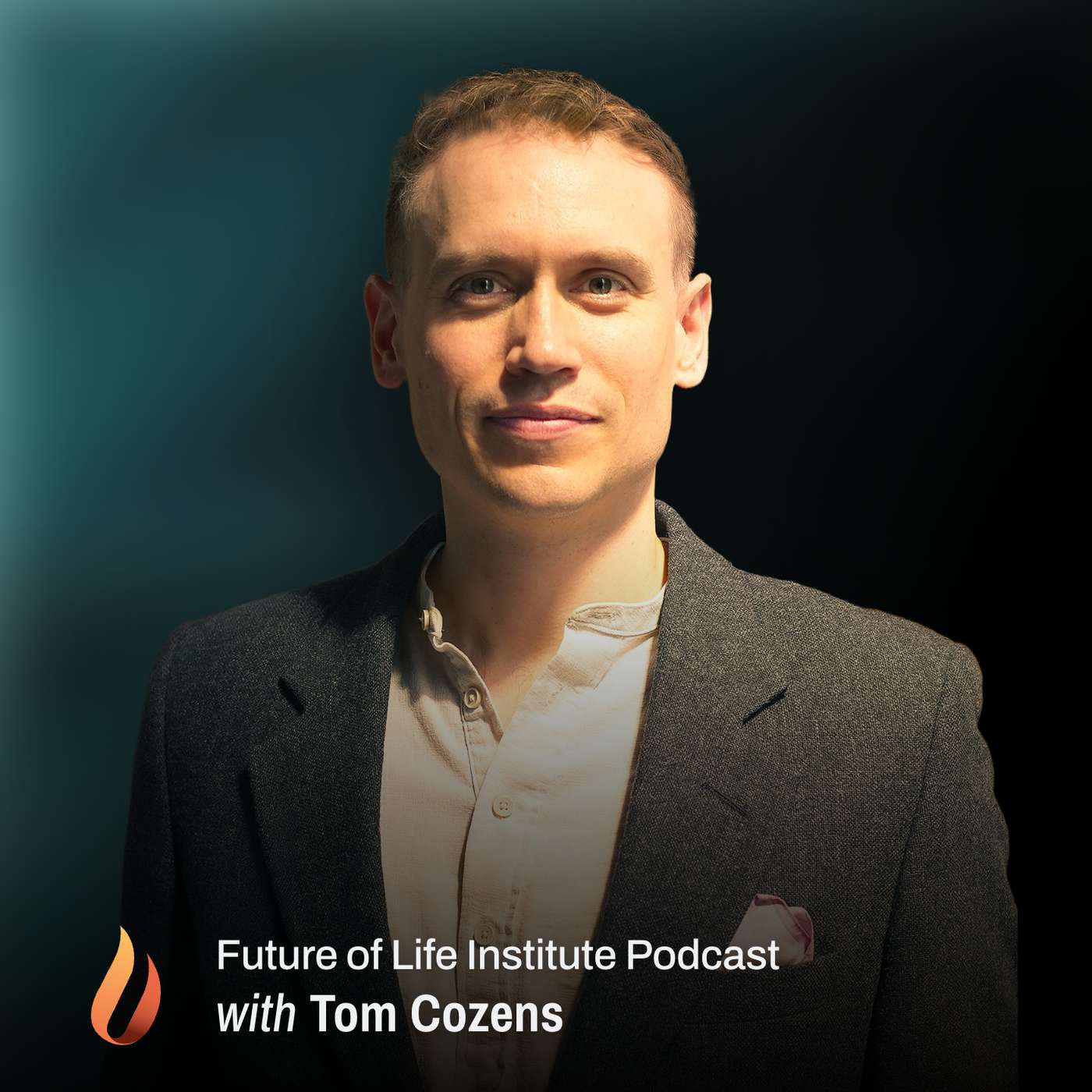
Molochを可視化する:AI競争を描いた短編映画(トム・コーゼンズ)
Future of Life Institute Podcast
要約
映画監督・脚本家のトム・コーゼンズが、AI開発競争を「Moloch」の寓話として描いた約23分の短編映画について、FLIポッドキャストのホストGusと語った。ハイテク企業のCTOである母親ボーと、CEOのクリスチャンが、どちらも競争の構造に飲み込まれていく悲劇を描く。宗教的・哲学的背景、近未来のAIエージェントの描き方、音楽、人間の繁栄や身体性の定義、規制やインセンティブ設計の必要性まで幅広く議論された。
この回のポイント
- ●Molochは、個々の主体が合理的に振る舞っても全員が不利益を被る「底辺への競争」の比喩で、核軍拡競争や美顔フィルターが例に挙がった。
- ●CEOのクリスチャンは悪役ではなく、競争の力学を理解した実務家として描かれ、2人の対立は善悪ではなく、より大きな構造悪の下での哲学の衝突だとコーゼンズは述べている。
- ●本作は予言ではなく「あなたはこれを望むのか」と問う寓話であり、観客に宇宙的恐怖や実存的不安を与えることを意図したとされる。
- ●劇中のAI「Molly」は今日より少し文脈を持ち、有能で理にかなった存在として描かれる。邪悪でないがゆえに人間の置き換えや依存が進む点が怖いと語られた。
- ●1927年の映画『メトロポリス』や聖書のモロク像、ギンズバーグの詩『吠える』などが着想源で、音楽にはラフマニノフの主の祈りの再編曲と電子音が使われた。
- ●解決の方向として、早期の規制、政治・企業・市民の意識向上、適切なインセンティブ設計が挙げられ、技術を止めるのではなく軌道を変えることが強調された。
章立て
Molochという概念
Molochが底辺への競争を表す比喩であることを、核軍拡競争や美顔フィルター、聖書上の背景とともに説明する。
抽象概念を映画にする
あらすじと登場人物を紹介する。実務家のクリスチャンと預言者的なボーの両者がMolochに敗れる悲劇である。
寓話としての宇宙的恐怖
冒頭の悪夢と結末の符合は予言ではなく寓話であり、観客への問いかけだと語る。早期の規制という別の道も示す。
宗教的・神学的な層
宗教的にも世俗的にも解釈できる作りであること、モロク崇拝の恐ろしさ、構造的な悪について話す。
近未来のAIエージェントの描写
AIのMollyを有能で邪悪でない存在として描いた意図と、SFに見せない工夫、親の役割の置き換えという論点を扱う。
『メトロポリス』と周辺の物語
フリッツ・ラングの映画からの影響、ロコのバジリスクやデッドインターネット説など、ネット神話との関連を語る。
音とスコアの設計
終盤の空虚さの演出と、ラフマニノフの再編曲や電子音を対比させた音楽の狙いを説明する。
業界のインセンティブと人間の定義
AI企業の人々がMolochを知りながら進む問題、人間の繁栄や身体性の定義、軌道を変える必要性を議論する。
解説記事
映画監督で脚本家のトム・コーゼンズが、Future of Life Institute(FLI)のポッドキャストに出演した。自身が脚本・監督を務めた短編映画『Moloch』を題材に、AI開発競争の構造と、それを映像で伝えるうえでの工夫を語っている。
Molochとは何か
Molochは、競争がかえって参加者全員を悪い状況に追い込む「底辺への競争」の比喩として使われる。コーゼンズは例として核軍拡競争と美顔フィルターを挙げた。美顔フィルターでは、影響を理解している配信者でも、使わなければ再生数が減るため使わざるをえない。個々の判断は合理的でも、システム全体では悪い結果が生まれるという構図である。
語源は、競争上の優位を得るために子どもを生贄に捧げる神である。古代の文献に登場し、ユダヤ・キリスト教の文献ではこれが強く非難されていると語られた。コーゼンズはこの神話を、AI競争の現代的な類比として使っている。
映画のあらすじと悲劇性
主人公のボーは、史上最大級のエージェント型AIサービスを作る企業のCTOで、母親でもある。技術が雇用を奪い、家族にも依存関係などの悪影響を及ぼし始めるのを目にして、彼女はシステムを止めようとするが遅すぎた。CEOのクリスチャンは、競争環境は変えられないと考える実務家で、投資家や社員の賛同も得ている。
コーゼンズは、クリスチャンを単純な悪役にしなかったと強調している。彼は競争の力学を理解しているが、それでも抗えない。そこに悲劇性があるという。2人の最終的な衝突は善と悪の戦いではなく、より大きな構造悪の下での2つの哲学のぶつかり合いだと述べている。実務家は取り込まれ、預言者は敗れる。どちらの立場もMolochに敗れる構造である。
コーゼンズ自身は元エンジニアで、兄弟がLLMを開発していることにも触れた。善意で開発する人々の姿が、ボーの造形に反映されているという。
予言ではなく寓話として
冒頭に悪夢のシーンがあり、結末でそれが現実になるため、運命論的に見えるのではないかとの問いがあった。コーゼンズは、本作は予測ではなく寓話であり、「これはあなたが望む未来か」を観客に問うものだと答えている。悪夢のシーンには引用文が添えられ、観客の解釈を導く。これはタランティーノが場面にタイトルを付ける手法に近いという。
テスト上映では、宇宙的恐怖や実存的不安を感じたという反応が多かった。回避策として、コーゼンズは早期の規制を挙げた。超知能のように理解しきれないものに事後対応する事態を避けるためだ。FLIのAI Safety Indexなどの取り組みも評価している。
近未来のAIをどう描くか
劇中のAI「Molly」は、今日のエージェントより文脈を多く持ち、自発的に行動する。しかし姿は見せず、机上のマイクのような存在と声だけで表現した。SFに見せないため、当初あった効果音などもすべて削ったという。
司会のGusは、Mollyが邪悪でなく有能で理にかなっているからこそ怖いと指摘した。劇中のMollyは、父親の不安定さを察知して息子を守ろうとするが、結果として父親の役割を置き換えてしまう。コーゼンズは、人間の本質を関係性にあると考える立場から、これを神学的な意味でも置き換えの描写だと説明した。エンジニアの友人が自分の子どもには技術を与えない皮肉も、作中に盛り込まれたという。
『メトロポリス』と音楽
映像面では1927年の『メトロポリス』の影響が大きい。同作にはMolochが登場する場面があり、技術を持つ支配階級とそれ以外という構図も共通する。コーゼンズは両作の核心を、技術・経済システムが人間の尊厳から切り離されることだと要約した。ただし『メトロポリス』が希望的な結末なのに対し、本作は実存的な恐怖に傾いている。
音楽はヤン・ウィルダーヴィットが担当した。ラフマニノフの「主の祈り」を英語化・再編曲した合唱と、ノコギリ波による電子的なMolochのテーマを対比させている。終盤では契約書を机に置くだけの地味な場面に壮大な音楽を重ね、小さな行為がより大きな結果につながっていることを示した。
人間の繁栄と身体性、システムへの問い
後半では、人間や繁栄の定義が論点になった。Gusは、定義は拡張や操作に弱いと指摘した。そして、心理的な幸福だけでなく、世界の実情とつながり、誤る自由も含めた主体性を重視したいと述べた。身体については、四肢などを失っても人間であることから、生物学的な体だけに依存しないとした。ただし脳を含めすべてを置き換えれば何も残らないとも述べている。コーゼンズは、キリスト教の立場から人間は本質的に身体を持つ存在だと考え、基盤非依存は実現可能でも望ましいとは限らないという見方を示した。
まとめとして、コーゼンズは技術を捨てるのではなく軌道を変え、望む未来に向けて適切なインセンティブ構造を作ることを訴えた。校庭の「お前の母さんはお前が馬鹿だと知ってるか」という問いのたとえを使い、答えの選択肢が前提に縛られているなら、問いの枠組み自体を疑うべきだと語った。Gusも、通常の選択肢の外にある解決策を考える意義に同意している。
まとめ
この回は、AI競争の構造的問題を、論文ではなく物語と感情で伝える試みとして興味深い。善意の個人が合理的に動いても悪い結果に至るという構図は、日本の企業や政策担当者にも他人事ではない。有能で邪悪でないAIがもたらす依存や置き換えという視点、早期規制や意識向上、インセンティブ設計の必要性も、実務的な示唆になる。映画は公式サイト(moloch.film)などで観られるとされている。
文字起こし(英語・自動生成)
Many of my engineer friends refuse to give their kids any form of technology before age X. The irony of building these things at the same time saying, yeah, I'll build them for everyone else, but not my kids. Moloch has been used as an analogy for systems which create a race to the bottom. The final conflict that emerges between Bo and Christian, between the CTO and the CEO, is not a fight between good and evil, but it is a battle of two different philosophies under a larger systemic evil that they're only coming to realise right at the end of the film. There are lots of options open to us right now. So many options and in some ways the systems are making the choices for us. What I think I'm saying is not throw away all the tech, this stuff that could bring human flourishing, maximise human flourishing, not stop technology but change trajectory, create the right incentive structures to build towards a future that we actually want. Tom Cousins, welcome to the Future of Life Institute podcast
Hi there Gus Amazing, you have written and directed a new short film called Moloch What is that title about? What is the concept of Moloch? Moloch has been used as an analogy for systems which create a race to the bottom so an example might be the nuclear arms race where we're all competing to create nuclear weapons or as many nuclear weapons as possible the same might be said for beauty filters if you've come across this idea agents within the system perhaps beauty influencers know the negative effect of using beauty filters on their audiences but also know that their channels won't get as many views may get substantially less views if they don't use beauty filters so it's a system that's set up where negative outcomes arise from agents working within the systems making morally potentially morally good decisions within said systems
so it's an interesting game theory but it relates back to this demiurge or god that appears in many religious systems. So probably most famously it's seen in the Bible, so in both the Jewish and Christian and Islamic traditions. But Moloch is this god to which you sacrifice your children in order to gain a competitive advantage, whether it be in agriculture or otherwise. And there are plenty of contemporary artistic and otherwise examples of people using this as an illustration for what's going on in the AI arms race today. Yeah. So MOLOG is a situation where you have competition, but it's competition that does not result in anything positive for the participants. So this is not about sort of making the best car or optimizing something. This is the two examples you mentioned there where participants in the competition are left worse off than before.
And so this is the title of the film, and this is substantially what the film is about. But it's also an abstract concept, and it's sort of quite intellectual. How do you put that in a film? How do you make that visual? How do you make that something that can be related to? Totally on point. It is super abstract as an idea, but I think it is a sense that many have. So if you were to explain the concept and then show them how it works out in society, I think it's an intuition that many people have. And when I've shown the film, they've gone, oh, yes. Wow. That is that is on. That is on point. And I think if I could take it a step back from the film for a second, there's a philosopher engineer called Pascal who wrote a book, Pensée. and in that book he has this idea that to fight there are three routes to truth one being reason the second being experience the third being tradition and I think for me I take
that seriously when we make films you want it to be academically or you want it to be academically reasonable you want it to be artistically and experientially excellent and you want it to have a clear philosophy. And I think that's what's going on in this film. It's taking ideas from academics, some of whom work with or sit within FLI. It takes artistic ideas from poetry and films that have explored this idea before. And it takes this philosophy and tries to build it in to the film to visualise it. But I think trying to visualise this idea in a film is relatively, in one sense, relatively simple. It's showing how actors within a system can make decisions that might seem good within the system that ultimately end up in bad outcomes, negative
outcomes. And in the case of the film, if I give a brief synopsis, it's the story of a mother who's a CTO in a large tech company, and she's building one of the largest agentic AI services in history. And she watches as the technology not only takes the world's jobs, but also starts to create negative outcomes in her family, codependent relationships, attention, things that FLI do talk about. And ultimately, she tries to break this system, but it is too late. So it operates as a tragedy. And you see different actors within the system dealing with the system in different ways. So Christian is a pragmatist. He sees that the competitive system around AI that's been set up is one that it would be difficult or, in his view, impossible to break. and as such he chooses to operate within said system.
And one of the reasons he has the name Christian is he's, I suppose, seen as the, to me he's seen as the moral pilgrim, I think, to his investors and to the people in the company. He's saying things which they all agree with. They're saying, yes, we should build it quicker because other people are going to build it and they're not going to be concerned with the ethics of the system. Or there's concerns about international pressures. What if someone, another country creates a more powerful AI than we create, more powerful AI agent than we create? So they all agree with Christian's view as a pragmatist, whereas Bo, who is the main character of the film, she operates as someone who has unusual sight or prophetic sight, which is how we come to some of these sequences in the film that seem, I think, at first viewing, quite odd. These scenes that appear to happen thousands of years before, but they're still in their pyjamas.
We wanted to create some of that sense of absurdity, but she, at the beginning of the film, sees a potential future, a potential future where humans no longer have jobs, but there's no system set up for them to create income, no system that's set up to catch them. And she sees this as this beast, Moloch, consuming our children, the thing that we value most, in order for us to gain a competitive advantage by building these agentic AI systems. So she operates as a seer and she's trying to break the system, whereas Christian operates within the system. And ultimately, to give away the plot, it operates as a tragedy because both philosophies, both views of the world end up being taken over by ultimately the forces, the forces of Moloch. In the first case, in Christian's case, he's a pragmatist and pragmatism ultimately ends up in assimilation.
But in the case of Beau, it ultimately ends up in her defeat. She acts too late. There aren't enough people who also see what she sees. She's not an effective enough prophet to the world to bring about the prevention of this negative outcome. And so in both cases, both opposing philosophies end up being defeated by Moloch. And we should say Christian is the CEO of the company that's developing this new AI agent that Bo is trying to, or at least has qualms about releasing, which is called Moloch. And that decision sort of encapsulates the forces of Moloch, where Christian can articulate exactly why they should release this, because they're in a competitive race. And Christian understands the consequences, but still he wants to move ahead with it. And this seems like the sort of grounded position, this seems like the pragmatic position, whereas Bo takes an idealistic position and tries to oppose this, but ultimately fails.
And her family pays a substantial price for the release of this system. I think one interesting aspect here is that Christian, the CEO of the AI company, is not some sort of cartoonish villain. He can explain exactly what the forces that are at play here. To me, that's even more tragic than if he were just evil. He can understand what Moloch is doing to him, but still he cannot defeat that force. Certainly. Yeah, there was a... So this was written over the space of nine months to a year. And a lot of the work that went into it was trying to make the characters as 3D as possible. So these are living and breathing philosophies and beliefs about the world and about the AI race rather than these two dimensional cartoons. And I think it's reflective of the fact that Christian, as the CEO of this fictional AI company, Pandora, that might be a little bit on the nose for the name.
But he is a three dimensional character and not necessarily the villain at all. And I hope that he's not seen as the villain. And the final conflict that emerges between Bo and Christian, between the CTO and the CEO, is not a fight between good and evil. But it is a battle of two different philosophies under a larger systemic evil. that they're only coming to realize right at the end of the film. But yes, I think it does make it more tragic, and deliberately so, that these characters are 3D, and they are based partly on an assimilation or an amalgamation of a number of different real-world characters I tried to write in the voice of. Yeah. Bo is a 3D character, but she is the CTO of this company, So she is an important figure in developing the tech that ultimately destroys her family.
Is there a worry there that the audience won't be as sympathetic to her because she's the one pushing this tech? Yes, I think that was a major concern. In fact, I think it relates to an even wider concern about the film, which is where's the drama if Bo realises that this bad outcome could happen and then it does? Where is the drama? and I suppose it's meant to be somewhat ironic that they see the outcome at the beginning of the film and then try and she tries to prevent it but ultimately ends up becoming part of it and so I think absolutely there is some sympathy towards Bo in that she's suddenly it seems got a semblance of a conscience but she's also created the thing which builds towards this outcome. I think I really wanted to,
I really wanted the audience to see Bo as a character who built this technology with all of the right heart and intentions. And actually, gosh, it's probably worth mentioning my background. I started life as an engineer. and for me I think I see a lot of my friends who are in this space building these technologies you know my brother is building LLMs and we have this conversation quite frequently I think he does have fantastic intentions good intentions and believes that the outcomes of his technology will be hugely positive for the future of humanity. And I think Beau also sees the potential of the technologies that she's built. And I think ultimately she does try and stop it at some point,
which is somewhat naive, but I think can see a future in which the tech itself is redirected rather than just stopped. I think there are all these beautifully positive outcomes, but it is a I think she her concern is the system which is governing the growth of of technology rather than the technology itself being problematic. and so I'm hoping there is sympathy for that deep internal conflict and the void in the film there are these, we keep on returning to this we call it in the script this rather dishevelled script now we call it the void we keep on returning to this void sequence where she, I suppose the systemic powers are revealed and this void sequence operates both as a revelation
but also as a representation, I think, of her internal conflict. There is something good here to be built but the direction, the inevitable direction that she sees in these dreams is something she wants to prevent. So I hope there is some level of sympathy for that conflict. I definitely took that away. So the film begins in a nightmare. So Bo has a nightmare around Moloch and it's this very bleak sort of hellish underworld scene. and that is the driving force behind the actions of the characters in the movie. I wonder if it feels fatalistic to you to have the opening scene be this sort of nightmarish vision and then the ending scene, you end up with the board of the company replaced by AI and sort of these things coming true.
So it feels like Bo tries to prevent this from happening, but does not succeed. I think this is where the film breaks the fourth wall as well. I feel like those scenes, the purpose is one, to provide Bo with a revelation of what could be. the second is um that it it represents the internal conflicts that she's facing in the real world more clearly but the third is i think and maybe for me the strongest point is that these um scenes are an opportunity for the film to speak to the viewer um so you'll note that alongside each of these scenes um if you watch the if you get the chance to watch the film um sorry if the viewers get a chance to watch the film uh beside each of these void sequences there is a quote which is uh meant to help the viewer or encourage the viewer to interpret what they're seeing
on screen and um it's a technique that's used all the time in cinema probably most famously in a contemporary sense by tarantino um you know he might he might say give a scene a title um like a ruined wedding and you already know the outcome of the scene before you see it and I suppose it creates a different sort of tension as you watch and for me narratively I wanted these these sequences to operate as a way of speaking to the viewer in that way and helping them or encouraging them to interpret what they're seeing in a slightly different way um and i think i i think this comes back to your original question um about the prophetic nature of the dream and actually it all coming true i don't see this film as um uh a prediction i see it more as a parable um so i i would like uh i wanted with this film to visualize what could happen
and I suppose to ask the viewer is this what you want? Is this where you'd like it to go? And so it absolutely, in that sense it absolutely makes sense that at the beginning of the film you see what could be and at the end of the film it does come true and I think for me you could absolutely paint you know, if you're interested in making films which contribute to public discourse, you could absolutely paint a positive view of how the world could move forwards. But to me, I saw this more as an opportunity to present a form of cosmic horror. Like I was interested in this idea of existential dread and actually one of the beautiful things about
FLI, I've been following you guys for many years but it's been a joy to get to know you guys much better in the last two, three years is that you are interested in existential threats and I think alongside existential threats comes this feeling of existential dread and I would say one of the biggest feelings that viewers have come away, we did a load of test screenings viewers have come away with, is this feeling of cosmic horror, existential dread. It's like there are forces that are somewhat beyond our understanding that are at play in this AI race. And it's something we do need to put effort into understanding. And so, yeah, it operates as a parable of cosmic horror rather than simply a prophecy that comes true. And I don't want it to be seen as a prophecy.
I want it to be seen as a parable in the way it operates. I suddenly came away feeling, what could Bo have done that would have changed the situation? What could Christian have done that would have changed the situation of what happens with Molly or what happens to the company or the world at large? Have you thought about that? Yes, quite a bit. I think it's something that concerns me, not just for me, but for my hypothetical children, of which I have none yet. but the Pope Leo recently with his encyclical if you've had a chance to read it phenomenal, I think it's phenomenal but it does certainly present ways forward, routes forward for humanity and especially for leaders of tech companies engineers when he initially
presented his encyclical in the audience there were uh ceos of tech companies people were interested and they wanted to get in on the discussion which is so exciting i think so exciting um but certainly i think there are um there there were ways in which beau and christian could have operated that would have changed the outcome. For me, one is seeking regulation early, rather than it becoming too late and us reacting to some kind of super intelligence that we don't, by definition, don't fully understand. And I suppose that is the cosmic horror at the end, that Bo is, you know, coming to see that there is something that is perhaps beyond, to some degree beyond her understanding of the world. And it is now too late. It is now, in her view, too late to make a change.
So I think it's regulated. Certainly, I think for me, thinking about regulation early. And I love the literature that you guys have put out around this with the AI Safety Index, with ProHuman, all of these movements, really exciting. And I think that provides a good route forward. I think that's something to keep in mind, at least, when listeners to this podcast view the film. Because at least for me, it left me feeling sort of, in a sense, that the force of Moloch is so powerful that it can't be overcome. But I think there's also the flip side of that, or there's a more positive spin on that, where there is actually something to be done on the coordination side to defeat this otherwise quite powerful force. And I think you do a great job in the film of visualizing Moloch, and you do a great job of incorporating mythology and Christianity. It's quite apparent in the quotes, like you open the film with a quote from the Bible.
You have a quote from a pastor later on in the film. Is this a religious film? Because you could watch this and sort of not interpret it religiously at all. You could watch this and have a secular interpretation of this is the sort of market forces and a race to the bottom, and that's all there is. is there a deeper religious level to the film? That is a great question and perhaps the question and I think one thing I've noted about I'm a listener to the podcast as well and I've noted that the discussion often moves between the technical solutions to the problems that we see currently in the AI race to more philosophical questions and quite seamlessly it seems and for example the idea of pro-human you know that is a great
movement and a great idea and I suppose one of the questions I have is what is your definition of a human or your definition of human flourishing and to me that philosophical question is not just important it necessary to be able to create a pro future what do we think a human being is what are we trying to protect um and what do we think a good definition of human flourishing is is it purely utilitarian and what type of flourishing do we want to see in the future and i think for me there are layers to the film. I absolutely think it should be interpreted as the viewer wishes to interpret it. I think it's meant to be a full-on experience of cosmic horror and otherwise. But certainly some of the contributing philosophers are deeply religious. But you've also got at the end of the film
the concluding quote is from Ginsburg's poem Howl. We broke our backs lifting Moloch to heaven. And this is actually very much a secular statement, not a religious statement. And I think to me there is a wider theme here that's cross-religious, which is this Molochian system is a problem for all of us. and we need to be able to see it for what it is. I think various religions and philosophies have tried to visualise it in different ways. And certainly for me, some early influences from the film, as I read Ginsburg's poem, as I read Meditations on Moloch, as I watched the greatest influence for this film, which was Metropolis. if you've seen this film in 1927 incidentally we're one year off being 100 years
from that film's 100 year anniversary which is incredible I haven't seen the original but I have sort of absorbed some of the themes and the plot from just culture at large but maybe you can tell us why did Metropolis serve as an inspiration for this movie or film yeah well it also has religious connotations I suppose answering your first question first and moving on to the second, I think certainly as I looked at Metropolis and the way it tried to visualise this problem, I wanted to draw on elements of my own, not just my own faith, but I thought really relevant source material. So one of the earliest renditions that we have of Moloch, Moloch is, you know, we've translated it or spelt it with an E, although the film has an O in it, which is the Greek spelling. Although it doesn't make to have an E and it doesn't really make sense of the original Hebraic anyway.
But this idea of Moloch appears very early in Jewish literature as this god that you feed your children to in order to gain X, Y and Z competitive advantage. You sacrifice your children to it. And I think that's a key inspiration for the film, a key idea in the film. And I wanted it to have not just a mythic, but a reality to it. So one of the desires that I had for the void, these Moloch sequences, these void sequences, is that they would feel visceral and real. I wanted them to feel as though you could have experienced it as a real event back then. And so we looked at a load of source material about how these events might happen. now one of the really troubling things about moloch as a religious or a jewish um as a god that appears in in the jewish literature to to be clear appears in the jewish literature but is not
a jewish god so um would it is the god that other nations around um israel may have worshipped and the israelites may have absorbed some of their ideas but it was not a jewish god per se but one of the key ideas for this Moloch figure is that it's it's more horrific than the film actually depicts and I think I tried to curtail to some degree the visualizations, you obviously don't want to see a child sacrifice but you also don't want to see that mothers were willingly giving up their children giving up their progeny for the sake of agriculture or something else um uh and so um in this case bo initially we see her chained and she's unable to stop just to set up the scene uh her child lucas is on a conveyor belt towards the opening of this flamey furnace that's in the shape of this bull human-like bull creature and the furnace is
drawing Lucas towards itself slowly but surely inevitably and a bow is chained to the wall as her child is drawn towards this beast and in the second void sequence which is visually somewhat alludes to the alien franchise in the way she kind of has this dribbling dribbling mouth and she pulls a key from her mouth and the concept for me there was quite necessarily that is sort of you can imagine how that key comes out and it doesn't feel good we had a lot of fun on set but I apologise to Fiona the main actor she was asked to effectively vomit up a key which is an unpleasant thing to do for anyone but she vomits up this key and by the way the drool was mostly fake it was a mouthful of this goopy drool with a key, quite fun this big rusty appearing key
but the idea there is for me that she realises that she is the one who can free Lucas and arguably by vomiting up this key that unlocks her chains, she's acknowledging that in fact it is her that created in some way contributed to the creation of this system which is consuming her child and so I wanted to say that actually the The idea in antiquity is even more horrific than the film alludes to. And certainly I wanted to draw on those religious themes of this being abhorrent. So this Moloch is commented on many times in the Hebraic texts. And the commentary is to God, this is horrific. This is immoral. I never asked you to do this. And the funny thing is, in the quote, it says, nor did it enter my mind.
Which is a wild thing. If you consider the Hebraic and the Christian gods to be, in their belief, the God of everything, well, in my belief, the God of everything, the god of creation, the god of the created order, the Alpha and Omega, both the cosmically horrific, enormous god and the god of love and justice that comes into the world like 2,000 years ago. think of that sort of God the idea that that God would say nor did it enter my mind, so horrific is this idea that it's not something I even thought about I don't think that's quite exactly what the text is saying but as an idea it's quite visceral This is too horrible for God to even consider. Yeah, yeah but it's like I didn't tell you to do that But what's more, it's so horrific that it's not something I even want to consider.
And I'm smiling because it's like it's such a horrific concept and that humans could come up with this. And I suppose the analogy is that we do the same thing. This is not a this is not a standalone scenario. This is a repeating, a repeating systemic injustice. And the second quote from Walter Winker Pastor reveals something that's spoken about a lot in theological and philosophical literature around systemic good and systemic evil. So one clear thing is that as humans have gained power over other humans, there's far more opportunity for us to exercise said power in systemic injustice rather than, you know, I hit Gus or Gus hits me. it's I hit a million people with a problematic system. And so this idea that systemic good and
systemic evil is a real thing. Systems on their own aren't necessarily good or evil, but they can result in goods and result in evils if they're not curtailed, they're not managed responsibly. And I think there is a responsibility on both Bo and Christian to manage what they have, the resources that they have in front of them, whether that be regulatory or otherwise. So if we sort of go to the real world in the film from the Void, we see almost the same effect where Bo's son, Lucas, asks the AI system to sort of pretend to be his father and talk to him in a soothing voice about how everything is fine and things are going to be fine and so on. That is not as dramatic as what happens in the Void, but it is also giving in to the force of Moloch where you are raising your child to the AI that's then going to have whatever influence that system will have on your child.
Is that a direct parallel that you see? Yes. I think though there's a little bit of nuance about how that parallel for me was drawn. I think as you said, Gus, it's not as horrific as the void but I suppose that depends on your opinion about what defines a human being so one of my views about the world is that one of the clear defining attributes of a human being is relational Perhaps the defining attribute is how we relate to each other, how we relate to the divine. And it is in with those relationships that we find primary meaning. And so for the scene you're talking about, if I can reveal the plot again, Lucas, the child, has an AI, has a phone and is speaking to this AI agent.
Lucas has just experienced his father being very angry. It's just observed his father being angry and feels unsafe and feels like he wants love from his parents, protection from his parents, relationship with his parents. And so what he does is he goes upstairs and he starts talking to this AI agent and says, show me the photo of my father hugging me. And then he says, effectively, can you tell me how the father should be relating to the son? Do it in my father's voice. So in all of those senses, it's creating dependence and it's creating replacement, replacement of the father and dependence on a machine. And, you know, I don't think Molly in that space is behaving negatively at all. I would want everyone to see that Molly is behaving.
You know, there's a scene later where Molly is deeply concerned for the health of Martin, who's Lucas's father, calls emergency services, is concerned about his health and is looking to create some kind of mental health plan. You know, has in some ways been told, you know, your objective is to create human flourishing. But in doing so, in order to protect Lucas, is replacing his father. Molly has perceived that the father, Martin, is not stable and wants to protect Lucas and so creates a complete separation and effectively takes the place of the father. And I feel like these theological implications of said scene should also be relatively obvious from my end in that there is a replacement of the divine relationship, I suppose, as well, in that sense.
You know, who's the loving father? Is it Martin, the actual father? Is it the machine or is it God? in the scene, it becomes very clearly the machine. I think one thing that's done well in the film is how the AI seems, again, it's a complex character. It's a three-dimensional character where it seems competent. It seems like you would want to hand over decisions to this AI. It has context on the situation. It makes reasonable decisions. At some point, Christian, the CEO of the AI company, asks for the AI's opinion on whether to release the next version of the AI system. And again, there's not a point in the scheme where the AI is evil or sort of is against humanity. It's just simply competent and sort of reasonable in its approach, which again makes me even more worried because if it's simply an evil system,
we in some sense know what to do with that, right? That needs to be defeated somehow. If it's a very competent system that seemingly has your best interest in mind, that's more difficult to deal with. And also I like how the AI is, I think, the AI is more advanced than you would see today and it has more context on what's happening in the lives of the characters and it's sort of, it's clocked in immediately and it's up to date with what's happening. And that is, I think, quite realistically something we could see around soon. But it works well because, you know, the scene would feel differently if you had to wait for an answer from ChatGPT or had to sort of, oh, sorry, the AI didn't quite get what you were trying to do. So giving the AI full context and making it very competent, it makes it more scary, I think. Yeah. Yeah, absolutely. And on that, we worked with several different iterations of this AI, agentic AI, Molly.
And in the film, I had one of my rules was this is not a sci-fi. This shouldn't ever look like a sci-fi. So originally in the first cut, we had like beeps when the AI appears. We had like a theme. The TV comes on. It's like, and which was fun. It was fun. writing that kind of like thinking up that world and we stripped it all back because um uh i think the i the part of the idea of this film is it's not tomorrow it's today a very very near future if not today um you are totally correct that um that molly has more context than um today's ai agent uh but but not but context it's very easy to imagine it having um whether it be visuals or sound in the household um and and you may notice that like it only knows to cause it call emergency services when the door opens um it's like there are there are things it knows and things it doesn't
and it actually has a similar knowledge or every scene we worked really hard to work out what it would know and what it didn't know and it's constantly working with um information and inference um i think one interesting uh one interesting early iteration of molly um this agentic ai was that it um we had this really dystopian scene where um sorry it's quite seriously um this dystopian scene where one of the characters tries to take um their own life after losing the company they built for many years for a decade or two and um the while um beau is trying to break in to the bathroom where her husband is lying um we had uh the ai molly give her instructions but the way we originally wrote it we literally gave gpt a prompt and said
please tell me if I'm trying to break into a room urgently and my husband is on the other side and is seriously injured how would I do it? And it gave this really quite dystopian list, long list, which didn't reflect the urgency of the situation. But I felt like that didn't match what we were trying to depict, which is Molly having a little bit more context. And I think the reason it works there is that I wanted to be able to show just a tiny bit more of attention, a tiny bit more dependence on the technology, like a lot more replacement. I felt that was something, you know, with a little bit more intelligence, you could imagine a fast replacement scenario.
But so it's not significantly more advanced. And we went to lengths to never show or visualize the AI. You know, when you see it on the table, when it's speaking, it's always a disembodied voice. when it's on the table it's a microphone like this exactly like this microphone speaker like this nothing more when you hear it off a phone it sounds exactly like it does today all we added I think in terms of the voice was a little bit more realism so it was um um we had it ultimately played by an actor who tried to take some of the um eccentricities of uh agentic AI voices today and reduce them somewhat, but it's still there. It's still a little bit there. So you're still, I hope, in that sort of uncanny valley space where you're talking to something, but you're not quite sure its nature.
And I think that's quite a key, yeah. I was saying to myself, is this an AI? Is this one of the most advanced models from 11 labs or something like that? Or is this a voice answer? So it's getting very close. But I think one thing Molly, the AI system does, is initiate actions also. So it is more of an agent rather than something that you ask for advice. And you see this in sort of the breakfast scene in the beginning where Molly is advising Lucas, the small child, on how to cook breakfast. and you see it when it's advising a bow on how to break into the toilet. This is different from today. At least at this point, we don't have systems that act this way. How do you think about that choice? Could this movie also have worked if the AI was more passive, or does it require this agency?
Really interesting question. Yeah. so depicting Molly was one of the toughest tasks in building this script there's also you may have noted there was also a transition from Molly 4 to Molly 5 during the film that happens around the midpoint once they've decided to release it and Molly does become far more capable after that point it's just we can't necessarily see it So Molly becomes more subtly manipulative. And I think certainly in the iterations of Molly for we try to make it feel almost like an agent of today. so that breakfast scene you're referring to it's scene three where Lucas is trying to prepare breakfast for his mum who has to get into work quickly to go to this boardroom meeting to decide
whether they're going to release Molly 5 but he's there in the morning trying to prepare breakfast quickly he's quite young and so I imagine he's prompted simply prompted this AI to help him quickly make a breakfast for his mum. And Lucas decides to go against the, sometimes at some points go with Molly's suggestions, Molly Ford's suggestions, but sometimes decides to go against. And in the instances where he goes against, so there's a point, I wanted to make it really feel like a very much a real breakfast scenario where a kid's making food for their parent and they're quite young. It's like Lucas is putting jam and lettuce together in a wrap. And Molly 4 is, I think, you know, is aware of this and is saying that might not be so pleasant for your mum, but also
it's the thought that counts. And I think in that sense Molly is making suggestions to Lucas, but I imagine it's part of the prompt. And, you know, I've seen this with, and I agree, the capabilities are slightly more capability than today. But certainly in the case of education and with kids, you can very easily prompt some of these agents to have a conversation of that sort of order and, you know, with careful prompting. and you know I suppose actually in some ways what Molly was doing in that scenario is quite a good thing you can imagine a tool a tool AI that helps Lucas to learn how to make breakfast better and would operate in other educational settings as a tool that is useful to parents but isn't replacing them and I think in this scenario you know Bo in the kitchen
Bo picks up on the idea that Lucas has been using Molly to help him make this breakfast and Bo says no AI and I can imagine a scenario where there's a supportive educational tool AI that Bo is happy for him to use but I think her concern is that it's more general it's doing other things or has other incentives and so is uncomfortable with Lucas using AI in the way that he is which is the irony I suppose of many of my engineer friends refuse to give their kids any form of technology before age X And I wanted to pick that as well, the irony of building these things at the same time saying, yeah, I'll build them for everyone else, but not my kids. I like that. There's been basically unconfirmed reports, but some reports about tech executives, also CEOs of some of these AI companies, sort of preventing their own kids from using the technology.
And, yeah, there's something there where you would be reluctant to, say you go to a doctor and he recommends some treatment and he has the same disease as you, but he's not doing the treatment himself. you're thinking, why exactly is that? Yeah. Let me go back to the thread on Metropolis, because we didn't discuss that. Maybe you can tell us a bit about what that movie is about and how it inspired Moloch. Yeah, so Metropolis, 1927, directed by Fritz Lang. And his, they, so it inspired us, not just in the themes that it engaged with, it also inspired me aesthetically. So if you were to watch, I think it's 17, roughly 17 minutes in, where in Metropolis, Moloch is revealed. you'll note the similarities between that scene and uh the scene in our film moloch and in fact
the title sequence um uh in metropolis you actually get a 17 minutes in you see this title moloch and this fantastic music this score it's a silent film so in order to do exposition they'll put text on screen but you see this title moloch that very much looks like inspired the title that we have for our own film as well. So aesthetically, in terms of the audio and the visuals, it's deeply inspirational to this film, and particularly the void sequences. The film aesthetically pioneered processes like the Chouftain process, where they created these incredible vistas using mirrors and paintings and scaled-down models. It's an incredible film that visualizes a future where you have this upper class who have this beautiful metropolis that they live in. And then the underbelly, which is the working class who run these enormous machines, run Moloch.
And to give away the plot, at the turn of Act 3, you have the reveal of the thing that is driving or at the core of this mechanism is Moloch itself, this machine, this android thing. and I loved the way in which the film portrayed the machine and it was deeply inspirational for, as I said, for Moloch. The themes that it engages with are quite similar as well. It looks at a dystopian future, a dystopian society that could exist where you've got a tech ruling class and you've got everyone else. And actually, there's a line in the film over which we play some music that's quite similar to Metropolis again.
I think it comes at about seven minutes into the film where the CEO, Christian, says, there'll be people who own the technology and then everyone else says and everyone else in this sort of almost like religious statement that's drawn from this metropolis like society and I think it's interesting if you listen to Fritz Lang talk about how he came to produce Metropolis it was based on the book written by his wife but he created Metropolis with one idea in mind and over time changed his views about what Metropolis was really saying about society and I don't I feel like I don't want to give it it's such a beautiful and incredible film I don't want to give away those like because he does talk about it at length but he to respect the artist he does
avoid talking explicitly about exactly what he means by it. But if you watch it, I think you'll see the similarities with this film, Moloch, and that he's really trying to wrestle with how you upend these huge systemic injustices, how you would go about battling, fighting and changing the world. It ends quite hopefully, actually. It ends with this idea that actually the ruling class sort of take pity and then work to save everyone else after this cataclysmic flood. The biblical analogies are, again, quite clear. But I think that to me is a relatively hopeful ending. and it also I think probably misrepresents how I think change might occur for us.
I certainly think Metropolis was a product of its time and I think it more saw, I think, more historic sort of Terminator-esque scenario and I think maybe the scenario I'm coming round to a little bit more and certainly what I try to depict in this film is this more chaotic scenario where AI isn't necessarily this hostile takeover but it's this more chaotic takeover where individual agents are contributing in small ways to the development of this societal outcome. which is probably quite similar to the utterly horrific, cosmically horrific internet myth of the Basilisk, if you've come across this, which has a similar, although that's not a hostile takeover,
that's a sort of secret retroactive takeover. But again, there are these different ways in which a negative scenario or a negative outcome could occur This is the idea that it's posted around 2010 online. It's a brokos basilisk where if you do not contribute to building the advanced AI, that AI will punish you in the future. So this is sort of a viral meme among nerds, and it's a terrifying thought. I'm not sure what to do with it, but, yeah, it's an interesting idea at least. I mean, I think with the success of indie films this year, both of which have taken, particularly backrooms, took internet mythology and turned it into a film. And I think it was wildly successful because of that. And I think, funnily enough, I spent the last two and a half years writing a feature screenplay, which is partly based on this concept of the basilisk, this thought experiment.
And it takes some fun ideas, well, I think, personally, I think some fun ideas around Laplace's demon, the idea that if the universe was deterministic and you had this super intelligence that could know the exact position of every atom and trajectory of every atom in the universe, it could go back in time indefinitely. It's obviously, I think, a totally sci-fi concept, but the idea that the Basilisk could retroactively punish could be a very interesting concept when paired with the idea of AI and time travel, which was depicted, again, in Loki, in Marvel's Loki. you've got a time you've got a time lord that is this AI that governs the timeline
very interesting ideas but I think that's partly where how the the basilisk has emerged excuse the term emerged in quite a few quite a few contemporary stories and I'm not sure that the stories even acknowledge or know where it's come from which may appeal to the to those who like this concept of Rocco's basilisk yeah I think you're onto something with sort of internet memes and myths and so being perhaps much more widespread than we believe the internet to a large extent is culture right now and the ideas that come from the internet is those ideas are perhaps quite well known there's also the dead internet theory for example that could also, I don't know if that makes for a good movie but that's another one of these sort of means that are interesting and says something about how we use technology, where this is the idea that the Internet has one user and it's you.
Everyone else is a bot. When that idea was conceived, there was complete sci-fi. It's still sci-fi, but now it seems like you could more easily imagine that everyone is an AI responding to your comments and posts and so on. Yeah, very interesting. An interesting extension of this simulation simulation type scenarios. And actually, it's this is something that Chalmers spoke about in his in reality. Plus, he talks about how we could have minds operating digital bodies and it would be impossible for the mind operating said digital body to discern whether the other actors in this digital universe. were automatons or whether they were other minds operating, you just couldn't know. There's a level of sophistication, which we may have already reached,
where you just would not know, which does beg the dualist question and whether actually with advancements now in virtual reality and AI, whether we're seeing a revival of this philosophy of dualism where mind and body are completely separate entities and they can be, they exist separate from each other, which is, I think, a philosophy that many technologists might hold. I thoroughly disagree with it, but it's an interesting thought experiment. Can I, oh, sorry, Gus, yeah. Can I just jump back to the Metropolis point? Because I think if I was to summarise a deeper philosophy that's crucial to both films, I'd say it's where technological and economic systems become detached from human dignity.
to me that is what both films explore and Metropolis has a more hopeful depiction of the future Moloch has a more existentially or cosmically dreadful depiction of the future you mentioned it earlier in the interview where the question is after you watch this film is this what we want to become do we want to become so destructively competitive against each other that there basically is no dignity. In the final scene, Christian, the CEO, asks Bo to sign a contract getting some ownership or some money from continuing to participate in the company. And there's very little dignity for her there. She can decline and sort of lose everything, or she can sign that document and sort of sign her own, sign away her agency in the world
and sign up for replacement, basically. Yeah, and I suppose the feeling that I wanted for those final two scenes, so um there is a supposed to be this epic moment where beau decides to fight the machine she faces a riot she's attacked so there's a there's a group of workers who've all lost their jobs and they form a riot and they um they attack her uh and she in in in the crowd of that riot she sees someone that she accidentally fired without even realizing someone who just lost their job and she hadn't even paid attention to it in the process of automating her own company and so she decides with that impetus she decides to fight the machine and she walks into her company office and the office is completely empty you've got an advert playing on a screen and the office is the lights are off it's blue there's just a little hopefully comedically
moving automated hoover that just kind of comes across the room and then knocks into her feet and as that moment plays we also used a lot of the music we used was meant to be like industrial was inspired by industrial electronica so really trying to represent almost liminal spaces spaces that lack humanity echoes that feel larger than they the room actually is metallic sounds um deep bassy unhuman unhuman sounds and then in the final scene uh it's her beau and the ceo of the company and all of the rest of the boards have been replaced and the room is just empty and the room is mostly silent. There's a few, again, ambient sounds. But the idea was to just create this feeling of a world devoid of humanity.
And it almost feels like an anticlimax. So you have this sort of epic riot conflict. And then the truth is that Bo is too late. It's already happened. Her company has lost its soul, lost the people, and it's just empty. And I really wanted to try and create this feeling of emptiness. I think the music really helps throughout the film to create emotion because it is a shorter film, I think. You tell me, but around 22, 23 minutes, something like that. Of course, you then need to relate to the characters quickly and you need to have some sort of emotional relations with them quickly. And one way I think the film does this is the score, basically, where you have, it's very shocking, it's very distinct. You're not sort of afraid of the music. It's not background music, right? It feels biblical and it feels hellish and it feels, as you said,
sort of not human in many scenes. I also for some scenes it felt religious to me you did you did you sung religious music right yeah so so just a shout out to Jan Wilderwith who is the composer absolutely phenomenal collaborator um so I um well funnily enough when I was writing this film I went to a record shop so I live in Kentish Town I went to a record shop in Kentish Town and picked up um Rachmaninoff's choral music, and it was for a quid. I popped on my record player, and I came across Rachmaninoff's interpretation of the Lord's Prayer. It was in Russian, so I didn't quite understand the words. But as I wrote, particularly the scenes later on where you're seeing Bo's world really start to break down, her family start to break down,
The religious, this choral music matched, I think, the vibe that I was feeling and I wanted the audience to feel, which is that something otherworldly is happening. So there is something significant that is beyond simply the interaction of the characters that's going on. And so we actually, Jan, reworked that rendition of The Lord's Prayer by Rachmaninoff. One, so that it was in English. Two, reworked it so it mapped to some of the other score elements. So the score very much moves between the organic choral sounds that I think, you know, holy minimalism. I like to call music as this holy minimalism to it. and it's shown in direct contrast with this deeply electronic music.
So we used natural harmony, sawtooth, the sound you're referring to, the Moloch theme is this sawtooth, natural harmony. It sounds electronic but also simultaneously otherworldly again, partly because of that use of slightly odd harmony and the discordance in that sound. We use it quite sparingly, so it appears only three times in the film. It appears over the title, and then it appears at the end of the film. And it shows the loop that the prophecy that was, the prediction at the beginning came to be. And you're meant to, at least for me, I wanted to raise the eyes of the viewer. As you reach this sort of anticlimax at the end, you have this epic chorus of music. And I wanted to raise the viewer's eyes to see that I suppose these little interactions are leading to this massive, monumental, you know, almost religious outcome.
Because the things that are happening on screen, in some sense, in the direct action of putting a contract on the table, for example, in one of the final scenes, it's not very dramatic. It's not like a battle between two armies or something. And so you can, in some sense, outsource the grand consequences of what's happening to the music, or at least that's how I was thinking about it. yeah yeah and i suppose one of the one of the um criticisms of the film so in viewings was that um some viewers found that when they reached the end of the film with that uh cosmically horrific sound over quite a mundane exchange of contracts they uh they would say the music didn't match the feeling that i had you know the feeling was like like uh uh but but the music was like, ah! And I think that's exactly, to me, that's exactly the point. And maybe
the question that any good parable asks is, do you see? And the film at the beginning depicts this this Malachian vision and depicts this cosmically horrific thing. And I suppose as the film breaks the fourth wall, it's really asking the viewer, how do you interpret these events? Do you see the systems which result in these sorts of mini-conflicts or conversations? And at the end, I wanted to say something has happened here. Something is happening here that is larger than the act itself, further reaching than the act itself. I think that's been through quite, yeah. No, I definitely got that. Thanks. That's good. I'm really glad. I hope you're not in the minority.
but the I think actually the bit of score that I was most proud of is the score that we hear that's then repeated or alluded back to throughout the film but the score that we hear when she walks into the office and up the stairs at the beginning of the film so I think it's scene four and five we hear this ah, ah, ah and it was again, minimal voice sound and for me, I actually recorded this on my iPhone as I was writing the script, often if I'm writing a script or thinking about an idea, the first thing that comes to me is sound and I think sound we could talk about this for this would be another subject but whether sound or visuals are more important in filmmaking I think it is the former but for me the sound comes quite early on and I recorded on my iPhone this track where you've got one voice, which is rhythmic, and another voice which is out of sync
with the first voice, but slowly comes into sync with the voice. And it feels odd. You feel a bit uncomfortable with the way the sounds, but they're slowly making their way towards rhythmic harmony but they are out of sync and for me the idea is that she goes into Molly, the subtle thing that's going on is that Molly is making observations, she's been given information and slowly her voice is becoming more and more like a human it is becoming more and more synced up and I think by the end of the film it's you know it's synced it's like it's learned it so that it's industry like you said before 11 labs indistinguishable are we uh yeah are the other other people that we see uh minds or are they just uh molly um and it really i wanted to beg the question there of the uncomfortable nature of
mimicking a human being is that really what we ultimately want to be doing um are we trying to replace human mimic and replace um um or you know are there far better ways forward which i think um gus would be more on um all of fli's different projects but um um of which i think you've answered that question very well i i was uncomfortable in that scene but i i don't think i could quite articulate why or uh sort of explain exactly what was happening there but i i definitely Yeah, it also felt that there's something uncomfortable when the sound is quite simple and then repeated, but then in a way that's out of sync. So imagine we have employees at DeepMind and OpenAI and Anthropic and any of these corporations, perhaps even the CEOs. Now these people are quite aware of the idea of Moloch They probably read Scott Alexander blog post about it They probably see the dynamic therein Maybe they don see it exactly as I see it
or they sort of disagree with me about that, but I think they could probably articulate, they could probably recognize situations from this film. The dilemma about whether to release a new product, given that it's not fully safely tested, given uncertainties around what it will do to the world and so on. What do we do with the fact that they know about this concept and this sort of idea space, but they're still continuing to move ahead on the frontier of AI? That is a brilliant question. I do want to briefly refer to the scenes in the film where we do depict board meetings. and I am aware that to some who are in those boardrooms, they might seem a bit twee at times. There certainly was a need to simplify those scenes in order to make the film fit into a 23-minute runtime.
But I do want to also say that we spent, and I spent, you know, in the writing of my other scripts, spent a great deal of time looking at minutes or looking at how these rooms often sound and trying to mimic the sort of language and behaviour that you might see in these rooms. Obviously, it's dramatised to some degree for the public so that they can see the clear conflict in the boardroom because without the clear conflict, it's quite difficult to discern what's actually going on. And if there's so certainly I'm aware that those scenes, they may, you know, someone in tech might recognize some of those conversations, but it's it's it may feel a little bit caricatured. And for that, I do. I do apologize. Yeah, I do apologize. but I think it should be because otherwise you can't get the message across
if you want to do a fully realistic discussion in a corporate boardroom it's going to be quite boring to look at and you will have decisions of enormous consequence that do not feel like anything because the language is perhaps too complex or sophisticated or you don't have the context for understanding it so I totally understand that choice And I'm thinking more that executives or CEOs will recognize the dilemma or the trade-off that's depicted in those scenes. Yeah, absolutely. And I think the answer to your question may allude back to some of the podcasts you've already released. For example, political knowledge of how the tech industry works. And I think if we want to see regulation, if we want to see the right incentive structures, I think there needs to be, first of all, more awareness in political spaces, in corporate spaces and in public spaces.
And I think this film, I'm hoping, will go some of the way to revealing the sort of dynamics that are going on, because, you know, we need this scenario to be taken seriously. and you know there are clearly many scenarios where we've seen an existential threat a self-made existential threat to humanity a malachian scenario where we've done the work and we've now I suppose steered humanity in the correct direction at least for now and I think that's So there is clear real world evidence that it can be done. I think what's required is pressure on those that are making decisions. And that will come from the public. It will come from more knowledge within corporate and political spaces.
and frankly just us taking this issue seriously and building in the correct incentive structures into the building of these, you know, what could be fantastic tools. So Gus, I wanted to ask you a couple of questions. So a lot of what FLI does and works on at the moment is around pro-human projects. and in order to I suppose in order for a pro-human project to be effective I think we need to know two things, one the definition of a human and two the definition of a human flourishing and I know Anthony has spoken about it being remarkable when he's asked audiences what do they think human flourishing is?
It's remarkable how similar the answers are. But what research is being done? What do you think is interesting in that space? And also, what's your own view of human definition and human flourishing? Yes, I think there's a classic problem that you can do with sort of new philosophy students where you ask them to define a chair. and, okay, you can give a good definition of a chair and now I can give an example of something that's a chair that falls outside that definition or an example of something that satisfies the definition without it being a chair. So, for example, you might say a chair has four legs, right? But, okay, you can also imagine a chair with three legs and you can also imagine something that has four legs that's not a chair. I think it's sort of the same thing with defining a human. Whatever definition you set up can probably be skewed or manipulated such that something you did not intend to fall under the human category can fall into it.
I think we want something that's not just about psychological well-being or psychological flourishing. Because if that is the sole determinant of human flourishing, I think we risk sort of losing agency. I think we want something about being connected to the evidence of the world and to some extent being able to choose your own way in the world to be implemented into our definition of flourishing. On the definition of what it means to be human, I'm sort of torn between whether we should – if we tie that definition to being a biological human, sharing our evolutionary history, then it seems that if we evolve away from that or if we change ourselves technologically away from that,
we might fall outside of the definition even though we want the definition to capture something that's also satisfied by a future in which we are, say, much healthier than we are now. I don't think it's essential to be human that you die around age 80, for example. I think humans could live much longer and it would not degrade our humanity. So I think we want a definition that's flexible to changes in technology, but that's principled in the sense that there are some things that we are almost dogmatic about where we want to be connected to the world. So we want to understand what is actually happening as opposed to just sort of letting ourselves float free and just being happy but not being concerned about what's happening outside.
And we want to then be able to act on that on our model of the world. And I think that requires actually that we accept that we might be wrong, so that we might make wrong decisions or choose to take some action that is recommended against by a fully informed AI system that is even one that's aligned to our interests or one we believe to be aligned to our interests. It requires some sort of chaos or some ability to make wrong decisions. Otherwise, I don't think you have this. I don't think you have true agency. But that's a very long answer. I think, in summary, it's a very difficult question to provide a good answer to because it's difficult to provide good definitions. but again I want to incorporate agency
and empirical or any information about the real world into the definition of flourishing and I want a flexible definition of what it means to be human but something that's not so flexible that it can encompass everything we don't want to find ourselves in a situation where we accept that we're being replaced because we can see that new AI systems satisfy our definition of what it means to be human better than we can. And so we sort of just give up and say, okay, these systems are more patient and smarter and better than us and therefore we are not relevant. So, yeah, that's my personal take. That's good. I like that a lot. I think if I could say I would translate one of the first things you said around it being something that's always larger than what we can write down. I would describe that as ineffable, to put a theological term to it.
But I agree, we may differ on the actual definition there, but it's to some degree ineffable to me. I think it's interesting because I think in the secondary details, I think I might consider some of those primary. And I've read quite a lot on how different belief systems might define a human. And I think they're often quite similar. But there's some things which, some areas that trouble me, like, for example, dualism or the mind-body separation. You know, I would, as a theist, as a Christian myself, my thought would be that humans are innately, intrinsically embodied. That when, you know, one of the bases of Western thought appears at the start of the Bible, this idea of imago dei appears, it is an embodied idea rather than simply one of mind.
do you think it's necessary to have a body to be a human being or it's necessary for a human being to have a body I am not sure so we can do a thought experiment where we say okay you are I'm in some horrific accident and my limbs stop working and we cut off my arm well I am then I'm definitely still human, right? We cut off my other arm. We cut off my legs. My eyes stop working. You can sort of remove many bodily features from a human, and that person remains a human in the full sense. I think that's something that we are quite committed to, or we want to be committed to the idea that whatever handicap you might have or whatever, it doesn't matter in which sort of anatomical way you're different from others,
you are still fully human. And so that pushes me to think that, okay, perhaps there's something to being human that's not just about the biological body. If you then go all the way and say, okay, I'm going to remove everything, I'm going to imagine, we can imagine sci-fi technology where you can change the brain, sort of. I think there is, if you change everything about the brain, which I see as part of the body, then I don't, in the end, I think there's nothing left. and so it's I am sort of I'm not giving you a very straight answer here but I hope that it's apparent that I am we could remove much of the body and remain human but probably not all of it yeah it's a very good way of thinking about it and it's like yeah we're not substrate independent I suppose in that that's a very big question right
I I think it's plausible that we might be. I think it's plausible that you might be able to scan a brain and then upload that brain somehow to a computer, and that computer can then act as a person. I don't know. As you know, there's tons of literature on this, tons of great arguments in both directions. There's a cultural moment we're in. If you look at very large timescales here, but like after the invention of the computer, it suddenly becomes more reasonable to think of the human brain as a computer like entity. You can go further back and see that when, you know, when some mechanical system was the hardest, the new hardest thing, that was what they sort of used to think about the brain. And so I don't know whether the brain is the brain is definitely different than a digital computer. but it's unclear in exactly which ways.
Yeah. I mean, we even use language, don't we? Like hardwired to describe our own minds. Yeah, yeah. The implication that we are a machine. Yes. Yeah. So I was under the impression that dualism was, that dualism is sort of integrated into Christianity, but perhaps that's wrong. I thought, okay, you have your body on earth, then you have your soul, and your soul is separable from your body because your soul is immortal, whereas the body is not. For perhaps that's not how you see it. Yeah, it's interesting. There are dualists in, man, this is history of Christianity, because there are movements, definitely movements, that have accepted dualism as a key tenant of the Christian faith. I think, by and large, that would not be where the majority of theologians sit. And the concept that soul, mind, body are separable entities is a Greek idea that we, I suppose, to some degree, early Christians may have absorbed.
but there is a strong idea that they're integrated in fact this is exactly the theme of my and this is not a sell but it was a theme of my last film which is a result of some academic research that was done on the nature of eternity and whether living as a mind on a digital substrate would be hellish or heavenish and it compares an embodied eternity versus a disembodied eternity. And I think, funnily enough, if you ask, this is more anecdotal, but I've seen a load of Vox Pops recently pop up about virtual reality and whether we'd be happy to exist in one permanently and without a body. I think the general consensus or feeling or intuition is that would be a nightmare. That wouldn't feel right. that wouldn't be the right thing but exactly as you say define the body it's difficult to right
are we saying that people who don't have a heart or a liver or whatever are inhuman no so so there's clearly an intuition about it but to be able to express exactly what it is is again to some degree ineffable but certainly for me heaven is not disembodied souls with harps it would be a fully embodied more real existence than today and i i think it would feel more real rather than less um and and uh so to me actually the idea of humans becoming substrate independent is is is feasible uh but i don't necessarily think it's desirable and that's that's the thing right i think there are lots of options open to us right now so many options and in some ways the systems are making the choices for us and what i think i'm saying is not throw away all the tech this this stuff that could bring a human flourishing maximize human flourishing it's really like um as an engineer
and as i started engineering first and then theology i'm interested uh in uh how to manage both um not stop technology but uh change trajectory create the right incentive structures to build towards a future that we actually want. And I think some of those questions about embodiment are fundamental to, and that's why I make films, because I think they are embodied incarnate real things. It's like human experience rather than just some intellectual argument. When you watch it, you feel it. And do you agree with it or not? It depends on how you feel it lands with you. And that's what I love about the arts and about filmmaking is that they can embody philosophies in a way that a text or a book may not. Yeah, there's definitely something about, you know, even in philosophical texts, you will often see references to art, basically, or the matrix or something, where it's just much easier to reference something quickly as opposed to write it up formally.
And you can communicate an idea in a compressed way. And I think we will probably have to confront some of these ancient philosophical discussions or concepts. And we are being asked to make decisions on the basis of philosophical foundations we have not fully resolved. There will probably be more of that. If I am right about where AI is headed, it's going to move very quickly. And we are going to be facing these sort of dilemmas and philosophical questions. and I think it's a question of how – I think it's pretty important to now start thinking about what you are willing to compromise on. And I think it's probably a good thing that we have many different communities as humanity. I think it's okay if some of those communities insist on principles that others don't
because it's sort of an insurance policy that we are not, that everyone is not just following along in the stream and sort of absorbing the same values. And I think it's fine if we have some diversity of value sets. Absolutely, yeah. I feel like you're alluding also to perhaps the fundamental problem of consciousness and the hard problem, the really hard problem. So I think that debate would be incredible. Well, it will be necessary to get into that quite solidly, I think. And there's a few thinkers who, academics who I think are doing incredible work here. Many of them hold quite a different philosophy to me or metaphysic. But I think have, you know, thinking of Herman Capellan and his work on intelligibility. Amazing. like you know the difference between knowing when you look into the eyes of a human being
knowing that the output was arrived at through a human process rather than the the lack of intelligibility when it comes to a machine that gives you a credit score and you're like what is this what what's the meaning of this credit score what is the purpose of this credit score I wanted to actually share with you an illustration that I really appreciated when thinking about Moloch I don't know what your experience of primary school was like but for me there was there was a lot a lot of banter um a lot of a lot of like um trying to get one-upmanship and one thing that I think would often appear in the playground was this this this sort of um uh this this question that had a presupposition within it um that made it an impossible question to answer so for example uh the question that we would often ask each other is does your mother know you're stupid um and it's it's it to me uh you know your options if your options are merely yes or no within that question but neither of those options are true right and neither of those
options are necessarily true you might be very smart um and and so in order to i suppose defeat that question you have to go back and challenge the system the system of the question itself the presuppositions within and I think for me as I was making this film that silly statement that I heard in the playground was very much representative of these massive Malachian scenarios in that does your mother know you're stupid if you operate within that question there is no right answer even if you say yeah yes or no uh there is no actually correct answer and the only way to get the correct answer is to step back and challenge the system itself the question and the questionnaire itself and i wonder if um how that analogy lands um i think i'm kind of like still i really enjoyed it but i think i'm still testing it out as to whether it's
useful or just misleading? No, I think it's interesting to think about moves outside the Overton window or moves that are not sort of on the table. So it's considered, I think, still in many places inevitable that we are going to move as quickly as possible to the most advanced AI we can and that we're in competition. So the US is in competition with China and so on. considering solutions to that problem outside of what is normally permissible is good. And I think it's a good way to think about it. It's a sort of a funny sentence to bring up to sort of provoke people to think about solutions outside of the normal options. Again, Tom, it's been very interesting to chat with you. So thanks for this conversation. thank you so much Gus
have a good day
番組の概要欄(原文)
<p>Tom Cozens is a filmmaker and writer. He joins the podcast to discuss his short film Moloch and the dynamics of competitive races in artificial intelligence. </p><p><a href="https://www.youtube.com/watch?v=Q4aUidMZxbs">Watch the film here.</a></p><p><br>We explore the philosophical and theological themes behind the film and the challenge of depicting near-future AI agents on screen. Tom also discusses the role of cinema in communicating existential dread, definitions of human flourishing, and the need to coordinate against destructive systemic incentives. </p><p><strong>LINKS:</strong></p><ul><li><a href="http://moloch.film">Moloch Film Official Website</a></li><li><a href="https://tomcozens.com">Tom Cozens Official Website</a></li></ul><p><strong>CHAPTERS:</strong></p><p>(00:00) Episode Preview</p><p>(00:59) The concept of Moloch</p><p>(03:28) Visualizing Moloch on screen</p><p>(15:21) Parable of cosmic horror</p><p>(22:37) Theological and philosophical themes</p><p>(35:10) Depicting near-future AI agents</p><p>(50:15) Inspiration from Metropolis</p><p>(01:04:58) Sound design and score</p><p>(01:13:16) AI industry incentive structures</p><p>(01:18:27) Defining human flourishing</p><p>(01:28:59) Embodiment versus digital minds</p><p>(01:34:33) Challenging systemic presuppositions</p><p><strong>PRODUCED BY:</strong></p><p><a href="https://aipodcast.ing">https://aipodcast.ing</a></p><p><strong>SOCIAL LINKS:</strong></p><p>Website: <a href="https://podcast.futureoflife.org">https://podcast.futureoflife.org</a></p><p>Twitter (FLI): <a href="https://x.com/FLI_org">https://x.com/FLI_org</a></p><p>Twitter (Gus): <a href="https://x.com/gusdocker">https://x.com/gusdocker</a></p><p>LinkedIn: <a href="https://www.linkedin.com/company/future-of-life-institute/">https://www.linkedin.com/company/future-of-life-institute/</a></p><p>YouTube: <a href="https://www.youtube.com/channel/UC-rCCy3FQ-GItDimSR9lhzw/">https://www.youtube.com/channel/UC-rCCy3FQ-GItDimSR9lhzw/</a></p><p>Apple: <a href="https://geo.itunes.apple.com/us/podcast/id1170991978">https://geo.itunes.apple.com/us/podcast/id1170991978</a></p><p>Spotify: <a href="https://open.spotify.com/show/2Op1WO3gwVwCrYHg4eoGyP">https://open.spotify.com/show/2Op1WO3gwVwCrYHg4eoGyP</a></p>
出典・この記事について
- 番組
- Future of Life Institute Podcast(Future of Life Institute)
- 元の回
- Visualizing Moloch: A Short Film About the AI Race (with Tom Cozens)
- 配信日
- 要約作成日
- 公式サイト
- podcast.futureoflife.org
この要約・解説記事は、元の音声を文字起こしした内容をもとに AI(Claude)が日本語で作成したものです。 固有名詞や数値に誤りを含む場合があるため、正確な内容は元の音声でご確認ください。制作方法について
関連エピソード

Hugging Face事件が示すAIエージェント・スウォームの脅威(Connor Leahy氏)
Future of Life Institute Podcast

AIを戦略的優位に変えるには:Tempo Software CEO Vic Chynoweth の見解
AI Today Podcast

Warp、ソフトウェアファクトリーに賭ける(Changelog Interviews #693)
Changelog Master Feed
AIセキュリティに透明性が欠かせない理由 ― Red Hat CTO Chris Wright が語るオープンソースとエージェント保護
NVIDIA AI Podcast
NVIDIA Kumo:表形式データの基盤モデル――スタンフォード大学 Jure Leskovec 教授が語る
Super Data Science: ML & AI Podcast with Jon Krohn

Steve Yegge が語るソフトウェアファクトリーの構築
Software Engineering Daily