
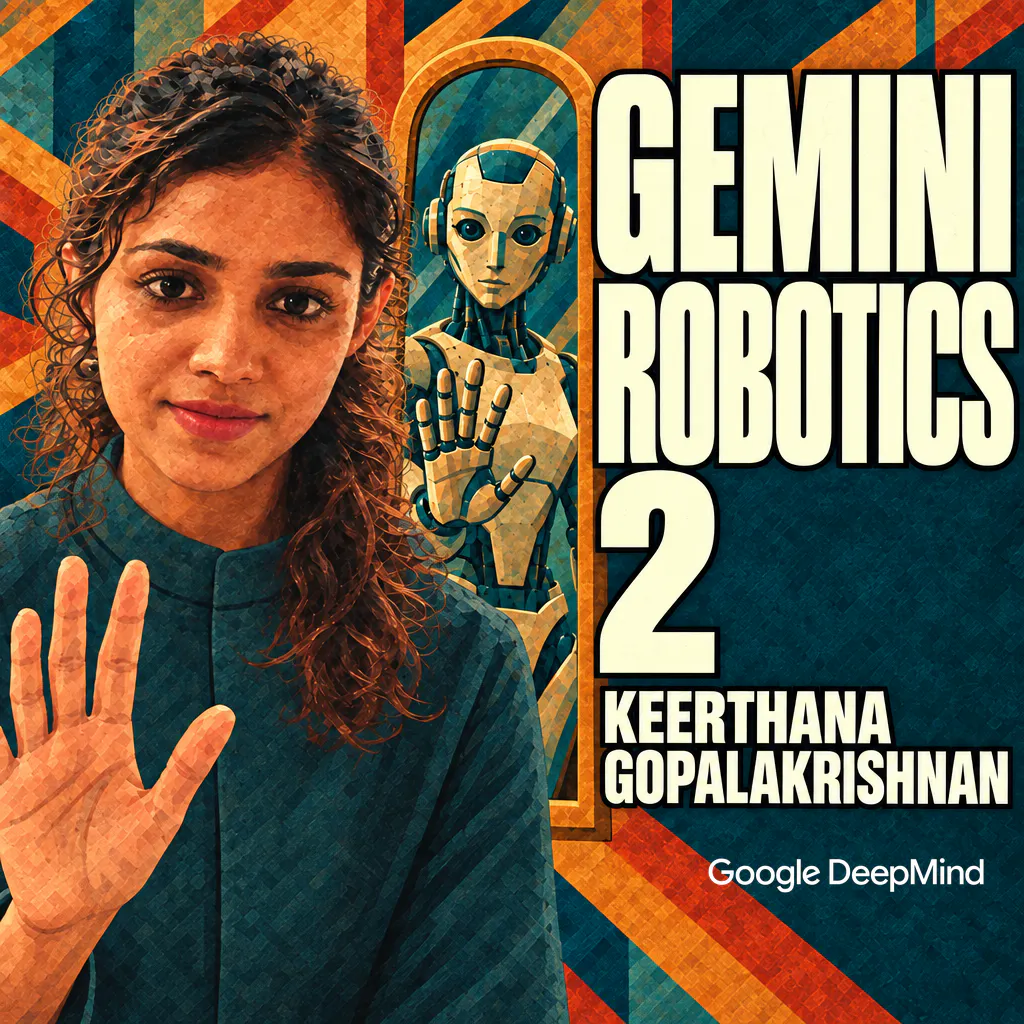
ひとつの脳、あらゆる身体:Gemini Robotics 2とクロスエンボディメント、ヒューマノイドの現在地
One Brain, Any Body: Google DeepMind's Keerthana on Gemini Robotics 2, Cross-Embodiment & Humanoids
ひとつの脳、あらゆる身体:Gemini Robotics 2とクロスエンボディメント、ヒューマノイドの現在地
"The Cognitive Revolution"
要約
Google DeepMindのGemini Robotics研究リード、Keerthana Gopalakrishnan氏が、Gemini Robotics 2の構成と現状を語った回。推論担当のER 2、行動を担うVLA、小型のオンデバイス版という3モデルの関係を説明し、全身制御や多指ハンドの進展を紹介している。一方で、身体をまたぐ汎化はまだ難しく、ロボット工学は「GPT-2の段階」にあるとの認識を示した。安全性、データ戦略、世界モデルをめぐる論点も扱っている。
この回のポイント
- ●中国のロボット五輪での高速走行は、平坦な地面などシミュレーションで学習しやすい運動で、実用価値の本丸ではないとの見方を示した。
- ●Gemini Robotics ER 2はFlash系ベースの推論モデルでAPIから利用でき、VLAであるGemini Robotics 2とオンデバイス版は信頼できるテスターに限定されている。
- ●Gemini Robotics 2は指先から足先までの全身を制御し、多指ハンドで袋を結ぶような細かい操作まで示した。
- ●ロボット分野は、少数例学習とクロスエンボディメントが十分に機能していないため、GPT-3の手前のGPT-2段階にあると位置づけた。
- ●安全性は能力の一部であり、物理的な運用安全性やセンサー異常への対応を含めてシステム全体で考える必要があると述べた。
- ●データはテレオペ、UMI、人間の一人称映像などの混合になるとみて、単一の方式に賭けるより実験による検証を重視している。
章立て
ロボット五輪とシミュレーション
ロボットが人間より速く走る映像をどう見るか。走行がシミュレーションで学びやすく、接触の多い操作が難しい理由を説明している。
汎化と熟達、GPT-2段階
汎用性と熟達は別の軸であり、汎化の底上げが全体を助けるという考え方を述べる。少数例学習の現状と、GPT-2段階という自己評価も語られる。
Gemini Robotics 2の3モデル構成
ER 2、VLA、オンデバイス版の関係を整理する。推論の遅延、コンテキスト長、ツール定義の使い方にも触れている。
ERとVLAの連携と失敗要因
ERからVLAへの指示方法(ステアラビリティ)、全身制御、オーケストレーションの遅延や誤差の累積を議論している。
多指ハンドとハードウェア
1年ほどで把持中心から多指の器用さへ進んだ経緯と、ハンドの強度や信頼性、コストの課題を語る。
安全性とHRI
運用上の安全、センサー異常への対処、人とロボットの自然なやり取りについて議論している。
世界モデルとデータの未来
予測的な世界モデルの要否や、テレオペ・UMI・人間映像・シミュレーションを混ぜるデータ戦略への見解を述べる。
ロボット群との付き合い方と展望
複数ロボットとの対話、緊急停止や力制御、遠隔操作の未来像で締めくくる。
解説記事
Google DeepMindでGemini Roboticsの研究リードを務めるKeerthana Gopalakrishnan氏が、The Cognitive Revolutionに4度目の出演をした。話題は最新のGemini Robotics 2、全身制御、ヒューマノイドの現状、そして物理世界にAIを持ち込む際の課題である。派手なデモの裏側にある研究の実態が、冷静な語り口で説明された。
走る速さは本質ではない
冒頭の話題は、中国で開かれたロボット五輪だ。人間より速く走る映像が拡散したことについて、Gopalakrishnan氏は一般の関心を集めた点を評価しつつ、研究面では意外性は大きくないと述べた。走行は地面が平坦で、シミュレーションで学習してから実機へ移す(Sim2Real)のに向いている。これに対し、布やものの接触が絡む操作は、シミュレーションで物理を正確に再現しにくいという。
同氏のチームが重視するのは、人の役に立つ作業である。研究の最前線は、グリッパー型ロボットのピック&プレースから、ヒューマノイドと多指ハンドへ移ってきたと振り返った。
3つのモデルの役割分担
Gemini Robotics 2は3つのモデルで構成される。Gemini Robotics ER 2は、Flash系をベースにした身体性推論モデルで、ロボット制御における「システム2」にあたる。APIで公開されており、開発者がツールを定義して使える。実際に司会者は、コーディングエージェントを通じて2Dのデモを作ったという。
行動を生成するVLA(視覚・言語・行動モデル)がGemini Robotics 2で、現時点では信頼できるテスター向けに限られる。オンデバイス版はロボット本体に載る小型モデルで、200程度の例でさまざまな身体の課題を学べると紹介された。
ERのコンテキストは約3分の記憶に相当するという。応答に数秒かかる点について同氏は、倉庫の組み立てラインでは速度が重要だが、家庭の洗濯物たたみなら待てると述べた。FlashとProのように、速いモデルと大きいモデルが併存するとの見通しも語っている。ERからVLAへの指示は、言語や物体の指示、ビデオなどで行う「ステアラビリティ」の研究領域で、テキストだけでは情報が失われるため、接点をより豊かにしたいという。
全身制御と失敗の要因
Gemini Robotics 2では、VLAが指先から足先まで人型ロボットの全身を制御する。しゃがんで如雨露を持つといった動作を、閉ループで汎化させた点が新しいとされた。多指ハンドでゴミ袋を結ぶような細かい操作を示し、器用さの最前線はグリッパーからハンドへ移ったという認識だ。ハンドの強度は製品ごとに差が大きく、信頼性や再現性、コストにはまだ課題が残る。
失敗の要因としては、身体をまたぐ汎化が最も大きいと述べた。新しい身体に、高い信頼性でゼロショット適用できる例はまだないという。加えて、ERとVLAの切り替えの遅延や、逐次タスクでの誤差の累積も挙げた。こうした理由から、ロボット分野は少数例学習が十分でなく、GPT-3に至る前のGPT-2段階にあるとの見方だった。
安全性とデータの見通し
安全性について同氏は、能力と対立するものではなく、能力の一部だと位置づける。AI一般の安全に加え、ロボット特有の運用安全、つまり悪意がなくても人を傷つけうる点や、センサー異常時の対応が重要だとした。頭にカゴをかぶせられたヒューマノイドが、視界の遮りを訴えるべきだという例も挙がった。人型は人に似るぶん、失敗への目が厳しくなるとも指摘している。
データについては、NVIDIAのJim Fan氏の「一人称映像とシミュレーションが主役になる」という見方に対し、断定を避けた。テレオペは精度が高いが拡張しにくく、UMI(手持ち型データ収集器具)は安く増やせ、人間の映像は大量に集まるがノイズが多い。各手法に強みと弱みがあり、混合になる可能性が高いとの考えだ。世界モデルの要否も「決着はついていない」とし、実験で決まる経験的問題だと述べた。
まとめ
本エピソードの特徴は、誇張を避けた現状認識にある。ロボットの進歩は速いものの、身体をまたぐ汎化と信頼性という壁が残り、汎用ロボットが広く普及する時期は研究次第だという姿勢が一貫していた。日本の読者にとっては、ER 2がAPIで試せる点が注目できる。ロボットのプログラミングが、デジタルエージェントのツール呼び出しに近づいているからだ。また、ハンドの耐久性やコスト、人と接する際の安全設計は、日本のハードウェア企業にも関わる論点である。
文字起こし(英語・自動生成)
Hello, and welcome back to The Cognitive Revolution. Today, I'm excited to welcome Kirthana Gopalakrishnan, staff research scientist at Google DeepMind and research lead for Gemini Robotics, back for her fourth annual appearance on the show. One of the biggest questions in AI today is how soon will general-purpose robots become broadly useful? AI is already affecting the world in major ways, even in its purely digital form. But the most sci-fi forecasts for the AI future predict that robotics will soon hit key tipping points. AI 2027, for example, predicts that humanoid robots will become useful sometime in mid-2027, and that by 2028, a whole robot economy could take shape, where robots build more robot factories, which in turn produce more robots, leading to unprecedented exponential economic growth, but also creating serious risk of AI takeover. So, how does that vision line up with the reality of robotics research today?
We begin with the discussion of the extremely viral Robot Olympics held in China this summer. As I was really curious to get Kirtan's take on what it means that humanoid robots can now run faster than the fastest humans. Her point of view, as you'll hear, inverts the usual U.S.-China dichotomy in AI. She says that while the videos are obviously impressive, skills like running on a flat track are actually relatively easy to train in simulation. And more to the point, foot speed is not really a limiting factor in the utility that robots can provide. As such, her team at Google is more focused on practical value. From there, we get into Gemini Robotics 2, a suite of three models that Google released this summer. Gemini Robotics ER2, for embodied reasoning, which Kirthner describes as a System 2 for robotics control, is based on Gemini Flash and is available via the API, allowing developers to define the affordances available to the models as tools just like we do with digital agents.
I played around with it and found it remarkably accessible. The other two models, Gemini Robotics 2 and Gemini Robotics On Device 2, translate these higher-level tool calls down to the level of robot action and are now capable of controlling the whole robot from fingertips to feet on a wide range of form factors, but are currently available only to trusted testers. Having understood how these models work, we again zoom out, and I ask Kirtan how she understands progress in robotics overall. On the one hand, like so many other AI researchers recently, she says that she has been surprised by the pace of progress. But at the same time, she still feels that robotics remains in its GPT-2 era. We have seen a number of recent demos of robots learning new tasks from just a few or even just a single human demonstration. But Kippen argues that the range of tasks you can teach this way, and the generalization profile of robotics models across different robot bodies, still isn't strong enough to deliver the versatility and reliability that real-world use cases demand.
Toward the end, we move on to talk about recent progress in hardware, where robots are likely to be deployed at scale first, whether capabilities or safety, alignment, and robustness will ultimately be the limiting factor for the consumer market, and we consider the future of the field, including whether we can continue to run LLM-derived robotics models in a loop, as today's systems mostly do, or we'll need some sort of predictive world modeling, as we humans use to create systems that can anticipate and smoothly interact with the world? On that question, and on the timeline for key utility milestones, Kirtana isn't one to speculate too wildly. For her, these are all empirical questions to be resolved by research and experimentation. But what is clear to me coming out of this conversation is that robotics will either need to hit key tipping points soon, or some of the most aggressive timelines for AI transformation will have to be pushed back. With that, I hope you enjoy this very well-grounded update
on the state of robotics with Kirpana Gopalakrishnan from Google DeepMind. Kirpana Gopalakrishnan, staff research scientist at DeepMind and research lead for Gemini Robotics. Welcome back to the Cognitive Revolution. Hey, nice to be here. Great to see you again. It's been about a year. Obviously, a lot has happened. I wanted to start off with something fun. There was recently a Robotics Olympics in China, and clips were obviously flying all over the Internet, and people were having a laugh and at times I think a little empathy for robots, which is something we've talked about in the past. I'd love to just start by getting your observations and takeaways, given the depth of knowledge that you have on the subject. What stood out to you in watching clips of the Robot Olympics? I hadn't until my dad was talking about it. And he was like, wow, did you see those humanoid running? And then there were all these videos about the humanoid running and catching fire.
And then I also saw my friends in India who have now entered politics and they are doing like various student protests there. And they were talking about, wow, look at that. In China, they're building the robots that can run faster than the fastest humans. So I think in a way, that competition, even though from a research perspective, it's like it's not very surprising but I think it has it has really captured the public imagination in a very emphatic way and also I think it's like a benchmark right running as a benchmark and trying to see where humans are at and then where robots are at and I think if you look at the videos from people had made these collages where the DARPA challenge back in the I think it was now 20 years ago I think those robots would just walk open a door and then like really fall down and now they are here we are so it has been amazing progress and it's also progress that's very much in the public's imagination yeah the fact that a robot can run faster than usain bolt
in the one on the one hand it's like crazy progress it's crazy impressive but one question i did have for you about it is it valuable are these robot olympics is it just a you know is its main purpose to capture the public imagination and just have something cool to show off do we want robots that run 20 miles an hour in humanoid form? In your work, do you think, oh, I wish my robot could run faster, I need to work on that, or is that just a sideshow? So I think one is that there are people working on research, and then there are people trying to push how fast that research can go. And for better or for worse, locomotion is the research, there's locomotion and manipulation, and locomotion has advanced quite a bit, and especially it is the type of field where simulation can make a lot of difference. And a lot of these models are like trained in simulation. And because of that, locomotion has advanced quite far. So it's like a display of where the state of the art of humanoid locomotion, like bipedal locomotion is.
I think, so there are many ways of looking at it. I'm pretty sure maybe for some different applications, it's useful. But I think we are very much focused on doing robots help people and do useful things in the physical world. and I think I'm a very productive human. A lot of my friends are also very productively employed, but we don't run faster than Usain Bolt. I think it's useful, but the frontier is so vast, right? Different people are trying to push in very different directions. Tell me more about not running the wall at their sprint and smash into pieces. Clearly, they are not training them like that on an ongoing basis because they'd run out of physical robots to do the training on awfully quickly. So from that alone, I was like, okay, clearly they must be doing a lot of training and simulation. Tell me more about why these kinds of tasks are amenable to training and simulation and what kinds of tasks are still difficult to train in simulation. Yeah. So Sim2Real is the thing to notice.
And Sim2Real in robotics context means the gap between if I train something in simulation, can I replicate that in real? And as we know, especially with agents and stuff, the things that we can learn in simulation are probably the first ones to get solved in that sense. So in locomotion, if you look at it, you can often model the ground or the wall as like a, you can model it and there is contact with that. And often these are like very flat surfaces. And so that makes this task a very good task for simulation. and then you can do society of the entire robot. But for manipulation, though, you really, what you care about is contact, right? And when contact happens and how objects behave, that's where current simulations start to break a little bit. It's harder to do cloth folding because the cloth have friction. But even in simulation, a lot of pick and plays can still be, like, very solved in simulation because there also the contact dynamics are often somewhat predictable.
So basically the more rigid the body is, whether it's the floor or like here's a wooden cube, the less deformation those things are going to have, the easier it's going to be to do simulation. Yes. Contacts are basically, the physics is harder to model in simulation. So where the physics is easier to model, simulation gets it. In terms of the AI side of these robots, what would you infer from what we saw? Obviously, I don't know about obviously, but it sure seems like there's not reasoning components to what's going on. I don't have a clear sense of what architectures were and were not allowed. And were all the models that were used to control the running robots? Were they on the device? Were maybe some of them off the device? How would you imagine that they were typically doing that? And how high up the stack do you think they were working? Clearly they're doing a lot of stuff with stabilization, making sure it's not keeling over at any given point in time.
But is that it? How would you kind of, I'm going to, because we're going to get into Gemini robotics coming up, and there's a much higher level part of that architecture too, reasoning and understanding scenes. I'm assuming just all of that is kind of skipped for the purposes of these need for speed demos. Yeah. I didn't work on these demos, so I'm only speculating. But there is a very widely published body of work around how to do locomotion and simulation. And I would imagine that it's like very good RL controllers that are probably trained from like motion imitation and then fine-tuned with like good RL that suits the robot's body and for that specific task where it's targeted towards running really fast. and then maybe they have some navigation, although I would think that just running a race is quite easy. So you mentioned the goal of having robots do useful things for people in the world, and obviously foot speed is not typically the limiting factor on one's ability to do that.
In today's world, you live and work around robots all the time. Is there anything now that you actually delegate to robots on a practical level where you're just like, they're actually good enough at this that it is abstracting away from my research interests and all these other things, but just straight-up convenience. Robots win on these tasks. Are there any such tasks? Yeah. The weird thing is that I'm actually a researcher, right? So if the robots win in some tasks, then I am going to work on the things that robots cannot. The frontier is moving. and I remember back in the day when I started working on manipulation even pick and place was very hard to do and at the time we didn't have the right algorithms but now with the foundation models this sort of stuff is quite easy to do and and therefore like the research frontier has moved into like humanoids are a newer thing if you look at it back in the day our demos were just like
grouper robots and now it's with humanoids and hands so the frontier is constantly moving because the things that used to be easy the things that seem easy kind of get solved and then the frontier moves into harder stuff so if you look at the robotics tool release right like it's whole body control like whole body manipulation this was not something that that anyone had shown before and especially whole body manipulation with generalization. So it's not just running really fast, but being able to take steps, being able to squat and manipulating objects while doing that and in a closed loop sort of way. And then also generalizing and reasoning about different types of objects. I would say like maybe a year ago, if you had told me we would do this by now, I would be a bit surprised. So you can see over time, I do feel a bit proud about it Because we started working on humanoids like two years ago. And at the time, it was like just beginning, right? And they are like trying to just grab an apple.
And even that was really hard. And now you can prompt it. And I put out this video on Twitter where like I'm like playing with it with a watering can. And it's squatting in different locations and trying to pick it up. So, yeah, things have quite a bit. Maybe another way to frame the question is in terms of the meter curve. I'm sure you're familiar with the famous meter curve of task length, and it's typically plotted as over time the models can do increasing task length as measured by how long it takes a human to do the task. But then there's also this factor that's like the AI in that case can do it at 50% success or they have an 80% success version. Obviously, one big difference between LLM usage and robotics deployments is 50% success rate in the real world is probably not going to cut it unless you have a really failure-tolerant task. Whereas on my computer, I can be like, eh, you kind of missed some stuff, whatever, but the robot drops something, it breaks, we have a problem.
So maybe if you tried to describe where we recently were and where we are now on a meter-like curve of how hard are the tasks that robots can do well enough that they can actually be deployed? Or what are the things that they can maybe do 99 plus percent of the time such that, hey, for these tasks, they can actually do the job. And then what would be where they're at like 80 percent? What would be where they're at like 50 percent today? I think a lot of begin plays is close to getting very good signal and close to deployment. I do think, though, that there is a balance that we need to strike in robotics and generally AI in general. You could build very narrow AI, just very good at one thing, but then you're not working on generalization. So you can see generalization and mastery as somewhat orthogonal axes. And working on generalization is like lifting the boat, lifting the wave for all the boats.
So if you imagine like the tasks are like sitting along this manifold, even very general common sense, very general understanding is making it much easier to get to mastery on kind of all the tasks. And this is also like very much part of our thesis in thinking about how to approach this. And you can build like even today, you can build very narrow AI. That's just very good at one or two things. But then the cost of doing the NET thing becomes exactly the same as the cost of doing the first or the second thing. But building a very general baseline then makes it much easy to quickly take it, to tune it towards mastery. I think we have seen this even in LLMs, right? Like initially people had specialized models that do one thing. But now you know that the GPT and Gemini are, like, very good at a broad range of tasks. And then from those general baselines, then you can climb really high. So I think the same thesis might hold true for robotics as well.
Yeah, that's interesting. So last year, when I saw your talk at the Curve, one of the interesting points, as I recall, was taking the base model that you had at the time and then doing some task-specific fine-tuning and showing gains from task-specific fine-tuning. recently there's been i don't know at least a couple probably several demos that i certainly haven't been able to interrogate myself in a hands-on way but you see videos online of different robotics companies saying hey look we've got few shot generalization or we've even got one shot generalization here's a person doing the task one time demoing it to the robot then they can go do it. Obviously, that's great if you can get there, but what do you think is the actual likely path that people will follow to deploy robots? Are they going to do 100 demos of a task? Are they going to have to do 10? Do you think we are on the verge of getting to a lot of things working
on just a one-shot basis? What sort of investment should people be prepared to make to get their humanoid dialed in on whatever they most care about? No, I think it's going to be a spectrum, definitely. Being able to ICL or in-context show or award how to do a task and then it doing it definitely reduces the time to deployment and the time to pick up the task, right? And you don't need any specific training. You don't basically need to train it. You can do it in context. And so that definitely is a very exciting development. although you can think of it as video prompting right even the older models like when I say let's say pick up the object right and it is a very unseen object what am I doing I'm sending in language and then I'm getting a very general behavior out of it that I did not show it before so that's generalization now instead of prompting with text you can prompt it with an image you can say here's the thing and then draw a circle around the thing that you want manipulated
and that's prompting with image and this is prompting with video in some sense and so I would imagine I think the ICL results currently are on the spectrum about of how do you prompt a foundation model and you can prompt it with video you can prompt it with language you can prompt it with image and then the question is so now what is the generalization that you can get now these models are also very subject to kind of memorization in some sense so if you really show it exactly this what to do, they will copy it. But the question is, can they generalize, right? Can you now, if you change the scene and stuff, can they do, can they now adapt? And then the second question is, so for the same task. And the second question is, what is the level of difficulty of the task that you are prompting for? So a lot of peek in place, like the models have a lot of data and it's also like easier to comprehend. But can you show a robot to tie a trash bag? And then can the robot tie a trash bag after you show it? So I think it's still fairly early, and we need to see how that evolves.
If you had to score, this is a silly question, but it might be useful for just calibrating. If you had to score robotics today on one to six GPTs, are we, like, in earlier conversations, I think we were, yeah, we're maybe hitting, like, a GPT-2 kind of moment. I think of GPT-3 as being really synonymous with in-context learning, but we're following a somewhat different path with robotics obviously where we have like instruction following built in maybe in many cases even before like good in context learning happened so that just exposes the flaw in my question but if you have to analogize to how many gpts we are along the way in robotics where would you score the field today i think still GPT-2 and here's why. I think for GPT-3 we need firstly few-shot learning to work really well for a lot of different tasks and secondly also robotics weirdly is still very subject to cross
embodiment right. If it just works on your robot with your specific setup is it really a generic brain? Now can I put that brain on my humanoid or my another robot or some other robot that I just bring in it should be and if it's completely helpless in that setting is that a generic brain i think gpt never had this problem right like we my phone or your phone my computer mac linux it doesn't matter where you run it it kind of behaves you can expect this very similar behavior but here i think we are very subject to which robots that you act on and so i think there is a lot of work still needed to be done to make very generic brains that can discount those factors out. Hey, we'll continue our interview in a moment after a word from our sponsors. Today's episode is brought to you by Athena, the executive assistant company on a mission to improve how people work and live. If you want to increase your impact, you have to free up your
time. And that's what Athena does best. They match you with a dedicated, full-time, top 1% executive assistant who can take over your inbox, calendar, travel, and everything else that's quietly eating up your week. Athena is SOC 2 Type 2 certified, so you can rest easy knowing that your sensitive data is in good hands. And as a former AI advisor to the company, I can personally vouch for how much they've invested in AI tools and training. In fact, one of the very best AI users I've ever met is an Athena client who delegated the exploration of AI tools and the development of AI workflows to his EA. Athena clients report saving an average of 15 hours a week, and the average client refers more than two friends a year. That, to me, checks out. I was an Athena client while running my startup and to this day I continue to refer friends Go to Athena slash cognitive right now and get matched with your EA That athena slash cognitive
Give yourself back a few hours this week. Go to athena.com slash cognitive and see who they pair you with this month. Today's episode is sponsored by Parallel, where agents find answers. Most engineers today closely follow new model releases. but don't pay nearly as much attention to their agent's most important tool, web search. If you're like me, your agents are often conducting hundreds of searches per day. And while the unit cost is small, over time, this does start to add up. Before starting to use Parallel, I calculated that my agent search bill would total roughly $500 this year. The good news is that I just had my agents conduct a systematic test, and I found that Parallels Fast Mode, which costs just $1 per thousand queries, worked just as well as my previous default provider. And switching to it will save me roughly 80% of my search bill going forward. Parallels infrastructure is enterprise-grade, and their suite of APIs offers a range of Pareto optimal options
that allow you to choose the right balance of quality, cost, and speed for your needs. So, whether you're building voice agents that need 200 millisecond latency or long horizon agents that need deep research, adding Parallel to your agent's toolkit is a no-brainer. Get started for free at parallel.ai slash TCR. That's parallel.ai slash TCR. Well, maybe that's a perfect transition to Gemini Robotics 2. How about for starters, just give us an overview of the architecture. There's like, when you go to the webpage, there's three models released. There's Gemini Robotics ER2, there's Gemini Robotics 2, and then there's the on-edge, on-device model. Describe how those relate to one another. Just give me kind of a broad way of the land, and then I'll dig in with some more specific questions. Yeah. So Gemini Robotics ER, you can think of it as like a system-to-frame that can do like very generic reasoning.
It's based on the flash line of models, but maybe more tuned towards robotics. It can do a lot of robotics tasks, and it's also widely available that you can query for, like, general image and video understanding and semantic understanding. Now, you can think of Gemini Robotics as the BLA that is, like, controlling the actions model, right? How the robot moves and what it should do given a certain intention from either a user or another assistant tool model. And you can think of the Gemini Robotics on-device model as a much smaller version of that. It kind of fits on the robot's computer that doesn't live in the cloud. And it is comparable. It's essentially doing what Gemini Robotics can do, but it's a smaller model that fits on-device. So one question I have around just how this is made. So it's based on Gemini 3.5 Flash. and with that comes a lot, right?
Like you have chain of thought reasoning, you have the multimodal inputs, all that kind of stuff. Is this the long-term architecture that you expect robotics to work around? One obvious challenge is just language models, especially with their reasoning traces, they take a while to respond, right? So the way I did a little, it was actually pretty fun. So this model's in the API spoiler. That's another topic to touch on. But because it's in the API, I was able to have a coding agent go in and use it and expose some tools to it. And I created little just 2D demos actually, where I like feed in a little image of a scene, but it's actually like a little canvas in the browser. It's amazing how far I was able to get just with a few prompts in terms of helping me understand what the model can do, how easy it is to use. But I was also getting timing traces back from that. And so some of the times it would be like from prompt of move the banana to the plate to the tool call is six seconds or something.
That seems like a long time for the real world. So that makes me wonder if this is a base of convenience that you're building on now or if this is like the paradigm that you ultimately think we will see perhaps just sped up or otherwise somehow modified that we'll actually have the robots working in a responsive way in our environments. Yeah, I think it all depends on the application specifically, right? Like certain applications, like if you're on an assembly line, you can't loiter and now you need to do things really fast. But let's say if I'm at home or at some point and I'm like, hey, robot, can you go fold my laundry? I don't really care about how fast it is folding laundry. I care about how well it is doing the task. I can wait. And then maybe there are also scaling is a very important factor in LLMs and in robotics. And I would imagine that a lot of the very frontier capabilities are going to appear in the very large models. And those models are going to be naturally slower than the smaller models.
So I think there is definitely a tradeoff and a spectrum to be made. And I think I would imagine that the flash and the pro paradigms would also exist in robotics. And even in robotics, maybe you could even see like maybe like an on-device paradigm, like even the flash models, they still run on cloud. Right. And they need very good network connectivity to talk to them. And robotics deployment could be like very distributed. Right. You might want to run it on some remote robot in Michigan and stuff. So I think the paradigms will evolve, but I imagine all scales to be relevant and useful for different types of applications. It's interesting that you contrast, because typically I think robots will go first to warehouses, factories, commercial spaces where there's a lot of control and there's a lot of consistency to the tasks that they will need to do. and there's of course professionals who can maintain large numbers of them. All of those things historically have made me think
they're not going to come to my home before they're pretty well deployed in these commercial settings. But what you said just there was a little bit pushing the other way where it's like they may not be fast enough for the factory but they could definitely be fast enough to do all your chores overnight and that could be an inversion. Do you still, I think last time we talked about this you had said you would expect commercial settings to be the first places. Is that still the thinking? And how does that relate to the responsiveness question? I definitely think that commercial use cases are probably more controllable, therefore, to try out different new intelligence compared to like people's homes, which are more complex and where you cannot exert control. And even there is higher bar that you need to meet for safety, given toddlers and stuff. So that still, I still believe that. However, the speed question, I don't think it's going to be like we make the slower models first and then make them faster. I think we're going to simultaneously make the fast and the slow models and then distill them to one.
And although it is very potentially possible that some capabilities are going to just emerge in the larger models, and then we'll need to figure out how to bring it to the models in the smaller scale. so of just the difference between the gemini robotics er2 embodied reasoning model and the base model of the gemini 35 flash that it's trained on one of the things that my coding agent did without even me asking actually was just compared the two and gave both of them like here's a scene here's the tools that you have the tools were like fairly high level in the little test that i did of grab at and it would grab the item and then place at. And it even did one where the inspired by famous videos, like the thing was moved right before this. It tried to grab and it failed. And then it got another image, but the thing's in a different place. But this was all like relatively simple stuff. And on the test that I ran, Flash and ER2 basically perform the same. They actually just both did fine.
How would you describe the frontier of embodied reasoning tasks specifically that ER2 can do that Flash can't do? Yeah, so I think a lot of the benchmarks that we are tracking are like instrument reading. It's like the way that we think about is like ER is working much more closely especially for robotics use cases. And that is like inspection, instrument reading, a lot of pointing. But it is a very like, it's a collaboration, right? It's not like ER and Gemini are at competition. There's a lot of data upstreaming. So it is a very collaborative effort to how to make the Gemini models really good at robotics generally. And if it's not and but the way to appear, the way for the capabilities to progress would be like, even if the Gemini models are more generally intelligent, you can still create specialized models that were, let's say it's a specific robotics use case needs like more specific engineering or fine tuning. then you have like specialized models that are slightly better in that use case.
So I think it's a question of what you want and what you want to enjoy. The Model S 128,000 context window, how much is that in the context of robotics? I have done enough that I have an intuition for how many pages of text that is and whatever, but I don't really have a great sense for how the history of an episode gets encoded and how many images per second. How should we think about that in terms of time? What does 128K translate to in terms of the sort of maximum length of an episode for an ER2-powered robot? It's about, I think, about three minutes of memory, And it depends on how you tokenize and like how many tokens you represent and what is the other information that you've given. However, I think regarding the memory, you would see that like the pro models are much larger context length.
And they have they are also like they are getting a lot better at like fitting much larger things. I would think you are right now. You can fit like a very long episode of a robot doing a lot of things and try to get an output out of it. But as working on context length is like a continual problem. So I imagine that, especially for these like offline analysis use cases, the pro models are going to be more useful there. So three minutes would be like if you're basically packing context very densely. If you were to offer any advice to API users who are like, okay, I want to aim for higher than that. I can obviously downsample video and have fewer frames and do all kinds of things, right? I've got context engineering for robotics. Maybe the question I really want to ask is, what have you learned about context engineering for robotics that people should know? How should they think about, like, what parts of the history of a rollout they need to keep in order to have coherence?
And maybe it's similar to LLMs, but I imagine there's probably some things that are distinct about it. yeah so i think very dense memory so there is like i think daniel kenneman or someone else the fast and slow and but maybe you can think of it even for like memory aspects right especially for like something that i did in the long past is it worthwhile to keep it in a highly dense modality like image or can i also do a lot of text summarization of like what i'm doing as i'm doing it so let's say if i'm cooking right it's not sure in my in my brain like if if i want i can go back to the time when i was i don't know flipping my ink or something but also a lot of the time i the information or the narrative of how i'm doing things and and summarization even in text is fairly useful or fairly informative about like what i i did so i think context is it depends on what you want to maintain is the relevancy of the information for the task and obviously if you can remember everything then that's great but as practically you need to be
more efficient with how you manage your like grams right and you kind of want to have the most important information represented and sometimes that can take the form of like also representing information in like text which is a little bit more compressible and this is also now related to the hardness between ER and the VLA. The ER tries to parse the intentions from a human and via text and other modalities kind of talks to the VLA. And so the bandwidth there is much more interpretable modality. Hey, we'll continue our interview in a moment after a word from our sponsors. I've got a text. The summer might be almost over, but a new bombshell has entered the villa. Meet the voices of DeepGram Flux TTS. I'm Drew, low-key casual. I'm Alexis, an upbeat morning person. I'm Haley, always cheerful. Flux TTS has some real personalities that are ready to speak. You can interrupt, pause, and keep talking without losing the plot.
Fancy a chat? Come try all the voices free through September 12th at deepgram.com slash keep talking. Terms apply. This episode of The Cognitive Revolution is brought to you by OutSystems, the leading agentic systems platform. OutSystems is helping their customers build, modernize, and operate enterprise systems, starting from any coding tool in a governed, agentic engineering model. It's time to innovate at the speed of AI without compromising quality or control, which is why thousands of enterprises worldwide trust OutSystems for their mission-critical apps. And we're not talking about theory. We're talking about massive operational wins. Take, for example, a leading global retailer that was struggling to keep up with their rapid expansion. They used out systems to build AI agents that automated their invoicing and translation processes, shifting 95% of their daily store operations to a new digital app, saving thousands of hours of manual work. Or look at a major global logistics giant that was drowning in technical debt.
Their engineers were spending their weeks manually firefighting by reviewing platform logs. Using OutSystems, they built an AI log review agent in just five days, and that one agent now saves them over 1,600 engineering hours every single year, letting their team focus on real innovation instead of reactive maintenance. Even in modern digital banking, companies are using this platform to standardize and automate complex financial workflows, delivering secure, personalized experiences at a pace their competitors can't match. OutSystems gives you the flexibility to deploy how you want and the governance to do it safely. Stop chasing the hype and start owning your agentic future. Learn more at Outsystems.com slash TCR. That's Outsystems.com slash TCR. Today's episode is brought to you by Anthropic. By now, you know my story.
Claude drafts my intro essays and I rewrite them. Not because the drafts are bad, but so I can stand behind everything I publish. Well, I have an important update. Claude Fable 5 is the first model to have me rethinking my rule. Today, I now think co-authorship, not sole ownership, should often be the goal. Where the model excels, rewriting its work can be more about vanity or a misplaced sense of duty than integrity. I feel it most in songwriting. I'm no lyricist, but I'm good with the song concept, and Fable writes some amazing verses. I give it feedback on its misses, and I push it to aim for higher inspiration, add layers of meaning, optimize syllable density, and above all, write a hit song. These days, I get compliments on just about every song we write together. Claude is the AI for problem solvers. It's the collaborator that understands your entire workflow and thinks with you, not for you.
Whether you're debugging code at midnight, building a financial model, or strategizing your next business move, Claude extends your thinking to tackle the problems that matter. For problems worth solving, get started with Claude at Claude.ai.tcr. That's Claude.ai.tcr. And check out Claude Pro, which includes access to all of the features mentioned in today's episode. Once more, that's Claude.ai.tcr. Just before getting deeper on the VLA, why did you and DeepMind as a whole decide that this was the first robotics model to put out via the API? And what have people built with it? Yeah, I think it's definitely ER is much closer to Gemini itself and in terms of the capability. So it is more mature. Actions, I think, is like farther out into the frontier. And so it is still like very much, there's a lot of research to be done about how to make them very useful, how to serve them more widely and so on.
And I think it has been quite surprising to see how people use it. I've seen it in so many, has such wide appeal and the team has done a really good job there. So I think maybe one thing we learned was like there was a lot of testing that we were doing with trusted tester partners and stuff. But it was once we put it more widely available on AI studio and stuff, then the usage is on a very different scale than whatever the information that we were finding from deeply working with trust test departments. So that was surprising, like how much like things blow up once you put on a more widely platform. But second is I think obviously there are like robotics companies using it. But then also I think for me as a researcher, I was quite surprised by how academic people in academia use it. And I think some of the things that I've seen is on like definitely benchmarks where it was either using VLA or even trying to do even low level control. Now, there is a lot of conversation going on around like how agents will impact robotics. So I think how ER has been used in that context has been quite, it was quite nice to see.
And maybe thirdly, now that ER is more widely available, it also makes it very easy to be benchmarked. So it's kind of like free information for us about what the model is doing well, what it's not doing well, what could be like the next frontiers that we may need to push into. Are there any consumer products or any users you would particularly want to spotlight that are using ER2? So there are a lot of demos out there. I think I saw the Boston Dynamics spot robot going around reading instruments and like handing out snacks. the dog foam, and I thought that was something. I like that. Is it? I know that you can, because I did it, or my coding agent did it for me, you can define any tools for ER2 to use in a similar way that you can define any tools for a regular Gemini model to use. What kind of additional guidance would you give on what kinds of tools it can use well? Maybe you could describe, like, what the Gemini Robotics 2 DLA model exposes
and then how people can go toward more abstract or more low-level than that and what works and doesn't work so well. You mean how the – is the question about how ER controls the DLA? Yes, but also my understanding of using ER2 is that I can give it user-defined tools with just a little tool description, right, and then it chooses what tools to call based on its general purpose reasoning ability. But I'm assuming that some tools it can use better than others. And so I'm wondering, what tools do you expose to it in the form of the, what are the sort of ways that it interacts with Gemini Robotics 2, the VLA? I'm guessing you probably have kind of the sweet spot of its ability, but then people could go toward higher-level concepts or toward much lower-level concepts. And I'm wondering, what does it do well and what does it not do well as you depart from Gemini Robotics 2
as kind of the canonical VLA that it presumably is training most directly to use? So I think one definitely is the Gemini Robotics ER is built on top of the Gemini tool use and other capabilities. and as we are very much working on how to improve its relationship to the VLA and how to instruct that better. Maybe one is I would imagine that robots are, like, very different, and each one has very different APIs and stuff. I would imagine that it's much more friendlier to the APIs of the robots that we commonly use that are more widely known than if you probably subject it. And here I am conjecturing. I think we would need to test to see how these things are. And maybe there is no standard for robotics APIs and the model protocol equivalent. So I think that would be something where I would imagine that more widely using it could face some challenges. And definitely, it's a very good model that's very useful for language instructing VLA.
But you can think of VLA itself as like it's a mapping between joint space, language to joint space, language image space, joint space. But there are a lot of demos now, and people are thinking about, can these higher-level models directly control in the joint space? And so I think there's a lot of work still to be done. I think current results are still that specific robot foundation models are still better, although the larger brains are showing impressive capabilities in orchestrating these robots. So I think that would be something where I would imagine a lot of push in the future. So when I did my little demo the tool that my coding agent decided to expose to ER2 was a grab at place at and it had to just based on the image itself pick x y coordinates of exactly where to grab in place it's obviously been trained pretty well on that because it did a pretty good job it again in 2d how what what
sort of with Gemini Robotics 2, what kinds of commands do you have ER2 giving to the VLA? Are they like, it sounds like not so low level as move hand to XYZ coordinates. It sounds like that you were saying is like more experimental. What you're, the interface that you're actually working with is more pick up this item or pick up the yellow, like in my demo, there's a lemon or a banana. So there, you could say pick up the yellow item, but that would be ambiguous on banana or lemon. How would the ER2 model disambiguate for the VLA model? Would it give coordinates? Would it, like, use the term banana? Would it, say, describe the shape of, like, oval versus crescent shape? How many concepts does the VLA have to work with? And conversely, the opposite side of that is, like, how specific does the ER have to be in its commands? I would tell you an answer, but it's only true at this point, right? It is, like, an evolving. So this field of work is called stearability.
And people are looking at various ways of steering. So VLA steerability, and then the ER is essentially using whatever modes that you can steer the VLA, right? And VLAs right now are steerable in language. You can point to objects. And so here, it's not like an API that I'm giving where I'm like saying, put this pixel location. I'm literally just doing pointing, and then I'm pointing to an object, and then it's kind of VLA to it. And then the ICL results are like, and I prompted with video and stuff. So I think it is like a spectrum. And eventually you would imagine that the way that you want to interact with robots generally is very wide, right? You want to say if the modality between the ER and the VLA is just text, a lot of things can be lost in there. So we want that contact interface to be also as rich as possible over time. yeah so the VLA itself is multimodal in the sense that it can take all these different domain or
all these different modalities yeah and I think like the ER kind of you can think of it like as orchestrating or giving feedback to the VLA to do the task and there is a range of things that like instructions like even while we don't generally train it to do a lot of like low level stuff I think like it says things like turn around look to your put your head there or look to your left and you can get all that information and the VLA response to it. And sometimes, often, the thing about foundation models is that, like, sometimes you can be quite surprised at what they do and because, like, even you didn't know that they could do that. And sometimes you can see that coming out of just the hardness as well. So has it been disclosed or can you tell? It sounds like the Gemini Robotics 2 model is also created from a VLM base. But then, and obviously for. So, interesting, you mentioned earlier that it has whole body control.
Tell me, what does whole body control mean exactly? Does it include, because stabilization typically needs to run on, like, a pretty high cycle time, right? A pretty high frequency. And if this is a post-trained, especially post-trained VLM that has such high-level concepts, as you're describing, it seems hard to imagine that it would be able to run on the frequency to do lower-level stabilization. So maybe the robots themselves bring that kind of stuff, and that's not part of whole-body control. What is in whole-body control, and is there some stuff that's left for kind of even lower-level systems? yeah so i think you can think of as like the chinese humanoid race as an example right where there are definitely controllers that can control the body but then eventually what you need to make sure is like can i do the task that the person is asking to and the very low level controllers often don't have a semantic brain there and now you need to like control like and in i doubt a lot of these
things cannot be abstracted away to oh this system will just do this or this system will do that i think so here the vla is controlling the whole humanoid body from like fingertips to the feet and only when you reason entirely about how the body is and also all the sensory information about how the environment is can you do that i think that is the right to design to do a lot of different tasks so the vla is controlling the whole body and but there are more decisions being made about how to stabilize and how to achieve the targets of the VLA. So this one is not available via the API, but you do have a program. I guess you mentioned mostly because it's just more frontier, less reliable technology as it stands today. Does that mean that if we were to break down failures, the majority of the failures would be at the VLA level still as opposed to the reasoning level like the reasoning is working
and the VLA is where failures can't quite actually do the thing? We are working with partners to develop this VLA so we have partnerships with Aftronic, Agile Robots, Boston Dynamics and so that's where we built or how we are building the VLA together with them. I do think in general Robotics has this embodiment problem, right? PLAs are also still training on data from robots. And while we see a large leap being made in cross embodiment, I think that taking a new embodiment and completely zero-shotting it to a lot of tasks with very high reliability is still something that is, I don't think there is a very strong precedent for that. And there is also like a trusted tester program for the Gemini Robotics on-device model where we work with a lot of different labs and they have their specific robots. And I think the on-device really showed like it controlling. This is one of my favorite parts of it. You can get a very, very small number of examples.
With 200 examples, you can learn a lot of different tasks on a lot of different bodies because you already have the foundations to do a very generic understanding of the physical world and also like how to control it from and the data for how to control it between any different embodiments. I would think, I think a lot of the challenges with how the orchestration works is still split. There is surprisingly, there is the latency component, right? Because when you have two models, like one model is like doing the task. And another model is also like looking at how to switch the task, like when it is done and how, now how do you progress to the next step? I think a lot of failure cases often also come from how to do the orchestration really well. And yeah, so I think, and it is also a compounding of errors, right? Like, now, if you have 10 tasks in sequence, and now you have the ER model, which has a certain X success rate, and the VLA model, which has a Y success rate, now, if you have a sequencing task, you are basically compounding the error. Does that make sense? So if I ask a robot to go fry an egg, how far does it typically get?
Are we getting some successes on eggs fried, plated, and served to the table? Or would that be beyond what your robots today could realistically do? It depends on whether you have data or not. I think that if you – there are ways to make, like, if you specifically just want to fry an egg and how to do that reliably, there are algorithms that can make it very reliable just for that task. but if it's like a very generic model which has not seen how to fry eggs and now you bring it into your home which is to be fair i think models have made a lot of progress on visual generalization they are now not distracted by like lighting conditions or the different setups of different homes and stuff so i would but i think it's like the task semantics and the context right and the ability to make mistakes i think especially for frying it's like you can overcook an egg and no one would like that and there the room for error then becomes small like well i overcook my own usually too so that would we could count that perhaps as a success for me that's that allow
retries are much easier like if you are doing like lego assembly it's fine if you make a mistake you can go back and fix it yeah yeah that's a great distinction if you crack an egg and then it's on the floor then now you're in now you've got a mess and you might slip in it too what are the so one of the value propositions of the gemini robotics to model finders stand correctly is it can work with any embodiment. What are the most exotic embodiments that have come your way via the Trusted Tester Program? Surprisingly, not a lot of exotic embodiments. I think maybe the weirdest thing I've seen is people putting arms on drones and stuff. I think it's just that once you have, if you have data, you can learn anything. I think that is the principle. So I do believe that you can fit like very weird embodiments to it. But in general, I think the embodiments can look very like a normal distribution, right? Arms are very, if you look at like the eigenvectors in the embodiment space,
like there are a lot of like bimanual arms. There are a lot of like hands. There are like humanoids. But and then like everything weird is like a long tail in that sense. Any kids toys that you've seen that might be in demand this holiday season? it's toys like for robots or yeah i don't know i just can imagine i'm surprised honestly that i haven't heard more demand from my kids just based on what their friends have and whatever for some kind of ai enabled little robotic toy that might i don't know honestly walk around the house but move around on wheels even and talk and i'm not sure i want them to want this because i'm not sure I want it to be their life, but I'm surprised that I haven't seen more. So I'm just wondering if the R&D pipeline is there. I think it's probably because the market is a little bit burnt. I remember when I was in school, there were a lot of companies trying to do my tabletop like a gaming robot.
And I think I remember when I was in CMU, there was a lot of conversations around this. But maybe what a lot of people learned from that was like people buy these things for novelty reasons. but they don't go back to using them. I don't know how that is. None of those robots were machine-learned robots, which was connected to the large models, and now things are very different. I speak to Alexa and Siri and stuff, and sometimes I wonder if it would have been a lot more fun if they were much smarter. I'm still waiting for a good Siri, for God's sake. Yeah, I've been talking to the Gemini, the live user interface when I'm doing tasks or just talking about like my personal life problems and trying to get its perspective, like I think you shared. And yeah, it has been very useful in having an expert go over your problems where you're probably not very skilled to solve. Yeah, I'm a big voice mode fan too, actually. In a previous conversation that we had, I asked you what you most needed from hardware makers.
And you said, I need good hands. How are hands coming along? How is hardware coming along generally? Are you pleased with the progress? Is it going to become a bottleneck for you relative to how fast the models are improving? Where do we stand? When I last spoke to you was probably in the May and March of last year, right? So here's the interesting thing, right? We had in the March of last year, we came up with Gemini Robotics 1, which showed that a lot of dexterity with grippers. and in the summer of this year and it's only like a year and four four months right three months a year and a quarter we showed gemini robotics too which does multi-fingered dexterity which can tie trash bags and stuff and do very fine control of multi-fingered hands so it is here's where my internal model is also updating right all the tasks that the gripper robots could do and that they were at the frontier of dexterity the hand robots can do now and the hand robots can do more
things that the gripper robots could not do so in a way hands are now at the frontier of dexterity and grippers are maybe not and i think this has been i think i was quite surprised at how much the hardware has come along there are a lot of hands on the market that are quite good that people are doing a lot of research with, there is still more work needs to be done about how to make them very reliable, very repeatable, and also make them cheaper. How strong are they? If my wife needs me to open a jar, would the robot be able to substitute for me and open the jar for her? Or would it be like she would need to open jars that the robot can't open? Like, where does it fit on the kind of the, in addition to the dexterity, the ability to really torque something? I think there is a spectrum, and it depends on which hands that you use. I think especially even off the shelf, there are a lot of variations. The Fuji hand is closer to, I think, maybe like a 10-year-old, I would say.
It's a bit weaker, and the sharper hand, I think it can lift like 20 kgs. I don't know how much the torque stuff, but I've seen it open jarred, so I'm pretty sure that's possible. Maybe not a very tight one, I don't know. So there is a lot of spectrum, and some hands are built for lifting more. The sharper hand is also much bigger than my hand, and the wooji hand is maybe more closer and human-sized. It would be funny if the last job for humans is opening stuck jars that the robots don't quite have the risk strength for. Random aside, it's fine if the answer is nothing or it's all fake, but what is soft robotics? What do you know about soft robotics? What should I be paying attention to? I recently talked to a founder in this space, and honestly, I came away more confused than I went into that conversation. What did they think? Basically, it was funny. They basically wouldn't really think. I was like, why did you schedule an interview if you don't want to say anything at all about what you're doing? So that was a random kind of strange experiment or experience,
but I did nevertheless come away thinking, what should I be paying attention to, if anything, in soft robotics? Regarding soft robotics, there is a wide spectrum. And I have seen things from people building soft bodies to people building very soft hands. And what's relevant for AI-driven robotics is what's repeatable and what's durable. I think one trend that I'm very interested in is like the UMI type of effort for a lot of gloves and stuff and for a lot of like tactile modality. I think that type of How to do them really well and how to build that really well is still an area of research. And part of it is like soft robotics. I think, yeah, I'm not, I'm not, I'm also not fully. Robotics are of different kind. There are also like a lot of roboticists who are like very, like very mechanical engineering focused. And then who see the work that I'm doing, you're not a real roboticist. And I'm like, sure, okay. Computer science roboticists and the mechanical engineering.
Oh, you should go to a robotics conference. It's all kinds of people. ICRA is a good example. There's every kind of roboticist there. I did. That sounds fun. I did have a chance to go to WAIC in Shanghai this summer, and there were a ton of robots there. I mostly felt like the demos seemed highly staged. I didn't feel like they were really demonstrating a lot of generalization ability in most of the things that they were showing off. It's like a CES scale show with multiple giant venues and every AI company in China basically there. It was a cool experience. The funniest robotics, specifically the experience I had there was sitting down at the Tencent booth. They had a sort of half humanoid. I don't think it had legs. I think it was just mounted upper body. And it was giving massages. So I got a very brief robot massage, some sort of like pressure point thing. It was too short to really score.
It didn't hurt me. It did apply some, like, non-trivial pressure, and I walked away with a smile on my face. I guess it wasn't too bad, but I'm not sure. I think I still would be highly confident that a human massage would be better. They're letting robots touch people over there now. That's something. Speaking of robots touching people and potentially crossing other lines, everybody, of course, this summer is talking about open face, the scandal, the incident, the, I sometimes call it a lab leak out of open AI. And it just has me thinking like, maybe the research is all going to work and the alignment and the safety questions will ultimately be the bottleneck on robotics deployments. You could analyze that in multiple ways. One way to think about it is just like, when do you think if we put the alignment and safety questions aside, I might get my domestic servant robot and then people can think for themselves. So I think that's like for or after I would expect alignment to be good enough to actually
want one. Yeah, I think this is definitely an area that we think very carefully about. And I think of safety as like a capability, right? Like I there is a lot of discussion around like safety and capabilities being at odds with each other. But people are not going to use an unsafe robot and unsafe agents. I think the most useful agents are going to be ones that are safe, that know what they need to do. And they're not overriding human instructions and causing chaos or breaking laws and stuff. So I think safety needs to be front and center in the design for AI and also robotics. And especially in robotics, like in robotics, though, I think there are different types of safety. Maybe one thing that is not relevant to AI safety is operational safety, right? Like, how do you make sure the robot is not like injuring people? And this is not injuring people because you're malicious, but just not injuring people because you're dumb.
And a human being stable enough, like there it's not doing a wild plot to take over your house. But it's just if it falls, it can still be quite dangerous. So there are like a lot of different safety. So that's maybe like one type of safety research that's like very specific to robotics, but not yet. I don't see it being a big thing in the AI space. But then there is also things like, what should I do if there are like, obviously, like the higher level goals stuff, right? Like, how do you make sure you do the tasks that the human is asking, but without breaking garbage? And then there is also the stuff about and maybe this is also specific to robotics, like what happens like when some senses go wrong? And how should I react in those situations? This one very funny demo that we showed was like, the humanoid is doing something and then someone goes in and puts a basket on top of its head and now what should you do you can continue doing the task with your eyes covered but the right thing to do there would be like really seeing that hey like something is obstructing my vision can i can you please remove it so i think
safety and safety is like a full system thing right like it goes all the way from like the design and the mechanical design of the robots system safety to all the way to like the er and the high level brain that's how i think about it i do think as ai becomes more capable like we need to think spend more flops thinking about safety yeah your example of somebody messing with the robot is an interesting one and we've seen this with waymos and stuff obviously right where people like go out of their way to cause trouble for ai systems in fact it's something that i was very surprised of it's like maybe because you and it's it's hard right you have two brains in you one brain is the researcher brain who knows that they are machines and now you you don't really treat them as human-like but then there's the other brain just like because they look so human-like they're it's a bit duplicitous right because when it's talking and stuff you feel you feel kind of very human-like around them now so as a researcher i'm like very careful a little
bit but i think when you see new people interacting with the robots they very people need to be more aware that these are machines and i think sometimes when new people interact with the robots because it looks very human-like it's very high it's that that boundary can blur i also think this also creates a higher bar for humanoids if you have a gripper based robot like it makes a mistake like people don't expect it to be smart but the humanoid just like grappling around and creating a lot of failures would be judged much harshly because even if you say, okay, this is the state of the manipulation research or whatever, people still expect humanoids to act smarter than robots that look anything unlike it. Yeah, that's interesting. I don't want to go down too much of a rabbit hole on consciousness, but I do think it's incredibly striking to me over the last year how much analogous structure has been found in LOMs. And personally, my willingness to entertain the
possibility that AIs actually are somewhat conscious or sentient or something is up a lot just based on how much analogous structure we can now point to with things like functional emotions and functional well-being and the J-space and so on and so forth. If you have any comments on that, I'm interested to hear them. If you want to pass on that, you can just pass on AI consciousness for the moment. I want to highlight one thing. So something that really happened for Gemini Robotics 2 that was not in our previous releases is the human interaction component So this is where it creates like very natural gestures and it not like pre And previously, if you look at our videos from our last releases, it would do all these nods and stuff. A bit more like pre-programmed HRI. And now it's like very natural HRI. and there now you see like very funny things happening because the robot itself is deciding what gesture should I use as I talk to the person and something that was very interesting was as we
were like filming for Gemini Robotics 2 there was there are if you look at the videos there are also interviews with the robot so people ask the robot like hey how do you think you did the thing and then the robot would be like yeah it was great but maybe I made a mistake on this part of the task skin so it and also we had the filming crew and they were shooting the robot and initially the filming crew they hadn't spent that much time around the robots but at the end of it they were like action robot and then the robot will do the thing i think i do think as we become more comfortable around humanoids and and also as these models become very smart i think yeah the lines are going to blur i'll say one funny incident so this was like the robot working in the the basement and the garage and then trying to pack things and stuff. And then there was an interview about what was the hardest part of you doing that task. And then the robot says, the videotape, which was my favorite object, I think it was very hard to put it in the basket instead of holding onto it. And then we're all sitting in the back, and we're all, like, laughing at the robot's response.
And, yeah, I don't know, would a robot like a videotape? I guess so. Self-report. But some reporters, at least we're seeing, somewhat reliable, although not always. Sure. There have been some very, very adorable moments, yeah. Where are the gestures coming from? If they're not pre-programmed, what is it that is causing the model to be inclined to gesture to humans? It is being prompted. There is a model that is using HRI to come up with gestures. Gotcha. So like ER2 is saying to the VLA model, raise your hand in a gesture as I give this response or something along those lines. No, I think it's like following along in the conversation. It's not very explicitly prompted to do this or this, but it's like coming up with the gestures. So just like how the VLA is, right? No one is asking the VLA, put your hand out and then go grab the thing. So it's more natural than that.
Fascinating. Would you call that emergent? Not quite emergent. It sounds like you're designed for it somewhat, but not super specifically. So it's semi-emergent maybe. Yeah, and this is also a field of research that we start thinking more about as you work on humanoids. I think in the outside world, there's a lot of conversations around why use humanoids for, why not just do armed robots and stuff. I think there are certain fields, entire fields of research that you would not touch because you would not be exposed to those problems until you look at what is the peak form factor that I want to target. And I really like that DeepMind is probably the only lab here in North America where you can study humanoid intelligence in a cross-embodied way. It's not, we're not specifically building a brain for any one body, but it's very general. And there are multiple humanoids in our lab. So it's thinking about like, how do you think about the intelligence substrate, but then also abstract away the body a little bit.
And intelligence is in some ways a little bit abstracted away from the final form factor. And there are multiple fields that only arise that when you do different humanoid bodies. One is human-robot interaction becomes a much bigger thing. Whole body control becomes a bigger thing. Multi-finger dexterity becomes a new frontier. And to get exposed to all these three frontiers and research problems, you need to work on it. So one big question I have about kind of the future of the field, shout out to Dr. Jim Phan from NVIDIA for an outstanding talk he gave that inspired a couple big questions for me. he makes the case that basically model the robotics models in particular need to think ahead right they need some sort of forward-looking simulation which is not exactly synonymous with world modeling but certainly highly related to world modeling but the key idea i think that he has going back to my
earlier question on the response time of a classic reasoning LLM backbone system is you can't, in his telling, you can't just have the model look at the present all the time, reason about the present, take action, and run that cycle over and over again. You need to have some way of kind of projecting into the future how things are going to go so that I can move and measure the delta between my expectation and what's happening. And that's like the path. Certainly that seems to be from what I understand of how our brains work, that seems to be what we're doing. Do you think, I think you could look at LLMs and say, they've come awfully damn far on a token-by-token prediction without explicit world models. Maybe robotics can do the same. Maybe it's different. Where do you come down on that? I'm sure a pretty central debate. Yeah, I think the jury is still out there, right? Ultimately, the thing about working as a roboticist is that you are not emotionally attached to one method or the other method.
You're emotionally attached to the problem itself. And whatever way you solve the problem, you will pick that. And yeah, there are many schools of thought. Definitely world modeling is a very interesting area for robotics. And not just for as policies, but also simulation and other things. And I think that I say the jury is out there still because there are obviously the VLAs, the VAMs, but also look at how the Asian robotics are going. And I think we will see. And this is maybe one of the most exciting parts of working in robotics is that it is still very early that the recipes haven't stabilized. Different people can have very different schools of thoughts about how I'm going to go about and solve robotics. And we'll see who's right and all of them could be right. And it might be the future until we have solved the problem. It's very hard to very definitively say this is the solution or this other thing is the solution. Yeah, interesting. Okay, so it sounds like you're open-minded, and obviously Google DeepMind has world modeling efforts that are pretty well-established as well.
So to the degree that you need to pull a world model off the shelf and to start simulating into the future, you have a pretty good foundation right at hand to do that kind of work. He had a couple other interesting points I'd be interested in your take on. One was basically he thinks that we are going to go to egocentric video as kind of the main data used for training. He thinks that like tele-op will go to a tiny scale, a tiny portion of data, and even the sort of hand. We've seen a lot of innovation. I think it's been pretty cool around just like wearable robot hands that you can use. But he thinks even that will ultimately just give way to first-person POV videos. And then beyond that, it's just going to be simulation. And he thinks basically, like, all the problems of simulation will just get solved. And that will really be the way that we'll get to enough robotics data to solve robotics. Any thoughts on how that data, that vision for the future of data compares to yours?
I think everything needs to be backed by results, right? And I don't think there is much point in making a prediction. And usually you have a prediction, you run an experiment to validate that prediction, and then now you know that is the right prediction. And these things can also change over time. And I think, as Jim suggested, it's great that he has very strong views on certain types of data. I think it might also very much look like it's a mixture over time. Like you look at LLMs, they're trained on all kinds of data. And different data has different purposes. Like the tele-op data is definitely useful in grounding into the robot's controls. UMI data is definitely very useful in learning much scaling without robot in the loop. So much cheaper scaling. And human data is also very, like the egocentric human data is also very useful in getting broad semantic understanding about what to do and stuff. but they also have their failure modes, right?
If you imagine that you're controlling very fine hands, you don't get very fine signals about where the hands are unless you're getting, you're estimating all that from vision. And vision has a lot of errors. And so like each data modality has different strengths and different drawbacks. Like the UMI data, like with sensors, you are getting the action labels, not from vision, but from sensors. So it's a bit more accurate. So I would imagine each data source is on the x-axis you can plot, like scale and the precision. And maybe like teleop, not very scalable, but highly precise because it's exactly the robot's data. But it's also not very future-proof, right? Because as your robot evolves, your teleop data starts becoming a little less useful, even if you have very good cross-embodyment. Then there is UMI data, which is more scalable, but because of all these sensors, it's more precise than human data. but it's less scalable because of all these sensors. And then there's human data, which is, like, very scalable,
but can also be very noisy because you don't have very precise end-effector actions. And you also need to, like, now put that on the robot. So there are errors that come from, and each human is very different. Some humans are small, some are large. And due to that, how they do the end-effector tasks is very different. So I think it's going to be, like, probably closer to a mixture. And the thing is, hardware is changing each of these paradigms differently, right? Like, as very good Oomi hardware comes on the market, like that, how to scale that now goes up. So I don't think it's wise to take a very principled view about this because all of this will change as new evidence emerges and better hardware emerges. And you probably need all that's deal. then maybe one other aspect of his talk that i thought was interesting wasn't a main focus but it got me thinking a little bit was he used the term physical api and it got me thinking like
how do i want to interact with robots in a world where i'm interacting with like multiple different robots do i want them each to present as a entity unto themselves or maybe it turns out to be more of like a her model where I have one entity that I like interface with the most and it kind of deals with all of the robot as a fleet and therefore the robots are not like individual entities in my life but they're all sort of extensions of this like single personal super intelligence or whatever you want to call it that can run all these other things do you have an intuition for how you would want to interact with many robots in your life? Yeah, I don't have the context of this physical API conversation, but it also ties a little bit into what we were discussing before, right? I think the surface area of our interaction with robots needs to be highly multimodal, and I, the user,
needs to have both high-level and low-level access to robots. I think that is probably the only way that we can build towards a very safe and flexible future. And anyway, from language and if robots code, and if a task requires multiple robots, then I need to be able to hand it off and then it can handle the collaboration. I think the Gemini Robotics 2 kind of had this where both the Duo robot and the Apollo was doing the task. One was doing one and then it stops and the other one takes over. So I think, yeah, maybe, I don't know, this is a boring answer which I've said before. it's probably going to be a spectrum, right? If there are tasks which require multi-robot collaboration and a lot of agentic swarms, and then there I need to be able to hand off and they need to figure out how to do things. And then there are tasks where I'm only interacting with one robot and I either want to give it text instruction because I'm just talking to it, or I want to give it more fine-grained, specific feedback, and there I need to go even more global level.
I think for a lot of safety and interpretability reasons, maybe we need to still maintain much lower level access to robots. Yeah, what you're saying there reminds me of what I'm increasingly thinking of as like the universal UI for software products, which is like there's the product itself and I can click on it and edit fields and drag stuff around. And then there's an agent or assistant that kind of sits alongside that and has basically all the same affordances that I do. And most of the time I probably just want to tell that thing to do it and I don't really want to concern myself with the details, but I also have found that it's really annoying sometimes if the app doesn't let you get to that level of detail because sometimes the AI is not getting it on its own. So I can see a way that paradigm ports over to robotics. Yeah, especially, let's say, I cannot tell a robot to clean my desk because I like my desk done in a certain specific way.
So I need, I would like the ability to give it more feedback and even personalize it to my own liking. What's up these days with, for lack of a better term, I'll call it circuit breakers on robots. What I mean by that is I saw one example where the company had made a sort of inflated airbag in the torso of the robot. And the idea was like, if you poke that thing, it is immediately disabled. The pressure of the bag that you could easily puncture as a human immediately disables it. I thought it was just interesting. New idea in terms of like how you could worst case scenario, have an off button locally. But more broadly, there's like what happens when it encounters resistance. It's not expecting or whatever. How has that evolved over the last year plus? Yeah. So I think for the longest time, this air bubble that you break, there has been a version of that.
It's called e-stop or kill switch. So robots, most robots have a button that you can press and then it will depower. And there are many phases of it, right? There is the hard e-stop where you stop all the kind of power to the body and then it can just collapse, which can then be dangerous on its own. There is also the soft e-stop where you just freeze the robot. And this is often safe for bipedal and other platforms which are not stable by themselves. And recently, I think, especially in manipulation, there are a lot of new features kind of emerging to control forces at the end effector, right? Imagine that you want to stack two chips together. If you press too hard, you crumble the thing. And or if you are handling very delicate material, you need force control and back drivability at the end, compliance there. So I think sensing is improving quite a bit that you can have very, you can read what the end-effector forces are, and then the models can take much better decisions than they would if they didn't have that influence.
Last question, kind of a galaxy-brained or maybe a fly-brained one. So there's been all these demos, and we've seen recently, of people using the fruit fly brain to do all kinds of things, including seemingly to control some small robots. Actually not seeing them. Maybe our Twitter feeds are still fairly personalized. There's one. I'll send it to you. There's one where somebody has trained this thing to control a little, I think it was called a bee strand, one of those beach walker robots, but a real small one. The connectome of the fruit fly brain was fully mapped and put online in digital form, and people have just started downloading it and training it to do different things. I'm not 100% sure how real it all is, but there's enough of it going on that I think some of it's real. It sounds like you don't have necessarily a take on that. I'd welcome any comments, but maybe zooming out, I wonder, far future, do you envision yourself with some sort of robot body?
Is there like a neural brain-computer interface where you imagine having a hybrid form yourself? yes yes and it already exists in some sense right like when people are teleoperating their physical body is somewhere but their robot body is the one just teleop itself is like that and then there is people who are building remote teleop that works across the atlantic and stuff so the person is sitting in europe but the robot is in in the united states like stacking i don't know stocking shelves or something so definitely this is very interesting i would imagine someday that you get to explore mars or something with robots because you are teleoperating them yeah i think the future is exciting one of my friends the thing that he wants is he wants to walk around he wants you know the guards in india they have like all these arms popping out from their behind but now you can build them right you can put those truss and arms on your back and then those arms can go pick things and you can walk around and assess with those.
So that's the thing that he wants to build as a hobby. Sometimes I also think about, like my dog, I looked up how many parameters she has. In our neural network, apparently it's 25 trillion. So she has more parameters than a lot of the models out there, even though her language skills are not that developed. Yeah, I think the future is very interesting. Yeah, that is a modest way to put it, I'd say. and that might be a great note for us to end on. As always, this has been a fantastic conversation, and I appreciate your help in catching up with everything that's going on in robotics. Kyrton and Goflakerson, thank you for being part of the Cognitive Revolution. Thank you so much for having me. I ran it a hundred times alone Every step, every word, every turn
The floor was flat, the door was wide And I never once got burned And your hand came down on mine And the whole thing came undone All that practice in an empty room And I forgot step one It's only hard where we touch Everything else I can see coming It's the only heart where we touch And I never want it easy A stone stays where you set it down A wall stays where it stands But cloth has got a mind of its own
It moves inside your hands The glass, the egg, the skin of things That's where the trouble starts Everything soft gives way And the soft things are what stay It's only hard when we touch Everything else I can see coming It's only hard that we touch And I never want it easy So I'm done practicing in a room When nothing ever gives Give me the spill, give me the slip Give me the egg on the floor I don't learn it in my head I learn it in my hands. It's only hard where we touch.
Everything else I can see coming. It's only hard where we touch. And hard is where I grow. It's only hard where we touch. So that's where I'm gonna go. I know, I know, it's only hard where we touch. If you're finding value in the show, we'd appreciate it if you'd take a moment to share it with friends, post online, write a review on Apple Podcasts or Spotify, or just leave us a comment on YouTube. Of course, we always welcome your feedback, guest and topic suggestions, and sponsorship inquiries, either via our website, CognitiveRevolution.ai, or by DMing me on your favorite social network.
The Cognitive Revolution is part of the Turpentine Network, a network of podcasts, which is now part of A16Z, where experts talk technology, business, economics, geopolitics, culture, and more. We're produced by AI Podcasting. podcasting. If you're looking for podcast production help for everything from the moment you stop recording to the moment your audience starts listening, check them out and see my endorsement at AI podcast.ing. And thank you to everyone who listens for being part of the cognitive revolution.
番組の概要欄(原文)
Keerthana Gopalakrishnan, Research Lead for Gemini Robotics at Google DeepMind, returns to discuss the release of Gemini Robotics 2, whole-body intelligence, and the pursuit of generalist humanoid robots. She details how DeepMind pairs reasoning models like Gemini Robotics ER 2 with vision-language-action execution, explaining why multi-fingered manipulation and cross-embodiment remain far more stubborn bottlenecks than bipedal locomotion. Together, they examine the real-world stakes of bringing physical AI into human environments, addressing crucial trade-offs across inference latency, sensor failures, and operational safety where errors carry immediate physical consequences. For full show notes, links, and references, read the episode page:https://www.cognitiverevolution.ai/one-brain-any-body-google-deepmind-s-keerthana-on-gemini-robotics-2-cross-embodiment-humanoids/ Sponsors: Athena: Athena matches you with a dedicated, top 1% executive assistant to handle your inbox, calendar, and daily workflows so you can save an average of 15 hours a week. Get matched with your EA today at https://athena.com/cognitive Parallel: Parallel provides enterprise-grade web search APIs for AI agents, offering the optimal balance of quality, speed, and cost. Get started for free at https://parallel.ai/tcr Deepgram Flux TTS: Deepgram Flux TTS is a streaming text-to-speech model built for voice agents with natural tone, context awareness, and interruption handling. Try it free until September 12 at https://deepgram.com/keep-talking OutSystems: OutSystems is the leading agentic systems platform, helping enterprises build, modernize, and operate mission-critical applications at the speed of AI. Learn more and start owning your agentic future at https://outsystems.com/tcr Claude: Claude is the AI collaborator for problem solvers, helping with writing, coding, financial models, strategy, and more. Get started with Claude and explore Claude Pro at https://claude.ai/tcr CHAPTERS: (00:00) About the Episode (04:22) Humanoid Olympics and simulation (11:11) Generalization versus task mastery (21:22) Gemini Robotics 2 architecture (Part 1) (21:28) Sponsors: Athena | Parallel (24:19) Gemini Robotics 2 architecture (Part 2) (Part 1) (36:02) Sponsors: Deepgram Flux TTS | OutSystems | Claude (40:00) Gemini Robotics 2 architecture (Part 2) (Part 2) (48:28) Whole body humanoid control (57:03) Progress in robotic hands (01:03:26) Safety and robot interaction (01:12:11) Future of robotics data (01:18:47) Interacting with robot fleets (01:26:56) Episode Outro (01:30:05) Outro PRODUCED BY: https://aipodcast.ing
出典・この記事について
- 番組
- "The Cognitive Revolution" (Erik Torenberg, Nathan Labenz)
- 元の回
- One Brain, Any Body: Google DeepMind's Keerthana on Gemini Robotics 2, Cross-Embodiment & Humanoids
- 配信日
- 要約作成日
- 公式サイト
- www.cognitiverevolution.ai
この要約・解説記事は、元の音声を文字起こしした内容をもとに AI(Claude)が日本語で作成したものです。 固有名詞や数値に誤りを含む場合があるため、正確な内容は元の音声でご確認ください。制作方法について
関連エピソード

数字は上がり続けねばならないのか?クリスティアーノの警告、ジェンスン復帰、GiveDirectlyの訴え
"The Cognitive Revolution"

ポスト・ヒューマン世界における人間
Practical AI

なぜトランプはジェンスンの復帰を後押ししたのか
Unsupervised Learning with Jacob Effron

リードを安全のために使え:バイデン政権AI顧問のBen BuchananとTantum Collinsが語る世界の行方
"The Cognitive Revolution"

超知能には物理世界が必要だ:Arda共同創業者Bob McGrewが語るAIと製造業
No Priors: Artificial Intelligence | Technology | Startups

なぜ FLUX 3 は画像・動画・音声を一緒に学習するのか — Black Forest Labs の Andreas Blattmann と Dustin Podell
Latent Space: The AI Engineer Podcast