
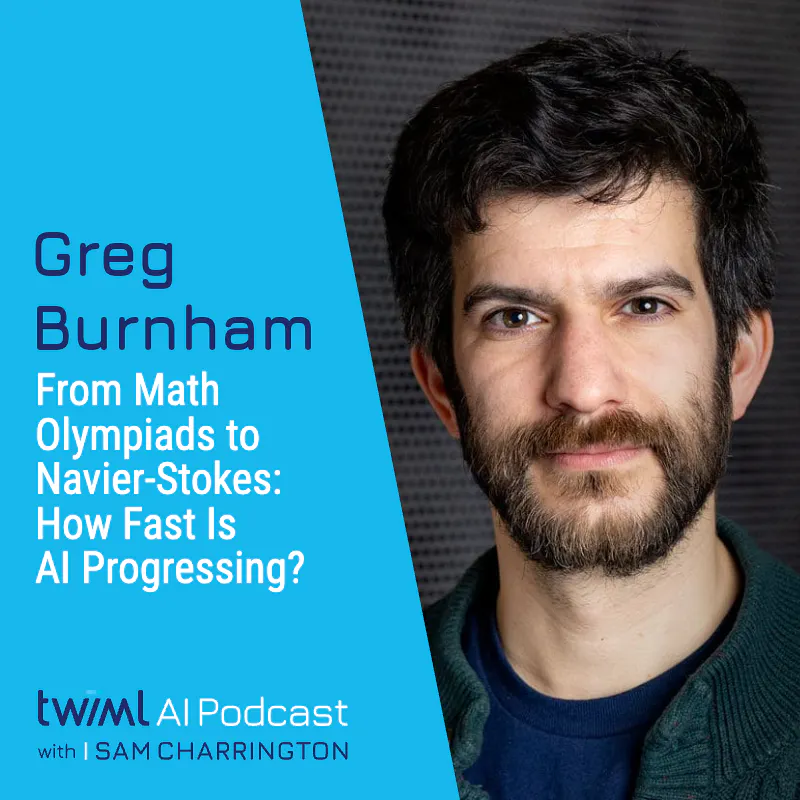
数学オリンピックからナビエ–ストークスまで:AIの進歩はどれほど速いのか(Greg Burnham氏)
The TWIML AI Podcast (formerly This Week in Machine Learning & Artificial Intelligence)
要約
Epoch AI のGreg Burnham氏が、AIの能力が小学校レベルの算数から未解決の数学問題の解決にまで急速に伸びた経緯と、その測り方を語る。ベンチマークを統合した指標では進歩がほぼ線形に続き、トレンドからの飛躍は見られないという。一方、真に新しいアイデアの創出、オープンエンドな業務、実行中の学習などはまだ弱いとし、研究の「目利き」力を監視する「トリップワイヤー」の考え方も紹介した。
この回のポイント
- ●Epoch AIは複数ベンチマークをつなぎ合わせた「Epoch Capabilities Index」で、モデル世代をまたいで進歩がほぼ線形に続いていると述べている。
- ●線形に見える理由として、各社が個別に訓練データを集める「浅い」説明と、汎化が深く効いている「深い」説明の二つを挙げ、実態は両者の混合だと見る。
- ●数学では、2024年秋の小学校算数の課題から、2025年のIMO金メダル、2026年のErdős問題やナビエ–ストークス問題の解決へと進んだと説明した。
- ●現在のAIの強みは膨大な先行研究の知識と驚異的な粘り強さで、ナビエ–ストークスの解決も人間の先行研究の構造に大きく依拠していたという見方を示した。
- ●新しい概念を生み出す理論構築型の創造性はまだ見られず、「人間にどれだけのヒントが必要だったか」といった事後評価で見極めようとしている。
- ●ボードゲームを繰り返し遊ばせる実験では、実行中に学習して上達する力は弱く、ハーネスの工夫でも頭打ちになるとした。
章立て
AI能力評価が重要になった理由
試験の時代から実務の時代へ移り、AIの得意不得意が現実に影響する段階に入ったため、高品質な評価が必要だと説明する。
ベンチマーク統合と線形の進歩
Epoch Capabilities Indexによる統合の方法と、進歩が滑らかな線形に見える理由の二つの仮説を議論する。
断絶の有無と自己改善の兆候
計算資源とデータに律速されるため不連続は起きにくいとしつつ、AI研究の「目利き」を測る実験をトリップワイヤーとして紹介する。
数学での急速な進歩の軌跡
GSM8Kから o1、IMO金メダル、FrontierMath、Erdős問題、ナビエ–ストークスまでの流れを振り返る。
AIは新しいアイデアを出せるのか
知識と粘り強さというAIの強み、人間の先行研究への依存、新概念創出の欠如、AlphaGoの37手目との対比を論じる。
未解決問題を使った新しい評価
人間が解けていない問題集で評価する方式と、検証方法、部分点の扱いの難しさを説明する。
仕事・実行中学習の評価
Epochの実務タスクや、ボードゲームを繰り返す実験を通じ、オープンエンドな作業と実行中の学習の弱さを示す。
能力の水準と変化率を追う意義
アライメントと能力の二軸、しきい値を越える瞬間の予測困難さ、家具組み立てなど物理領域の評価に触れて締める。
解説記事
AIの数学能力は、ここ2年ほどで小学校レベルの文章題から、数学者が長年取り組んできた未解決問題へと進んだ。TWIML AI Podcastの今回の回では、Epoch AIで能力研究を率いるGreg Burnham氏が、その進歩の速さと、進歩をどう測るべきかを語った。
試験の時代から実務の時代へ
Burnham氏はまず、2025年ごろまでのAI評価が司法試験や医学試験のように人間向けの試験に近かったと振り返る。いまはAIが人間の実際の仕事に影響し始める段階にあり、何が得意で何が苦手かを正確に把握する必要があるという。同氏が特に重視する問いは「AIは新しいアイデアを出せるのか」である。数学はそのための試験場として使っていると説明した。
滑らかな線形の進歩とその理由
Epoch AIは、世代ごとに飽和していくベンチマークを統計的につなぎ合わせた「Epoch Capabilities Index」を作っている。同氏によれば、この指標はモデル世代をまたいでほぼ線形に伸びており、推論モデルの登場でやや傾きが増した程度で、顕著なトレンド破断は見られないという。
なぜあらゆるベンチマークで同時に良くなるのかについて、同氏は二つの説明を挙げた。一つは、各社が必要な分野の訓練データを人手で集めて投入する「浅い」説明。もう一つは、モデルが深く汎化し、直接訓練していない分野にも力を発揮する「深い」説明である。真実は両者の混合だろうが、後者が強ければ能力の上限を見通しにくい超人的AIが現れうると述べた。
またEpochは、進歩のエンジンはGPUや学習データといった投入資源の拡大に大きく媒介されていると見ている。そのため供給網が急拡大しない限り、モデル側の不連続は起きにくい。ただしAIがアルゴリズム改善で自己改善を始めれば、この前提は崩れうる。そこで、直前世代のAIに最近の人間の研究成果を再発見させる実験を準備中で、現時点では再現できていないという。同氏はこれを、研究の「目利き」を監視するトリップワイヤーと呼んだ。
数学での急速な軌跡
同氏の整理では、2024年秋にはなお小学校レベルのGSM8Kが課題だった。その後、o1の登場で高校数学コンテストの成績が跳ね上がり、2025年にはIMOで金メダルを獲得した。Epochが作ったFrontierMathは学部上級から大学院生レベルの問題で、2026年初めにはその大半が解かれたという。
2026年には未解決問題への挑戦が始まった。5月には内部モデルがErdősの単位距離問題という大きな問題を解き、最近ではミレニアム懸賞問題の一つであるナビエ–ストークス問題の解決が話題になったと述べている。
AIの強みと限界:新しい概念は出せるか
数学者による分析では、AI生成の証明は人間が書いたものと同種で、内容は人間が称賛するに値するという。ただ同氏は、現在のAIの強みを「先行研究をほぼ暗記していること」と「極めて粘り強いこと」だと整理する。ナビエ–ストークスの解決にも数千のインスタンスの群れが使われ、ある種の力任せの要素があったと述べる。しかも人間の先行研究が築いた構造の上に成り立っており、ゼロから理論を組み上げる力はまだ見えないとした。
微積分の導関数のような新概念の創出は人間でも稀で、数学的作業の9割は計算や領域間の応用だと数学者から聞いたという。創造性の評価は難しいため、人間が苦戦した問題を設定したうえで、専門家が事後に検討する。Gowers氏は単位距離問題について、「反例を探せ」といった小さなヒントで人間にも解けたかを検討した。同氏はAlphaGoの37手目のような、専門家が見て新しいと分かる事例を数学でも待っていると語った。
評価手法の変化と、まだ弱い領域
Epochの新しいFrontierMathは人間が解けていない問題集で、最高段の「ブレイクスルー」はまだ解かれていない。答えを人間が知らないため自動検証の工夫が要るが、評価の位相転移ではあっても本質は変わらないと述べた。
一方、苦手な領域もある。Epochの業務を再現した課題では、文献要約は得意でも、スタイルガイドに沿った図の作成、短いデータ洞察の考案、新規プロジェクトの提案といったオープンエンドな作業は得意でないという。さらにボードゲームを繰り返し遊んでメモを取らせる実験では、上達は世代間の差としては現れるが、同一インスタンスの反復では伸びない。メモやスキル、マルチエージェントなどのハーネスも試したが、すぐ頭打ちになったと説明した。戦略ガイドを与えれば大きく向上するが、AI自身は作れないという。実行中の学習が可能になれば、データ収集と再訓練という遅いループより速く能力が伸びうる点が重要だと指摘した。
まとめ
今回の議論の核心は、進歩の速さそのものよりも、どう測り、何を警戒するかにある。能力は滑らかに伸びているが、しきい値を越える瞬間は予測しにくいため、日常的な能力の追跡が欠かせないというのが同氏の立場だ。日本の読者にとっては、AIが「人間が解けなかった問題」を解き始めた一方で、新概念の創出や実務での継続学習がなお課題だという整理が参考になる。ベンチマークの数字だけでなく、実務に近い評価や、自己改善の兆候を示すシグナルに注目する視点を持ちたい。
文字起こし(英語・自動生成)
AI's progress in mathematics has been remarkably fast. Not too long ago, Frontier Models struggled with grade school math. Now, they're contributing solutions to problems that have resisted mathematicians for decades, including, most recently, the Navier-Stokes equations. But as AI moves from tests we already know the answers to to more open-ended research challenges, it gets harder to understand what these systems are truly capable of and what their progress tells us about where AI is headed. My guest Greg Burnham leads capabilities research at Epoch AI, where he and his team are developing new ways to track AI's rapidly evolving strengths and limitations. Here's Greg on why measuring and understanding AI's capabilities matter so much right now. AI capabilities writ large have gotten to such a point where what they're good at and bad at is starting to have real impact on the world, like on things we care about for other reasons. We're past the academic exam phase of understanding AI capabilities.
And for that, we need high-quality benchmarking, high-quality evaluations. And one of my big questions is, just can AI come up with new ideas? If AI systems get sort of superhuman at this, that's a big deal for the world, both in terms of economic and scientific progress, but also in terms of it becomes harder to predict what AI systems are capable of. We use math as a test bed for this. I'm Sam Charrington, and this is the TwiML AI Podcast. For over a decade, I've been exploring the ideas and innovations shaping the future of AI through conversations like this one that help you understand what's real, what's next, and what matters. Let's jump in. Let's talk a little bit about AI capabilities research broadly, how you pursue that research and why you think it's important. We're getting to a point in the trajectory of AI overall where
AI capabilities can have a real impact on the world. So maybe the transition could be characterized as school to work in maybe even up through 2025. Most ways that we tested what AI could do looked more like human exams, like that you might give to kids or maybe advanced graduate students. I was going to say. Right, right. The kid exams, it is remarkable. The bar exams, the medical exams. And these, like, AI was perfectly good at these already, end of 2024, beginning of 2025. So we really saw this transition happening over time, to be clear. But this is certainly the year where AI capabilities are impacting work activities that humans were engaged in anyway for their own purposes.
And so as these capabilities grow, it's just important for us to keep tabs on them. They grow very rapidly in some qualitative sense. We see no measurement we have shows any slowdown in how AI is getting better and better at any tasks that we're able to measure. And so we think that just understanding the impact AI will have on the world, it's important to know what it can do, what it can't do, and keep tabs on how that trajectory is going. I want to push back on one thing you said in terms of we're not seeing any slowdowns that can be looked at broadly, like in terms of maybe the number of, you know, benchmark data points that we're looking at, you know, certainly we're seeing this broad performance. but is it also true that like on a particular I feel like on a particular benchmark we're getting like the you know for for expected reasons when we went from you know GPG-2 to GPG-3 like we're
taking these huge steps up these benchmarks and now like there's just a lot less room left and we're making more incremental progress do you see that as a slowdown in AI performance or is Would you characterize it differently? I would say, well, I'd say there's two issues here. One is on the benchmarks we have, what does performance look like? Two is, are there things our benchmarks don't measure that maybe there has been less or it could even be negative improvement on? And is there some reason why it's the things that are hard to measure where there's been the least progress? But on the first point, because this is a very, this is a much more cut and dried statistical point, we absolutely see continued progress on benchmarks. Like a benchmark that was challenging for GPT-3, you know, many years, whatever, six years ago, is now completely, you know, solved, aced by GPT-4.
Benchmark's challenging for GPT-4, same for GPT-5, now we've got GPT-6. So we do some statistical work to try to aggregate benchmarks over time because the benchmarks that people used to track progress years ago, now every AI model off the shelf that you've heard of that you might use is too good at them. So people make new benchmarks. And then you have to sort of do this like stitching of like, okay, well, a model that was pretty darn good at this benchmark was not so good at this next one. And you can use like that, you can stitch those together and get this sort of composite score. We call that we have a methodology for doing this, we call the epoch capabilities index. And that's a unified way of tracking benchmarks over time. And we really do see this thing continuing to go up, you know, pretty smoothly, linearly. And that march of progress is steady. That's an important point. That's truly if we have,
we've made more benchmarks and AI systems that are harder, that models start off at zero, and then within a year or two years, they're at 100% and we have to make a new benchmark to keep up. And that's really been the story of the last, certainly the last three years, I'll say with confidence there. It seems like that, like normalizing across different benchmarks to produce a result that is coherent, that sounds like a very challenging problem. Like you describe the result as like, you know, kind of continued linear improvement. And I imagine if that's like a constraint, you can kind of map backwards to, you know, to factors that will show you that continuous linear improvement. But, you know, starting from, you know, a set of disparate benchmarks that have their own kind of, you know, ranges and challenges and, you know, where AI sits in them and kind of mapping this across different generations of AI and coming up with, you know, something that makes sense, you know, objectively at the end.
And then having that thing show continued linear progress, that sounds like, you know, almost like too good to be true and like suspicious that it is true. Yeah, I agree. So let me go into that a little because I think it's a killer point to understand. And it is surprising. So I think you're very right to be surprised. In fact, if you look at AI benchmarks, they are all correlated with each other, even if the benchmark, the scores across models are correlated with each other, even if the benchmarks are in nominally different domains. So maybe you don't expect – you don't find this so surprising if it's like I've got one benchmark that's graduate chemistry questions and I've got another one that is coding puzzles. And the models that are good on chemistry are also good on software engineering. Maybe that's not super surprising. They should be correlated largely by the models themselves.
Like as the models get better, they're going to get better across these disparate benchmarks. But this – exactly. But that's the surprising point. So all that you need to be true to see this linear trend over time is basically every time, you know, Opus 4.5, Opus 4.6, 4.7, GPT 5.2, 5.4, every time these come out, if they get better on all benchmarks at once, then you're going to see this linear – this big over time linear trend. Like that's two sides of the same coin statistically. Why does this happen? Like this is a huge question. Like you're right to find that suspicious. And I would say there are two explanations that we see. And it's an important question which of these explanations is more true. And of course the truth is some mix, but let me give the two explanations. One is the AI companies are making darn sure that their model gets better at all of these benchmarks with each new generation of model.
And the main mechanism you might imagine them doing that if they're like looking around, okay, people care about chemistry, people care about software, people care about operating, but, you know, answering my email. Like they would collect training data, one form or another, that would help the model learn how to do these tasks. And that's something of a very manual, human-in-the-loop process of just saying, hey, we're doing product development. Like they want this feature, they want that feature, our users want all these features. And the way you do that in machine learning is you collect training data and throw it in. I'm oversimplifying, but that's that. sort of like a shallow way to make it happen. So I'll call that shallow. The other one is deep. The deep way to make it happen is if the model general, is if the AI system can generalize very, very well. So yeah, you never trained it on chemistry, but you trained it a lot on math and software engineering and it just got super smart. And with a modicum of chemistry basics,
it was able to derive the rest from first principles sort of thing. This is like a deep form of generalization. Both of these happen to some extent, like kind of the revolution with GPT, even GPT-3 around that era. This is like quite a while ago was, oh, if you train it to like predict the next word, then it actually gets better at a wide, wide range of language oriented tasks that people had been trying to handle individually. Suddenly it just got good at everything. And that wasn't because anyone was like, oh, let's have data specifically around sentiment analysis or syntactic structural analysis. Like, it wasn't anything like that. It was just give it this very general thing. But now we're onto this world where you have to, like, train it specifically. Right now, there's a huge industry of collecting all this rich training data. And it's really unclear how much generalization you're getting from, you know, in this deep way. And anyway, that's sort of a big question because that deep generalization means you could really see
If that happened in a rich way where you just didn't have to even be trained on something at all to gain capability in that area, then you might have a radically superhuman AI that would be pretty hard to understand, to bound its capabilities. it's still a little counterintuitive that this would be that this would be linear and maybe you know maybe part of the question is like are we talking about you know linear across generations of uh of model releases or linear within some regime like segment you know segmentally linear or the the thing i can say is we have like a statistical methodology So benchmark score, like what are we talking about here? Our unit here is a score from zero to 100%. And typically the way these scores go, just historically, empirically, is like they follow like an S-curve. Like they start out sort of bad, then they get better, they get better pretty rapidly,
and then you can only get up to 100%. So then they sort of level off, takes them a while to get that last, you know, little chunk, and then they're at 100%. So you've got these like sigmoids is what that S-curve is called. We just got a statistical methodology for stitching sigmoids together. And what comes out is a linear function. And this looks like this is an artifact of the statistics, to be clear. But this, sure enough, looks very regular in its own statistical analysis terms over across generations of models. Like, absolutely. Like it's been, if anything, it accelerated a little with the development of so-called reasoning models around late 2024, where the models started to get good at math and software engineering and things that require lots of logical reasoning. Maybe like it's a higher linear slope. But this is just like that's a statistical artifact. You now have to ask, okay, well, if your score is like one model, the score is 150 and the next model score is 152, like what do those two points mean on your benchmark aggregate index?
I think part of what I'm asking myself as I hear this described as linear is does it say that in spite of the model, the Frontier Lab vendor claims that, you know, Fable is like dramatically better than Opus or that GPT-6 is like the step function, you know, improvement over GPT-5.6, you know. So linear implies to me that it's kind of incremental and there's really been no step functions. This is a really great question. And, yeah, we believe this is one of the big uses of this Statsy tool we've got is you can try to find, you know, trend breaks and you can try to find accelerations. And we mostly don't see that. Yeah, like one way to put it, that is everything just about is on trend. Fable, Astra, whatever, is on trend.
But the trend is crazy. Like, you've got to hold both of these together. Right, right, right, right, right. This is sort of the Zoom Dev view Epoch takes with everything, is a lot of this, we think the engine of AI progress is heavily mediated by raw inputs, like GPUs, the training compute, like training data. Maybe those are the big ones. And then there's this like factor of the labs come up with algorithmic, like innovations, like research breakthroughs. But we really think like a lot of it is coming from the scale up in the compute and the scale up in the training data. So until you see the data and the GPU, The data and compute supply chain ramp significantly or discontinuously, to be more precise. You're not likely to see discontinuities on the model side. I think that's right. A big thing we're keeping our eye on, to be clear, is are there AI abilities emerging that could cause a discontinuity on the model side?
So this is why people talk about recursive self-improvement, or sometimes they call this a software-only intelligence explosion. And the point of these concepts is, well, sure, right now there's a comparatively slow process for building more GPUs and collecting more human training data and whatnot. But if an AI system got really good on the algorithmic innovation side, could it do more with less or do more with a fixed compute budget? And that could change the dynamics here. So the feedback loop might no longer run through the physical world. We don really it not clear we see evidence of this yet I say on balance we don really see evidence of this yet But it the sort of thing that has spooked the people inside the labs the AI companies I mean saying like gosh this could be right around the corner. That's like a bit of the fear. And if that happens, then the pace we're used to, we might get that discontinuity.
Have you developed a particular benchmark to identify and track this? Or is it more the way you look at the benchmarks that we've been talking about, the statistical model that we've been talking about for an indication that, you know, there's some kind of, you know, exponential in the curve. And that's, you know, probably one of the likely causes, you know, for that kind of exponential adjust continuity. All of the above. We want as many tools in our arsenal as we can for this. So that this statsy like acceleration detector is definitely a good is definitely a good tool. But we also sort of get, you know, down in the weeds with some of our specific evaluations and benchmarks saying, I'll give you an example. Here, this is some forthcoming work we have that I'm happy to to preview. We take a recent AI research breakthrough or innovation from humans and we
take AI systems. We don't connect them to the internet and we choose AI systems that were developed and released just before this recent, whatever the recent human innovation is. And we basically say, look, here's the metric that that innovation, the number that it makes go up, It improves this sort of efficiency, whatever, some metric. And we say, AI system, your goal is to improve this metric as much as you can. But we don't tell it the innovation. And so we see, is it capable of replicating that human innovation that was highly relevant for AI, you know, research and development? And so far, we don't see them able to do this. There's this nebulous idea called research taste, which is like, where's the good idea? Like, what experiment should I do next? Where should I go hunting for big improvements more than the mundane improvements of just more compute, more data? Like, where should I look for a breakthrough? And AI systems don't seem great at doing this, at least in an AI R&D context.
But they're, like, getting a lot better at a lot of things that are adjacent to this area. So we really do think this is an important, sometimes I almost call it a tripwire, that we're, you know, the future is foggy, some foggy landscape. We want to put a tripwire out there so that if AI ever does cross some threshold where it's able to do rapid improvements in AI algorithms themselves, then we want that tripwire to sound. So we go, okay, gosh, watch out, like maybe something, maybe we're about to see a big improvement, a big, you know, uptick in AI capabilities. And how does this relate to AI's performance on some of the math challenges? You know, certainly Navier Stokes has been in the news quite a bit recently. Prior to that, there were some ERDOS results and others. How do you think about the role that those math challenges play in this broader view of trying to understand AI's trajectory?
Yeah, very good question. If I may, I would rewind history just a bit here to say the trajectory we've been on, because once you step back, it's wild. So up until fall of 2024, so we're talking two years ago, grade school math was still a challenge for these LLM-based AI systems, the kind of AI we're talking about here. And the benchmark, there was literally a benchmark of 8,000, you know, word problems. so and so you know has so many apples that sell for this gsm 8k that's the one and gpt4 which is 2023 had like done pretty well on this so people started looking at so like adding into the mix a benchmark just called math like four capital letters uh that um started pulling from some
high school math competitions and there was like slow progress on this but but not a lot and then And at the end of fall of 2024, OpenAI comes out with the O1 preview model, full O1 by the end of 2024. And this showed a huge spike in math competition capabilities. But we're still just talking like medium, hard, high school math competitions, like something, you know, thousands of math, nerdy math, 16-year-olds were into across the U.S. And this became, you know, the new territory. My company, EPOC, around that time released a benchmark called Frontier Math. At the time, that's all we called it. We now call it tiers one through four to distinguish from later versions. I'll get to it in a bit. But the original Frontier Math consisted of problems that I would say go from advanced undergraduate to advanced grad student. So sort of early career research warmups almost.
These are problems that are no longer thousands of thousands of high schoolers would tackle them. These require deep background knowledge in in various areas that that, you know, niche areas like we're talking a problem from, you know, elliptic curves that you'd give to a grad student like shortly before they're going to embark on their novel thesis research. just to get them familiar with the details of the niche that they're going to be trying to work in and make an original contribution to. Over the same period, we also saw high, like so over 2025, we also saw high school math contests get completely aced. We got the gold medal on the International Math Olympiad. Even by the beginning of 2026, we saw most of these frontier math problems solved, though not all of them had in fact been solved by an AI system at that point. And so just like even just here, this is a very rapid trajectory from over the course
of just a little over a year going from, you know, like hobbyist high schooler to graduate student, like very competent kind of, you know, up there graduate student in terms of the problems they could solve. really rapid AI progress. At the same time, we started to see people test AI systems on unsolved math problems. Like the frontier was no longer something, this is what I mean, we'd gone from exam to on the job, where it wasn't like, here's your qualifying exam as a grad student anymore. It became more interesting to say, well, here's a small problem that maybe a mathematician, a professional, thought about for an hour, didn't solve AI systems, can you do it? And at that level, we started, this was all just this year, like 2026. At the beginning of the year, there were like starting to be claims of, oh, maybe here's a problem that was posed by a famous mathematician. This is maybe the Erdos problems. There's this, just for background, there's this
very prolific mathematician, Paul Erdos, who proposed over the course of his life, maybe or like well over a thousand, maybe a couple thousand problems. Other people still like haven't fully cataloged all the questions he asked. Some of those became central to whole fields of math. Some of them were, you know, no one really paid much attention to, including Erdos himself. And AI started to notch a few solutions to some of the easier ones of those. Fast forward to May of this year, and an internal model, probably something like the Astra model that we now have publicly available, was able to solve a big one of those. This was sort of a historic moment. The so-called unit distance problem, which was a problem about how many points you can fit in the plane that are just one, just unit distance of one apart from each other. It was sort of like very cool that you could frame it. It's such a simple problem. But there hadn't been progress, much progress on this problem, despite a lot of attempts since Erdos had posed it, you know, decades and decades before.
And it was a serious problem. It wasn't one of these no one had thought about it. It was definitely had received a lot of attention and an AI system solved it. And it was really this this was like a aha moment of, oh, my goodness, like, I can solve problems that humans have cared about just independently. And we've seen a lot more of that since. And, you know, with a sort of the recent wow moment being the solution of the Millennium Prize problem. This was, you know, the Navier Stokes problem. This was a collection of these Millennium Prize problems, a collection of seven problems that mathematicians sort of, or at least one math institute set as like good goals for the new century. Like they were, they were, they're much older than the year 2000, but they were sort of canonized in the year 2000 as, hey, like these are worthy targets of entire subfields of mathematics and it would be a big deal. And so one of them was solved. So it's been a hell of a ride. The historical context is super interesting. You know, we're all living through this trajectory, but to step back and see, you know, how much has happened in the past couple of years is pretty, pretty nuts.
Yeah, you have to, as one of my colleagues said, you have to like not get frog boiled by it. Like the temperature is rising and it's easy to, I don't know. Anyway, so there is this interesting gap so far. Like you might hear the phrase jagged frontier, where the AI capabilities are jagged in the sense that they'll be superhuman on some axis and not superhuman, still inferior in capability to human on some other axis. And that remains the case so far in math. In particular, there's a couple of things. In hindsight, the analysis by mathematicians of the solutions AI has found to these like big, important, previously unsolved math problems has, it's always, in first place, it's been nothing too super duper surprising. Maybe there was like a direction that humans had overlooked or could have invested more in and AI sort of had the persistence.
Maybe this is a good word or the bravery or the temerity to like wade into these very in-depth, intricate computations and calculations. And sure enough, came out the other side with a solution. And humans look back and are like, ah, that's not a crazy direction to try at all. And maybe if we'd like gone in that direction, we would have come up with this. This isn't something that like would be surprising. What I'm curious about is. Are we seeing the AI systems come up with a solution to the problem or an algorithm to create the solution to the problem? And I think I'm trying to, like, ask a lot of different things here. You know, one is, like, creativity. One is maybe levels of abstraction or the way it's, like, you know, thinking, abstracting, you know, around these problems.
You know, I'll kind of pause and let you react to that. Yeah, let me throw out a couple things there. Let me know if you want me to expand on any of them. So when humans solve these math problems, they write up the solutions in papers, proofs that this is true or this is not true. And those proofs are not usually – like not exactly algorithms. They're written in natural language. They have sort of – they leave the reader to fill in some of the gaps. And AI systems are coming up with just the same kind of thing. Like it's the same product. There's a lot of complaints about their writing style, but, like, the arguments, the substance of the arguments really are the thing we expect to see from humans, such that if a human came up with this, and, yeah, maybe cleaned it up a little, I don't know, like, would be lauded for having, like, made a very insightful connection between two different areas, or having gotten an intricate argument just right and balanced different considerations to make everything come together.
to land the proof. A hundred percent, like this is not a, this is something we're past the point where we can say, well, AI systems are sort of like not really doing something that humans would, you know, be impressed by on human terms. No, AI systems are doing things. And is there a way to categorize or qualitatively are we finding that, and I think you spoke to this a little bit, like, you know, is there a qualitative difference between, you know, the best human approach and the AI approach in a sense of, like, you know, AI brute forced it. You kind of spoke to this versus, like, pulled in things from some other domain and, like, created some elegant solution, or are we past that point as well? Here, I'd give more nuance. we there's an emerging sense of at least for the moment what an AI shaped problem looks like maybe I could say AI has two big advantages right now one is it knows everything like it knows all
the prior work it's got the literature memorized I'm speaking loosely but that this is this is basically valid. The other is it's extremely patient and persistent. So if there is some intricate, you know, calculation you have to do, I don't mean like numerically or algorithmically. When I say calculation, I just mean lots of equations and you have to make all the pieces work out just as a very high level conceptual logical kind of computation, but still something very intricate, they just have the patience to go for that. And if you take the Navier Stokes example, I think it's not a coincidence that OpenAI's reported system that solved it included a swarm of thousands of different instances of AI systems trying lots of different things and sharing ideas where clearly it was able to, like, there's an element of brute force there. so there's degrees of brute force this is where the nuance is it wasn't like somehow uh you know
you you asked it to like it wasn't solving this in by any means in the dumbest most low level way like we're past that point as well they used to solve some problems and like kind of surprisingly low level like grind it out kind of ways like that's not really what these look like anymore But like the high level, a higher level version of that still is maybe what you might say here. So and I like the frame of precise and intricate computations here. It's important. I'll say one more thing about the Navier-Stokes solution. It's important to recognize that humans sort of put in place a lot of the structure through previous work that AI then went. And as far as we can tell, I mean, humans are still figuring out exactly what goes into the AI solution. But as far as we can tell, it builds on a lot of prior human work. The AI didn't like build it up from the ground. That kind of theory building, as mathematicians call it, we still don't see that very much from AI systems.
Last point I'll make before pausing on this is just remember its point in time. Like remember that trajectory. We've seen very rapid. And so mathematicians who are saying we have to adapt our profession to the fact that now you can push a button and get what used to have been a career result like you know are also I think cautioning And we can expect the capabilities will freeze right now We see you know that linear whether it linear or exponential as a matter of perspective, but it's going up. And it's like, we see no reason to expect it to stop there. So this is a big thing EPOC is looking for. Can AI move from intricate computations plus lots of background knowledge to more of a developing new ideas more from whole cloth. And if so, and that's a big thing we're watching for in our own math benchmarking activities. It's interesting to think that, at least the way I characterize this as brute force versus
pulling in things from other domains, those are not mutually exclusive. Like for an AI that has access to all of the research from every domain, an approach that could be very fruitful is to brute force the exploration of adjacent domains and pull that into the solution to a given problem. That's it, I think, a lot of what we see. And maybe just to say the other thing that would really supercharge them and bring them closer to full human parity or even, you know, dominating human capabilities would be something like coming up with a new idea. And maybe like in calculus, the idea of the derivative or the integral of a function. Like that was something that was, you know, maybe mathematicians in the 1500s had been like grasping for this idea. And then Newton or Leibniz or whomever comes up with like, hey, here's like I can I can describe a new thing, a new mathematical concept.
And that unlocks a lot for us. That lets us solve problems we previously couldn't solve. And so that's the sort of thing we don't yet see AI doing. It's also the sort of thing that's rarer for humans to do. Like a lot of human math progress has been, well, I sat down and I put in the work and I did the computation and I worked out which was the dead end and which was the good path. And here's the answer. Now, X, Y, Z is true. I've proven it. Or I studied one area and I noticed something and I thought it might be applicable to this nominally superficially different area. Like humans do that sort of stuff all the time. That's 90 percent, vaguely speaking, of human mathematical work from what I hear from mathematicians. The new idea stuff is rarer, so maybe we should expect it to be not the first thing AI gets good at. But so far we don't see AI really doing that yet. How easy or difficult is it to define a new idea in such a way that we can easily distinguish them?
Like, you know, if we think about kind of the evolution of this discourse around, like, is it AI creative? You know, initially it was like, yeah, it's very creative. It created this, like, poem in Pirate. Like, that's creativity. That's, you know, that was a new idea. But that's certainly not what we're talking about when we're talking about, like, advancing science, advancing mathematics, et cetera. um you know so a how do we like how do we define that but also you know from your perspective as someone who's studying this is it like you know we've got this long line of folks that are coming that says here's this ai with a new idea and you're like yeah well let me evaluate it against my new idea criteria no it's not really that or are we actually like is it pretty clear to everyone that the AI is not having new ideas and like we're waiting for the first person to come and say that AI has the new idea. Like, how do you think about that whole space? Very, very challenging nut to
crack. So we, you know, try to approach it from different angles. One thing you can try to say is I've got a problem. I don't know if a new idea will be required to crack it. And this could be problem in math or in science or any quantitative area. But humans have tried to crack it. Humans have tried to make, you know, this number go up, whether that number is the efficacy of some, you know, drug at fighting some disease or something like that, or some, you know, or it's a math result of some conjecture that has stumped mathematicians for a long time. And you can say, okay, well, I don't know if, I'm not sure how I'm going to measure a new idea, but I can at least tell if this problem has been solved or this number has been made to go up or whatever the concrete metric is. And you can then at least check if that has happened. Now, I was probably a year ago more optimistic that there would be a tighter relationship between math problem that humans have failed to solve
and post hoc qualitative assessment of creativity. but uh but you know that this is so this is sort of the combination the like you know double punch we're trying here first you set a target that's hard on human terms that humans care about the humans have tried to be creative to solve and then you do post-hoc review with experts and say what do you make of the solution why hadn't you found it no offense uh you know what is in the AI solution that humans had missed and so on. And this is risky, like risky in terms of humans being honest about it because, you know, your ego might be wrapped up in it or you might, once you see the solution, it feels more obvious in hindsight. So would you have described it? Like very risky, but you still, you try your best. And, you know, you might say things like, well, how, like here's an interesting approach that we haven't operationalized in detail, but it's a nice heuristic, I think. How big a hint would a human have needed to solve this
in hindsight? So, for example, that unit distance, a very prominent mathematician, Fields Medalist Timothy Gowers, did this sort of exercise on this unit distance problem once AI had solved it, saying, how big a hint and how specific of a hint do I think a mathematician would have needed now in hindsight, like to solve this problem. One, yeah, and he came away with like an interesting exploration of, well, actually AI sort of disproved this conjecture as opposed to proving it true. It said actually it's false. Even that is a huge hint. Humans had mostly thought it was true. They were wrong, but they'd been trying to prove that it was true instead of looking for a counterexample. So even just the hint of try to find a counterexample is pretty big. And then there was like one more piece and he was like, I think, though, very hard to say, we can't really do the counterfactual experiment. I think with just that, with like this sort of two-part hint, it would have been possible for like a human would be like, oh, okay, I know what to do now, blah, blah, blah, and like probably would have at least hastened
a human solution. So you can do things like that, maybe, still very qualitative, but you try to be honest with yourself and be rigorous. You could imagine doing a more rigorous version of this experiment. And anyway, things like that. But then the fact is math is still, for the most part, a sort of discipline removed from physical real world impact. Not always, but its impact is often hard to predict. There are domains where impact is not at all hard to predict. I'm in the chemistry lab and I'm trying to improve the yield of my synthesis process. And if AI makes incremental improvements, I expect incremental yield. And if AI suddenly comes and says, no, no, no, you're doing it all wrong. Let me redesign your whole thing from scratch. I've got maybe a creative idea. Well, at some point, you don't care if it's creative or not in the qualitative sense. You just care that you saw discontinuity in the yield of your chemical substance or whatever. And that's a bigger impact for the world anyway.
What I took from that is that we filter on the problem and how hard humans have kind of banged their heads against the problem. Then we look at the results that AI has come up with and try to kind of subjectively say, you know, is this based on a new idea or is it more brute force or something else? But it's kind of imperfect and messy and like we're not really sure, but we don't think that we've come up with great examples of AIs coming up with, you know, quote unquote new ideas. That's exactly right. One reference point I'd give is way back in, gosh, well, the teens, I forget which year, the famous Go playing system, the game of Go. AlphaGo. I had that thought earlier as we were discussing this. Like, if I remember correctly, the, you know, part of the solution was like,
oh, that was an innovative move that no human ever would have done. There was a specific one, yeah. It was a very specific move in there, yeah. Yeah, they call it move 37 because it was the 37th move in this game where, yeah, apparently this was a very surprising move. Like you said, no human would have done it in this particular position in this game of Go. And I think it's like encouraging for our admittedly quite subjective program here that Go experts looked at it and were like, oh, my goodness, like that's not, you know, that's new. And then it also became clear that that was pivotal, that that move gave the AI system playing Go a decisive advantage. And so that's sort of what we're looking for in math. And at least, you know, maybe we have some hope that humans will be able to spot it when it happens. But yeah, that's what we haven't seen quite yet. And again, the trajectory is fast.
Things are always a little more qualitative than, you know, than they are or continuous than discrete. But, you know, so anyway, this is where we are now, which is kind of wild in its own right. Earlier when we were talking about frontier math, you kind of characterized it as, you know, one to four, I think, and then advanced, and we never circled back to your more recent work. Yeah, we've got a couple – two new sets of frontier math problems. We ditched the tier system, whatever. Okay. So now these are – I'll lump them together because it really is the – this is our main tool. So we have, you know, our latest iteration on frontier math consists of a bunch of problems that humans have tried and failed to solve. They're curated to be of a special interest to mathematicians where, and some of them we've characterized even on a bit of a scale from, like, this would be moderately interesting, or this would be, like, maybe what that means is two teams of mathematicians have tried this problem.
It's at least 10 years old, but it's not central to any research program. It's just something that people would be happy to get an answer to, all the way up to like a major breakthrough. Four tiers here. Breakthrough is the highest. None of the breakthroughs have been solved yet, but don't get me wrong. If Navier Stokes had been in this problem set, it would surely be a breakthrough there, regardless of the fact that humans had done a lot of work and gotten maybe within spitting distance of the solution before AI finished it off. But, yeah, we really view this as just a way of finding AI, a way of finding cases where AI might have had a creative idea, because we can tell easily whether it solved these problems. This is maybe the big piece of work on our side, was to make it easy to verify automatically whether an AI system has solved this problem. It's not obvious when you think about it that no human knows the answer. So how do you tell without a human looking if AI has found the answer? But there's a couple techniques you can use for this, and we employ different techniques for this.
It can go into that, but it's something of a technical detail. And so when a new model comes out, Astra came out, we hit go, and it's like, oh, it solved three new problems from our list. Okay, let's go look at the solutions. Let's share them with mathematicians. Let's see what's going on here. And then we analyzed that with the help of mathematicians, analyzed that for like what kind of qualitatively, what kind of solution was this? What does it mean when the models are so good that we have to shift from, you know, these benchmarks that we understand to like this collects these collections of problems that we just don't have the answers to? It's definitely a phase transition in the science of AI capabilities measurement, which is what I work on. But it doesn't change the game all that much. It just means we have to look for harder problems. I think I joke sometimes that even certain forms of optimization problems, like allocating scarce resources efficiently, that's a benchmark of sorts that will survive the singularity.
Like even if AI is like off going crazy, running rampant in the galaxy, it'll still have to, you know, it'll still have to decide how to, you know, optimize. So optimization is always going to be a benchmark, even if we're superhuman. Basically, it used to just be we knew the answers ahead of time. Now we don't. So it takes this extra trick of, OK, how do we tell when AI has gotten something right? But this isn't insurmountable, especially like I was saying with, you know, numbers in a scientific context. It's intuitive that, okay, the best humans were able to do was, you know, X, but we just say to AI, hey, try to do Y greater than X. And, you know, if it does, that's, you know, those numbers go on and on. So it's no problem. But, yeah, you're right to sort of note the phase shift and to be somewhat surprised by it. Yeah. And is there a methodology, a concrete methodology for assessing and awarding partial credit? Is that part of the way you think about benchmarks in this post-phase shift?
Yeah, it's a good question. It depends on the benchmarks. Sometimes it's something like, well, you just want to make this number go up, and the higher the better. So partial credit is very continuous and very natural in those cases. For math problems, sometimes it's just like, well, what we care about is if X, does Y always hold? Like, is this always true? And then it's kind of, sometimes humans will find and publish partial results for the AI systems. We usually just say, you know, all or nothing, but we have a large enough collection of such conjectures that, you know, we hope to have some, you know, smooth gradient of, well, okay, this one got two more out of 100 or something. And so it looks like a pretty smooth signal. That's typically how we approach these things. Yeah, across benchmarks. Yeah, maybe what I was thinking was, you know, once you're in the regime of very challenging unsolved problems, is it possible that AI systems are doing, you know, surprising or novel or creative things, but still not quite getting them to the full, you know, the full solution?
And do we care about that? Do we want to track that? And is that part of the way you've constructed the benchmark? It's a great question. And it's not central to how we construct the benchmark. It's probably like it's certainly worth tracking. The problem is it's just labor intensive. Like you can have AI review the AI. We do this occasionally. Say like, which problems did it make partial progress on? What if we let it think for longer on those problems? And nothing yet. Like it doesn't seem good at understanding how close it is to a solution. Humans aren't necessarily very good at this either. I did want to mention that while we focused on maybe the area where AI is the very best, like has come the farthest, the fastest math, we do see lots of areas where we also think it's important to measure AI capabilities, where the progress is somewhat fuzzier, less clear, and certainly less superhuman, or even in some – well, maybe. Maybe. Still superhuman in some ways, but the ways in which it's not yet are maybe more obvious and feel less rarefied.
What are some examples? A couple examples One area that forthcoming work we excited about is just it a question everyone must be wondering can AI take my job So our job at EPOC often involves many things and all sorts of research, not just AI benchmarking, but other topics about trends in AI and writing research reports and doing data analysis, making infographics that are, you know, make a point in an easy to digest way. We've been collecting examples of these from within Epoch, where the judgment at the end of did the AI system manage to do this, you know, Epoch task is too messy for traditional benchmarking. So it wouldn't be obvious, like, how to say, did it get the right answer or not? It's not about making a number go up. It's not about satisfying some logical chain of deductions, it's like, here's the infographic to go along with this report. Like, does it meet
our style guide? And does it look good? And does it, you know, is it better or worse than the human reference that we, you know, one of my colleagues did? And here we see like an interesting mix of some things, I think we sort of all our experiences like, yeah, if you ask it for a summary of the literature, it's going to do a pretty good job. It's like very good at that. But there's other tasks where it's, you know, hard, like creating compelling visuals that follow our style guide, or this is a good one, coming up with a new, like, short form data driven insight. We call these data insights, you can find them on our website. And these, like, often we try to boil down a single like important observation into a single chart and a single sentence. And this is like, this is hard, but we don't see them doing a great job at this. Come up with a new project for EPOC to undertake and do a prototype.
Very open-ended. Not so good at this. Like these more open-ended tasks, we do see, again, my guess is if we will do this, go back in time some and see, have models gotten better at this? My guess is we'll see progress. But the level compared to like humans is still a little, still a little meh. I want to give one other example, which is learning on the fly. This is a case where, this is another case relevant for can AI take my job? Because you didn't start, you weren't great at your job on day one. But as you practiced, you know, you got better and humans, you know, have this sort of, you know, they learn on the fly. We take a, we like to measure this for AI. We have a benchmark that's taking a complicated board game. We did a human study for saying how many times do humans have to play this board game in a row before they sort of figure out how it works and can get a very high score on it. We do the same with AI. We say play it once, take notes, same AI instance, like play it again, take notes,
play it again, take notes, and see how you can do. AI systems have gotten good at this board game, but not by playing it repeatedly. It's more of an intergenerational thing, like GPT 5.6 scores X out of the box and then stays flat on its playthroughs. GPT 6 scores much higher. It's like much better at it, but it's still out of the box, and then it stays flat in its playthroughs, and it's still less than the top human. So this kind of on-the-fly learning is something we also don't see AI systems as being good enough at, even to just pick up a board game, let alone a messier job, a real-world job like that. So these are sorts of things where we don't see these capabilities, and we think it's important to try to catch when they emerge. My gut on the ladder, the AI learning on the fly, is that it's maybe a harness-solvable challenge versus a model-solvable challenge, and maybe, you know, no one's focused on that. Like, with the right set of memory structures and, like, some kind of sidecar heuristic-y thing,
like, you know, we can probably make a big step improvement in AI's ability to, like, you know, improve game to game, but it's not, it might not require dramatic model changes. Do you think about that? And do you have, you know, in this domain or in other domains, like, formal or structured ways of thinking about, you know, what, you know, model versus harness, you know, granted this whole model versus harness thing in and of itself is, you know, practically brand new, but it's proving to be important in, you know, distinguishing, you know, where these improvements come from. Yeah, definitely. We've done some experiments on this for the board game case in particular, where we've tried a very simple harness first the first party harnesses like Claude Code or Codex we've tried
multi-agent setups we've tried like we we give them a you know note-taking tools and say you know make it clear like okay your your goal is to learn the game so you can do really well like in your final plays of the game so explore take notes figure out like we try to prompt them well I mean we want to find good results if we can, because it's like, that's a big deal for the world. The game is a test bed, but real jobs would also, you know, benefit significantly. Risks would also go up if this capability, you know, you test in the lab, is it a great hacker? You find maybe it is, maybe it isn't, but you find that it isn't, and yet it can learn on the fly, then okay, once you deploy it, like, look out. So anyway, we've tried pretty hard and have mostly not found anything that cracks this, that cracks this on the fly learning. There's been some general research about this as well, not just us, about, you know, people taught, like there was, people still use these so-called skills where you like just write some notes to an AI system of, look, when you do work I ask you to do, you're going
to need to use this tool or produce this kind of output. And like, here's my notes on how you could do that well, so you don't have to like learn it on the, like pick it up fresh every time. or use these skills. And these show some improvement, but then there's like a plateau, like pretty quickly, at least in the research I'm familiar with, of like, you can get some improvements. My sense is, this is very loosely speaking, it's like low hanging fruit. Like if you're telling it, oh, you're gonna have to navigate this like finicky website that my company makes me use. And like, just, you're gonna get stuck. And like, you have to look in this menu and that's where the button you're looking. But like straightforward advice that's like obviously useful. But when it comes to higher level strategic thinking, kind of hard to bake that into the harness where or like where the board game plays like has this, you know, sort of brings this out where it's like there's not any perfect advice that like you have to find the advice for yourself in a sense.
Like you have to learn the game. Like, so I will say if we give it extremely detailed strategy guides for here's how you beat this game. Like here's everything you could possibly want. Like it's a cheat by human state. Like no one would play the game that way. They do very well. They do much better than if they basically have to find that for themselves. The question is, do they, right, creating the strategy guide. They can't create the strategy guide for themselves, which is like pretty interesting. So, like, we do expect eventually they'll get better at this. But it's, again, it's a big deal. if that happens, because now it means, okay, go back to that first benchmark suite. Okay, they're not great at making charts for us or coming up with data insights for us, you know, without guidance, but now put them in on the team for a little while and let them learn on the fly, and maybe they do become good. So you sort of see these as a combination. Like if on our board game where it's easy to measure, they're not getting better over time, then it's okay for us over in the real world, like human in the loop evaluation studies for us to just do one try and say,
okay, well, they weren't great and we don't think they learn on the, so that, you know, but really, you know, those go together. And is the board game a synthetic one that you created for this challenge or is it a real board game that people play? It's a real board game. It's called, or the first one we did this with, we'll do this with more, is called Earthborn Rangers. It's fairly obscure. If you go to, like, boardgamegeek.com, it's, like, 500th most popular or something. So it's not, like, up there. It's a small devoted community to it. And AI systems don't seem to know that much about it. Like, they've heard of it. They can give you some facts about it. But it doesn't seem like something they've been trained on specifically. It's impossible for us to tell this with high confidence, but that's sort of why we chose it. it's just hard to make these things from scratch and know whether they're hard or whether they're broken. You know, so that's why we, but the risk, which you might have in mind is what if AI systems like, you know, just know about it from their training data. It's a risk on our mind. It's just
a risk. One thing we will do in the future is we're moving on to video games. Incidentally, it's another area where AI is like very much not like human reaction time and visual and spatial reasoning again coming along fast but not uh not really there yet um that so video games you can always test on a new game like a game that just came out uh not in the training data probably um or at least you know not as robustly in the training data uh and so we'll be testing can ai systems do well on those do they do better on like you know the older version of a video game than like, you know, Grand Theft Auto 4 verse 5 or whatever, like when GTA 6, whatever it is, comes out. Like, I don't think we'll be doing this one, but, you know, are they worse at that? It's interesting when you bring up video games, it immediately calls to mind kind of the classical reinforcement learning approaches, which is kind of learning on the fly, but kind of different. Yeah, we call the second sometimes in-context learning,
where the only, like, lever the AI system really has is managing its context. And, like, look, when we give it the strategy guides and they do much better, clearly this is a powerful lever, but it's not as powerful as updating the weights. And, like, so, yeah, I mean, like, what's the big picture here? If you have this fast loop of in-context on-the-fly learning, then AI capabilities might sort of improve much more rapidly than the slower loop of collecting more training data, doing more reinforcement learning, which is done on language models as well these days, and then deploying a new model. Now, AI might automate that whole loop, but it'll still be slower than if it can just, you know, work out its own context on the fly. Yeah, it's interesting when you zoom out on some of the questions that you focus on, and we haven't talked explicitly about it, but you have a blog post where you kind of write out these nine big hairy questions that you're tracking,
they kind of group into, like, how do I assess where AI is now? That's like, can it do my job? Like, how is it, you know, competitively? And, you know, where is the puck going? Like, can it learn on the fly? You know, can it do research? Can it come up with new ideas? These are all, it is kind of where it is now, but also like what, you know, Is it positioned to like dramatically self-improve or like, you know, what's the trajectory? That's exactly right. The, I mean, I think for people thinking more broadly about what they need to know about AI, this is, the second topic is, you know, just as important as the first. But it's really, you know, even if you take some of the recent incidents, like the hugging face incident, like, just sort of think of two axes. Alignment of, is the AI doing what I want it to do holistically?
Obviously, hacking into some other companies' computers is not well aligned. And then capabilities, just like, what can it get done? Can it hack into, you know, reasonably well-secured other companies' computers? And what that incident was, was like an early example, very like, I think pretty robust example of, well, we don't have the alignment thing solved and capabilities are getting so big, so strong that this is becoming a problem. And so paying attention to capabilities, like what we should expect is becoming more important sort of day to day. And we're just trying to produce benchmarks that both say, where are we now? Exactly like you said, like, what can it do now? This is maybe relevant for more mundane economic utility or whatever, as well as, you know, do we see the dynamics of the system changing in a way that might be alarming, basically. Kind of also thinking about it as like first and second derivative of capability.
Yeah, I think that's right. Some of these things make it the slope goes, you know, much faster, hyperbolic growth or whatever in some of these cases versus merely just like, yep, it's growing and it continues to grow. Both are important. I mean, I think we've seen the disruption we've seen to date has come from these kind of unpredictable thresholds. Like when, you know, GPT-2, GPT-3, suddenly you have the chat GPT moment and you're like, oh, this thing, I want to talk to this thing. I might use this thing instead of a search engine. This thing is useful to me for finding information. And then like a little while years later, whatever, two years later, you had the – it's getting better slowly and steadily at helping me with coding or with like using my computer. But suddenly you have – And thinking models. With the thinking models. And then you had the Claude code moment where it was like, oh, suddenly this thing can actually do software projects for me even if I'm not a very – not an engineer myself. And it's like hard to predict when these thresholds will be crossed.
So it's useful to still track, but like it's useful to track the mundane capabilities today and say, look, you know, cyber is maybe the latest example where it's like, look, we see their ability in controlled settings to do hacking going up smoothly. And at some point it's going to cross some threshold where, oh, shoot, it can hack hugging face or whatever. Hard to predict where those thresholds are, but still very useful to track those capabilities. So even the first derivative, as you said, version of this, we find very useful. We've got a fun benchmark we hope to release. Maybe by the time this is published, we'll have it out on a furniture assembly where we build some IKEA furniture, make some mistakes and see if the AI system can just give them photos, like say, oh, wait, you made a mistake and step back in step four. Like, stop, go back. And we see the same smooth capabilities like Astra, GPG-6 Astra, pretty good at this, actually. and you know but it wasn't out of nowhere it was like from a smooth and this is you know important
because we haven't seen AI have much of an impact in physical industry yet like it's been mostly digital and even before robotics hit the scene hits the scene we might expect that you know clawed in your glasses or something is saying like hey you know I'm going to guide you through repairing your car or whatever I'm going to help you fix this machine in the factory that broke so So, you know, we want to track those capabilities, too, just for the mundane impact. Anyway, impact all over the place is coming. Benchmarks, help us say so. Awesome. Awesome. Well, Greg, thanks so much for jumping on and sharing a bit about what you're working on. It's super interesting stuff and a very thought-provoking way of thinking about, you know, AI and where it is, where it's going. Thanks, Sam. Really appreciate it. Awesome. Thank you. Thank you.
番組の概要欄(原文)
AI systems have gone from struggling with grade-school math to helping solve research problems that have resisted mathematicians for decades, including Navier-Stokes. In this episode, Greg Burnham, who leads AI capabilities research at Epoch AI, joins us to examine what that progress says about where AI is going. We look at how these systems are solving hard math problems, how much they rely on persistence and prior human work, and whether they are starting to produce genuinely new ideas. We also discuss how to measure progress as traditional benchmarks become less useful, why capability gains appear surprisingly steady across model generations, and where models still struggle with open-ended work, learning from experience, and identifying promising new research directions. 🗒️ Full show notes: https://twimlai.com/go/778.
出典・この記事について
- 番組
- The TWIML AI Podcast (formerly This Week in Machine Learning & Artificial Intelligence)(Sam Charrington)
- 元の回
- From Math Olympiads to Navier-Stokes: How Fast Is AI Progressing? with Greg Burnham - #778
- 配信日
- 要約作成日
- 公式サイト
- twimlai.com
この要約・解説記事は、元の音声を文字起こしした内容をもとに AI(Claude)が日本語で作成したものです。 固有名詞や数値に誤りを含む場合があるため、正確な内容は元の音声でご確認ください。制作方法について
関連エピソード

「暴走するAI」を恐れるな:Eryk Salvaggioが語る終末論ナラティブの正体
Tech Won't Save Us

100言語を話すAIをどう活用するか:DeepL音声部門責任者 Leo Doin 氏に聞く
VUX World

NvidiaはJensen Huangを手放せない――復帰の裏側とAnthropic上場後の波乱
AI Inside

AI利用が増えるほど利益率が下がる?トークノミクスと価値証明の難しさ
Agentic Conversations (formally mlops.community)

Gemini 4 Neon が25タスクのベンチマークで GPT-6.2 と Claude を抑えて首位に
How I AI

AIは開発者の就職市場に何をもたらすか:エージェント型コーディング時代のスキルと採用
The Data Exchange with Ben Lorica