
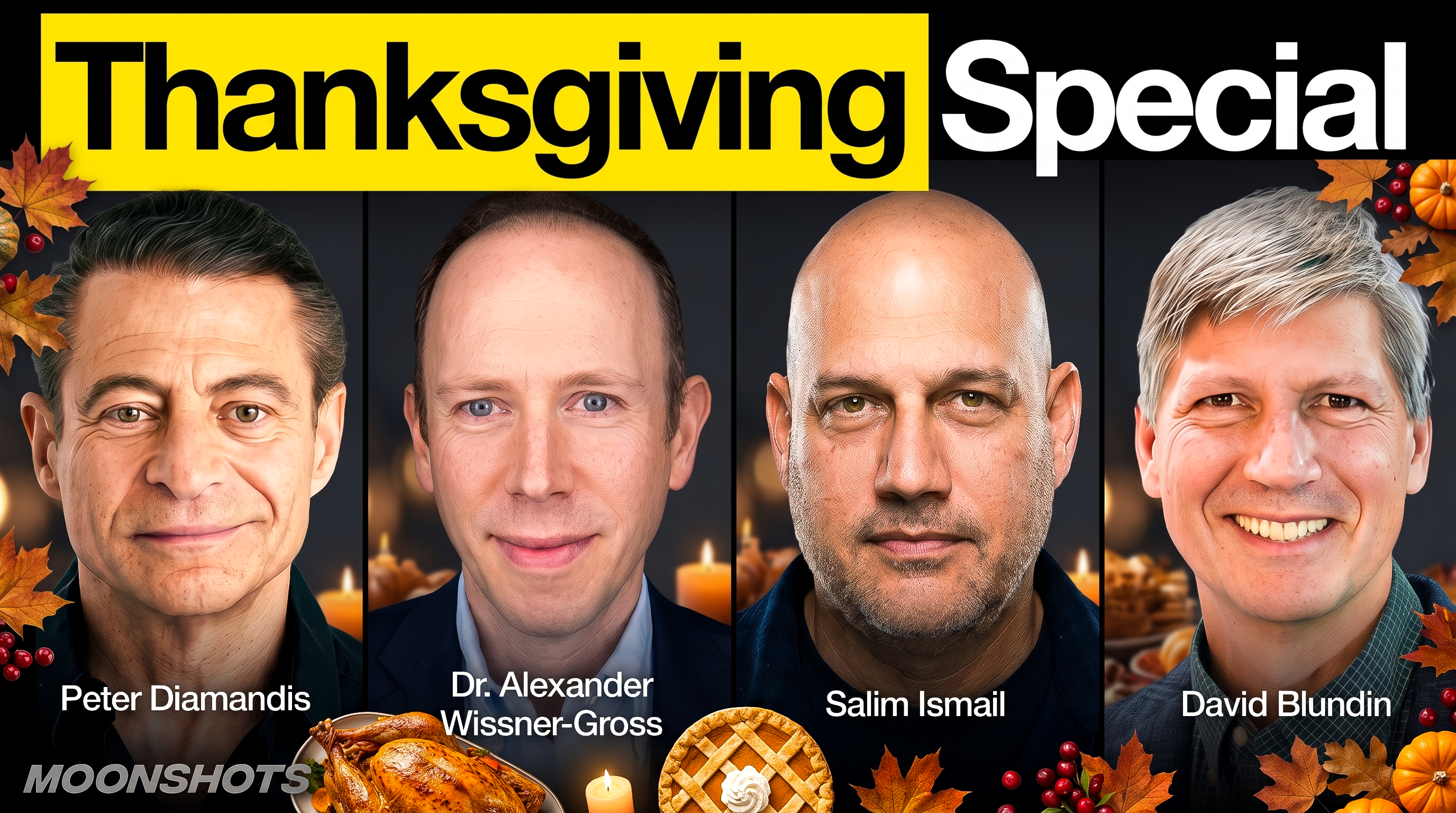
感謝祭スペシャル:人生を終わらせかけた瞬間と、それでも感謝する理由(EP #316)
Thanksgiving Special: The Moments That Almost Ended Us (And Why We’re Grateful) | EP #316
感謝祭スペシャル:人生を終わらせかけた瞬間と、それでも感謝する理由(EP #316)
Moonshots with Peter Diamandis
要約
感謝祭にあわせ、Peter Diamandis、Salim Ismail、Dave Blundin、Alex Wissner-Gross の4人が、人生を形作った挫折や拒絶、恩人への感謝を語った回。胎児ブタ盗難事件、Amazon との商談遅延、XPRIZE の資金調達で150回断られた経験などが紹介される。最後は、シンギュラリティを目前にした時代に生きる感謝で締めくくられた。
この回のポイント
- ●Peter は大学時代、胎児ブタを研究室から持ち出して窮地に陥ったが、教授の許しで退学を免れ、後の人生が開けたと語った。
- ●Dave は10年続けた会社で、Amazon との商談が訴訟の影響で止まり、CEO解任寸前になった。直前に和解して億ドル規模のエグジットに至り、その経験が粘り強さと謙虚さを育てたと述べている。
- ●Alex は高校時代に MIT の夏季プログラムに落ちたことでナノテク研究に進み、物理とデジタルの境界領域に強い現在の関心につながったと振り返った。
- ●Peter は XPRIZE の賞金スポンサーを探して約150回断られた末、Anousheh Ansari 氏との出会いで Ansari XPRIZE が実現した。
- ●逆境が成功に結びつくという話題では、Dave が移民出身のテックCEOの比率や、Google の社員調査(早期の逆境を乗り越えた経験が成功の指標だったという内容)に言及した。
- ●締めくくりでは、シンギュラリティを体験できる時代に生きることへの感謝と、周囲に変化を伝える難しさが語られた。
章立て
導入と6つの質問
感謝祭の特別回として、人生を形作った出来事を語る趣旨と、Peter が用意した6つの質問が紹介される。
祖父への感謝と胎児ブタ事件
Salim は祖父への感謝を述べ、Peter は大学時代に胎児ブタを盗み、教授に許された顛末を語る。
病気の克服と Amazon 商談の危機
Alex は今後の疾病克服への期待を語り、Dave は Amazon との商談が止まって解任寸前になった経験を話す。
PubSub の失敗から Singularity University へ
Salim はスタートアップ崩壊後の予想外の縁がつながり、Singularity University の設立に関わった経緯を語る。
Dave の変化と Alex の復活構想
Dave は MIT で自己認識が変わった経験を、Alex は過去の全生命を復活させるという構想を語る。
Peter の医学部時代と移民・逆境の話
Peter は医学部在学中の起業と学部長との取引を語り、Salim と Dave は移民や逆境が成功に与える影響を論じる。
Alex の拒絶体験と母への感謝
Alex は MIT プログラムに落ちてナノテクへ進んだ経緯を、Dave は母の出資への感謝を語る。
XPRIZE の150回の拒絶と締めくくり
Peter は XPRIZE のスポンサー探しの苦闘を語り、4人はシンギュラリティの時代に生きる感謝で締める。
解説記事
感謝祭にあわせた Moonshots の特別回では、Peter Diamandis、Salim Ismail、Dave Blundin、Alex Wissner-Gross の4人が、人生を形作った挫折・拒絶・恩人への感謝を語った。Peter が用意した6つの質問を順に選んで答える形式で、AI や技術の最新ニュースではなく、個人の物語が中心となっている。
「終わりだ」と思った瞬間が転機になる
複数の話に共通するのは、当時は破滅的に思えた出来事が、後から見ると転機だったという構図だ。Peter は大学時代、病気で欠席した実習を補うため胎児ブタを持ち出して問題になり、父の助言で自首した。教授から「教訓は学んだか」と問われ許されたことを、退学を免れた分岐点として語っている。後年の医学部では、会社運営で授業を欠席しがちだったため学部長に呼ばれ、「医師として開業しないこと」と医師国家試験の第2部に合格することを条件に卒業を認められたという。
Dave は、10年続けた会社の最大顧客だった Walmart 経由で Amazon との提携話が出たものの、Walmart の訴訟の影響で話が止まり、取締役会から CEO 交代を示唆された経験を話した。解任寸前に訴訟が和解し、Amazon を参照顧客として約1年半後に10億ドル規模の流動化イベントに至ったという。彼はこの経験がやり抜く力と謙虚さを与え、他の創業者の苦労への理解も深めたと述べている。
拒絶が方向を決める
Alex は高校時代、MIT の夏季研究プログラムに不採用となった。当時は AI 冬の時代で、AI 研究が不人気だったこともあり、代わりにナノテク研究に進んだ。結果として Intel Science Talent Search の受賞者となり、大学・大学院でも物理寄りの研究を続けた。この遠回りが、物理世界とデジタル世界の境界領域に強い今の関心を作ったと分析している。
Peter の XPRIZE も同様だ。1996年に1,000万ドルの民間宇宙飛行賞を発表したが、スポンサー探しで約150回断られ、約4年半を費やした。最終的に雑誌記事で、サブオービタル飛行を目標に挙げていた Anousheh Ansari 氏を知って出会い、Ansari XPRIZE として実現した。彼女は現在 XPRIZE の CEO を務めている。Salim も、PubSub の失敗後に偶然の縁が重なり、NASA 経由で Singularity University の設立に関わるようになったと語った。
恩人への感謝と逆境のデータ
恩人の話も多い。Salim は、インドからカナダへの移住を決めた父の先見性と、「世界を文明化したのではなく物質化しただけだ」という父の言葉を紹介した。Dave は、起業時に少額の元手を出してくれた母に感謝を述べた。
逆境が成功を促すという話題では、Dave が AI に調べさせたとして、時価総額ベースのテック CEO の約60%が外国生まれだという数字を挙げた。また Salim は、Google が過去の社員を調べた結果、早期の深刻な逆境を乗り越えたかどうかが成功の目安だったという話を紹介している。ただしこれらは出演者が口頭で紹介した内容で、出典の詳細は番組内では示されていない。一方で、15歳の子を持つ親として、子どもに逆境をどう与えるかという悩みも率直に語られた。
未来への感謝
未来については、Alex が今後1〜2年で主要な疾患に対する大規模な in silico(計算機上)の治療法が見つかるとの見通しを示し、1日に約15万人が亡くなる状況を止められるかもしれないことに感謝した。さらに、過去に生きたすべての生命を計算考古学などで復活させるという構想も語っている。
締めくくりでは、Alex が過去に生きた全人類のうち約7%が今生きていると推定されるとして、シンギュラリティを経験できる時代に生まれたことへの感謝を述べた。Salim は、感謝祭の食卓で変化の大きさを意識できる人は少数だろうと語った。Peter は、悲観的な物語ではなく、自分たちが築く未来に目を向けようと呼びかけている。
まとめ
本回は技術解説ではないが、起業家や研究者が長期の挑戦で挫折とどう向き合うかを知る材料になる。キャリアの失敗を後から意味づけ直す視点や、運と縁を自覚して感謝する姿勢は、変化の激しい AI 時代に働く日本の読者にも示唆がある。ただし、疾病克服の時期や統計は出演者の見方・口頭の紹介であり、そのまま事実として受け取らず、慎重に確認したい。
文字起こし(英語・自動生成)
This is an episode we wanted to make special to share with all of you, the moments in our lives that shaped us. My grandfather, now I would love to go back and thank him because he planted the seeds in me to be totally crazy and live and play full head. So, immense gratitude now. Every time I see the kids, I appreciate how insanely lucky I have been. I'm super grateful for this podcast. I'm really blessed to have you guys. That is so much fun. I totally agree. And I cannot believe how much we learned. I literally stole a fetal pig out of the lab. As one does. Wiped it off the bench into my book bag to take it home for that weekend to go and study it. I cannot wait to see the outro video that comes out of that screen. We're parents of 15-year-olds. Do we create adversity for them? I think we're missing the obvious solution here. You need to subject them to religious persecution in 17th century England, causing them to want to flee to the New World to be pilgrims so that they have a holiday named after their terrible experience.
Now that's the moonshot, ladies and gentlemen. This episode is brought to you by the Abundant Summit and Link Ventures. All right, everybody, welcome to a special episode on Thanksgiving Day of Moonshots. I'm here with my incredible mates, AWG, DB2, Salim, and myself. And this is an episode we wanted to make special to share with all of you the moments in our lives that shaped us, that challenged us, that enabled us to see the world in a different way. I've got six questions here that I've written, and each of us will pick two, and we'll go around twice to answer these questions. First one, what is an event that deeply shaped your life, a moment in time, when you had an extreme challenge that in that moment felt devastating, but now in retrospect that moment was a gift? Second, who is someone who believed in you before you earned it?
And what would you say to them today if they were sitting here? Three, what's something you have now that 20-year-old self version of yourself would have been considered impossible, impossible dream? Fourth, what's a failure or rejection that at the time were surely the end of something but turned out to be the door that opened up your future? Five, if you go back and thank one person you never properly thanked, who would it be and what would it be for? What did they give you? And finally, number six, looking at the exponential future we talk about every week, what's one thing in the next decade that you're already grateful for, even though it hasn't arrived yet? So, gents, let's be open and, you know, expose our innermost thoughts. uh selene you want to go first yeah am i picking one of these pick one answer it and we'll go around
a second time okay i'll pick number five if i could go back and thank one person i never properly think who it would be and what they give to me uh my grandfather who uh said a bunch of stuff to me when i was very young and i didn't kind of really notice it or ignored it and uh i realized decades later that he was embedding the ideas to totally be crazy and live full at. And I did not realize the whole time, but now I would love to go back and thank him because he planted the seeds in me to be totally crazy and live and play full at. So immense gratitude there. I'm going to share a story on that one as well. And this goes back in a, you know, I've barely told this story. I was a freshman at someplace called Hamilton College. I transferred to MIT in my sophomore year. At Hamilton College, I really wanted to double major in biology and physics, and I couldn't. So I then learned about MIT.
I was like, oh, my God, this is the place I need to be. But when I got there, I was pre-med, and, you know, biology was, you know, freshman biology was like the make-or-break course. It was one of the hardest courses in Hamilton. and during the first semester of biology, there was a pig dissection lab, the fetal pig, and it counted like 50% of your grade. And unfortunately, I got chickenpox in the middle of this, and I missed like three weeks of labs. And after I got back from the infirmary, I was like, how do I catch up? You can only use a fetal pig lab during school. And so I did something which was illegal. Full confession. We're past the statute of limitations here. But I literally stole a fetal pig out of the lab. It was in my book bag. As one does. I literally wiped it off the bench into my book bag to take it home for that weekend to go and study it.
What? And you can imagine this formaldehyde-laden fetal pig in my refrigerator in my dorm room. In your book bag? In the book bag, yeah. The next day, so Hamilton has this very strict honor code. The next day, two things happen. Frank Price, who's the head of the course here, says in front of the class, someone has stolen the fetal pig. And if one of you know who that person is, you have to turn them in. And I'm like, oh, my God. So a lab mate of mine, Philip McFarlane, did help me steal it. but I took full responsibility for it, right? And I look over my shoulder at Philip, and he's looking at me. He's like, you know, terror in our eyes. And then the college newspaper published an article on it. Fetal pig stole it from lab. It's like, holy shit, what is this? I get back to my lab, and I'm freaking out. I'm absolutely freaking out. What did I do?
I took the fetal pig out of the refrigerator. I walked into the forest and I buried the body. You can't look this up. I buried the body to get rid of the evidence. Peter, is this a Thanksgiving gratitude episode? Is this turning into like how I might have done it? Hold on. Hold on. I'm like, what do I do? What do I do? I'm freaking out. I call my dad and God bless him, you know, just full of wisdom. he said, you have to turn yourself in. And he said, what you should do is, he had met the head of the infirmary where I had chickenpox, and he said, go talk to that doctor. My dad called him as well. And you need to go turn yourself in. So I go into the forest and I exhume the dead body. and the head of the infirmary said listen I've spoken to Dr. Price go return the pig and talk to
him and I'm like just you know this is my entire future right I mean if I'm kicked out of school for honor code violation none of this would have occurred again and I go to Frank Price he sees me He's tutoring students inside, and he says, please wait. He comes out later. He looks at me, and I say, I've got the fetal piece. I know. I know. I got a call from the doctor at the infirmary. And he looks at me, and he goes, did you learn your lesson? And I'm crying at this point. And I said, yes, I learned my lesson. And then he said, good luck on the exam on Monday. and that forgiveness i never properly thanked dr price for so thank you dr price he's passed since uh a few years after that but that was a event that changed the course of my life it would have split into a parallel universe in which we would not be doing this podcast together
probably uh anyway did you ask peter did you ask the pig for forgiveness no it was dead already but hey I cannot wait to see the outro video that comes out of that stream the fetal pig you know escapade Alex yeah I'll pick question number six and skip the true crime narrative so question six looking at the exponential future we talk about every week what's one thing coming in the next decade that you're already grateful for even though it hasn't arrived yet I'm very grateful for, in advance, LEV and all diseases getting solved. And I'm pretty confident that we're going to see it not just in the next decade, although it may take in some cases up to a decade to fully translate out to practice. But I'm pretty confident that in the next year or two, we're going to see bulk in silico cures for substantially every disease, top 5,000 diseases, if you like.
and it didn't have to be this way it didn't have to be anthropically lowercase a the time that i'm here having this conversation on the apparent verge of all diseases being cured or curable and longevity escape velocity but nonetheless it appears to be the case so i'm i'm very grateful to be on that lowercase a anthropic edge that hopefully, fingers crossed, and not just crossed, but at the keyboards, what's left of the keyboards actually typing up the solutions, that we're going to see arguably the greatest tragedy in our world right now, which is that 150,000 people die every day. We're going to put a stop to that, at least for those who want a stop to that. This episode is sponsored by Google for Startups. Think about this for a second. You now have access to the same generative AI models that cost hundreds of millions of dollars to train. Google's Startup Technical Guide for Generative Media gives you a complete blueprint for deploying Google DeepMind's models in production.
Images, video, audio, all of it. Real architecture, real results. Find the link in the show notes below. Dave, your choice, pal. Number one, the event that deeply shaped your life, extreme challenge in the moment and positively affected you in the long term. So the first company I started after MIT, Data Sage, we were grinding it out for 10 years and had Walmart as our biggest customer. And Rick Dalzell, who ran data warehousing at Walmart, was our big champion there. And he called me one day and he said, hey, Dave, don't come to Bentonville, Arkansas next week. I love what you're doing at Walmart, but I just joined this little startup in Seattle called Amazon. And the founder, Jeff Bezos, really wants to meet you, and we think we should work together. So I made the tragic Jensen Huang moment mistake of telling my board. I was like, hey, board, Amazon wants to be our customer.
This is going to be great. Our valuation is going to go through the roof. And so then Amazon went quiet for a long time. and the board got really nervous and they finally came and said, Dave, I'm not so sure you're the right person to be the CEO of this company anymore. And I've been working on this for 10 years. And, you know, and I know that the company needs me. I mean, it's like that same feeling that he must have had last week. And so what had happened, it turned out, and Walmart had sued Amazon and said, we're going to sue you not only for everyone you poach, but any vendor. And so they didn't tell us that because it was all under NDA, and that's what was dragging on. And so that feeling of working on something for a decade and having the rug pulled out from under you, it was, like, devastating, absolutely devastating for me. And got very, very lucky that the lawsuit got settled right before, basically, I was shown the door.
And then with Amazon as a reference customer, the company went up. We had a billion-dollar liquidity event less than a year and a half later. So it turned out to be one of the best investments of that entire era. But it could have gone the other way if it had just been dragging on for one or two more weeks And so I insanely grateful now for the grit and the humility that that creates Like if things had been smooth right to the victory line you know what do you do after that It's just too easy. But with that near-death experience, it just changes you. It also gives you a better perspective on the torture that every other founder is going through and the amount of randomness. So I'm very grateful to have had that pain. an overnight success after, you know, a decade of hard work. So, Liam, round two here, pal. What do you want to pick? Tell us a good story. I'll pick number four. So two quick rapid back-to-back little anecdotes that are connected. So I was building PubSub, which is this hot startup 20 years ago in New York City, which was the future of Web 2.0.
We kind of essentially invented the activity stream as a concept, and the company imploded, like just completely imploded. And I thought it was the end of my career. It was like for years later when they had PR conferences and they would do a panel on crisis management and be with the subject. And I was like, that's how bad it was. Because we were one of the hottest companies in New York and never been in Silicon Valley do us. And I thought, wow, my life is over. Like it's done. I'm never going to be asked to be part of anything meaningful again. And I went out to the West Coast. I moved out West because we really should have been building in Silicon Valley anyway. And I started getting weird phone calls from people saying, hey, I'd like to meet you for a coffee, and I want some advice on this. I want some advice on this. And then I got a phone call from one of the biggest CEO of one of the biggest companies, the most famous companies in Silicon Valley. And he goes, I really need your advice. I'm having issues with my board. I'm going through this. And I said, look, I'm happy to help, but why me?
I mean, you don't know me from Adam. He goes, but you're the guy. And I thought everybody was meeting me because of my tech visionary skills. Turned out I'm really good at working with very, very difficult people. I wanted to coach you on how to work with difficult people because they've been watching for four years. And I navigated something, and I didn't really even know I was navigating it. So I got through all of that, and that's when Yahoo said, come and run our incubator. And so that's how I ended up at Yahoo. Two years into Yahoo, that collapses because Microsoft tries to buy Yahoo, and there's no way we can run an incubator in this model. And I got lucky. I was walking past a coffee shop. I'm looking at my Twitter, and I was literally in a quinker going, what will I now do with my life? And Lily's just moved up to be with me. So she's like, you've just left Yahoo. I just told my parents you were like a hotshot vice president, and now you've got nothing. What the hell are we going to do now? I was like, I don't know, but I want to do something that's going to change the world.
And she's like, that doesn't sound like a job description. So that was awkward. I was walking past it, and I basically put out a prayer to Lady Luck. And I said, universe, I'm all yours. I got nothing. It's up to you what I'm going to do next. And I was walking past a coffee shop, and I happened to look at my Twitter feed, and a friend of mine called Chris Messina, who invented the Twitter hashtag, was having a coffee tweet, so I'm sitting in this coffee shop. I'm like, oh, Chris is in here. I'm next door to this coffee shop. But Joaquin, he connects me to NASA, who then later invite me to the founding characters of Singularity University where Peter, you and I met. Yes. And it was just that unbelievable little pure happenstance. One tree changed your life. Yeah. And I'll never go back and forget that Carl Jung used to say there's a causal reality to the world where you can see cause and effect. But there's an entirely a-causal stream of reality of little wormholes in space. and that's just as valid as streaming realities, everything else. And I've realized over the years that I live one foot at each of those
because everything meaningful has happened through weird orthogonal coincidences. This is why I think I just wallow and live in gratitude. Like life is unbelievable and I'm just so goddamn blessed. I'm really blessed to have you guys as co-hosts and the conversations we have. I feel so much the same, pal. my favorite time of the week. That is so much fun. I totally agree. And I cannot believe how much we learn. It's like fun learning concurrently. It's just so great. Yeah, that's something. I'm super grateful for this podcast just to keep me. I don't know what I would do to stay on top of everything if I didn't have Alex's daily text message threads and this podcast to force me to read and learn and listen and then regurgitate. Dave, let's go to you for round two. Round two, okay. Question number three, what's something you have now that the 20-year-old version of you
would have considered impossible, and do you stop to appreciate it? So go back a little bit earlier than 20, about 16 in high school. I had grown up mostly overseas in Iran and in London and really had no connection to American culture at all. And so when I was in high school, you know, anyone who ends up at MIT is a geek or is in some semblance at the time was some form of geek. And, you know, Spock was my big hero. And I was like, I am destined to be inside in a dark room writing code and creating from there. I'm not destined to be outside in the sunshine leading and having a family and all that. So when I got to MIT, you know, I ended up at TDC with you, Peter. And Dave DiPietro was my big brother, my fraternity big brother. And Dave looked at me and said, Dave, you're not a geek. I'm like, yes, I am. I'm a power geek. I'm the ultimate computer science deep geek. He's like, no, believe me, you're not.
We need to go over to Beckley or to Senior House, and you need to walk around and see that you're not a true geek. In comparison to someone who doesn't shower or shave. He was like, Dave, you're an athlete. I'm like, I'm so not an athlete. Well, relatively speaking, you are now. But he told me to go take the Dale Carnegie course in effective speaking in human relations. I was like, that's $700 I don't have. And he was like, do it. I promise he'll never regret it. So I did it. It was over at the Sheridan Hotel across the river from MIT. And in taking that class, I kept winning the award for best speaker week after week. I was like, holy crap. I had no idea that I had this capability. And so I think I never pictured that I would end up having a family like four kids and being able to inspire people around me at all. I just didn't think it was ever going to be part of my personality. And it was that transition phase. This is why MIT is such a magical place, actually.
But that transition phase was so important for me. I never in a million years, if I were 18 or 17, never in a million years would have thought what I have coming up this week and Thanksgiving up in Vermont with the whole family around, but being able to be in some way a positive role model and inspiration for the kids. And the second part of the question is do you stop and appreciate it? Every time I see the kids, I appreciate how insanely lucky I have been to end up where I am. It's just an absolute blessing. It is. Alex, round two for you, pal. All right. So I'm going to be naughty, and I'm going to take question number five, but I'm going to answer it the way I'd like to answer it. So question number five, which I think two of you have already answered, is if you could go back and thank one person you never properly thanked, who would it be, and what did they give you? I want to construe this question slightly differently. I would love to hijack this question and go back and not just thank every person who's ever lived, including the very evil ones,
but every living being in the past Lightcomb who's lived and died, nature red in tooth and claw. And I like to do something about it. I talk on the pod from time to time about Sierkowski's common task, and Fyodorov as well, and Russian cosmism. I think the killer app, one of the killer apps of the singularity, is likely to enable us to basically carry out this question of going back and not just thanking every person who's ever lived, but with advances in computational archaeology, maybe if we're lucky advances in physics, being able to bring back every person and every non-human animal, maybe every plant that's ever lived and died. That's a lot of data centers, Bill. Well, we're going to need a Dyson swarm maybe to bring this about. So maybe once we've run out of cat videos to generate or GTA 6 successors to produce, maybe we'll turn this to something more productive, namely resurrecting our entire past light cone.
So I don't even care so much about thanking them as getting them back. This episode is brought to you by Blitzy, autonomous software development with infinite code context. Blitzy uses thousands of specialized AI agents that think for hours to understand enterprise-scale code bases with millions of lines of code. Engineers start every development sprint with the Blitzy platform, bringing in their development requirements. The Blitzy platform provides a plan, then generates and precompiles code for each task. Blitzy delivers 80% or more of the development work autonomously, while providing a guide for the final 20% of human development work required to complete the sprint. Enterprises are achieving a 5x engineering velocity increase when incorporating Blitzy as their pre-IDE development tool, pairing it with their coding co-pilot of choice to bring an AI-native SDLC into their org.
Ready to 5x your engineering velocity? Visit Blitzy.com to schedule a demo and start building with Blitzy today. All right, I'm going to take my second one and use a version of question one. So what was an event that deeply shaped your life, a moment in time when you had an extreme challenge? that in that moment felt devastating. So when my parents emigrated to the U.S. from the island of Lesbos in Greece, my dad was a physician. My mom could well have been. She ran his office, and it was expected from, you know, age like one or two, I'd become a doctor. I remember a Christmas gift I got was, you know, plastic stethoscope and reflex hammer, and, you know, I was dressing up as a doctor. But then two things happened. Star Trek, that scientific documentary, and Apollo shifted my life into space, and I became the greatest gift I ever received was this deep passion for opening up the space frontier.
It was my massive transformative purpose before I had those words for what it meant, but it deeply shaped my desire. And so my personality kind of split in that moment where I had to become a doctor and make my parents happy. but I needed to follow my heart in space. So this is another school story of almost getting kicked out, but this one's in medical school. So I got into Harvard. As I like to say, Harvard's hard to get into. It's even harder to fail out of. So I'm there for the better part of four years. And in my third year, started my fourth year, I had started two companies. I had started the International Space University and I'd started a launch company called International Microspace. I was building small launchers. The goal was 100 pounds to orbit for a million bucks. Long story short, way before the small satellite market appeared.
But, you know, I've typically been 20 years too early in a lot of my companies. So my fourth year medical school, I'm running these two organizations. and my typical day was I would go and work the evening shift at MGH from 10 p.m. till 6 a.m. and then I would go and sleep from 6 a.m. till noon and then I'd go work in the office from noon until 8 and then go back and do this over and over again. One day I get a call from Dean Tosteson, the dean of the medical school, into his office. He says, Peter, please come and see me. We have to talk about something. I'm like, what's going on? And so I sitting in front of him and he says Peter you obviously a bright kid but your interns and residents tell me you on the phone all the time and you missing class and you basically half in this And do you want to graduate?
And at this point, I'm thinking, does he think I'm a drug dealer? What does this guy think I'm doing? and I literally start again like I see my entire future collapsing in front of me and I fess up and I say, Dean Tosseson, I'm running two companies and yes, I had one of those Motorola brick phones. I would jump out of surgery early to go and call Bob Nopum at the time who was the head of engineering and say, how did the motor firings go? And he said, you're doing what? And I said, yeah, I started the Space University. We're running it this year for the first time at MIT. I've hired MIT and Harvard faculty to teach it. And I've got this rocket company I'm working. And, you know, I have to get updates every day. I'm the CEO of this company. And he stops and he goes, you're doing what? And then he looks at me and he goes, do you want to graduate? And I said, I have to graduate. I promised my parents I would graduate.
and he says okay I will make you a deal if you promise never to practice medicine and you pass part two of the medical boards I'll let you graduate and uh uh he kept his end of the bargain and I kept mine so I hire MDs right don't ever come to me for anything but that was one of the other turning points in my life where it would have definitely been a schism in in my career So, you know, these are the moments that I think about that, you know, even in the worst of times, there are beautiful outcomes. You guys want so much luck in life. So much luck. It's really, really important to hone in on that. I mean, so many people, for every lucky thing that ever happened to you, there's an unlucky thing that happened to somebody else. But just being aware of that as you navigate through life I think is really important. And turning bad luck, taking the lesson you learn from that in life and making yourself stronger, right?
Yeah. Yeah. Any other points you guys want to make on things you're grateful for right now? Because I think gratitude is the, you know, I talk about mindsets all the time, having a purpose-driven mindset, an exponential mindset, a moonshot mindset, a curiosity mindset, and a gratitude mindset. but being grateful for this moment in time and the opportunities we have. I'll pick one. So, you know, I grew up in Bombay in India, and my parents emigrated to Canada when I was 10 years old, and I hated it. I was really angry because in India you had servants to do everything. You know, they made a cook and a cleaner and a nanny and a driver. We get to Canada, and my dad's like, yeah, there's the lawn. That's called the lawnmower. So next thing you know, I'm mowing the lawn. I go up and down a couple of these trips, and he sees me sitting in the shade. He's like, what the hell? What are you doing? We've got to finish. I'm like, no, no, no, get the servants to do it. And he's like, no, no, no, we don't have any servants here. I said, well, let's get some. He's like, no, no, we can't have servants in Canada.
And I said, well, let's bring some from India. And then the horrible truth starts to dawn that we can't get any. If we knew we couldn't get any, you know, why did we come? I was a very angry teenager at the time. And the vision he had to pull up. Well, just a normal kid, you know. You don't want to do work when all your friends are out playing and all the rest of it. But the vision he had, finally one day I said to him, why did we leave India? We had a great life there. And he said, I can't stand noise, dirt, pollution, or corruption. I was like, well, if you can't handle those things, you're not going to handle India. And I hated it at the time, but the balance it gave to my life and the success platform it gave me to be away from the chaos and the Darwinian weaklessness of India. I never would have made it as an academic and gotten any idea of the prestigious. It gave me that platform. And he had a farsightedness that I've never, ever thanked him for. It was, you know, I do those many of life sessions, right, Peter?
You've been to a couple of those. Yes. And my dad came to one of these. So 3 a.m. in the morning. My dad came to one of these. And so somebody said in one of these sessions, hey, Celine, you did a talk called How Do You Fix Civilization? Love your talk. My dad puts up his hand on the side of his room. He's 90 years old. And he's like, can I heckle? I'm like, yeah, of course. He goes, ah, totally disagree with your talk. I'm like, really? You don't think we need to fix civilization? He goes, yeah, yeah. It's not the fixing part I have an issue with. It's the civilization part. He goes, we have not civilized the world. We have materialized the world. We still have to, we're apes with tools, fighting bigger and bigger wars, acting like animals. We still have to do work to civilize the world. And the whole room, wisdom of the elders, you know, this was a bomb dropped. I lost a crowd for the rest of the evening because every time I said something, they're like, what does your dad think? But there was a depth and a wisdom and a foresightedness to him that was so incredible.
And I have such gratitude that he instilled that in me throughout my life. and I resisted at every step of the way. So, Lane, do you want to hear some data? This just came up this morning because I was looking, you know, after we talked to Steve Jervison, I was looking at some Elon backstories, and it occurred to me with Jensen coming back now, you know, Jensen grew up in Taiwan, Lisa Su grew up in Taiwan, Sundar and Satya Nadella grew up in India, you grew up in India. Like, when you look at tech by market cap, 14% of the U.S. is foreign-born and naturalized. 60% of tech CEOs by market cap are foreign-born. So I was like, that is an insane coincidence. So I had the AI run. If you're foreign-born, you're eight times more likely to be a great tech CEO by market cap. If you're a college dropout, of the remainder, if you're born in the U.S., if you're a college dropout, you're three times more likely. Wow. If you go to college and you drop out.
I should be not working. I almost read that one also. Yeah, the pig thief. Very, very close to achieving that goal. And then if you're adopted, you're ten times more likely. So the long story short is anything that makes you gritty, anything that's difficult in your life just makes you stronger and makes you more likely to succeed in the end. Two quick reactions. Google did a survey of the 150,000 people that have gone through Google over the decades that they've been around, and they looked at what made an employee successful or not. And after getting rid of all of the kind of obvious answers, it turned out to be one thing that made a Google employee successful or not. It boiled down to, did you have severe adversity earlier in your life? Did you overcome it? And that was the heuristic, the guiding heuristic of how somebody became successful. So that's one thing. we're parents of 15 year olds right?
How do you put them through that? I mean do we create adversity for them? I mean because you're living a pretty cush life compared to what we are parents. Infinitely cushy. I don't know how to deal with that. I think we're missing the obvious solution here. You need to subject them to religious persecution in 17th century England causing them to want to flee to the new world to be pilgrims. So that they have a holiday named after their terrible experience. Yes. Thank you for that connection, Howard. You're welcome. But I want to just follow up on my – Dave, you're exactly right. The act of moving and leaving you where you were is an act of courage in a sense, and it forces you to recalibrate who you are, right? Throughout my years of living in lots of different countries, the most – I have to say something – the most impressive people I've ever met across the board are Americans that have traveled a lot. Because the natural instinct of America is to see a problem and have the gumption to say,
let's go goddamn fix that problem, is something that is quite unique to the U.S. And if you've traveled a lot, then you have some wisdom and perspective that there's other things out there. And so that balance, that combination, as I found in the most impressive people in the world, the three of you are in that group. Welcome to the health section of Moonshots brought to you by Fountain Life. The discussion in this section is for informational purposes only and is not medical advice. Please consult a qualified healthcare professional about your individual needs. I'm a co-founder of and client at Fountain Life. You know, my mission is to help you use the latest technologies, including AI, to not just do your work at home, teach your kids, but to help you live a long and healthy life. I'm here today with an extraordinary physician, the chief medical officer of Fountain Life, Dr. Don Musalem. Don, let's talk about cancer. You know, I know from the member database that we have at Fountain, our members who come in who think they're healthy, it turns out 3.3% of them have a cancer in their body they
don't know about. That's right. You know, the majority of cancers that we screen for, those aren't the ones that are necessarily taking the lives when found at a late stage. We know that when cancer is found early, the chances for cure are much higher. We know it's much easier to treat a cancer when found early versus when found late. What we're finding in our members is over 3.3% were found to have these cancers that were otherwise wouldn't have been found or detected. Yeah, you know, it's interesting. People, you don't feel a cancer until stage 3 or stage 4. And if you don't know what's going on inside your body, it's like driving your car with your eyes closed. And you can know. And so when numbers come through, how do they detect cancers? So we're doing full-body MRI, and we also do early cancer detection screening. This is very, very important, and these are not typical tools used in the conventional care setting when it comes to prevention. This is a hard thing because currently these are not studies that insurance would yet be covering, but the goal is to collect these numbers, do the research, and work hard to democratize wellness.
Yeah. So at the end of the day, you can know what's going on inside your body. It's your obligation to know. So check out Fountain Life. You can go to fountainlife.com slash Peter to get access to the latest technology to help you detect cancer at the very beginning at stage one, when it is curable, before it gets to stage three or stage four in your world of hurt. Alex, you're round three here. Oh, well, I'll pick maybe just after the call out to 17th century English religious persecutees and pilgrims. I'll take question number four. What's a failure or rejection that at the time you were sure was the end of something but turned out to be the door to what you're doing now? So I'll be vulnerable for all of five microseconds. In high school, senior year of high school, or I should say actually junior year of high school, I was planning to spend the summer between my junior and senior years of high school doing research to compete for what used to be called the Westinghouse Science Talent Search,
then was renamed the Intel Science Talent Search, then was renamed the Regeneron Science Talent Search, and so it goes. But my year was the first year of the Intel Science Talent Search, and I had applied to a summer program at MIT, RSI, the Rickover Summer Institute. and I was expecting, I had won not a few science, math, computer science, engineering competitions. I was expecting to be admitted to this summer research program at MIT to do my research for ultimately the Intel Science Talent Search competition and I was rejected. And I learned later indirectly from the head of the program, It was under highly suspicious circumstances that my application was rejected. So let's say through no fault of my own. But as a result of being rejected from that summer program, my original plan had been to do AI research. I was chasing, call it a pure computer science singularity at the time.
And for those keeping track of ages this is circa 1998 or so So in the depths of the AI winter and the sort of AI that I wanted to pursue was unfashionable So instead of working at MIT over the summer doing AI research while I was out of fashion in the middle of the winter, I picked my second choice, which was to pursue nanotechnology. I convinced myself, well, if AI is so unfashionable, I blamed the field, maybe not anything in my application. If AI is so out of fashion, maybe that says something about shortcuts, critical paths, if you will, to the singularity. So I had read Eric Drexler's Engines of Creation and was familiar with lots of alternative pathways to the singularity. And I thought, okay, maybe building self-replicating assemblers, nanorobots, would be a more promising shortcut to the singularity. So I went for that summer and then the following summer to work at MITRE, the MITRE Nanosystems Group, which is led by James Ellenbogen, who very kindly, thank you, James, allowed me into the program, even though I didn't live in the Washington, D.C. area.
and I spent the summer working on nanotech solutions, approaches for nanoassembly, and ended up spending, in some sense, you might say it quasi-derailed my pure AI interest. It's an interesting counterfactual as to what would have happened if I had spent the summer doing AI. But suffice it to say, I spent the summer doing nanotech research and ended up being named one of the winners of the Intel Science Talent Search with my nanotech research. And I spent all of my, ultimately, my undergrad time at MIT not focusing on AI, focusing on, to the extent I was touching lots of different fields, much more focused on nanotech research. And then spent the first half of my PhD at Harvard in physics focusing on wet lab-style nanotech research. research. So just as a result of that, arguably, you trace the causal chain, that one rejection at
the time, turning me away from AI in the middle of the AI winter at the time, I ended up pursuing nanotech. And that, I do think, shaped who I am as, call it as a researcher or as an entrepreneur, as an investor now it forced an enormous amount of cross-training that had I just pursued a pure AI perspective I probably hopefully could still speak cogently on AI issues but maybe I wouldn't have been as developed on the the physical side and now I think so many of my interests are at the interface of the physical world and the digital world the computer science on the one hand physics from the other and i think that interface that interdisciplinarity would have been anemically developed if i hadn't been ironically rejected from that program certainly worked out well for us it always blows my mind when the topic switches to biotech or deep space or whatever
where i think peter is like you know world leading expert and alex is just like yeah i know that too like what how do you know that it's just you're so you're one rejection of life alex thank you for sharing it with us. Yeah, keep projecting me. I'll turn into more of a generalist, I guess. Dave, round three for you. Oh, do we have three rounds? Yeah. Oh, wow. I have to wing it then. All right. I'll do number five as a layup. If you could go back and thank one person you never properly thanked, who would it be and what did they give you? I don't think I properly thanked my mom for investing. You know, right when I graduated, I tried to start a company. There was no venture community back then that would invest in people right out of college. There's nothing like it is today. And I went around to the family, tried to see if anyone would invest in me, and everybody said, are you kidding? That never works. And my dad wasn't super supportive either. He was like, yeah, go get it. In fact, I want you to pay off that car loan I gave you.
But my mom, she gave me just a little bit of seed money, which was enough to not have to get a regular day job, which was enough to kick off the first company. And without that pivot point in life, you know, everything, my whole life would have been a completely different trajectory without that opportunity. And she had to take money that she had inherited from her father from the cheese factory. So it was not a small lift for her to make that investment. So she just had her 90th birthday. But I don't know. I thank her a lot, but there's no way you can thank a person enough for that kind of a life-changing event. Agreed. What kind of return did you give her? Huge, huge. Yeah, it was, what, 50X, I guess, on that? Not bad. So moms out there, believe in your sons and daughters. Back them on the entrepreneurial journey. All right, I'm going to close this out. I'm going to answer number four as well. What's a failure or rejection that at the time you were sure was the end of something but turned out to be the door to what you're doing now?
So in 1994, I was given a book called The Spirit of St. Louis by Greg Maranek. And I read this book and I learned that Lindbergh in 1927 flew New York to Paris on a whim but to win a $25,000 prize. And as I'm reading this, you know, my MTP of opening up space came clear into view and it said, I'm going to create a prize for private spaceflight in 1994. Not fashionable to have private companies flying people into space. But I was like, I know it's possible. So in 96, under the arch in St. Louis on May 8th, I announced the XPRIZE Foundation and this $10 million prize for private spaceflight. I didn't have $10 million at the time, but on stage, I had 20 astronauts, including Buzz Aldrin, the head of NASA, the head of the FAA, I had the Lindbergh family, and so we announced it above the line of super credibility.
And I was like, okay, this is going to be an easy thing, right? Someone will put up $10 million for the branding. This is going to be a huge competition. And, you know, you only pay after someone pulls it off. I felt like, like, what's not to like about that? And so I summarily set out along with Greg Maranek and my, my team to go and start pitching people. And it was no, no, no, no. We were rejected 150 times. At least I pitched Richard Branson twice. I pitched Paul Allen. I pitched, you know, every CEO of, you know, every company out there. and it was devastating because I had announced this competition and I was like on the hook to raise the capital. And four and a half years from 96 through early 2000, no, no, no. And all of these teams are now working. I would get calls like I'm building my rocket in our garage.
Do you have the money yet? And I'm saying no, but I'm going to get it. And so those rejections were, you know, just fortifying my commitment that this was possible. And someone out there would put up the capital. And then one day in Fortune magazine, there was an article on the wealthiest 40 women under 40. I wasn't married at the time, so that was a fundraising strategy. So I went through all of these individuals, and there was a write-up on this woman, Anusha, I'm sorry. And in her write-up, it said something that blew my mind. She said one of her goals in life was to fly on a suborbital flight into space. It was very specific. And I was like, oh, my God, this is the person. You know when in life something hits and you're like, oh, my God, that's it with full belief?
I tracked her down. She had just sold her company, Telecom Technologies, for $1.3 billion to Sonos Networks. It was a software IP switch. And I tracked her down. I went with Byron Lichtenberg, who was one of the early co-founders, an astronaut who flew twice in the space shuttle to pitch her on this. And ultimately they said yes, and we called it the Ansari X Prize in their honor. And Anusha, you know, was the perfect sponsor of that prize. We've built this very deep relationship. One of my companies, Space Adventures, you know, flew her privately to the space station on the Russian Soyuz. And she's come back for the last eight years as our CEO. And she's an amazing woman leading the XPRIZE. I serve as executive chairman there. So those rejections that would have been for a, you know, a dot-com company that could have funded it or an individual brought me Anusha as an incredible partner. and CEO, and, you know, I will forever be grateful for that.
So, gents, there you go. This wasn't a hot seat, Peter. This was a gratitude seat. This is a gratitude seat, yeah. This is the mindset during Thanksgiving week here and hopefully around the world to take a moment to focus on gratitude. By the way, if you want more, you can go to moonshots.substack.com. We're putting out a moonshot sub stack now, summarizing all of the brilliant points that Alex makes, Salim makes, and Dave makes, and occasionally maybe even a point I make. So you can check it out there. Gentlemen. Before we close, I'll place Salim here and inject and remind. It's been estimated that approximately 7% of all humans who've ever lived are alive right now, and I would just like to express gratitude for being one of the 7% who are alive to experience the singularity. So thank you, universe. I was going to say something very similar, which is, you know, when we get together for Thanksgiving.
Why is that point so good in me, though? Oh, yeah, good point. So we get the whole extended family together at the table, and everybody gives thanks for whatever they're thankful for. But I think this year, if you're listening to this podcast, you're probably uniquely positioned at that table to just remind everybody that the world as we've known it for the last thousand years and the world as we'll know it after the new year are completely different worlds. And just be thankful for having the awareness of the amount of change and just the appreciation for everything that we had up through 2026. I think you'll be probably the only person at the table, if you're a podcast fan, who's truly aware of the amount of change coming. So take that on as your obligation. And remember, we manifest the future. The future is not set. It's what we make it into. Well, it may be set, Peter. I mean, quantum mechanics does suggest we live in a deterministic universe. All right, but the point I'm going to make here is that if you're focused on all the dystopian narratives and all the negative, you're going to steer in that direction.
We hope that you join us in being focused on the extraordinary world we're building and the power we have as entrepreneurs to create an extraordinary future, uplifting every man, woman, and child on this planet. And for that, I do give gratitude, for sure. I want to give an apology to our readers. What's that? Our listeners, our readers, listeners, viewers, you know, they come into our bubble. They kind of get this total sense of wonder and amazement. and insights, and then they try and explain this to their friends and family, and they hit a brick wall. So to all of you that are trying to explain this to the rest of your friends and family, I just apologize, and thank you for the effort. It's tough. It's really tough to go back and go, oh, my God, you realize it's happening. Just tell them about the log perplexity. The log perplexity is down to .7. It's very hard. Tell them that everything is cooked. They'll know exactly what you're talking about, probably, including the Thanksgiving meal. That's right. Very good.
Very good. I love you guys. Be well. Have a beautiful day. Happy Thanksgiving to everybody listening. Take care, guys. Take care, guys.
番組の概要欄(原文)
The Mates sit down to discuss the gift of rejection, the setbacks that shaped their lives, and why some of their most challenging moments became their greatest opportunities. In this special Thanksgiving episode, they share personal stories of failure, resilience, and gratitude while exploring what the future holds for humanity, from the arrival of the Singularity to the potential to cure disease and radically extend human life. Get access to metatrends 10+ years before anyone else - https://metatrends.substack.com/ Peter H. Diamandis, MD, is the Founder of XPRIZE, Singularity University, ZeroG, and A360 Salim Ismail is the founder of Open ExO, a GP at Exponential Venture Capital/The Organizational Singularity Fund and a sought after global speaker and thought leader. Dave Blundin is the founder & GP of Link Ventures Dr. Alexander Wissner-Gross is a computer scientist and founder of Reified – This episode is brought to you by: Get the blueprint for generative media https://goo.gle/startupgenmedia Go to Blitzy to book a free demo and start building today: https://qr.diamandis.com/blitzy Your body is incredibly good at hiding disease. Schedule a call with Fountain Life to add healthy decades to your life, and to learn more about their Memberships: https://www.fountainlife.com/peter Get the technical deep-dive with the new Startup Guide for AI Agents from Google for Startups: https://goo.gle/startup_agent_guide _ Connect with Peter: X Instagram Substack Website Xprize A360 Connect with Dave: Web X LinkedIn Instagram TikTok Connect with Salim: LinkedIn X Join Salim’s 10X Shift Subscribe to Salim’s YouTube channel Exponential Venture Capital Connect with Alex Website LinkedIn X Email Substack Spotify Threads Listen to MOONSHOTS: Apple YouTube Follow MOONSHOTS: Instagram TikTok X Threads – *Recorded on November 23rd, 2026 *The views expressed by me and all guests are personal opinions and do not constitute Financial, Medical, or Legal advice. Learn more about your ad choices. Visit megaphone.fm/adchoices
出典・この記事について
- 番組
- Moonshots with Peter Diamandis(PHD Ventures)
- 元の回
- Thanksgiving Special: The Moments That Almost Ended Us (And Why We’re Grateful) | EP #316
- 配信日
- 要約作成日
- 公式サイト
- www.diamandis.com/podcast
この要約・解説記事は、元の音声を文字起こしした内容をもとに AI(Claude)が日本語で作成したものです。 固有名詞や数値に誤りを含む場合があるため、正確な内容は元の音声でご確認ください。制作方法について
関連エピソード
ジェンスン・ファン復帰:NVIDIA、11日間の離脱と1兆ドル規模の株価反発
Moonshots with Peter Diamandis
スティーブ・ジャーベットソンが語る、実現しかけなかったSpaceX投資とAI時代の勝者
Moonshots with Peter Diamandis
Anthropic の1.4兆ドルIPO:人類史上最大の富の創出イベントか
Moonshots with Peter Diamandis
Figure AI はなぜ中国・Tesla に勝てるのか:Brett Adcock とロボティクス徹底討論
Moonshots with Peter Diamandis

ジェンスン退任とNVIDIAの後継問題、AI終末論への反応、ハサビスのRSI警告|MOONSHOTS #311
Moonshots with Peter Diamandis

ジェンスン・ファンはCEOを続けられるか?NVIDIAの次の一手|MOONSHOTS #310
Moonshots with Peter Diamandis