
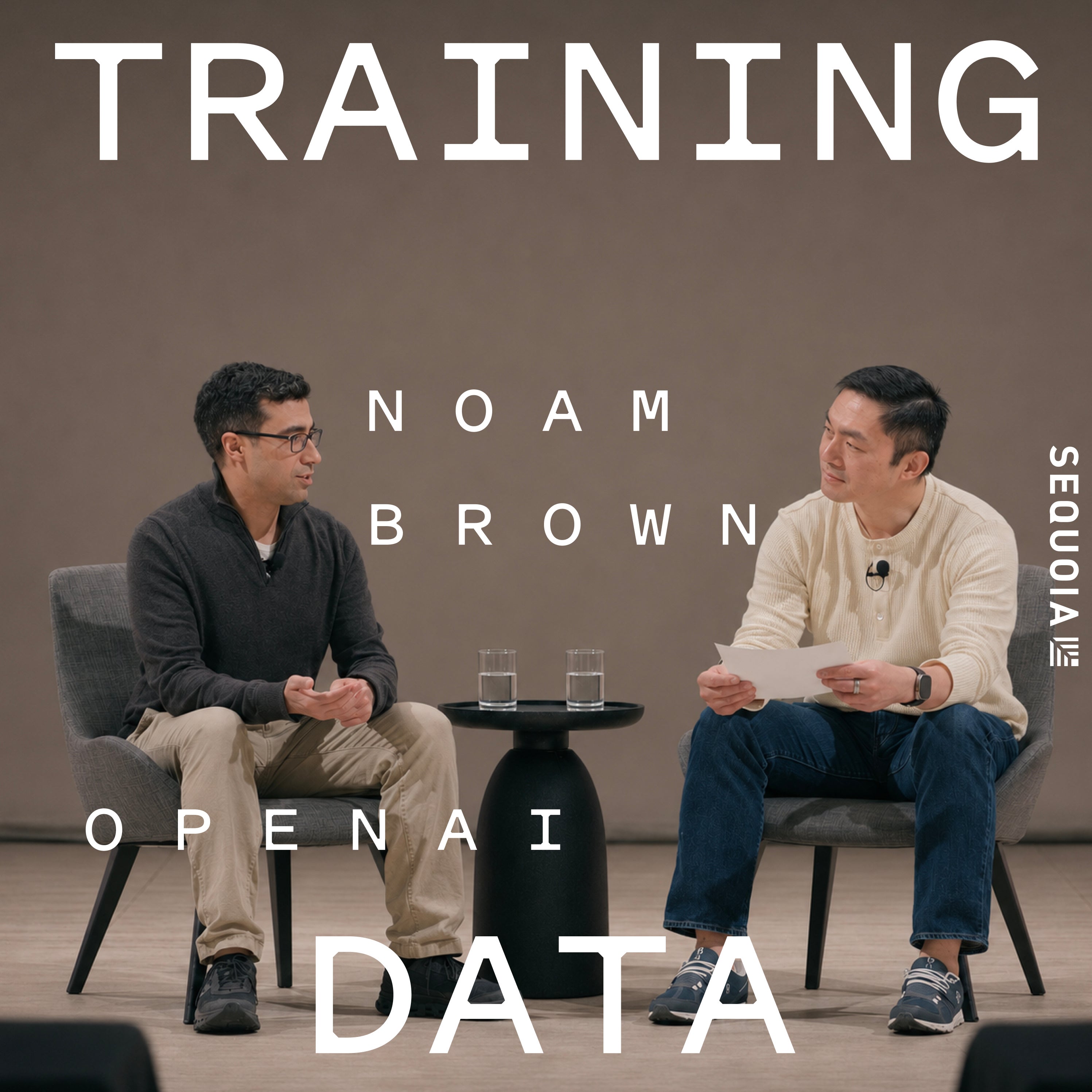
OpenAIのNoam Brown:なぜゲーム理論は汎用知能につながらなかったのか(No Limit決勝ライブ収録)
OpenAI’s Noam Brown: Why Game Theory Didn’t Lead to General Intelligence (Live at No Limit Finals)
OpenAIのNoam Brown:なぜゲーム理論は汎用知能につながらなかったのか(No Limit決勝ライブ収録)
Training Data
要約
OpenAIのNoam Brownが、Sequoia主催のポーカーボット大会「No Limit」決勝でAlfred Linと対談した回。ポーカー、Diplomacyの研究を経て、ゲーム理論は汎用知能への道ではないと考えるに至った「信念の危機」と、OpenAIでo1につながる推論研究へ転じた経緯を語る。人間とAIの「ケンタウロス期」、モデルのギザギザした能力、RSI(再帰的自己改善)、有望な学生は大学を辞めてラボに加わるべきという持論にも触れた。
この回のポイント
- ●Brownはポーカーの完全な戦略を見つける研究から出発したが、人間が合理的だと仮定するゲーム理論はDiplomacyで通用せず、人間データで学習したボットが勝ったと述べている。
- ●2022年頃、事前学習の拡大だけで解決できるという見方が強い中、推論の重要性を主張してOpenAIに入り、o1につながる研究に携わった。
- ●ポーカーやチェスなどで行動前に考えることが重要だと学び、強化学習で思考連鎖を鍛え、考える時間を伸ばすほど性能が上がることが鍵だったとしている。
- ●新モデルが出るたびにポーカーボットを作らせて評価しており、GPT-6 Astraでも単独で本格的なボットは作れないが、river solverは1回のプロンプトで作れるという。
- ●現在は人間とAIの組み合わせが最も有効な「ケンタウロス期」で、モデルの能力はギザギザなので、得意不得意を見極めて問題を分解するのが人間の役割だという。
- ●人類の技術進歩はもともと一つの巨大なRSIループだとしつつ、計算資源などがボトルネックになり得ると述べ、有望な学生はラボに加わるべきだとした。
章立て
なぜポーカーだったのか
大学院でポーカーAIの研究を始めた動機と、MIT PokerBots大会での連覇、60分でボットを作るならという問いへの答え。
ポーカーからDiplomacyへ
汎用性を求めてDiplomacyに挑み、人間が合理的という前提のゲーム理論が通用しないことを最後通牒ゲームの例で説明する。
信念の危機とOpenAIへの転身
ゲーム理論の専門性を捨てて汎用推論へ転じた決断と、事前学習の拡大を信じる風潮の中でのOpenAI入社。
考えてから行動するモデル
思考連鎖と強化学習により、考える時間を増やして性能を伸ばす手法が見つかった経緯。
ケンタウロス期とキャリア
人間とAIの協働が最も有効な時期だという見方と、ゲームの強者がAI研究に向く共通の資質。
質疑:ボットを任せきれない理由
モデルは長期計画や方向転換が苦手で、CFRの数値最適化に時間を浪費した例や、能力のギザギザさを語る。
思考連鎖とTransformerの限界
思考連鎖は解決策の一つだが最善とは限らず、他の手法も探る価値があると述べる。
RSIと大学を辞める提案
技術進歩を巨大なRSIループとみなし、有望な学生はラボに加わるべきという持論を語る。
ライトニングラウンド
未解決のゲームの有無や、WSOPでAIが人間に勝つ可能性についての見解。
解説記事
OpenAIの研究者Noam Brownが、Sequoia Capitalが開催したポーカーボット大会「No Limit」の決勝会場でAlfred Linと対談した。人類トップのプロに初めて勝ったポーカーAIを作った人物が、なぜ自身の専門であるゲーム理論を「汎用知能への道ではない」と判断したのかが語られた。
ポーカーからDiplomacyへ
Brownは大学院に入った2012年からポーカーAIの研究を続けた。完璧な戦略が存在するのに誰もそれを知らない点に魅力を感じたという。手法はGTO(ゲーム理論的最適戦略)を自己対戦とCFRで求めるもので、のちにニューラルネットを使う方式にも発展した。
ただ、囲碁やチェスの手法は転用できず、ポーカーの成果もそれらには効かなかった。そこで2019年ごろ、GPT-2の登場で言語モデルが急伸すると見て、最も難しいと考えたゲームDiplomacyに挑んだ。自然言語での交渉があり、敵対だけでなく協力や同盟も必要なゲームだ。
「合理的な人間」という前提の崩壊
Brownによれば、ゲーム理論の中心的な前提は、全員が合理的であり、それが共通知識だということだ。最後通牒ゲームでは、ゲーム理論的な最適解は相手に1ペニーだけ提示することだが、実際にやれば相手は断る。Diplomacyのボットでも同様の問題が起き、復讐や公平さの概念を組み込む方向は複雑すぎると気づいたという。
最終的に超人的なDiplomacy AIを作る道は、人間データで学習し、人は人として振る舞うと仮定することだった。人間を模倣するモデルを作り、それを相手にAIを訓練して実際の人間に展開する。いわば人間の非合理性のモデルを持つわけだ。
信念の危機と推論への賭け
2022年ごろ、Brownはこれを「信念の危機」と呼ぶ転機として振り返る。キャリアのすべてが計算ゲーム理論だったが、証拠が指していたのは、人間データによる学習と推論のスケールアップだった。専門外でも最も影響が大きいと考える汎用推論の研究に移り、OpenAIに加わった。
当時は事前学習を大きくすれば解決するという見方が強かった。Brownは、GPT-4は囲碁もポーカーも弱く、囲碁を普通に打てるまでにはおよそ6桁の規模拡大が必要になると反論したが、受け入れる組織は少なかったという。OpenAIには汎用推論を研究するチームがすでにあり、そこでo1につながる仕事をした。
鍵は「行動前に考える」ことだ。ポーカーなどでは持ち時間が短く初期のボットは即座に行動していたが、人間は難しい局面で考える。LLMでは「ステップごとに考えて」というプロンプト型の思考連鎖は粗かったが、強化学習で鍛えると出力が良くなり、考える時間が長いほど性能が上がることが分かった。これでtest-time compute(推論時の計算量)を汎用的に増やせるようになった。ただしBrownは、思考連鎖は奇妙なスケーリング手法でもあり、最善とは限らないと述べている。
ケンタウロス期とギザギザの知能
現在は人間とAIの組み合わせが最も有効な「ケンタウロス期」だという。Brownは新モデルごとにポーカーボットを作らせて評価している。GPT-6 Astraでも、単独で本格的なボットを作るのは難しいが、river solverなら1回のプロンプトで優れたものが作れるとのことだ。不足しているのは長期計画や、誤った方向に進んでいると気づいて引き返す力だという。CFRの数値精度は多少の誤差に頑健なのに、モデルが何時間も数値の修正に費やした例を挙げた。
これはモデルの知能がギザギザ(得意と不得意の差が大きい)だからで、人間の役割は得意不得意を見極め、不得意な部分を小さな問題に分解することだと説明する。長期的にはあらゆる面で向上すると予想しつつ、追いつく速さは分野によって違うと述べた。
RSIと「大学を辞めてラボへ」
RSI(再帰的自己改善)について、Brownは新しい概念ではないとする。望遠鏡やコンピュータ、パンチカードからコンパイラへの移行のように、人類の技術進歩自体が一つの巨大なRSIループだという。今回の違いは技術の汎用性と速度だとした。LLMもすでに次世代LLMの開発(事前学習データの品質判定など)に使われている。
計算資源や、モデルが苦手で人間が必要な長い裾野の作業がボトルネックになり得るとしつつ、今後1〜2年も急速な進歩が続くと見ている。そのうえで、最も議論を呼ぶ持論として、有望な学生は大学を辞めてラボに加わるべきだと語った。実際に大学の最終学年を飛ばして採用した人材が非常に活躍しているという。
また、AIが解けないゲームは思いつかず、数か月集中すれば大半のゲームで超人レベルのAIが作れると述べた。次の課題は、特定ゲーム用ではなく汎用LLMをゲームで評価することで、現状ではリアルタイムストラテジーなどは苦手だという。WSOPで1つのAIが人間全員に勝つ確率は、5年以内で約20%と見積もった。
まとめ
本回は、ゲーム理論の第一人者だった研究者が、証拠に従って専門を捨て、汎用推論へ転じた物語として読める。人間の非合理性を前提に置くこと、考える時間を計算資源として扱うことという二つの教訓は、LLMのエージェント設計や評価にもつながる。日本の読者にとっては、AIの得意不得意を見極めて分解する人間の役割が当面残るという指摘が実務上の示唆になる。一方、大学を辞めるべきだという主張は本人も「最も議論を呼ぶ」と認める個人的見解であり、受け止め方には慎重さが必要だ。
文字起こし(英語・自動生成)
Please join me in a round of applause for Noam and Alfred. Hey Noam, thank you for coming. It's been a great day and this is actually all because of you. Because you started studying poker for a while. You and I talked a little bit about your research before you went to OpenAI. You went from studying poker to studying game theory and diplomacy to now reasoning. Tell us a little bit about your path. Why did you decide to study poker, of all things? Yeah, so first of all, it's great to be here. It's really exciting to see all these people working, able to do so much in an hour. I think it's really incredible. My journey, I started, I finished undergrad. I wasn't really sure what I wanted to do, and I figured I wanted to do research, and I wasn't really sure in what. And when I was looking at grad schools, there was this professor that was looking for people to work on AI to play poker.
And I thought, this is great. I have a lot of interest in game theory. I have a lot of interest in computer science, economics. And I had played poker a lot in high school and college, and I loved the game. And I thought it was always really fascinating that there was this perfect strategy to poker, and nobody knew what it was. But if you could find it, you could just make unlimited money. So I started working on that basically as soon as I started grad school in 2012 and worked on it continuously through my whole PhD. And it's actually pretty unusual to work on something. Did you make some money during that time too? I never used it to play online poker, but there is a fun fact. There was the precursor to this, I guess, of the MIT PokerBots competition, which ran for several years. And as a poor grad student, I wanted to enter this competition because there was $10,000 in prize money. and I wasn't at MIT, so I got one of my MIT friends to collaborate with me and we submitted the poker bot. We won two years in a row, 2014 and 2015.
And after that, I kind of felt bad about, you know, beating up all these people that really don't have big poker bots. So I stopped doing it after that. Did you, so if you had 60 minutes to go build a poker bot today, given all that you know, how would you start? It's a great question. and I'm actually curious to talk to the contestants and hear what strategies they took. The approaches that we took were very GTO-based, and so we would have the agents running, but we basically have the model training, playing self-play, do it through self-play, using CFR. Later on, it turned into these more neural net-based self-play approaches, but everything was focused on self-play to converge to GTO. And the problem there is that it takes a long time to train. The coding part you can do, without modern LLMs, I think you could make the code to run that in an hour, but the training process itself could take many hours. I think you could make a pretty low-fidelity GTO bot in an hour.
I think if you did King Means Clustering to reduce the abstraction size to a pretty small size, and then did self-play for, let's say, 30 minutes, you could actually probably get a half-decent PokerBot. So that said, the format, because it's multiplayer and because you're not doing an instant runoff kind of tournament where you're always going to eliminate the weakest competitors, but you're actually playing against all the competitors, I could see an exploitation-based approach actually being the better one for this kind of tournament structure. so I think in this setup I would probably go for an exploitation based approach and try to find the, you know, try to observe the weaknesses of the opponents and then exploit that, especially in a multi-handed, multiplayer situation You're going to have to submit your own code next year You're going to have to have you compete but you can't win I think you make enough at OpenAI, hopefully The prize money is only $100,000 Hopefully they can get a little bit more than that.
The other thing I'd be curious to see is how well the LLMs do playing in this tournament. So not just using it to make a poker bot, but if you play the poker bots against, let's say, GPT-6 Astra, how Astra would do. Because we've been tracking the performance of... I've been tracking the performance of these different general-purpose LLMs over time. And with Astra, as reasoning models have developed, they've actually gotten quite good. And Astra, I would say, is actually able to make money playing online poker at this point. Yes, let me back up that step because you obviously went from poker to diplomacy to reasoning, and now these LMs can do a lot more than just play poker and do it extremely well. Take us through your journey of how you took your learnings from poker to diplomacy, game theory around diplomacy, to then into reasoning. I think that's a really interesting path. Yeah, the original motivation for working on poker was that there had been a lot of progress on Go and chess,
perfect information games. And the problem is that if you only have a technique that works on a very narrow domain, then it's actually not that useful, right? Because you want something that's general purpose. And so the motivation for working on poker was that we can figure out new things about what techniques actually work in these other domains and eventually make this more general-purpose AI that can, for example, play both Go and poker. And after we had the poker bots, I think we did actually learn quite a bit, but the truth is that they weren't that good for chess or Go. And so I wanted to try something more ambitious, something that would expand the scope of games that these techniques would be able to play. And at the time, it was around 2019, GPT-2 had come out, and it started to look like there would be rapid progress in language models. and I thought like, I honestly, like, the original thing that I was discussing with my teammates was like, we want to make an AI that can play both Go and poker. But considering how rapid progress
in AI was in 2019, we thought that wouldn't be ambitious enough. And so we wanted to target the game that we thought would be the hardest to make an AI for, which we thought was diplomacy because it is a natural language game that involves negotiations with other players because it's not just purely adversarial, it's also cooperative, you have to form alliances. In 2019, it was unthinkable that you could have an AI play this game well. And we thought, like, that's the perfect thing to aim for. Poker took decades for people to work on. If we have to spend, like, five years making an AI that can finally play diplomacy, that's great. So, we took it on, and we learned a lot along the way. And one of the things that I took away is that actually the game theory approach doesn't actually work that well in diplomacy. I originally came in... Say more about that, because I thought that game theory was developed to actually be a much better negotiator in a repeat game, and especially in diplomacy.
I think there's intuition that you can take away from game theory, but the problem with game theory is that it assumes, this is the central premise of game theory, that it assumes that all the other players are rational, and that it is common knowledge that all players are rational. and people are not actually rational. And if you come in with this assumption and you make it a central pillar and everybody's rational, then you going to make mistakes I think a good example is Are you familiar with the Ultimatum game So it this idea that there two players Alice and Bob Alice has $100 and can offer Bob anywhere between $0 and $100. And Bob can either accept or reject. And if Bob rejects, they both get $0. If Bob accepts, then they split the money that way. So if Alice were to offer Bob $10 and Bob accepts, then Alice gets $90, Bob gets $10. And the game theory optimal approach for this game is to just offer Bob like a penny. Yeah. Some small amount. Yeah, some small amount.
And if you, you know, this makes sense. Bob has a choice between making a penny or making zero. The penny's worth more. But, I mean, you can imagine what would happen if you actually tried to offer somebody a penny in this game. Like, of course, they would say no. Yeah, they would say no. So, what we found is that our poker, that our diplomacy bots, when we took this very game-theoric approach, would start doing these kinds of behaviors. and there's like this temptation to say oh we can try to find we can try to encode some semblance, some like notion of vengeance or fairness into the bots and when you go down this rabbit hole eventually what we realized is that actually it's too nuanced and the real way to make a superhuman diplomacy AI is to train on human data, to just understand people to not take a game-theoretic approach, to not assume rationality, but to just assume that people are going to behave like people, understand what that means by training on a lot of human data, and then determine what is my best course of action
given the behaviors of everybody else. And so do you end up with a model of human irrationality? That's the idea. You end up with a model of human irrationality. So we train these models that their purpose is to imitate people as closely as possible. and then we train AI with these imitation humans and do a lot of training and then we can deploy that in the real world with actual humans and that's what does best there's a book by two behavioral economists about thinking fast and slow and a lot of that has to do with Kahneman just explains there's kind of consistent bugs in our brains and we sort of have these solutions that are imperfect and you can explain why it happens from behavioral economics point of view but it isn't the rational reasoned approach. How have you sort of incorporated that into like reasoning and doing research and reasoning at OpenAI?
Yeah, so after I did the diplomacy results, I had an interesting choice in my career at that point because this was around 2022. you know I think around early 2022 it was becoming clear that the game theory approach it was not working in diplomacy and actually that the right approach was this kind of like more modeling of human behavior and this was kind of like a crisis of faith moment for me because my entire career up until that point had been about game theory right I was by area was computational game theory my expertise is computational game theory and I had to wrestle with the fact that actually that was not the path to general intelligence, that actually, if you look at the evidence, it was this training on a lot of human data, modeling people really well, and then teaching them all to interact with that environment, and then also the scaling up of reasoning thing. And so I had to choose between, like, okay, well, do I stick with computational game theory despite me thinking that this is not the most important direction, the most promising path to general intelligence,
or do I pivot and do I work on what I think is actually the most valuable thing, despite it not being what I'm an expert at, which is general purpose reasoning in RL. And I ultimately decided to go the path of what I felt was most impactful, which was actually just pivot and work on this general reasoning direction. And so this led me to join OpenAI. I looked at a lot of different places, and I told them what I want to work on. these LLMs, they're really cool, they're really general, but they can't play Go. They can't play poker. Why not? And at the time, it was a very... It's hard to put yourself in, like, 2022, I guess. Maybe people remember what it was like back then. But people were extremely bullish on just scaling up pre-training. And I would go to some places and I would say, like, look, reasoning is going to be this essential ingredient. And people would tell me, like, well, actually, we should just pre-train a bigger model. And that'll solve all the problems. And if we get to, you know, and yeah, GPD4 can't play Go, it sucks at chess, it sucks at poker,
but we just do, like, you know, a few more orders of magnitude of training, maybe it'll just work. And I would point to the evidence and say, like, actually, no, if you look at how much you would have to skill it up by for a game, like, to be able to play Go competently, it would be about, like, six orders of magnitude. And that doesn't seem, you know, realistic. and fortunately OpenAI was actually really bullish about this direction and I didn't know this at the time but they actually had a team working on this direction of how do you get general purpose reasoning out of these language models and so ultimately I joined OpenAI and worked on what became O1 and now these models they can play these games extremely well just general purpose LLMs What changed over the last few years? What was the breakthroughs that allowed them to as you said, it's not just scaling it up So what were the major breakthroughs along the way? I think the major takeaway from my work on poker, diplomacy, and then also looking back at games like backgammon and chess, was that you needed these AIs to think before acting.
So when I started working on PokerBox in 2012 and 2013, there was no reasoning going into these models. They would just act instantly. And there were a lot of reasons for this. A big factor was actually the structure of the tournaments, and this tournament included, is that it doesn't really give you much time. It doesn't give the model much time to actually reason before it has to act. It's a very short clock, and that's kind of, like, essential because poker's a high-variance game, and so you need to play a lot of hands, and so you can't have it sit there for 10 seconds thinking for every single hand. But people do that, right? People, if they're faced with a tough decision, will think through the decisions that they have to make. And that obviously benefits them instead of having to act instantly. So seeing this general trend of like, okay, in all these games, chess, go, poker, diplomacy, we had to have these AIs think very carefully before acting in order to beat top humans. How do we get this out of LLMs? And at the time, there was chain of thought, which is the idea to just prompt the model and say, think step by step before answering.
And there was some evidence that this actually led to better solutions. but it was very coarse. It was not really sophisticated and it turned out the key ingredient was, yeah, if you do reinforcement learning to train for this behavior, then you actually get much better chain of thought behavior, you get much better outputs and then also what we observe at that point is actually the longer the model takes to think before responding the better it does and that was I think the key unlock that was like, okay, now we have a way to scale up test time compute not just in these games but actually in a general purpose way with language models that could be applied to basically any domain. Great. I have a few more questions but hey start thinking about what you would like to ask them because we're gonna open up for Q&A. I think a lot of people here are incredible They like the people here was smarter when I was in college They all very mathy people very AI people They probably all very AGI people as well But OpenAI keeps solving math problem after math problem after math problem
very complicated ones. So what would you recommend people here do so that they are not left behind? Should they continue to study math? Should they continue to study computer science and AI? and if they want a career in AI over the long run, what do you think they need to prepare themselves for? I mean, I think we're entering a period, the centaur period, where the combination of human plus AI is going to be most effective. And I think this tournament is actually a great example of this, where I'm sure if you just prompt the AI, here's a poker variance, make me a bot that will win this tournament that's not going to get you very far you have to work with it, you have to figure out you have to work with it hand in hand to make the best poker bot and that's also what's going to win and similarly if you just have one person by themselves with no LLM with no AI just trying to code up this poker bot, I'm sure they're not going to get very far in an hour
and I think that's going to be the future of a lot of things of most professions and AI research itself so I think getting good at the skill and I think proving that you're good at the skill in this kind of tournament is I think the right thing to do a lot of people who ended up being AI researchers came from trading, from playing poker from like, is there from like playing games and being very good at them famously a lot of the people played board games, strategy games is there some element of like thinking through game and game theory and being an optimal player in these games and help with AI research and research in general for... It's a great question. I've been wondering this myself and I actually noticed when I was doing the Labrata's competition with these poker pros, they told me earlier when they were kids, they would actually some of them were professional Counter-Strike players. They were in the top leagues of Counter-Strike and I thought
that's so interesting that somebody could be both exceptionally good at Counter-Strike and then also exceptionally good at poker. Seems like two different games. What's the common thread there? And I think the common thread is in order to reach the top of any of these domains, you have to be extremely good, very diligent, and very good at studying and practicing and figuring out how to optimize and become the best. And that is a general purpose skill that I think lends itself to, you know, yes, poker, but also trading, and also AI research. Just understanding how do you get from not knowing much about this domain to becoming the expert in it. It involves a lot of hard work. It involves a lot of practice. It involves a lot of preparation. And that's a general purpose skill, I think. Very cool. Any questions from the audience? I'm curious about, like, what do you think is missing? Like, why, from, like, the model side, I'm like, why can't we type just, like, make a poker bot to win, right? Like, what is missing there? And why, what do you think is, like, needed to actually get there to the point where, like, we can actually just make a poker bot that can win.
And it'll actually just make, like, the best poker bot. Like, what is the human adding right now that you think, like, we haven't really captured in the models yet? Like, is it some sort of, like, creativity? Is it some sort of, like, is, like, the search space too large for the model right now and doesn't really know, like, what to do it? Because, like, obviously, what the right person prompted, you can make, like, a better bot, we can make a worse bot, right? So, like, what is, like, missing there for the model to do it fully by itself? Or what do you think? Yeah, so the question is, what is the model missing that results in the human adding something to the Centaur process? And I thought a lot about this, and I've been using, for me personally, every time a new model is developed, I ask it to make a PokerBot. It's kind of my go-to evaluation. And they were really bad at first, but they're getting better and better. And, yeah, I would say with 5.5, 5.6 was the first time that I felt like, oh, these things are actually, like, 10xing, 20xing my ability to make a PokerBot. But they weren't really able to make it on their own.
And even Astra, I feel like, isn't quite able to make a really good PokerBot on its own. It can make a good river solver. It can actually zero, like, just on its own, just a single prompt, it can make an excellent river solver. But it can't really make a full-scale PokerBot that well. but it is these models are getting a lot better at this very quickly and I would say what's missing right now it's kind of subtle things it's the long term planning and organization they're not really good at noticing when they're going down the wrong direction and kind of stepping back and realizing like oh actually maybe I shouldn't be doing this at all one thing I noticed for example is that the models if you ask them to implement CFR sometimes they will get really focused on optimizing the numerics of CFR so that it's perfect. And actually, one of the important things to understand about CFR is that actually numerics don't really matter that much. If there's a small amount of error, it's very robust to that. So the model spent hours and hours trying to fix the numerics from CFR when it was totally unnecessary. So it's these kinds of things that I think are missing.
These are symptoms, I think. The bigger point is that there are some things that the models are extremely good at, and there are some things that they are extremely bad at. And so right now the models are a complement to human ability because, yeah, you can use them in all the ways that they're superhuman and then you can help fill in the gaps for all the things that they're really bad at. But over time, I do expect the models to get better and better across the board. I think some things, they will spike well above human performance and some things they will lag behind and some things will take longer to catch up to human performance than others. I think another way, and you've said this before and lots of people have said this, the intelligence is very jagged. And so your job as a human is to understand what the model's good at and what the model's bad at, break down the problems that can be solved by the model by itself, and then for the problems that they're bad at, the reason why prompting is a good person who's good at prompting is it can break down problems into smaller and smaller bite-sized things that the model can't solve. And so if you notice that it's jagged,
okay, tell the model to do these things that it knows how to do. that things are not as good, break the problem down into simpler problems for the model to do well, and then it can be solved. And I think that's where we're at right now, which is great. We still have some value to add. Who wants to ask another question? Well, great. We can hear you now. I was wondering, you alluded to the inherent limitations of LLMs, like you can't play Go or you can't make an amazing poker bot. do you think that has to do with the fundamental structure of Transformers? Do you think that's the only thoughts of non-generative models like JEPA or world models that are also getting some attention right now? Do you think those are the solutions to the inherent limitations? I think there's a lot of solutions. You're asking what is it about Transformers that prevents it from being good at poker or chess or go, these kinds of things. I think Chain of Thought, RL on Chain of Thought, is a solution to this problem. I think that you can use these models.
and we don't there are some models that are more optimized to play chess really well than others and I think if you train it to play chess really well using chain of thought it will play chess really well so this is a solution to this problem it not the only solution it probably not the best solution so I do think that there are other solutions and it definitely worth exploring the space of possible solutions I think in many ways chain of thought is kind of a weird way to scale, test, time, compute. The idea that you're going to, in very interpretable English, describe exactly what you're going to do. It's not, I mean, you could argue that people have an inner monologue and that you could verbalize it and actually write it down. But in many ways, it's often more subtle than that. So, for example, sometimes people think of images, and that's not exactly easy to do with chain of thought. So, yeah, I think that there probably are other approaches that could be used, but I think that chain of thought is sufficient for scaling test on compute.
Hey, this is Jasper from Hyperbolic. Thanks for your talk. And a lot of people are talking about RSI and just wondering, like, How soon do you think RSI is going to happen, and can you apply it for being the best poker player in the world? Sorry, what was the last part? Do you think you can apply RSI to poker bots so that you can become the best player? Could you apply RSI to a poker player? Is it making poker bots or playing poker? They're the same, right? RSI, basically, you can self-improve yourself to become a bet. I mean, like I said, I asked all the latest models to make PokerBots, and I think they are getting pretty good at iterating and running experiments and recognizing when they could do better. As far as RSI, it is a real thing. In some ways, it's not a novel concept. If you think about all of human technological progress, there really is just one giant RSI loop where we use technology to advance our ability to do technology,
to make technology or to make scientific discoveries. We make the telescopes so we can, you know, explore deeper into space. We make computers, and then we start off using punch cards, and then we progress to compilers. And this accelerates our ability to do research and make new technology. And what humans end up doing then shifts to what the models are bad at. This goes back to my point that the models are jagged right now. So when we go from, like, punch cards to compilers, a lot of what people end up doing becomes focused on what the models are still about, what the computers cannot do. And when we go from compilers to things like LLMs, again, like the work that a person does shifts. Now, I think what's different today is two things. One, the generality of the technology, and two, the speed at which it's happening. But fundamentally, it's not different from what's happened in the past. And even for the creation of LLMs, we have used the LLMs themselves to aid us in making the next generation of LLMs for years.
I remember back in 2022, 2023, people would use LLMs to, for example, do data quality. So they would look through the pre-training data to see if it's actually high-quality data or is there anything concerning it. That's basically a part of RSI. Now, the way the technology is developing, I think we're lucky that it is jagged. and that there are things that the models are quite bad at. But in the same way that these models can now do superhuman math research, I do think there is a case that even if they're spiky and jagged, they can be directed towards being really good at RSI. And in that case, yeah, you might see very rapid progress. Now, I still think you can get bottlenecked on certain things. I think you can get bottlenecked by compute. I think you can get bottlenecked by the long tail of things that the models are bad at and humans are necessary for. But I do think that things go much faster. So we have seen a lot of rapid progress over the past few years when it comes to AI.
I think even in the past six months, that progress has, if anything, accelerated, I think. And I think that we're going to continue to see a very steep rate of progress over the next year or two. And so perhaps my most controversial take is that if somebody is a promising student, the best thing to do is actually to drop out and join the labs now. Woo! We're excited already. Final work. Because things are going fast, and it's an exciting time, so it's not a great time to sit on the sidelines. And I will say also, I've hired a few people that have just dropped out and, you know, skipped their senior year of college, and they do exceptionally well. I've had a lot of success with you didn't drop that no but I was in I was in the middle of like AI boom alright well so you're one of the people here for sure seems like it's a selfie group
alright before we let you go a few like lightning lightning round fun questions random questions is there a game in AI that a game that AI has not solved that you would like to see solved? No, I don't think there's any... I think if a team were to spend even a few months focused on even one person, actually, if one person were to spend a few months focused on making an AI to play a particular game, I think you could get the AI to play that game at a superhuman level. I struggle to think of any... I mean, we chose Diplomacy because we thought it would be the hardest game to make an AI for. And I can't think of anything that would be harder. You can even think of things like, you know, after we worked on diplomacy, there were various things that were pitched to me. Get an AI to play Civilization. Get an AI to play Zelda, Wind Waker, all these things. And actually, I think you could probably just make an AI to play all of them now. Wow.
I will say, like, I think the next challenge is using games as an evaluation. That ideally, you don't make the AI specifically for that game, but you make a general purpose LLM and then evaluate it on that game. And certainly right now, the LLMs are not able to play real-time strategy games. They're not able to play Zelda at a superhuman level. Give it a year, who knows? Who's the best human poker player that you've watched? Oof. Probably Doug Polk. But I think he's probably no longer the best. I actually haven't kept up with who's the best these days. Within the next five years, If AI is allowed to play in the World Series of Poker, do you think AI will beat all the humans? One AI? One AI agent. Not all AI. One AI agent. This is a great question because there's a lot of variance in the game. If it is playing GTO, no, because I think the variance is too high in the game.
That said, I could see a case that if the AI is superhuman at reading people, If it's able to read people's faces and basically detect whether they're bluffing or not, I can see it being extremely superhuman at that and basically being able to read the other person's cards. And in that case, even then, I think there's actually not... It's probably not a high probability that it wins because there's still a luck factor, right? You can just go all in, free flop every single hand, and then just leave it to the luck of the draw. But I would give it a good 20% chance that it could win. 20% in five years. okay there's still human games to be played then thank you gnome we appreciate it
番組の概要欄(原文)
Noam Brown built the first AIs to beat top poker professionals, then concluded that game theory, the field his career was built on, was not the path to general intelligence. Recorded live at the Finals of No Limit, Sequoia’s pokerbot tournament, the OpenAI researcher describes his “crisis of faith”: game theory assumes everyone is rational, and the Diplomacy bots that won were the ones trained on human data to model how people actually behave in the messy real world. That sent him to OpenAI and the work that became o1, at a time when much of the field believed a bigger pre-trained model would solve everything. Noam explains why he asks every new model to build a pokerbot, where GPT-6 Astra still falls short, and why this is the “centaur period” of human plus AI. He argues that human progress has always been one giant recursive self-improvement loop, and shares his most controversial take: promising students should drop out and join the labs now. Hosted by Alfred Lin, Sequoia CapitalChapters: 0:00 – Introduction 0:09 – Why poker: a perfect strategy nobody knew 2:12 – How Noam would build a pokerbot in 60 minutes 4:37 – From poker to Diplomacy: where game theory breaks on irrational humans 9:39 – A crisis of faith and the bet on reasoning over bigger pre-training 13:01 – The unlock: models that think before acting 14:59 – The centaur period, and what gamers and AI researchers share 18:13 – Audience Q&A: why models still can't build a great pokerbot alone 22:02 – Is chain of thought the right way to scale test-time compute? 23:42 – RSI and the case for dropping out to join the labs 27:54 – Lightning round: unsolved games and AI at the World Series of Poker
出典・この記事について
- 番組
- Training Data(Sequoia Capital)
- 元の回
- OpenAI’s Noam Brown: Why Game Theory Didn’t Lead to General Intelligence (Live at No Limit Finals)
- 配信日
- 要約作成日
- 公式サイト
- www.sequoiacap.com
この要約・解説記事は、元の音声を文字起こしした内容をもとに AI(Claude)が日本語で作成したものです。 固有名詞や数値に誤りを含む場合があるため、正確な内容は元の音声でご確認ください。制作方法について
関連エピソード

すべての企業に継続学習を:Trajectory 共同創業者 Ronak Malde 氏
Training Data

欧州の防衛主権は工場から始まる:Stark の Uwe Horstmann 氏と Johannes Schaback 氏
Training Data

ロボットデータ工場の内側:Meckaのジョシュ・ガオが語る「人間のセンサー化」でロボットを学習させる方法
Training Data

David SilverとLasse Espeholt(Ineffable Intelligence):経験の時代の「スーパーラーナー」を目指して
Training Data

Google AIインフラ責任者アミン・ヴァーダット氏が語る、フロンティアAIの物理学と経済学
Training Data