
AIはより健康な未来を築けるか?医療・生物学の最前線を語る
Can AI help build a healthier future?
AIはより健康な未来を築けるか?医療・生物学の最前線を語る
Microsoft Research Podcast
要約
Microsoft Research の Doug Burger が、Eric Horvitz、Eric Topol(Scripps Research)、Ava Amini と、AIが医療・生命科学にもたらす変化を議論した回。逐次診断を行うエージェント型システムの成果、画像AIの社会実装の遅れ、全患者モデルとバーチャル細胞、データ不足というボトルネックが話題になった。最後に10年後の医療への期待が語られた。
この回のポイント
- ●Horvitz は、AIに臨床医の立場で質問や検査を選ばせる「逐次診断」の枠組みを紹介し、複数の最先端言語モデルが高い能力を示したと述べた。
- ●Topol は、この研究を精度向上とコスト低下を同時に示した初の例と評価した。一方、マンモグラフィなど実証済みの画像AIが臨床に導入されていない点を問題視した。
- ●Amini は、生物学の課題は多階層(分子から患者まで)の統合にあると指摘した。また原子レベルの完全な解釈性は必須ではなく、必要なのは科学的発見に役立つ出力だという立場を示した。
- ●データ面の課題として、AlphaFold を可能にした PDB のような大規模データが医療・生命科学には欠けていると議論された。Amini は、活動・機能を測る「機能読み出し」型データの重要性を強調した。
- ●計算コストが下がっても実験は常にボトルネックだが、AIが有望な実験を絞り込むことで実験の効率化に寄与し得るという見方が共有された。
- ●Horvitz は10年後に一部のがんの慢性疾患化やアルツハイマー病の進行遅延が実現すると予想し、Topol はさらに予防まで可能になると述べた。
章立て
イントロと登壇者紹介
シリーズの趣旨と、Horvitz、Topol、Amini の3人のゲストが紹介される。
各者が見る現在地
Horvitz は逐次診断の研究を、Topol は画像AIの実装の遅れと全患者モデルを、Amini は生物学AIの実装課題と多階層性を語る。
生物学は抽象化できるか
計算機アーキテクトの視点から、生物学も階層的な抽象化で理解できるのかが問われ、完全な解釈性は不要という意見が出る。
予防医療と医師・AIの関係
米国の医療制度が予防に向かない構造や、環境音声記録(アンビエントスクライブ)、診断エラー、AIの共感について議論される。
コスト低下とデータのボトルネック
トークンコストの低下が創薬や医療にどう効くか、実験が常にボトルネックである点、データ不足が議論される。
次に必要なデータと注目領域
機能中心のデータセット、免疫系、老化の基礎メカニズム、新しい測定技術などが注目点として挙がる。
生物のプログラミングと最後の展望
合成生物学による機能設計の可能性と、10年後の医療への期待が語られる。
解説記事
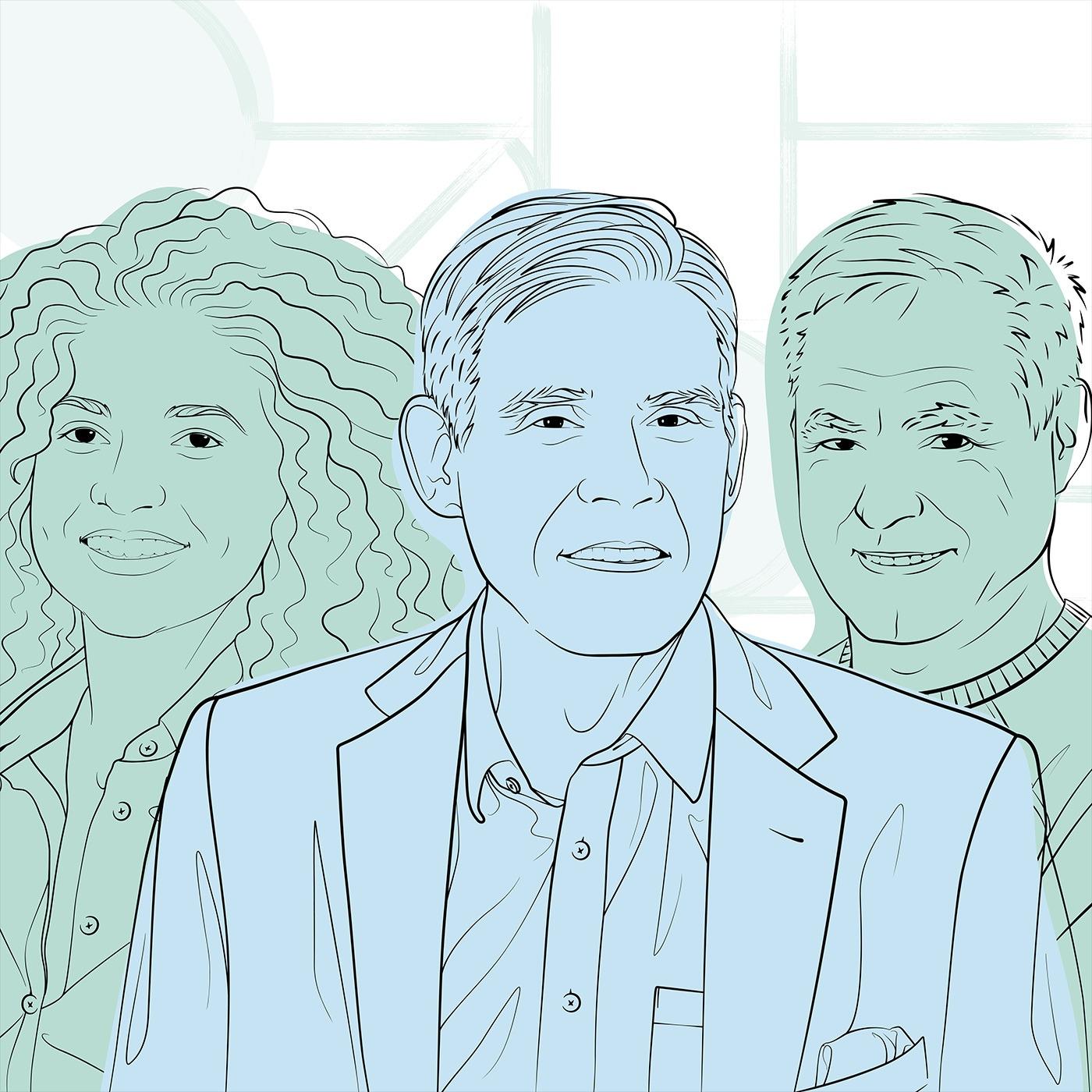
Microsoft Research Podcast の「The Shape of Things to Come」の今回の回では、ホストの Doug Burger が3人の専門家を迎え、AIが医療と生命科学をどう変えるかを語り合った。ゲストは、Microsoft の主任科学責任者 Eric Horvitz、Scripps Research の Eric Topol、Microsoft Research の Ava Amini。診断支援から創薬、データの制約、10年後の展望まで、楽観と課題の両面が語られた。
診断を「臨床医の立場」で試す
Horvitz は、医療診断のベンチマークを「医療認知」の領域へ進めた取り組みを紹介した。症例の全情報を与えて診断精度を測る従来の方式とは異なり、AIに臨床医の立場を担わせる。初診時の主訴と病歴だけが与えられ、AIは仮説を立て、質問や検査を選び、検査の情報価値とコストを天秤にかけ、不確実性の中でいつ診断を確定するかまで判断する。これが「逐次診断」の課題だ。Horvitz は、複数の最先端言語モデルが高い能力を示したと述べている。ただし人間の一般医との比較には限界があり、割り引いて受け取るべきだとも断っている。
Topol はこの研究を、エージェント型システムが他の最先端モデルや医師より正確に診断し、精度がほぼ倍増しながらコストも下がった初の例だと評価した。AIが請求の上積みやコスト増に使われがちな現状との対比で、「精度が高く、しかも安い」点を強調している。
実装が進まない現実
Topol は一方で、生成AIという「目新しいもの」に注目が集まる陰で、より実績のある医用画像の深層学習が活用されていないと指摘した。網膜、胸部X線、心電図などで有効性は示され、マンモグラフィでは10万人超の女性を対象にした無作為化試験もある。それでも臨床には使われていない。理由として、医療界が変化に慎重であること、財務的制約、低い利益率の病院が投資を避けることを挙げた。また医師も患者も強く求めていないことが背景にあるとし、患者側や患者を代弁する医師が動くことが推進力になり得ると述べている。
Amini も生物科学の側から同じ問題を指摘した。予測・生成モデルへの期待や投資は大きいが、それが何を解決するのか、実験科学者のワークフローにどう組み込まれるのかという実装のギャップが残っているという。Broad Institute との共同研究は、AI側と生物学側を下から統合する試みとして紹介された。
全患者モデルと、生物学を理解するということ
Topol は次の段階として、電子カルテ、画像、ゲノム、プロテオームなどを統合した「全患者モデル」を挙げた。現状でも、電子カルテと多遺伝子リスクスコアの組み合わせで疾患の発症時期についてある程度の示唆が得られるという。ただし長期で深いデータはまだ大規模には存在しない。バーチャル細胞よりも先に、成熟した全患者モデルが実現するという見通しも示した。
Burger は計算機アーキテクトとして、「生物学も、チップのように階層的な抽象化で完全に理解できる日が来るのか」と問いかけた。Horvitz は、人体は多階層の動的システムであり、原子レベルまでの理解は期待できないとしつつ、因果モデルや解釈可能性の技術で複雑さを扱うべきだと述べた。Amini は問いを逆転させ、そもそもそこまでの解釈性は必要ないと主張した。数年先に実験で検証できる成果を出すには、科学者が必要とする出力が得られれば十分だという立場である。
データとコストのボトルネック
Burger は、トークンのサービングコストが年に4〜10倍の速さで下がっていると述べ、医療や発見のコストにどう影響するかを問うた。Amini は、有望な実験をモデルで絞り込み、ウェットラボの実験を高確信度のものに集中させる「計算と実験のトレードオフ」を挙げた。ただし実世界は常にボトルネックだとも述べた。Horvitz は、AIで「どこを見れば価値が最大か」を計算して実験を導く方向に最も期待していると語った。
Topol は本当の制約はデータセットだと指摘する。AlphaFold が成功したのは Protein Data Bank があったからで、医療や生命科学にはそれに匹敵するデータがない。Amini は、PDB が静的な構造であるのに対し、足りないのは活動や機能を測る「機能読み出し」のデータだと述べた。自身の Project Ex Vivo では、がん細胞の状態と免疫療法への抵抗性などの機能を結ぶ「状態-機能マップ」を作っているという。
免疫、老化、生物のプログラミング
注目領域として、Topol は人間で計測が欠けている免疫系を挙げ、胸腺のAI評価ががん免疫療法への反応予測に使える可能性に触れた。Horvitz は老化の基礎メカニズム、特にDNAメチル化によるスイッチの維持の謎を解けば、複数の疾患を一度に予防できるかもしれないと述べた。Amini は、生物の階層をつなぐ新しい測定技術に期待を示した。
議論の最後には、望む機能を持つ生物をDNA配列から設計できるのかという問いが出た。Amini は、学部時代に大腸菌で状態機械を実装する合成生物学の研究をしていた経験に触れ、自然言語でタンパク質の機能を指定してAIが候補を設計できる現在を、長年の構想の進展として語った。
まとめ
本エピソードの特徴は、AIの能力そのものよりも「実装」と「データ」が鍵だという認識が3者に共通していた点だ。日本の読者にとっても、実証済みの技術が制度やインセンティブのために医療現場に届かないという指摘は示唆的だろう。研究開発側は、論文上の精度だけでなく、現場導入と、機能データの整備という課題に目を向ける必要がある。10年後の展望として、Horvitz は一部のがんの慢性疾患化やアルツハイマー病の進行遅延を、Topol は予防まで可能になる未来を挙げた。これらは出演者の見通しであり、実現が保証されたものではないが、今後の医療AIの方向性を考える手がかりになる。
文字起こし(英語・自動生成)
This is the Shape of Things to Come, a Microsoft Research Podcast. I'm your host, Doug Berger. In this series, we're going to venture to the bleeding edge of AI capabilities, dig down into the fundamentals, really try to understand them, and think about how these capabilities are going to change the world, for better and worse. Today, I'm bringing three experts in the fields of biomedicine, working on the front lines of AI, biology, and medicine to see where healthcare is going, where the deep understanding of biology is going, what medical advances are coming, and how will AI change the future of health. These questions are really important because they will determine the shape of things to come. In today's podcast, I've invited three leading researchers in medicine, biology, and machine learning slash AI.
Eric Horvitz is Microsoft's chief scientist and is both a PhD and an MD. How you spend all those years in school, I have no idea. I've known Eric for decades, and his work has shaped the entire field of machine learning. He's a legend in the machine learning community and is a good friend. Eric Topol is our second guest. He's the executive vice president of Scripps Research. the largest nonprofit biomedical research institute in the United States. He's published over 1,300 peer-reviewed papers. Shocking. Shockingly productive. Authored four books. So just an amazingly impressive, prolific scientist and physician. Finally, Ava Amini is a principal research manager in Microsoft Research. She's a rising star in our organization, an expert in the intersection of AI and precision medicine, and she's a co-lead of Project Ex Vivo, a collaborative effort between Microsoft and the Broad Institute that is focusing on defining, engineering, and targeting cell states in cancer.
So thank you all for joining today. I think we've got a really, really amazing set of people, myself excluded. And I'd like to start to my guests here. It's clear there's a huge disruption happening at the intersection of biology and medicine and AI right now. Just, you know, we're seeing things, breakthroughs happening at an accelerating pace. Models are helping us to discover structures and create extractions that are really useful for moving forward the field of medicine. I've seen some recent talks where scientists with cancer used AI to design drugs for themselves. I mean, just unbelievable. And today, I've got some long-term questions for us to discuss, maybe a little bit provocative, but I'd like to start with what each of you see as what's happening right now, like on the intersection of medicine and biology and AI. I think each of you has a unique vantage point.
I'll go around the horn, and I know, Eric, there's a cover article on Science Magazine that's really exciting, and so maybe you could talk a little bit about that as well. So I'll start with you, and then I'll go to Eric Topal and then Ava. Thanks. I think health care and the biosciences are fortunate disciplines in that there's been a digitalization of content, whether it be protein structure over decades, electronic health records, and so on, that makes these fields amenable to being at the ready for AI inferences and innovation. And therefore, I've been extremely optimistic about the long-term futures as well as what we'll see early on at the frontiers of AI when it comes to the biosciences and healthcare.
Just extraordinary to see what's happened over just the last five to eight years in the biosciences with both discriminative and generative AI models. You know, the AlphaFold breakthrough was tip of the iceberg, and we see just a whole, in some ways, a crest and a crashing of the wave of possibilities now when it comes to experimental platforms, experimental design, data interpretation in the biosciences, hypothesis generation, I should say, as an assistant and a companion to scientific reasoners and human scientists. In healthcare, we have an extraordinary opportunity to address long-term challenges in patient safety and getting to timely diagnoses and accessibility of healthcare. and after a couple of years of intensive work,
I and just fabulous colleagues at Microsoft worked intensively on taking healthcare challenges when it comes to applications of AI and benchmarking medical diagnostic challenges, for example, and moved it into what I would call the realm of medical cognition, where instead of looking at a whole case that's given to an AI system and looking at the accuracies that are reported on its ability to diagnose, for example, a form of differential diagnosis, we instead put the AI system in the shoes of a clinician. You get initial symptoms, chief complaints, and history, a little window on what's going on when a patient comes in in an ambulatory setting, and then it's up to the clinicians to ask the right questions and to then think about tests, balancing the information value with the cost of the tests. This is the sequential diagnosis challenge, and we apply AI to both the formulating hypotheses component of that
as well as decision-making about the next best test to order, questions to ask, and also when to call a diagnosis, even under uncertainty, as a concluding convergent diagnosis and getting on with things. with therapy, for example, and show just, I think, remarkable abilities of a number of frontier language models to do a fabulous job and, you know, and again, did some comparisons with human generalist positions, which have to be taken at face value with limitations in what we did on the comparison, but still show the promise of the methods for assisting clinicians of the future. Well, congratulations on the paper. It's a really big deal. Eric, moving on to you, you're the one person on the podcast who's not a Microsoft employee, and so you see a very different, I think, set of things than we might see from our vantage point, although I think each of the three of us sees different things in general.
Could you just tell us what you're seeing? Like to somebody listening, you know, we have a broad listenership from all different segments, not just experts in AI or medicine. Like, what are you seeing that your sort of technical, smart, average listener would be able to take away? Yeah, sure, Doug. I mean, I think first I do also want to congratulate Eric and the team at Microsoft because this was a seminal paper in science. It was the first ever to take an agentic system and make more accurate diagnoses, not just compared with physicians, but a lot of the other frontier models, markedly improved accuracy over physicians, almost doubling, but at lower costs. I mean, that's something we haven't seen. What we've seen is using AI to upcode and using AI to potentially raise costs. This really was the first demonstration you could have higher accuracy at lower costs. It's kind of like eat more, weigh less, or it takes better, you know.
Anyway, it's pretty impressive work. Now, what I've seen, which is striking, is that we have all attuned to the shiny object of generative AI, which is great. It's, you know, four years in. But we've somehow missed using where it's even more proven, which is in the image phase, a deep learning of medical images. whether it be the retina, chest X-ray, electric cardiogram, all these things. And so there's this real paradox where, for example, we aren't implementing all that we've learned from mammography, over 100,000 women in a randomized trial, or colonoscopy, 44 randomized trials, and eking out all the embedded information that humans can't see, but AI can interpret from every type of medical image that we know of. So we're not harvesting that opportunity. Now, why is that important? Well, the next phase of AI is, you know, I guess what I'd call whole patient models,
whereby we would have, as Eric mentioned, electronic health records. We'd have all the images, raw images, and other layers of data. It could be genomics. It could be proteomics. It could be, you know, the exosome, all these layers of data. But we can only get the most out of that at the individual level for being able to predict diseases and when they might occur and what if scenarios if we change something to defer or prevent the disease. And using these sorts of remarkable data sets to really change medical care in a way we've never done before. So I'm excited about that. But we are still idling. We haven't used the work that's been done to affect patient care. I'm still waiting for that to happen, it's vexing, to say the least. Just before I go on to Ava, you know, since you raised that, what do you think the community should do differently so that we're not missing that opportunity?
I mean, there's a ton of research going on. There's a lot of work. There's businesses adopting AI. What is the community missing? Well, it's missing implementation. So it all sits in these great journals and, you know, gone through peer review and just impressive data, particularly these randomized trials that were done in the real world and not used in caring for patients or helping patients. So there's no real good reasons why this hasn't moved forward. There's lots of excuses. but you know the medical profession is slow to adopt change oftentimes there's financial constraints there's unwillingness to invest at health systems level because you know they're working at very low margins and you know they don't they don't want to get into something that they're not fully confident with.
You know, one thing that's noteworthy is the physicians are not clamoring for these advances. I mean, if I, or the patients, if you're a woman undergoing mammography and you don't get state-of-the-art AI, which almost, you know, no women in the United States do, you think you might run a revolt or you have to pay for it to get that interpretation in a very limited network. There's so many of these things that people are not getting that either the physicians who advocate for patients or the patients themselves, maybe that's what we need to drive this forward. I'm going to come back to that. That's a really, I think, important point because it touches on just the economics of the system. But Ava, let me turn to you. You're deep in it, right? You're playing with the models and working with, you know, outside organizations and actually pushing on, you know, disease states. So what are you seeing right now?
Yeah, from where I sit specifically, it's at the intersection of AI and biology. So more focused on the biosciences versus medical and healthcare, but the perspective is very complementary to what Eric and Eric were both mentioning, because right now we're at this phase of extreme excitement, a lot of optimism, a lot of energy, a lot of investment. But when it comes down to it, the reality is implementation again, where we have enthusiasm about building predictive and generative models, AI models for biology. But really, the question in my mind is, What are these actually going to solve? What questions can we deploy them towards? How are we going to implement them? How will they be adopted by experimental scientists and integrated into our workflows? And that is a gap that I think still the community needs to bridge. We're making steps towards bridging that. For example, through our collaboration with the Broad Institute, where we're really trying to build bottom-up, a joint research endeavor that marries both the AI side and the biological side.
And so in the next phase, I think really the challenge in the test will be how can we implement these models and systems in a meaningful way towards meaningful problems. And then the second big piece that I seeing and I really strong on is very aligned with this vision of the whole patient model And it comes down to the fact that biology is incredibly complex because it inherently multiscale right We have operation at the level of molecules that then go onto the level of individual cells that organize into tissues and organ systems, and those organ systems all function within an organism in a remarkably coherent way. And that's a machine learning and computational challenge that is very hard to find in any other field, how you actually integrate across these scales of the hierarchy in a coherent way such that context and information from all the way down at the molecular level can be brought up meaningfully to insights at the patient level or the human level.
And so because of these complexities, there's so much opportunity as well for real AI innovation in terms of how we bring data to these models, how we represent the data, what type of data we need, how much of it, how diverse should it be, all these very fundamental technical questions. and then juxtapose with the real biological questions of, let's say we did have a whole patient model, what is the number one or number two or number three highest set of priorities that we would deploy such a system for? Or do we democratize and, you know, go after a breadth rather than a depth of applications? So really it's a tremendously exciting time for research on both the computational side and biology side for these reasons. And we keep coming back to the whole patient model. So I want to toss out maybe a provocative question, and I'll use my platform to draw back to my old historical areas.
So I think, as you all know, I'm a computer architect by training, so build systems out of chips and software and wires. And, you know, one of the things in that part of the field in computing is that we humans have built these incredibly complex systems, like literally billions of circuits on a postage-sized stamped chip. But we understand pretty much everything about them because we've built them from the ground up. We've created the abstractions. We've created the rules of going from one layer to the other. But, of course, deep inside the transistor junctions, it's a messy stochastic dance, quantum dance of electrostatic forces and the PN junctions are really stochastic devices, but we just build these abstractions that are clean. Do you all ever think we'll get to a point where biology is the same way? Like we understand it well enough, we have a hierarchy of abstractions, and we know what everything does, and we can point to any part of the system and say that's it,
or is it always going to be this messy thing that's just so complex we can't possibly understand it? Can I say, Doug, that once we run a degenerative model on that very clear, precise set of abstractions that you provided in your career, we're back into messiness again and really trying to understand the algorithmic behavior, especially when it's stochastic. my sense is, carrying the analogy forward to a multi-scale dynamical system, the human body, is that there's going to be very high degrees of complexity when it comes to the dynamics and interactions of parts at different levels of abstraction. and thus we'll have to think through what are ways to manage that complexity in our inferences and in our tests and in our studies and in our data collection
such that we could, again, keep moving the analogy forward, to come up with techniques for interpretability of what we see and we can intervene as well as causal models and abstractions that help us understand both intra-level and cross-level interactions. I think that was a no. Well, you know, it was a no that we will never understand, you know, the details, the critically important details down to the precise atomic level of the kind that you had and have had in architectures and in systems design. So, yes, I could have been right, but I could have just said no. No, no, no. I'm just trying to simplify it for the audience. Sorry. Sorry. I went on a long discourse. I did a low-rank approximation on Eric Horvath and got one. Sorry to boil you down.
It's helpful. Any other comments here? Yeah, I'm just going to throw a couple here. Firstly, as you know, there's a lot of interest in creating the virtual cell. Yeah. You would be able to do any number of perturbations and predict its response, and that would help to, whether it's discover drugs or unravel a lot of biology. Now, at the patient human, the virtual human level, we are so weak right now. The virtual cells a ways off, but the virtual patient kind of analogy, like for example, if you had a polygen at risk score or even a genome sequence, you might say, oh, this person has risk for, say, heart disease. But we don't know whether it's age 50 or 90. You know, that's not really that helpful. So what it turns out is when you, even the models that have been done so far and published,
they already can give us some timing. They can already color this. And we are still looking for deep. That's just with electronic health record and lifestyle or electronic health record and polygenic risk score. We don't have deep and long data yet at scale. Wait till we get that. So I do think we're actually going to get to some more mature whole patient models before we get to the virtual cell. We're never going to get to be able to do all the perturbations you could do at a cell level, but there's a lot of different cells in the body. Yeah. But one other point about this is that we really need to be beyond you're at risk for. We have a real chance to enable prevention. we've never really done in any meaningful way in health care. So I think it's an exciting step forward, but it's going to take a lot of effort to make it real.
I was at a conference this past weekend on the intersection of AI medicine, and that topic, Eric, came up, prevention. And I think the argument that some very thoughtful speakers made is that our economic model of health care is just fundamentally at odds with preventative medicine. Like the system isn't incentivized to do it. People can choose to do it. But, you know, you go into the doctor when you get sick, and the hospital treats you, and they might give you some advice. But there's no fundamental incentive for the system to invest to prevent future problems outside of maybe your general practitioner. Do you agree with that? well I would just say welcome to the United States that's the model but if you go elsewhere you'd find there are incentives to keep the population healthy huge economic no less health burden incentives so we are in this
peculiar unique situation where we have disincentives because of all the structures that are one year of insurance coverage Why would they care to prevent diseases when they have such short-term interests? And, you know, just very poor structurally to make this shift. But it doesn't mean it won't happen. It may not happen here or only here in select entities like a Kaiser program or certain ones that are more geared for this sort of shift. Ava, I want to turn to you back to the original question. So digital systems are, you know, precise abstractions built on a stochastic mess. Do you think we'll be able to get precise rules about biology on top of all the stochastic messiness, even though it's more complex? I would like to almost turn the question on its head. Instead of saying, will we get there? Do we need to get there? I would argue that it's perhaps not necessary to have that complete atom-wise or interpretability
of where every molecule in a cell is moving at any given time and how it reacts to this perturbation and so on and so forth. I think it's far more important to think about what are the necessary outputs from a model or a system That's an orchestration of many models, perhaps, to actually enable the discoveries that a scientist is going to, you know, want to undertake. And from a lot of things that, you know, are immediate in terms of being able to look ahead one year, two years down the line to experimentally validate, I don't think we need that level of interpretability. whether or not we get there is you know I think we can debate about that I would lean on to the side of Eric H and saying maybe I don't think we will ever precisely get there because of just the inherent entropy and dynamics of biology
but I would take a strong stance of saying do I think it's necessary no. Yeah this huge headroom Doug between what you asked for when it came to the precision of us systems architect and a hardware architect and what we can do to deliver incredible benefits to patients under some uncertainty, under stochasticity, with much deeper knowledge about causation across the levels of understanding in human physiology. Exactly. But, you know, what level of that do we need to enable discovery or enable better interventions or treatments or preventative measures? Right. You know, I don't think that fine grained precision is strictly necessary for that. I certainly don't think you need to have that level of understanding to do very, very useful and important things.
But I think what the two of you were just doing is very nicely saying, Doug, you're overly biased by your 30 years in your field. Butt out and stop trying to apply your lessons to biology, which I take as a fair point. It doesn't mean I will, but I hear the feedback. So, Eric Topol, over to you for a sec. People talk a lot about AI and the role of humans and the role of AI and, you know, doctors. And just maybe as an initial framing, what I'm also seeing now is an explosion in entrepreneurial activity, people starting companies, people generating new ideas. Then you have this very slow-moving health care system, and slow-moving just because of the scale at which it operates. It's a big fraction of the U.S. economy in the United States. So how are you thinking about the role of people and AI together? I know it's a loaded question, but you're really more than any of us are on the front lines. It is a tough one to unpack, Doug, because there's so many different dimensions of this.
Like, for example, the use of ambient scribes to shorten the amount of data clerk time that doctors and clinicians have, which is starting to really take off throughout the U.S. and those who are frequent users are really being rewarded for saving a lot of that keyboard time. Right. So that's one element which is kind of operational. But it turns out once you have a digitized note that's more accurate than the notes that have been in our charts for decades, that it does all kinds of things. You know, it does ordering and scans and lab tests and future appointments and peer authorizations and whatnot. So it even nudges patients about things that were discussed at a visit or whatever. So that's one phase. The one that Eric mentioned is starting to be realized, and that is accuracy, promoting accuracy.
that is our diagnostic accuracy he referred to treatment accuracy but our diagnostic accuracy is is horrible and they wind up with all sorts of disability and deaths estimated by Johns Hopkins at 800,000 a year that's a big toll of diagnostic errors so I think we're going to start seeing AI I help people. And then we also have this one very peculiar thing that I never would have predicted, and that is because physicians, clinicians are squeezed, they are not having much time with patients. And so patients turn to chatbots and AI to find out that they are more empathetic than humans. Now I would never have predicted that because a machine wouldn know empathy if it fell on it But it turns out it can channel it And patients like the idea of being able to review lab tests and answer all these questions
have unlimited time, instant access, and everything else. So these are some of the movements that are occurring right now on the consumer side, which is big. the alleviation of some of that data clerk function on the part of physicians that are more progressive, that are trying to make the move. And I hope that we'll see a return with the gift of time, with patients being somewhat more autonomous, physicians having more time with patients, that we get that patient-doctor relationship. That's something that's eroded terribly over multiple decades. But we have the signs that we could actually get that back, and I hope that we will. I could still tell you the name of my family doctor when I was, you know, between 5 and 10, but I couldn't tell you the names of my last five. So it's a great example. There you go. You know, we talked about the whole patient model, and please, you all, bear with me for a sec.
Like, you know, in digital computing, we had Moore's Law, which ran somewhere between 50 and 60 years. And I won't bother being all like persnickety about what it actually was because there's a popular culture version that's not right. But what it did drive is an annual exponential drop in the price of computing. And what we're seeing now is an even faster rate of drop in the cost of tokens, you know, 4 to 10x per year. We don't know how long it will go, but it's unbelievable. Now, of course, the models have been growing so rapidly that we don't see those costs. But the cost to serve a token on a fixed-size model has been plummeting. And so I wonder when we talk about, you know, the whole patient model or virtual cells and all of this data and the cost of the health care system, do you see those trends driving down the cost of medical care and the ability to do these sorts of things? Are there other cost drivers down, or do you think we're heading for a world where it's just going to get more and more and more and more expensive
to do all of this advanced stuff for people, and it will be unaffordable except for a few? Yeah, I can start with this one, because there is an angle here for both the medical side as well as the biosciences side and earlier discovery and experimentation and drug discovery workflows. And there I would say the promise is this idea of trading off computation for experimentation and having an interplay between the two where some of the experimental cycles that you do send in the lab are those that are high confidence, you know, areas of that experimental search space that are prioritized by a model, let's say, such that you can use experimental resources much more efficiently, whether that's money reagents, physical reagents, personnel, and therefore drive the cost and the lead time to discoveries down
by doing some experiments virtually, if you will. So running queries in silico that can then project the outcome of an experiment in a causal way, given an input state, what is the output state of following this intervention, right? Therefore, you can basically balance the cost expenditure in this way, such that you can really, really drill down in the real world on those things that are most promising, hopefully with faster timelines and lower overall experimental spend in the wet lab. So that could be one way that it manifests, and as the cost of tokens goes down, the hope is that that acceleration will amplify, because now the computational side is the faster iteration side of this whole discovery loop
versus the experimental one. But before we go to the Eric's on that question, you know, over the next five years, I would guess the cost of tokens for running these experiences will drop somewhere between 1,000 and 10,000 X. So doesn't that make the analog, the real world, which I'll call the analog world, the bottleneck? Or does it just shift how you spend your time? I think the fact is the real world will always be the bottleneck, right? You cannot replace the real world entirely by, you know, virtual experimentation. We'll always need the real world. The vision is that it will, you know, focus where and how you spend your time in the real world such that those experiments that you do do are high confidence and ones that, you know, would be backed by something that is computable, if you will.
I think it's a very strange world we live in where the real world will always be a bottleneck, is a quote that we all just heard and probably agree with. Just to build on, I mean, the area of biosciences that I am most excited about is exactly at the frontier of where Ava's last sentence ended, and it's turning the AI around to compute where the most value is, given probability distributions of what you would see if you would look. A guiding experimentation, in other words, and faster computing and cheaper tokens will help us do that better, which basically addresses directly the bottleneck. It's saying, look, give me your research constraints. I'm going to figure out how to tell you what collaborative view and where the most exciting, interesting, surprising results might be. It's beamforming to save lives. Exactly.
I mean, I think the bottleneck, as you're pointing out, Doug, with the exponential reduction for tokenization, is the data sets. That is, you know, we just saw billions being allocated for life science data sets. The amount of cost to bring in long, deep data of patients, which hardly exist today. You know, you can get electronic health records, but that's not what you want. You want all these other layers of data. I mean, so, you know, remember, Eric pointed out early on that AlkaFold has been the signature contribution. And that was because we had the protein data bank. The data set was all there. All it took was, you know, milking it for what it could do with AI. Now, we don't have any data set like that in life science or in medicine. And so I think that's what's going to turn out to be holding us back from where we could, you know, really zoom forward.
That's a really, really interesting point. You know, there's a historical analogy here because my team was building, you know, infrastructure, inference-serving platforms in the 2010s for RNNs, you know, where you needed labeled data to train the models. So data were the bottleneck. And so we were building good models. but then when the transformer put those pieces together and you could just train on unlimited amount of text without labeling, it just turned the problem from a data problem into a supercomputing problem and just said, okay, how big a computer can we build? And, of course, caused major platform changes. Do you think a breakthrough like that might be possible in the bio space as well? Because right now we're data limited, to your point, but we were in the same situation in 2016, and then, boom, this crazy thing happened. Well, certainly, I mean, there have been opportunistic leveraging of data sets like the genomic data sets, like the nucleic acid data sets,
which are providing new kinds of predictive models, not based necessarily, for example, in protein sequences, but also in looking at the nucleic acids and nucleic acid library. So there are other data sets that are around that haven't been harvested yet in biosciences that are showing some surprising utility. In medicine, it's interesting to think about, like, you know, if we had an Aladdin's lamp and we could ask for certain forms of data of the clinical type where that goes from that link phenotypic clinical data down to, you know, sort of sequence level information about a patient, of their DNA and their expression in someone of proteins. What is the nature of that data we would ask for, and how would we harness it to think out of the box? You know, and you're the interviewer. I don't want to ask a lot of that question, Doug, but I'd love to hear if you had your magic wand.
You can say, I learn data of this type that I don't have for either self-supervised training or supervised training. What would I ask for? You get only three gigantic databases to choose from, to ask about. Yeah, so I'll draw a comparison to the AlphaFold and the PDB example. There, the answer was spot on, right? We saw that breakthrough because the PDB exists, and yet it is limited because these are static structures of proteins, and we know that proteins are dynamic and they're active, right? They execute function through activity. And so I think the real missing thing is these kind of activity-first data sets for different layers of the biological stack. One, you know, proteins are an easy example. Can we create, you know, this same scale and diversity of data, mapping protein sequence to function across a range of functions?
Historically in the field, there are isolated data sets here and there. They're not really scaled. How can we creatively leverage what's out there? But are there new spaces? And we do know there are new spaces in just protein biology as a whole where we can actually go out and create first-in-class activity-based data sets. And I think that's also even more true perhaps on the cellular level as well. You know, there was a comment about there are so many different cell types in the human body. We cannot comprehensively map, you know, what every single cell type will respond to every possible, you know, chemical perturbation that exists because the spaces are just too, too vast, especially in chemical space. But if we're intelligent and principled about how, what spots of that space we choose to construct a diverse data set, that's also missing.
And so I would say this kind of functional readouts of biology, whether that's on the molecular level or the cellular level or the tissue level are really what's missing. And in our ex vivo collaboration, we're tackling part of this in the context of cancer cell measurements, looking at trying to build what we call state-to-function maps that look at a spectrum of cancer cell states and measure functional outcomes, for example, resistance to immunotherapy or resistance to a targeted therapy, and try to build these bridges, but that's just one slice of it. And I think more of that same ethos of functional readouts of biology is 100% what I would go to first. Eric Topol, over to you for a sec. we had a pretty broad range discussion what are what are a few of the things right now that are
just where you think people our listeners need to pay attention what's what are some things you've seen recently that are super exciting i want to do this around the horn and then i want to bring us around with a you know go a little crazy at the end i'm going to ground us and then i'm going to go wild well you know i think the missing layer uh in humans is the um immune system the immuno and everything we've learned to date points to that as a critical underpinning of the health plan. We need to get to that. We actually published a piece in Nature today about the immuno. It's hard starting to see some breakthroughs of how we can, you know, quickly, meaningfully get an assessment, whether that's AI of the thymus gland, which had been previously thought goes into involution inert mode by age 20 and now we know at age 80 some people have a perfectly intact thymus gland.
And back to Ava's point about it, it can predict cancer immunotherapy response and liability to develop cancer. We also have proteomics where we can look at both the immune system, the age of a person's immune system relative to their chronology age, and immune cells, cell proteomic clark. And we're going to get into a much more granular assessment of function I agree with what we need of these functional carolers which we sure not So I think once we get that that a layer It's really going to help us because that immune system, whether it's the vulnerability to cancer or whether it's what's going on in the brain to promote neurodegenerative disease or in the arteries for atherosclerosis, it's central. And we haven't had a way to measure it in people, which is amazing. and only in an academic lab in 20 people, and that's not what we need.
So to take that forward and add that into the models, I think that's going to be a really vital step. Yeah, I'll pop up a level, and I'll say that I think that we will get more than we expect by pursuing the foundations of aging. and this is the immune system fits in there but I think in general we don't understand why it is that many diseases show up with ADHD even kinetic lesions like LRR something called LRRK2 transposition for Parkinson's disease it shows up in the 60s and 70s but why? Why did the body hold off until then and then it comes through for Alzheimer's disease and other, as Eric mentioned, the neurodegenerative diseases, typically are age-related. What happens with the methylation, for example, of our DNA that defines our cells in the
specialization? I'll use your language a little bit, maybe dip switches, turning on and off expression that defines cell types. Literally, they're just like ons and offs. What happens with the maintenance of those ons and offs and the coherence in the with age. It's a big mystery. If we could crack some of the foundations of what happens with age and not just make statements oh, more entropy, more chaos, but understand interventions and some causation there. I think we will unlock a number of diseases all at once and prevent them. I promise you we will have more entropy. Oh yeah, I'm sure that's true. Sorry for that. It was a joke. And Eric Topol wrote a book called Super Agers. I was watching Eric, not just now. I'm sorry, Eric. I was running into your territory. No, no, not at all. Yeah, great, great points. Okay, Ava, what are you excited about?
I was thinking as both of them were speaking, I was trying to think of what is the single most thing to be excited about. It's hard to pinpoint one. I would say there's a technical one and a biological one. On the technical side, coming back to our data discussion, I think innovations that allow for creative utilization of existing data such that we can turn it into a supercomputing problem, as you pointed out, Doug, is something of great interest and excitement for us here and in general in the field. Because data exists, right, there are certain classes of data that don't exist, as we talked about, but there is a lot of biological data out there and biological tools out there that we can utilize creatively to compute on. On the biological front, one thing that we haven't really discussed is new measurement techniques
that will be able to link biological modalities in new ways. So making new types of measurements in biological systems that we haven't previously done before and coming back to this multiscale theme, right, that will hopefully allow us to link those layers of the biological hierarchy in new ways and draw meaningful connections between those layers so that we can get to more of these like meta-level outputs and outcomes. and on the kind of higher level I love both the points about the immunome and aging as kind of systems level you know, phenotypes and readouts to go after and so that is something that I'm really, really excited about moving away from this perhaps overhype on virtual cells and really thinking about systems level phenotypes and phenomena
is, I think, tremendously promising. So I've always been fascinated by, you know, you have your set of DNA, and that DNA encodes a program, you know, to build an organism. But the execution of that program, like building the cells and the cells reproduce, and then they specialize and then they form systems and then they form functions, I mean, that whole, you know, epigenetic and system, like just the fact that a human brain is encoded in the DNA, and not directly, obviously, but indirectly with those rules. Do you ever think with all of the advances in understanding, and this is maybe my looking way out question, we'll understand those rules and be able to write genetic programs to form full functioning systems or organisms that don't exist? like that just will say, hey, I want a glob of cells that can suck CO2 from the air
and then spit out algae into the ocean, and this is an organism that will do it. And here's the DNA sequence that will build that organism through all the specialization of cells and replication, because that area seems to me to be a whole next level of complexity over just understanding the pathways in a biological system. But this is all your area, so I'm spitballing here. Do you think we'll get there, or is that just so crazy that we should not even think about it? Yeah, I think that programmability is kind of the promise, right? Can we do functional design and engineering of biology through interfaces that make sense to us as humans, whether that's natural language, whether that's other modalities, even perhaps images. If, you know, we can specify a function visually, could that be executed by a protein, right? Or do chemistry depictions, all these kinds of notions of programmability.
but really what you're talking about Doug is the heart of you know synthetic biology was driven by this ethos of trying to make life programmable and operate and design genetic circuits that could execute functions in living matter just like we engineer electrical circuits as the basis of computing. And it's very nostalgic for me in a way because in undergrad, this was my research. Oh, I didn't know that. In synthetic biology. Awesome. So actually, I think you would appreciate this. We were trying to implement state machines in E. coli bacteria by creating these genetic circuits that would respond to different orders and combinations of chemical inputs. And these were just kind of a toy example. But the principle is bringing a computational paradigm into a living system
and designing an actual circuit in DNA that could enable the cell to execute that function. And it's astounding to see how far we've come to now being able to think of, you know, specifying a protein's function in natural language and, you know, having an AI model that could design 100 candidates that would meet that function. And so I think that's like a long-standing vision of biology, and it's kind of gone through these different, I guess, what's the word? Evolutions, if you will, of how we actually get there. So it's a great perspective on the field over the past couple of decades. Even small circuits, like adding to human cells, just a system that would count their generation number. So you can read off, is this like 1,000 or just four?
Is it a cancer? A number, digital. Eric, Topal, I think that Eric Horvitz and Ava are arguing for determinism in biology, like we were talking about earlier. I think they just, they're arguing against themselves, which is kind of fun. What are your ways? Oh, you know, the things I was seeing recently, you know, like Jason Durie up at UW was being able to do genome editing during embryogenesis in real time. To get at your point, Doug, about these are things that were inconceivable a year or two ago, maybe even a month ago. So, no, I do think we're going to unravel that aspect of programming, that we have so many, you know, advanced methods, and, you know, with the analytics capability that's unsurpassed and we'll keep getting better. So, yeah, your idea, the idea of having organisms that would fix
all our environmental problems has been around for a while. Of course it has. It's not a success, but they were primitive. You know, they were not the kinds of things that we might be seeing in the years ahead. So we need those things desperately, you know, to deal with all the problems we have. So I hope, in fact, that we'll see them. And I think we will. It's just a matter of when. Yeah. Okay, I think that was kind of my list of questions, but maybe I'll go around the horn starting with Ava and then Eric Horvitz and Eric Tobol for closing thoughts. Like, we've had a great discussion on this crazy area that's moving fast and accelerating, you know, and orders of magnitude more power in the models coming that will accelerate it further. So what would you like to leave our listeners with? Ava, I'll start with you. Yeah, a couple things. One is that the models are fundamentally tools for acceleration and, you know, improved intervention.
And the reason I personally got into this space at this intersection of computer science and biology was because I saw computer science as a powerful abstraction system and tool set by which we can understand and design biology. So I think above all, you know, both in the biosciences and in the healthcare space for the viewership to remember that we're trying to advance that tool set for the benefit of researchers and ultimately patients and the rest of life on our planet in kind of the grandest sense. That's awesome. Eric Horvitz? Ten years from now, the average person, the public, will recognize AI as having led to impressive breakthroughs in health care. And this will include, and explicitly named as AI breakthroughs,
it will include transforming a number of fatal cancers into chronic diseases by then and making a headway into delaying onset and progression of Alzheimer's disease, among other breakthroughs. So I think there will be several, and those two would be huge accomplishments, and they'll be known as AI breakthroughs. That's great. Eric Topol? Yeah, I mean, my optimism extends even beyond that, that we will have the ability to prevent Alzheimer's disease and prevent cancers that we aren't today. And so I'm left with just remarkable optimism about where medicine can go now. And we've identified, we've discussed some of the things that are holding it back, but you can just project that it won't look the same in the years ahead. I hope sooner rather than later.
but we eventually will have a medicine of practice that is unrecognizable from today. I'd like to thank all three of you for taking the time out of your busy schedules to join us. I think for our listenership, you know, these are a set of people who are doing incredible work on the front lines and time spent away from their research is time spent away from inventing the future. So thank you all for joining and taking the time. And I really enjoyed the discussion and just being able to sit here with the three of you was a real privilege. Thank you. Thank you. Thank you so much. Thank you all. You've been listening to The Shape of Things to Come, a Microsoft research podcast. Check out more episodes of the podcast at aka.ms slash research podcast or on YouTube and major podcast platforms. Thank you.
番組の概要欄(原文)
What can AI enable in medicine, and how do we get there? Microsoft Research lead Doug Burger, Microsoft Principal Research Manager Ava Amini, Microsoft Chief Scientific Officer Eric Horvitz, and physician-scientist Eric Topol of Scripps Research explore these questions and more. Show notes The Shape of Things to Come podcast series
出典・この記事について
- 番組
- Microsoft Research Podcast(Researchers across the Microsoft research community)
- 元の回
- Can AI help build a healthier future?
- 配信日
- 要約作成日
- 公式サイト
- podcast.show/microsoftresearch
この要約・解説記事は、元の音声を文字起こしした内容をもとに AI(Claude)が日本語で作成したものです。 固有名詞や数値に誤りを含む場合があるため、正確な内容は元の音声でご確認ください。制作方法について
関連エピソード

なぜ Anthropic の IPO は失敗するのか――Gary Marcus が語る弱気論
Big Technology Podcast

技術面接は壊れている:HackerRank CEO が語るAI時代の採用
Software Engineering Daily

413: 『We Are As Gods』著者スティーブン・コトラー――情報過多、アイデンティティ崩壊、そしてフローがリスキリングを助ける理由
AI and the Future of Work: Artificial Intelligence in the Workplace, Business, Ethics, HR, and IT for AI Enthusiasts, Leaders and Academics
個人創業者として戦うトークン詐欺の実態と対策
How I AI

AIコーディングエージェントにも「人月の神話」問題がある(第322回)
Data Science at Home

AI、現代のエニグマ:Bletchley Parkで行われたNathanの基調講演
"The Cognitive Revolution"