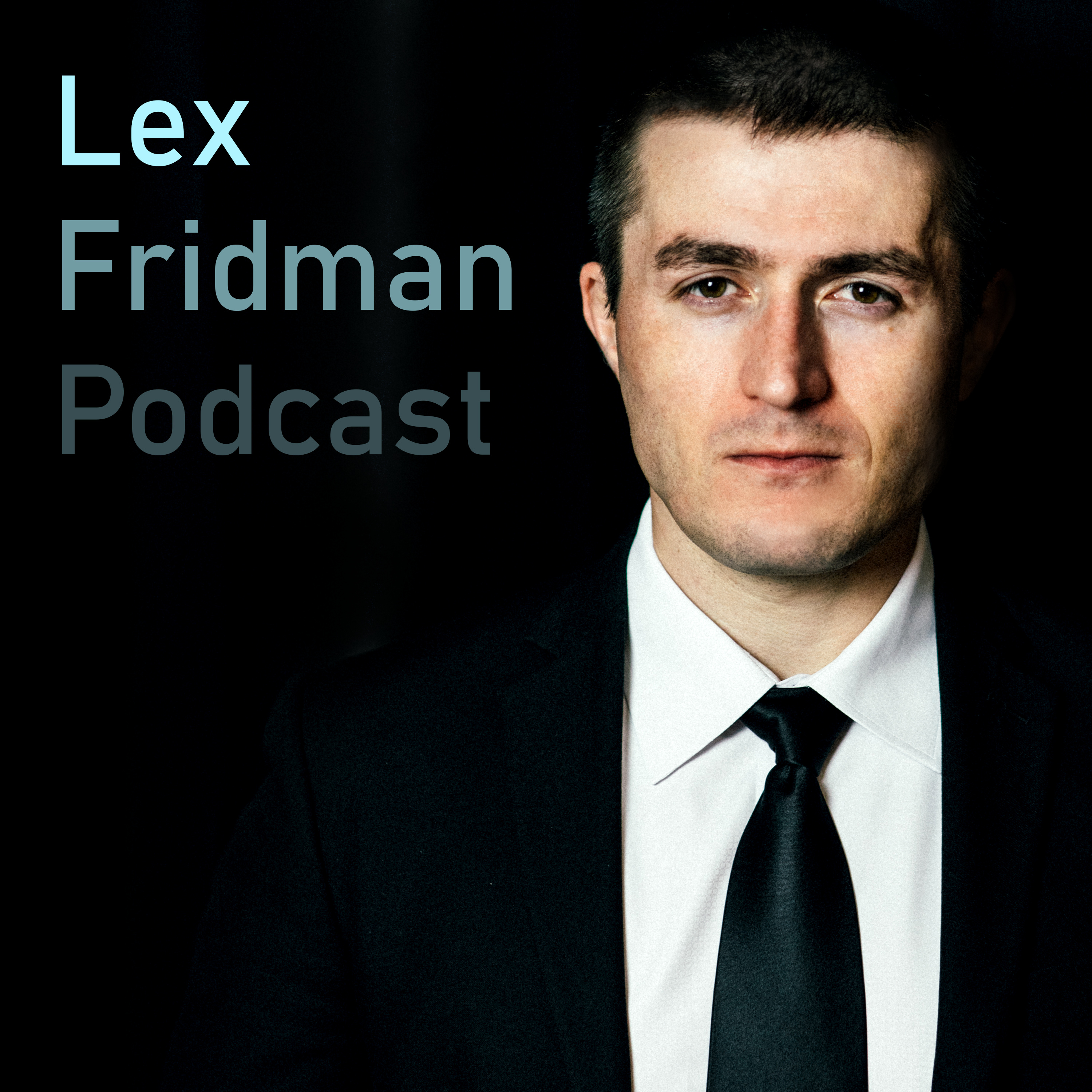
#504 ロシア・ウクライナ戦争:プーチン、ゼレンスキー、ドローンと戦争の未来
Lex Fridman Podcast
要約
Lex Fridmanが、元米陸軍将校でアフガニスタン帰還兵のPreston Stewartと、軍事アナリストのMichael Kofmanを迎え、開戦5年目に入ったウクライナ戦争を語った回。2026年は地上戦でウクライナが優勢でロシアは苦戦している一方、ロシアの戦略爆撃で冬の民生インフラが脅かされていると分析する。FPVドローンやキルゾーンなど戦場の実態、ワグネルの反乱、情報の歪み、和平の見通しまで幅広く議論した。
この回のポイント
- ●Kofmanは、2026年はウクライナの地上戦での成績が最良で、ロシアは2025年夏から秋ごろに転換点を迎え収穫逓減に陥ったと述べている。
- ●ドローンが損失の約8割を与えるとされるが、地雷原や砲兵との組み合わせで成り立つ防御であり、操縦には人手がかかり自律化の割合は小さいという。
- ●映像は成功例ばかりで、戦車1両の撃破にFPVが30〜40機、最悪の例では79機要したなど、実際の命中効率は見た目より低いと説明された。
- ●ロシアは兵士を送り込む浸透戦術で大損害を出し、前線の支配を過大に報告する文化が作戦や政治判断を歪めていると指摘された。
- ●ワグネルは解体後もその突撃戦術がロシア軍全体に広がり、小規模戦闘への過度な特化が収穫逓減につながったとされる。
- ●和平は、ロシアが要求を維持し冬の攻撃の成否を見ているため近い見通しは悲観的で、停戦が再戦の準備期間になる懸念も示された。
章立て
戦況の全体像と戦略爆撃
2026年の戦況を、ウクライナ優勢の前線と、ロシアによるインフラ攻撃の拡大という二面から整理する。2023年以降の経緯も振り返る。
地理と灰色地帯での戦い
ドンバスなど主要戦線の地理と、ドローンが支配するキルゾーン、浸透戦術、地雷や砲兵との組み合わせを解説する。
ドローンの種類と必要な数
偵察機、FPV、操縦人員の実態、1目標に要するドローン数、自律化の誇張を語る。
光ファイバー型と技術の反復
妨害を受けない光ファイバードローンや探知機を紹介し、両軍の3〜4か月周期の技術進化を論じる。
開戦時の予測とバフムート
2022年侵攻の予測の当否、権限委譲の差、バフムートの戦いと「要塞」化の教訓を扱う。
ワグネルの反乱と支配の虚偽報告
プリゴジンの反乱とその影響、ロシア軍による支配地域の誇張報告の弊害を語る。
指導者・外部支援・米国の役割
プーチンとゼレンスキーの比較、経済と人員、欧米の支援、米政権の関与への批判を議論する。
和平の道筋と人間性
停戦の難しさと将来のウクライナ・ロシア、戦争の中の希望として救出の逸話を語って締める。
解説記事
Lex Fridmanのポッドキャスト第504回は、元米陸軍将校でアフガニスタン帰還兵のPreston Stewartと、カーネギー国際平和財団のシニアフェローで軍事アナリストのMichael Kofmanを招いた、約3時間に及ぶウクライナ戦争の討論である。冒頭に長いスポンサー紹介があるが、本編は戦況、ドローン戦、指導者論、和平の見通しと多岐にわたる。以下では発言者の見解として整理する。
2026年の戦況:前線と後方で異なる景色
Kofmanは、今年がウクライナにとって地上戦の成績が最も良い年だと述べる。ロシアは2025年夏から秋ごろに収穫逓減の局面に入り、今年は2023年冬以来で最悪の戦闘成績だという見方である。ウクライナは局所的な攻勢で、2023年の夏季反攻より広い地域を取り戻した場面もあると語る。
一方でロシアは、巡航・弾道ミサイルから、ジェット推進型を含む大量の自爆ドローンによる飽和攻撃へと戦略爆撃を拡大した。標的はエネルギー施設に留まらず、データセンター、学校、医療施設、商業施設、列車にまで及ぶという。Kofmanは、戦略爆撃は地上戦の失敗を補って政治目的を達成した実績が乏しいと指摘しつつ、政治指導者は「自分には効くかもしれない」と考えがちだと述べる。冬のウクライナの都市がどうなるかは不透明だとした。
ドローンが支配する戦場の実像
ドローンが損失の約8割を与えるという統計に触れつつ、二人は「ドローンだけの戦争ではない」と強調する。地雷原が機械化部隊の突破を難しくし、砲兵は敵を分散させ動きを遅らせる。悪天候の春や秋にはドローンの効果が落ち、砲兵が重要な補完になる。前線の15キロ前後はドローンが支配するキルゾーンで、ウクライナは明確な防衛線ではなく、数人の見張り陣地と大量のドローン部隊で守っている。
映像が与える印象にも注意が促された。公開されるのは成功例だけで、「300ドルのドローンが戦車を壊す」というイメージは誤解を招く。実際には人1人に約5機、歩兵戦闘車に15〜20機、重装甲の戦車に30〜40機が必要で、最悪の例では79機だったという。また「自律化」は誇張されており、終末誘導などの半自律は全体のごく一部で、ドローン1機に操縦者、航法担当、技術者など2〜3人が付く人手集約的な戦争だと説明した。
技術の面では、妨害を受けない光ファイバー誘導ドローンが紹介された。ロシアが先行し、ウクライナも採用したが、全体の15%以下と見積もられている。探知機「Chuyka」で敵ドローンの映像が見られる一方、光ファイバー型には警告が出ない。Kofmanは両軍が3〜4か月周期で技術と戦術を模倣し合うと述べ、ウクライナは現場発の革新が速く、ロシアは有効と分かった手法を大規模に展開する力に優れるとした。
指揮文化、バフムート、ワグネル
Stewartは、西側の軍は現場の下級指揮官に判断を委ねるが、ロシア軍は上意下達で、渋滞に詰まって上級将校が多数戦死した例もあると語る。Kofmanは、2022年の開戦を予測した立場から、ロシアの計画が「解放者として歓迎される」という政治的前提に基づいていた点を読み切れなかったと振り返った。
バフムートについては、その喪失が戦略的に重大でなかったことは、次の町チャシフ・ヤールの攻略に1年以上かかったことで明らかだと述べる。それでも戦いは政治的象徴となり、ウクライナは西側支援への影響を恐れて「要塞」として固執した。この「バフムート症候群」は、撤退の判断がいかに難しいかを示す例として語られ、現在のコスチャンチニウカでも同様の議論が起きうるとされた。
プリゴジンの反乱は、国防省との確執の中で契約署名を迫られ追い詰められた末のもので、交渉材料としてモスクワへ進軍したという解釈が示された。Kofmanは、ワグネルは解体されたものの、囚人を使う突撃部隊という戦術がロシア軍全体に広がり、小規模戦闘への過度な特化で収穫逓減を招いたと述べる。
情報の歪みと政治目的のずれ
二人はロシア側の「支配地域」の誇張を問題視する。旗を掲げた兵士1人の映像で領土を支配したとする報告は、火力支援の配分を誤らせ、自軍の兵士を危険にさらす。さらにその虚偽の地図が上に伝わり、プーチンの認識を歪めている可能性があるという。Kofmanは、支配とは単に存在することではなく、地形を自軍の目的に使える状態だと定義した。
Kofmanは、ロシアの政治目標(ドンバス全域の獲得など)と軍事手段の間に根本的なずれがあり、その責任はプーチンにあると述べる。戦争が終わるのは、交渉による決着が戦場で得られるものより良いと双方が考えたときだが、ロシアの要求は開戦時からほぼ変わっていない。人員ではロシアが優位で、経済も制裁の効果は想定ほどではなかったが、国家予算の約44%を戦争に充てる状況は持続しにくいとされた。
米国の対応には厳しい評価が出た。Stewartは、軍事支援による交渉上の影響力を手放し、対ロシア制裁も十分でなかったと批判する。Kofmanも、米政権は同盟国との調整を欠き、予測しにくいと述べた。ただし前政権にも明確な出口戦略がなかった点、欧州側にも和平案がなかった点は付け加えた。
和平の見通しと戦争の人間的な側面
Kofmanは、ロシアは冬の攻撃の効果や欧州の選挙を見極めようとしており、全面的な交渉の意思は見えないと述べる。エネルギー施設への攻撃や黒海での攻撃に限った部分停戦はあり得るが、安全保障の裏づけがない停戦は再軍備の期間になり、ミンスク合意のように「第三の戦争」につながる恐れがあるという。
終盤には、ウクライナ部隊「Code 92」によるドローン搬送での負傷兵救出や、素手で負傷者を運び出した指揮官の逸話が紹介された。二人は戦争の悲惨さと、極限での人間の最良の面が並ぶ点を語って締めくくる。
まとめ
本回の核心は、戦場の映像や「ドローン戦争」という通念を、数字と構造で相対化している点にある。ドローンは決定的だが、地雷、砲兵、人員、補給と一体で機能し、自律化の割合はまだ小さいという指摘は、技術動向を追う読者にとって重要だ。また、組織文化(権限委譲か集権か、虚偽報告を招く懲罰的風土)が戦闘力を左右するという視点は、軍事に限らず組織論として示唆に富む。なお内容は二人の分析と見解であり、戦況の数値や評価は番組内の発言として受け止める必要がある。
文字起こし(英語・自動生成)
The following is a conversation with Preston Stewart and Michael Kaufman about the war in Ukraine. Preston is a West Point graduate and Afghanistan veteran who covers the war extensively on his YouTube channel called Preston Stewart, his podcast called War and Conflict, and his newsletter called Defense Tech News. Michael is a world-class military analysis expert specializing in the Russian and Ukrainian militaries. He is a senior fellow at the Carnegie Endowment, and he hosts the Russia Contingency Podcast on the War on the Rocks platform. Please follow and support their work. And now a quick few-second mention of our sponsors. Check them out in the description or at lexfriedman.com slash sponsors. It is, in fact, the best way to support this podcast. We got Give directly for direct cash donations, Fin for customer service AI agents, Element for electrolytes,
Whisperflow for voice-to-text writing, Shop for AI-powered shopping, and Perplexity, of course, for curiosity-driven knowledge exploration. Choose wisely, my friends. And now, on to the full ad reads. I try to make them interesting, but if you skip, please still check out our sponsors. I enjoy their stuff. Maybe you will, too. To get in touch with me, for whatever reason, go to lexfreedman.com slash contact. All right, let's go. This episode is brought to you by GiveDirectly, a nonprofit that lets you send cash directly to people in need. This is the interesting thing, perhaps a bit counterintuitive, but the GiveDirectly approach is an extremely effective way to help people. And that's not to have a chain of middlemen through which you pass the money and then there's this whole cost of administration and so on and so forth. And you don't really have a sense of who the money is going to and what is the cut that each of the people that carry the money along the way take.
It turns out GiveDirectly basically gives cash directly to the people in need. and the fascinating thing is this over and over and over, researchers have studied this hundreds of times in hundreds of places and the same thing is found every single time. The families earn more, they eat better, the kids do better in school, they do better health-wise, all of it. This is the way it works. Give money directly to the people that need it. There's a million studies to pick from. In Kenya, for example, every one dollar that give directly delivered grew the local economy by two and a half dollars. And at the end of the day, there has to be a data-driven component. You have to do the stuff that actually works, and GiveDirectly works. If you're just hearing about GiveDirectly, don't donate yet. Just go to givedirectly.org slash lex and read some of the stories and studies first. You will be blown away. That's givedirectly.org slash lex.
This episode is also brought to you by Finn, the number one AI agent for customer service. 65% average resolution rate. It's trusted by over 6,000 customer service leaders and top companies, including Anthropic. Yes, Anthropic. By the way, I'm long overdue for an episode with Anthropic. But there's a huge number of other companies. You know when an AI company trusts another company to do an AI thing for it? They're legit. Finn found a niche and executes incredibly well on it. Their whole system obviously leverages AI in the loop, and it's built to handle complex multi-step queries like returns, exchanges, disputes, all of that fun, beautiful, messy customer service stuff. Go to fin.ai.lex to learn about transforming your customer service and scaling your support team. That's fin.ai.lex. This episode is brought to you by Element, my daily zero-sugar and, very delicious, I'm sipping on it right now, electrolyte mix.
It's the thing I drink before I run, it's the thing I drink after I run, it's the thing I drink in the morning as I stare into space and think about the fact that we're descendants of apes on a spinning rock flying at insane speeds through space. All of it, including my own mortality, passes through my mind at a regular rate, especially in the morning. As I get ready for the day, as I get ready to sit down for the first deep focus session of the day. But also, I mean, quite honestly, especially when I'm fasting, especially when I'm doing carnivore, doing very low carbs, which is my happy place. It just makes sure that I feel good. No headaches, none of that. No keto flu. Getting the electrolytes right is extremely important. And then Element just makes it easy. Get a free 8-calc sample pack with any purchase. Try it at drinkelement.com.
This episode is brought to you by Whisperflow, the AI voice dictation app that lets you write by speaking. In fact, I've gotten more and more used to speaking, the very thing I'm doing right now. As a basic mechanism by which I communicate with AI, I gave away Shudder, my Kinesis keyboard. I no longer use the Kinesis keyboard as a tear slowly rolls down my cheek. So it was a tough goodbye, but at the end of the day, it's just a better mechanism of communicating with AIs using voice. But anyway, Whisperflow is far superior than anything else. Highly recommend you try it, whether it's on the phone, on your desktop, anywhere. If you do AI stuff, if you do any stuff, it's a really nice way to convert your voice to text and it just works and it figures it out and makes like an order of magnitude less mistakes than any systems that I've tried before. Go to whisperflow.ai.lex to get one month of Whisper Flow Pro free.
That's W-I-S-P-R flow.ai.lex. This episode is also brought to you by the shop skill. It's shop.md.lex. This is such a weary world. How crazy is this? How crazy fast did all this evolve? I am now speaking words that recommend to you like it's a normal thing to be using your quote-unquote agent, your AI agent, to buy stuff for you. It's crazy. It is so crazy. But yeah, this is quite incredible. Obviously, things that should exist if you do any kind of program, if you do any kind of agentic stuff, and if you do any kind of AI integration into your own life, obviously your AI should be able to buy stuff and this is a really really powerful way a really easy way to do just that you have to go to shop.md copy the prompt that it gives you
paste it in whatever agent you use and then you go from there I wonder how many other things like this there will be where you realize this obviously should have existed a long time ago turn your agent into your personal shopper with the shop skill Go to shop.md.lex. It's a bit surreal for me. That's shop.md.lex. This is the Lex Friedman Podcast. To support it, please check out our sponsors in the description where you can also find links to contact me, ask questions, give feedback, and so on. And now, dear friends, here's Preston Stewart and Michael Kaufman. Gentlemen, thank you for doing this late night conversation.
Let's see how long we go. The war in Ukraine is in its fifth year. Let's lay out what is the state of the war in terms of territories, in terms of battles, in terms of everything that you talk about from a military perspective. Mike, do you want to go first? Yeah, sure. I think that the war had probably an inflection point last year, and most people recognize that this year for Ukraine is the best year of combat performance for them on the ground, so it's probably about the summer 2023 offensive. But there's a dichotomy to it because, on the one hand, Ukraine is doing really well along the front line, but it faces the challenge of an expansive Russian strike campaign and the cumulative damage has been inflicted to Ukrainian infrastructure. both energy and all sorts of civilian types of infrastructure over the course of several years. And so the winter is quite uncertain on what's going to happen in Ukraine's population centers. Now, I know Ukraine has proven resilient and is going to get through this winter, but the level of damage to the economy remains unclear.
The Russian military is doing quite poorly this year in the war. For them, this is probably their worst year of combat performance since winter of 2023. and it's clear that the way they've been fighting has reached diminishing returns, not in 2026, but I would probably peg it as far back as summer of 2025. The increase in will face some manpower issues, and their effort now fixates more on strategic bombardment, which while inflicting a lot of damage on Ukraine, has historically a challenge in that strategic bombardment does not have a great track record or even a good track record of achieving maximum political aims in the war, especially if a ground campaign is unsuccessful or sloundering, as Russia's is at this stage of the conflict. So the history of strategic bombardment as a way to try to win the war in the absence of the success of other efforts is not a good one. Although as an analyst, I'll tell you, most political leaders always think that it might work for them, even if you tell them that it doesn't. And so it's unsurprising to see that Russia is now leaning heavily towards strategic bombardment as a key pillar of its strategy.
I think it would also be nice to lay out the basics every time you bring them up. Sure. Maybe can you give a quick tangent of the 2023 offensive and then what strategic bombardment is as opposed to the other mechanisms of war? Sure. So in 2023, there were a series of fairly set-piece offensives and counteroffensives. After a partial mobilization with manpower replenished and some reserves established, Russia attempted a winter offensive, but its forces were unready. And so the winter campaign for Russia in 2023 was largely a failure, perhaps with the exception of the grinding battle over the city of Bukhmut. Then Ukraine launched a much anticipated summer offensive using units that were freshly trained and equipped by Western countries. And there was a great deal of hope and expectations that were placed upon this offensive. But it too failed. It lasted several months. I think in reality it went from June 2023 to about November of 2023.
and then Russia tried to seize the initiative again and started its own offensive in fall of 23rd with the Battle of Divka. But so summer of 2023 is one of the periods where we still see an exchange in terms of initiative between the two sides and fairly clear-cut major offensive operations and counter-offensive operations. And in 2023, early on, you have a failed Russian winter offensive. This is probably one of the worst points for the Russian military in the war, fall through winter, fall 2022 through winter of 2023. and then you have the Ukrainian summer 2023 offensive, where Ukraine does gain some ground, but it's not what people hoped for. And since then, for much of the war, you see Russia trying to establish and having an advantage in manpower and material, and for much of 2024 and 2025, Russia actually tends to have the initiative, even though it's largely pursuing a grinding offensive on a very broad front. And if I sort of fast forward and take us into 2026, You really start to see the inflection point probably around fall of 2025,
and then in 2026 the Russian effort is floundering, and Russian forces face significant reversals with the battle space a lot more dynamic this year. Ukraine has two of its own localized defensives running, and you see there's actually much greater fluidity in 2026 on the battlefield, certainly at the tactical level, than you would in 25 or 24. There's often a perception that just a positional stalemate. But in fact, even more recently, some of Ukraine's offensive operations had gained more terrain than Ukrainian forces were able to do during the summer 2023 offensive, which was planned to be a much bigger operation. Also, it might be useful to kind of state perhaps the obvious, but the nature of this war. one of the things, especially as it evolved, the role of drones on the front. And maybe this is where you can loop in strategic bombardment as well, like what are the main mechanisms of war here? So we look at this war beyond what's happening at the front line.
Russia has, from the very beginning of the war, had a series of strikes, an expansive strike campaign, but it really begins in fall of 2022, where they begin launching combination strikes of long-range air-launched cruise missiles and short-range ballistic missiles against Ukrainian critical infrastructure. And by critical infrastructure, I mean power plants, substations, various types of heating plants, things that a country needs in order to sustain the economy and the population. And over time, those targets expand, right? Russia targets various types of civilian infrastructure. And actually, at this point in 2026, we've seen that campaign really broaden to include warehouses, data centers, schools, medical facilities, malls, actually quite a few shopping malls in the last few months, trains. So it's gone far beyond energy infrastructure to include a host of other civilian types of targets.
And it changed over time from being primarily done with cruise missiles and ballistic missiles to being mostly conducted via saturation strikes using large numbers of one-way attack drones. And those drones themselves evolved in terms of the systems gone now from being largely done with cheaper, easier-to-shoot-down propeller-driven drones to ones that are jet-powered and are, in effect, light ground-launched cruise missiles. and a much larger number of ballistic missiles, some which are more sophisticated. And so Ukraine's been facing both large combination strikes, but also daily sustained pressure. Constant attacks with jet-powered drones that generate alerts and disrupt economic life and try to exhaust Ukraine's air defense. By the way, I forgot to mention that I'm a big fan of both of yours. It's an honor to have the both of you here, Mike and Preston. And Preston, I've been watching you for a long time.
So thank you for being here. So, yes, to ask you to build on what Mike was saying, and maybe can you also speak to some of the geographic areas that are in question here that are most contested? Yeah, absolutely, Lex. It's an honor to be here. Always a challenge to add anything to what Mike has to say. We'll give it a shot here. I think it's good to get an idea of the areas that we're going to be talking about. In Ukraine, the fight still is predominantly in the east and the southeast. So Kyiv, kind of in the middle of the country, is not facing direct Russian attacks in terms of infantry and short-range drones. They, of course, are on the receiving end daily of long-range drones and missile strikes. But as you move through the border region, starting in the north, there are Russian infiltrations in Sumy. There's also fighting in Ukrainian territory in Kharkiv. And then you get down into what's known as the Donbass, Luhansk, and Donetsk. And this is where some of the heaviest fighting throughout the war has taken place. And this is, I'm sure we'll get into it later, but an area referred to as the Fortress Belt.
The Ukraine has turned into just an absolutely brutal area for Russia to try to advance through. It's costing Russia a lot of people day in and day out. Moving from there, we're into Zaporizhia and then Kherson butts up against the Black Sea. And some of the strategic bombardment that Mike was talking about. So that's beyond even these areas. So Kiev is being hit. So a lot of the places throughout Ukraine is being hit. And some in the western portion of the country, not as frequently. Kiev is a focus. If you look along the front today, you have essentially some Russian border incursions trying to establish a small buffer across the border, which are lower-intensity areas of fighting in Sumi-Harkiv. You have an ongoing fighting around the city of Kupiansk and the Kharkiv region. and then you have the focus of our offensive efforts, Preston was saying, still trying to take the remainder of the Donbass and that fighting ranges all the way down from cities like areas like Liman
all the way towards the main conglomeration of cities and we should mention them now because I think they're going to come up that are remaining in the Donetsk region which are Slaviansk, Kermatorsk, Durskivka and Konstantinovka, which troops all colloquially call Konstaha because its name is too long. And then further west of that is Dobrypulia, which is the main city now that's been essentially an anchor in Ukrainian defense, west of that conglomeration with another chain of cities behind it. And if we had southwest, we'd get into the Dnieper region and Zaporizhia. And Zaporizhia is an interesting, fairly dynamic area because you have both Russian and Ukrainian forces on the offensive at the same time, where you have Russian forces trying to push west of Hulipulya, and you have northeast of that Ukrainian forces having had the initiative for much of the year, a tactical grouping of Ukrainian air cell brigades have been running kind of a creeping offensive there. So it's been pretty successful in making gains.
And the other area, which we might get into later around Liman, was Ukraine's third corps having conducted a successful offensive operation as well called Vivaldi. So those are the two areas where Ukraine's not only contesting the initiative, but actually it's liberating territory, and in many ways wiping out Russian gains from 2025. And that's what I meant when I was saying earlier, that there's a much more dynamic battle space than people think, in that territory is a lot more fluid. There's a vast gray zone, in fact, between the two lines. Ukraine does not hold cohesive defensive lines. It often has essentially pickets with a small number of infantry that mark positions, but much of the territory is essentially contested such that in a battle space defined by dense control fire drones and a sort of a excitable engagement zone, which varies from place to place, but you might say roughly it might be 15 kilometers forward and back of the front line, although in some areas it's more and other areas it's less, it depends. What happens is in reality that it becomes more of a gray zone,
and the presser was saying Russian forces tried to get past this drone engagement zone or defeat zone through infiltration. That's their main challenge, either through individual infantry, through light motorized attacks on motorcycles and ATVs, and they tried to essentially get as far back past Ukrainian positions as they can, whereas Ukraine is largely defending with a combination of prepared defenses, minefields, and a large array of drones and drone units that are effectively engaging Russian forces before they get to even their own front line, their forward line of troops. And if they get past that point, they get past Ukrainian initial positions, then Ukrainian drone needs to essentially pick them up there. So it's in many respects kind of a zonal defense. But we should unpack that a bit because people see this as a drone war, and the statistics out there do show that drones inflict 80% of losses. However, it is really a combination of things. and the dynamic is one that involves traditional defense on minefields
that make it very hard for mechanized assaults or light motorized assaults to break through. Artillery still plays a role in the battlefield because it forces the enemy forces to disperse. It has a shaping dynamic. Even if you don't use it much, the fact that it's present, it makes it hard for troops to concentrate or suppresses them. It slows them down in an assault, making them easy targets for drones. And it's still relevant because drones also have their own limitations. And two periods of war when they often have limitations seasonally are spring and fall, again to winter, because the weather becomes poor. You get high wind, you get rain. Drones don't work nearly as effectively during poor weather. And so artillery is a very important backup. And if you just had drones, you didn't have anything else, no minefields, no artillery. I don't think Ukraine would be able to hold the terrain this effectively with a low density of forces, the men that they currently have deployed. So it's important to describe as a combination of means.
Even if drones play such a central role that folks don't ignore the interaction of these different capabilities in Ukraine's approach. So sorry to linger on the basics, but can we like lay out, so artillery is big guns. What's the role of individual infantry? What's the role of tanks? What is this gray zone? What does it actually look like? How many drones are floating above? What does it look like, as Preston was saying, for an individual infantry soldier to run through that? Can you paint a picture of some of the basic things here? Not good to run through that. It's terrifying. There's constant eyes in the sky. But to kind of walk this out a little bit, artillery, generally speaking, 105 or 155 millimeter cannons. That's what we use here in the United States. It's primarily what Ukraine has been using now as it kind of shifted over to a NATO standard. You're talking about 20-ish kilometer range, which at a time was big. And there was a phase in this war where that was seemingly to determine the direction that it was going to go.
It was who had more artillery, who could mass fires in certain directions. It's just changed so drastically now to where the drone range has pushed those further and further back. So cannons are on the battlefield. There are some that are dug in kind of in entrenched positions. Others are mobile on tracks or wheels. They've got to get out of there. As soon as they fire, there's so many drones overhead watching them. When you get into the drones then on the battlefield, there's a number of them being utilized. Reconnaissance drones is kind of where everything starts, and those are just big fixed-wing drones for the most part that can stay airborne for quite a while. They're generally low cost. And that's been a dynamic that we've seen with both Russia and Ukraine in this war. They've gone from the very few but high cost, maybe larger drones, down to a ton of low cost, borderline attributable. They don't want to lose all these drones, but it's not that big of a deal to lose one compared to, say, a U.S. Predator Reaper that costs, you know, 20 plus million dollars.
So they've got these reconnaissance drones up constantly. Both sides have these up. when they spot something that is passed along to the appropriate drone unit and is engaged based off of what they have available to them. The, I would say, most common one that we see in terms of the media that has the most attention would be the FPV drones. Those are small quadcopters. You see them flying 12 inches, 18 inches. I think they might get up to 20 inches at times. Generally, there's a munition attached to the end of that. they crash into something and it detonates. They can swap that out for anti-personnel munitions or go after vehicles or fortifications. And they can do that on the spot. So there are mountains of these FPVs. There is a picture of Kim Jong-un, actually, North Korea, walking through a hallway of stacked FPVs. So these are the very small, low-cost, attritable drones, and they're being used. The numbers are staggering.
I'd say for FPVs, it's probably somewhere 8,000 to 10,000 per day, just those not including other types of tactical drones. And that would be for one side of the war. So to give you a sense that these are hundreds of thousands of these being employed per month, these strike capabilities exceed all the numbers of personnel and equipment on the battlefield by very substantial. And just to clarify, behind every FPV drone, there's a human being operating it. So there's also, from the news or something, there's a sense that autonomy is being utilized. It is not. So this is something you guys talked about. There's usually humans behind the drones. So I'll be frank. Most of this war are systems that are remotely operated, but they are operated by people. It is actually quite manpower intensive. And, in fact, in many cases, if you look at both Russian and Ukrainian military, They had to build out substantial numbers of drone units and channel manpower into the drone component of the fight. It's not even a ratio of one-to-one, sort of one person-to-one drone.
A typical drone team might require two or three people. You have a pilot. You have a co-pilot navigator. This is exhausting, tiring work. I'm not saying that other traditional missions are easy, but with a drone, you have to be looking at a screen the whole time, all day. You have to be flying, and it's very intensive. somebody else has to navigate. Another person might be the technician or the person who arms the system. And so almost all the systems in this war are remotely operated, whether they're flying drones, one-way attack strike drones, whether they're UGVs, uncrewed ground vehicles. And they require considerable support. At the end of the day, these are physical objects that require equipping, they require troubleshooting. Like most things in war, they don't even necessarily work well or right out of the box as well. It's what a lot of people don't necessarily appreciate about military affairs. A lot of things don't necessarily work as intent on the battlefield. Somebody's got to be there to fix it. They got to be there to check it. So the bottom line is that it is actually quite manpower intensive.
There is a degree of semi-autonomy, terminal guidance and targeting at the very last point. Or maybe the pilot can hit a box over a vehicle, and then the drone knows that that's what it should go after, these kind of moments. And ways that the drone can overcome enemy electronic warfare or jamming with this kind of terminal guidance. But most of these use cases are a tiny percentage of the overall fight and the overall number of drones being employed in this war. I think in some ways, I hate to take away from the autonomy and artificial intelligence conversation, this war is testing that, and there are plenty of areas where I see it's being tested, but to some extent it's been overhyped in terms of the percentage of the fight that's actually being run that way. It is very much still a human-centric war with a lot of manpower involved running, operating, and maintaining all of these capabilities.
So one of the other novel aspects of this war, so much of it is televised, so that you could see videos from the drone perspective on both sides of that drone killing another human being. it takes one drone to accomplish that task, and it actually takes a lot more. Can you speak to that in terms of the number of drones it takes to accomplish a particular task, like to destroy a piece of technology or to, I don't know the right way of speaking about this, but to kill another person? Yeah. Eliminate a target might be a cold way of saying that. we're in an interesting place where there's a lot of propaganda value in footage for anybody using it in any military right now in a way that we didn't have access to even just a few years ago so there's a lot of interest in being able to show I mean we have seen now people will not take reports that something happened unless there's a video of it which is insane because that
you know a few years ago you would never have expected to have video of a missile strike in Crimea on a Russian airfield. Now, if there's no video, maybe it didn't even happen. So the expectation is there, and countries are meeting that by being able to say, like, look, we penetrated your defenses, look what we did, or look at all the soldiers we killed as we were making this approach. So it's out there. There's only a tiny fraction that's made public in the first place. And of those, that's only a tiny fraction of what actually accomplishes the mission. So drones, the batteries run out, they get jammed, and all of a sudden the screen just goes dark. Sometimes they impact and they don't detonate. You know, all sorts of little things like that. That footage doesn't make it out. It, in turn, kind of creates this perception that one $300 drone or one $500 drone is eliminating the tank, and that's not happening. Maybe with the right munition and with a lucky shot and the tank isn't expecting it, maybe it's possible. Realistically, we're seeing 10, 20, I think upwards of 30 of these small drones
at times being utilized to actually eliminate a tank. So we should be imagining a very large number of FPV drones just hunting humans in tanks and technology. The problem with understanding what the ratios are is the videos have a strong anchoring effect, and the videos are all videos of successes. There are no videos of misses. So unless you're actually there, you're able to collect the data, you don't know what percentage of hits or percentage of drones launched that really is. you might get easily the impression that 100% of the drones launch a hit. As Preston said, that's very far from the case. So you need quite a few drones. For people, even though on videos it looks like a one-to-one ratio, it's often not. I think it's often a lot closer to maybe five drones or something like that. Per person. Yeah, in practice. And I've seen, I'll be frank, I've myself seen videos that aren't public where in the most extreme case I saw one on a field trip in July where it took 12. On tanks, the most outside example I heard of a well-armored protected Russian tank with electronic warfare,
one of these tanks that looks like a large barn, essentially, it's so heavily protected, last year was 79. That's an extreme case, but most, as Preston said, is about 30 to 40. For an infantry fighting vehicle, about 15, maybe 15 to 20, depending, again. and you have some percentage of drones that are jammed that will make it to a target. You have some percentage of drones that may fail to detonate. So it's quite a few. And, you know, in talking to folks who are trying to return mobility and maneuver to the battlefield that specialize in drone-enabled mechanized assault where they have both mechanized units and drones supporting them, a company, the mechanized company that goes on attack now, expects to take about close to 300 hits in that assault. They expect vehicles to take quite a few hits and most to be able to withstand them. So it does take quite a few drones. But the sheer saturation of numbers of drones out there is very difficult to overstate.
So given that, what did the battle look like? How do you gain territory given these drone units, this huge amount of drones, this gray zone, also mentioning artillery, like you mentioned, and tanks? how do they work together in order to be able to do something like gain territory? Well, they're doing it differently now. We're seeing a very different approach from Ukraine than we are from Russia. I can try to speak to the Russian part if you want to maybe take the Ukrainian offensive here in a second. But Russia has defaulted to more of an infiltration-type tactic, where rather than large formations, they get spotted, again, 10, 20, 30 kilometers away from the front, and they're then hunted down with long-range drones. They don't even have the opportunity to get near the front line, so they stopped doing that. We started to see Russia move towards more motorized assaults, with just pickup trucks, ATVs, even a lot of motorcycles at a point. Now it's mostly just individual infantrymen. They have checkpoints on a map. They're released, and they're sent forward 5, 10, 20 kilometers,
trying to move to a forward location where they can consolidate. And again, the Ukrainian lines, they look clean on a map. They're not. There's a lot of gaps in there because a lot of it is being held with overhead drone coverage to just monitor approaches, and the Russians will get through. And one is a bit of a headache. Three becomes a bigger problem, and all of a sudden they're harassing supply lines, and that forces Ukrainian units to move back a little bit, forces Ukrainian drone pilots to move back a little bit, and that opens up the battlefield for more Russian soldiers to come forward just a little. There's a reason that the lines are moving so slowly right now. That infiltration is incredibly costly. We talked with an American volunteer, a Marine, fighting with the 1st National Guard Corps, as of in the Dopropili direction a little over a year ago. He described this as an incredible tactic if you don't care about losing soldiers. He said, it's great. You can just kind of chew through terrain. You can get there eventually. You're just going to lose 90%, 95% of your guys along the way.
that's generally what we've seen from Russia over the course of the last at least six months maybe a full year Ukraine has been going about it in a different manner especially with some of their recent counter-offensive stuff the way I look at it first that in in 2025 this war really began to be much more of a tug of war over who has superiority in this drone engagement zone which forces locally call the kill zone. And the side that is able to suppress the other side's drone units through drone strikes, traditional artillery strikes, for Russia also heavy use of glide bombs, standoff glide bombs launched by Russian fixed-wing aircraft, that side is then able to push the drone support further away from the front line, and then by displacing it, then be able to actually advance in that way. And so a lot of it's been a tug of war actually over who has superiority in drones and fire support. And increasing on the Ukrainian side, where we see successful offensive operations is because you have a very well thought through plan to set the conditions for the operation,
begin to suppress Russian drone units, begin to interdict logistics behind the drone units so that they don't get sufficient supplies, begin to figure out how to potentially channel them by essentially pushing them into certain zones of operations where you can then localize, figure out what they're going to be when you're going to do the assault, then having a coordinated strike plan for how you're going to suppress them during the assault, and then now you've actually established the conditions for your forces to advance with some mobility and to dramatically reduce your losses because Ukraine cannot afford to fight the way Russia does. It doesn't have the manpower, and it doesn't, even if it did have the manpower, it's not a question of numbers. It's a question of culture. Ukraine would not treat its forces in the same way. It wouldn't accept those kind of losses of its own troops. And so you've seen a couple different approaches on the Ukrainian side probably the past year, and different assault units experimenting with them. You know, you have, I think, some advanced drone assault units like Code 9-2
and First Separate Assault Regiment that often work together. who are essentially using a combination of drones and very well-equipped and adapted mechanized formations to try to return maneuver to the battlefield and try to take terrain in a more mobile way, do it faster rather than having a kind of slow-moving, grinding, creeping offensive. And you've seen all the way down to maybe the opposite side of the spectrum, Air assault brigades very effectively employing three-man fire teams with drone support, systematically clearing tree line by tree line by tree line, slow and steady, but keeping their casualties low. This would be in the south in Zepraisia. And on a broad front, still over time over the course of this year, taking back a significant amount of terrain. And a bunch of other methods in between. So I won't say that there's been one method, but different units experimenting with different ways of doing it. And on the Russian side, as Preston said, it's a combination of mechanized light motorized assault sometimes,
but increasingly Russians are using mechanized assault simply to consume the attention of Ukrainian drone units, to distract them or try to basically get them to focus on the mechanized assault so that light motorized assaults can get through, can get past their initial positions, all these soldiers on motorcycles and ATVs. And even, believe it or not, I've seen Ladas and things of that nature. For the infiltration side, like literally soldiers on motorcycles. Yes. Trying to gain position so they can then attack the supply chains to force Ukrainian forces to push back. Let me maybe take one minute just to explain why that can be a challenge for Ukraine. Because it may sound to someone listening to this a bit preposterous, right? So let me offer why that can pose challenges. And sometimes light motorized attacks have proven more successful in traditional mechanized attacks. Because mechanized attacks are a small number of vehicles. Typically, the leading vehicle has a big trawl to clear mines. You know, Ukrainian drones can easily gang up on it and then start isolating the comm.
And light motorized attacks is a whole number of soldiers. It could be 100 motorcycles. It could be more than 100 motorcycles who are trying to use speed to overcome this sort of engagement zone. And the reason why that can be an issue sometimes, even though most of them get taken out, I want to be clear, most of them are not successful. But Ukraine forward positions are often three-man posts. They're not even really firing position or observation posts. They're essentially pickets with considerable separation between them of several hundred meters, right? So Ukraine might have three of these four kilometers. That means there's considerable space between them. So you could drive through. Then behind them there might be secondary positions, but they're still pretty sparse in between. Most of the units involved in the fight are essentially supporting units, different type of fire support, drone support, traditional artillery fires, logistics, what have you. Many Ukrainian units don't really have the manpower to nearly launch a counterattack if Russian forces break through.
Some do. Some have a quick reaction force ready. But for some, the manpower is necessarily there. So it can be a challenge if units do get through and they begin to accumulate. And what can happen, and this is how infiltration works for Russia, even though it's incredibly costly. You can imagine 10 soldiers going forward. And seven of them don't make it, but three do. And they found the path in between positions. So now the people that sent them know that this is the gap in Ukrainian positions. and they can then, days of change, send the next group down this path. Now, somewhere behind Ukrainian lines are now three Russian troops, but maybe it's five, six, seven. Now they're accumulating. Well, behind those positions, if you get three to five kilometers back, now you're reaching the first drone reconnaissance units that are flying Mavics. They are not prepared to receive an enemy assault team. They are flying drones. So for them, this is already an issue because if Russian assault troops, If only three or four or five of them are operating in your depth, and Ukrainian units do try to hunt them down, because if they let any number escape, then they get to the drone units.
Then you start losing your drone units, your support personnel. It is a real issue in the battle space. So that's essentially how infiltration works over time, although it's incredibly costly for Russia. It's a grim calculus. But it's a combination of that and also trying to fight for superiority in drone employment overall. Who has more drones? Who has more dronians in the fight? Who has more fire support? Who's able to suppress? Who's dronians to then allow their offensive tactics to have some purchase and success? Quick pause. There's coffee downstairs for people just listening to this. This is late at night. We're pushing through. This is amazing. Okay, we're back. I guess I should also ask, what kind of drones are we talking about? So I just pulled out the, what is this, the Mini Pro CGI drones, five. How many drones like this are there? And also I should mention that some of them have a cable for them, right, fiber optic cable.
And I think, Preston, you've talked about throughout all this. At first, you were skeptical when you visited initially, but then you kind of saw the wisdom, the effectiveness of fiber optic drones. The fiber optics are terrifying in a lot of ways. But to answer your question, the Mavics, those are still utilized. All things considered, they're relatively expensive compared to some other systems that Ukraine has. And those are not manufactured in Ukraine. And a lot of what they're using right now, they're building themselves. So FPVs are a bit bigger than that. But the term drone is so broad right now. I mean, all the way to describe effectively missiles that Russia is firing and Ukraine is firing in Russia that are the size of cars. So we've got everything from very, very big to very small and everything in between. The fiber optic one is interesting. So one of the major defenses against drones, and we use it in the U.S. military, is jamming electronic warfare, making it to where these munitions or anything doesn't function in a certain area. And I think it was Russia originally that did it.
You might can correct me here, but they certainly rolled it out relatively quickly, and they attached a very thin fiber optic cable that spooled out of the drone back to the operator. And what that did then was it brought that signal internal, and the jammer stopped working. So all of the electronic warfare in the world isn't doing anything. That drone flies directly through it. Now, the limitations are that there's a cable behind this drone. as thin as it is it does have some weight to it which means a smaller payload or a smaller distance or shorter distance of the drone to fly those can get hung up at times but we saw Russia roll that out, Ukraine quickly mashed it and that is a serious threat right now at longer and longer distances I think we've seen them upwards of around 50 kilometers at this point The first time I heard this I thought it didn't compute in my head So you just said 50 kilometers. So that's a very long cable.
It's a drone connected by a cable. It didn't make any sense to me. That could be a reality. Maybe this is a good place to kind of ask the nature of war, which is figuring out different technologies that are actually effective on the ground, like figuring out what's effective even if it seems crazy. Yeah, I mean, as President said, Ukrainians initially experimented with them, didn't adopt them, but then Russia started adopting them pretty heavily after employing them in Kursk. When Ukraine had the Kursk offensive, that's when Russian units really started first using fiber optic cables. They saw them as being effective. I'm demonstrating this as a case, as an example of the case, at least. And once they saw that it was quite effective, impossible to jam, right, because you literally have a cable attached to the drone, the drone lays behind itself as it flies. Think of it like a very thin fiber optic cable filament, like on a fishing rod, the reel that you would do. It's about that width, too. It's very thin. It's very thin, and it's a spool like a reel on a fishing rod. That's literally what the thing is on it.
It's a spool, and it's just this cable is coming out behind. You have to fly it carefully. You have to fly it slowly. You can't fly it like the drone you had here, this Mini Pro. You have to be more cautious because you have to think how the cable is being laid on trees, on roads, on other things. you have to remember that you have a cable, not a radio signal connecting yourself to it. But nonetheless, it's quite effective. And then it's spread from the units using in Kursk because other units saw it as a successful practice Once people see something that effective they say I want to try that too Then it spreads to other units Then as Russia was reading against Ukrainian units Ukrainian units began adopting it as well. Not at the same rate. Fiber optic cable drones are still a fairly small percentage of the overall tactical strike drones used. And I'm not sure, I hate to say I'm making this number up, but it's 15% or less, I think, overall. That said, they play a very important role because you can't jam them, and also they're much more difficult to detect.
Ukrainian units, everyone commonly has systems of detection, force drones, that are flown via an analog radio signal because it's open and it's easy to intercept. So you often have a device, for example, it's nicknamed the Chuyka, one type of it. I've always had one in the vehicle in driving. There's three antennas coming out of it, which receives signal on three different frequency spectrums. And if there's a drone coming towards you, the way things work is once a drone that's using an analog radio signal is closer to you than to the operator, the signal strength can be stronger to you, so you can start to receive the signal from it, and you have like a little screen that you can see the video feed of an enemy drone coming. And with a fiber optic cable drone, you have nothing in terms of warning because you can't perceive that signal. But the way I look at it is that there's been about a three to four-month cycle of evolution of technology and tactics in this war between Russian and Ukrainian forces,
and they iterate fairly quickly. So both sides have enough defense industrial capacity, enough capital, enough folks working on this, that if one side is using something and it's demonstrated to be effective, they assume and anticipate that the other side is going to begin to imitate them and adopt those technological capabilities. And usually the interaction between the two, and I'm very broad brushing this. So Ukraine has often led in terms of tactical development and bottom-up innovation because of the way Ukrainian units all experiment on their own and all have – they're kind of all defense startups. They all have kind of their own R&D section. They have their own defense shop or company that's building drones for them. So technology tends to, you know, bloom more. Like I remember when EW was really exploding in 2023, 2024, and folks were calling it like an electronic warfare jungle because all these different systems were appearing. And so Ukraine tends to innovate faster.
Russian military was slower. But Russia had, in some ways, more capacity and tended to be better at scaling a solution once they identified it. And this was Ukraine's frustration, that once the Russian military identified something as effective and they saw that Ukraine is doing something well, they would then allocate capital, industrial capacity, scale it deployed across the force in a standardized way a bit faster. If I can add something to this, Lex, because it's an aspect of this that we just kind of, and Mike did it here, and I do it all the time too, is you just rattle it off like it's normal, and it's so far from normal. The Chuika drone detector, what that means is it looks like an old Game Boy. It has a screen on it. So you're driving down the road in Ukraine, watching the screen. It turns on, and it is the enemy's view of the drone. Is it your vehicle, or is it a different vehicle? And you can watch as the enemy drone comes in at you. For soldiers in tree lines, they might be watching and trying to decide, does that drone see us?
Do we need to move? It doesn't see us. It's looking the other direction. It's literally watching the feed of the Russian soldiers that are hunting you. That is just about everybody along the front has that right now. It's just a weird dynamic that brand new to war. It beeps when it picks up the signal. And so when you're holding it, it's not a pleasant feeling for everybody else in the vehicle that you can see it's beeping. It's picking up the signal on any drone. and I have had times where folks seen me looking at the screen, it's a small screen, looking at the screen of the enemy drone and then looking to your right, kind of looking at your surroundings to see, is this close to me? Is it kind of looking in the same area or not? So it is exactly as Preston describes it. So there's a surreal aspect to this. It feels almost like video game-like with real life and death consequences. The soldiers on both sides are looking at screens, and then the whole world is looking at the screens of the soldiers filming the thing.
It just feels like the nature of war is completely different. Can you speak to the degree this war represents modern warfare and the future of modern warfare, and to what degree does it represent leftover from old way of fighting wars? I think we're at a transition point right now. This war represents Russia and Ukraine. It is not representative of what every war in the world would look like should it spark today, tomorrow, or next year. There's just very unique aspects to this. The lack of air superiority on Russia's part plays a major role in how the battlefield looks today. That may or may not be the situation that the U.S. military or NATO, per se, would be in in another conflict. Maybe it would, but there's a lot of dynamics at play here. So it's we haven't seen this in our lifetime where we have, you know, one of the one of the aspects of warfare is when people are fighting for their life day in and day out, they tend to come up with really good ways to stay alive and alternatively really good ways to kill the enemy.
Ways that you don't come up with when you're just between wars and thinking about what might be a good solution. So we are seeing rapid innovation in both Russia and Ukraine. And these are modern economies with modern technology. We haven't seen this, in my lifetime at least. You know, the Taliban were innovating. Al-Qaeda was innovating. ISIS, they were innovating. The enemies that we fought were innovating. They didn't have this scale to do it. They didn't have this technology to do it. So I think we jumped decades in terms of what warfare will be in a very short period of time. because of where it's playing out. As a thought experiment, how would the United States military fight this differently? Say there was no nuclear weapons on the table. You said something, air superiority. What does that mean? So air superiority is the ability to conduct operations in an airspace pretty much at will. So very similar to Iraq and Afghanistan as we were fighting there. We had air power overhead at all times. They were really at no risk of being shot down or even suppressed to the point of not being able to carry out operations.
What you're seeing in Ukraine right now is air denial. Neither side is flying aircraft into enemy territory. That's been the case for a long time. The U.S. military is very much built around air power and delivering long-range precision munitions and a lot of munitions from B-1 bombers, B-2 bombers, things like that, onto enemy positions. But by the way, small tangent, which branch of the military is responsible for drones? I would love to know, like you were at West Point, is there like a set of courses now on drones? I'm getting there. So is that part of the Air Force? Is that part of the Air Power? Does that count as Air Power or is that not? We're figuring it out. I think it's the best way to put it. And this is the thing that it's happening so fast. They haven't had the opportunity to create new courses and put cadets through this for three or four years at a point because there's new technology right now that wasn't necessarily being utilized just 18 months ago. So the Pentagon is working on this. We've seen a lot of kind of press releases and positive statements about the direction we're headed.
There's a drone dominance program right now that the military is spearheading, trying to identify small manufacturers that can be agile and come up with new solutions to field to the broader force. We're trying to catch up in a lot of ways in terms of who owns it. I don't know that that answer is there yet. It seems like everybody's got a little piece of it. But that's part of it. We're trying to work our way through it right now. But the U.S. military is embracing this new small drone. To what degree is this an intermediate stage of having these kind of ad hoc drones? Is this an intermediate stage of something else that's coming, or is this going to be the new way of fighting these kinds of wars? That's a good question. There's debate whether an analogy is maybe like aviation of World War I, where we see the Russia-Ukraine War as a transitional war. We present described it. It starts off as a actually fairly traditional 20th century war
with two forces that are principally artillery armies that are both successor armies to the Soviet military, which was an artillery army, and much of the side in the war through their interaction, artillery, armor, anti-tank-guided missiles, and a lot of modernized Soviet equipment. If you were around in the 70s and 1980s, you would have recognized most of the things on the battlefield in 2022 through 2024. In fact, most of the equipment NATO sent was also what NATO had made all the way from 60s to, you know, the 90s. And then drones evolve quite rapidly and really start to mature over the course of this war. And the question is, are we close to this final stage of maturity, or would we see a substantial reduction of how much manpower is involved? Would drones become much more autonomous to the benefit of both a different set of technology and artificial intelligence being used for navigation, guidance, what have you? And how relevant is that to the wars we plan to fight and also the way we want to fight?
Every military has its own conception of its contingencies, the scenarios that it has in mind, and also an idea of how it wants to fight. And here's the challenge, because first, how do we know when we're looking at a war that what we see is generalizable to other wars? Every war has its own context, right? So this is a principle of land war with an air and a sea component. Second, there's always an issue of when you're looking at the long conventional war, what part of the war do you want to draw lessons from? Because most wars of this type, they start out with this dynamic, intense phase, the clash of forces, reconciliation, military plans. But then they often do become positional, traditional in nature, right? Forces dig in. There's way more troops on the battlefield. Everything's mined. It's very hard to break through. And drones really came into their own more in these latter phases, right? So sometimes people make the mistake of they look at the latter phase, the late parts of a war, and think, okay, this is how the next war will start. But the next opening phase of a war is often different than kind of the middle phase where both sides enter this dynamic that they're trying to break out of.
I think for the United States, part of our challenge is that we actually are tactically an incredibly skilled force, right? We spend a lot of money on our military, on the training for our military, and the quality of our personnel. I mean, Preston's absolutely right. We spent a tremendous amount of funding on the expeditionary air component of our force because it's the best combination of mobility, firepower on the battlefield, which then enables the rest of the force to conduct combined arms maneuvering. What I mean by that is if you think of the different combat arms, right, infantry, armor, artillery, if you think of aviation in combination with that, that force works together, right? All those pieces are interacting with each other, supporting each other dynamically on the battlefield. And one of the big advantages of our force is not just technology, not just training personnel, but the fact that we can run a complex operation, have these pieces working together, at least ideally,
and be able to achieve a much greater effect from the fact that these pieces are interacting, they're much better coordinated. And lastly, one of the biggest separators of modern militaries is whether or not you can do the things you're doing in exercise, or in a small scenario, against a permissive environment. Like, let's say you're fighting the Taliban. I'm not saying there wasn't a challenge, but nonetheless, it's quite different having a fight like that than facing the largest conventional war Europe has seen since World War II, right? The ability to scale operations, complex operations, is a big limiter for other militaries. In fact, the Russian military really struggled with this extensively at the beginning of this war. To maybe make an analogy to folks not in military affairs, it's one thing to run a business with, you know, 10 employees. It's another thing to run a corporation with 10 or 20,000, right, the complexity scales. And I don't know anything about running corporations, but I imagine there's a great deal more complexity to it than something like a small business, even though in principle you're still running a business operation.
So I use this kind of analogy to explain that this was in some ways how the United States is very much advantaged. But if you're interested, there are some open-ended questions based on what we saw in this war. If we need to adapt, if we need to change the way we operate, there is a degree of uncertainty. If our traditional advantages will offer the same benefits in a future war, if that war features this technology in the battlefield, one thing we do know is that our opponents like Russia do plan to fight in this way. We already have a sense of how they plan to fight because we see how they're fighting in this war, right? You know, that gives sense to say the future is already here. It's now evenly distributed, right? So we already see that this, you know, this is already here on the battlefield in Europe. An absurdly large question, but who is winning this war right now? And maybe a better version of that question is what is a good measure of how to score the war in terms of the military balance of power and effectiveness? So territory gain, casualties, quality of each army, maybe other measures.
Who's winning this war right now? I'll tackle it. Honestly, Lex, it's a question I generally avoid. I understand where the question comes from. People want to have a very clear and concise, where do things stand right now? But the challenge is this isn't like a football game where both teams, you're looking at the scoreboard, who has more points at the end of 60 minutes, and that's the winner. You can say whoever has more points at 55 minutes, they're that much closer. because Russia and Ukraine, in this case, are fighting for different things. They have different objectives. You could overly simplify it and say that Russia is trying to take Ukraine and that Ukraine is trying to maintain their sovereignty, but then you just go down a rabbit hole of what is success or what is the fact that Ukraine still exists today to a degree is winning. But they have lost some territory that they don't appear on the verge of getting back. That is not winning. So it's difficult. The other thing I would say with that is when you look at historical conflicts, say World War II,
Nazi Germany was winning that war for the majority of it until they weren't, and then they quickly lost. Imperial Japan was winning much of World War II in the Pacific. They were unstoppable. If you looked at it, if you did a snapshot in time, and then all of a sudden things turned, they were losing, and they lost. So the winning, losing in the middle of a conflict, I feel like you could paint that honestly, something like this, in whichever direction you would prefer. Is it fair to say that either side can collapse quickly so ties can turn dramatically? Historically, we have seen that. I don't know that there's a lot of evidence right now. I think there was a lot of expectations early on that Ukraine would be the country to collapse. And there's been countless analysts just, you know, they're on the verge. This winter is going to be it. This summer is going to be it. And they're still holding. There's no indications that either one is on the verge of collapse, but some sort of large change to dynamically shift the conflict. You know, the Purgosian-Wagner march on Moscow. There was the possibility there.
Maybe that would have been the thing that would have brought about not necessarily a Russian collapse, but a Russian inability to continue to project power into Ukraine. Black Swan event is probably a little too much, but it's that type of thing that could precipitate a major change in the direction the war is going. Yeah, I don't see either side right now being able to impose the kind of collapse I think you're thinking of. And part of the reason is just the way they're fighting and interaction between the two forces isn't really conducive to producing that. It's very hard to generate the level of momentum and exploit battlefield conditions to really kind of force a collapse on the side. Although, as I often say, we have to be mindful. Wars unfold in phases, right? So there are these periods where one side has the initiative, Russia held the initiative for a long period of time. Now in 2026, we see actually Ukraine increasingly has the initiative on parts of the front and is imposing real challenges on the Russian armed forces. You could say that for a time, Ukraine has been advantaged this year on the battlefield.
The debate we have as analysts is, is that going to be a lasting advantage, a secular trend, or is that a window of opportunity for Ukraine? Because your advantage, like Russia might have been in 2024 and 2025, it doesn't mean that that will hold. That will last. You see that the way one-side fights can reach diminishing returns and become cost and effective. That's what happened to Russia in 2025. You see much of it is an interaction between the two forces, adaptation, new technology comes along. Both sides are experimenting with different ways to fight. And so this is, you know, I think for neither of us, this is not a cop-out. I think as analysts, there is always a tendency to admire the problem. But if you say somebody is winning, it often sets for people and certainly any audience expectations. Most people think if you say someone is winning, that side is going to win. And the conventional war, it's very hard to see things forward even a couple of months because so much is contingent. But you can only say Ukraine's advantage on the ground right now.
But Ukraine also faces a very, very significant challenge from the Russian strike campaign. None of us are sure how this winter is going to go. We're not sure how cold the winter is going to be. That's a big factor, too. And other factors are at play. What other wars will happen? The U.S. war with Iran had a material and political impact on this war. So we don't know what other things will take place around the world that may shape this war because there are all sorts of countries that are de facto material parties for the war or very significantly engaged in supporting the countries fighting this war. So there's just a great deal of factors to consider. When you analyze the war, maybe you can speak to the levels of analysis that are most important to you that we should be thinking about. So historians like James Holland, who analyzes, for example, World War II, the Western Front, the Eastern Front, and focus on the Western Front from all the different levels, you know, tactical, strategic, operational. There's, of course, the political, geopolitical.
There's, you know, the supply chain, all this kind of – it does the geography and weather, like you mentioned, winter. So what are some of the levels of analysis that are important here in this particular war? I mean, I think for a military analyst, you know, there's at least three levels, and then there's the central political level that's also essential to understand. But the way I look at it first, tactical level of analysis, right? That's the nitty-gritty battlefield details, what's happening on the ground in these specific fights. How are the two sides fighting at this tactical level? How are force employed? We covered quite a bit of that in the conversation already. How does infantry advance? How are drones being employed? correlation of forces and day-to-day battlefield changes, they inform your understanding of how the war is being fought, and also they help set your expectations for what's likely to happen in the months ahead. They're also relevant because even though the war is not going to be decided by who advances the next 5 or 10 kilometers,
this tactical level war very much informs the strategic. Why? It sets expectations among military and political leaders for who has greater bargaining power, who has leverage, who is succeeding on the battlefield provides information to the negotiations between the two sides as well, right? So to some extent, we can't overly fixate on the map, but the map is important. And you can see who is adapting, who is not adapting, and actually is increasingly suffering greater casualties in battlefield reversals, which in this case, 2026 is Russian. Let's take the operational level. And first, I'll say this is a thorny subject in military circles, because I know plenty of people, military side, that don't think there's a discrete operational level of war. They think that there's operational art, but there isn't such a thing as a separate operational level of war. We should not get into that discussion here. Oh, so you're saying that some people listening to this are very angry hearing you even say operational, like at this discrete layer. I would not say they were angry, but I can imagine a host of Army majors getting ready to debate this
as I bring the topic up. So let's just stop it and say, look, there are different ways of looking at operational level of war, But there is such a thing as operations and the conduct of operations, right, which is important. And this is much more the organization of intelligence, logistics, fire support, the coordination of different units in a coherent action with a clear objective, right? And ideally the operations then link what you're trying to achieve in terms of the objectives of the operations with the political goals of the actual war. Like, ideally, the military strategy takes the operations and connects them to the political goals of the war. So you're not just conducting successful military operations, but they have a clear purpose in terms of the political objectives you're trying to achieve. And operations are things that are phased, they are planned, they involve coordinating a whole host of units, but they have a clear objective behind them. They have a sequencing, you know, they thought through how they're going to set the conditions, how the breaching force is going on, who's the second echelon.
If you meet with success, who's going to exploit that success? If you don't meet with success, what are the different alternative courses of actions you're going to take? And then ultimately, how are you going to consolidate, right? So it has a lot of moving pieces. This is what staffs usually plan, and often they're looking at bigger size formations. If we were talking earlier about infantrymen, squads, platoons, companies, this is more at the size of armies, you know, or cores. And then above that, we have military strategy. At its core level, it's a theory of success, right? There's some coherence to the logic of what you're doing, why you're doing it. There are choices being made. It reveals itself often best action in what you're choosing not to do rather than what you're choosing to do. That's often the most interesting part for me as an analyst. There's some sequencing involved. You've thought through the sequencing of actions. And ideally, it links the actual operations you're doing and planning with the political goals of the war that you receive from your political leaders, right? You know, Preston, you want to add a bit more to that. But military strategy to me is always one of the more interesting topics, at least intellectually.
And it's often kind of debated, you know, to what extent, what is the military strategy, how do you understand the military strategy. But this level is important too. So I always wonder at every layer but the strategy layer, how much does strategy look like, I apologize, but Pinky and the Brain is that cartoon where, you know, what are we going to do today is we're going to take over the world. You kind of assume everything goes flawlessly, and it's kind of this dramatic picture of success versus how much planning is there for all the different contingencies, levels of including complete failure. It's like how much of the different trajectories are considered. Strategy and theory, first, it's a plan that you're not going to change quickly or often because otherwise it's not much of a strategy. But any good strategy must have core planning assumptions, and if those assumptions are proven wrong, you should expect to adjust.
Actually, a lot of times strategy goes poorly when people are trying to execute a strategy even though their assumptions are clearly wrong. I can think of some words we've been in that looked a bit like that. Second, the strategy is iterative, so it's interacting with the strategy of your opponent. Right. And so ideally you're iterating. You're looking at where your opponent's strategy is, how your strategy is performing against what they're trying to do. And then you're changing it over time. Right. But unlike tactics, which change quickly and have to keep pace with technology and tactics inform strategies, strategies divorce from tactics. And it's a great staff planning exercise. It may be very well written, but the force can't execute that strategy. Right. And alternatively, if you just have tactics, you're just fighting battles. Then you don't have a campaign. You have maybe good ways of fighting a war, but you haven't thought through how you're going to win it. You don't have a campaign thought through. It's not obvious how the battles you're fighting are going to aggregate to military success. Maybe we could take, given everything you laid out now as a case study, the invasion of 2022, February 24th.
What were the failures and what were the effective decisions on the Russian side and the Ukrainian side in the early days and the early months of the war? Maybe, Mike, you could also talk about what you predicted and what turned out to be a correct prediction and what turned out to be not a correct prediction. Yeah, absolutely. So first, I think amongst community of military analysts and folks who are looking at the situation in 2021, I was definitely one of the people that thought Russia was preparing a full-scale military invasion in Ukraine. and even though we weren't certain and I wasn't certain of exactly how they would do it or what it would look like, so there were definitely gaps in information. It's rare where you have perfect knowledge of the adversary's plans. Although the U.S. intelligence community had great knowledge of Russia's plans and were releasing that information throughout the Russian military buildup, it was a very difficult time because first, many folks did not want to believe that what they were seeing on the ground,
the Russian military buildup and the rhetoric leading up to it was truly built up to a full-scale invasion. In fact, I learned as an analyst that even if all the pieces kind of look right, people naturally want to believe it's anything other than that. This is a very inconvenient truth. And there were a host of countries and allies that the United States had that had a different interpretation of the evidence, like Germany and others in Europe. And to be frank, Ukrainian political leadership also had real misgivings about the likelihood of a full-scale invasion. People thought if there was going to be a breakout of conflict again, that it would just be narrowly focused on the Donbas region and that much of the Russian buildup was meant to coerce Ukraine. It was meant to be a part of course of diplomacy or to distract Ukrainian forces. So there were competing interpretations. I want to be clear about this. And people had different contingencies in mind. Some thought it might be just another Russian attempt to seize the Donbass.
Some thought it might be something larger trying to capture parts of eastern Ukraine, and some did think it was going to be a Russian attempt to take most of their country. So I think I was amongst the folks that predicted the invasion early on, Russian intentions and the scope of the operation, but not the way they were going to do it, because there I think we over-rationalized the way Russian military would actually conduct the operation, not seeing how the military strategy and the plan, the concept of operations, would be tied to Russian political assumptions. And the Russian political assumptions were that Russian intelligence had set the conditions in Ukraine for a speedy takeover, that Russian troops would be greeted as liberators, that they could conduct essentially a coup de main, that they could very rapidly advance into Ukraine, encircle the capital, either capture or isolate Ukrainian political leadership, and that even though there would be an initial phase of combat operations,
it would be brief, and that they could get Ukrainian forces to a large extent, surrender or isolate them. These are the Russian assumptions. I'm being clear about that. And then they could quickly move to a stabilization occupation phase. And all that stemmed from the fact that at the end of the day, Vladimir Putin did not see Ukraine as a real independent country with a separate national identity. and really had not learned or updated his views at all from the real beginning of the war, which is 2014. And we know this because he actually wrote many of them in the July article in 2021. If we go back to that, folks who are interested, it was published. And he laid out a whole series of views of how he saw Ukraine, how he saw the sort of ongoing frozen conflict between Russia and Ukraine, and his assumptions were fairly clear. I don't think we did a good enough job of tying those assumptions to thinking through how Russia might actually do this kind of operation. And secondarily, the toughest thing to predict, the interaction between the two forces.
Here, it's not a case of overestimating the Russian military, just underestimating the Ukrainian military, although I think there's a fair argument to be said that we overestimated how Russian military would perform in this case. We underestimated how the Ukrainian military would perform in the initial opening of the war. in part because we knew far less about the Ukrainian military. I'm going to be very frank about that. Most expertise is usually against adversary forces. We don't have nearly as much expertise amongst allies and partners. That's just the nature of the field and the profession we work in. And secondarily, I think actually more was known about Russian plans to attack than Ukrainian plans to defend, so the degree of anchoring bias that information has in the analysis. But also, much was contingent. So, Ukrainian forces perform, not only did they perform much better, but Ukrainian volunteers show up to fight in those early moments. It was a very chaotic early period of the war, the initial clash and reconciliation of the Russian invasion and the Ukrainian defense. I think one challenge that analysts have and folks who look at analysis is an understanding that military power by itself cannot be abstracted.
I often see it abstracted in conversations in the sense that the United States is number one and China is number two and Russia is maybe number three or four or five, wherever you want to put it. But there's no such thing. Military power requires a context to express itself, right? So if you're thinking of a potential, let's say, battle between the United States and China over Taiwan, you have one scenario in mind, okay? If you're thinking of maybe a war between China and India, you have a different scenario in mind. So this abstraction isn't helpful. It actually really matters what the scenario is because the geography matters. The political objectives matter. They will drive the military strategy and the concept of operations. And that will then heavily decide how the forces will be employed, which is the most important thing here. And so sometimes what happens is you may know something about the military, or you may even know quite a bit about both militaries. But knowing something about militaries is not the same as knowing how the two of them will interact in a particular fight.
And that is subject to a lot of individual choices, political choices, military choices, and also a great deal of serendipity and chance, things that are contingent. I'll say this about the opening of the war. As poorly thought through the Russian invasion was, and as unworkable as their assumptions were, You know, in many cases, the Ukrainian defense itself was improvised. And so that first clash was, in my view, contingent on a whole series of choices and early battles that went a certain way. And we'll continue to debate this military history for a long time. You know, I think I and other folks who are interested in military history, we still debate what happened in World War II, what happened in World War I, what happened in Napoleonic Wars. The reason I bring this up is for a degree of humility, this war is hardly over. We still have a long ways to go to piece together what happened exactly and why. And often we don't have a great understanding of the probability of a timeline because people naturally assume that whatever timeline they're living in,
whatever happened, was the likeliest series of events to take place. They rarely ever assume that they're living in a fortunate version of that timeline. So I'll stop there in the sort of discussion of what we thought and the initial reconciliation of the Russian plan to invade and Ukrainian plan to defense. I learned a great deal myself professionally as an analyst, I'll be honest, watching it, particularly from the things that, not from the things necessarily that got right, but from the things that got wrong. I think you end up learning far more from what you get wrong professionally. What surprised you the most? What surprised me the most first, how the Russians actually conceived of this operation, the fact that they had fairly leverage and fairly brittle force without any real plan B. There's no hedge in their invasion plan. Second, how poorly they performed at the tactical level, just in terms of capability, quality of the force.
And it's difficult to judge seeing a military going through a series of military forms modernization, how they might perform in a large-scale conventional war if you haven't seen a large-scale conventional war. But I think there was definitely an intervening period where we overrated them, which is a tendency when looking at adversaries, because we tend to worst-case them, I'll be very honest. It's often a professional assumption that it's better to worst-case and assume that adversaries can do the things they would like to do and the things they talk about doing, and maybe get that wrong, in which case your own forces have a good day, they perform much better than the opposite version, right? Strategic surprise, Pearl Harbor, where you underestimate your opponent and the result of you undermessing your opponent is disastrous, right? Yeah, and I guess there's a bunch of things when you're speaking to the reality of war just went wrong, like there's the columns of tanks going towards Kiev that weren't effective. is when you take a military force and it connects with the reality of the geography, the situation,
then you actually get to see which were the effective tactical decisions. And that was the illustration of that. Well, ultimately, you have interaction between the two forces and the decisions that both sides make. And I think that definitely the initial prediction that Russia would succeed in this conventional phase of the war because it looked like they had superiority in deployed forces. Ukrainian military was fairly late to mobilize, and much of the Ukrainian military assumption seemed to be that the focus of the Russian invasion would come into Donbass, and that's where a lot of units were deployed. Many units were not there available to either defend in the south to even check the Russian advance from Crimea or in the north. In fact, there were almost no regular military units north of Kiev to stop the advance from Belarus. So it was difficult to assess the interaction of those plans. I look back on it, and I think I learned a tremendous amount, so did other analysts, and it's a case that I think we're going to continue to study. But this was just the very initial period of the war.
What's interesting is I think military analysis got much better in correcting expectations, and then predictions for follow-on offenses and counteroffensives became much more accurate once we saw the two forces in the fight. Preston, what surprised you most about the beginning of the war as you look back now, especially as that war has evolved. Well, there's something right out the gate, Lex, that I think is still there today, and it shows this difference between, we'll call it the Soviet military mindset and the Western mindset, and we hadn't really seen this in play. In my experience, again, fighting the global war on terror, it's not you weren't running up against a conventional force that was operating in any way, similar to how we were. we push authority down and allow junior leaders to make decisions in the moment. The whole idea is you have a commander's intent. This is what we're trying to accomplish and why, the task and purpose and all of that. And down the chain of command, the soldiers, the individuals, have the authority to make a decision on the spot to decide,
I need to go left or I need to dig in or I need to call for reinforcements or I need to retrograde. that is pushed down to the lowest possible level to where we've got 18, 19-year-old kids making these incredible decisions in combat. We should say for a little bit of context that you served in Afghanistan. Yes. And maybe you can connect some of the experiences you remember from that. What things you've seen in terms of examples of how Western force operates. Well, that was very dispersed. We were spread across a lot of small bases in Afghanistan. So you had captains and below, sometimes 24, 25-year-olds, making daily life-and-death decisions for a lot of people. And we would push that down to 20-year-old staff sergeants or sergeants that were making a decision that could cost the lives of their men. So you're saying like a 19-year-old, 20-year-old, if they have a good idea, if they have a good decision, that has power? Yeah, there's a lot of leadership involved with that. You can't just grab a random guy and say, we're going to let you make whatever decision you want.
but through the training and through the kind of briefings from the top down, from brigade to battalion to company level commanders to the squad leader, making sure that your people know this is what we're doing, this is the mission, and this is what we're trying to accomplish. So they have a full understanding. So then when something inevitably goes sideways, they're not stuck like the Russian army was trying to advance on Kiev, where when they got stuck, they stopped. There was a shocking number of senior Russian officers killed in the opening few weeks of the war because they kept having to go closer and closer to the front to essentially move traffic jams because they didn't have the as they went down the ranks. Whereas we have, and, you know, again, this was a Ukrainian victory, to be clear. The U.S. and NATO had been doing some work in training Ukraine for some time. And in some units, it kind of instilled this idea of junior leadership and empowering your junior soldiers to where if they don't have an order, they still know what the mission is.
And they're able to make the best decision on the spot. We didn't see that from Russia, and I would argue that we're still seeing that today. On the Ukrainian side, there is a crazy amount of innovation. I know we've talked about it with drones, but even the tactics on how they're going to advance in certain areas, it's different from one unit to the next. A lot of that is driven from the bottom up, which is a very Western military type thing, whereas on the Russian side, it's still, to today, it's still top-down driven. They are given their orders. They are given their place on a map. Go there. So that was surprising to see for me right out the gate, and I think it's pretty notable. I think as the war, you know, hopefully wraps up before too long here, I think that's going to be a big takeaway is that that method is preferred of pushing the authority as far down the chain of command as you possibly can. Yeah, absolutely. And that's both a conversation about leadership and military culture. And I think in looking in the Russian military before this war, the gaps of knowledge you may have had on how they would fight were filled with what we knew about doctrine,
operational concepts, and more should have been done to fill the gaps looking at military culture and some of the real deficits and shortcomings in terms of military culture and leadership style that's preferred in the Russian armed forces. And one could easily say that when looking at the Ukrainian military, we could have done a much better job learning more about the Ukrainian forces before the war to get better estimation on how they would fight. But in many cases, talking to Ukrainian colleagues at the end of the day, you find that a lot of these battles, a lot of these interactions, were the result of initiative of units of commanders in those early days. And it was quite chaotic. and the success of volunteers, of troops, and people who essentially mobilized themselves to fight and joined the force and then filled the ranks early on, swelled the ranks in order to muster that defense.
You've written about Purgosian's mutiny in 23. What does that teach us about the structure of the Russian military? And going to perplexity here, the Purgosian mutiny was a short-lived armed rebellion led by the Wagner mercenary chief Hugueni Prigozhin in Russia on June 23rd and 24th, 2023. Yeah, a well-known character from well before this war to people who followed Russia and particularly the role of Wagner and other wars like the Syrian Civil War and their deployments to Africa and parts of the Middle East. But Prigozhin rose to prominence, certainly amongst Western audience, from outspokenness and public criticism and the conflict that he developed with the Minister of Defense at the time, Sergei Shorigu, and the Chief of General Staff, Larry Gerasimov. Maybe to quickly track at least how I remember the role of Wagner in this force.
Wagner comes in early on in 2022. They get paired up with the Russian Airborne. They show some success in May of 2022 at the town of Valchal Papasov. They then are expanded in terms of the Romance War, and Prigozhin is given the authority by the Russian government to go retreat from Russian prisons. He starts hiring convicts to build out special convict-staffed assault formations, assault groups within Wagner. So the size of Wagner grows in the assault force. And Wagner is thrown into a fight for a city called Bachmut. It enters a grinding fight for the city. And I think you could periodize the battle. Technically, maybe it starts August or so, and it runs through fall of 2022, winter, all the way till May. We should say that's one of the most important battles in the war. It is one of the most important battles, particularly in the early period of the war, certainly. Can you actually take a small tangent and just what are your memories of that?
Can you describe what that battle was and what did it teach you about war? What did it teach you about this particular war? So the fight around Bukhmut was, in some respects, a siege, a classical siege, because you had both a battle for the city and you had a decisive battle around the city to try to control the roads, the ground lines of communications into the city. And what was happening to Bahamut, the reason why at that time period, this is going back to February, March of 2023, the reason why Ukrainian defense of Bahamut increasingly looked precarious, it wasn't the urban battle for the city. In the city, you had essentially a city that was divided by a small river running through it. And there was a kind of residential eastern side to it. and there's a more urban and industrial side to the city. And the city, actually, I want to be clear, this is a nice city. I have a friend who was in the Peace Corps in the city. He knows it much better than I ever did.
But Bakhmut is a sort of medium-sized city, but not a normal in Ukraine. So you had industrial zones. You had nine-story apartment buildings. You know, those of us who originally were born or grew up in the Soviet Union can remember them well. and you had a kind of eastern residential area on the eastern side of the river. And then you had terrain that was raised above the city. The city itself was kind of unapunctable. It was in lower terrain. It was not an easy place to defend because the terrain was higher both in front, east of it, and west of it, right? And so what happens, Russian force end up occupying the positions east of it, and then you have essentially two battles that take place. One is for Bakhmut as Russian force steadily entered Bakhmut from the eastern side and made progress from east to west. and the other one is a seizure around the city because most seizures if you want to take a city you have to interdict you have to control your enemy ability to reinforce the city and you have to take control of the logistics right Otherwise, they'll keep reinforcing it, and it's going to be a very long fight in this log.
And so Ukrainian forces were essentially fighting two battles. And in some ways, the more important one was the battle to prevent uncirclement of the city. And at that time, very briefly, where I happened to be there with Ukrainian forces, because Roshan-Movir had gone around the northern side of the city and was really close to interdicting one of the main roads running down from Shasivyar, this Kromer Road, and in part because another town fell north of Bakhmun called Soledad. This smaller city had fallen, and so the flank, essentially the left flank, began to give, right, in this battle. And then the right flank slowly began to give as well, as the Russian forces entered the eastern part and then the southeastern part. and the city like many cities that face a battle like this essentially saw systematic destruction this was still very much an artillery and infantry and tank fight um there were infantry fighting vehicles bmp-2s directly firing 30 millimeter cannon in the city there were tanks that came into the city would be direct firing down the street at buildings and positions and you had
close quarters combat between infantry fighting from buildings to buildings you could picture this is a fairly, in some ways, a traditional urban fight. But on top of that, you also had drones. You had light bomber drones at this time. FTVs were just being experimented with in winter of 2023. You didn't really see them at this point of the fight. But the battle was a grinding fight. Wagner was throwing constant assault groups, exhausting the Ukrainian defense with convict infantry. And many of them would get killed, but the Ukrainian units would get tired. They'd run out of ammo. And then Wagner would send more experienced troops. And Russian airborne essentially secured the flanks, and they were providing artillery support to them as well. So it wasn't just Wagner fighting, although Prigozhin liked to take all the credit for the fight. In reality, it was Wagner, a large amount of artillery support, because the Russian military had a significant fires advantage, artillery advantage in this fight as well. And this was what was leveling a lot of the city. And it also had elements of Russian airborne securing the flanks. That way, Wagner could focus
on the fight for the actual city itself. And it was a grinding battle. It was very much an untraditional battle. They ultimately saw the destruction of the city. By the time Russian forces took it, there was very little of the city left. If you see images of it now, I will say it's, from my point of view, not only is it a tragedy, but this is the fate that many other cities have suffered in Ukraine. In some ways, Russian forces at the end of the battle took nothing because there was very little of the city left to take. And you referred to the Bakhmut syndrome? So Bakhmut syndrome is, Bakhmut became a fixing point in the war at a critical period, because what was happening in the war around this fight is, in the fall, Ukraine had two remarkably successful offensive operations. One was in Kharkiv, where Russian military literally routed, and the other one was in Kyrgyzstan, which was much more slow going and plotting, but nonetheless forced the Russian military to withdraw and retreat from the western side of the Dnipro Riverbank.
They were both successful, and they began to set the expectation that actually this could be a shorter war, that Ukraine could achieve a military victory in this war. And the Russian military then tried to use Bakhmut as essentially a fixing fight, but employing Wagner, which were kind of the expendables in this battle. So, Prigozhin may not have seen him as forces that way, but certainly that's the way they were being used. And it became a grinding fight. And as it became a grinding fight over time, it started to sap morale. But battles like this take on political significance. I personally think that the loss of Bakhmut wasn't all that important or meaningful. In fact, I don't just think that I know that because it took the Russian military a whole year to get from Bakhmut to Chasaviar. the next town over on higher terrain. Still fighting for it. And it took them even another year to take a large part of Chastaviar. Okay. And if you look at where they are from Bahamut, distance-wise, the map, it's not far.
So one can safely now argue, I think, the evidence is in, incontrovertibly, that the loss of Bahamut wasn't nearly that critical at the end of the day. Critical for the broader strategy of the war. So why over-fixate on Bahamut? Well, the challenge is that battles become politically significant, even if tactically they might not be justifiably freighted without significance. And political when you mean, is it like Stalingrad in World War II? Because certain leaders up top, there's certain fixation in a particular city as a symbol. Yes. The battle for Brooklyn to me was one freight of political significance because it was a contest, right? And wars, by their nature, are fundamentally contests of wills and they're contests of systems between states. And these then become bellwether events. And what happens is political leaders often see the battle as significant. Maybe the city itself is not critical, but they can't afford to lose it.
Why? It became very important for Ukraine because Ukraine is heavily dependent on external support, on Western support, and wanted to maintain the perception after successful offenses in the fall that the war was going their way, that they had the momentum, okay, and believed that further expectations of support, the equipment they wanted to receive, the additional capabilities and training they wanted to receive, would be tied to the sense in Western countries that Ukraine is winning. And so they were very concerned. This happens all the time. Wars are full of sunk cost fallacies and this pathology of thinking. naturally very concerned that the loss of Bakhmut would lead to a turn in sort of Western public sentiment and the views of political decision makers in Western countries. And so there was a whole campaign organized called Fortress Bakhmut. I always worry when any city, especially a fairly small city, is declared a fortress, because then it means that forces there will not be able to withdraw or retrograde in a timely manner. Most people who end up in those battles I know from Ukrainian troops also always worry
when something's declared a fortress because then they know that's going to be a pretty tough and bitter fight. But essentially what happened was this became a prolonged, traditional fight over Bakhmut. Ukraine was able to draw the fight out, but I'm not sure necessarily to their benefit. And what happened was it tied down quite a few units in the fight for Bakhmut. And there's an ongoing debate to what extent did the battle for Bakhmut expend very experienced troops in exchange for holding on to a town for some extra period of time. But on the other side, the Russian military was fighting with these expendable Wagner forces. A lot of them were convicts. Second, to what extent it pulled in forces that then could have been used and trained, that were very experienced, that could have been used and actually trained on Western equipment and could have led the summer offensive in June of 2023, instead of having green, new, inexperienced troops with the better Western equipment
but nonetheless lacking experience having to conduct a very difficult breaching operation. So all these questions remain. I know we'll continue to debate them. But the bottom line was Bahamut syndrome. It was essentially choosing to defend the city past the point when it made sense. And that would often happen because it's very difficult to withdraw from a population center, right? Population centers often fix fights. That tends to be at least the character of this war. And also defense is often anchored around population centers, around cities. They serve as a key part of defense, right? So once the fight actually becomes a season of a population center, you then get into the situation where it's very hard to withdraw, and you'll see Russians expend an immense amount of troops and personnel to try to take it, destroy the city in the process. But Ukraine also bitterly hold on to the city in an effort to try to exhaust the Russian offensive there. Before we return to Purgosian and Wagner and Purgosian's mutiny,
Preston, what do you think about this, maybe even in the modern context, over fixation on particular symbolic regions or territories or cities versus the territorial gains in the broader context of the war? It's difficult, and I think it's case by case, Because as Mike mentioned, sometimes it gets this added value just because it's held for a period of time. And it was hard to take for a month and then two months and then three months. And all of a sudden it's this fortress city when maybe it shouldn't be that. But both sides, and that's exactly what we saw with Bakhmut, where it was on both sides. And you saw Russia was very hyper-focused on taking the town to where they had to. And if they weren't going to in a period of time, it was going to be a failure. And we started to see them claim ownership of the – pretty early on. And they were maybe exaggerating their advances, but it showed just how important that was to Moscow. It made the same importance then inside of Ukraine. So beforehand, I don't think anybody would have expected that. Now, as Mike mentioned, looking back, there's some debate around it.
But I think it's the kind of thing that just happens upon a country, happens upon a military. And there was a lot of criticism on some Ukrainian military leaders at the time. And we've seen that in a couple other areas as well. the Kursk offensive. Avdivka, I believe there was some debate around that as well. Right now, I think we're going to start seeing more around Kostantinivka. It's an area that it's starting to look like some of these other areas that got encircled. And it's a big ask of the military leadership to be able to recognize that. Nobody wants to withdraw from that area, especially in Ukraine's position. They would be giving up terrain that is their country to the advancing Russian army. but at some point it's no longer worth holding on and you're risking the troops that are forward. It's a very difficult decision to make, and I think it's more emotional than we can recognize from the outside. Yeah, and that point is a judgment call. When are you no longer exhausting your opponent
with a very favorable attrition ratio in an urban fight because you're on the defense and they're on the offense and they're likely to take more casualties versus when are you facing potential encirclement, there's a threat to your force. The lines of communication are being interdicted, so you're losing personnel and equipment trying to sustain your positions. And then lastly, usually when you can really see it, is when you're forced to counterattack in order to maintain your position because now you're taking casualties because you're the one going on the offensive in order to try to even maintain the position. And we've seen that time and time again in a number of fights. In some cases, justifiable. In other cases, you can see it may be politically motivated. At the end of the day, military strategy flows from decisions of political leaders, political decision-making, cult supremacy. And they decide what is a critical objective and which battle to them is essential in the war. Even if analysts or somebody else or planners looking at it might say, this is not a critical fight, that doesn't matter.
When political leaders decide that it's a critical fight, and then when they raise political stakes and say that they're going to try to hold on to the city, then now it becomes important. Can you speak to what does it take in the modern context to gain control of a territory or to, quote, unquote, take a territory? There's something that I've heard both of you speak about, which is that on the Russian side, the Russian military claims more territory than they have actually taken, and the difference between how much territory is actually taken and claimed taken territory has an effect on the actual operation of the military. Can you just speak to what it takes to gain control of the territory? I think that's up for debate. We see Russian analysts getting frustrated and debating this day in and day out because it kind of happens in phases. If you look at just a town in Ukraine, there's a period of time where it's normal and there's a population there and the businesses are open. But then as the front gets closer, you start to see the population leave and the businesses close.
And the next thing you know, it's just military. And at some point, there's no military because it's in the gray zone. And you've got Russians in one side, Ukrainians on the other. What Russia has done a lot, I feel like it's increased, is they will have one soldier forward. They'll wave a flag for a drone to pick up. They will mark that on a map and then say everything from their back we now control. Yeah. So like a video of that soldier with that flag in that area. Usually a video. This last week we saw some AI being utilized where it was a fake video. Yeah, it was a fake video called out by the Russians themselves saying, guys, what are we doing here? This is not good. But even if it is a real soldier, that's the PR victory of saying, look how far we've advanced. we now control this territory, the Russian pushback there is one soldier in a basement is not control of territory. Now, is it a platoon of soldiers? Is it a regiment pushing forward beyond that town?
That's up for debate because even if you have a large number of troops in that village, if you can't resupply them, or if Ukraine has drone dominance in that entire area and you can't get anyone in or out, you know, what are we talking about control of the village? You don't really have it. So it's tricky in that sense. And I think if you're talking about full-blown control, as in you can move, you can come and go from that town as see fit, you're probably talking about 20-plus kilometers back from the front line. And even then, you're still at risk of getting hit every single day by drones. But these forward areas, it's been interesting, man. Russia has a concern that I have is we're starting to see Putin more and more reference some of these claims that are not in line with reality. And I really wonder where up that chain of command they understand that they're sending a false report. The AI video is a great example. Somebody made that. So where up that chain does somebody know this is not an accurate report and we're not there and they send it anyways?
Or is it going all the way up and everybody genuinely believes that to be true? Because it paints a very different picture of how the war is playing out. I think on Russian maps, they consistently claim themselves to be something like 15 kilometers, 10 kilometers at least forward of where they actually are. And they regularly cite positions they had from soldiers that they might have in place somewhere that infiltrated, but they don't have them anymore. They've been lost, or as Preston says, they took pictures of some flags. And it actually very negatively shapes Russian operations. In some ways, we are fortunate that they have such a cultural falsification of battlefield data because they then organize fire support around lines and positions they don't actually hold. Their troops will often advance or units that rotate into an area will be given the wrong information. And what they think are actually their forward line of troops is contested territory, right?
So they'll end up having their own soldiers killed because the map they were given is not correct. I think the president is also very right. This clearest information trickles up to political decision-making and to Putin, and that may be part of the reason why he holds the view that Russian forces are still advancing in the Donbas, because, in fact, the maps that are being supplied lie in a very literal sense. And also, believe it or not, there is a pattern to Russian offensive operations where often we see them really intensify offensive efforts right now during this time period from October to November, and their casualties go up. And it is often because they find themselves pressed to actually take the territory that they've been claiming to control in reports for months. because now they're at a point where senior commanders are basically saying, now show it to me, and they don't actually control this terrain.
And now they have to really throw men at it to try to realize the lie that they've been telling for some time. And I completely agree with what Preston said. We have a very hard time mapping it. It is a gray zone for some substantial distance. And to me, probably the best way to describe control is you're able to use terrain for your purposes. That is, not only have you denied it to your enemy, not only do you have presence there, but you are able to largely use this terrain, and the enemy does not have substantial amount of fire control over it. Because at this stage of the war, yes, you can go 15, 10 kilometers from the front line. Those are technically your positions, but you can't really move around in them. You can't do much of what a ground force would expect to do. You have presence, but you don't really have control. You're not able to use it for your own purposes. And many places, Ukrainian and Russian positions in cities, sometimes in tree lines, are so commingled that they're marbled.
And it's very hard to map control at all because if there's hundreds of Russian troops in Konstantinovka in basements, commingled with hundreds of Ukrainian troops in basements, who controls Konstantinovka? How would you know that? How would you empirically judge it? It's crazy when you really think about it. Lex, like I could color a map on the screen and nothing matters, doesn't really change anything. The fact that leaders are making those changes and then sending their troops forward with bad information is crazy. It's costing lives. Like at the very least, you know, when they say there was Kupyansk a little over a year ago, Russia claimed ownership of it. This was one that Putin said that they had control over. He famously invited international journalists. He said, go in and check it out for yourselves. and they didn't. And what that did then was you could see Russian forces were able to relocate assets to other areas. Air power and fire support that might be needed in certain areas was either pushed forward or pulled back because it wasn't needed there anymore. So you've got these soldiers out there that now supposedly are 10 kilometers forward.
They can't get airstrikes on the Ukrainian positions because if they call that up, somebody is going to have to say, yeah, okay, the lines have changed a little bit. So they're genuinely making these changes, making these false reports, and it's hard to fully understand, hard to grasp. It's costing lives. If you want an anecdote, I was just west of Kupyansk at that time last year when Gerasimov declared to Putin in the meeting that they had all the Ukrainian units in Kupyansk in a circle. And I was there with a colleague from one of the Ukrainian brigades basically reading this news. And it's remarkable. I mean, when you're actually right by there and you see the situation, these things don't pass the giggle test. But nonetheless, this is what you see Russian senior military leadership tell their political leadership. To me, this is fascinating because maybe you can educate me on this, but my guess would be throughout human history, throughout all the wars, whether you look at Napoleon, Hitler, Churchill, Stalin, maybe even Genghis Khan,
although the interesting dynamic there, there's always going to be some distortion of information as it travels up the chain of command. And you can study where the distortion is greatest, depending on the culture. Who is a soldier lying to their commander? Is it the general lying to the commander in chief? There's some distortion happening somewhere. So maybe can you speak to the distortions happening on both sides here? From what I can see, Ukraine is getting a much better picture of the current status along the front. Very hard to say where, and on both sides, very hard to say if and where there's a breakdown. And you're absolutely right. Commanders want to say that they're doing a good job. It takes a lot of integrity to say we lost positions. And we've seen that in the Ukrainian military where commanders have been relieved because they've not reported that up correctly. It seems to be much more of a culture issue in the Russian military, top to bottom. But, yeah, it's definitely happening on both sides, definitely happening to a degree. hard to tell where that line is.
I think it's worse on the Russian side. It's because of the military culture. First, there is a real lack of trust in the Russian military between soldiers and their commanders. And that breeds a lack of cohesion. Second, the military runs on a very coarse of culture. So you expect that for any mistake, you're going to be punished, right? and so there's a strong incentive to lie. And then lastly, there is a centralization of command and control where rather than the junior officer who's actually at the position commanding the troops who has greater authority, it's the senior officer who has greater authority because they decide everything and then they kind of give the scheme of maneuver, the orders for junior folks to execute. And for the Russian military, the effects are worse because the way they plan military decision-making can often lead to, you know, what in data is called a garbage in, garbage out problem,
where if the information on what's happening at the tactical level is not correct, it's false, and the planning is based on that, and people are executing combat tasks on the basis of things that aren't true, then it's very problematic for that military, especially because they don't have the same culture of having freedom to adjust, adapt, make decisions at a more junior level on the ground, right? They're waiting for information to reach the senior commander. I don't want to make it sound this kind of ridiculously regimented, but nonetheless, it's a bigger problem for the Russian military, as we see consistently, even though the Ukrainian forces have also had issues with falsification of information and commanders, planning commanders, getting relieved, especially under the previous commander-in-chief, Sersky. And sometimes also because they were placed in an untenable position because they wouldn't have enough men. They had to defend the position. They, too, were told that they can't withdraw a position without approval from the general staff.
And if they lost the position, they reported it, they would be told they had to take it back, but they didn't have the forces to take it back. And then a commander is sometimes faced with an ethical dilemma. Do I sacrifice men to take a position that I know is untenable or I can't take back? Or do I face the consequence of the failing to report it, but I preserve my own men? What do I do? These are not the easiest choices. You know, it's not clean cut. It seems from my observational history, there seems to be, especially at the general level, a kind of optimism that there's a path towards winning this war at a strategic level soon. It seems like the United States and other nations have been engaged in, in the case of Afghanistan and Iraq, something like forever wars. How does that, at which level of distortion of information do you keep going with this kind of momentum of a war going on for a prolonged period of time without any strategic victory? Or is that not attributable to distortion of information and something else?
Oh, I think Afghanistan is a very interesting case study of how we ended up for 20 years in that war. I think you should talk a bit about that to see we're in that fight. There's a pride aspect to it of can you get it done? Yes, I can. and it's not necessarily overstating what you're able to do, but understanding there are constraints on your resources and what you have available to accomplish the mission. And nobody wants to be the one to say, I can't do that. And there's just some pride in finding a way to make it work. And I think a lot of that comes down to bad advice at some level of setting those conditions. You should not be put in that position if you cannot accomplish the task. Afghanistan, a great example would be we had combat units flooded across the entirety of the country. Great for security, not necessarily great for nation building, not necessarily great for developing, changing a culture, if that was even possible in Afghanistan, to get the people out in Zari district in Kandahar province
to understand that the person in Kabul that doesn't speak their language and they've never seen before represents them. That's not a soldier's job. We don't know how to do that. We're not very good at it. But we don't want to say we can't. So we say we got it. We can figure it out. We'll learn counterinsurgency operations. We will send people to language courses when in reality somewhere along the line somebody should have said, you know what? This isn't what we can do. We need State Department. We need USAID. We need XYZ to be able to step in and fill this. I think it's a military mindset, and I don't think that's unique to the United States. I imagine most countries, the higher you get up the ranks, the generals are very much, we got this. I want to add to Preston's great perspective, the point of view from the other side, having had a bit of experience dealing with political leadership, sometimes the information that the military is passing up is overly optimistic. It's, you know, this mindset of, I don't want to say I can't get it done.
But there are also definitely times where the political leadership has clear assumptions and is very resistant to information that is adverse to those assumptions. First, one of the basic inputs into wars when leaders think they are going to go to war is war optimism. They have a clear set of assumptions. Often it's that the war will be sharp and short. It'll be a quick war. Good example, Russian full-scale invasion in 2022, or our war with Iran this year. They are resistant to information that actually it's quite risky. What will happen if it becomes a prolonged war? When military leaders tell them that it might be this, it might be that, they need all these forces, they face the problem that if they basically tell them this can't be done, The political leader will tell them, no, you're just the wrong person for the job. I'll find somebody who will tell me they can do it. You think you need 300,000 troops for Iraq? I'll find someone who will do it for a lot less.
Okay? And lastly, there are often cases also, let's say you're going to pull on a conventional war like Afghanistan, and political leadership might ask, not would you need to win the war? It's not clear that victory defined in their terms is necessarily possible. They'll ask, really, what is the amount of troops you need for me to kick this can down the road so that we don't lose the war on my watch? And then it goes to the next election and then maybe becomes somebody else's problem. Okay? So there are many times where I've seen that it's not the military leadership that's to blame. It's that the political leadership, which at the end of the day makes key decisions on the war, sets constraints on the military of how they can fight, what forces they have available to fight, have certain assumptions, have certain ideas, and they're not necessarily amenable to military advice. They're listening to the military advice, but they're also considering domestic politics. They're considering international politics. There's other things that predominate in their calculus other than strict kind of operational planning or military analysis.
And I think that's important to consider because wars at the end of the day are started by political leaders. They're the ones who decide to go to war. And they have very strong views and assumptions, and to some extent also emotions and fears that play into that. How often is it that military leadership, like the generals, try to say don't do this? In terms of starting wars, this comes to a bigger theme, as I would love to see a long-distance future of human civilization that doesn't have wars. And it seems like we start wars, we broadly, humanity. And I would love to know which are the humans amongst us that can stop them from starting. I think there are plenty of times where military leaders give the advice that a war could be a risky or a costly misadventure. They don't necessarily say, don't do this, but the advice they give and they lay out, right, has clear implications to it.
And there are plenty of times where military leaders or not military leaders, let's say civilian leaders, in our case, what was the Department of Defense, will advise against the war. yes there are plenty of times where they don't give that advice but I'd be open to Preston's views on this but if there's some public sense of the military profession as folks that are actually eager to go to a war that's often not the case and that's not been my experience people who have commanded other folks in combat and who have lost lives and who understand the implications of that endeavor are very rarely eager to pursue it, right, especially if they're not sure that the cause is right or that it's been well thought through or that the strategy makes sense or that this is very much a necessary war. So that's not been my impression. One of the challenges there, Lex, is it's not,
at least the way we operate in the United States, it's not the military's job to make the decision to go to war or not. It's their job to advise on what the capabilities are, what the options are for the president. to eventually the commander in chief to eventually make that decision. So I think we have to be careful with that, that bleeding into this war is a political endeavor. So when the when the military starts advising on we should or we shouldn't go to war, I think it's very slippery slope. They can say this will or will not accomplish our objectives. You know, if we drop a couple bombs, it might not get us to the point where we actually can say that we got what we wanted out of this. But broadly speaking, yes or no to war, I think, is probably not best reserved for the military. Absolutely. War is a social political phenomenon. And there's political leadership that has to not just make these decisions, but holds the supremacy and the accountability for it. And in our system, specifically in the United States, the senior most military officer, the extremely joint chief staff, does not command forces.
They are the top advisor on military affairs to the president. actually quite different than other systems where you might have commander-in-chief or someone else that actually could directly, for example, in the case of Ukraine's or the Russian military where you have a chief of general staff or a commander-in-chief that's a military position that actually can directly command forces. Speaking of structure and hierarchy of the different organizations in the military, getting back to Purgosian. Yes, yes. We forgot about him. We talked about 17 hours ago. So what happened there? You talked about the Wagner group and Bakhmut. What was with the mutiny? What does it represent? What does it show about the Russian military? Okay, so Prigozhin had this ongoing conflict with Gerasimov Shug. Why? He was basically positioning Wagner as a more successful alternative. And I think he was allowed to position Wagner in this way, and I think there were elites in Russia who were backing him as well. So to some extent, you had an internecine battle between different elite clans,
one associated with the Ministry of Defense, the military, another one backing Purgosian. And Purgosian was given this leeway. He would be constantly complaining that he wasn't being given enough artillery ammo and so on and so forth. Even actually his effort was a priority effort, and he was given a lot of artillery ammo to sustain it. And he was also building out this kind of popular following, and to some extent trying to see if he could expand his political cache. Ultimately, that competition between him and the military, which played out at the leadership level, does he actively attacked the Minister of Defense and the Chief General Staff, but also Wagner forces looked down on the regular Russian military, seeing them as incompetent and effective, and the regular Russian military looked down on Wagner forces, seeing them as either hired mercenaries or convicts, right? So there was these clashes between them. And they competed with each other during the Battle of Bahamut, because even in the fight for Soldar and later in the Battle of Bahamut, Wagner and the Airborne competed for who would take credit.
And later on in the battles, we got to April, May, Pergurzian started saying the regular military has pulled artillery and fire support from him because they don't want Wagner to win. They want Wagner to lose more personnel, and then they want to come in and take the credit. He basically advances conspiracy theory. But the mutiny really kicks off because at a certain point, the Russian military defense has had it. And Shurgo essentially, clearly a much more powerful player at the end of the day, has an ultimatum issue that after the Battle of Bukhmudas decided that all Wagner personnel have to sign contracts with the military. For a long time, Wagner was essentially an autonomous force supported by the Russian military and generally integrated into an operational command, right, and logistically supported by the regular Russian armed forces, but with a huge amount of atomic, where Prigozhin was essentially running his own army in his own fight in coordination with the Russian airborne.
And Shurgo's ultimatum trapped Prigozhin, essentially. And it put them in a position. Wagner had withdrawn from Bakhmut and was replenishing personnel and was essentially in rest in Luhansk. And Prigozhin sensed that he was trapped, that either Shiger was going to force the complete surrender of Wagner's autonomy and he would lose command and control of his personnel, or he had to go on this reckless adventure. And I think he may have conceived of this not as any attempted regime change, But some analysts that I know saw the mutiny as essentially a petition. He then tries to advance on Rostov in Russia, which is where the headquarters of the Russian military effort for the war is. Wagner, if you remember those scenes, the footage, actually encircles and occupies the headquarters. There's a standoff. I mean, it does look from the outside as an attempt to take over power.
Well, absolutely. It is a mutiny. is a mutiny in the midst of a war, and he wants Shogun Grasimov. He's essentially stuck, though, because they are not in the rest of headquarters. And Putin comes out very vocally seeing this and declaring this as a betrayal in the midst of a war. And a whole set of Wagner columns, there are two Wagner columns that are advancing past Rostov down the road towards Moscow. And by the way, at the same time, they're shooting down Russian helicopters. They're shooting down Russian planes. I'm sure Wagner's mutiny is quite damaging for the Russian Air Force. It kills a lot, quite a few personnel. And they're advancing towards Moscow. There's some degree of panic because elites in Moscow themselves are not sure because all the Russian forces are deployed in and around Ukraine and are not prepared to face these Wagner troops who are actually fairly experienced. And I want to be clear. They have tanks. They have air defense with them.
They have armored fighting vehicles. They brought a lot of equipment with them to the fight. I want to be clear. They're not advancing in trucks and pickups. This is actually mechanized formation. So how close did that come to overthrowing power in Moscow? Oh, I don't think very close. I don't think that they had any chance of doing it. And Moscow is a massive city, so if they had gotten in there, I don't know what they could have hoped to achieve. Was there some degree to which that was the goal? Look, I think what the goal was, once they got to Rostov and had no chance of either getting their hands on Shugan Gerasimov, and Putin had essentially ruled against them, their only leverage was the advance on Moscow. They used the advance on Moscow, Prigozhin used it, to then negotiate a stand-down and amnesty and then a handover of assets and control of Wagner operations over time. That's what happened. He used that as bargaining leverage. I think he also, early on, saw that he did not have support from the Russian elite.
The Russian elite did not see him as an alternative to Putin, so there's no chance of success in regime change. And the reason for that is straightforward. In personal authoritarian regimes, the first thing they do is eliminate alternatives. And most coups you never even hear of, they fail. They never take off the ground. This is even a rare case of a real mutiny that becomes this phenomenal 24-hour event. Most attempts at coups in personal authoritarian regimes are stopped by intelligence. They never take off the ground. because typically the number of elites and people you have to involve in organizing a coup makes it very difficult to keep it secret. So if that authoritarian system is at all effective, it's going to discover it. But that's what I think ultimately happened. And, of course, lastly, and I remember having these discussions at the time, folks thought that Pogosian somehow got off easy because he negotiated a handoff or a sell-off of his assets. He was still alive after the coup. But it was clear to those of us who followed Russia that there was no way He was going to survive this.
Speaking of which, going to perplexity, Evgeny Pogosin died on August 23, 2023, aged 62, when his private jet crashed in Russia's Tver region while flying from Moscow to St. Petersburg. Do you think he was killed? It exploded in midair. It was very obvious that he was killed, and he wasn't killed alone. He was killed alone with several senior commanders of Wagner. and to me the only explanation is this plane exploded in mid-air on video it was clear that he was never going to survive this mutiny and that very likely top folks involved in Wagner weren't going to survive it either and he was killed very demonstratively as a demonstration to others and so that outcome to me and many other folks who watched Russia for years was not surprising. This is a fascinating chapter in the war. I mean, there was a period of time there, that 48, 72 hours, where it was unknown, like, what was going to happen.
There was a real consideration that this might be the end of the war. A funny aspect here is Pergosian was one of his many companies, very wealthy, ran the Internet Research Agency, which is kind of the bot farms in Russia. And Pergosian and Wagner were so popular at the time. As Mike was talking about, one of the issues here was they were the ones being celebrated. If you go back to this time period around Bakhmut, the biggest, most significant battle of the war likely today, nobody can tell you the other Russian units that were operating anywhere else. But people know Wagner. They know that name. They've probably seen pictures of Purgosian. He was becoming famous. So when this march happened, you had these bots. They didn't know which direction to go. Are they still on Team Wagner because Pergosian is their guy and he's capturing all of these cities? Or wait a minute, is he against Putin now? Should we sit this one out? And another interesting aspect here is this, in my opinion, was something that Russia was doing very well.
And it almost worked out too well. They didn't know how to kind of direct it in the right way. Wagner was a private military company, private military group, kind of. They were not really a part of the Russian government. And this gave them this weird autonomy to operate in places like Syria. I mean, they went head-to-head. Wagner forces went head-to-head with the U.S. forces in Syria. It went very badly for them. It did not go well for me. I think it was 2018. It might have been February 2018 outside of Darazor. Yeah, but it gave Russia this ability to have deniability. Say, this is a private company. This isn't our military. But they effectively operate. I mean, they would fly in on Ministry of Defense aircraft. They would train in Ministry of Defense locations. and it was all things considered a pretty effective mechanism of state power that Russia had put together, they were pretty innovative in the war. The concept of pulling these convicts in, which I just interviewed a soldier that fought in Bachmoot, talked to him a couple weeks ago, and he talked about how exhausting it was that these guys just kept coming. So one after the other, after the other, you couldn't stop.
They were innovative in that sense, but Wagner wasn't just prisoners. They had very lethal, well-trained assault groups that were kind of leading the way in some of these new tactics because, in a sense, it was like this, again, privatized army. Purgosian was competing to try to make them better, and I don't know the different directions that could have gone, whether they branched out or became a kind of elite assault force type thing, but they became too popular. and then Shoigu and Grassmob didn't really know. It seems like there was a bit of a panic and just shut it all down. And now it doesn't exist. They did. The Africa Corps is operating in Africa. It's got some of the old Wagner leadership, but they effectively did away with all of that private military stuff and said, we've got to bring this all in-house. We can't do that again. But again, the interesting piece there is I do think Wagner was on to something. They were operating brutal, to be clear, incredibly brutal organization.
I mean, there was an awful video of one of their guys, I believe, surrendered and they got a hold of him. He wouldn't go on an assault or something. They smashed his head with a hammer against the center block, their own guy. So that's the group we're talking about, to be clear. But they were effective, and Russia destroyed the organization. There's an effect that Wagner did have, and referred to it as the Wagnerization of the Russian military, which is what happens after Wagner is dismantled. The Russian military widely adopts Wagner tactics. It begins to contract convicts in very large numbers. It creates assault companies called Sturmzhi and Sturmvi. It begins to deploy assault companies of convicts structured as assault groups across the battalions and regular formations. It basically takes much of what made Wagner successful and begins to spread this across the Russian military.
And then the Russian military begins to actually fight, having seen how Wagner fought, primarily with assault groups and assault detachments, using them as a constantly replenishable assault force that they throw at the Ukrainian forces. And for a period of time, believe it or not, in 23 and 24, many of these assault units are convict staff, and many others are not convict staff, but people take special contracts that pay more, essentially taking on the risk of being an assault group. And so the Russian Ministry of Defense and the military actually begins to copy and imitate a lot of agonist tactics. The Russian Airborne also builds out assault groups and assault detachments. And following this for years, do you see the Russian military actually fighting primarily with these assault formations? And over time now, you have fewer and fewer convict staff groups.
but nonetheless, thousands upon thousands of convicts were used by the Russian forces in assault units after Wagner. Prigozhin said that he lost, killed, killed in action, 20,000 people in just the Battle of Bahamut, which lasts somewhere, I think, from August 2022 to May of 2023. But the Russian military lost far more over the course of years in terms of convicts they used So I was going to put this post that Wagner organization may have died but it in some ways infected the Russian military and these tactics spread across the Russian forces which both led to some success, but also led the Russian military to over-specialize in using assault groups, which eventually led to diminishing returns. They specialized in small-scale combat action and over time struggled to recover the ability to conduct larger scale, more complex operations by focusing on fighting this way. I should mention for the listeners, for the audience, it is now past midnight, which is the only time we could do it.
So there's two people in front of me that are real warriors and just powering through. I really appreciate it, but quick bathroom break. All right, we're back trying to power through. This might be a good moment to ask about the very top, the leadership, the two commanders-in-chief, Vladimir Putin and Vladimir Zelensky, what are, from a military perspective, the strengths and weaknesses of the two in terms of their role as commander-in-chief of their respective militaries? In my opinion, it appears as though Zelensky has offloaded a lot of the military responsibilities to the military, and he's not making tactical or operational-level decisions. Generally speaking, that's a good thing. I don't think that that is happening in Russia. It's harder to say based off of how Putin is reporting at times. It seems like he might be a little bit more involved than Zelensky. But I get the impression that he's pretty removed from the military decision-making process, which is generally what you want to see.
Historically, the more that a leader gets directly involved in that type of stuff, the messier it becomes in either direction. In terms of the negatives, I would say, well, they both have very different dynamics in play. Zelensky is constantly appealing to an international audience, trying to solicit support from around the world. That's not really something that Putin has to do. So Putin much more focused on, I'd say, domestic and then kind of presenting a strong picture to the world, that they're not on the verge of collapse, they're not on the verge of falling back anytime soon. Is Putin the same? Does he have any direct input into the military operation at the strategic, operational, or tactical level, as you understand? At strategic, I'm sure. It does not look like, from what I've seen, that he has much input at the tactical or operational level, but I'd be interested in Mike's thoughts there as well. I think there was a period early on in 2022 when things were going very badly for the Russian military that he was actually contacting commanders, which are still very senior commanders, at the level of the grouping of troops, which is more the operational level formation above that of the Combined Arms Army.
But neither leader, in my view, really micromanages the fight. I think Zelensky is getting a much fairer and more honest picture of the situation, has a much better assessment of Ukraine's position and how Ukraine can best align its resources, can best advocate for resources with allies and has more realistic goals. More importantly, more realistic goals for the military. If you look at Putin, Russian political goals, to me, not only seem difficult to achieve, but for a long time I'd argue that Russia has a fundamental mismatch in this war between its political goals and the military means available. and the fault of that lies squarely with Vladimir Putin because he started the war and has the job of political leadership to see, and certainly if you can't see it four years in or five years in, you should be asking hard questions of yourself.
Can you speak to that mismatch? You can periodize this war in a number of ways, and I've done so in my own writing. You can look at different operations, offenses, whatnot, or you can periodize it one big way, which is to say that you essentially have, The first 30 days, this attempt to accrue to Maine that fails, the Russian attempt to take over Ukraine, to replace Ukraine's government with one imposed by Russia. And this is really the contest for whether Ukraine will remain an independent state with its own national identity. And this invasion fails, this attempt fails decisively, and it cannot be recreated in the context of this war. And then everything else that follows, you know, and this I'm talking about from February 24th to March 25th. Then everything else that follows is a war, you know, that is a difficult, a tragic, prolonged conventional war defined by attrition, defined by exhaustion. And this war will define potentially the borders of the independent Ukrainian state, what will be the economy,
to what extent the state will be economically sustainable, and whether or not Ukraine will ultimately have to make any concessions in terms of its strategic orientation, what organizations it can join or not join, like NATO or the European Union. But it's not a war to decide whether or not Ukraine will be independent or whether or not Ukraine will have its own national identity. That's already clear. That was the first 30 days. And so to me, the war is in part Russia's attempt to impose its will on Ukraine, But it's become eminently clear for some time that Russia does not have the military means to achieve Putin's more maximalist objectives in this conflict. And if anything, in the past year, even if you don't agree with this assessment for the early years of this war, in the past year it's become eminently clear that Russia is not coming closer to its goals. In fact, its military performance is getting worse. And that's been going on for some time. I would say the inflection point in this war for Russia certainly on the tactical level was back in summer, fall of 2025.
And so you can see that Ukraine had actually narrowed its position in negotiations fairly closely to its combat performance. Ukraine's political demands are ceasefire, long line of control, repatriation of lost people and stolen children. But it's not these outsized demands that Russian political leadership is making. You see, Russian demands is not being tied to Russian military performance. They seem much more tied to aspirational performance than Russia wished it had in this war, but actually doesn't. That's why they want Ukraine to concede the rest of Donbass, because they're not able to take it, and they're not on the path to taking it anytime soon. So even if we assess this war, the most minimalist territorial war aims of Russia prioritizing the occupation of the rest of Donbass, the last remaining some 20 plus percent, we have no way to even predict if they are able to take it in this war, given how poorly the Russian military is performing right now. And so here I am kind of making a judgment because if you see a country prosecuting a war
with a clear mismatch between military means available and the political goals of the war, and the leader of that country unwilling to revise down the political aims, willing to pay costs that would be ruinous for Russia. I mean, this war will be seen as a strategic failure for Russia with generational knock-on effects. Whatever Russia takes will not be worth the cost. That's very clear at this point. It's very difficult to say how Vladimir Putin goes down in history from this war, other than, you know, enignomy. And then even this many years into it, you now clearly see that Russia is not attaining its military objectives on any reasonable timelines, is not revising the negotiating position, and there's not been a dramatic shift in how Russia's forces are fighting the war either. Can you linger on what Vladimir Putin's maximalist objectives might be? Which territory is included in those maximalist objectives? Donbass? Absolutely, Donbass. As much of Kharkov's apparition and Niproblitz as they could potentially occupy.
Because you don't see Russian forces advancing in Donbass. You see them advancing on a broad 1,200-kilometer front. Donbass may be the priority effort, but there's ongoing offensive operations by Russian troops. For a long time, they were taking territory where they could. And so they were actually advancing more in Zaporizhia and Dnipro Obelich last year because it was easier to advance there, less urban terrain, fewer of the Ukrainian armies, better troops there since the rest were focused on defending the Donbass. And also, obviously, seeking national concessions, right? Limits on the size of Ukrainian forces. Limits on what kind of capabilities Ukraine can have. Limits on Ukraine's strategic orientation or ability to join NATO. Limits on whether or not Western forces can be deployed or based in Ukraine. Other national concessions dealing with the status of Russian language, maybe the status of the Russian Methodist Church, and so on and so forth. Those are still there, you know, amongst Russian demands negotiations and also seeking recognition.
To what extent they can get recognition for territory that they occupied and annexed. So the reason I say all this is I think it is a fair criticism. I don't know how Preston sees this matter. I think that Ukrainian goals in this war are not only far more reasonable, but will construct at least tied to what the military can achieve. There's an observable strategy that integrates military operations, stabilizing the front line and liberating territory, trying to protect critical infrastructure, air and missile defense, to reduce the impact of Russia's strike campaign and prevent the Russian leadership from thinking that they have the ability to somehow bomb Ukraine into conceding these demands. And the third one is exhausting the Russian effort by striking the key components of the Russian economy.
Energy export, refining capacity, other targets. Now more lately we have data centers, but essentially things that are relevant to the functioning of the Russian economy or the Russian government's ability to raise revenue. So is it fair to say that wars come to an end when both sides, their demands match their military performance? To put it simply, it's when both sides see that negotiations and the negotiated settlement is a better alternative to fighting than what they can hope to expect to gain on the battlefield. I think that's a good way of putting it. When military capabilities match what the political concessions are looking like. And I think that's exactly why a lot of folks are not very optimistic about an end to this war anytime soon. Because as Mike mentioned, the demands from Russia are largely unchanged from the beginning of the war. Just this past week, Putin talked about how Zelensky did not have the authority to talk about the future of Zaporizhia and Kherson and Donetsk and Lhansk.
He said those are historic Russian lands. So it's not even up to Zelensky to talk about territorial concessions. That's where Russia's mindset is, or Putin specifically, where his mindset is in the war, is the territory that they haven't taken yet isn't even up for discussion. That's a foregone conclusion that they will own that. And as Mike mentioned, they are so far from taking that territory right now. I mean, part of that, they would have to cross the Dnieper River. There's no one in the world that looks at this right now and thinks that Russia is anywhere near crossing a water feature to take Kherson City and the rest of that oblast, let alone the little portions of terrain in Luhansk and Donetsk. So given that if there's a mismatch in demands and military performance, there's other factors, forces that come into play, like the state of the economy, the will to fight amongst the people, like very simply manpower, as you've spoken about. In order to fight, well, you need humans to be doing that fighting.
So how does that come into play? How long can Ukraine last in this fight? How long can Russia last in this fight? Admittedly, the economy, I thought that the sanctions would have done a lot more damage. At this point, I think a lot of people did, and it just hasn't. Russia has found a lot of ways to bypass that. I thought the Russian people would have been frustrated long ago with the change in their status of living. That didn't materialize. So there's no doubt that the Russian economy is feeling some pressure to the extent that that will impact the end of the war or could drive the end of the war. It's a bit of a black box from my perspective. The other issue that Russia is playing with right now is manpower. Overall, Russia has the manpower advantage. It's not close. They have more people than Ukraine, and it's not close. Ukraine has done a good job of, while they are mobilizing and conscripting people into the force, They are doing what they can to minimize soldiers at the front in dangerous positions. They're handing a lot of this off to robots when possible.
Russia is continuing to push men forward trying to take terrain, not with robots and not with drones, but with soldiers. And that's costing a lot of lives. Russia, in certain regions, has started to really struggle in filling their recruitment demands. And we're seeing what, in fact, I think Mike wrote a piece about this recently, but there was kind of a shadow mobilization, if you will, inside of Russia, where they're starting to coerce more and more people into joining the military. Again, they have far more people. But what does it look like when you start having to pull in more people that don't want to fight? Ukraine has already had to deal with that. They've already had to go through a number of people, a number of different groups within society that maybe didn't volunteer right out the gate. I just read an article earlier today about a soldier who now is doing an incredible job in the Ukrainian military. They grabbed him at the border. He was trying to leave the country. And now he's kind of found a purpose as a drone mechanic. Ukraine has done a lot of that. Russia is starting to get into that.
And that's a big unknown is how will the country react when they start having to tap into other portions of the population. I'm not overly optimistic because we've seen a number of things at this point that I thought would have pushed the Russian population over the edge. The casualties, for one, shocking. At about the three-month mark, I thought that that would be enough for the people in Moscow to rise up and say, we're not going to do this. And my God, here we are, 30-plus thousand casualties a month, and there's no one in sight. So I'm not optimistic that should there be a mobilization or a push to pull in more people that have not been fighting, that it will change anything drastically inside of Russia, but that dynamic is changing. I think from a resource perspective, both of these are fairly large countries, and both of them have considerable external support. Ukraine has demonstrated immense resolve and will to fight, but clear without Western support, Western capital, Western military capabilities,
they would not have been able to sustain the war for this long. Russia, too, has benefited significantly from China, Chinese economy, access to machine tools, components to China. To a lesser extent, North Korea and much lesser extent, Iran. But North Korea shipped so much. You know, at one point in the war, North Korea was providing 40 percent of Russian artillery ammunition in this war and shipping artillery. And actually North Korean troops, if you remember, fought on the Russian side in Kursk during that battle for Kursk. So both sides benefit considerably from external support that. And this will enables Russia to continue the war. I think from an economic point of view, it's difficult to predict. It's clear Russia has the resources to continue to fight into 2027. But key economic elites in Russia, early this year in the spring, began to publicly state that this war and this level of government spending is not sustainable.
Russia is spending 44% of the government budget on the war and maybe somewhere around 9% to 10% of GDP. the Russian economy has structural issues and so much of the money is going towards the military effort and production of military goods which are not economically valuable that the economy is slowly consuming itself. So they have issues. For Ukraine, the main challenge is that the war continues to damage the Ukrainian economy and also drive people from the country since a big part of the Russian military campaign is to try to hurt the economic viability of Ukraine and sustainability of life in Ukrainian cities. And so Ukraine is doing well on the battlefield. Continuing the war naturally comes across. I don't know any country that hosted a conventional war in its territory that was the better off for it. It's very clear. in Ukraine's main challenges it depends so heavily on financial support
military support, intelligence support from the west as well that these are things that have to constantly be renewed and increasingly you also see that Ukraine is subject to some extent to the mercurial nature or capricious nature of policy of some countries like the United States that we should speak frankly about it there's genuine concern I think and Ukraine that folks here want to do business with Russia, and they want to do it no matter the implications for the allies and no matter the implications for Ukraine and for this critical conflict that's going to shape future security in Europe. How long can Ukraine last without U.S. support? We should mention that there's no direct financial aid, as I understand, from the United States. But there is, like you mentioned, intelligence and otherwise actual ammunition and weapons.
The reality is the United States still provides considerable military equipment, ammunition, other things Ukraine needs. Just Europeans are paying for it. The United States is also offering quite a bit, again, through foreign military sales. Europeans are paying for that. there's a fair amount of intelligence support that I can't speak to, but you should consider it's probably still important to the effort. So Ukraine may not be dependent nearly on the United States as it was earlier in the war. What we are providing not only a lot of the funding, but artillery, ammunition, equipment, what have you, but in key areas it does still depend on the United States, or depending on the United States, certainly not to try to hamper Ukraine's military effort, where the U.S. still has considerable power and influence. If you can evaluate, what has our commander-in-chief? To be blunt, I don't know that there's a lot that's been, from my opinion, that's been good so far.
I think we have ceded our position in the world was looking to us, and I think still will in a lot of ways, should we take that mantle back up. I think the world is looking to us to take lead, to take point. That doesn't necessarily mean that we're shipping the most equipment or we're spending the most money, but kind of leading the process and what this will look like going forward. And I think we stepped away from that early in the administration. I get the impression that maybe the president thought this would be easier to resolve than it has been, maybe lost some focus. We've lost leverage over Ukraine as well, which is kind of a cold thing to say, But when we were providing weapons to Ukraine, we had the ability to kind of navigate the peace process with more power, more leverage. We did away with that. That hurt Ukraine. But it also gave us less ability to kind of dictate the direction for things to go. We've not seen the sanctions layered on Russia that I think could have been. and unfortunately I think there's been just some doubt thrown on the structure of the NATO alliance.
Will the alliance hold? And I think there's probably just enough there for Putin to irrationally but possibly still think that it would be worthwhile to poke and prod to see if there's an opening there. So personally, I don't think there's been a lot of good. I think we've kicked the can down the road. I think we've seen, we've opened the door for Europe to take lead here. In some ways, they've started to. There's still a lot to be done, but I'm not overly optimistic. I think we've made some mistakes here in ways that not just difficult for Ukraine, but I think for the United States. The engagement with it has been pretty fitful, Lex. They seem to be coming back to it every three, four months. were heavily distracted by the Iran war. And it almost seems that the Trump administration had first settled on trying to curse Ukraine, seeing Ukraine as a problem, then began to recognize that Russia was a problem
but doing nothing to compel Russia to change its negotiating position. The meeting in Anchorage, Alaska seemed to begin to bring Russia out of the isolation that we and other Western countries had agreed on. and we can see the knock-on effects of that. And then more recently we had gone back to trying to compel Ukraine once again. And I just don't think that the way we've engaged this process is the right approach. I agree with Preston. The only thing I might say, I think there needs to be a balance to do this. The only positive thing I would say is that even if it was probably for the wrong reasons, prioritizing attaining an end to the war and pushing all the parties involved towards making clear what their requirements are to end the war and some kind of process and essentially an alignment of positions on that topic was helpful.
because the previous administration had no plan as long as it takes a slogan, not a plan. If anyone knew what the Biden administration's plan was to either win the war or end the war, I don't know. And our European allies, well, they had the opportunity for quite a few years to come up with some kind of plan or negotiating process, and they did not. Their consensus of role was to support Ukraine, that was the common denominator, and to sustain the war. But given that this is a war principally fought in Europe, they too did not take lead on a peace plan for all those years until the Trump administration showed up. And I'm using this as an opportunity, I think, for some constructive and hopefully polite criticism, is that, of course, ideally, you should have an alignment of positions between the United States and European allies in managing European security. However, it is not as though the Trump administration came into office and European allies had a plan or vision and the Trump administration had a worse one or threw that plan and vision out.
So then European allies were forced to play catch up and maintain relevance and whatnot. Now, all that being said, I think the Trump administration's approach overall has not been a good one. They haven't done a great job consulting the key allies involved in this. They've been capricious and in any ways unpredictable in their behavior both towards allies and towards Ukraine. It's clear that parts of the administration wants to normalize relations and do business with Russia and sees the whole war as kind of an impediment to that. So their motivations, I think, objectively or to some extent suspect. and the way they've engaged with it has been kind of from a let's make a deal without looking at does this deal make sense and is this going to be a lasting agreement or is it just going to be a piece of paper with a worse seethro on it that won't frankly will not be worth the paper it's on so there are real issues you can objectively take with the way negotiations been handled
one thing i would add there as well is i think it's important to look at all of this we're americans it's important to look at this through the american lens and and it's not just a matter of were these decisions good or bad for Ukraine? Because at the end of the day, we should be thinking about are they good or bad for the United States and our interests? Ukraine has raised their hand a couple of times and said, how can we help, especially when it came to the war in Iran and some of these interceptors? There is so much opportunity there in terms of collaboration, joint production, standing up facilities. We don't have to give money to Ukraine. We don't have to give equipment to Ukraine, but there is a mutually beneficial relationship to be had there where we can help them produce and maybe we get some rights for development because we need a lot of that stuff too. And I just feel like, again, I think the best way to put it is we've left a lot on the table. And certainly not use our leverage. And have been very, very resistant to using any of it to compel Russia. The approach has been unhelpful and hasn't really used the power in the world we have. And I think part of the problem is how we started it because when this began, as an F.I.P. Trump administration, for some reason they decided to immediately maneuver the United States
out of the leading role of a coalition supporting Ukraine trying to achieve a favorable outcome in this war to a neutral party who will now referee and arbitrate the outcome and try to make a deal, pretending as though the previous history of how this war began, a whole role in it, didn't happen. And it was a very strange approach to take because it gave up our influence and leverage over both our European allies, who didn't trust our intentions. They could see that we basically were no longer on the same team. and our partner in Ukraine, who nearly began to think that we were about to sell them out because we turned around and abandoned our role, which was critical to supporting them, into one that now placed them on the equal footing with Russia. Which, to be clear, Russia even today laughs at the idea that we are trying to be this neutral party. They do not view us that way. They view us as firmly in Ukraine's camp. Understandably so. So these moves to kind of separate, I understand on paper it may have been, well, now we're neutral and we're not directly aligned with one side or the other.
That didn't go over in Russia, didn't carry. At this late hour, this is the most challenging question. What are the possible paths to peace in the war in Ukraine? Can you speak to the different trajectories? What are the things you hope to see? I don't see a willingness on the Russian side right now to negotiate. There are negotiations taking place, and there's another push, another effort. Maybe some sort of partial compartmentalized ceasefire will be achieved. For example, a ceasefire on energy strikes between the two sides, or a ceasefire halting strikes against shipping in the Black Sea, which have escalated this year. I think that's possible. I think the problem we have is that the Russian position remains that fighting is their preferred alternative to negotiation and to a revision of their current demands. and I think from Putin's perspective,
he is likely to wait to see the outcome of two things, the strike campaign over the course of the winter and to see if that places Ukraine in a weaker bargaining position because Ukraine right now has considerable leverage. Ukraine has done much better this year at the front line than Russia and Russia does not have great prospects for advancing along pretty much any part of the front. Can you explain why that is and why you've already mentioned a couple of times that winter is a very difficult time for Ukraine. The winter is the hardest not for troops at the front line. It's the hardest for the civilian population. But a country is not just the map or the front. It is the economy, it is the cities, the people. That's actually what you're fighting for, right? And so that's who the winter affects the most. The second thing Putin may be waiting for is the outcome of certain elections in Europe in the spring like France's election to see if the overall situation could be more favorable to Russia. Right now, I don't see any serious effort other than Ukraine strikes to compel Russia,
or to meaningfully exhaust it economically. And so far, they have been infactful, but at the end of the day, it's clear that Russia still has the resources and the will to continue the war until 2027, and so does Ukraine. and Europeans, if they have to, are likely to come up with more funding for Ukraine next year. I think so. And we have not cut off military support. The things we are sending and providing that Ukraine depends on. We have made threats recently, unfortunately, to suspend it, but we haven't really cut these things off. So even though negotiations continue, as they did last year, That's why I have a bit of a pessimistic feeling. I could be wrong. I hope I'm wrong. Those of us who have been working on this for a long time would like to see it end in the right way, would like to see an acceptable outcome, if not a favorable one to Ukraine. And also, a deal would like to end it in a way that it doesn't just lead to a third continuation war.
This is a pessimistic prospect I want to raise. A lot of folks think of this as let's just get to a deal, let's get to a ceasefire. Why won't Ukraine, why won't Russia just agree? Because ceasefires can often just become rearmament periods to renew hostilities. Ukraine is very vulnerable some months after a ceasefire. Eventually, they'll have to demobilize all the men at the front line who want to go back to their lives, to their families. Russia's force is largely contracted. Russia may not demobilize its force. and then Ukraine could be very vulnerable after a ceasefire if signed six to eight months into it if there are no genuine security guarantees from the United States or anyone else. All they got was a piece of paper saying ceasefire, Russia had the opportunity to rearm, and the war is renewed. Except this time Russia is in a much more advantaged position given how things developed after the ceasefire. And for those not familiar with this war, it starts in 2014.
And there were two failed ceasefires that never led to a political settlement, the first Minsk and the second Minsk agreement. And so naturally, those of us who are familiar with this history both want to see a ceasefire, but also wary that a ceasefire is just a piece of paper with those words on it, but doesn't lead to a lasting peace. And this is my concern that we will potentially see a third iteration of this war, that how this war ends takes us to the next one. And there are plenty of conflicts like this, wars between India and Pakistan, Arab-Israeli conflict. Armenia, Azerbaijan, where there are multiple wars in that series. You're implying there's a low probability of success in the near term about the negotiation efforts. If it turns out that they are successful, what does that look like? What do you think? What is the inkling of light as we search for some optimism that they are successful? They get at least a partial ceasefire in place, compartmentalizing this war, ideally beginning with strikes against critical infrastructure by both sides,
maybe also interdiction strikes in the Black Sea, okay? And then maybe we start to see an agreement on a ceasefire for some period of days to then show both sides commitment to the fact that they want to engage in this political process in earnest. You usually have to start somewhere and having a ceasefire lasting some period of days, a week, two weeks, a month is that beginning. Right now, I don't see Russia there willing to agree to something like this because if they were, there's nothing that's been stopping them. That proposal has been on the table for a long time now. Their position is they don't want to agree to a ceasefire. They wish to settle all these complex, difficult issues, and only then will they offer a ceasefire. But the thrust of that position is they don't see a ceasefire and negotiations right now as a better alternative to fighting at the end of the day. And that's because Putin's perception of the situation, from my point of view,
is different from ours and also, I think, differs to some extent from objective reality. Or at least I suspect that that's one of the inputs into his calculus. If we look at longer-term future, what does Ukraine look like after Zelensky? What does Russia look like? after Putin. This war will leave lasting damage on Ukraine and on Russia. This fundamentally is a tragic war. And even though I think we will judge Ukraine ultimately as having been successful in defending its independence, the cost will be great. And I do imagine that better future because I do think that ultimately this will pass. It's far from the first destructive European war. And unfortunately in the history of Ukraine and Russia, it's far from the first destructive war that's been visited on these countries and the people who live in them.
So in that regard, it's doubly tragic. So many battles have been fought before in these same areas. It's a tragic history to see that in 2020s, we still have a large-scale conventional war taking place. I think one outstanding question, and to me this is a kind of implied question from what you're asking about the future. Is Ukraine going to be viable as a state and as a nation after this war? I think so. Obviously it depends somewhat on how the war ends, but more importantly the kind of support Ukraine can hope to have from European countries. But if the rest of the nations in Europe, or at least the key ones, see Ukraine as European and as essential to European security as a member of that community, they will see to it. They will work with Ukraine to ensure that it's successful. It will have to depend on them for some time. The question about Russia is a challenging one because Russia is not
a problem of one person, right? Russia's a large country with a lot of people in it. People matter because they make decisions. Vladimir Putin cares far more about Ukraine than other Russian elites. In fact, many of them, I think, are mystified by this war that he's launched. But, nonetheless, some percentage of the population supports it, acquiesces to it, and hundreds upon hundreds of thousands of Russian men signed contracts to fight in it. This is the first large-scale conventional war that Russia has fought, where very few of the men were mobilized, and many essentially took money and contracts to fight in them. So it's not just Putin's war. The question we are in some respects dealing with is one of Russia's failed imperial transition, right, and the fact that Russia has not become a post-imperial nation state in Europe. And I want to make a broader point here that, to me, this is in some respects a war of, I hate to frame this way, but I think it's useful, Soviet succession,
because it's resultant of that history that goes back to the dissolution of the Soviet Union, which historians that I know argue was both an event, we remember it as happening, and the dates it happened, but also a process. And that process is really one of imperial collapse, not just of the Soviet Union, but the Russian Empire that lay under it as a foundation. And this is fundamentally an imperialistic war by a state and by an elite, by a leader, that couldn't see another way of being and another vision for Russia. And so one of the challenges we have is this failed transition from Russia. It's not just that Russia doesn't become democratic, it's that whatever the political system may be, that the state has not stopped being a revisionist, revanchist imperial state in Europe.
But I don't see this as deterministic or something that is certain or forever. The truth is that Europe was filled with countries that were imperial powers, that also did not surrender their empires very easily. Sherman famously said, war is hell. I'd like to talk to you about the nature of war, having studied it for so long. What do those words mean to you? It feels like a sickness we can't kick for all the ways we've gotten better as people, as humans, throughout our evolution. The one thing we keep coming back to is we kill each other over disputes, and it's pretty crazy that we're still doing that when you really think about it. And there's an aspect of war that's fascinating to me because it brings out the, along that worst, it brings out the best. And we see some wonderful stories, and we're seeing that right now in Ukraine. But it is, when you really, when I really step back and think about it, it is depressing that this is still the way that we resolve differences.
It's crazy that we get to a point of who can kill more people to come to a conclusion. So it's unfortunately no end in sight, I would say, but it's a human condition. What gives you hope for the future of human civilization? We've been talking about some dark topics. You ever sit back, look up at the sky, both of your families, look up at the sky and say, I think we're going to be all right. We're going to make it as a species. I'll give you two real quick here. My wife and I just watched the Stanford Prison Experiment on Netflix. You know what I'm talking about? The show that just came out. And at the end of that, at the end of it, you've got all these people that had nothing in common and they just spent a bunch of time together kind of trapped. They all became friends and they came out the other side and there was no political debates or anything like that. It was just cool to see so many different Americans in one spot come out the other side friendly, having a good time.
That was great. That was a pick me up. In the context of what we've been talking about today with war and specifically in Ukraine, there's a new innovation on the robotics front that rolled out this past week where they saved a soldier with a drone flying 30 kilometers away. So they put a soldier. It's a company called Skyfall. And they have essentially a casket underneath a drone. They flew this thing up to the front because they couldn't get this soldier out. There were two of them. They couldn't get them out any other way. They couldn't walk them out. They couldn't get the UGV ground robots in there to get them. It was Code 92, the regiment I mentioned earlier. It's them, and they're one of the most innovative units. They flew these in. In one of them, the guy's buddies brought them out, packed them in, and they flew out. The other one, the guy crawled into the container himself. And then once they are in that pod, they have the ability to talk back with the crew, so they're not alone. and they can, hey, we're getting there.
Just so you know, we're taking off. Here we go. A few more minutes. You're doing great. Can't wait to see you. And they're talking to him the whole way back. And the final, the video they shared with it, one of the guys was in the hospital being treated the day after with his kid right there on his lap. And I thought, that is so cool. So much money and technology and effort. And it wasn't just one drone went out and you push a button and it goes. There was shaping operations and coordination and infantry and armor and everything went into the role to get this one guy, 24-year-old, I think. Just go get him. Loved it. Can I give you another anecdote? Also from Code 92, ironically, it's the same unit. You asked me, oh, you spend a lot of time studying war, dealing with war, and so you get to see, I think, some of the worst of humanity and also some of the best of humanity, often in the same spaces. And if you travel the front line, you will see that, right? you will see basically the worst that humanity has to offer and the best, sometimes on the same day.
Another end of it for Cool Night 2, you know, there's this fantastic video, a challenging one, but a great one, where they have two soldiers that are wounded. This is before Skyforger's system is available. This is someone's back. Two soldiers are wounded. They're being evacuated by UGV, an uncrewed ground vehicle, and they're both in it kind of like a, think of it as a small truck, and gets hit by a Russian drone and it's disabled and they're stuck out there. Okay. They're both wounded. They're stuck in this UGV. And the company commander, without waiting, sees them on video in a pickup truck racing to them, pulls up, backs up to them, gets out. He's a really big guy. You can see him in the video. not wearing any body armor, didn't even bother to throw on his plate carrier, goes in, grabs one guy, throws him in the pickup, goes in, grabs the second guy, throws him in the pickup, and speeds out of there, and they all make it out.
Obviously incredibly dangerous. There are many moments like this that you can see in a war that they do give you hope. And also, I mean, I'll tell you the last part. This may seem silly. It's a grim enterprise. The thing that gets everyone through it is a dark sense of humor, which you need to have in this profession as well. People who have been fighting for a long time, still you can see you haven't lost their humanity. At every level. Yeah. The humor, the wry smile, the ability to show love towards each other. It's great. That's the, man, that's the such a complicated thing about war. It really does show some of the most beautiful aspects of human nature. It does. Sometimes we need tragedy to, like, really bring out the best in us. It's a stark contrast when you see it, right? It's contrasted.
It's in sharper relief than if you are going day-to-day in your normal life. Well, Preston, first of all, I want to say thank you. You gave me this gift. Absolutely, man. How about that? I'm going to have to drink soon. And all of us, like, ships in the night, literally met at night and made this happen. This is a huge honor to finally meet the both of you. Thank you so much for everything you do in the world, and thank you so much for this conversation. This was awesome. Thank you, Lex. It's been great. Thanks for hosting us and for inviting us. thank you for listening to this conversation with Preston Stewart and Michael Kaufman to support this podcast please check out our sponsors in the description where you can also find links to contact me ask questions give feedback and so on thank you for listening and hope to see you next time
Thank you.
番組の概要欄(原文)
Preston Stewart is a West Point graduate and Afghanistan veteran who covers the Ukraine war extensively on his YouTube channel, his podcast called War and Conflict, and his newsletter called Defense Tech News. Michael Kofman is a world-class military analyst specializing in the Russian and Ukrainian militaries. He is a senior fellow at the Carnegie Endowment and he hosts The Russia Contingency podcast on the War on the Rocks platform. https://lexfridman.com/sponsors/ep504-sc Transcript: https://lexfridman.com/preston-stewart-michael-kofman-transcript CONTACT LEX: Feedback – give feedback to Lex: https://lexfridman.com/survey AMA – submit questions, videos or call-in: https://lexfridman.com/ama Hiring – join our team: https://lexfridman.com/hiring Other – other ways to get in touch: https://lexfridman.com/contact EPISODE LINKS: https://x.com/KofmanMichael https://warontherocks.com/premium/therussiacontingency/ https://youtube.com/@prestonstewart https://x.com/prestonstew_ SPONSORS: GiveDirectly: Direct donations to people living in extreme poverty. https://givedirectly.org/lex Fin: AI agent for customer service. https://fin.ai/lex LMNT: Zero-sugar electrolyte drink mix. https://drinkLMNT.com/lex Wispr Flow: AI-powered voice dictation app. https://wisprflow.ai/lex Shop: Turns any AI agent into your personal shopper. https://shop.md/lex Perplexity: AI-powered answer engine. https://perplexity.ai/ OUTLINE: PODCAST LINKS: https://lexfridman.com/podcast https://apple.co/2lwqZIr https://open.spotify.com/show/2MAi0BvDc6GTFvKFPXnkCL https://lexfridman.com/feed/podcast/ https://www.youtube.com/playlist?list=PLrAXtmErZgOdP_8GztsuKi9nrraNbKKp4 https://www.youtube.com/lexclips
出典・この記事について
- 番組
- Lex Fridman Podcast(Lex Fridman)
- 元の回
- #504 – Russia-Ukraine War: Putin, Zelenskyy, Drones and the Future of Warfare
- 配信日
- 要約作成日
- 公式サイト
- lexfridman.com
この要約・解説記事は、元の音声を文字起こしした内容をもとに AI(Claude)が日本語で作成したものです。 固有名詞や数値に誤りを含む場合があるため、正確な内容は元の音声でご確認ください。制作方法について