
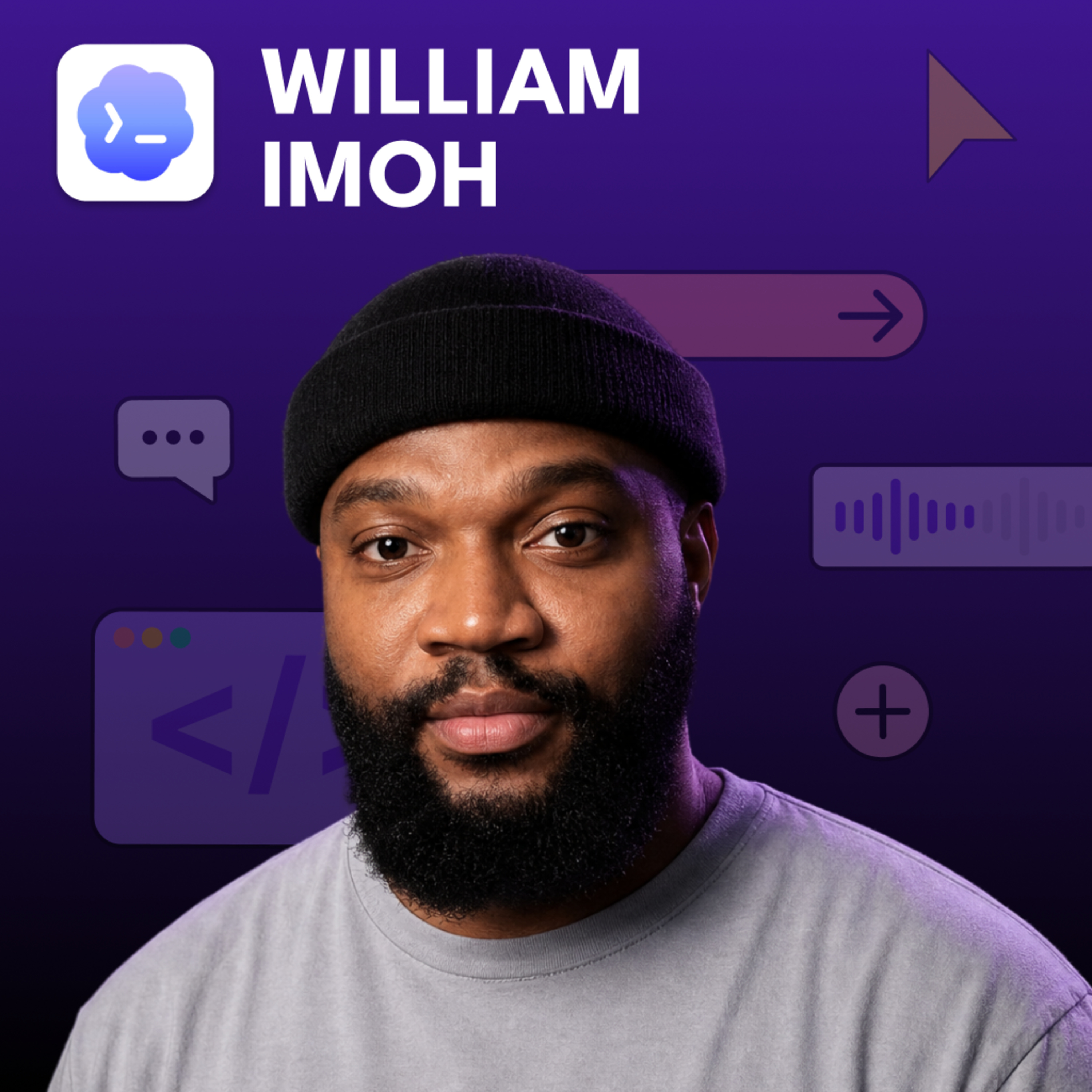
Codexで「もっと良いDuolingo」を作った創業者 William Imoh
How I AI
要約
Hackmamba創業者のWilliam Imohが、ノルウェー語を話せるようになるためにCodexとGPT-Liveでリアルタイム音声学習アプリ「Mural」をiOS/Android向けにネイティブで作った経緯を語る回。Swiftを書いたことがなくても、デザイン言語と体験の具体的な言語化で実現したと説明している。後半では、Grok Botに指輪物語のキャラクターを役割として割り当て、約25人のチームを一人で率いる運用法と、エージェントへの依存への不安を語っている。
この回のポイント
- ●Duolingoで1,000日連続学習しても会話できなかったため、評価せず訂正してくれるAIと会話するMuralを自作した。
- ●Swiftを書いた経験がなくても、「秋の色合い」「ミニマル」「Appleのシニアデザイナーのように」と具体的に指示し、ライトモードやliquid glassまで言語化して仕上げた。
- ●GPT-Live-1での利用コストは30分で約3〜5ドルと述べている。オープンソース化され、本人はOpenAIの予算に1,000ドルを入れて公開している。
- ●Codexはプロジェクト単位で業務を整理し、複雑な作業に使う。一方、Grok Botでは指輪物語のキャラクターを役割に割り当てた「fellowship」を運営している。
- ●銀行と顧客データ以外の全ツールへのアクセスをエージェントに与え、MCPで見つからなければコンピューター操作も許可している。
- ●モデルの進化でスキルの多くは不要になり、成長戦略、コンテンツ戦略、「de-slop」スキルなど少数だけが残った。
- ●本人が恐れているのはAIによる代替ではなく、エージェントが使えなくなった場合の依存だと語っている。
章立て
Muralを作った動機
ノルウェーに移住後、相手が英語で返してしまうため学べない問題と、Duolingoの限界からアプリ開発に至った経緯を語る。
Swift未経験での開発手法
化学工学出身の独学エンジニアが、プロダクト経験を活かしてCodexにSwiftとKotlinでの開発を任せた方法を説明する。
最初のプロンプトとデザイン言語
秋の色合いやミニマルなど具体的に指示した長いプロンプトと、ダークモードを修正した過程を紹介し、デザイン言語の重要性を論じる。
ノルウェー語会話デモ
Muralで実際に会話し、文法の訂正や英語を拒否する挙動を確認する。フラッシュカードやテーマ機能も紹介する。
成長マインドセットとGPT-Live、コスト
AIを忍耐強い家庭教師として使う姿勢を評価し、GPT-Liveの強みと30分約3〜5ドルのコストを説明する。
Codexプロジェクトで運営する会社
「100X」の方針のもと、Notionで業務を棚卸しし、ChatGPT/Codexのプロジェクトで業務を分けて管理する方法を紹介する。
指輪物語のGrok Bot fellowship
Gandalfを参謀役とするボット群、全ツールへのアクセス付与、採用管理ツールThreePipesの活用例を説明する。
プロンプト戦略と依存への不安
再起動、具体化、レビュー依頼などの対処法に加え、エージェントへの依存への恐れを語る。
解説記事
Hackmamba創業者のWilliam Imohが、「How I AI」にゲスト出演した回を紹介する。彼はノルウェー語を話すためにリアルタイム音声アプリ「Mural」を自作し、さらに指輪物語のキャラクターを役割に当てたAIボット群で、約25人のチームを一人で率いる運用も明かした。
なぜ「Duolingoの次」が必要だったのか
Imohはドバイからノルウェーに移住したが、現地の人は丁寧なので、下手なノルウェー語で話しかけると英語で返してくれるという。そのため会話の練習ができず、1,000日連続でDuolingoを続けても会話はできなかったと述べている。彼が求めたのは、自分を評価せず、間違いを訂正し、ノルウェーの村に放り込まれたような状況をつくってくれる相手だった。
デモでは、Muralが英語での返答を拒み、「et møte」と「en møte」のような冠詞の誤りをその場で訂正する様子が示された。さらに、検索して時事ネタを会話にするテーマ機能、フラッシュカード、字幕表示などもある。字幕は、初めて聞く言語を理解するうえで必要な唯一の補助だという考えから載せたと説明している。
Swift未経験でネイティブアプリを作る
Imohは化学工学出身で、独学でWeb開発を学んだ。4年間のプロダクトマネージャー経験もあるが、Swiftは一行も書いたことがなかった。それでもReact Nativeではなく、プレミアムな体験と最新のiOS機能を求めてネイティブを選び、SwiftとKotlinでの実装をCodexに任せた。
Claire Voは、かつてのスタートアップでは「チームが書ける言語」でスタックを決めていたと振り返る。AIエージェントがいれば、言語選びはユーザー体験を基準にできるという点で二人の見方は一致していた。
決め手になったのは「言語化力」
最初のプロンプトは長く、「Appleのシニアデザイナーのように」「秋のような暖かい色」「不要な要素は削除するかトグルにする」「完成後にデザインをレビューする」といった要件が並んでいた。GPT-Live-1とGPT-6 Lunaを使うことも指定したという。最初に出たデザインはダークモードだったため、ライトモード、暖色、グラデーション、liquid glassを使うよう修正した。
Claireはここから、センスとは具体的な参照語彙のことだと指摘する。liquid glass、ミニマリズム、グラデーションといった言葉を知り、ユーザージャーニーを誰にでも実行できる形で説明できるほど、エージェントへの指示は精度が上がるという主張だ。練習法としては、ブランドやアプリの違いを言葉で説明することを挙げている。
Imohは、類似アプリの多くがダークモードで機能過多だと感じ、自分は「音声と字幕」だけに絞ったと話す。
GPT-Liveとコスト
GPT-LiveはOpenAIのリアルタイム音声モデルで、割り込みに強く、アプリの音声操作にも向くとClaireは説明する。Imohによれば、30分のセッションで約3〜5ドルかかる。アプリはオープンソースで公開されており、本人はOpenAIの予算に1,000ドルを入れて利用者に使ってもらっているという。Claireは、人間の家庭教師より安く、深夜でも練習できると評価した。
Codexのプロジェクトとfellowshipで会社を回す
Imohは今年の第3四半期に向けて「100X」という方針を掲げ、人員を大きく増やさずに目標を引き上げようとした。ただし、コンテンツ生成や創作物をAIに任せることはしない方針だという。まず自分の仕事をNotionに棚卸しした。顧客対応、インバウンド営業(11〜15件を並行処理)、プロダクト、経理、採用面接などが挙がった。
チーフ・オブ・スタッフの採用は、内定者が始まる前に辞退して頓挫した。そこでAIに切り替え、ChatGPT/Codexのプロジェクトを業務ごとに分けた。オペレーション、成長、営業、ポッドキャストなどである。Codexは、Muralのような複雑な開発に使うという。
Grok Botでは、同僚のように使えることが決め手になったと語る。参謀役がGandalf、マーケティングがLegolas、エンジニアリングがElrond、経理がGimli(発言上は「Jimmy」)、営業がAragorn、カスタマーサクセスがSam、プロダクトオーナーがFrodoだ。Gandalfに他のボットを作らせたという。
ツール権限は、銀行と顧客データ以外をすべて開放している。Google Workspace、Linear、Notion、カレンダー、Pipedrive、QuickBooksなどに加え、MCPで届かない場合はコンピューター操作やブラウザ操作も許可する。候補者と話した後は、「この人をThreePipesに入れて」と頼むだけで、メールや会議メモを集めて登録し、要約とスコアリングまで行うという。この運用をImohは、最終的に残るのは「用途に合わせたシステム・オブ・レコードとAIインターフェース」だという考えに基づくものと位置づけている。
スキルは、モデルの進化で不要になったものが多く、成長戦略、コンテンツ戦略、「de-slop」の三つ程度に絞られている。
プロンプト戦略と依存への不安
エージェントが期待通りに動かないときは、まず再起動し、それでも駄目なら手順やテストを具体的に指定し、自己レビューを求めるという。Cursorのエージェントの出力をGrok Botにレビューさせることもあるそうだ。苛立ちよりも、エージェントが使えなくなった場合に営業や採用を回せなくなる恐怖のほうが大きいと打ち明けた。
まとめ
この回の核心は、実装言語を知らなくても、体験を具体的に言語化し、問題は解けると信じて問い続ける力があれば個人でもネイティブアプリを作れる、という点にある。日本の読者にとっては、プロダクト設計やデザインの語彙がAI時代のスキルになるという示唆が大きい。また、広範な権限をエージェントに与える運用はリスクと隣り合わせであり、Imoh自身も語る依存リスクを踏まえて検討する必要がある。
文字起こし(英語・自動生成)
I tried building this app, but it just wasn't a great experience. I bombed the hackathon. I think I probably came in last with it. The meta skill that you have, which is like a growth mindset, which is I can learn Norwegian. Like I can learn something. If you just have this confidence that this thing is a solvable problem, learning a language is a solvable problem, building an app is a solvable problem, and if you can just ask the right questions and get the right feedback, you can get there. I wanted to speak Norwegian as someone to something first that wouldn't judge me and something that would correct me. Now, I know it's counterintuitive in some parts and some conversations that you want to be skeptical about what AI has access to. For me, I just let all that fly out the window. The only thing it doesn't have right access to is the bank. You run a business and like me, like to keep that business lean with agents. So tell me a little bit about how you run your business with agents. I don't get frustrated. I get scared because I'm so dependent on agents now that I fear for myself.
What is this agent go to zero tomorrow? What am I supposed to do? Welcome back to How I AI. I'm Claire Vo, product leader and AI obsessive here on a mission to help you build better with these new tools. Today I have William Emo, founder of Hackmamba and creator of Mural Chat, a real-time language learning app that he built for himself to learn how to speak Norwegian of all things. William's going to show us how he went from knowing nothing about native development to hacking together one of the coolest native apps I've ever seen, plus how he uses an army of Lord of the Rings-themed rockbots to run his business as a solo founder. Let's get to it. This episode is brought to you by WorkOS. AI has already changed how we work. Tools are helping teams write better code, analyze customer data, and even handle support tickets automatically. But there's a catch. These tools only work well when they have deep access to company systems.
Your copilot needs to see your entire code base. Your chatbot needs to search across internal docs. And for enterprise buyers, that raises serious security concerns. That's why these apps face intense IT scrutiny from day one. To pass, they need secure authentication, access controls, audit logs, the whole suite of enterprise features. Building all that from scratch? It's a massive lift. That's where WorkOS comes in. WorkOS gives you drop-in APIs for enterprise features, so your app can become enterprise-ready and scale up market faster. Think of it like Stripe for enterprise features. OpenAI, Perplexity, and Cursor are already using WorkOS to move faster and meet enterprise demands. Join them and hundreds of other industry leaders at WorkOS.com. Start building today. William, welcome to How I AI. Thanks for joining. Thanks. Thanks, Claire. Thanks for having me. So I invited you on the podcast because I saw this app that you have up in Mural, I think
it's Mural Chat. And I just thought it was such a cool use of AI and something that, you know, a year or two ago would have been sort of like unimaginable for someone to build on their own, like almost impossible. And you've shown that you can build this amazing app with this really interesting use case and do it all by yourself with AI. It's just, it's kind of unbelievable to me. So tell me what brought you to building this app. Like what problem were you trying to solve? What was driving you? Yeah, I think you're also correct that a year ago, it was technically impossible. It was possible to build the app, but with a poor experience because I tried. I was at a hackathon in San Francisco, and I think it was an All Things Web hackathon. I tried building this app, but it just wasn't a great experience. I bombed the hackathon. I think it probably came in last with it. And the main motivation behind this is I live in Norway,
and I want to move from Dubai to Norway because I wanted an adventure. I didn't know what to expect. I just hope everyone spoke English. As soon as I got here, I learned that people actually speak Norwegian. And to make it by, I mean, a lot of people speak English, but you need Norwegian to get by. But then the Norwegians are also very polite in the sense that if you try to speak Norwegian to them, but it's poor, they speak English back. unlike the French. So they speak English back to you. So this meant I couldn't learn Norwegian, right? And then I tried using Duolingo. I had a thousand-day streak. On Duolingo, I was always chasing streaks. But I wanted to speak Norwegian to someone, to something first that wouldn't judge me and something that would correct me. But also I wanted to experience that felt like being thrown in a Norwegian village where you have no other option but to speak Norwegian. that was just the experience I wanted I love this because in our house we are trying to we
my husband and my kids are trying to learn Italian and they're doing it this like very classic language learner way which is a combination of Duolingo and like listening to like basically these like tapes these audio lessons and so they're in the car and they're like you know, hearing somebody speak Italian and they repeat it. But the only way you can really learn a language is immersion. And I love what you call out because it's so counterintuitive, which is you said you can't learn this language because people are so polite. They will respond to you in English. And so you can't actually get that reinforcement loop of like, did I say it right? What am I supposed to hear? And so you built this app to give you that experience. Tell us a little bit about, like, are you an iOS developer? Are you, like, a fancy developer? So, first, I have a chemical engineering degree, but I taught myself to code to do some web development.
So I did a lot of web development over the last five, six years. I can write some front-end, and then I can write some back-end code to save my life. building a web building a mobile app i can do it with something like react native for instance but i wanted today at least when i built mural i wanted a native experience so i wanted like a premium feel to it because i felt like i could build anything but i wanted to optimize for the best user experience possible and i wanted to use like all the the better ios features So I decided to build in Swift Well It wasn't going to be me building it I needed Codex to build it So This is building Swift for iOS and Kotlin for Android And guess when we have AI agents Building stuff Like the language doesn't matter Like the language I know doesn't matter anymore I just choose the best possible language For the type that I'm building
So that's why I went with Swift And Kotlin even though I haven't written a line of Swift in my life. You know, what's really funny about this is, you know, over 10 years ago, I did a venture-funded startup, a real startup, and we picked the language we built that application in based on who we knew could write that code. So we were like, well, we know a bunch of people that can write Python, and we know a bunch of people that can do this, and so we're just going to build our app in that language to optimize for humans we knew. knew how to write that code. And now, I love what you said, which is you can just pick the best language for the user experience, the thing that you want to build. And it doesn't matter if you have somebody on staff that knows that language or not because you have our friend Codex on staff. See, Codex, you might be pulling it up and just showing us how you get organized around a Swift... Actually, never. Don't tell. Sorry. We're doing admission right here.
I have not built a native mobile app ever. Even in the age of AI, I have not built one. So I am learning as we go. How did you kick this off? How do you work it? Background, because I have some software engineering background, I understand how to architect the apps. I understand what's required if I need to make the front end, the back end. Also the experience that I want. I think that was the most important piece here is the experience I wanted for this app. I used to be a product manager as well. I was a product manager for four years. So I've learned to work in ethics and user stories, right, because those are closely tied to user problems. So that's one way I've found I've had, like, the best results when building AI apps. So how did you start? I first started with a very long prompt. I was very specific, and this prompt opened with literally, I want a very aesthetically pleasing application. Like, this is my equivalent of make no mistakes,
but I want an aesthetically pleasing iOS application that I can learn Norwegian with. And I described the experience I want, which was basically, I want this application to run on GPT Live 1, because GPT Live 1 was just released I think a week after So GPD Live 1 was the technology that I tested that enabled me build this I don think I be able to build this without GPD Live 1 today So I specified we need to use GPD Live 1, and then we needed to use GPD 6, Luna, for any other AI tasks on it. I described also the experience I wanted. So I wanted an orb that was, you know, a porphating orb that I could talk to that felt like a phone call, like a familiar interface that we would use. And then I went on to describe the style. So I wanted something warm. I literally wrote, I want something that feels like fall, like autumn.
Use fall colors. And again, it should be really beautiful. follow design best practices like you are a senior designer at Apple. So I'll just give you references of like, because I needed to get the taste that I wanted. Because I live in Norway now, I love to adopt like a very minimalist style. So I was like, make it like it should be really minimalist. No element on the screen should exist unless it absolutely has to. and if something isn't necessary, remove it or put a toggle for it. So this was like the base experience, and then I requested that it reviews the design after it's done. Now, the first design it produced was shit. It was in dark mode. Dark mode? I was like, no, this isn't going to work. Maybe that feels like autumn in Norway, right?
It starts to get really dark. I think so. Yeah, I had to refide it before. I was like, first, this shouldn't be in dark mode. Not everything belongs in dark mode. It should be light mode. Use light, warm colors. Explore gradients. And I'll use liquid glass as much as possible as well. So I want to pause really quickly because what I think is so interesting about what you just said in that prompt and our conversation so far is, look, you don't need to know Swift. Like, you just don't. It's none of your business. You don't need to know. You need to know that maybe that you should use Swift, although AI could figure that out. But what you do have that I feel like a lot of people haven't invested in their own skilling is design and product language. like truly the ability to describe what you want with specificity. And when people talk about taste, do they talk about taste?
Oh, like what is taste? We need taste. And really what you need is design language and references in the world that you can point to. You need to know what liquid glass is. You need to know what minimalism is. You need to know what a gradient is. And I think the more rich your reference set is when it comes to design, the better. And then on the product side, the more you know how to articulate a user journey in a way that anybody can execute on, an engineer, human engineer, an AI engineer, the better that, like, workflow will be. And so, you know, when people ask me, like, how do you develop taste or how do you get good at work? I'm like, describe websites. Like, use your words to describe what makes brand A versus brand B special or what makes website A or app A better. And the more you practice that, I think the better you can be at prompting agents to do a great job.
Yeah, I agree. I look at and some of I put this out there, I didn't intend to share it with anyone because I wanted to build this for myself to use just by myself. And then I put out a tweet out here. I made this thing. I think it's really cool. I'm not going to share because I don't want the burden of having to maintain it and having to like deal with users expectation. Everything has to be a business. I already have a lot of problem with running a business. I don't want another one. So I put it out there and people loved it. and not just people liking the experience, but I also saw a lot of people that had similar applications. And then I looked at the difference between what I built and theirs, and I noticed a lot of it just had to do with the experience, like how it felt when you looked at it, right? A lot of it was also in dark mode. I rejected first. It had a lot of features, right? For me, I just wanted a speech and a caption. A caption would be the only way you would understand what's being said
if you're just hearing the language for the first time. That was my opinion, and that was the only thing I wanted. Can you show it to us real quick? We're going to put your Norwegian to the test. Yeah, can do her, am I? Yeah, I'm going to. Can you speak English? I'm going to speak English. Norsk is in a meeting. Yeah, please, please just speak English. I understand, but I speak in a bit. What do you speak in a meeting? Yeah, we can speak in a bit. Fyggg. Can you speak in a meeting? Yeah, yeah, I'm on a meeting with my friend. I am one really impressed.
I'm very impressed at your Norwegian. I mean, I know nothing about Norwegian, but it impressed me. And two, I totally get it. Like, I get why that's the way you need it to learn, like, need to learn. So can you just walk me through what that conversation we just heard kind of, like, was? Like, what were you talking about? Basically, I was trying to, first, I was like, hi. And because URO starts with hi and then figures out your level of language learning or speaking. So it says hi back. And then it said something complex. And I said something mildly complex back. And I said, I'm doing all right. And Miro asked me, so what am I doing? I said, I'm in a meeting with a friend. And Miro said something, but I ignored that. And I said, please, can you speak English? And Miro said, no, I cannot.
I cannot speak English back. I have to speak Norwegian. So I think I can pull up the past conversation. Yeah, yeah, I want to see. Yeah. So it was like, hi, like, what do you want to talk about today? I was like, oh, yeah. I was like, are you ready to start or do you want to think a little bit? I was like, hmm. And I said, can you hear me? And Mira said, yes, I hear you. What do you want to talk about? I said, yeah, I'm in a meeting. And I said a meeting wrong. I said, yeah, I'm in a meeting. But that's the wrong tense. So it says it's called et murte, not en murte. So it corrected me as I said that and then asked, what's happening in the meeting? Then I said, can you speak English? And Roushio said, I'm only going to speak Norwegian. What are you doing in the meeting? I said, oh, please just speak English.
And then Roushio said, I understand, but I'm going to speak Norwegian. What are you talking about in the meeting? And then I gave up. Quick question. When did you start learning Norwegian? Like how long? So I started learning Norwegian. I mean, I had a thousand-day streak on Duolingo. Okay, so you had a little bit of a head start. Yes, but I could have this kind of conversation. I wouldn't know what to say. I'm stuck at I'm a man, or this is a phone, you know? Yeah. So I wouldn't be able to hold a conversation. And then I took the Norwegian language exams. And I took a course for like a week, like a short course for a week, just so I understood like grammar. I took the exams. I passed. As soon as I came out of like the exam hall, I deleted Duolingo because I was like, nah, this is just completely useless. and I tried and that was my like my motivation to build something like murals started after
that so murals just helped me get better at practicing my Norwegian in different like settings and you know this is I could talk about like the weekend I can also see like the words that I learned and how well I gone with each one I recently introduced flashcards for instance in case i want to practice like the uh the words yeah exactly um and i also have themes because at the end of the day you want to be able to speak these languages uh within a particular setting and i can also pick like a random theme about like maybe ai or something um in the world today it would search the internet and come up with a conversation about that. But at the end of the day, it all lives on the talk screen. I just go here, I start a conversation with Neuro, and I just talk about stuff, whatever. And it just keeps nudging me further and correcting me as I go.
And it wouldn't stop correcting me until I say it properly. As AI adoption grows, so do your company's security risks and requirements. New frameworks, audits, and vendors keep piling on, but your team isn't getting any bigger. Most compliance tools promise automation, but you're really stuck doing all the work by hand, chasing screenshots, validating controls, and playing catch-up when audit season comes around again. Vanta works differently. Their agentic trust platform is built to scale with you, not slow you down. With over 1,400 automated tests across 400-plus integrations, Vanta collects evidence and monitors your controls year-round, cutting your audit prep by 82%. Plus, you can access the Vanta agent everywhere you work, whether your team is in Vanta every day or living in tools like Quad or Cursor. Want proof? Over 16,000 fast-growing companies like Ramp, Ryder, and Harvey save time and resources while scaling fast with Vanta. My listeners can get $1,000 off by going to Vanta.com slash HowEyeAI.
That's V-A-N-T-A dot com slash HowEyeAI for $1,000 off. Okay, so we've had a lot of impressive people on HowEyeAI. There's been a lot of impressive things. One, let's put aside that you vibrated this whole thing, which is awesome. Two, let me just say the meta skill that you have, which is like a growth mindset. which is I can learn Norwegian like I can learn something and I feel like this is the skill that really helps people go very far in the age of AI which is like if you just have this confidence that this thing is a solvable problem learning a language is a solvable problem building an app is a solvable problem like these are solvable problems that you have the tools and if you can just ask the right questions and get the right feedback you can get there I think that is just like that is the skill of the and also I'd say being really low ego which is like I'm okay
getting it wrong as long as I can be corrected and I think AI is such a great teacher because I tell this to people about learning to code I say it's an infinitely patient private tutor like it's not going to make fun of you it's not going to say you're stupid it's not going to be embarrassing so like the ability to use ai as a tutor for any topic and let it be patient with you and let it let you make mistakes i just i think it's the skill that is a real signal that somebody's going to be very high impact in this in this next phase of of the world and so that is what I'm observing of you at a higher level. No, thank you. This is so – it's, like, giving me so many ideas. The other thing I just want to pause before we go into a couple other workflows is GPT Live. So for people that don't know what GPT Live is, it's OpenAI's, like, kind of real-time voice model, and it does really good with real-time experiences and, like, interruptions,
which make it great for this kind of language testing. The other thing GPT Live is really good at is voice control of apps because it's so fast. So I think we did an episode, I'll have to dig it out, of voice control through GPT Live in your app. So I think GPT Live is a totally slept on model that people don't appreciate how much you can do with it. The only thing, I have to ask you a question, is this expensive to run? Absolutely. So the hardest answer, yeah, but I just chug it into, like, my token budget, right? I made it open source so anyone can run it. And it currently costs around, it costs about $5 to chat with Miro for, I think, for 30 minutes. yeah so for about 30 minutes it's going to cost five dollars in now it's going to cost between
three and five dollars for 30 minutes um but then i'm building this for fun so i'm just i i put a thousand dollars on my open ai budget and just let folks burn it to the ground um i think it's We're making like $100 now. Well, what I'll also say is that it's less expensive than a one-on-one tutor, and you can't call your tutor to your house in the middle of the night and say, I'm ready to practice some Norwegian. So it's so cool. Okay, we're going to do a couple more workflows. We'll get you out of here. So aside from building cool apps and learning Norwegian, you run a business, and like me, like to keep that business lean with agents. So tell me a little bit about how you run your business with agents. Yeah. So first of all, sometime in June when we started planning Q3, I put together a mandate internally, and I called it 100X.
And this was a way for us to go 100X our current revenue goals and the way we set up as a company without drastically increasing headcount. and this meant that we needed to use AI as much as possible without using AI to generate content or feeding any of our creative work to AI tools. So first of all, I had to figure out everything I currently do. I put together a list on Notion. That was my first step. I really said everything. So as a founder, and I'm a solo founder, so I do a bit of customer success. I handle most of the inbound sales. Currently working, I think, about 11 to 15 deals in parallel at the moment. I handle the product team as well because I used to be a product manager. And I do a bit of like accounting, HR interviews, like hiring to just talk to folks. And we're a team of around 25 people internally.
So I wanted a way to be able to manage a lot of things. First, I wanted to hire a chief of staff. I tried hiring someone They didn't start They quit on like Just before they started For some reason I think that was like Hail Mary for me So I decided to adopt AI tools And I tried different tools I tried Claude first I got used to use To Claude Co-Work And then for some reason My account got banned I don't know why I skipped it I went back to ChatGPT And installed Work and I decided to use projects as I currently have on here. I set up projects for everything, basically, because I just wanted a siloed way to manage individual things I do. My company is called HackMamba. So for every critical piece that I work on directly, I create a project for it. I have a project for HackMamba operations. This is where I manage things like, you know, invoicing, campaigns.
And if anyone sends me a message on Discord, this is where that would likely fall into. And that task will be run from here. I have stuff for growth. So this is like I also get like an operator brief every Sunday night of the week. So what's something we should start doing? What's something we should stop doing and stop we should keep doing? I also ask you for like the three highest impact activities I would conduct this week. So that's a routine. So I use routines a lot as well. We built an internal tool for growth. This is what we use with our customers. We go from content ideation all the way to distribution in Bokey. I also support with the growth for Bokey and content creation. So I created a project for it. For sales, I did the same thing for our website. This is my podcast, Everything Outside Code. I manage like interview briefs and all that
In there and just every other thing So I use projects a lot With Codex Now for Codex I kind of reserve Reserve like the Complex work So for instance Miro I have written Swift so I kind of like wanted Astra To work on Miro So I wanted Frontier Model On that stuff That what I do on Codex But on the flip side I found GrokBot And instantly I think it was Amazing like it was a game changer for me Because it gave me colleagues Whereas with ChatGPT I got, like Codex I got folders And on Grockpot I got My fellowship As I like to call them If you've seen Lord of the Rings You know what the fellowship of the ring is So I just I was first asked to create a chief of staff. I just called him Gandalf. Straight up. Straight up. And then I asked Gandalf to create everyone else.
I did other bots for engineering, marketing, project, product management, account, sales, and customer success. And kind of the personas are, you know, very close match. You know, like Legolas is, you know, pretty Legolas. He's the marketing dude. And Elrond, the elf, runs engineering. I have Jimmy, the dwarf, with the coins in accounts. Argon recruits everyone and sells the fellowship. He runs sales. And Sam always pays support. So his customer success for this one. And yeah, Frodo is in charge of getting the ring. He's basically the product owner in this case. So for our third around TM. And yeah, so this, I set up a fellowship. And with my AI workflow, what I do, first of all, after setting up the fellowship, not just on GrokBot, but also on Codex, was to give it access to everything.
Now, I know it's kind of intuitive in some parts and some conversations that you want to be skeptical about what AI has access to and what it does and what it has read or write access to. For me, I just let all that fly out the window. The only thing it doesn't have right access to is the bank. So I'm like, anything else can go wrong. I mean, I don't have access to customized data, right? So that's safe as well. But the bank and customized data, aside from that, every other thing is all for grabs. So I gave it access to like Google Suite. I gave it access. I just looked at my browser window. I have like 15, 16 tabs open And I just give you access to everything That I could, you know, I could see From linear, notion, my calendar Pipedrive, QuickBooks Everything that I had access to I give you access And then for ChatGPT Like for Codex I just enable computer use and browser use
So if it cannot find it via MCP Just use my computer That's alright, it's fine Whatever, I just give it access It's like, allow once? I'm like, no, allow always. That's, you know, just use it. So setting those up, that was like the next thing. And that just instantly changed a lot of things for me, right? So I wasn't giving it information. I would just like, I couldn't even put a typo in the info box. I would just like give it my, like a thought. Like I've been hiring and talking to like a lot of candidates. I built a tool internally called ThreePipes And the reason I built it is because I have a firm belief that at the end of the day We're going to be left with systems of record Like a custom database That is designed around a problem That's what's going to be left And an AI interface So I would build these tools internally
And they just become systems of record ThreePipes is for people and HR So now I just tell my group bot, and the good thing is I don't need a skill for this. I talk to a candidate, and I just say to my group bot, hey, I just spoke to this person. Get them into three pipes. It goes, scours my email, my calendar, looks at meeting notes, collects all that information, puts it in three pipes, gives me a summary. It's all done. And then scores the candidate as well and says, you've spoken to 15 people. This person ranks number seven on that list. just so you know, like FYI. And I skipped on it, then I can switch contacts to something else, the sales. So that's like the one piece. And then the final piece of how I use AI and how I'm set up currently would be the skills that I have. So there are a couple of important skills that I do have, and I call these important because over time, while I've made a lot of skills, the models have gotten a lot better that I don't need these skills anymore.
So there are just very few that stuck. A skill I use for growth marketing, like to create a growth marketing strategy based on what we know at Hacknama. A skill to create a content strategy also based on what we know. And then my content de-slop skill. Critical skill in the stack. I think this is so useful. I mean, for folks who have stuck around this long in the episode, you've gotten, like, true gold, which is you have codecs for complex tasks, codecs projects to keep everything organized. GrokBot, as you do this, very similar to me, where, like, GrokBot has roles. So it's, like, your marketing role, your HR role, your sales role. You need an eye of Sauron that looks across everything for things going wrong. That's the last one. Eye of Sauron. And then you use just, like, skills very precisely, like very specific ones.
William, this is one of my favorite episodes. I've done a lot of episodes. This has been one of my favorite ones. I'm going to ask you our one question we ask every guest, and then I'm going to get you out of here back to all your awesome work. But when your Grotbox, your Codex, your Norwegian agent just is not replying to you, doing what you want, what's your prompting strategy? Are you polite? Do you yell? What's the real truth? So first I just restart the agent. She should be re-pixed. I just reboot. I reboot and I try again. And if it doesn't work, I try to be a bit more specific, right? Because I know how to do it already. I just don't want to do it because it's like low-level work. So I get very specific on do this first, test this first, and also review what you've done to be sure this is what I asked for. So just ask you to like go over it again.
And more recently, I've had my GrokBot drive my cursor agent. so while the cursor agent would do like some random stuff that isn't really accurate my grandpa is sort of like that agent that goes and reviews all that again and uh improves it also um so that that's been like one way but the agents have just been like really good that if it doesn't get it i just go on twitter and i blame tibo for not fixing at tivo that's exactly right he was straight you know for not fixing codex like yeah i tried no i just switched to agent use something else and wait and updated but yeah that's that's typically my strategy i don't get frustrated the frustration i feel is if he eventually doesn't get it at the quality i want i get scared because I'm so dependent on agents now
That I care for myself I'm like what if all these tanks What if What if agents go to zero tomorrow What am I supposed to do How am I supposed to manage 15 different Like sales opportunities In a week In tandem Having all these calls Still doing like hiring Doing all these things at once That's the only like Panic attack I get Because I'm like This goes down I'm screwed what am I going to do what a perfect end to our episode William this has been super super fun for our audience where can we find you and how can we be helpful yeah I'm on LinkedIn I'm on X William on LinkedIn just find a dude with I put on headphones I fly small planes on off days So that's a way to find me. And if anyone's interested in growth, especially if you have a DevTool product and you want to reach the next five 10K users, I'm always happy to chat about how we could do that together, basically.
Amazing. Well, thank you so much for joining How AI. Yeah, thanks. Thanks for having me. Thanks so much for watching. If you enjoyed this show, please like and subscribe here on YouTube, or even better, leave us a comment with your thoughts. You can also find this podcast on Apple Podcasts, Spotify, or your favorite podcast app. Please consider leaving us a rating and review, which will help others find the show. You can see all our episodes and learn more about the show at howiaipod.com. See you next time.
番組の概要欄(原文)
<p><strong>William Imoh</strong> is the founder of Hackmamba, a developer marketing company, and the creator of Mural, a real-time voice app he built to learn Norwegian after moving from Dubai to Norway. He has a chemical engineering degree, taught himself to code, and spent four years as a product manager, but he had never written a line of Swift. In this episode, William shows how he used Codex and GPT-Live to build Mural natively for iOS and Android, then walks through the Lord of the Rings–themed Grok Bot “fellowship” that helps him run a team of about 25 as a solo founder.</p><p><br></p><p><strong>What you’ll learn:</strong></p><ol><li>The design prompt that made Mural look nothing like any other language app</li><li>Why 1,000 days of Duolingo left him unable to hold a conversation in Norwegian</li><li>What GPT-Live-1 costs per session and the latency threshold that makes or breaks a voice tutor</li><li>How he assigned every solo founder role to a Lord of the Rings character in Grok</li><li>Why he gave his agents access to everything across 15 open tabs, except one thing</li><li>What he still has to do himself after the models improved</li><li>Why the fear that keeps him up isn’t replacement—it’s dependency</li></ol><p>—</p><p><strong>Brought to you by:</strong></p><p><a href="https://workos.com/?utm_source=lennys_howiai&utm_medium=podcast&utm_campaign=q22025" target="_blank" rel="ugc noopener noreferrer"><strong>WorkOS</strong></a>—Make your app enterprise-ready, with SSO, SCIM, RBAC, and more</p><p><a href="https://www.vanta.com/howiai" target="_blank" rel="ugc noopener noreferrer"><strong>Vanta</strong></a>—Automate compliance and simplify security</p><p>—</p><p><strong>In this episode, we cover:</strong></p><p>(00:00) Teaser</p><p>(02:52) Introduction to William and his language learning app</p><p>(05:58) William’s tech background and how he started building</p><p>(08:07) The first prompt</p><p>(11:09) The importance of design language and articulation</p><p>(14:38) Live demo: a Norwegian conversation</p><p>(21:11) Having a growth mindset</p><p>(22:48) Why GPT Live works for this</p><p>(23:34) What it costs to run</p><p>(24:50) Running Hackmamba with agents</p><p>(26:58) Codex projects for organization</p><p>(28:47) His Lord of the Rings Grok Bot fellowship</p><p>(34:05) Recap</p><p>(34:54) Prompting strategies</p><p>(37:21) Where to find William</p><p>—</p><p><strong>References:</strong></p><p>• Mural on GitHub: <a href="https://github.com/Chuloo/mural" target="_blank" rel="ugc noopener noreferrer">https://github.com/Chuloo/mural</a></p><p>• Codex: <a href="https://chatgpt.com/codex" target="_blank" rel="ugc noopener noreferrer">https://chatgpt.com/codex</a></p><p>• GPT-Live: <a href="https://openai.com/index/introducing-gpt-live/" target="_blank" rel="ugc noopener noreferrer">https://openai.com/index/introducing-gpt-live/</a></p><p>• Grok Bot: <a href="https://grokbot.com/" target="_blank" rel="ugc noopener noreferrer">https://grokbot.com/</a></p><p>• Cursor: <a href="https://cursor.com/" target="_blank" rel="ugc noopener noreferrer">https://cursor.com/</a></p><p>• Boki: <a href="https://boki.io/" target="_blank" rel="ugc noopener noreferrer">https://boki.io/</a></p><p>• Notion: <a href="https://www.notion.com/" target="_blank" rel="ugc noopener noreferrer">https://www.notion.com/</a></p><p>—</p><p><strong>Where to find William Imoh:</strong></p><p>X: <a href="https://x.com/iChuloo" target="_blank" rel="ugc noopener noreferrer">https://x.com/iChuloo</a></p><p>LinkedIn: <a href="https://www.linkedin.com/in/william-imoh" target="_blank" rel="ugc noopener noreferrer">https://www.linkedin.com/in/william-imoh</a></p><p>Hackmamba: <a href="https://hackmamba.io/" target="_blank" rel="ugc noopener noreferrer">https://hackmamba.io/</a></p><p>Hackmamba Podcast: <a href="https://hackmamba.io/eoc-podcast/" target="_blank" rel="ugc noopener noreferrer">https://hackmamba.io/eoc-podcast/</a></p><p>Mural: <a href="https://mural.chat/" target="_blank" rel="ugc noopener noreferrer">https://mural.chat/</a></p><p>—</p><p><strong>Where to find Claire Vo:</strong></p><p>ChatPRD: <a href="https://www.chatprd.ai/" target="_blank" rel="ugc noopener noreferrer">https://www.chatprd.ai/</a></p><p>Website: <a href="https://clairevo.com/" target="_blank" rel="ugc noopener noreferrer">https://clairevo.com/</a></p><p>LinkedIn: <a href="https://www.linkedin.com/in/clairevo/" target="_blank" rel="ugc noopener noreferrer">https://www.linkedin.com/in/clairevo/</a></p><p>X: <a href="https://x.com/clairevo" target="_blank" rel="ugc noopener noreferrer">https://x.com/clairevo</a></p><p>—</p><p>Production and marketing by <a href="https://penname.co/" target="_blank" rel="ugc noopener noreferrer">https://penname.co/</a>. For inquiries about sponsoring the podcast, email jordan@penname.co.</p>
出典・この記事について
- 番組
- How I AI(Claire Vo)
- 元の回
- How this founder built a better Duolingo with Codex | William Imoh
- 配信日
- 要約作成日
- 公式サイト
- podcasters.spotify.com/pod/show/pen-name
この要約・解説記事は、元の音声を文字起こしした内容をもとに AI(Claude)が日本語で作成したものです。 固有名詞や数値に誤りを含む場合があるため、正確な内容は元の音声でご確認ください。制作方法について
関連エピソード

エージェント型動画編集は現実になった――今すぐ試すべき使い方
The AI Daily Brief: Artificial Intelligence News and Analysis

FigmaのPMは毎日どうAIを使っているか|Ezra Mechaber(FigmaのPM)
How I AI

金融向けChatGPTをつくる ― OpenAI金融サービス責任者 Joseph Kim 氏
Latent Space: The AI Engineer Podcast

AIの進化が速すぎる:2週間で2つのフロンティアモデル?!
AI For Humans: Weekly AI News, Tools & Trends

自社のビジネスは「パーソナルエージェント」に備えられているか?
VUX World
Grok vs. Dot vs. Muse vs. Claude Duet:パーソナルエージェント対決で最強はどれか
How I AI