
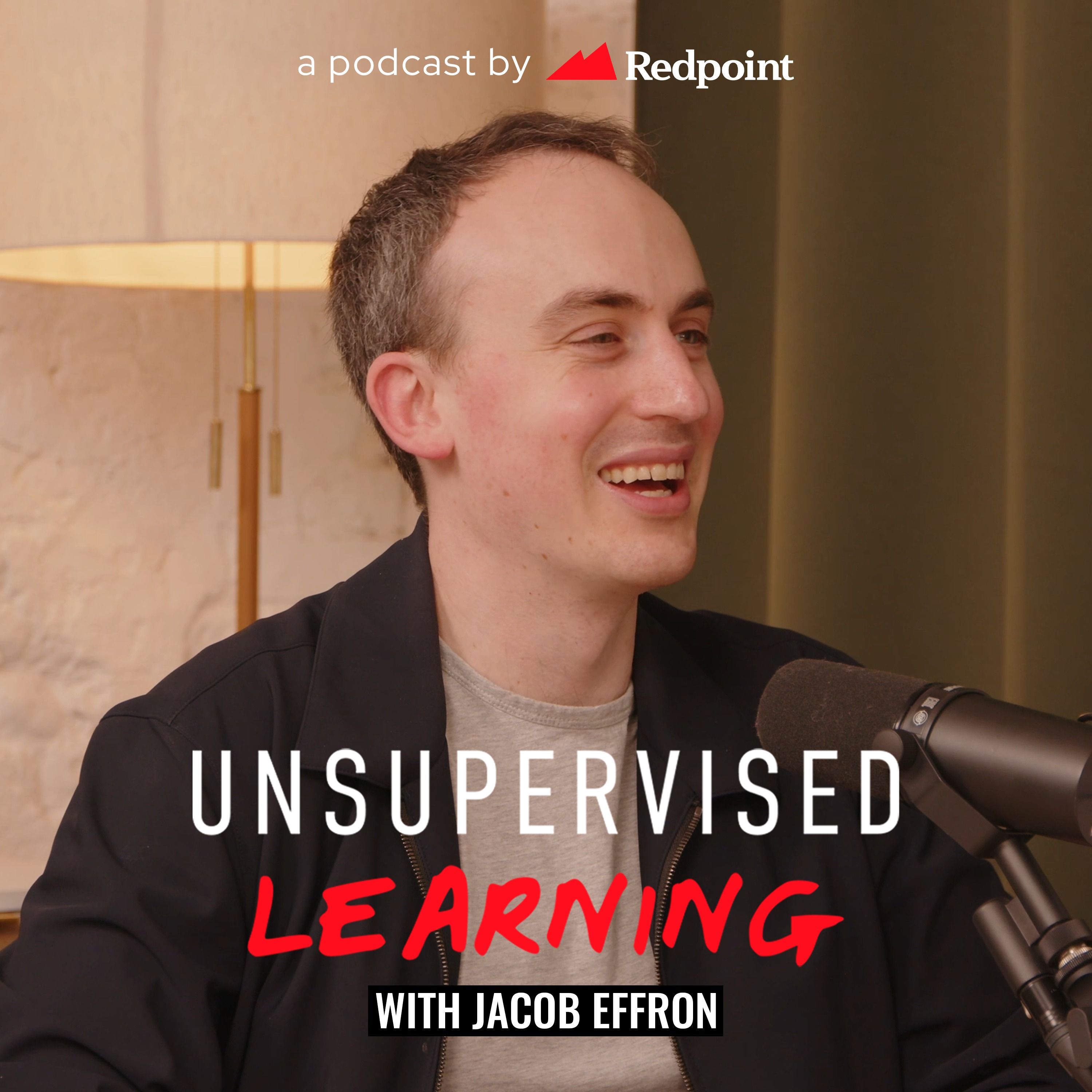
Ep 97: Jev開発者が語る「決定モデル」、ベンチマーク疲れ、そしてなぜ大手ラボは見逃したのか
Ep 97: Jev Creator on Decision Models, Benchmark Fatigue & Why the Labs Missed It
Ep 97: Jev開発者が語る「決定モデル」、ベンチマーク疲れ、そしてなぜ大手ラボは見逃したのか
Unsupervised Learning with Jacob Effron
要約
TypeSafe AI共同創業者でJevの開発者Diogo Almeidaが、Jacob Effronと対談した回。人間向けの文章ではなく機械向けの構造化された判断を返す「System 1」モデルJevの狙いを語り、形(shape)の新奇さより信頼性が重要だと強調した。KVキャッシュに縛られたコーディングエージェント設計への批判、ベンチマーク偏重への違和感、Anthropicの評価やAI安全性についての見方も述べている。
この回のポイント
- ●Almeidaは、LLM呼び出しの大半は最終的に人間ではなくソフトウェアが消費するものだと考え、機械ネイティブな「認知の核」を目指してJevを作ったと述べている。
- ●新しいモデルの「形」を作るのは安価で、難しいのは信頼性と実用性だと主張。見せかけの新モデルやベンチマーク最適化は期待を裏切り、開発者の信頼を損なうと懸念を示した。
- ●コーディングエージェントはKVキャッシュ(append-only)を前提に設計されており、ルーティングやサブエージェント、圧縮などが制約されていると指摘。これを「KVキャッシュの専制」と呼んだ。
- ●意味的な依存型(semantic dependent typing)や、ツール呼び出しごとの高速で安価なセマンティック・セキュリティチェックなど、将来の応用アイデアを披露した。
- ●コーディングエージェントによる開発速度向上は20〜40%程度と見積もり、AnthropicのIPO評価には期待の過大評価(ミスキャリブレーション)が含まれうるとの見方を示した。
- ●真のエージェンシーまでには「巨大なブレークスルーがあと2つ」必要と推測し、ASIやRSIの議論は技術より哲学的だと述べた。
章立て
機械ネイティブなAIという着想
LLM呼び出しの大半は機械向けであるべきだという信念と、Jev開発の動機を語る。
開発者とのco-evolutionと「無力感」
モデル提供者に依存する業界の姿勢を批判し、開発者がジャギッドネスについてもっとフィードバックすべきだと訴える。
新しい形よりも信頼性
新モデルの形は安価に作れるが、実用性が重要であり、過剰な約束と過小な提供が信頼を損なうと述べる。
KVキャッシュの専制と将来構想
コーディングエージェントの設計制約と、意味的依存型やセキュリティチェックなどのアイデアを紹介する。
マルチモーダルと競合・資金調達
画像モデルの現状、5年前でも可能だったという見方、競合モデルの登場や資金調達の考え方を語る。
Anthropic、生産性、AI安全性
Anthropic IPOへの見方、コーディングエージェントの生産性見積もり、AI安全性やエージェンシーに関する見解。
解説記事
TypeSafe AI共同創業者で、OpenAIのInstructGPT論文の共著者でもあるDiogo Almeidaが、Unsupervised LearningのホストJacob Effronと対談した。話題は、9月に公開して注目を集めた「決定モデル」Jevの設計思想から、業界のベンチマーク文化、コーディングエージェントの構造的制約、Anthropicの評価、AI安全性まで幅広い。
Jevの出発点:「機械が消費する出力」
Almeidaが繰り返したのは、LLMをAPIやサブモジュールとして見たとき、その呼び出しのうち人間が読むものはどれだけかという問いだ。文体や散文が重要な呼び出しもあるが、彼は、最も文字列志向の人でも機械向けの割合は「何ナインもの%」になると答えると述べている。コンピュータが本当に欲しがるのは文字列ではなく、せいぜい極端にカーディナリティの高い列挙型くらいだという。
この発想から、テキストではなく構造化された判断を返す「System 1」モデルを目指した。名前は人間の直感的思考を連想させ、周囲には反対されたそうだが、AIが圧縮されて行き着く形は実際にSystem 1的だと考え、弱点も正直に伝える方針を取ったと述べている。彼のNorth Starは、数学の難問は解けるのに会計に関わる作業は自動化できない、という不思議な状況を解消することだ。
新しい「形」より信頼性
Almeidaは、新しいモデルの形を作ること自体は安価で、自分も1週間でできると思っていて実際にできたと語る。難しいのは役に立つこと、つまり信頼性だという。他社が似た形のモデルを次々に出す現状については、実用性を欠いたまま期待だけを煽る「過剰な約束と過小な提供」が開発者の信頼を損なうと懸念した。
この文脈でベンチマークにも否定的だ。ベンチマークに最適化されたリリースは善意を使い果たし、時間のない開発者ほど被害を受けると言う。彼によれば、この種のモデルについては人々がすでに新リリースに関心を失い、ベンチマーク疲れが想像より早く来ている。社内にはベンチマーク最適化版を出して市場を試す案もあったが、出さなくてよかったと振り返っている。
開発者こそ声を上げるべき
Almeidaは、業界全体が「モデル提供者がやることを受け入れるだけ」のストックホルム症候群に陥っていると批判する。映画『WALL-E』で椅子に座って与えられるものを受け取る人々の比喩も使った。必要な信頼性や知能の水準を一番よく知るのは開発者であり、もっとモデルの「ジャギッドネス(得意不得意のでこぼこ)」について文句を言うべきだと促している。
また、用途ごとにモデルの人格を理解してシステムをロックインさせる使い方は、開発者中心の世界観ではないと述べた。目指すのはSQLのようにプロバイダ非依存になるほど信頼できる知能であり、依存関係の更新を毎回気にするのは本来のソフトウェア工学と逆だという。
KVキャッシュの専制
技術的に最も具体的だったのが、コーディングエージェントの設計がKVキャッシュ(追記のみの状態保持)に強く縛られているという指摘だ。彼によれば、これがルーティングやサブエージェントの有効性を妨げ、どの文脈を渡すかという判断が難しくなり、結局は巨大な状態を渡し続けてコンテキストが劣化していく。
彼は、複数のエージェントが同じ文脈を共有する、読み取り専用エージェントが作業中に可視化を生成する、圧縮をタスクに応じて意味的に行う、過去の履歴を安価に検索して同僚とも共有するなどの構想を挙げた。さらに、自然言語で性質を指定して検証する「意味的な依存型」や、ツール呼び出しごとの高速なセキュリティチェックも将来像として紹介した。これらは新しいリリースの予告も兼ねた話だったと述べている。
画像、競合、そして業界観
画像モデルについて、テキストより信頼性が劣化しやすいと指摘したうえで、自社の画像モデルはテキストモデルの10%程度の完成度で、本番利用の承認は出せないと率直に述べた。5年前でも実現は可能だったとし、OpenAI時代に「1年前にAGIを持てたはずだ」という文書を書いたという。
Anthropicの評価については、コーディングエージェントは大きな価値があるが、投入資金に見合うかは別問題だと慎重だった。ラボの最大の強みは金融工学だという見方を伝え聞きとして示し、「世界を治す」といった期待は過大評価につながりうると語った。生産性向上は20〜40%と見積もる。AI安全性では、ASIの議論は技術の現実から離れていると見ており、真のエージェンシーには「巨大なブレークスルーがあと2つ」必要だと推測した。
まとめ
日本の開発者にとって注目すべきは、モデルの賢さを単一の軸で測る見方への異議と、信頼性を設計目標に据える視点だ。ベンチマーク偏重への批判や、KVキャッシュがエージェント設計を縛るという指摘は、実運用でエージェントを組む際の判断材料になる。一方で、これは開発元の発言であり、競合比較やコスト面の主張は番組内で検証されていない点には留意したい。
文字起こし(英語・自動生成)
As you think about Anthropic, is that something you're optimistic on? Is like, hey, that's undervalued or something you're like, ooh, I don't know what's going to happen to that? I get the sense that a lot of the expectations baked in are ones that are not just product level, but based on, like, misunderstandings of the future of AI and what it can do. So my guess is that because some people might be valuing, like, building God as basically infinite, there will be some amount of miscalibration there. and I think that, you know, like the let them cure cancer is going to be like Marie Antoinette's like let them EK. Jeb took the AI world by storm about a month ago and I've been wanting to talk to Jogo, their CEO of TypeSafe, for quite some time. So it was really fun to have him on the podcast. I think maybe even better with a month to reflect on everything that's happened because we talked about a ton of different things. It was really awesome to get Jogo's perspective on, you know, the shapes of problems that he still thinks need to be solved by AI models, how he thinks about pushing JEV models to be even better.
It was also fun to get his thoughts on Anthropics' upcoming IPO, AI safety, a bunch of other topics. I think folks will really enjoy hearing from him. Without further ado, here's Jogo. Well, I've really been looking forward to this. I think ever since your viral launch, I feel like the second that happened, I was like, I have to have you on the podcast. And so I appreciate you making this happen. And I think actually in many ways even more interesting that we're some weeks removed from it. Given that the early results were not what you expected and maybe not as strong as you were hoping, what gave you that kind of early confidence in this research direction of RLCD? I mean, I feel like you kind of alluded to it in the GPT-3 example. It seems like there has to be a leap of faith that any great research effort undergoes. And what was it about this approach that just in the early days when you didn't have the signals early on, you were still kind of confident in? Oh, man. Oh, man. Oh, man. This is like, I'm getting a little emotional right now. I have a fun little side topic that gets into this, if that's okay.
My co-founder was debating on whether or not I was mission-driven at OpenAI. I would have described myself, in hindsight, as one of the lowest percentile mission-driven, because I think that the OpenAI mission is not really, it's kind of intentionally left as vague, so many people's missions can fit into it, but, like, the grand mission was never something I super believed in, even though I truly want AI to be extremely, extremely transformative. So I'm still trying to figure out, like, am I, was I mission-driven then or not? Because I'm really mission-driven now. But the answer was, you know, just a lot of work trying to square, like, AI being super incredibly awesome, which I think it is, and AI being really not that useful in every, like, productivity staff around. And this is like the kind of thing that like most people like just focus on one or the other and they never have like a bridge answer or like they never have a sensible bridge answer. I think distribution is like a nonsensical answer here because so many companies have gone all in on that and then gotten burned. It's almost certainly not a distribution.
And to me, it was like believing that like, hey, AI is clearly smart and also that the future is clearly going to be machine native. The question that always motivated me, and I used to ask this question even to early people joining or even to investors in our early rounds, or even the pre-seed round, which I don't even know if that counts, like taking a safe. I used to ask this question of, okay, imagine LLMs are an API, like a sub-module that is called by software, which even in the most string model lands, they still need to be called by software, by something like a harness. that harness can be a while loop, but what percentage of those calls going into the LLMs are actually meant for human consumption, so things like style matter, and, you know, prose and all of that, versus for computer consumption, which is going to be very, very different. You know, like, I don't think a computer really ever wants a string, except when that string happens to be an extreme cardinality enum, which is a very valid use case. But it's very rare that
That is the thing that computers want because they operate on bits. And when I just ask myself or anyone this question, even the most string-filled of people will give many nines of, like, percent for the machine-native component. It's just a question of when that will happen. And to me, it was always like, okay, what does that thing look like? Let's work backwards from that cognitive core and make it work. And I will say, Jeb is not yet there. There's still so much more work to do to make it so much better. and that's what really drives us all. Is Jed not yet there because, I mean, today the shape of calls and tokens actually is more for humans than it is for computers themselves? How much of it is just you're also waiting for the use cases themselves to evolve and how much of it is areas you want to push on the model? I think it's a bit of both. It's like this interactive dance and this is also why we released these dreamer-ready features, like the things that we are, you know, like wouldn't recommend for the most stable of use cases
because we really want to be honest about our model's properties. So we've released a lot of these things because the reality is that the people who best know how much reliability, you know, robustness, like intelligence is needed for their downstream application is not us. It's the developers themselves. Because developers are for the expert at this and they will know way better than anyone on our team. We have smart people, but they will know better what reliability profile they need, as long as we give them the right knobs, which string models don't tend to do. So there's an entire spectrum of this. I think that they need to co-evolve together. The reason why we launched was not like, okay, this is like a good moment in AI. Everyone told us not to launch then, just an FYI. It was that we felt like, hey, this is getting to be something we're really proud of. It's kind of impressively smart at a lot of things, if you prompt it right. and we are ready to keep pushing those limits with the rest of the field to help us co-evolve use cases, figure out weaknesses, deal with jaggedness. There's so much we do to focus on jaggedness and insufficiency and intelligence
that having people play with it would be so helpful. Why'd folks tell you not to watch? We launched around the time of the Pacing the Frontier discussion and people were like, hey, it's kind of like a bad vibe to launch a capabilities product during this. like everyone's like really doom and gloom about AI and it's a kind of a bad vibe and like I don't know if you guys should do this and we're just like that discussion never really made sense in the first place um or it is at best incomplete in my opinion you talk about kind of you know wanting to push in so many directions I mean I think one thing you know that you guys do is you're always kind of transparent about the things the models can't do you know areas where they're not as strong how much of that is like the roadmap for what you're pushing on like you know how much of is other areas. How do you think about where you want the company to push in the next month or two? Month or two? Oh, that's a... I mean, in AI world, I don't know if I can ask longer than that, right? I wouldn't say jaggedness is purely our roadmap. There are some things that models truly are weak at,
and this is where that taste stuff comes in, right? Like when I was talking about the reality of what you can extract from these models. The reason we call them System 1 models, among other things, And System 1 actually, people did not want us to name that it either, because System 1 thinking tends to be a bad thing. Like, people use that as kind of like an insult, right? Yes, like the part that just naturally happened from evolution, you know, from back in the day before... Exactly, instinctually are much larger brains, yeah. Exactly. And, like, people often, like, say that that is the mistake-making side. And I believe that the shape that actually AI gets compressed to happens to be, like, very System 1. and therefore the honest thing to do is to communicate its weaknesses, because I think that on its own can be incredibly, incredibly valuable for software, and most of what people need actually is system one stuff. You know, like, why can we solve Millennium Prize problems in math, but not automate anything touching accounting? Like, that is, that should be really weird to a lot of people, and, like, I think that that is, like, still our North Star,
even if people get distracted by, like, cost, speed, you know, like, oh, it's good for, like, really fast decisions or whatever. Like, I see these as, like, distractions compared to what is really needed for AI to meet its potential, and that is my North Star. And so obviously you put the models out there and you have a lot of people using them in different ways. How much does, like, the real-world usage of the models come and feed back into the roadmap versus just, like, the stuff you all are planning to do? I would say it's almost none real-world feedback. I think people should be complaining to us so much more. I think that like the field is still in a Stockholm syndrome of like oh yeah the model providers just do stuff in their one track path and we happen to be like the victim is the wrong word but like you know like in what's that movie WALL-E you know like they're like they're just like the people in the chairs that are just getting fed the AI and I think this is like the state of things right now where like people plan around AI changing but they don't have a sense of agency of where to take the field
and I think that this is not the way it should go. That's actually really disempowering and kind of lame in my opinion. And also I think that there's so much more we could do collaboratively as a field and I think that the field could like push us a lot more to say like, hey, we want to be doing these things. We think it is within the realm of capabilities. Let's figure out how to do it together but not just putting stuff into the model but figuring out how to prompt them, figure out how to like unearth capabilities. Let's work together for these sci-fi use cases because I think that is the way the future is going to go. And I would want so much more of that. My joke internally is that the number one way to get me to respond to something is to talk about model jaggedness because you have very high up people say, like, hey, can I meet with Yugo? And I'm just like, no, can you meet with my CTO or GTM head instead? But if they complain about model intelligence, I am on that and debugging that myself for better or for worse because that, I think, is the thing that will really move the needle for us long-term.
So right now we mostly have to go with our old roadmap because we are not... I think people are still in that mode of like, yes, let's just do whatever the model providers let us do instead of like, let's collaborate on this insane future together. And actually there's another aspect of that. I think people have a deep distrust of model providers too because they train on their data. And, you know, like this whole discussion of like, can GPT wrappers even exist? I think is very disempowering too, because the whole application ends up becoming a chatbot. So the moat ends up becoming the equivalent of a system message that you send every time, versus like the moat and the intelligence and the behavior and the specialization actually existing in software where we just make little micro decisions for you and you do all of the stick logic. Yeah. So there's so much to do. There's so much to do. No, I think your point's really interesting because I feel like when Jeff came out, there became maybe like a common set of patterns or rules that folks were like, oh, yeah, like, this is a really good use case for Jeb, and you should, you know, try it out in this thing or that thing,
and everyone tried it out and, you know, kind of got that sense of patterns. You know, I almost feel like people are trying to get their own mental models of, like, okay, I use, like, you know, Opus 5.5 for, like, this kind of thing, and I use Jeb for, like, this kind of thing. And I feel like your point's, well, you know, your point is, like, this is a dynamic, evolving thing that you could, there's not strict boundaries, I guess, between those two types of model categories. But, like, what's your ish? ish. I actually think that what you're describing is a little bit sad to me, and I understand that we're playing a role in this. I do not think that that is the most developer-centric worldview. For people to start building theories of mind of the sub-models they call and have their systems locked into that is, in my opinion, a really, really bad thing. I think the North Star for Intelligence is going to be a lot like SQL. We want to be so reliable that it's actually provider agnostic. We obviously want the best models, but we don't want it to be locked into things that only work with Jev. So what is your mental model for how this all evolves in terms
of this thing people are doing today of like, hey, Jev works really well for these things. Maybe there's other sets of models that have been to your point. RLVR works really well for code and math. We'll see what else it ends up working really well for. Like, does... Well, I have to interrogate that gesture. What was that about? You want to interrogate it right now? Yeah. Well, really well is quite relative. As far as I can tell, even the best companies still require humans in the loop for all of this stuff, despite superhuman results in some axes. And that still, like, people should have an answer to why that is the case. Like, if they are so unbelievably good at software, like, why do normal software engineers have anything to do? not that I want them automated, but, like, they clearly aren't, and there's clearly something missing there, and I think thinking of, like, intelligence as this single axis that is measured by whatever the benchmark of the day is, is, like, totally wrong, and there's, like, obviously nuance
missing there, because the people who go all in on not understanding that nuance get burned super hard. So, I think that RLVR is incredible, but he's incredible at human-in-the-loop stuff still, and I think that wisdom comes from understanding reality where it's at, knowing its weaknesses, and we obviously use agents a lot, but we really value understanding its limitations. You know, I just wouldn't say that it's like, oh, super great, and it just solves everything, personally. Maybe I'm using the wrong models. I think a lot of our listeners are trying to figure out, you know, like a simple mental model maybe of Jeb, which I know you disagree with, is like, you know, hey, there's some set of tasks or some set of things I'm trying to do that will make sense for this. There'll be some set of things that make sense for other things. And I'm sure 95% of our listeners right now are trying to just, like, adjust their own mental model of, like, okay, what am I, like, Jav use cases? When do I use Jav? That's a very pragmatic take for the short term, and I'm in favor of it. This is, like, where it's about giving engineers power, because, like, we shouldn't be overly opinionated about what they use it on.
And if they need to do things to make it work, abso-fucking-lutely, hell yeah. Like, if you need to do, like, the worst, dirtiest hacks to provide value in the world, like, you know, We are not going to stop you. That is awesome. And also, if you have to do too many hacks, that's still our fault. In a deal where you wouldn't need to do that, and the more it becomes close to semantic understanding, the more beautiful the code is, the more reusable it is, the more you can plug it in into places that you wouldn't expect it to. It's kind of like the Unix philosophy of doing incredibly small, useful things, but because people have a mental model of it, they can compose it together into big ones. I feel like this is great. And also, like, we should not be, like, recreating regexes. We should be recreating, like, beautiful primitives. Not that I hate regexes, I just don't like reading them. You know? And, like, you know, like, it's, like, more, what's the word? Is it write code type stuff And like we want to be beautiful composable We want to like build on layers like LMs have failed to do so and we want stuff to be more like software
You know, I think I have an okay mental model of software engineers at worst. Like, it's kind of weird that people even want to update to the latest and greatest models. I hate updating my dependencies. Like, updating dependencies is, like, the worst thing ever for production software. It's fun for personal use. Like, I used to use Arch Linux. I get it. And also, like, why would I want to bear the burden of that? And the only reason people keep doing this treadmill of, like, maybe the next model will fix my problems is because I don't think they solve those problems so well that they can run in the background, fuck off for literally ever, and maybe, you know, revisit it every, like, couple of months to see, like, is there a cheaper or better alternative available? But it works fine right now. I don't know anything like that. And that is, that's a sad state of the world. Like, it's very counter to how software engineering tends to work. I guess in your vision of the world, like, the algorithms have a place in the world in, like, 10 years? Super duper. Absolutely. I hope if that they do not have a place, then something strictly better exists. I'm not opposed to LMS. I'm not actually opposed to either chatbots or coding agents.
Completely different things. And I really don't want to go to a world where they don't exist. The thing is, I think people overuse them for a lot of tasks. And I actually hope the market for that increases too as people get better at it. And I'm basically certain that there's tons of use cases for it at basically every single intelligence product that has existed, maybe since GPT-4. All of these models had beautiful, awesome use cases that maybe would get dominated by another model, but they should be able to run in production. And it takes a lot of nuance and understanding, and it's really not built for engineers. So, I love LLMs. I hope that I can continue to chatbot anything that I need pseudo-expert-level answers to that don't need to be correct. That is the use case in my mind for chatbots. And I love being able to spin up, throw away software instantly when I want custom dashboards and stuff because I think it's the best use case for coding engines.
And that should stay for the rest of time. I don't think people should be doing that. And we should keep on building our toolbox, so to speak. I think it's just awesome. Is your intuition that the toolbox will include, like, many other shapes of models in the future with, you know, other RL acronyms? Or if we're talking 10, 15 years from now, like, are there, you know, are there a bunch of different, like, tools in this toolbox? Or is it kind of like your approach and the LLM approach cover most of the use cases? I'm going to end up saying something spicy here. But, whew, I would say when I first, when we first launched this, I was really excited for novel shapes to emerge. I'm really, really excited and I still think that that will be the case I think new shapes are freaking awesome we plan to keep shipping them I'm a little bit worried that, again what we talked about, maybe this was like before we got on the record that ML people especially have like kind of like lost the actual message I was trying to say and I'm worried that people are now over-focused
on like the shapes of tasks rather than the reliability The shape of task is incredibly cheap. You know, like, it's super easy to do that. When I thought this would take a week, I thought it would take a week to make the shape of the task, which it did. And this is what's happening now with other people making similar models with similar shapes. But the shape really doesn't matter compared to actually it being useful. And that is the thing I think people really, really need to focus on. So there will 100% be way more shapes than these two. Even if no one else does it, we will do them. I think people are making too many new shapes right now and not caring enough about, like, the utility of it. And I'm worried that this will, like, actually burn the goodwill that people don't like being over-promised, under-delivered to. And, like, these things are, like, pure over-promised, under-delivered. And I think that that's, like, not good for the world. You know, like, if people have, like, creative, playful energy, we don't want them to waste it on stuff that clearly doesn't work. As far as I can tell, people dislike that. And even if they dislike it, I hate it. Like, I... Oh, man. And I think there's going to be a balance.
there will definitely be a lot more future shapes to be had. And I just really, really hope that people start giving, like, unbelievable levels of fucks for utility, usefulness, reliability. What would a developer want in this situation? Rather than ML people who I think focus on, like, I want to flag plant. You know, like, I want to be the one who names the thing that gets cited. I want to, like, get revenue in the short term because people will play around with it. and I want to do the same thing that every other AI company does. I really hope we don't do this, but over-promise, under-deliver in order to get attention, because it feels like a lot of the AI economy-ish is really driven by that attention. And that is so, so bad for developers. It's actually the absolute worst for the developers who do not have the time to test these things themselves, because they're the ones who get swept up in all this, and this is also why I'm anti-benchmarks. it's a it's a it's so bad for those people you know you have to play around
with some of this stuff yourself to have any sense of how good it actually is yes and like that is tragic you know like it makes sense like I actually think that as far as I can tell people have stopped caring about like benchmarks for our class of model maybe I'm like in the wrong niche for this but my sense and there could be survivorship bias is that people already don't care about new releases here because they've all been lied to so many times. And this is good for us as a company, but bad for the field, because actually, if someone makes a genuinely good thing, there should be a way to acknowledge it and shout it out and say like, hey, this is awesome. But like in the world where everyone optimizes for benchmarks and demos and things that don't require liability, it's very hard to communicate that other than this very manual process of evaluating models themselves, which is actually super duper hard because benchmarks also don't capture that. One thing I'm struck by, you know, is obviously this idea of like these shapes of problems, right? And the chatbots are very good for some shape of a problem you're trying to solve.
Coding agents, like you said, very good for some shape of a problem. Obviously, folks have found jab really helpful in different shapes of problems. Are there other problems out there that you're still like, God, there's just nothing out there today that's good for... So many. What are like some that come to mind that like of these future areas hi i'm ann maris and i'm the producer of unsupervised learning thank you so much for listening to the show i love working on this show and i have the challenge of hitting 35 000 subscribers by the end of the year if i don't hit that i'll be fired so please subscribe thank you bye what are like some that come to mind that like of these future areas what i realized is that a lot of people are still stuck in like fairly basic patterns and we have like a gigantic job to both push the frontiers of model intelligence reliability all of these things that we really care about as well as education to push the limits of software and it's like there's like a thing in like the intersection of education and pushing the frontier forward which is like this collaboration between research and product which
is i think where all gigantic like ml wins come from and this is i think is like kind of an unexplored place. Like, if we had more help, we could do so much more here to, like, encourage people in the world, or even fund the kinds of things that we think should exist, and really allow people to push the frontiers of what software can possibly do. So, I'll give a couple of examples of this, and, you know, this is going to be a little bit of a spoiler for a launch, a release we will have sometime in the future, is that we want to, like, fund these things, and there's so many cool shapes of stuff missing. Like, one of the things people know and passionate about is coding agents that are free from the tyranny of the KVCache. I think that so much coding agent is built around the KVCache. And the KVCache is freaking awesome, too. I don't want to, like, toss it away, but I want to be aware of it and design around it and make different sets of trade-offs to make things that were, like, pure sci-fi possible. Another thing that I think would be so unbelievably cool is, do you know what dependent typing is?
Dependent typing is a lot about, like, adding constraints to your programs that are, like, higher level than purely the type system. You know, like, you can make sure that your function returns an int, but dependent typing would allow you to do things like it is an int greater than zero. And then now downstream applications can use those properties to have their own sets of guarantees, et cetera, et cetera, et cetera, to get higher and higher levels of composability, with your software, because they're more legible, and they don't require as much, like, unit testing edge cases, and also as much human understanding to understand the whole system. And one of the things I think would be so freaking cool would be a dependently, a semantic-dependent typing, where instead of, like, having to represent your outputs as pure types, like int, float, you could actually say specific properties of that in natural language, because there's so many properties you could care about in software, and have a type system that uses dev-like models, verify that everything works together. I think that would be so unbelievably cool. Maybe it doesn't matter in a world where everyone uses coding agents,
but I think that, like, we should do stuff like that just because it's awesome. And that's what early internet energy is about, like, to me. Security is a huge thing as well. Like, as these models get cheaper, faster, all over the place, where can we add extra levels of security kind of to avoid if you guys saw the news about, like, the Cohere, Quinn 3.8 Next Flash, debatably makes a sketchy call to phone home. It's debatable. I'm not going to talk about whether or not that's legit or not because I haven't read enough about it, but why can't we just have checks on top of every single tool call that actually are semantic to your organization rather than whatever anthropic thinks should go into their autorouter? You know, like maybe in this part of the codebase, they shouldn't be making any calls to this other part of the codebase at all. And how do you add these checks? You need, like, extremely fast and cheap security all over the place, which could be super awesome. You know, I'm not saying everyone should build it right now, but I think that we should collaborate with, you know, the making, pushing capabilities and software in order for, like, thinking.
It's so interesting because a lot of those problems, like the problem you're talking about now, like you could imagine, you know, approaching from the perspective of a model company or like there's all these, you know, enterprise agents, security companies that are popping up, right, that are model builders themselves. But they're like, yeah, let's put in some like, you know, some actual like deterministic software to monitor these things. And it's interesting to like think about you approaching a similar set of problems, but more from like a model perspective versus obviously there's plenty of other folks that are just trying to build software that you can put around in LL. So my philosophy is that we should enable those software players to win. And just give them tools. Exactly. But ideally, they also tell us, we don't want their data, but they should tell us, like, hey, you have jaggedness on this particular axis that makes our thing less reliable. Let's work together. And actually, they could just tell us, like, we are not going to tell you what we work on at all. Here's the rough shape of this task. Fix it. and I would just be like, hell yeah, thank you so much for telling us this. Hopefully it solves your problem and a whole bunch of other people's problems.
I hope you produce tons of value in the world. Like, I hope you make like a decent amount of money and I hope that this enables other people to build all sorts of other things because now this jaggedness thing is healed. And that is the relationship I hope to have. And this is why I'm like so jazzed about software. No, I love it. You said something there that I wanted to come back to because it was just a great phrase. I think you said that the tyranny of the KV cache in coding agents. Maybe explain for our listeners a little bit about some of the limitations in coding agents due to the KVCache and how you think about that problem space. I would say almost all design decisions around the UX of coding agents, like the stuff that actually functionally changes stuff, is built around the KVCache. And this is natural because the biggest wins in ML are always very hardware aware. This is how things have gotten so efficient recently, or pseudo recently. since GPD4 is very expensive. You just really need to design around this, which is great because it's efficient, but it's also quite limited.
This is why routing doesn't tend to work. Routing absolutely works if you're making the equivalent of what we call instruction following calls. Like, you know, task in, task out, you know, fuck the cache, throw it away. Routing is amazing for that. Actually, you can do way more advanced things than just routing in that case. There's so many advanced patterns you can do when that is your assumption. Like, you can actually try it with a cheap model, use an extremely cheap judge, and if it's sufficient, keep it. If not, try a larger model. Or, you know, try multiple times and fix the best. Like, there's so many things you can do. But when you have, like, this stateful KV cache, you are, like, really constrained to it being kind of append only. And you have this complicated tradeoff, kind of like an iPython notebook, where you can never delete the memory. Because it's, like, a really weird, you know, agglomerated state. and it turns out that it's very hard to engineer around this because the models are trained with it. So if you actually start doing fancy stateful operations with a model having free reign over that state, they'll end up looping and stuff like that because they're so tuned to having that KV cache
and so efficient to have that KV cache. So this prevents you from doing routing effectively. It prevents sub-agents from being really effective because now you have this weird trade-off of like, what state, what context do I pass to my sub-agent? Because this requires intelligence in order to know what to pass in. If you pass it all in, this is a huge input token cost instead of a cash read cost. And when your sub-agent makes an output, how do you know what to pass in? And what subset is relevant down the line? And the safest thing to do tends to be to append a lot of stuff. And now this is the equivalent of, from a state management perspective, imagine your state is like global variables. It's passing one giant dictionary around forever until the models break and they start getting dumber over time because context fraud is a real thing. and this is totally cool, just to be clear. I don't believe that there's, like, anything super tragic about this on its own because it's very useful. I think what's tragic is that's the only way to do it, and I think there's so many more advanced patterns that you could do if you could assume that I could just put intelligence all over these operations,
and that is the kind of thing to me that I think, from an engineering, architecture, design, beauty, power perspective, is so limiting, and that is what that tyranny is because the people who have tried to do those cool algorithms have mostly failed because they've tried to use LLMs for it and LLMs are not optimized for routing logic within the software or making discrete little decisions. They're optimized for making human-pleasing outputs that are not super reliable running as a sub-process. And this then makes people believe this doesn't work. And actually, a lot of what our original shape looks like, it not too dissimilar from Langchain There nothing wrong with Langchain interface right Some would even say that it was maybe perfect for classifiers on top of LMs I think, I can't remember back in the day, but I'm pretty darn sure it's going to be pretty darn good if someone made a Langchain-compatible wrapper on top of our model. The problem is people didn't like it
because it made models so much dumber because the models are not optimized for that type of pattern, and this is also a form of tyranny where everyone just thinks Anthropic and OpenAI, or whoever else is, like, number three right now, is, like, doing their best and giving us the best intelligence possible, when the reality is there's so many other intelligences possible. And, like, there's trade-offs there. You know, like, there's truly a lot of trade-offs that are made in this design that people can feel but cannot really measure because it's really hard to do so. What's, like, an example of the shape of what a coding agent could look like, I guess with like a different intelligence design. One feature that I think would be really sick is what if you could have like multiple agents sharing the same context? And you're like truly like rewriting from the same context. That sounds really complicated. Like there's no way that works right now because of the KVCash. But like nothing stops that from happening. And actually a very common pattern people have with agents these days is like they're just cooking on crazy stuff. They don't know what's going on.
And after it does the thing you ask it to do, people are like make a visualizer or a dashboard or a learning tool. And it's kind of crazy that that has to be, like, an extension of the context that has all of the trial and error in it, or starting from scratch looking at a git commit. Why can't... And rereading everything from scratch. Why can't it share the state? And why can't you have, like, an agent here that's actually basically read-only for the code base but allows you to write the visualizer such that as the agent is cooking, you actually get live visualizations of maybe using a slightly dumber model, like Sonnet instead of Opus, to write out what Opus is doing so you kind of get a sense of what's going on instead of having to read the gibbetsing updates or whatever else. That would be cool. Another example here is compaction. Compaction makes a lot of sense for a write-once kvcache that is append-only, because, like, oh, it's full, we need to restart it. But compaction is a form of compression,
and compression is just not totally solvable. Like, it's very hard to compress without priors for compression. But what happens if you compress based on what problem you were solving before and now you want to actually ask a problem that is different from that one and it would use information that was compressed away? Like, that agent is like delta, very much losing hand. But what if how the state gets compressed was actually semantic and it could detect, hey, I'm doing a new task. I should actually think about what the context should be for this new task using an ROI calculation, which should be in code. You know, the code should compute, you know, expected value of, like, cache reads and cache writes and everything, and recalculate, perhaps, a new KVCache for this other test, and maybe even keep the other one hot. I don't really know. This sounds like cool sci-fi. One more. One more, then I will stop on this topic. But I'm just so excited about this. One thing that I think would be really cool is, hey, I keep cooking on the same code base, and I keep reading the same files, and having to re-understand my system's abstractions over and over and over again.
You know, there's a partial solution to this, which is, like, maybe the agent should write markdown files, but then how do you keep it in sync, blah, blah, blah. You know, it's kind of a thing, you know? But what if you could look at the history of old models, but, like, not as, like, a... Like, I feel like right now it's, like, a little bit of a hack. Like, oh, it's a tool that you can use sometimes if the model deems it as necessary. But what if, like, by its nature, one of the first steps you do is even an extremely cheap map reduce over all history to find the relevant stuff here? And what if that history could also be shared with your coworkers who are using the same code base so you can actually have insights from what they're working on? Like, these are very doable software problems, right? The problem is it's, like, very unfriendly with a KD cache when all the intelligence needs to be append-only. And there's so many other cool things. Oh, I love it. Yeah. Yeah, the creative juices flowing. I guess, you know, another thing I'd be curious about is I feel like you all obviously have released some stuff around images, right?
And obviously multimodal, I imagine, is a focus. I think most of our listeners probably think of Jeb in the context of these decision models or type 1 things and kind of in classic LLM replacement. Maybe talk a little bit about the multimodal world, how you see the shape of problems there, how Jeb models fit into those. So there's a couple of branches to go off of here. I will say branch one is that being aware of the reality of AI is so unbelievably important. And by its nature, just like long context tends to degrade intelligence no matter the model, multi-modality tends to degrade intelligence too. And this is like a well-known fact by like anyone in ML circles. And actually every modality has different rates at which it is degraded. And this is very measurable stuff, except when you put them into chatbots, because chatbots are optimized for human preference. It becomes a very fuzzy thing on whether or not it's better or not. It's very measurable that multimodal models will be less reliable than the text models. And my philosophy has always been
automate the easy work before the hard work. Like, will JIV models be used to automate software engineering? Maybe one day. But software engineering, maybe I'm arrogant, seems a lot harder than, like, really easy tasks that LMs fail at. And in order to, like, be calibrated to the world, we should study why they fail at those easy tasks. and, like, really honestly, like, go in-depth into studying them, not to cheat them, which I think is, like, quite common, but, like, actually, like, dig in and figure out what is missing and why. And sometimes it's not the model, sometimes it's the prompt, sometimes it's every other stuff. You know, like, it's a collaboration between software and model. But it's through that that I think we, like, learn the truth. I have, like, stories about how we got to even be anti-benchmaxing more. But this is a thing that LLMs try to avoid because they will look bad on benchmarks, as far as I can tell. And so that is one aspect of multimodality. We have to take into account text tasks will be automated before the image tasks. Thing two is we invested really heavily on text tasks,
and very much, like, we've done, like, a tiny amount of work in comparison to the image tasks. Like, I am, like, kind of jazzed that our model does as well as it does. I think that that's great. Like, as far as I can tell, our lead in images is not as large as our lead in text, but we do have an overall lead in images. My vibe. Could be totally wrong, but that's kind of what I've sensed. And I would actually describe the image model as completely insufficient. Like, I would be truly embarrassed to say that this is prod-ready, because there's so much jaggedness left in it, that I'm jazzed if people find stuff to actually deploy, but I will say that this does not have, like, my seal of approval yet. We need to do so many rounds. Because, like, it's not quite as bad as, like, other people just shipping a shape or something, but it's, like, in the grand scheme of it, like, our image model is, like, maybe 10% of the way that our, like, text model is. As you move from, like, 10% by your characterization
to, like, 90%, 95%, what are the first kinds of things that you're excited about gem models doing on image side on image land i have a soft spot for video games and computer use video games because i have like a video game background i and oh man i i confession i've also like played around with botting them not for competitive reasons but just because it's cool to automate stuff and i think like being able to play around with that and like i think software is a little bit like warping technology to your will and being able to like expand what you can warp to will is just very cool in general. So I think that is really cool in video games. Computer use, I think, is going to be super duper valuable. Unbelievably valuable. I think it's, like, especially combined with, like, lots of other stuff, I think that AI should be so much better for interfaces. It's actually kind of confusing to me how it is so bad. You know, like, why there's a lot of people who don't like using computers, and they still have to, even if
they're like old and not experts despite that despite ai being probably better than an assistant that they could hire to do a lot of computer stuff for them and i would love for that to be reliable enough that people could like trust it as an interface and you know i guess an additional thing that is like i have a soft spot for and this is why i'm wearing my like unsloppable shirt is i would love ways to just stop slop um for me personally it might be bad for the internet like Like, the Internet is funded by ads, so, like, maybe it's a good thing. I don't know. But I would love if I could have some or someone would make me, like, a flop stopper where I just don't need to see it anymore. That would be lovely. One thing I'm being curious about from the outside is, like, the extent to which, you know, the advances that you had at JEV were enabled by, like, all the advances we've seen in, you know, AI in the last two, three years. Or could you have just done this five years ago? So, like, obviously you have a different approach that is, like, in some ways orthogonal to the rest of the field. Like, couldn't you have done this five years ago? Or how much of what you built, like, does leverage some of the stuff that's been done, you know, on the LM side?
Five years ago, it would have been harder but doable. Back when I was more naive, oh, man, I sound like an old dude. When I was more naive and I thought that this would take a week of work, what convinced me, I love writing documents. I think it's a great way to think. I wrote a document at OpenAI that was titled, We Could Have Had AGI a Year A Go, at least by OpenAI's definition of AGI, which I don't think that people really listen to the letter of the definition, but I think it's actually a really great letter. I think that models starting from GPT 3.5 era, possibly even GPT-3 era, could have met the definition of AGI at the time, which is still the same, like doing most of the world's economically valuable work by volume. It doesn't say by volume, but I assume the spirit of that is by volume. Because the models are so unbelievably smart. Like, GPT 3.5 level models surpassed median level intelligence at all sorts of things.
And, like, shouldn't that be used for tons of automation, at least for the easy work? And so, yes, I think that something like this would have been harder, but it could have been done five years ago. Absolutely. and, you know, like, on the people who are, like, obsessed with, like, for example, like, the benchmarks of the day and they see, like, what tasks AI is doing, these tests are, like, really hard. They're, like, really, really, really hard. GPQA was saturated 2023-ish, maybe not totally saturated, but it was, like, surpassing PhD student level at 2023, I believe. Google-proof question answering for, like, PhD-level intelligence at the extremely hard multiple-choice tasks, it was passing that level 2023. Like, how is it that that level of intelligence was not being put to work? That is super tragic. So, I think we've had a lot of, like, raw material for intelligence for a very long time, and we're going to see a whole lot of craziness. Yeah. Speaking of that craziness, I think part of,
I imagine there's a lot of noise, you know, I thought there's been a lot of noise in the ecosystem, them and I bet many of our listeners will be familiar with, you know, after you guys came with these models, you had OpenAI and Cloudflare and Microsoft and everyone kind of released these models. I know you'll say that the benchmarks aren't a good way to test them. They obviously, I've tried to show that they're near equivalent. I guess, how do you think about, like, you obviously have now invited a bunch of competition into the space. How do you think about like what, you know, keeps Jev, you know, I guess everyone likes to ask about Moat, so I guess I'll ask it on behalf of our listeners. Like, how do you think about that going forward for the business? Oh boy. It feels like other people are digging our moat for us, which is kind of not how I thought it would go, and I think that that's kind of bad for the field. I think that releasing models that are like kind of more benchmark optimized than real optimized actually burns that goodwill for people to try things out, which is the only thing that matters. I truly think that this is not great for the field, and my hope is that just getting
unbelievable facts about reliability is going to be the North Star. I think that will be immensely, immensely valuable for the world. There's just so much more to do there that I think that it's a little bit early to worry about competition. It's kind of like OpenAI worrying about a moat at GBT 3.5, like, who cares? Like, GBT 3.5's market is nothing. Or it was nothing, right? I think in comparison. It's still, I think, going to be nothing in the grand scheme of things. Like, we truly believe in Jevon's paradox, obviously. Hence the name Jev. Like, Jevon's paradox, like, are we seeing rebound? You know, more demand because it's so cheap? Absolutely. I believe every good sees rebound. Are we seeing backfire? Like, the total market size increases? this is when Jevons Bay Docs holds? Absolutely not. A key part of it has to be, wow, this is so good and so cheap, I'm going to be throwing it all over the place because it's mixed value in all these places,
and my budget for AI will actually increase. Speaking of investors, I guess you obviously recently raised a pretty big round. How did you even think about the amount of capital that made sense to raise for this business? I'm sure people were trying to throw money at you. How did you even think through that? I will say that people probably don't believe it, but, like, we can run our service profitably. And I hope that we never have to do the thing of, like, temporarily subsidizing to get lock-in. I don't want to, like, axe it out entirely because, like, I'm a pragmatic person, but, like, I really hope that doesn't have to be the case. I hope that... I find that to be, like, a very shadowy, sneaky way to get people to use your service. and I hope to be the kind of person who's always collaborating in these prisoners dilemmas until forced otherwise. So we actually did not need the money and our
goal instead was, hey we want actually the most valuable people on our side to help us build this business because we have no fucking clue how to do this so we really opted for who are the best people in the AI who will help us you can see who we got on our board. Well, I always like to end with a quick fire round where I just stuff some overly broad questions into the end that I haven't had a chance to ask elsewhere. I'm curious, you know, over the last month, you know, or last six weeks of having this product out there, like, what's one thing you've changed your mind on in AI in the last, like, six weeks, having just seen how... Whoa that such a cool question Whoa Whoa That a quick fire question Holy smokes I will say that we were really worried if our philosophy about caring about, like, the actual reliability of intelligence was a mistake. Like, we had people on the team say, like, hey, should we just release a Benchmax version and just hype it up and, like, do one of those early releases that, like, obviously is not great,
but just to, like, test out if the market exists. I'm so glad we didn't do that. And I say seven weeks because, like, I don't remember when launch was, but, like, seven weeks I think was before launch. We really did not know this. We, it was, like, a big leap of faith for us, and, like, we were just really, man, like, I don't think we could be, like, proud of ourselves if we did the same over-promise, under-deliver. And, like, I think that that paid off super-duper well. Actually, I don't know if it paid off. Maybe the product has sold itself, and maybe it would have done even better. if we, like, really optimized for attention. But that was, like, awesome. And I actually feel like now that my brand has been solidified as our brand, I hopefully never have to do that, like, even close to that again. And that debate no longer exists for us, I hope. I hope, I don't know, I truly, truly hope, because I have, like, a hard time, like, even giving, like, un-nuanced, slightly incorrect answers, because I think that that's just a disservice to anyone listening to me.
I'd rather just, like, not answer the question than do the standard, like, CEO compression of the truth that errs on the side of Generous. So I hope that I will never really have to do that. But, like, something I've learned as well is that this reliability saga was sped-run so fast for our class of models. I feel like, I could be wrong, but my temperature check of the environment now is people have already gotten, like, extreme fatigue of, like, the benchmarks and not actually useful stuff way faster than I would have thought. Like, I would have, like, thought that this would be a concern based on what I see, because people keep falling for benchmarks every time a new model's released. Like, people are like, well, cool, let's talk about it. And then it disappoints, except when it's, like, an open-air anthropic model, apparently. And that just happened. I could be wrong, and, like, maybe we'll see. I think it just happened a lot faster than I would have thought because our model is so benchmarkable,
such that people could like blast out so many benchmark crushing things so fast. I feel like this next one is going to be very anticlimactic in comparison. But I am, as a podcast host, I'm contractually obligated to ask you, you know, like we're an AI podcast. The other big AI story right now is obviously Anthropic, you know, going public and folks kind of thinking through that business. And I'm struck even in the course of this conversation. Like, I actually don't know how you're going to answer this question. Because on the one hand, I feel like you're very disappointed in so many of the lack of capabilities that LLMs have, and maybe that they're almost a hammer trying to go on every nail of different sorts of use cases. On the other hand, you have been complimentary of there are things that coding agents are really good for. And so I guess as you think about Anthropic as a $1.5, $2 trillion company, is that something you're optimistic on as, hey, that's undervalued, or something you're like, ooh, I don't know what's going to happen to that? I think coding agents are massively valuable. It's unclear to me how much of the actual use is truly valuable. Like, it being, like, net positive is different than it being worth all of the money put in.
That is probably a product question for them to figure out. If they actually are truth-seeking, they probably have a better answer to this. Like, did some people, like, just token max too hard? Or are they actually getting the relative value that spending that would make a difference on? so I don't think I'm informed enough for that I have my guesses on what percentage gain coding agents are for various levels of projects and skills of engineer and I wouldn't say that software is anywhere close to solve but that doesn't mean that they're not valuable I just think that there needs to be a pragmatic take here I think that it's possible that the coding I could see the coding agent market going either way I could imagine it going very up and very down very up in the sense that as people learn to actually get more value. Can people use it more? I believe so. I could imagine it's going down because a lot of people had, like, overdone it because, like, there's so much FOMO in the field. And actually, my sense of the state of AI is not that it's been, like, an upward exponential, but a lot of, like, hills that keep going up, down,
up, down, up, down. And then eventually having, like, a little bit more at the trough, trough of disillusionment. I actually don't know how that word's pronounced. The trough, yeah. Yeah, and then eventually it becomes, like, more stable usage. And I think that you know, like the flatlining revenue might be indicative of that people are like realizing that maybe they spent too much. I think so from a product perspective, I think that there will be better experts than me at that. I actually get the sense that the greatest strength of the labs is not models or products or distribution, but financial engineering. This is the thing that everyone who's like very veteran at the labs always talks about, where my understanding is they structure these deals in incredibly beneficial ways to not fuck themselves over, but fuck other people over who are taking the risk and trying to latch onto the rocket ship and are willing to accept whatever terms that... On the compute side?
Yes, on all sorts of sides, but especially compute. I think that financial engineering, as far as I've heard, is their greatest strength. and I have no idea how much of a rat's nest that is and how vulnerable they would be to any which direction of the market going. You know, like a bubble can pop just because expectations are not met, not because it's not truly a transformative technology. So I'm a little, I try not to, I try to be calibrated in my predictions. I try not to be overly confident when I have no privy information and I'm a more conservative person. I get the sense that a lot of the expectations baked in are ones that are not just product level, but based on misunderstandings of the future of AI and what it can do. So my guess is that because some people might be valuing like building God is basically infinite,
there'll be some amount of miscalibration there. And I think that, you know, like the let them cure cancer is going to be like Marie Antoinette's like let them eat cake. Oh, that is a good line. Maybe it didn't spicy then. That was a great one. I feel like the, yeah, obviously some people are underwriting, you know, the move from coding agents to general knowledge work to bio to these other spaces. And obviously like not the perfect use cases for RLVR by any means. I still get the sense that the nuanced way to understand agents, perhaps, and maybe all of AI right now is what decisions can you trust them with in terms of stakes for the company, and can you get value without too much of the downside? And coding is quite unique in this, or math is actually like super duper unique, where like there's no downside other than the compute user end, right? Like math models do
not cost companies anything except if they're like paying people to validate their proofs, which it's unclear if they even pay them for that. To me, maybe someone knows. But code also has like somewhat more kept downside because you have like a git, right? And you have humans in the loop and like there's ways to protect you from unwanted side effects, which is the main downside of powerful tools. And powerful tools are necessary to do knowledge work, because knowledge work often involves, like, side effects in the world. I'm talking a lot, like, I give you a scientist right now. My sense is that for a lot of other fields, they don't have anywhere close to the same levels of, like, safeguards and ability to revert and, like, tracking and all of that. And that is why, to my knowledge, no one has automated, like, a drive-thru yet, even though people have tried really, really hard. And the stakes of a drive-thru are a lot lower than the stakes of many other forms of knowledge work. So I think that the truth will be, like, there'll be, like, nuance and skill into it, and the people who will be the big winners
are not the ones who just YOLO all in, but, like, understand reality and, like, deploy them, you know, in line with the realities of technology. So I am, and I'm not, given my state of AI, I feel like most people are very FOMO-driven, and they do not have a great understanding of the state of AI, and they will probably err on the over-optimistic, which will get them burned with many side effects, or like the over-pessimistic, which is business as usual, which is how most businesses have been for this AI boom. One thing you said there, like, you know, I'm curious, you said you have an estimate for how much these coding agents actually improve engineering productivity. What is that estimate? Okay, I will say I have, like, error bars on this, because I think that there's, like, long-term effects, like, you know, skill degradation and tech debt and stuff like this. So my estimates are in the 20% to 40% speed-up range, but again, it really depends on the use case,
and it also depends on, like, the skill of the user, and if you can, like, you know, because the side effects are the bad thing, if you can isolate the side effects in a way that those are very legible. So depending on the use case, for some, it's kind of like an infinite percent speed-up. You know, you would do things you would never, you can do things you can never do otherwise. For others, they are, like, just so bad that they're as bad as, like, coding the thing by hand. I would guess, on average, it's, like, a decent but small boost. And I believe that is the consensus that I've seen in the field right now. Yeah. Another question I'm not totally sure how you answer, like, how can, you know, there's obviously so much discourse around AI safety these days. Like, how concerned are you about a lot of these, you know, this AI safety conversation? I think AI safety is not one monolith, and there's, like, a ton of different slices of it. I think that the ASI discussion is actually extremely different from the bio risk discussion, which is very different from, like, the cyber risk discussion, which is different than, like, trust and safety.
Maybe, like, ASI versus, like, bad actors, you know, using bio and cyber and whatnot. I get the sense that most people concerned with ASI are a little bit divorced from the reality of the technology, and this has been the case since day one. You know, I feel like you need to, like, actually build a reliable system with AI to have a voice in the room that something is going to be, like, so reliably, maybe not evil, but misaligned that it can destroy the world. But I think we're pretty far from stuff like that. Additionally, there's actually a bunch of nuance towards, like, you know, ASI, RSI, and, like, whether or not the models have a sense of agency on their own. Like, paperclip maximizer is actually very different than bad actor programs super employee to destroy the world type things. And, like, actually I think that those end up becoming quite different in threat model. I think that we're breakthroughs away from true agency. As much as people like to, like, read these chains of thought and, like, try to ascribe real agency to it,
I would guess that we are something like two breakthroughs of gigantic magnitude away from this. I think even one breakthrough would not be sufficient is my guess, but maybe one gigantic one could be. And I think the threat model of humans with super tools who want to do damage is very different than the ASI-RSI thing. I think a lot of people who also believe in RSI both have not studied the history of AI very much and also, like, have no appreciation of Amdahl's law, where, like, you know, like, if you assume that intelligence is the spectrum and it's the only one that matters, and you have to map things into that spectrum, and you can also, like, map humans and chimpanzees, it's a horrible argument, in my opinion, then it does look bad, but the reality is that it doesn't work that way, and like, the nuance of, like, the many different types of intelligence and how to do them reliably really matters a lot in this whole analogy. Could the field of AI development become a little bit faster?
Yes, but people have been trying this for a long time, and it usually doesn't work out. And I don't think that people would count, like, a 10% speed up on AI research as RSI if it doesn't actually increase over time. So I'm very open to being convinced by evidence, but I think that it's more of, like, a philosophical problem rather than a technological one. the kinds of people who like read like a post from super intelligence and treat it like reality over like a very interesting sci-fi book makes me kind of worried. Yeah. Well this has been a fascinating conversation I thought we covered a ton of things. I want to make sure to leave the last word to you. Like anything you want to point our listeners to, I mean I'm sure they're all familiar with, and certainly by the end of this podcast certainly hope they are, but like anything we haven't discussed or I don't know, the floor is yours. There's so much stuff to have happened in software plus AI. I think it'll be so fucking incredible. I think
that we need to start untraining ourselves of this lack of agency that LLM has kind of taught us about AI and start really building again. Like, like this, you know, like there's so many possibilities that are going to be opened up and we should get back to playing rather than being like these victims of stuff and I will do whatever we can to make you know playable AI um but uh it's I really want oh man I have like so much to say here I I feel like I I will be doing whatever I can for the field to like have this opportunity to just rethink software rethink interfaces rethink everything but it's going to require like real builders to figure out how to do that and I think that together we can make AI this really awesome force for good in creation and just all around awesomeness. You know, like, and sometimes even, like, really weird, wacky stuff. I feel like that's where
technology really shines. I'm Jacob Efron, and this has been Unsupervised Learning, a podcast where I get to talk to the smartest people in AI and ask them tons of questions about what's happening with models and what it means for businesses in the world. As I hope is clear, I have a ton of fun doing this. It's a nights and weekends project in addition to my day job as an investor at Redpoint. But our ability to get these incredible guests on really comes from folks like you subscribing to the podcast, sharing it with friends. It's really what ultimately makes this whole thing work. And so please consider doing that. And thank you so much for your support and listening. We'll see you next episode.
番組の概要欄(原文)
Jev creator and TypeSafe AI co-founder, Diogo Almeida, joins Jacob Effron to talk about why AI still isn't automating the easy work it's been smart enough to do for years, and why he built a new class of model around reliability. Diogo coauthored OpenAI's InstructGPT paper and spent two years in stealth building Jev, a "system one" model that returns structured decisions instead of text, which launched in September. Diogo and Jacob discuss what the viral launch was really like, why he thought Jev would take a week and it took years, why almost every LLM call should be meant for a machine, and why developers should push model providers harder on jaggedness. They also cover the tyranny of the KV cache in coding agents, why new model shapes are cheap and reliability is the hard part, his estimate that coding agents deliver a 20 to 40% speedup, why he sees financial engineering as the labs' underrated strength, and why he thinks we're two gigantic breakthroughs from true AI agency.
出典・この記事について
- 番組
- Unsupervised Learning with Jacob Effron(by Redpoint Ventures)
- 元の回
- Ep 97: Jev Creator on Decision Models, Benchmark Fatigue & Why the Labs Missed It
- 配信日
- 要約作成日
- 公式サイト
- unsupervised-learning.simplecast.com
この要約・解説記事は、元の音声を文字起こしした内容をもとに AI(Claude)が日本語で作成したものです。 固有名詞や数値に誤りを含む場合があるため、正確な内容は元の音声でご確認ください。制作方法について
関連エピソード

ビッグテックの3兆ドルAI投資、Anthropicのコードの9割はClaude製、AIがAIの脳を編集する ― Moonshots EP #308
Moonshots with Peter Diamandis

Kerr's Law の誕生:エージェント時代のボトルネックはチームの「メンタルモデルの同期」にある(Changelog Interviews #689)
Changelog Master Feed

AI翻訳コンテンツを各市場で成果につなげる方法 ― Acclaro のアンドリュー・トーマス氏
The AI in Business Podcast

光ファイバーは数十年、GPUは3年:AIブームはドットコムブームとは違う(第318回)
Data Science at Home

2026年のソフトウェアファクトリー標準 — Zach Lloyd(Warp.dev)
Latent Space: The AI Engineer Podcast

AIエージェントを作った後、どう統制するか:Lyzr AI共同創業者Ani Narayan氏に聞く
VUX World