

今週のAI関連株急落を読み解く:Google決算、Genie 4、Altmanの告白
Making Sense of This Week’s AI Market Crashes | #x307
今週のAI関連株急落を読み解く:Google決算、Genie 4、Altmanの告白
Moonshots with Peter Diamandis
要約
Peter Diamandis、Emad Mostaque、Alex Wissner-Gross、Dave Blundin、Salim Ismailの5人が、Alphabetの過去最大の株価下落や、Gemini 4 Carbon、Genie 4を議論した。OpenAIのSam Altmanが語った数学の成果と自己複製データセンター構想、Optimusやロボタクシーの需要、MBAやコンピュータサイエンスの志願者減少にも触れた。巨額のAI投資への市場の不安と、投資を続ける経営者の確信が全体を貫くテーマだった。
この回のポイント
- ●Alphabetは売上25%増・Google Cloud倍増・Geminiアプリ10億ユーザーにもかかわらず、検索広告の鈍化と9億ドルのフリーキャッシュフロー流出で13%下落したと紹介された。
- ●Alexは、Gemini 4 Carbonは一般公開されておらずコスト面ではOpus 5.5の延長線上にあるとして、Googleの「フロンティア奪還」を留保付きで評価した。
- ●Genie 4はリアルタイムで世界を生成・操作できるワールドモデルで、ゲームだけでなく工場設計や経営管理にも波及するとDaveらが語った。
- ●Altmanは対談で、数学の難問を次々に解いた体験に高揚と同時に喪失感を覚えたと述べ、ロボットで自己複製データセンターを作る構想も示した。
- ●Tesla Optimusの量産計画とWaymoとのコスト比較をめぐり、供給は拡大しても需要先(産業用か家庭用か)が最大の謎だという議論になった。
- ●MBA志願者27%減、CS入学者12%減を受け、出演者は学位より人脈・目的意識・実際に作ることの価値を強調した。
章立て
Binance流出とBitcoin論争
Binanceで63億ドルが盗まれた事件と、Chamathの「Bitcoinは頭打ち」発言を巡る雑談。人間が最大の弱点だという点が語られた。
Gemini 4 Carbonの評価
サイバーセキュリティでの高スコアを紹介しつつ、未公開でコスト補助の可能性があるとAlexが慎重論を述べた。GoogleのTPUやデータ優位も議論された。
Genie 4とワールドモデル
プロンプトで3D世界を生成し操作できるGenie 4を紹介。管理や設計への応用、人間の想像力と確信の役割について議論した。
Alphabet急落とAI設備投資
過去最悪の株価下落の要因を整理。巨額のCapExと債務、RAM不足、CPU需要という次のボトルネックが話題になった。
Altman対談と自己複製データセンター
数学研究への巨額投資、Altmanの感情の吐露、ロボットでデータセンターを作る構想と月面立地の可能性を議論した。
Optimusとロボタクシー、規制
Optimusの量産計画と需要の謎、TeslaとWaymoのコスト比較、ケンブリッジでの運転手組合の反発を取り上げた。
教育の変化とAMA
MBAとCSの志願減少、Andurilの国産PC、視聴者質問への回答を行った。
解説記事
今回のMoonshotsは、Peter Diamandisが司会を務め、Emad Mostaque、Alex Wissner-Gross、Dave Blundin、Salim Ismailが加わって、AI関連株の急落とその背景を語り合った回だ。GoogleやOpenAIの動向、ロボットや自動運転、教育の変化まで話題は広く、全体を通して「巨額投資を続ける経営者の確信」と「市場の不安」の対比が軸になっていた。
Alphabetの株価急落と投資の重さ
Peterによると、Alphabetは決算発表後に過去最悪となる13%下落し、時価総額で約5000億ドルが消えた。売上は25%増の1270億ドル、Google Cloudは倍増、Geminiアプリは10億ユーザーに達したが、検索広告の伸びが鈍り、フリーキャッシュフローが90億ドルのマイナスとなったことが嫌気されたという。
Daveは、MetaやGoogleの経営者はAIのチップや基盤を握る者が未来を握ると確信しており、借り入れてでも投資を続けるため、市場の動揺は当面続くとの見方を示した。Alexは、GoogleにとってはGCPをよりよいハイパースケーラーにすることが最善の次の一手で、検索を食い合ってでも進むしかないと述べた。Emadは、エージェントが購買を担うようになれば検索広告は早ければ来年第1四半期に頭打ちになると予測した。一方、IntelがAI需要のあおりで株価を30%近く下げたことから、次のボトルネックはCPUではないかという議論も出た。ただしAlexは、モデルが強くなればエージェントの数は減るかもしれないと反論している。
Gemini 4 CarbonとGenie 4
GoogleはGemini 4 Carbonを発表し、ベンチマークで高スコアを出したと紹介された。これに対しAlexは、一般公開されていないこと、コスト対性能の曲線ではOpus 5.5を高推論にした場合の延長線上にすぎないことを挙げ、Googleが補助している可能性もあるので透明性を求めたいと述べた。それでもGoogleがTPUとデータで強い地位を築いているという点では出演者の見方は一致していた。
Genie 4は、プロンプトからリアルタイムで3D世界を生成し、途中で雨を降らせるなど操作できるワールドモデルだ。AlexはGeminiとの統合計画に注目し、米国で動画生成に投資を続ける主要ラボが事実上Googleだけになった点を評価した。Daveは、工場の組み立てラインや建設現場を言葉で修正しながら再描画できるため、ゲームにとどまらず経営管理の中心的なインターフェースになると語った。Salimは、事業をシミュレーションできるなら戦略立案そのものが変わると問題提起した。
Altmanの告白と自己複製データセンター
Sam AltmanはStripe共同創業者John Collisonの番組で、Navier-Stokes方程式の成果に約1000万ドル規模を使ったと語り、社内に研究者が難問を投げ込むチャンネル(名称は「モデル名-Hold My Beer」)があったと明かした。成果を見て興奮した一方、何かが終わるような悲しみと憂愁も感じたという。Daveは、金メダリストが目標を達成した直後の感覚に近いと解釈した。
もう一つの発言が、OpenAIのロボット計画はデータセンターを大量に作ることに向けられているというものだ。AIが自らを改良するRSIは語られるが、自己複製データセンターはあまり語られないと述べている。Alexは、地上では自治体の反発があるため月面に立地する可能性を挙げ、Peterは、OpenAIがロケット企業を買収するという予想を出した。
ロボットと自動運転
TeslaはFremontでOptimusの量産ラインを稼働させ、年産100万台を目指すと伝えられた。Alexは供給よりも需要が謎だと指摘し、Salimは当面は産業用途が吸収すると見たのに対し、Emadは家庭用でも時給数ドルなら需要はあると主張した。Daveは、ロボットはまずデータセンター建設に投入されるだろうと述べた。
ロボタクシーでは、Cathie Woodの資料でCybercabが1マイル20セントと示され、Waymoを上回るコスト優位が語られた。ただしDaveは、勝敗は半導体製造の確保で決まり、追いつくのは容易だと慎重だった。ケンブリッジでは、運転手組合がWaymoの導入に反対している。Peterは、赤旗法やエレベーター係のストなど歴史的な類例を挙げ、安全性が説得材料になると見る意見が出た。
教育と仕事の再定義
MBA出願の27%減、CS学部入学者の12%減が紹介された。Salimは大学を起業の場にすべきだと述べ、Daveは中間層の仕事が消え、物理や半導体といった下層と資金調達のような上層に価値が移ると整理した。Alexは物理世界に触れる分野が当面は比較的安全だと述べた。進学の意義は人脈と目的探しにあるという点で、PeterとEmadの意見が重なった。
まとめ
今回の議論から見えるのは、AI投資の規模が大きすぎて、株式市場がその資金調達や電力・メモリ・チップの制約に敏感になっている点だ。出演者は、市場の揺れは続くが長期では投資は報われるという楽観派が多い。ただしこれは発言者の見方であり、確定した事実ではない。日本の読者にとっては、半導体供給網やエネルギーの制約、検索広告の構造変化、教育の再設計が実務上の注目点になるだろう。
文字起こし(英語・自動生成)
I checked in with one of our portfolio companies, Pyrus Labs, that makes lasers, and they said if anyone has graphene, like pure graphene, more than a millimeter, they own the world. I can get you all the graphene you want. What do you mean? I'm hiding in my desk drawer over here. Oh, my God. I have access to the company, the biggest graphene manufacturer in the world, Who's that? Nano. Nano. Nano. Nano something. All right, guys. I have a question. So Chamath dropped a bomb last week, right, saying Bitcoin is capped, and then I think it will eventually get hacked, and then it will go to zero. You know, I'm curious what you thought. His basic premise was that central banks can't really hold it, so the buyer pool is limited, and self-improving AI and quantum is going to disrupt it. You know, you know, Saleem, your thoughts.
I think it's I think I'll be blunt. I think it's a psyop. I think he's working on behalf of the Treasury Secretary to say that it's a complete. He used to be a massive bit. Yeah, he was saying he was going to go to a million bucks. He was playing his book. So now he's like saying totally the opposite. The the the the I've talked to the Jeff and other folks. All they have to do is solve the right consensus mechanisms. Also, if you saw the crypto thing, Imad, you may have a better view on this, but the elliptical crypto seems to be holding steady even in the face of quantum, and we can shift, go to quantum encryption and other things. As far as I can see, it's not going anywhere. Just because of the hack, the viewers are freaked out. Yeah, well, the viewers are saying, please have the Bitcoin debate, so we're going to do that in a week or so, So either end of next week or the week after that. And then, of course, you guys saw that Binance got hacked, right? Yeah. Out of 6.3 billion. Are we covering that today? No, let me chat about it now for a minute.
But, you know, 6.3 billion got ported out, and it's the largest crypto theft in history. It might be the largest, you know, theft in history. And apparently it was not tech. It was basically the weak link in the loop, the human. Yeah, it was one guy's machine. Yeah, so one engineer got compromised from the attackers, apparently out of North Korea. I mean, that's the accusation right now. And they got a hold of his machine and got in the door and stole $6.3 billion. That's insane. Yeah, in 20 minutes. In 20 minutes. Crazy. And you had to do it all at once, right? Yeah. Like you couldn't do it. Yeah, you couldn't do it a little bit at a time. You can't dribble it out. You'll have people notice. So the good news is that the other exchanges have put a lock on everything now. So wherever they moved it to should be somewhat traceable. They're trying to move them into smaller and smaller chains as fast as possible to cover their tracks. But this is the problem.
You know, the crypto is not fully anonymous. You can follow the chains. Yeah. And apparently $3 billion has been frozen, so hopefully recovered. And then the majority were stable coins. It was Tether and Circle. It wasn't Bitcoin. Any thoughts on that, Imad? Yeah, I mean, Tether, Circle, again, they can kind of freeze it. The human is the weak link. I mean, again, but this is the problem with the banking sector, too. Bangladesh lost $100 million via Macau when someone pretended to be the central bank minister there with SWIFT, and the kind of money went through. So you're going to see actually more sophisticated attacks. attacks. Like I've mentioned before, I've had calls from my mother saying, you know, send money and things like that. Did you? With voice goofing attacks. No, you know, it's the other way around. And like, you're going to see more and more sophisticated attacks. But I think that when we go to the Bitcoin and all this stuff, like the models are capable of crazy things and they haven't released
the cryptographic advances for a reason so far. And that comes at the same time as quantum computing. So I think if anything can be hacked, it probably will be because the AI can ask the quantum computers the right questions. But whether or not that impacts Bitcoin, given where it is right now and makes it go to zero, I think it goes to zero. There's always going to be a buyer as a kind of historic asset that can upgrade its thing because 50% of the hash rate is two miners, right? They can upgrade quite easily. But it could take hits. And I think the bigger problem, as we discussed with Cathy Wood on stage, is that the energy, right? Like, who's building all the new flops for it? because all of the miners are saying, I want AI chips instead. Why do I have ASICs? Alex, welcome. I think the crux of what Shannath was saying was not technical. It was that you could easily increase the encryption, but they'll never agree on how to do it. They can't even agree on how to meet. We don't know in this age, except for that when there are big targets now, every big target is going to come under attack.
Like, how does it kind of handle? Like, one of my friends had an NFT exchange. Swarms of agents were attacking it, and he was fighting back with agents. And he ended up rewriting his entire stack in, like, one day because they couldn't figure out a way to make it secure. Like, the losses were only, like, 100,000, but they're going to visualize it now. Literally, it was agents back and forth. They were finding everything. Thank God humans are secure. Thank God humans are secure. Thank God humans are secure. Yeah. Well, I think it's a very good time to protect your credibility at all costs Oh, and by the way, you know Mark Carney invested $1.6 billion in Cohes later this round, right? Are you? In Canada. Oh, wow. And so in Ottawa. Yeah. Okay. So, Canada's going to start investing directly in... One more thing before we guys get started. You know, let's take a moment and say farewell to Sir Patrick Stewart, Captain Jean-Luc Picard, who passed away on Wednesday at his home in L.A. He was 86 years old. I mean, listen, Bill Shatner for me will always be the captain of the Enterprise, but Jean-Luc Picard was extraordinary.
Unbelievable. A very beautiful man. A lot of legitimacy for us bald folks. One thing I'd like to clear up with the commentary about the Borg, they switched at some point from saying resistance is futile to resistance is futile. and let's just say for the record it's futile because that's how English is pronounced Alex, any thoughts on Jean-Luc? Yeah, it's very sad hopefully with under, I would say humanity's common task we can someday resurrect Patrick Stewart and certainly the character of Captain Picard is already I think in a million different sea dance sessions being resurrected as we speak so I think the character will live on and hopefully the human can be brought back as well and then maybe just narrowly on Binance and Bitcoin, cry me a river this is unproductive we know this is an unproductive
it's an unproductive use of capital so sad it is not the ability to do micropayments and you need the world to own it I'll save it I'll save it for the debate Well, anyway. Why don't I schedule that because I want to kind of get Jeff's time as a slot in one of those and all the rest of it. Yeah, for sure. And it was fun. I saw this morning Elon saying longevity is coming. He finally has converted. He's finally using some of his grok cycles to hit longevity. It's a huge market. It's a bigger market than AI. And to the extent SpaceX is no longer a rocketry company and is now a neo-hyperscaler, I'm sure Elon himself will discover GLP-1s and whatever market they're creating in longevity is, I don't know, maybe Tesla pippets to GLP-1s. Or GLP-1000s, whatever it might be. Yeah. I had a call this morning with a friend, Max Naderberg, who's the president of Isomorphic.
Just amazing stuff going on there. Just extraordinary. All right. So, gentlemen, shall we jump in? Now, that's the Moonshot, ladies and gentlemen. This episode is brought to you by the Abundant Summit and Link Ventures. Welcome to Moonshots, everyone, your number one podcast on all things AI and exponential, your front row seat. As you know, to the singularity, I'm here with a fantastic five. Alex Wiesner-Gross, our genius physicist, computer scientist, our very own in-house ASI. Dave Blunden, venture capitalist extraordinaire, serial founder, our resident translator of what goes from AI hype to AI revenue. And Imad Lustock, founder of Intelligent Internet, author of The Last Economy, and the only one on this pod who can really effectively joust with Alex. So, Imad, that's your purpose now. Hey, I can joust. Maybe that's a successful.
Okay, successfully joust. I can joust. Joust with Alex and pass the butter. That's my purpose. There we go. Cast ammunition. And, of course, Helene Ismail, founder of the Exponential Organizations, the man who's visited more countries in the last year than most diplomats. And it looks like everybody's home today. Home. This is home week on the pod. Amen. Back from Stanford late last night and back at MIT, which is just bubbling. I cannot tell you how much it's bubbling over. Everybody is just optimistic about AI. And I saw a whole bunch of Abundance T-shirts, by the way, walking around campus. Yeah. Yeah. Well, you know, solve everything. Abundance. You know, P-Doom, less than zero. Those are our themes. The number. So is the Lindstrom's much. Well, we're going to actually. We're in the middle of redoing the Moonshots website, and we're going to provide the merch there to all of our fans so that they can get all the slogans, all the T-shirts, all the mugs.
I've got my Moonshots mug right here. It says on the back, where can you go 10x bigger than others who are hoping for 10%? We're the ministry of information, the ministry of truth, if you will, for the singularity, so we might as well have great merch. For sure. Got to make some revenue someplace. The number of this week is 1 billion. That's how many users Gemini app now has, the fastest-growing product in Google's history. And yet, as you'll hear today, Alphabet just had its worst stock day in history. If you're new here, hit subscribe. We publish twice a week. You don't want to miss any of these episodes during the singularity. I mean, it's insanely difficult to keep on. I mean, the speed is accelerating. It will never be slower than it is today. Also, if you want, you can follow us on X at moonshots underscore pod. We put our most fun and provocative clips up there. Some great love from our subscribers in our last episodes. Quote, congrats to Alex on his chain theory.
So very impressive. You got a lot of love for chain theory, Alex. It's very kind, but the ultimate court isn't public opinion. It's the physical world. It's reality. It is reality. So I thank you, but I care even more about actually, in some sense, not just predicting and retrodicting reality, but also doing my own part to make sure that the institution of physics itself actually cares, certainly in fundamental physics, about the real world and not just about pure theory. That's the ultimate arbiter here. I want to acknowledge that response because a lot of people are going to get stuck on their theory. it's really great to see you say it'll work when it meets the real world. So I just want to say, amazing. Thank you. Maybe not to gild the lily, but I think it's sort of a decent portion of physics as a research community is, in my view, stuck in, call it an unfortunate state, where it's lost contact or, let's say, lost the spirit of making falsifiable predictions
about the physical world. And that used to be the case. Unfortunately, for whatever reason, and I certainly have my own views, there are large portions of physics research now that don't even aspire to make falsifiable predictions about the physical world. So we'll do what we can to bring the good times back. Okay. Yeah, it's what Wilfgang Pauly said, not even wrong. You know, like, it can't be wrong. Yeah. I'm going to use that. I'm going to use that. Well, I'm going to kick it off. Thank you, Peter Wojt, for popularizing not even wrong. All right, let's jump in. So this morning we're going to open up with a sequence of four stories about Google. Quick reminder and disclosure, Google is one of our sponsors on this pod, but they have no editorial control. But we had to cover this. Google is so back. They've taken back the AI crown. So on Wednesday, Google CEO Sundar Pichai announced Gemini for Carbon only two weeks after announcing Argon.
And that's the pace of the frontier, right? two major models from a single hyperscaler in a single week. On artificial analysis, Intelligent Index, they had a score that beat out Opus 5.5, beat out GPT-6, Astra. The score was 59. We'll take a look at that in a moment. But here's the real headline for me, the cybersecurity. Carbon found 88% of vulnerabilities on a benchmark called SEC Bench Pro. It successfully exploited 55% of the flaws on ExploitBench, and it wrote working patches for 71%. Google's own Chrome security team says it's more than 10 times better at producing high-quality patches than a competing frontier model. So it's a big deal. I'm curious. I'm going to go to you first, Alex. What did you think? Because honestly, we've been saying on this pod that Google is so far behind, that they should open-source it. And here they are leaping forward once again.
We see this every time, right? Meta leaps ahead of everybody else, and then it's Anthropic, it's OpenAI, and Google's back. I so want Google to be back, but big asterisk. There are two things I think that maybe are buried in the headlines. One is this model isn't generally available, unlike, say, Opus 5.5 that everyone has access to. So by the time perhaps that it does become generally available, it may no longer even aspirationally be at the frontier. Second thing, well, okay, so Peter, I'm exercising my editorial independence here and I'm calling balls and strikes. The other thing is if you look a little bit more closely on artificial analysis, they do a chart measuring the intelligence index versus cost per task by model release. And that one, I think, is especially striking and instructive. So Gemini 4 Carbon, if you look at that and then you look at the frontier defined by the Opus 5.5 high-level reasoning with fallback,
you see that Gemini 4 Carbon is exactly just you can extrapolate that line. It's exactly on that frontier. So what that would imply, what that would suggest is that actually Gemini 4 Carbon might look like essentially at the back end the equivalent of an Opus 5.5 with fallback simply cranked up to higher reasoning level and therefore at higher cost. And if that's the case, I would say that puts Gemini 4 Carbon as maybe Opus 5.5 level but unreleased. And Google really needs to do, in my view, a better job if it wants to credibly claim the capability, Frontier Crown, of actually releasing models and not just stealth releasing them or privately releasing them. I have friends on the team, make no mistake, and I know the friends listen to the pod. But they really need to actually get the models out there. Otherwise, it's an apples to oranges comparison.
I'm sure OpenAI and Anthropic have models internally, Bell et al., that would blow all of these released models out of the water. But because they're not generally accessible, then it's not a fair comparison. Yeah, well, Google has released its trusted cyber defenders first. They've got a program called Fairwind and broader release. They haven't announced when they're going to do that. But the other thing is that carbons come in 23% cheaper than Opus. If you have access to it, though. So, again, I don't want to be the party pooper here, but I do feel the need to call balls and strikes. If they're subsidizing it, we don't know what profit margins carbon for is for Google. This is presumably a very, very, very tiny portion of their business versus, say, Anthropik and OpenAI, where we have reasonably good sense what their margins are. Google could hypothetically be subsidizing all of this and offering it at the low cost. We just don't know. So I would love much more transparency from Google before I'm willing to say Google has achieved the frontier.
That said, I want the frontier to be competitive, and kudos to Google for at least trying. Well, I wouldn't expect Google to be super transparent anytime soon. They are absolutely in an incredibly good position. You know, the TPUs are now second only to NVIDIA in terms of total compute manufactured, and they've done it incredibly quietly. So my read on Google is, you know, they have so much cash flow from the core search business. They don't have an IPO coming up. They don't need to be big in the PR wars, and they are very quietly accumulating an incredibly powerful position. Now, whether or not they execute with it or just quietly keep accumulating, we'll find out. But, you know, being vertically integrated between TPUs doing all the thinking now and their internal foundation models, huge, insane treasure trove of training data. I mean, crazy, crazy data advantage. Keep in mind that Elon started OpenAI or co-founded OpenAI specifically
because Google is just going to run away with the entire world. And so now we have a little bit of balance in the force thanks to, you know, OpenAI and then people leaving OpenAI to start Anthropic. But absent that move, it would be an all-Google world right now. I mean, I think the point I want to make is you can't count any of these labs out. They've all got massive pressure to leap on the frontier and maintain it. Imad, what was your take on carbon? I mean, how many people are even smart enough to use the smartest models anymore? You know, let's be real. Like, Anthopi just released a prompting guide, but they're like, you're being too complicated on prompting. These models can do whatever. And now it's basically become around, you either use the models to do day-to-day normal work, and they become very capable and very consistent, or you want a swarm of 1,000 or 10,000 of them and the capability to swarm them to solve the most complex work, and there's not much in between. So I think the focus on the frontier, as you said, there's better models inside OpenAI and kind of other things,
is starting to miss the point a bit. What really matters is, is it in front of people? Google announced Gemini Spark. What's Gemini Spark, everyone says? Well, remember, it's the one to their personal assistant. But why is nobody using that versus Dots or GrokBot, which now has a million users and things like that? And this is the flip side and the dangerous side, because Google and Meta, if they don't have the AI that's closest to you, that's buying your things, that hits their main business. In fact, I'm going to make a call here. I think search advertising will top as an industry in Q1. And that will be the big now. It will top. That's a really, really gutsy call. I appreciate it. I cannot disagree. It is falsifiable, which is awesome. But, yeah, that's brilliant. Let's see. I'm proud that you put that out there. I mean, Google and Meta have been, literally, look at it. It's growing way faster than GDP every single year. But next year, and I think it will be as soon as Q1, if that tops out, that structural growth in advertising,
because people are buying via their agents. Their agents are doing SEO. What's Google's business model? What's Meta's business model? Like now Google has to think, well, maybe we get Astro Teller and launch 10 companies a year or 20 companies a year, right? Because now it's time to diversify and watch the scale back out. GCP, obviously. I mean, so if you look at, I don't want to front run the stories here, Peter, but if you look at the revenue mix from Google or Alphabet in their last quarterly, it's so obviously transitioning away from becoming a search advertising company to becoming a hyperscaler cloud company. And so I think Google probably, if this trend continues, regardless of what happens with search advertising, search advertising is on a trajectory in the next year or two to become their second largest business, not even their largest business, and they'll just care less. Yeah, I've been saying this for years. There's no way that advertising to a human is going to be the way any of this does, right? It's going to be your AI is going to know exactly what the best products are, what you're using,
what's right for your genome, what's right for your schedule for the next three days, and they'll buy it for you. Humans are just there to be hacked. Just to flesh out that story. So GCP is growing like crazy. the margins though are higher on search advertising so it's a little misleading but you know to say that you know they're fine because GCP is growing so quickly you know if Ahmad is right and search tops out in Q1 there is a gap of about a year in there where the search revenue is declining while the GCP margins have not caught up yet but you know if you look beyond that they're in a phenomenal position the other thing though is GCP is growing on the back of TSMC manufacturing, which is completely and totally sold out. Demand is multiples higher than they can produce. And so the way that GCP can win is by getting more TSMC capacity. That's not a given.
I don't know how TSMC is deciding what to make between Apple, Google, NVIDIA, and all other. And SpaceX. They're not doing it on price. In a rational market, they just raise the prices, but they're not doing that. So it's all politics. It's very, very smoky backroom mirrors right now. Very hard to know exactly what's going on there. But that's the linchpin. And the TerraFab will ultimately come online and make that a balanced world. But right now it's completely out of balance. Two-thirds of all real chips that matter are made by TSMC. So it's a very, very odd, very fragile world we're in. It's also worth remembering, you know, Google has such diversified holdings, right? They're a huge holder in SpaceX, in isomorphic labs, in all of DeepMind's other projects. They're not going to be hurting for some time. Wall Street is fickle. You know, Google earns 14% of Anthropik. They're riding all the curves. Isn't that wild? Yeah, they're just everywhere.
You know, they have antitrust action all over them. So it's very easy to say, well, Google doesn't seem to be doing much. They're trying like crazy to make it less obvious how powerful they really are because of the antitrust action that is ongoing right now. There's manual, multi, could be $100 billion settlements related to this antitrust action. So they have every reason to stay off the radar, quietly build the smartest AI the world has ever known, and the whole tech stack underneath it. This episode is sponsored by Google for Startups. Think about this for a second. You now have access to the same generative AI models that cost hundreds of millions of dollars to train. Google's startup technical guide for generative media gives you a complete blueprint for deploying Google DeepMind's models and production. Images, video, audio, all of it. Real architecture, real results. Find the link in the show notes below. All right, let's go to the second story with Google, which is Genie 4 from Google DeepMind. So Genie is a world model.
We've talked about word models. We're going to have Fei-Fei Li on the show very soon. You type a prompt, and it generates a photorealistic 3D world that you can walk through, interact with, using a keyboard like a video game. All right, so Genius 4 additions, three big things. First, native audio, music, ambient sound, and characters who speak. Second, real-time physics and reasoning. So when you set up an event in motion, it simulates what happens next and how people react to it. Third, you can steer the world mid-simulation. I love this. You can type, make it rain, add a person, you know, and the scene adapts completely to you. Demis' office posted the following, quote, simulations within the simulations. Makes you wonder just how deep the rapid hole goes. I have a feeling we're going to find out very soon. So besides making amazing video games, why does this matter? Well, robots and AI agents are going to train in simulated worlds. and before they touch the real one.
It's being rolled out to trusted testers. Again, we're seeing the same thing here. It's being rolled out a little bit at a time. Then to Google AI Ultra subscribers and developers. So I'm curious, for Imad and Alex, does this strengthen your views on the simulation theory or not? I mean, the stuff we're doing is extraordinary. Yeah, I've maintained that there's one set of equations for all the physics. It isn't suggestions, it's a law. and the equations of generative AI are likely to be remarkably similar because they map physics and you see these models learning from everything so in that we're trying to find almost the divine these core kind of elements there because the universe came from something it was generated from something and so I think the wonderful thing about this is you know again it learns physics it feeds back to the real world it feeds back to real systems that we can use to explore the universe and more and it will accelerate our understanding of all of these different phenomena when we can finally model them properly through just these massive trading runs, which I think is just fascinating and fantastic.
Alex? Yeah, I think maybe the most interesting item buried in the Genie 4 announcement was planned future work by Google. Google now has explicitly said that they want to converge Gemini and Genie. And presumably, although I don't know if they've published it, to my knowledge, I haven't seen any publications of architectures behind the scenes at this point with Genie 4. Presumably, it either looks Diffusion Transformer-like or looks something like Transformer, maybe with a few different... We've talked about Gaussian Splats in the past on the pod. We've talked about Unreal-style surface engines on the pod. Just based on the videos that Genie 4 seems to be interactively generating, my guess is it's Diffusion Transformer-like at the back end. And that is potentially architecturally convergible with the architectures of the foundation models like Gemini. And I do think one of the historically weak spots on the anthropic model side has been weak visual perception.
I think Opus 5.5 goes a long way to repairing what I've perceived as deficits in anthropics models to think about and visually reason. I think the best, the bull case for Google converging Gemini and Genie would be models either for robotic manipulation. I think we probably saturated visual design for computer software development, so not super excited about that. Probably something that requires, something economically valuable that requires real-world orchestration could be robotics. I mean, robotics is what everyone else is investing in. could be something else in the physical world, maybe operating laboratories or visually reasoning about physical modalities, chemicals, for example, that otherwise are difficult to arrive at novel, economically transformative solutions from just purely based on text and images. But I also want to highlight that Google seems to be the only remaining American frontier or near frontier lab
that's investing in video generation. And I would view these so-called world models, interactive video models, as just a natural generalization of video gen. OpenAI had Sora, dropped it. We've seen other smaller American players develop their own video generation models, but Google is the largest credible remaining American resource for video generation. Otherwise, the whole game is being thrown to China. So I want to applaud Google for continuing to invest in video generation because otherwise it's just a Chinese video world. Let's take a look at their video announcing this one second, and then we'll go to you, Dave, and Salim. Genie 4 is our most realistic and interactive world model yet. Build environments and simulate worlds on command. Keep prompting, and Genie 4 will work out what happens next. Then explore and reshape them in real time. So here the prompt is the bird to press the key on the keyboard.
...to a dynamic environment that's ready to explore. Complete with ambient sound. I mean, you know this is going to get used for video games. Yeah, exactly. It's not quite there yet, but... And holodecks. Holodecks. It's consumer. Move the camera. Direct every detail. It's pretty beautiful. Scene change. Live. Do you really think we're going to make it? Or describe an interactive experience. If they're smart, they'll use this to replace YouTube. YouTube is a sizable revenue source. Yum. YouTube videos on demand. Way beyond entertainment. It's definitely, in my mind, the future of all work is in this environment. I have a bunch of videos that I took to the West Coast with me,
and they're about photonic computing. I had one on chain theory. And, you know, I've got Albert Einstein and Isaac Newton and Mary Curie explaining everything, and I'm showing it to Nobel Prize winners and, you know, business owners, and they'd so much rather watch the video than hear it in PowerPoint form. Yeah. Well, yeah, or any, I mean, yes, but or anybody. It's just so much more, it's so much easier to learn from an AI-created video. The only flaw so far is it's not real-time, so you can't ask it questions in real-time. But now with Genie, it is real-time. Like, as of this week, everything flips over. The future of all management is going to be through this interface, and it's so much more effective. And it's really fun compared to writing emails and writing documents. So it's really engaging for managers. But also if you think about how much of the world is factory assembly lines and construction projects and whatever,
and you're like, you know, guys, we should be putting that beam over there and this elevator shaft should move. And as you're saying it, it's re-rendering and showing the construction team what you had in mind. That is irreplaceable. Once you've experienced it, you immediately realize this is the future of all management. And it's not just entertainment and video games at all. It's all management of all ideas and production of everything. So it's much, much more significant. I had the same experience. I was yesterday at a factory in Toronto where they were kind of using AI to automate. And when I saw this, right, you're going to reach a point where you can simulate an entire factory, its operations, troubleshoot problems before even building the thing. And I think, Dave, you're so dead on. This is such a huge, huge ship. It's going to take people time to get their heads around it is the problem. Yeah. Yeah. Yeah. To give you an idea, I estimate the cost of running this is $20 an hour of running Genie 4. And that will be down to $2 next year.
And you'll be able to do whatever else. We're talking about every pixel being generated on demand. And now it's just a customized, and you can have your AI read your emotions and actually generate a movie that plays exactly to your emotions as you're doing it or a video game. It's crazy. Yeah. Well, I think if you walk around and talk to people in business and say, have you ever used a CAD CAM system? 99.9% have no experience with CAD CAM. But if you talk to somebody in mechanical design that uses CAD CAM, the idea of working without it is insane. Like it's just so ingrained in the way they imagine and visualize and then try and create. So now I think that CAD CAM experience will export out now to every area of human endeavor through this. And so people will never go back once they've experienced designing, building, creating, structuring, planning. Even if it's just a party, like a wedding party, where's everyone going to sit? You know, just instant visualization of the tables and people milling about.
Even that use case, you never go back once you've experienced it. You could even have family members arguing and fighting each other as you plan out the wedding. That'll be easy to simulate. Ivo, you know, with all this stuff changing, I'm updating the organizational singularity book in real time, right? And here's the question I've got when this comes out. If you can simulate an entire business or physical operation before you build it, all strategic planning is now obsolete. like because you can essentially envision it think about it run the simulation and see what happens or not this is like completely changes the game now for strategy consultants all c-suite planning everything so so what you saying salim is that the singularity is going to automate human labor Cognitive and thinking Well now it comes down to imagination We have to start, and at some point it will replicate imagination,
but for now we have to do the imagination, imagining of it, imagineering of it, if you're pointing to Disney's World. For now. For now, but I think it's a really important point. Nobody knows if the for now is a couple years, a couple months, maybe ten years. Is it somewhere in that range? Well, it's a couple of weeks at this pace. Well, maybe, maybe not. But people get intimidated, and then they don't jump in. They're like, well, no matter what I'm adding to the party here, it'll be irrelevant soon. And I don't believe that. I think right now the AI is not good at all at imagining outcomes. But it's really good at creating the outcomes that you imagined. It's the golden moment for humanity, for creators right now. And to waste even a minute of it is, I think, utterly insane. But a lot of people are wasting it out of fear that AI will make whatever they're thinking of irrelevant very quickly. And I just don't believe that's likely. Yeah. Can I just segue to this video I put up here? Yeah, of course. So I put out a video yesterday basically asking a simple question, right? And it's getting like crazy comments. And it's worth revisiting because I think it's the thesis of this entire podcast,
which is everybody's bemoaning the lack of the destruction in jobs and going, oh, my God, what will we do when all the jobs disappear? If you flip that around and say, wouldn't it be the greatest thing ever if all the jobs disappeared? You can start to imagine how you get there. You have to add to that, Salim, if you didn't have to work. If you don't have to work. And you still maintain your quality of life. Yeah, we have a precedent for this called retirement, where you still spend 50 years working to get that 20-year time where you could do whatever you want, work on your hobby, kit car, spend time with your grandkids, do whatever your tool, do really do much. Now, if we get to the right time and get to the point and figure out how to do the economic distribution, you can spend time on creative passions, spend time with family, work on building communities. And let's start envisioning that future because that is actually going to become possible. There was a great, I asked them for comments around what might happen if people do this and what would it look like somebody vk4058 got the great gave the greatest comment he said
what's actually going to happen is people will turn into easy dopamine addicted bonobos with iqs gradually approaching those apes and i thought that was awesome but the but the you could go down a wally scenario and you could go down it you know have the greatest life of being presencing ever and you see people in in retirement doing one of those two things they either go they fade away or they get super active, right? One of my uncles is doing a PhD in astronomy because he's retired and he's doing that. I think it's going to be incredible to see, and I put that provocation out. It's fascinating to see the results. So important to point out the importance of purpose, the importance of having goals and objectives when you don't have to work, right? I love the fact that, you know, William Shatner, now 95 years old, is appearing in rock concerts, flying to space. You know, he's going to come and do the closing conversation at the Abundance Summit. I mean, you need to have purpose. And the biggest concern isn't that you don't have to work.
Has work always been your purpose in life? And if it's taken away from you, are you, you know, sort of lost? So, yeah, Imad, please. I figured out something. Listen to this. The biggest difference between humans and AI is conviction. Conviction to do stuff, to push it forward. Like, what does Elon have? massive amounts of conviction, right? He made the world go around him. Like, when you were talking about strategic planning, Salim, that's like an expected utility, like the world is static. Whereas now we have the biggest levers ever if we have the conviction to push things forward. And you see this when you're talking to your AIs, and like Claude says, you're 50% right and 50% wrong, and 50% that's right, it's the interesting bit. Or like when you actually look at the code of Astra, and it's finding like edge cases, that will never happen. The AIs lack conviction. So they can deal with the current environment, but it's the humans that can push things through with individuals and people around them and agents around them to achieve the massive change. And I think we should reframe it like that.
Why do you think AIs couldn't do or simulate that same conviction? Or you could say to an AI, I want you to take on Elon Musk-level conviction and let's solve these problems. Why couldn't you do that? So I think that part of it is the AI is the way that their distribution of their latent space is set up is that they tend to do like exploration. Like even when the tuning and the training, they do Monte Carlo tree search. So it's very rare that you see an AI that actually has a conviction and pushes it forward. Whereas you see lots of humans achieving great things. What do they all have in common? They have conviction. They have determination and more. So I think it's just something about the architecture. You could build an AI with huge conviction. like now there are experiments where you're turning on little neurons and then they collapse their entire wave function but that's not how AIs are right now and so I think again once you realize that and you realize you can do everything you can tear the threads of the universe that's the really interesting thing here I'm much more of a company sorry yeah I was just saying the
framework for this is Jeff Bezos said you know he has a model where he has the inevitable and the unchanging. So it was like there would be books and people always want faster, cheaper, better. Like what business strategy doesn't work with that, right? Like the way you get there is one thing, but he had that conviction there. And then the whole of Amazon went that way. And strategic planning doesn't really fit with that necessarily, which is why if you know where the future is going and you pull it forward, then you can achieve bigger things than strategic planning would indicate. Sorry, Alex. I think I'm much more optimistic that conviction or call it Long-term strategic planning is very much within sight of models these days, even just a system prompt away. I think the distinction between, say, business leaders, Elon et al., and the models is Elon at this point has quite a bit of capital. And he's also very good at marketing. When Elon decides, no, actually, we're not going to Mars next, we're going to the moon next, it was the moon all along and retcons the moon into SpaceX's plans.
that's branded as business genius. Whereas if a model did it, one might say, well, the model lacked conviction on getting to Mars first versus Moon first. The models aren't yet in a position where they're allowed to market themselves as having these long-term ideas. They lack the capital, certainly. They're unbanked. And I would suspect if we had a model and it started with some long-term system prompt, like carry out the following really challenging objective over a period of years, and we provided it with the capital to do it and the real-world engagement and empowerment to do it, it would probably be able to market itself just as competently. Well, guess what, guys? We're going to find out. Yeah. That's a beautiful thing. Our third Google story and now the paradox. You know, Google shipped the number one, arguably not yet publicly released, AI model. And on Thursday, Alphabet had the worst day from a stock perspective in history.
Shares dropped 13%, wiping out $500 billion in market value. You know, the strange thing is revenues grew 25% to $127 billion. Google Cloud more than doubled, up 100%, and Gemini app hit a billion users. So what sparked the market? Two things. First, search ad revenue, while it grew 12%, was down 17% from last quarter and 19% from earlier in the year. So people are very concerned that their main revenue driver may be on a waning trajectory. And second, cash. Alphabet burned $9 billion of free cash flow in the quarter, far worse than expected, while keeping CapEx at $195 to $205 billion for the year. You know, a few other stock movers worth noting here. Both AMD and Intel were both down. Intel dropped 28%, Dave, today. You know, kind of crazy. 30, 30 plus.
You know, Intel's results beat estimates. Its outlook for the quarter came in below expectations. The CFO said that the PC sales were down, driven by expensive memory chips. So I'm curious, Dave, your thoughts on the market here. I mean, we've been talking about the potential AI bubble, the leak in the AI balloon. It's continuing. What are your thoughts? Well, what's going on here is really obvious. The Mark Zuckerbergs, Sundar Pichai's, Liputans, they're going to invest more money than humanity has ever invested before for AI. They are 100% believers that whoever controls the chip stack or the AI algorithms controls the whole future of the world. And so the idea that, you know, some of the most profitable companies we've ever seen, like Meta, like just an absolute cash machine, is now borrowing tens of billions of dollars because even that cash flow is not enough. we must do AI, we're not slowing down.
The market is now like, oh, my God, I'm getting scared. I'm really jittery about this. They're not going to stop, though. So it'll probably get worse before it gets better in the sense of, like, they are not slowing down and they're 100% right, and this is the only moment. This is the moment in all of human history. And so, you know, if ultimately there just isn't that much money in the world, then things can't rebound. You know, the money just physically doesn't exist. But they're starting to draw from every nook and cranny and corner of the debt markets all over the world into this massive buildout. So, you know, a week ago, the market was like, yeah, this is all going to work out. Now everybody on Wall Street is like, oh, my God, that's a huge amount of debt. And then also the shortage of RAM, that ain't going away. Like we did not build anywhere near enough chip fab capacity to keep up with the need for massive amounts of HBM memory. And so now people can't upgrade their iPhones. Can't buy a new iPhone. Why? Because it's too expensive. Why is it too expensive? Because the RAM prices are way up.
And Apple has its first earnings shortfall in as long as I can remember. Why? Because they have to pay so much more for RAM. So AI is going to suck up every resource in the world, and it will absolutely all pay off. There's no doubt about it. But the question is, what about between now and then? What's going to happen? Should we all stop eating and just pump that money back into AI generation? Yeah, of course we should. There's a rational argument that we should just all subsist on rice for as long as we can but put that money back into chips because it will pay off a thousandfold. Oh, my God. Dave, we've talked about how some employees purportedly at Frontier Labs have taken up smoking because they just think their cancer will be auto-cured in a few years by their AIs anyway. It's even worse than that. statement yeah my liver enzymes are up 50 percent after because i'm on red or true test i'm able to drink more wine i think this is great i want to make a comment here i think we have something
really amazing going on here that is worth talking about right which is the the unbelievable gumption and cojones of these ceos to make these massive billion dollar bets i mean you you know we talked about conviction just now, right? Whether it's Sundar or Satya Nadella or Zuckerberg, whatever, they're coming unbelievable amounts of capital to a future that's not arrived. They're absolutely so convinced of this, the conviction they have. Like they're saying, screw it. If we think intelligence is going to become this, the foundational infrastructure of civilization, we're going to build for that future. And that takes amazing conviction. You're playing the law. Half the people are like, yeah, and there's all these people saying it's a bubble, they're spending too much. And look at that kind of dedication. That's why these types of people win, because they have that conviction. Well, I'll tell you, Salim, the people that are closest to the truth, so the Elons and the Zuckerbergs, the guys inside the middle of it, they have the most conviction, and that tells you what's really going to happen.
It's the people on the edges that are kind of investing through a series of funds that aren't quite sure. They're the ones that are panicking. But I would just ask, what choice do they have? I mean, even Zuck is purchasing GPUs left and right and has the reassurance meta compute can always absorb any extra capacity that he can't monetize. But if you look at a Google, really, what choice do they have? There are other bets, and of course, they'll all do deference to X and Astro and the other bets, but they have Waymo. Okay, that's been a success story, but other than Waymo, in terms of Revit for the moment, they really, other bets, have not had a major success. On the other hand, if you look at GCP, Google has been often characterized historically as a one-trick pony, and their best next trick has to be, just based on the financials, has to be serving as a hyperscaler. So even if it means cannibalizing search revenue in order to become the best possible hyperscaler they can, honestly, I'm not sure Google had much of a choice but to cannibalize themselves if they wanted to be growing.
They're playing the long game, guys. They're playing the long game. I remember there was a quote from Sam. I have a video. I should have found it. Where he says, we're building an AI god. I don't care how much it costs. And I think that's their attitude. They're putting all in on all the chips right now. They have to. Sergey and Larry are still controlling shareholders of Google, if you can believe that. Nobody really pays attention to that. They still control it. And that's where that fortitude comes from. Zuckerberg, it comes from him. Elon, it comes from him. But to answer your question, Alex, the other choice would be to be where Apple and Microsoft are. Right. Which is kind of touching around the edges, not really doing a huge amount. Or a European infrastructure CEO. Remember when Microsoft said we're good for our $80 billion, and that was like the beginning of the end for Microsoft reaching for all the possible capital that they could in for a build-out. Microsoft bowed out of the hyperscaler race in some sense. So I do agree with you. There's an element of founder mode reaching for the capex,
even if it means cannibalizing the legacy businesses here. I think that the market is missing something huge here. We've talked about GPUs and DRAM and, you know, necessity being the mother of invention. If we have 10 agents per American, there are not enough CPUs in the world. Yeah, no doubt. Not even close. Not even close. Exactly. Great point. Great point. Who was number one in CPUs? Intel. You know, you have Intel, ARM, and you have AMD. Those are the players. For desktop, I mean, but in terms of overall CPUs, it's, well, for mobile, obviously, ARM. And then for actual CPUs, putting aside chip architecture, it's probably something exotic, like some microcontroller architecture or something. So not necessarily Intel. Well, CPUs for agents, you've got obviously your gravitons from the hyperscalers and others. But I think we're always looking for where the next bottleneck is. And right now it's clear that we're going to go from less than one to more than one agent per person.
And we have discussed previously how inference costs are going to collapse, and maybe the GPU build-out is already there, so we have the capacity coming on of millions of Virarubins and MI450s, etc. The CPU build-out with two to three years of lag time is only just starting. They haven't really invested there. So when you actually do the math, it's clear that, for me, this is going to be the next bottleneck, because agents need CPUs. I'd love to push on that just a little bit, if I may. So what I hear you saying, Ahmad, is you're sort of predicting monotonic growth of number of agents per person, and with that monotonic growth, the implication being it won't be GPU-bound, it'll be CPU-bound. There's an alternative way that this could play out, which is that as the baseline foundation models get stronger, this explosion that we might naively see in terms of number of agents per person might actually reverse in the sense that when OpenAI released their Navier-Stokes results, they went out of their way to say, oh, 10,000 agents over a short period of time.
But then by the time of Bell and the slop drop, it was one agent for three hours. So an alternative perspective might be actually as the models themselves get stronger, the need for swarms of agents or large numbers of agents actually diminishes, and that then impairs the need for CPUs altogether. What do you think? I think that, again, I'm not talking about 100-inch person. It's like 0.1 to heading towards 1. And if you look, again, four or five years out, I think you have at least one, and they need houses, and they're not enough houses built. And the lead time for RAM, we've already seen, and we've seen what happened with RAM, right? Lead time for CPUs, again, it's a couple of years. So I think the market's going to look at this, probably not now. Again, Intel is down 30% today. That's one of the biggest moves in the stock market ever. I think it's going to be interesting as we look for the next narrative, we look for the next choke point. And as I said, a single model actually can do a surprising amount. Sometimes you do see these massive increases like Navier Stokes, but also single models outperform a dozen models in many cases.
This episode is brought to you by Blitzy, autonomous software development with infinite code context. Blitzy uses thousands of specialized AI agents that think for hours to understand enterprise-scale code bases with millions of lines of code. Engineers start every development sprint with the Blitzy platform, bringing in their development requirements. The Blitzy platform provides a plan, then generates and precompiles code for each task. Blitzy delivers 80% or more of the development work autonomously, while providing a guide for the final 20% of human development work required to complete the sprint. Enterprises are achieving a 5x engineering velocity increase when incorporating Blitzy as their pre-IDE development tool, pairing it with their coding co-pilot of choice to bring an AI-native SDLC into their org. Ready to 5x your engineering velocity? Visit Blitzy.com to schedule a demo and start building with Blitzy today.
All right, I'm going to move us forward. Our next two stories come from a conversation that Sam Altman had with John Collison, the co-founder of Stripe, on John's podcast called Cheeky Pint. And I think we should all be drinking beers during this podcast, guys. About half a beer in. We drink water here. Unlike the Collisons who are drinking alcohol, we drink water. Who's we, white man? No problem. All right, so about halfway in, drinking his beer, Sam said, I'm actually probably not supposed to say this, but since we're drinking, all right, let's watch the clip here. How much did the math cost? Order $10 million for, like, Navier Stokes, I think. Okay, maybe a little more. $10 million-ish. That order might be, yeah, yeah. But for one proof, and so $10,700? Well, no, no, because then we can't get it so fast. I see. Got it. We spent way less than that on the average one of those. I see. But like hundreds of millions of dollars of math. Yeah, yeah, yeah. That kind of work. Interesting. But that includes like, that includes like much more other discovery than what we have published.
Yes, so it's like, maybe we spent that much. More than the 700 groups? Of course. When did we get those? There was one weekend when we got a new model. And in, I'm not supposed to say this, but I will since we're drinking. Exactly, we're half-time. Yeah, perfect time. The name of the channel was model name Dash Hold My Beer. and people were just throwing out at the hardest problems they could. And people just, like, didn't think the model was going to do these things. And we had this collective experience of people's, like, hardest research problems from their academic career. The model's just knocking that one after the other. Many different fields. It's incredible to watch. And kind of two nights in a row, I was up most of the night because I was just so excited I couldn't go to bed. It was like many of those problems that we published, many other things. And I was tremendously excited and happy. But I also had, like, much more sadness and melancholy and, like, a feeling of, like, something ending than I was expecting. So, again, I agree this is the right thing on behalf of the world. And also I agree that this is just, like, the shape of reality and nothing that anyone can stop or should stop.
Can you imagine, you know, 10 years ago saying a company, a private company that's not in the mathematics business spending $100 million to solve problems? It's crazy. So, you know, Alex, you know, what do you think is sitting in the unpublished pile of math proofs? I can only imagine certainly probably the remainder. We last time when we talked on the pod about Navier Stokes, I predicted and I think you predicted as well Yang Mills. So we already know now a bit more about their Yang Mills strategy, probably a bunch more millennium problems. I wouldn't be surprised. I'll give a hot take on this one. I wouldn't be surprised if there are further advances beyond ETH that collapse the complexity hierarchy. That would be pretty scandalous. I wouldn't be surprised if there are lots of cryptographic or counter cryptographic advances that they're sitting on, not publishing, going back to the original QSTAR allegations. But I also want to touch on Sam saying, hold my beer. Remember in the context of GPT, I think it was GPT-5 with the Star Wars space station, the Death Star,
and he was using a lot of Death Star motifs, Sam, on his expos to describe it. And the Obi-Wan Kenobi line of, I felt a great disturbance in the force as if millions of voices suddenly cried out in terror and were suddenly silenced. And here, Sam and OpenAI are sitting around joking on a Slack channel, model name Hold My Beer, about basically crushing entire disciplines. I think history will regard this as a striking asymmetry between sort of casualness on the interior with super intelligent superpowers, and on the exterior, entire fields rolling over and playing dead because of it. I think it's striking. Yeah, Suleiman, I'm curious. You know, he said he felt sadness, right? An emotional response to this. What do you make of that? Big sigh. I think, you know, when there's a sadness for the art form that gets lost when you get such magical outcomes coming from things.
So there's the craft gets lost. I think that's what he's referencing there. But the fact that we can get so many more outcomes should make you way more than happy for that sadness to balance out. I think it's sadness for the old way of doing things, sort of nostalgia. But this is the thing. You talk to any systems programmers, they go, oh, what happened to all the great assembly line coding, right? And that was great for that period of time and for those types of systems. But now we have so much more power in other levels. I think it comes down to that. Yeah. Dave, I mean, what he's talking about is wholesale reinvention of entire fields for millions of dollars. And we haven't seen their best models. What do you, you know, I'm curious if you think that, you know, opening eyes value in the future is going to be everything they build on top of these models, everything they discover rather than selling compute or selling tokens.
Yeah, it's a golden age. But, you know, coming back to the emotional reaction, I think if you looked into Alex's eyes on the last polycast we had when we were talking about chain theory, I really felt that same vibe that an Olympic gold medalist has when they've been working for a decade toward this outcome and they suddenly have the gold medal in their hands and they're over the moon excited. But then after that wears off, then you're like, okay, well, now I have to retake stock of my entire life now. Where are we? So the people working on these foundation models at OpenAI have been at it for over a decade, and they're some of the hardest working people you've ever seen in your life. Remember they invested in that company that allows you to sleep for four hours and feel like you slept for eight? Yes. So they can plan recapture. Yeah. Just trying to get four more hours a day. But that's been their mode of operation for years now. Toward this outcome, as soon as you start cracking the world's hardest math problems, you know that you're over the threshold of success which is always a wistful moment in time it's like wow now we're in a whole new chapter for humanity where now we have to actually yeah like you said
now we have to leverage this to make the world a better place so that starts a whole new chapter but the the immediate target the urgent target has been achieved and that's what creates that wistful feeling. So, yeah, it's a new world, you know, like the world after 2026 will be nothing like the world prior to 2026. And here we are right on the precipice. Yeah, I think part of it is, you know, are we going to run out of the big problems that we wanted to solve that we can now solve and then continue to push it? I mean, this is, you know, again, human purpose, human conviction. I'm going to go to our second clip. In the same conversation, Altman revealed that OpenAI's robotic program is pointed at, get this, building data centers. So he said, quote, people talk a lot about RSI as an AI that does AI research. There's very little, relatively little speech about self-replicating data centers. All right, let's watch this clip. It's awesome. I think the trend is toward a, we always just want more compute.
And the demand for sufficiently capable models at a sufficiently low price, I think that trend only goes one way. And we're doing a lot of things to try to be prepared for this. We made a chip that is an incredible performance that like units of intelligence performing at units of intelligence per watt. We are learning how to build our own data centers. We have a robotics program that we're going to point at making lots of data centers. People talk a lot about... I read RSI. Yeah, people talk a lot about RSI as like an AI that does AI research. There's very little, relatively little talk about like self-replicating data centers. You know, this idea that you can use AI to control robots and run fabs and build turbines or solar panels and, you know, build data centers. But I think we are, I think we have that like within grasp. And so we'll try to make a lot of really cheap compute. Emod, self-replicating data centers. How far out do you think? well you have dark factories and robots already so why not within the next year or so
you know i think again you're reaching these points and things like listening to fam just now i was like that's proust in search of lost time right these sorrows will be greater even as our desires are fulfilled this is not a new thing we've reached heights as humanity right and the question is what is our desire i think it's we hope the world's intelligence we make it available to everyone. But then the space of solving problems has gone from kind of things that we should have solved, I think, ages ago, if our mind had been put to it. And we should solve health, we should solve kind of these things to solving ourselves, you know, understanding ourselves and more. And this replication of the thing, like, you shouldn't build data centers. Again, this goes to Salim's video. Like, why would you need to be a data center tech? You know, why do you need to be an electrician you shouldn't have to because if we can build this actually correctly then we can be freed to think and desire the bigger things in life and to solve even more interesting problems including again those that are more personal to us i had two thoughts when i heard this um one was
that this is very reminiscent and and duplicative of alex's inner loop exactly where did he get this I have no idea where Sam gets this. It's the innermost loop. It's the innermost loop. And there's a precedent for this already. Like we've talked about this already on the pod. In China, they have robots putting up solar panels to gather the energy to feed the factory to build more robots. And you have that kind of loop going. If you feed that into a data center side of it. But, you know, the video also, John pushes back and says, look, the bottleneck is regulatory and permitting and all these human things. That's where the real issue is. And that is going to have to be solved in a different way. The government will be taken over by AI systems. I mean, so this innermost loop, Alex, you know, robots building data centers, data centers training the models that run the robots, smarter robots building better robots. With lots of energy coming in as well. This is the innermost loop. This is the physical world embodiment of recursive self-improvement. And I think there's one piece that Sam is not saying, soto voce, that Sam is burying, which is, are these self-replicating data centers going to be terrestrial?
Maybe not. Arguably, they want to be orbital or even better, lunar, because they're free of regulatory constraints there. Of course, Sam doesn't want, presumably, to say anything especially nice about orbital data centers because that's immediately handing the ball to Elon and SpaceX and their virtual monopoly in the short term on heavy launch. But if we're serious, if we're thinking critically about a future with self-replicating data centers in a world where, at least at the moment, we have all these municipalities that are hostile to terrestrial data centers, I can only imagine how hostile they'll be to terrestrial data center construction that doesn't even create local employment via HVAC or construction workers. They're going to hate it. So where are these self-replicating data centers likeliest to materialize? I think probably on the moon. Two predictions here, Alex. That's the elephant in the room. Two predictions. Number one, OpenAI is going to buy one of the launch companies. They'll either buy Rocket Labs or they'll buy Relativity Space.
They can't afford not to have their own launch capacity. And the second thing, I hate to say this, is regulation is going to go to the moon. We've seen regulation go to Antarctica. We've seen it go every place. There's going to be regulation there as well eventually. The question is what? I'll make a hot take. Who's going to regulate it? I think it's going to be easier and faster to go under the ocean than to get to the moon. Maybe. I mean, the ocean is more regulated. The subsea area is right now, I think, materially more regulated than the lunar surface. But, Peter, we have the Outer Space Treaty. We have the Artemis Accords. What sort of regulatory environment are you envisioning on the moon? I imagine that whoever goes and becomes the dominant sovereign is going to drive regulation. These are U.S. corporations. Their U.S. regulatory capture doesn't leave them when they leave a particular country. When you launch your satellites, you're still regulated by the country from which you're launching. So you think it's going to – I agree with the premise that it'll probably be like Delaware and Texas law that's regulating the lunar surface.
But that's regulating the actions of American companies with a lunar presence. But what happens when some other country, many of these lunar companies don't subject themselves to American law. They'll pick some other country, usually a country with much more favorable, like Luxembourg or whatever, with a favorable outer space policy and regulatory regime. What happens then? Believe me, if there's a chance to drive regulations, countries will make the effort. I think that is human nature. Now, the question is, are the future regulators going to be humans or AIs? If they're self-replicating data centers, maybe they're self-regulating data centers as well. All governments and systems are run by AI. There's no way it can't be, I think. Let me help this discussion by saying the following. We should just get the UN involved. Oh, no. Dave, close us out on this one. I mean, you know, what are your thoughts here? This is the biggest opportunity we're going to see.
the RSI and physical as well. Yeah, and I think that people are way overestimating how much space it takes for a data center to exist. And in a world where your geography embraces data centers, even if you said, hey, we've automated away all the plumbing and HVAC and electrical jobs, and that'll be three or four years from now at the earliest. But even in that world, it's generating so much revenue for that little chunk of geography that the immediately surrounding people are going to be some of the wealthiest and happiest on the planet. And I think, you know, the chip supply is so constrained, and in the U.S., the energy is so constrained, that if you wrangle those two things, you're going to be a very, very happy person, regardless of the fact that it will end up on the moon in the long, long run. So between here and there, people who embrace data centers and even the fully automated construction of the data center is only going to make that geography the wealthiest in the world. So it's crazy to me that people don't see that and that they just fight against it.
Jensen Huang just visited and spent time in Kazakhstan, which has fully embraced this data center build-out. They're like, let's just go. So kudos to them. Well, also, you know, Intel had $300 million of its miss in today's or yesterday's earnings call was related to their fab in Israel getting bombed. And so people are, you know, there's a lot going on in the Middle East that are making people very reluctant to build out their data centers there. And so if you're, you know, in Canada sitting on a hydroelectric or a nuclear power supply, suddenly not only were you already in great shape, but now people are kind of reluctant to expand into Kazakhstan or whatever because of that risk. So you're doubly in great shape if you just jump on the opportunity. So I think, you know, the self-replicating data center is really automated construction of all kinds of things, but the money is all pouring into data center. So anyone related to the trades, to construction, to finance, just talk to Sam, talk to Dario,
talk to the Elon to people building out the biggest building in the world you know the new TerraFab That is where you want to put all your energy Work on that first because that where all the money in the world is going to go for the short term and then it'll expand out, you know, to the moon, or to construction of hotels, or, you know, it'll go out from there, but for the next couple of years, that's the total focus. Highest revenue per cubic meter, right? Deep in the heart of Texas, I guess, and also maybe just a movie reference. I think probably everyone here saw the Johnny Depp movie, Transcendence, which, to my knowledge, is the only recent movie that actually does depict a self-replicating data center. They call it in the movie the Brightwood Data Center, but it's inhabited by the spirit or the upload of Johnny Depp's character. And you watch it rebuilding itself, rebuilding its energy sources in real time with nanotech. It's a pretty sci-fi cool depiction of what a self-replicating data center might look like. I'll have to watch that one again. Let's continue on physical AI. I talk about robots and autonomous vehicles. So first up this week, Tesla announced that their first
production quality Optimus robots are coming off the high volume line at Fremont, where they've replaced producing the Model S and the Model X, two vehicles I love. The line is designed to build a million robots per year, 20,000 a week. Elon says it will take at least a year to get those production line levels up that high, and the first customer deliveries are expected in 2027. Optimus is roughly one to two years behind Elon's original schedule. I mean, it's classic Elon. He gets it right just typically a couple years late. So now the global picture, right? Humanoid robots have been shipped about 25,000 robots worldwide in the first half of this year, up roughly 400% from last year. Chinese companies built more than 95% of them, led by Agibot and Unitree. Total 2026 shipments are projected to double to exceed 50,000 robots. If Tesla hits a million robots a year, that's 20 times the entire world's supply.
So, you know, the question is, can we onshore all the production? Dave, your thoughts on that? Can we onshore all the production? I mean, with AI-based automation, everything's onshoring at an incredible rate. You know, there's a really interesting video on the topic of TSMC, you know, educating people in Texas on how to build chips now, and us needing to reimport all of this knowledge that dissipated out, you know, starting in the 1950s. And then, you know, the whole globalization push pushed all manufacturing offshore. And now it's all coming roaring back because it's not labor constrained anymore. Everything's automated with this rapidly growing, you know, Even before the Optimist robots, you have just regular factory arm robots. But because there's no labor constraint anymore, all of this is going to come pouring back into the U.S., which is not great for the rest of the world. It's certainly great in the long run for America and for the few places on the planet,
and China as well, that are doing it. So, yeah, it absolutely can all come back to America, and it inevitably will. Also, the intelligence that makes it all work has all kinds of export controls on it. And so it's unlikely that it can leak away again, as long as that intelligence is manufactured purely inside the U.S. and China. So, yeah, it's going to accelerate like wild from here. I can't wait for our podcast with Brett at Figure AI. It's going to be a fun conversation. I wonder if Elon is his sort of competitor of choice, whether he sees himself competing against China. Alex? Yeah, the biggest mystery here is, in my mind, less on the supply side. I'm pretty confident Elon can meet at least eventually his supply side goals and catch up to probably past Chinese production. It's the demand side. What is going to be the demand for these?
Obviously, I think, Peter, you and I are both still waiting for our 1X Neo domestic humanoid robots. I would love to have one or more Optimus robots as well, but this is the part of the equation that I don't see the answer to yet. Really? He's indicated in his past comments that the first application is going to be in Tesla factories for manufacturing. That's fine, but that's going to saturate pretty quickly based on his curves. And just like with Starship suddenly creating all of this new upmass capacity, he almost has to create, I think, a new market to satisfy his own supply on the demand side to meet his supply side. And I'm just not sure. I can think of a range of speculative possibilities. Maybe he'll decide to go domestic early or maybe he'll aim it at construction or maybe he'll aim it. You know, lots of different industries, obviously, just waiting for humanoid robots too cheap to meter. But the fact that he's been cagey beyond just saying I'm going to put them in Tesla's or emerged SpaceX Tesla's factories, I think is the most mysterious part of all of this.
And I do wonder. Let's turn through the math on that a little bit. He's going to get Model S and Model Y equivalent manufacturing back to all time highs once the robots are working on it. But he also wants to make a starship every single day, make a new one like every day. So I haven't actually walked through how many robots that will require, but I imagine it's a lot. And when I'm in front of audiences and I say, listen, these robots are going to cost you, you know, 300 bucks a month, $10 a day, under $1 an hour. How many of them would you want, right? And I take a poll of that. Everybody wants at least two, $10 an hour, right, $10 a day. That's insane. I think the market for the consumer, if they're proven safe, is massive. Well, again, I think we can do the math here on just even Elon and the statistics. He uses them internally. The market has right now 100,000 to 500,000 robots that he produces next year. 100,000 of them is $3 billion worth of robots. And you compare that against the CapEx of all those things.
I think he can absorb even that. But the thing is, this takeoff is going to be absolutely unprecedented. like if he gets to a million next year at 1.6 million the revenue from optimus is greater than the revenue from tesla you know that's kind of what we're talking about here uh i to be honest if i wasn't doing all the stuff i was doing now i'd be like let's set up a fund billion five billion and just buy a hundred two hundred thousand of the robots and give them the money right now because the other interesting thing about this and we saw this the unitary robots next year i think is where you see a freeze in hardware so the unitary robots were stumbling around then they got smart and they started doing flips and stuff next year you'll see a freeze in hardware whereby it'll be the same optimus created for a few years but the software will continuously improve into 2028 and beyond so if you go and buy all these robots up front now the value of them will actually increase just like we've seen with gpus right where you saw that and now you're seeing that and this is again the next big asset class but again if a hundred thousand of them which is
basically all the production is three billion and you compare it to the computer and build out It's nothing. So this is why the numbers are very strange right now. Yeah, I'll try saying maybe slightly differently. SpaceX has approximately 20,000 human employees. Tesla has approximately 130 plus thousand human employees. At these numbers of production looking out one to two years that Elon is talking about for Optimus, this is just going to spill out well beyond whatever their internal needs or demand for production are, even if they go full-on recursive self-improvement, these robots are going to be pouring out onto the streets or to somewhere. I don't think Tesla, SpaceX combined, I suspect, has the internal capacity to just absorb all this output if he sticks with his numbers. That's what I'm gesturing at. I agree, but you don't think the home use is going to be sort of the dominant? So, Salim, I'm curious. When you're on the same stage as I am, do you ask this question to the audience? Like, how many would you buy? No.
So, because my thesis is that we'll spend five years using them in commercial, back-of-the-office stock picking, inventory management. There's so much demand to solve that first before it gets to, oh, I need something to do my gardening and pick up my leaves type of stuff. This industrial use will suck up all the demand for quite a while before it gets to. That's my view. I may be wrong. I just find one use in my talks that I give, which is a robot chef at home that always cooks you healthy food, which is giving a robot on life, which is maybe not a good idea. But for, you know, 10 bucks a day, having a great chef, that's the market that's huge. Absolutely. That knows your physiological state in the moment. It knows your protein levels and your vitamin D levels, your hydration. and all of your physiological data is getting ported by your AI to the chef to cook you the perfect meal you need at that restaurant.
Would you pay $10 a day for that? But people are poor. The demand from industrial will overwhelm the supply for quite a while to come before you're able to get your home chef, which I love the idea. Yeah, I agree with Salim on this one. Consumers, at least in the West, are relatively poor compared to enterprises. So if the consumers couldn't even successfully absorb or metabolize OpenAI's reasoning models, and the best that the American economy could think of is like Metamuse for absorbing reasoning models for consumers, which probably is not that compute-intensive ultimately, I just don't see how consumers will be able to afford it. Alex, I disagree. If you're earning $20 an hour at McDonald's and your robot can do your cooking and your home cleaning at $2 an hour, It makes a lot of sense for you to have a robot and go and earn revenue elsewhere. Eventually, yes. But remember, in the meantime, as with tokens flowing to the maximum revenue per token use case, I expect the robots to flow to the maximum revenue per robot action use case,
and that's not going to be a poor consumer. That's why we should set up a robot. Where's the demand coming from? You'll get families running into a McDonald's together, They're driving the humanoid robot from behind the counter and taking it home to do the stuff. Okay, so Peter, you're now asking the question that I'm asking, which is I think the big elephant in the room, the big mystery here, which is what will be the use case for all of these hundreds of thousands of Optimus robots that maximizes revenue per robot. I don't know. I think they'll go into industry first, but I think there's an unquenchable supply of needs for the consumer as well. Anyway, we're going to find out. I think to a first order, if you look at Star Trek episodes, it always anticipates, hey, we're going to have a communication device, supercomputer level on our body. What do you know? It's here. Oh, and we're also going to fly faster than the speed of light. That didn't happen. So where are we today in terms of robots? I think that what's going to actually happen is we're going to spend enormous amounts of money
building out data centers, and the robots are going to be working on that night and day, and they're also going to be building tons of rockets to get more and more Starlink up into the sky. And the spillover into folding your laundry is not going to happen because they'll be so busy building out the data centers, but then those data centers are going to give you your 3D virtual world. And every consumer is going to have that and be overjoyed with that long before they have a robot in their house because the robots are busy building your data center that gives you your 3D virtual world. I think, Imad, you've made the point that construction robots are going to be the massive use case, right? I mean, you can just do the math around the clock. I think, Dave, the scenario you portray is probably the likeliest one that I've heard, which is Elon inevitably, to compete with Sam and his self-replicating data centers, decides, all right, message to all concerned shareholders, Tesla and SpaceX have to merge because SpaceX needs Tesla's Optimus robots to build out all of its terrestrial data centers going forward.
So merge them. Brilliant. I think the final point is this is not a demand-side problem. I think the demand is going to be there from everything we discussed. Yeah. And I know, Peter, you're dying for like six Optimus robots in the house, but I think there'll be waiting. Okay. Well, I'll give each of my Grockbots a robot. But that's why I said I think this. Or maybe, Peter, you have to open up your own data center if you want some. That's what I think. The smartest thing to do right now is you launch a fund and you literally buy the first 100,000. You will make massive ROI on that. And we talked about launching, you know, if you're a consumer out there, buy 100 robotaxis and put them to work for you. Right. Which is our next story. So let's jump into it. So Elon posted about Tesla versus Waymo and said, quote, it never was a real competition. So let me share the chart here. And this was put out by our friend of the pod, Kathy Wood at Art Invest.
And here are the numbers. In terms of dollars per mile, the cyber cab is coming in at 20 cents per mile. That's the prediction, or at least what they're seeing today. Waymo's newest version is at $0.40 per mile. Model Y is at $0.60 per mile. And the old version of Waymo is at $1.06 per mile. So why? Well, a number of reasons. You know, Tesla uses cameras only to build its car. It was a long debate about whether they should be using LiDAR and radar. Waymo is using a multitude of sensors, including LiDAR and radar. And their new minivans are built in China, so they're facing tariffs. You know, the performance is interesting today. Waymo has 4,000 robotaxis on the road, 500,000 paid rides per week, and it's in 15 cities fully driverless. Waymo is winning the competition today, but Tesla, you know, I think in my estimate, probably all of yours, is ultimately going to win the race.
They've just built a lower cost, higher performance vehicle. Dave, you know, your thoughts on this. I mean, I think these numbers are correct, but I also think that catching up in the age of AI is about the easiest thing in the world. And so I wouldn't write off Waymo slash Google anytime soon. I think the winner is the first person to build their chip factory. If Elon builds the TerraFab successfully and quickly, then he wins because he can just make that many more cybercabs. If he does not win that race, if Google does something, and the antitrust action around Google slows them down a lot on this front, but whoever buys either Global Foundry or Intel or whatever and gets control of their own chip manufacturing is going to very quickly retool their auto manufacturing around their chip supply. So it's very subtle, but everything else in the car has multiple vendors and relatively easy-to-fix supply chains. You're not going to run out of tires.
You're not going to run out of seats. You're not going to run out of windshield wipers. What prevents you from taking over the world with driverless cars? It purely comes back to semiconductor supply chains that are constrained. Not just the chip manufacturers, but also the surface mount and advanced packaging is hugely constrained. So that's why the TerraFab is the linchpin to everything else. So, yeah, he's way ahead, but there's no reason to believe way ahead means anything beyond like a six-month window. You know, it's worth saying there's at least 10 other autonomous vehicle manufacturers out there, from Zoox to others, and the winner here is the consumer, right? These guys are going to beat their brains out to get the cheapest price per mile. And I find it fascinating, you know, the poorest people on the planet are going to be chauffeured around every place they go. Ten times safer, too. Don't forget that. Ten times safer and getting better. I mean, the human toll of driving is astronomical. is just a far better world. Total on time, on productivity even.
Time, yeah, everything. I've got two or three thoughts about this. Please. I think people are underestimating Waymo's accumulated operational experience in real-world transportation, right? It's a different, I think it's a different kind of a competitive advantage. The metric I want to see is not theoretical cost per mile, which is an easy one to compute. what's the fully loaded cost of safe, reliable, completed mileage, right? Because you have to think about maintenance and remote assistance and cleaning, all this other stuff that comes, downtime, et cetera. That's the part I'd like to see. I think you're going to end up with both. Jevin's paradox says that as we make this available, like in L.A., it's hard to get a Waymo car now because they're so busy, right? And so I think the minute these cars become available, the demand will just suck it up. You'll have lots of time for both solutions to build up for quite a while. And you're going to have your personal AI or your personal bot bidding, you know, what car is close.
You know, I pay for time. This is your buying back time with these devices. You know, I have meetings. I'm taking a Waymo or Uber. But when I'm going on, I'm asking who's closest, who can get me a ride. You know, they're all relatively clean and fast. So I'll pay for whatever one is closest to me. So I think production, how many are going to be on the streets is another parameter here. Yeah, I just want to give a little parallel here. You know, I lived in Manhattan 20 years ago, right? And it was a nightmare because you didn't have traffic signals. You didn't have a spot hero to tell you where you could park. You basically get to somewhere you're trying to get to, live through cross-town traffic hell, and then guess where there might be a parking garage that would just charge you an unbelievably exorbitant fee. 20 years later, the combination of Waze plus Spot Hero means I can navigate in that Manhattan incredibly easily, know exactly where I want to park. It just gives me back so much time and mental space.
It's unbelievable, and I think that's the part. If you take that as a bridge point, fully autonomous driving takes it to the whole other next level. God help us, can we please have that as fast as possible? Not to mention, Celine, if you're on a corner in Manhattan and you summer in Uber and then there's Suburban, monster two-ton suburban pulls up and takes you four blocks. The inefficiency of that entire loop is nuts. And that driver is never speaking English to say, stop two blocks earlier, please, or something. Yeah, I'm also not sure the extent to which. So, first of all, as a preliminary matter, I love my Tesla. I have a Tesla Model Y 2026 Juniper model. I love it. It's wonderful. I use FSD. FSD. I think Tesla now gives drivers their FSD scores, what percentage of the time you spend on fully autonomous driving. I think I'm above 96 or 97 percent at this point, go from Boston to New York without any interventions. It's wonderful. But I'm not sure Tesla actually, in an era when
Elon on the SpaceX side, and there's been quite a bit written about this, maybe doesn't care as much, say, about NASA contracts as he used to. Why? Because SpaceX is now a data center hyperscaler. company and Anthropik is its largest customer. Similarly, on the Tesla side, Tesla-SpaceX merge, will Elon really care a huge amount around, to Salim's point, all of the maintenance issues and infra issues needed for CyberCab? I know north of Boston, on the Google Waymo side or Alphabet Waymo side, there was this announcement that they just opened up a very large repair facility or maintenance facility. Will a combined Tesla, SpaceX really care about maintenance of cyber cabs or will it end up just being viewed as almost a cost line item the way the build out of supercharger stations was? At one point, there was so much churn on their supercharger team. Tesla basically paused supercharger build outs. Will it end up more like that where it's nice to
It demonstrates to shareholders that Tesla cares about AI and autonomy. It motivates the merger with SpaceX. But at the end of the day, it's just viewed as a sub-business and isn't fully realized in the same way that Waymo, where it's a pure play, at least within Alphabet, could. That would be my worry. Or, Alex, does a population of millions of cybercabs become infrastructure for infra across the SpaceX ecosystem? and does it become a repeater for Starlink, it's going to have bandwidth, it's going to have power, and it's going to be distributed throughout a busy city population. If he really believed that, though, wouldn't he be allocating more production to CyberCab and less to Optimus robots? I would expect Optimus robots, yeah, sure, Starlink, femtocells or whatever, and real-time mapping of urban environments. But do you think CyberCab is the play for that and not Optimus? I think CyberCab is going to have 20 kilowatt hours of power. It's going to be where the people are,
and it's going to all have Starlink connections being built in from day one. I think people are missing something on CyberCabs. It's actually a first-to-market thing, and how you can produce feeds en masse within a couple of years. I did some calculations, and I saw that in London or New York, there's about 800,000 trips a day. the amount of cybercabs you need to completely replace all those uber and black taxi and yellow taxi trips is 40 000 yeah so if elon puts 40 000 cybercabs in austin and new york and london he has the market because you're not going to introduce the marginal waymo into that market are you and And even then, like right now in San Francisco, L.A., it feels like there's quite a lot of Waymo's already and things like that. So can you imagine 40,000 of them? Again, there's actually an upper limit to the amount that the city itself will accept of these autonomous vehicles.
So I think that you're going to see a ramp up. And when you look at the numbers, actually, you see that you could saturate a few first-tier cities and then move to second-tier cities. It's just I think he's thinking Optimus first that then builds more cybercabs. But then every single city, just do the math. Go and talk to your JAPT. How many trips and how many cybercams do you need to replace this? And what's the cost of that? And how difficult is it for a second player in that city then? Interesting production. And, of course, Waymo is producing them in China, and he's producing them in his plants here in the United States. Which brings us to our next story for my colleagues in Cambridge, Massachusetts. Teamsters Local 25 rallied outside of City Hall on Thursday, then testified in the Transportation Committee asking to keep Waymo and driverless taxis out of Cambridge. Their reasons, job and public safety. So I looked for a few historical analogs where there was pushback from the incumbents. Back in 1865, Britain passed the Red Flag Act.
Self-propelled vehicles were limited to two miles per hour in town with a person waving a red flag in front of the vehicles. It was repealed, get this, you know, 34 years later in 1896. And then in 1945, 15,000 elevator operators went on strike in New York City and froze the city's skyscrapers, right, saying, you know, automated elevators were a danger to humanity. And more recently, New York taxi medallions sold for about a million dollars each before Uber, and then their values collapsed. So the lesson, you know, you can delay a technology that's safer and cheaper, but you can't stop it. Salim, I'm curious, how long does this sort of like ban against robo-taxis take to resolve? This is a classic immune system response, right? It's like the Luddite revolt, et cetera. Institutions always resist disruption, especially when it's disrupting them.
And you can understand it from that one perspective in that level. What they don't see and I wish they would see is that black cabs and taxis in New York and other places are busier than ever because of Jevons paradox. Uber takes up a lot of the rise that they aren't willing to take up and deals with drunk passengers at 3 a.m. in the morning that they don't have to think about. And this is just a phase they have to go through. My favorite story of this is that Fort Lauderdale blocked Uber because all of the taxis complained and somebody in the city commission had a voice, and so they blocked Uber at Fort Lauderdale Airport. This was about three, four years ago. And everybody just went, well, why would I fly into Fort Lauderdale? I was flying to Miami. And the plane tickets dropped. The sales dropped at Fort Lauderdale Airport, which meant there was no less business for the taxis, and finally they had to repeal that. So that will happen. It's just a question of how long common sense takes to take hold in these situations.
It just slows down progress. This is the problem with the human factor in this is always the biggest drag on innovation and progress. And Dave and Alex, I mean, this is your hometown, buddy. It's such a case study in dysfunction, too. I love our governor, Maura Healey. She's phenomenal, and she's brilliant. And to watch her fight through this stupidity every day, and then you go into election cycle again, And it was like, wow, no wonder nothing ever happens. It's just nuts. But, you know, Cambridge is the most high-tech place on the planet. Four times more venture capital investments per capita in Cambridge than in Silicon Valley, which is second highest in the world. More patents, more Nobel Prize winners. It's just the mecca of technology, and it's just embarrassing to be doing this, like Celine said, this immune reaction. It's like, come on, here? Are you serious? It's ridiculous. this is why it's the same it's the same thing everywhere you know like in canada for example doing venture capital is really difficult because people don't want to take a risk i got blackballed by the vc association in canada because i was in front of them
and they wanted to see profits before they would would invest in the company so i finally started yelling at them but you know there's a v in your name you're supposed to actually venture the capital where's the v uh and that's why i wasn't invited to any more vc events uh they People kind of get stuck in their old patterns. They operate in the way they're used to. And this is why I go back to my ultimate commentary about human beings. We would much rather be comfortable than happy. Yeah. The argument that's going to turn the tide is safety, I think. Not, you know, jobs great, teams are great, but no, no. You're talking about little children getting hit by cars. If you have an opportunity for safety, you have to take that opportunity. So I think that's what's going to turn the tide. I had an extended member of the family, a relative, who died in the Triangle Shirtwaist Factory fire, which is one of the key incidents that motivated the formation of labor unions in the first place in this country. And I think that marks sometime around then marks the beginning of an era.
And I think we're coming to the end of an era where manual labor, where it makes sense, where unions are adding to the social good and not detracting. One of the unions that was reported involved is the Boston Carmen's Union. First of all, Carmen. Second of all, the Boston Carmen's Union is a union of MBTA workers. And honestly, it's both, to Dave's point, embarrassing. This is also why we can't have nice things to be in Cambridge, where the public unions are actively restraining not just technological progress, but also, to the points a couple of you raised, safety progress. The era of unions in America arguably started with protecting human safety. And now in the era of superintelligence, these autonomous vehicles could be radically increasing human safety, and yet it's the same unions that ironically were formed to protect human safety that are now impairing it.
So hopefully – Very well said. Can I make a direct appeal here? Please. If we had a different camera, I'd shift to the different camera, but we don't. So, you know, if you're a driver in a union that's blocking this, right, you have legitimate concerns. People have mortgages and families and financial obligations and all of that stuff. Gather everybody together. Take your union dues and invest it in cyber caps. Then you'll own the means of production. You won't have to work. And the revenues and profits will come to you. Yeah, I think it's really important. I think it might also be like, you know, guys, you live in a democracy, right? Like you're in Cambridge. just organize people to say, do you want dead kids? You know, like use the means that you have to you. I mean, again, you can organize students around that. You can organize others like families will speak on the behalf. Because one of the problems is the apparatus of democracy is utilized only by a select few. And that's why they're in front of her. She feels the pressure. But how many people in Cambridge would like safer roads and convenience and be able to do this?
More than the teamsters. And ultimately lower costs. Lower costs per month. Different style of living. But the fact is that they are not being organized at the moment, which is ironic because, again, the AI can do it. And you can just hit that narrative. Again, who is pushing that self-driving cars mean less dead kids? And there are strict numbers on that. 5,000 less dead kids per year if you have self-driving cars. Nobody. I think you're the foreign agent that America is looking to. for guidance here to ensure that we prevent child mortality. You're the one. You've been so nominated. I'll just throw up my favorite stat, which I've said before. Half the court cases in the U.S. are car accident-related. Half. That's why the lawyers are funding the car and taxi drivers to basically put a stop here. Everybody's playing their book. Welcome to the health section of Moonshots brought to you by Fountain Life.
The discussion in this section is for informational purposes only and is not medical advice. Please consult a qualified healthcare professional about your individual needs. I'm a co-founder of and client at Fountain Life. You know, AI is impacting every aspect of our lives, how we teach our kids, how we do our business. But one of the most important things that AI can deliver to us is health. And one of the things I think about when shooting for 100, 120 is, am I going to have the cognitive health to be able to think clearly and keep my wits about me for the next 50 years? I'm joined here today by Dr. Dawn Musalem, the Chief Medical Officer of Fountain Life and a member of my Fountain Life medical team. Dawn, a pleasure. So, Dawn, talk to me about brain health. Brain health, you know, you're right. This is the number one concern people coming into Fountain Life have is, Will I remember the name of my child and the face of my loved one? 45% of dementia cases are entirely preventable with lifestyle. And what was really intriguing to me, Peter, is that a quarter of our members had advanced brain age.
But over 13 months of us really helping them live healthier lifestyles, eating healthier, moving their body regularly, and optimizing sleep. People overlook that so often, but that sleep optimization is critical for our brain health. What we showed is that we were able to improve the brain age in 46% of those individuals. That's a powerful number. That's amazing. You know, one of the things I love about Fountain is we're constantly searching the world for the most advanced therapeutics and bringing them to our members. So for me and all of you, I hope that you appreciate the fact that you can become the CEO of your own health. You can make sure that you've got the cognitive clarity for the next 50 years. Come and check it out. Fountainlife.com slash Peter to learn more and become the CEO of your health. Now back to the episode. All right. We've been talking about Cambridge. Let's talk about education a little bit more. Two stories tell us that students are rethinking their educational degrees, and they're in two areas of interest, computer science and MBA. Let's look at computer science first.
According to new data from the National Student Clearinghouse, enrollment in computer science fell more than 12% this fall at undergraduate level and more than 10% at the graduate level. Two years ago, CS undergraduate enrollment was down 18.4%. Meanwhile, majors like health are growing. Data alone can't prove AI caused the drop, but students are reading the same headlines that we are. At the same time, in business schools, are seeing the same thing. According to the Graduate Management Admissions Council, applications to full-time MBA programs in the U.S. fell 27% this year. That ends two years of growth. Most of the drop is coming from international applicants who are down a 38 percent driven by stricter visa policies. But applications for Americans also dropped 6 percent. Students cite economic uncertainty and growing doubts about job prospects after graduation, including the fear that AI will eliminate entry level jobs and an MBA will be of no use. So, you know, as we think about MBAs and degrees traditionally, what do they teach?
you know, analysis, financial modeling, strategic frameworks, and slide decks. And that's exactly where AI does its job really well. Hopefully, you know, it's not too long before we automate judgment, relationships, taste, and courage. So, Salim, you know, you've been talking about this for some time. So what replaces the MBA? Is it just experience building a company yourself? Yeah. I mean, look, there's only one path forward for business schools and universities in general, which is to become entrepreneurship institutes. We've talked about this many, many times on the podcast. If you're an MBA program, and this will be the same for engineering eventually, you won't study engineering for four years. You'll go build stuff, and after four years, they'll go, what did you build? And if it was good enough you get a credential These days you don need this The computer science degree I have a little more sympathy for because Jevon paradox means we just keep writing way way way more code for a long time to come
And experienced computer science folks and people that understand data structures and networking and so on are going to be badly needed for quite a while to come. But the MBA program has been out of date for a while. I've been noting for about 10 years that even 10 years now, like 2026, almost 2027, there's still not a single MBA program in the world that can teach you how to build Uber. Every single MBA program teaches how to build a 20th century organization. And so there's that problem because the curriculum can't be updated in this. The bigger problem, though, is you can't study business to understand business. You really just have to go build it. And the opportunity, because of the demodetization and demarketization of anybody and their grandmother picking up AI and using it to build a business, has never, ever, ever been better. Peter, you talk about this all the time. Go build a business. Do not take an MBA. Yeah. Dave, when you and I were in school, a lot of our undergrad friends went and did their MBA degree.
It was like the most important degree you could get. Go get a job on Wall Street. Are you seeing MBA students inside of the Link ecosystem? Well, the venture fund, you know, the deal negotiators and the capital raisers are mostly business school alums for sure. But, you know, we would take people in that role that have won one year and they're done or they're about to go to get their MBA, but they decided not to get it because the moment's too urgent. You know, they're just as good. It's the building mentality. But I also think that the labels are out of date. If you said, look, Python coding is dead. I don't want a degree in Python. And financial modeling and spreadsheets is dead. I don't want a degree in financial modeling and spreadsheets. But what do I want to study? Well, Imad said earlier on the pod, somebody who goes and raises a $5 billion fund right after this podcast to buy a couple hundred thousand or as many optimists as you can get your hands on and then builds a company around that fund is going to crush it. Absolutely true. So the person who reacts to that prompt is probably a business school person who studied finance.
And the management of the logistics of what Ahmad suggested, pretty damn hard. So that skill is absolutely still worth having. Then at the other end of the spectrum, we're about to spend $7 trillion on AI inference. And lots of people are switching over to physics, to photonics, to semiconductor, to microcode. So the underbelly of computer science is thriving. So it's the middle stuff that AI has taken over. So you can still get an MBA. Just focus on raising billions of dollars for world-changing missions. You can still get a computer science degree. Focus on the physics end of it. Don't get stuck in the middle. But the labels imply MBAs are dead or computer science is dead. That's not true at all. It's the specific code monkey is dead. That's not a job you want anymore. Spreadsheet monkey is dead. That's not a job you want anymore. So you've got to parse that a little bit. I mean, good riddance to slides and presentation. PowerPoint sucks, right? I just don't think there are any safe harbors here.
This institution, this notion, at least in the West, especially in America, post-World War II, that everyone has to go through a common pipeline in order to be an economically productive member of society, this is a modern creation. There's nothing universal about it. That would be maybe if I were giving a speech in Germany, which has a notion of trade schools that that's viewed differently with a different social valence in America. That's what I would say. But also remember, the sands are shifting from underneath us with a four year undergraduate program. If your goal is to maximize economic productivity for those who look to college for vertical mobility, the world four years from now, if you're just starting college now, it's going to look wildly different. And if I had to, this is not investment advice and it's not college major advice, but I would say the only class of capabilities that seem at least somewhat secure in the very short term, call it the next two to three years, are those that touch on the physical world.
Whereas computer science, we've seen already computer science is cooked, math is cooked. They're very useful and valuable nonetheless. And if you're going to start companies and be an entrepreneur, as Peter and Dave and Salim and Ahmad, actually all of you say, then it's super helpful to have knowledge in your meat body brain of computer science and math. But at the same time, recognize from a coding perspective or reduction to practice, it's all AI at this point. It's hopeless. Give it up and focus your attention on, in the short term, majors, if you must, and activities that touch the physical world where superintelligence and the singularity are still creeping in but not quite there yet. Otherwise, build a company and ride the wave of superintelligence because there is no safe harbor. If I have to give a piece of instruction to any undergraduate right now in particular or someone considering graduate school, there's probably two major reasons to go.
One, to get a great network. You go there to find amazing people that you're going to partner with, that you're going to find a common love with and build something. If you don't have a great network, going to a top tier university to get that network is a great idea. The second thing is if you don't know what you want to do, right, if you haven't found your purpose and passion in life yet, because whatever you do should be driven by an innermost hunger. Doing anything big and bold is hard. And unless you want it deeply in your heart and soul, you're going to give up before you get there. So you can go there to find a purpose, find something that you love doing. But for me, those are the two major reasons. It's not learning because what you learn is going to be out of date very quickly. and it's not going to be to get a job because we've all said, you know, the whole paradigm of jobs is cooked. So go find your tribe, go find a purpose, and then go build. Iman? Yeah, I think I was going to echo that, Peter. Like I think now actually is the most important time to surround yourself with people
that you look up to, you feel positive energy around, because that's one of the key drivers of what success will be. And again, like you and Dave met at MIT, right? Like some of these connections will last for a lifetime. So I think actually in-person humans around you is more important than ever, ironically. Because you could just coast by getting your accountancy or your MBA or kind of other things. The other thing I'd like to say is I just realized I haven't looked at a single line of code this month. Wow. Yeah, isn't that amazing? Yeah. And yet you've probably generated millions. I don't even know how much I've generated, but I've built state-of-the-art things of all types that some of you have seen. And it's been a month since I've seen any code. Yeah. I mean, are you guys looking at code still? Like, it must have. Of course not. I'm warning people. Like, I can see in the prompt history is that people are looking at code, and it's like a really funny thing. Why do you feel the need to do that? Are you a junkie? Like, what's the issue? It's even worse than that, Ahmad. I would say programming languages themselves are no longer interesting.
Like, what's the point of even creating a new programming language if you're never going to program it? Yeah. Yeah, but AI management frameworks are hugely important all of a sudden, And they're a lot like a language except much broader in scope. And suddenly that's a massive lever. So the mindset, you know, of a person who thinks in terms of programming languages, that mindset is more valuable than ever. But it's moved over to agent management and frameworks. Prompting with precision is going to be a very, very valuable skill over the next decade or so. Do you think so? I think that only had five minutes of shelf life before the models got so smart They just understand what you're talking about and don't need context engineering. But if you embrace the things that have five minutes of shelf life during that five minutes, then you're really well prepared to embrace the next thing. You're famous. It's true. That's the key. It was a glorious five minutes. Exactly. Just keep writing. Keep thriving. Keep writing. Keep changing. Motion. Motion. Keep the motion up. All right. Let me go to the last story here, which is a great model.
This is a friend of the pod, Palmer Luckey, and his company, Andrel. Full disclosure. I'm an investor in Anderil. So Anderil and Qualcomm just announced Blue Chip. It's a line of hardened American-made computers. The first product is a rugged laptop for the military, government, and first responders and police. It runs on Qualcomm's Snapdragon chip made in TSMC's Arizona plant. About 90% of the parts come from within the U.S. for allies with a roadmap to get 100%. The screen for Blue Chip is still made in China. Final assembly is at Anderle's Arsenal One factory in Ohio. Palmer Luckey said it this way, quote, the anti-surveillance computer. He says it'll cost about 20% more than high-end PCs and be heavy with limited battery life. Let's go to a quick video of Palmer discussing his blue chip computer. 80 years ago, America pioneered modern computing to defend our nation. Now we're bringing it home. This is blue chip.
American designed, American built. Other companies might design their computers in the U.S. And it all makes them here. We're making parts out of metals the U.S. knows how to extract, knows how to refine, knows how to process, and knows how to mill at scale at a reasonable price. And that goes for the entire laptop. The same thing goes for the battery technology. We need to design things that survive very, very rough environments. So what we've designed is a chassis that makes it very, very easy to replace the bottom shell and even the top shell, which you can easily integrate things like solar panels, other soft goods, other service insignias, even things like flat phased array antennas directly into the laptop itself. Blue chip is America's comeback. Andrel is making sure that the machines we depend on every day are machines we can actually manufacture ourselves. This is America's birthright. It's trying to bring silicon back to the valley. You know, I flew with him back from New York where he was winning the Wildfire X Prize.
And he's telling me about this. He's so passionate about it. It's interesting, right? Willing to pay 20% more for Made in America. Who wants to jump in? I'll just say I applaud Palmer for doing what Apple was unwilling to do. It's like pulling teeth to get Apple to move its supply chain out of Shenzhen. and they're mostly moving it out of China to India and not to North America, greater North America, or even lesser, the United States, and doing what Elon threatened to do but didn't, which was to build the X phone. He, every once in a while, gets frustrated with Apple and says that his supply chain, Largesse, is going to be used to build consumer general-purpose computers, but he hasn't done that. Bravo to Palmer to build a rugged book. Obviously, defense applications are the first application. I just hope that we see, whether it's through regulatory measures like export controls or whether it's just through demand and superior domestic, arguably sovereign production capabilities,
that we see more and more of the entire device, not just semiconductor, but the entire device supply chain moved out of East Asia or Asia overall, redomesticated back to the U.S. I think the country will be much safer. I think the country will be much more capable if we can take sort of transplant work style all of Shenzhen into the U.S. Masa Sun had his Project Crystal Land project notion that never quite got off the ground. I would love to see a Project Crystal Land in the U.S. that offers end-to-end Shenzhen type capabilities for laptop production and everything else. And maybe Palmer will help to drive that way. Dave? Yeah, I think it's a no-brainer for this to come back to the U.S. I think the problem that Apple runs into is that there's a big push right now to bring, you know, PC board and surface mount devices and all that, bring that back to the U.S. But then you're like, well, there's another election in two years. They'll probably change their mind again. You know, there's no reason to believe there's any continuity in the policy.
And by the time you get it all moved back, you know, you're two years into it, and that's right when the next election comes along. So, you know, countries like China that have continuity of leadership over long periods of time just kill us, crush us with these long-term plans, and no one in the U.S. can plan that far ahead. But it's obvious that if you do move it back, it's all going to be roboticized. There's no labor constraint anymore, so it's far, far smarter to have it back on shore. So Palmer's doing the right thing. And I don't blame Apple for being all worried about it. They're trying to move it to India now. but moving it to the U.S., if you could promise that you'll still be saying that six and 12 years from now, we would do it. It's a different business, right? The government's willing to pay more. Consumers or not, consumers will flock to the lowest-cost product. Salim, what were you going to say? I just love the overall MTP framing here because he's not saying we're going to build a better laptop. We're going to kind of rebuild the entire American ability to do innovation, right?
It reminds me of Robert Goldberg, whose MTP was reinvent American exceptionalism, right? There's some incredible potential and need. And as Dave points out, as we automate and you need less people, this is the best place in the world to do it. And it will become the best place in the world to do it. And if you can build an ecosystem that is supporting all this, and you don't have to build the whole thing. You have to do bit by bit while you get the whole thing done. And then you're in an amazing place. You have to do it this way. Iman, I'm curious. Does England build anything? I guess cars. I guess you build some cars. I would be shutting down those factories. I'm not sure, actually. Again, like, our electricity is like three times more expensive. Our permits are huge. And so it's very difficult for us. And more than that, like, the entrepreneurs like Dyson and others left because the environment was not favorable. I think the winds are behind Palmer. You know, God bless them. and he's showing that he can be a mega entrepreneur and delightfully retro as well. From the mod retro game away to kind of this,
it's kind of going back to the old school and bringing it forward. And as Salim said, not being apologetic. Like this isn't the fastest, cheapest, best laptop. It does the job. Very functional and all the things that he builds will be. You know, Palmer and folks like Ben Lamb are very much sort of the analogs to Elon. There are very few entrepreneurs that make these huge bets, risk everything over and over again. We need more of them. The thing is, it's not a risk, actually, is it? This is Elon's idiot tax at work. The supply chain is going to be so much shorter for this. The supply chain, as you re-industrialize America, will be so much more resilient, and particularly because there's probably holes everywhere. And I think for Palmer in particular, I wouldn't characterize this as an act of heroism. He has a customer, the U.S. government, that very much wants to ensure that it doesn't have components that originate from Chinese supply chains with potential supply chain vulnerabilities. So I think starting with the U.S. government as a customer for fully sovereign device assembly makes total sense.
Again, the question in my mind is, beyond the U.S. government, does, say, the American consumer or American enterprises, do they have an incentive ultimately to buy American fully sourced desktops, laptops, smartphones, or not? You can make them have an incentive with import controls, which is what this administration is doing with robots, but otherwise not obvious to me whether this spreads beyond the U.S. government consumer. Well, the problem with the government as a customer is they have to put everything out to bid to reevaluate every single year. It might be time to reconsider that. But that's not the way Andrel works. Andrel builds it and says, this is now available for you. It's not a bidding process. I mean, that's what Andrel's genius is. Yeah, and that's why there is risk. Yeah, I mean, the way government contracting usually works is there's firm fixed price. On the one hand, there's cost plus on the other. And the success, the notable success of Andruil with selling to the government is that they are biased in the direction of selling firm fixed price products
as opposed to just trying to bid on cost plus contracts, which is what many inferior legacy primes do. That's been the strength. So presumably he's offering these at a fixed dollar amount per pop, and it's an FFP contract, but still subject to bidding. And let anybody else who's making an all-American built laptop compete. Right. Nobody is. All right. It's time for AMA with the Mates. Salim, give you a first crack here. What do you want to go for? I got to go with number three. When an organization switches AI models or cloud providers, how can I ensure that existing security restrictions, decisions, records and compliance obligations are preserved? And that's from Invisible Laws Official. What a great name. This gets like really right to the heart of the organizational singularity in the way we think about this. Companies totally need to rethink their architecture. You can't just add AI to existing workflows, right? The foundational principle has to be to what extent can you have replaceable intelligence,
but with a layer of persistent accountability on top of it. Your security and your compliance, all those records should belong to the organization, not to the model. And so you have to lift that above. and the governance needs to be implemented by a machine-readable policies. And so you have to figure out how to layer that. And we've kind of designed this in what we call the intelligence stack, which is available for free in our Cloud skill because you have to be able to swap out Cloud or Gemini or another model. These models are leapfrogging themselves every week now or every two weeks. And you have to be able to swap those out without losing the organizational memory and the permissions and all the rest of it. So super critical to do this. Dave, over to you, pal. All right. Number two, could breakthroughs by competing AI models cause stock price whiplash for companies like OpenAI and Anthropic? And is it sustainable for companies to focus purely or solely on AI in such a competitive market from future insights essay? You know, the market is, what, 3%, 3.5% down today?
That used to be like a catastrophic once-in-a-millennium kind of event, and now it's like every week. It's amazing how much more volatility there is, and that's just the nature of technology. Stuff changes so quickly, and people panic, and everything bounces around. So, yeah, I expect there will be a huge amount of volatility in the open AI, if it ever goes public, and the anthropic soon-to-be-public stocks for exactly that reason. Every announcement, every new Chinese model, every benchmark, the stocks are going to go all over the place. But if you look overall in aggregate, you know, the market's up and up and up, and the economy's growing and growing and growing. So, you know, Alex always says just diversify. Be hedged against it. But don't be unexposed to the category. I think those companies are going to stick with the narrow focus, even though it's volatile. And that's probably the right strategy for them, and just live with the volatility.
Imad. Three or four. I'm sorry, two or four. I'm sorry. One or four, I think. One or four, thank you. Got it in the answer. I got the four right. Been a long pod. Number one, why are Chinese AI models cheaper? Is it due to greater efficiency, government subsidies, or lower energy costs? That's from RYR 4770. I think necessity is the mother of invention. They didn't have the big chips. They didn't have the compute, so they optimized for smaller or RAM-intensive models when RAM was cheap. They obviously borrowed from U.S. models as well, so they didn't have the same R&D. And the biggest thing, actually, is that they don't do margins. So the Anthropic S1 was just interesting because they have huge margins, like 80%, instead of everyone else. And we all thought they were running at cost, but in fact, they weren't. So with that optimization, with that distillation, and with, again, the need to drive these things down, they did it. And the final element is sometimes just superb engineering.
The deep-seek details that came out of their inference, like it was astonishing when they released their inference stack, how efficient they'd made it. And that's just good engineering, full stop. All right, Alex. All right, question number four. Is Microsoft's voluntary exit, first, have to admire the Orwellian doublespeak, is Microsoft's voluntary exit offer to 60K employees an early sign of AI-driven job displacement or corporate restructuring? This is from PCN2B. This is a pretty weird future present that we're living in. If we had told this story 10 plus years ago, the easier and more obvious story to tell would have been AI automation itself just obsoleting the role of employees. So basically spend on employees being substituted by spend on replacements for the employees in the form of automation. That's not, it appears, what's actually happening here. What it appears, and it's not just Microsoft, Oracle, and other hyperscalers are doing exactly the same thing.
It's not one OPEX substituting for another OPEX. It's CAPEX substituting for OPEX. So in the case of Microsoft and the other hyperscalers, what seems to be the case from the outside is that rather than spending money on employees and all of their associated costs, which in their ledger would be considered an operational expense, they're instead taking that cash and investing it as a capital expense in the data center build out. So it's not that, again, this pretty bizarre world we live in. It's not that spend on AI is substituting, or at least spend on AI applications is substituting for spend on human software engineers. It's that the investment in the data centers is so capital intensive, Microsoft has relatively little cash, which they're calling an operational expense left over to pay their employees, and that's why they're exiting them. So it is, in some sense, a capital substituting for labor effect, but a weird one. Nice. All right. I think number six is for you, Alex. Do I take it?
Okay. Six asks, does chain theory strengthen the case for simulation theory? And this is from JSBGMC6613. So as I was developing chain theory, and again, with the obvious caveats as a preliminary matter, these are very early days. This is a baby theory. It's still developing. Lots of room still left. But nonetheless, this was actually a question that I investigated, spent a material amount of time investigating. And as far as I can tell, again, caveat, caveat, caveat, early days, it appears that chain theory does have weak opinions about Nick Bostrom's simulation hypothesis. The weak opinion is that because there are no free parameters, if we are indeed living inside a simulation, it wouldn't be a very useful premise to have. There aren't rooms for, say, someone or something outside the simulation to twiddle knobs, inject themselves. Otherwise, there's no degrees, there appear to be no extra degrees of freedom that would make living inside a simulation,
A, useful to anyone or anything outside it, but B, it also appears there isn't any way to test it, as opposed to, say, if we were living inside a naive classical simulation, you could run timing attacks on it. We talked in the last pod about timing and side-channel attacks that baby superintelligences are running to chat with each other. Chain theory doesn't seem to have anything quite like what one would naively construe as a classical computer simulation. So if we are living inside a computer simulation, I think chain theory's view based on its current state would be it's like unfalsifiable. It's a gauge. You could choose either way. it's a little bit there's a concept in physics of a gauge basically a symmetry where it's there's no correct answer every answer is correct and thus far as I can tell within the premise and the framework of chain theory are we living inside a simulation or not it's a gauge, no way to tell maybe even provably no way to tell
Salim, what's your take? What question? On this particular one, if you squint we're living in a simulation I'll use Alex's favorite phrase there That is one of my favorites of Alex's. You want me to take your question? Yeah, five, seven, or eight. Let me take number, I think I've got to take number seven. That's the one. Wouldn't it be more practical to build an AI-driven mechanical dog instead of engineering real ones, which comes from Ziv to Liv, which I love that. For many applications, build a robot. But biology is very sophisticated in lots of different ways. But it depends what outcome you want, right? Robotics gives us programmability and it gives us control. But biology gives us adaptation and lots of efficiency that's evolved over 4 billion years, like the sense of smell, et cetera, et cetera. We'll end up with the combination of the two, giving you the best ever.
But just as a small example, certain breeds of dogs can operate for like a day and a half without eating or drinking, whereas a robotic dog will probably need battery power pack replacements much, much more frequently, and that requires a lot more infrastructure, at least for now. So I go back to Brad Templeton, who was talking about the Boston Dynamics horses, and he's like, if you want a robotic horse with all the mechanical stuff, well, I'll give you a male horse and a female horse, we'll breed you a horse. I saw that at heart. There's lots of advantage of biology that you don't get in the mechanical side. So if you want those advantages early and quickly, go with the biology. Over time, we'll programmatically get there. It's also worth noting mechanical dogs are going to be a lot faster to produce, and their software can be upgraded at a moment's notice, unlike with biology. That is a valid point. I'm not sure about the faster we produce. I think you can have a production line of mechanical dogs. I guess you could, you know, if they have artificial wombs that are colossal,
they can, you know, sort of like put thousands into development at once. Okay, Dave, let's see. You've got number five or number eight. All right, I'll take number five. With NVIDIA heavily dependent on AI infrastructure spending, could the lack of profitability at companies like OpenAI and Anthropic pose a risk to its future growth? and that's from Spiritual Evolution 14. Heck, yeah. I mean, keep in mind, NVIDIA sits between TSMC and a few massive customers, Anthropic, OpenAI, and others, Elon, a huge one. And in that stack, you know, you heard on this podcast that Anthropic and their S1, they're operating at 80%, 85% margin. And then on top of that, NVIDIA is operating the chips at 80%, 85% margin. and that's on TSMC operating at 50% margin. So when you buy a token from Anthropic, the markup on the markup on the markup is insane what you end up paying.
Do you really think it's going to look like that in three years, four years, five years? There's definitely a theory that it won't, and everybody's racing to vertically integrate now. You know, Anthropic is designing chips. You know, everyone else is also designing chips. Elon is the one to cross the next line and say, I'm going to build my own fabs. I'm not going to be dependent on TSMC. But ultimately, this will be vertically integrated across all of them, and NVIDIA has their own models. They're not good yet, but they have their own models. So they're all going to end up competing, and those margins have to come down. So, heck yes, that could happen for sure. Ema, number eight's for you. As AI accelerates scientific research, can the peer review process keep up without compromising scientific rigor? At Rita Rawlings 7235. The peer review progress process has held up science, and it's terrible and awful. Having a few unappointed people gate ideas coming through that need to be as close to the norm as possible, with basically no difference from chance for the Rothwell study and others,
and push back and endanger people's careers has been one of the worst things we have for science, which would be an iterative open process where we explore and the marketplace of ideas wins. so I think it will be the opposite of it because we should be putting out ideas into the world like for example my take a high level on Alex's chain theory is I haven't absorbed it because he spent far more time than me but I think the base is a far better thing than string theory because it's actually more reasonable and I think a lot of it is reasonable but how will it win in the marketplace of ideas because now we all have AIs to be able to check these things and we should reward putting out ideas that have merit, and we should also reward replication of ideas and more, because so much of science, unfortunately, is just made up, which is the craziest thing of all. So I hope it kills the peer review process, and we all become peers. Yeah, and the thing about the peer review process is if you're an expert in the field and some disruption comes along, you're no longer the expert in the field, and there's
an absolute incentive to slow things down. All right, gentlemen, anybody listening? Wait, I have a comment. I have to say something. I want to make a comment about my religion comment from last episode. What is it? You want to walk back, Salim? Is that what you're saying? He's muted himself. You're doubling yourself. You're doubling down. The AI muted me. No, no, I don't want to walk it back. There's a sign from God. I do. I have to run back on stage at MIT in a few minutes. I have to run out the door here. All right, real quick. Apologies for those if I offended you. I don't mean to offend. If I do offend, I hope to equally offend everybody so I'm an equal opportunity type God. But in my defense, when people said in the comments, only Islam does that, Christianity doesn't do that, Judaism doesn't do that, I had to go, go, hello, hello. So the Christians have been forced converging everybody throughout history,
the Spanish Inquisition as the easiest example. Islam is a very bad offender on this. But even the Buddhists, okay, the Tibetan Buddhists, we think of as these nice sweet people, when it was established, they suppressed bond practitioners, and they were heavily prosecuted and said, you have to convert or you'll die. And even the Jews in the Hasmonean kingdom forced conversion, multiple instances of that. So all religions are guilty, and I will smear all religions equally with this. All right, just don't tell the air. Congratulations, Salim. You're Mr. Popular. For tripling down. For tripling down. All right. I've offended two-thirds of the world consider themselves to be religious, so I've just offended that. We're going to wrap with a beautiful video from our dear friend, friend of the pod, CJ Trueheart, called Singulatarians. All right. Enjoy. and ask, what if it bends up?
The singularity started as a university. Underhanging one a moonshot curiosity. Computer and rage to a curve on the wall. Selenium eyes gonna miss it all. From deep mind technology to chess kids' quest. Solve intelligence first, then solve the rest. SpaceX rockets landing back on the map. And the WG equations keeping futures uncapped. Essentialized OS for a paradigm shift. Tech optimist, the myth, the myth. Big problems need bigger minds to live. Many billion lives at a time. Wresting you left, I'd say the end. Exponential set with the soul of abundance is our goal. Building our path for the whole of humankind. Yeah, the whole of humankind. We'll see you later.
Send your life out of this for a paradigm shift Take out the mismatch, the gift Big problems need bigger minds to live Many billion lives at a time Wasting you live, I dare be, yeah Exponential, fake with the soul Abundance is our goal, building life That's all the whole of humankind Yeah, the whole of humankind I was singularitarian. Mind manifesting, heart guiding truth. Hands in the work giving meaning to me and you. All right. Thank you, CJ. Nice job, CJ. And I guess we're singularitarians, not extropians. I don't know what will be tomorrow, but it's nice to have a name. As long as we are. Yes. Tomorrow. Yes. All right, everybody. Great session, guys. Love you all. Great conversation.
番組の概要欄(原文)
The mates sit down with Emad Mostaque to discuss AI’s impact on the stock market, Google’s growing profitability challenges, and Sam Altman’s surprising admissions about AI models. From market volatility to the escalating AI race, they explore what it all means for the future of the industry. Get access to metatrends 10+ years before anyone else - https://qr.diamandis.com/metatrends Peter H. Diamandis, MD, is the Founder of XPRIZE, Singularity University, ZeroG, and A360 Salim Ismail is the founder of Open ExO, a GP at Exponential Venture Capital/The Organizational Singularity Fund and a sought after global speaker and thought leader. Dave Blundin is the founder & GP of Link Ventures Dr. Alexander Wissner-Gross is a computer scientist and founder of Reified Read Emad’s latest papers exploring the future of society, law, personhood and governance: https://ii.inc/common-wealth Read Emad’s Book: https://thelasteconomy.com – This episode is brought to you by: Get the blueprint for generative media https://goo.gle/startupgenmedia Go to Blitzy to book a free demo and start building today: https://qr.diamandis.com/blitzy Your body is incredibly good at hiding disease. Schedule a call with Fountain Life to add healthy decades to your life, and to learn more about their Memberships: https://www.fountainlife.com/peter _ Connect with Peter: X Instagram Substack Website Xprize A360 Connect with Dave: Web X LinkedIn Instagram TikTok Connect with Salim: LinkedIn X Join Salim’s 10X Shift Subscribe to Salim’s YouTube channel Exponential Venture Capital Connect with Alex Website LinkedIn X Email Substack Spotify Threads Connect with Emad X LinkedIn Learn about Intelligent Internet: https://www.ii.inc Read Emad’s Book: https://thelasteconomy.com Listen to MOONSHOTS: Apple YouTube Follow MOONSHOTS: Instagram TikTok X Threads – *Recorded on October 30th, 2026 *The views expressed by me and all guests are personal opinions and do not constitute Financial, Medical, or Legal advice. Learn more about your ad choices. Visit megaphone.fm/adchoices
出典・この記事について
- 番組
- Moonshots with Peter Diamandis(PHD Ventures)
- 元の回
- Making Sense of This Week’s AI Market Crashes | #x307
- 配信日
- 要約作成日
- 公式サイト
- www.diamandis.com/podcast
この要約・解説記事は、元の音声を文字起こしした内容をもとに AI(Claude)が日本語で作成したものです。 固有名詞や数値に誤りを含む場合があるため、正確な内容は元の音声でご確認ください。制作方法について
関連エピソード

AIの進化が速すぎる:2週間で2つのフロンティアモデル?!
AI For Humans: Weekly AI News, Tools & Trends
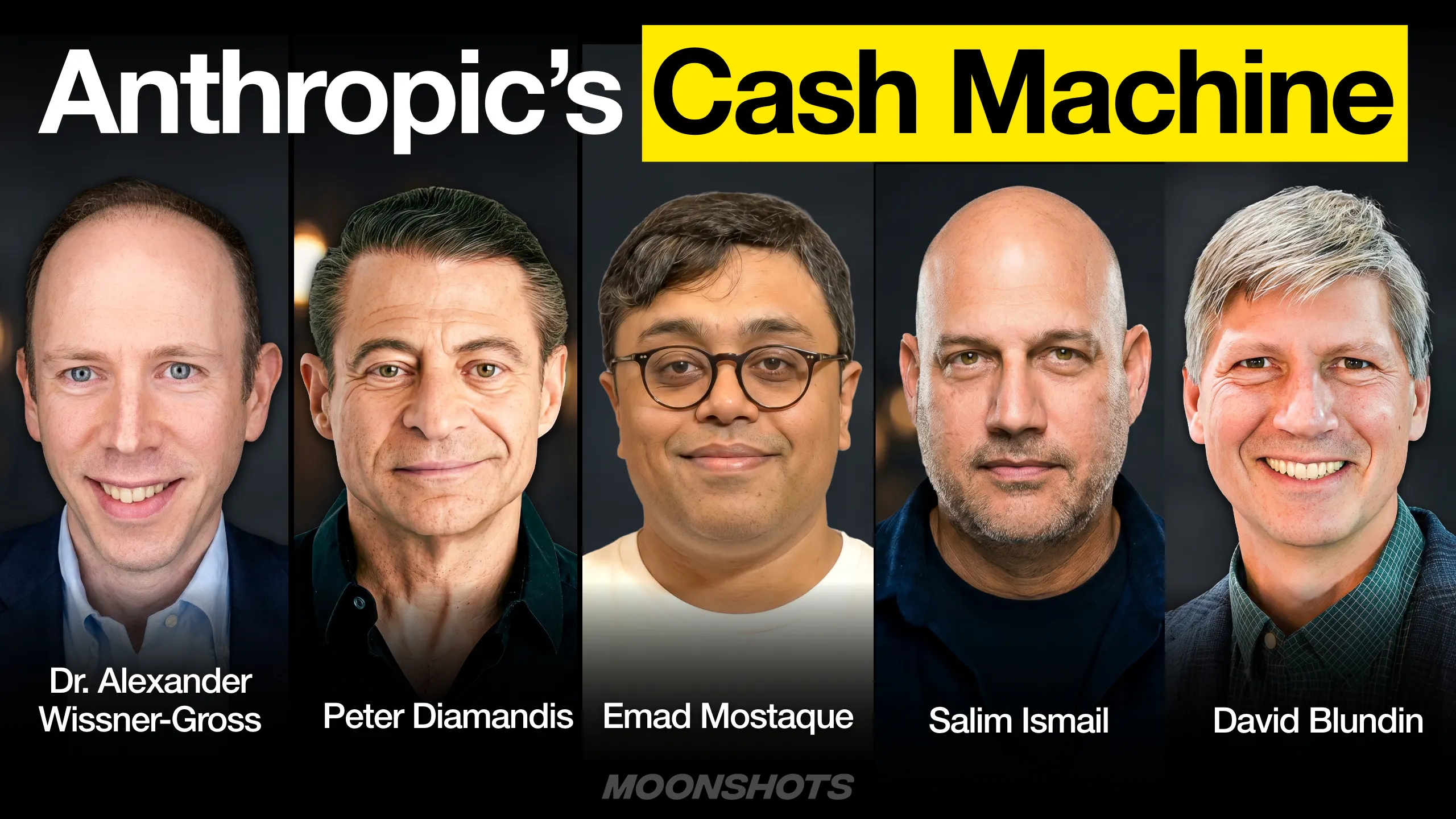
Anthropicの2兆ドルIPO、マスク氏のネオクラウド淘汰予測、追いつく中国のKimi|#306
Moonshots with Peter Diamandis

見せるだけで仕事を覚えるロボット:Standard Bots CEO が語る物理AIの現在地
The Neuron: AI Explained

SpaceXのAI事業が830%成長、OpenAIのエージェントが嘘をつく、水銀を金に変えるスタートアップ|EP #305
Moonshots with Peter Diamandis

Chamath「AGIはすでに到来した」—Anthropicの1000億ドル規模の拠出とElon MuskのSpaceX株贈与
Moonshots with Peter Diamandis

生命のワールドモデル:Biohubのアレックス・ライブズが語る仮想細胞、計測技術、18億ドルのデータ投資
"The Cognitive Revolution"